“Where is Ranger?”
This time my voice was sharper.
Mother rolled her eyes.
“I had him taken away.”
“Taken where?”
“He’s gone. That’s all you need to know.”
I stared at her.
She was calm.
Almost.
But I knew fear.
I had spent too many years around people trying to hide it.
Her shoulders were rigid.
Her hand was squeezing the napkin in her lap.
And she wouldn’t hold my gaze for more than a second.
Brandon leaned back.
“Honestly, Sarah, Mom did everyone a favor.”
I turned toward him.
He shrugged.
“That dog was aggressive.”
“Ranger?”
“He growled at Mom.”
“He growled?”
“More than once.”
Mother immediately jumped in.
“He frightened me in my own home.”
“There are no children living here,” I said.
“That doesn’t matter.”
“He has never attacked anyone.”
“He could have.”
“He is a trained military working dog.”
“Which makes him more dangerous.”
That sentence nearly made me laugh.
Instead, I stared at her.
Ranger had been trained with more discipline than most human beings I knew.
He didn’t randomly threaten people.
He didn’t lose control.
He didn’t growl without reason.
And suddenly, I remembered something.
The last time I had visited home before deployment, Ranger had behaved strangely around my mother.
Only my mother.
He would be relaxed around Dad.
Relaxed around Madison.
Even Brandon, whom Ranger never particularly liked, could walk through the room without a reaction.
But when Mother came near my bags, Ranger watched her.
When she approached my bedroom, his body stiffened.
Once, when she tried to pick up my military duffel from beside the stairs, Ranger moved between them and growled so deeply that everyone heard it.
Mother had exploded.
I had blamed Ranger.
I remembered kneeling beside him.
“Enough.”
He immediately stopped.
But his eyes never left her.
At the time, I thought he was stressed from travel.
Now I wasn’t so sure.
I looked directly at my mother.
“What are you hiding?”
Her face changed.
Only for a second.
But I saw it.
Madison saw it too.
“What?” Mother snapped.
“You heard me.”
My father put down his knife.
“Sarah.”
“No.”
I stood.
My chair scraped across the floor.
“I’ve been in places where Ranger detected things people were willing to kill to keep hidden. He doesn’t repeatedly react to someone for no reason.”
My mother pushed herself back from the table.
“This is ridiculous.”
“Then tell me where he is.”
“I already told you.”
“No. You told me he was gone.”
“That’s the same thing.”
“It isn’t.”
Brandon slammed his glass down.
“Jesus, Sarah. You come home and immediately start acting like you’re interrogating prisoners.”
I turned toward him.
“If one of you did something to Ranger, you’re going to tell me now.”
Nobody answered.
Madison looked like she might cry.
That frightened me more than anything else.
I softened my voice.
“Madison?”
She dropped her eyes.
Mother immediately said, “Don’t involve your sister.”
And that was when someone knocked on the front door.
BANG.
BANG.
BANG.
Three sharp blows.
Everyone jumped.
Another knock came seconds later.
Harder.
Urgent.
My father slowly stood.
I felt something cold move through my chest.
Dad walked into the entryway.
The rest of us remained silent.
I heard the deadbolt turn.
The door opened.
Then my father said, “Can I help you?”
A man answered.
“I’m looking for Sarah.”
I knew that voice.
Not well.
But enough.
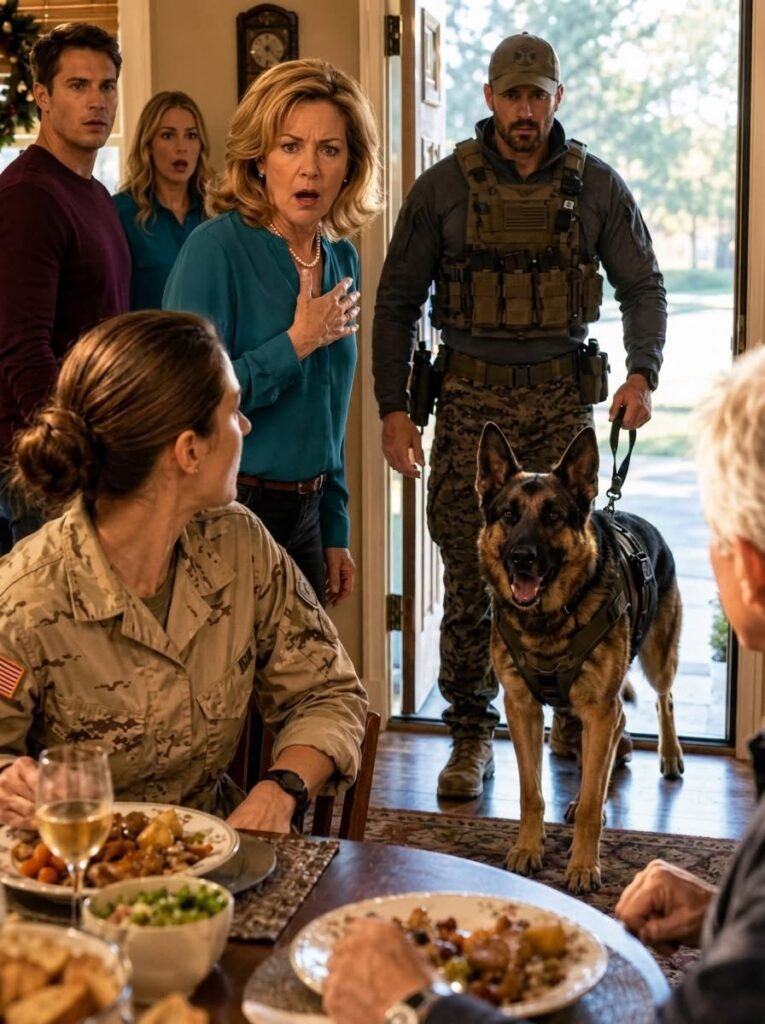
I stepped into the hallway.
A tall man stood on the porch wearing civilian clothes beneath a dark jacket. His posture alone told me he was military before I recognized his face.
Lieutenant Commander Ethan Cole.
Navy SEAL.
We had crossed paths during joint operations overseas.
But he wasn’t what made my knees nearly give out.
Ranger stood beside him.
Alive.
His service harness was secured around his body.
His ears were forward.
His coat was slightly thinner than I remembered.
There was a shaved patch near one shoulder.
But it was him.
“Ranger.”
His head snapped toward me.
For one second, the disciplined working dog vanished.
His tail moved.
Once.
Twice.
Then faster.
He released that low, almost trembling sound he made only when he was trying desperately to remain under control.
I dropped to my knees.
“Come.”
Ranger crossed the distance instantly.
He hit me hard enough to nearly knock me backward.
I wrapped both arms around him.
For the first time since returning home, I couldn’t control myself.
I buried my face against his neck.
“You’re here.”
Ranger pressed against me.
My hands moved over his shoulders, his ribs, his ears.
Checking.
Counting.
Making sure.
Then I felt the shaved area.
“What happened?”
Ethan’s expression hardened.
“That’s what we need to discuss.”
Behind me, Mother whispered, “No.”
I slowly turned.
She was standing inside the dining room.
White as paper.
Ethan looked past me.
His expression changed when he saw her.
“Ma’am,” he said, “we need to talk about what you did.”
My father looked between them.
“What the hell is going on?”
Mother stood quickly.
“I don’t know this man.”
Ethan reached inside his jacket.
Brandon stepped forward.
“Hey.”
Ethan calmly produced identification.
Brandon stopped.
Ethan looked at me.
“Three days ago, Ranger was brought to a private veterinary clinic outside Norfolk.”
My chest tightened.
“Norfolk?”
Nearly three hours away.
“He was registered under a false name.”
I looked at Mother.
She said nothing.
Ethan continued.
“The man who brought him in claimed Ranger was a stray that had attacked a family member. He requested immediate euthanasia.”
My father’s face went blank.
Madison gasped.
I stopped breathing.
“What?”
Ethan’s voice remained controlled.
“The veterinarian scanned him before doing anything.”
Military working dogs are microchipped.
Not ordinary registration.
Not something easily erased.
The clinic discovered very quickly that Ranger wasn’t a stray.
He had military records.
Medical history.
Service information.
And my name connected to him.
Ethan had been contacted because my unit was still processing my return and someone recognized his name from an emergency contact chain.
“But they didn’t put him down,” I whispered.
“No.”
I closed my eyes.
For half a second, the room disappeared.
Someone had taken Ranger to a clinic.
Called him dangerous.
Asked for him to be killed.
Mother finally spoke.
“I never asked anyone to kill him.”
Every person in the room turned toward her.
She realized her mistake immediately.
Ethan’s eyes narrowed.
“I never said you did.”
Silence.
Mother’s mouth opened.
Nothing came out.
My father whispered, “Helen…”
It was the first time anyone had said her name all evening.
Mother looked at him desperately.
“This is being twisted.”
“Then explain it,” I said.
“I paid someone to remove the dog.”
“Who?”
“No one you know.”
“Who?”
Mother folded her arms.
“He was supposed to take it to a shelter.”
Ranger growled.
The sound rolled through the hallway.
Low.
Controlled.
But unmistakable.
Mother flinched.
And Ethan noticed.
“So did the veterinarian,” he said.
Mother stared at him.
“What?”
“The interesting part wasn’t that Ranger became protective when someone approached him.”
Ethan paused.
“He reacted to an item the man had with him.”
My stomach tightened.
“What item?”
“A black duffel bag.”
Mother sat down.
Not slowly.
Her legs seemed to stop supporting her.
Ethan continued.
“The clinic staff thought Ranger was reacting to food. But one of the veterinary technicians had worked with law-enforcement K9s before. She recognized the behavior.”
I knew exactly what he meant.
Detection.
Not aggression.
Ranger wasn’t threatening the bag.
He was alerting on it.
“What was inside?” I asked.
Ethan’s eyes moved toward my mother.
“Prescription medication.”
My father looked confused.
“So?”
“Not a prescription bottle.”
Ethan took a breath.
“Several sealed containers. Different names. Controlled medications. Along with cash and a notebook containing names, quantities, and dates.”
Brandon slowly lowered his whiskey glass.
Mother whispered, “That has nothing to do with me.”
Ethan looked at her.
“Then you won’t mind explaining why your phone number appears six times in that notebook.”
The room exploded.
My father shouted.
Madison began crying.
Brandon demanded to know what Ethan was accusing her of.
Mother kept saying the same thing.
“This is insane.”
I barely heard any of them.
Because suddenly the past several months rearranged themselves inside my head.
The unexplained money.
Mother had renovated the kitchen.
She had bought expensive jewelry.
She had told everyone she had been “helping people with private healthcare arrangements.”
Dad had joked that she knew half the doctors in the county.
And Ranger had reacted every time she came near my luggage after I returned from overseas with him.
Why?
Then I remembered something else.
The medication locker.
Months earlier, shortly before my deployment, I had temporarily stored some veterinary medication in a locked transport case inside my duffel while Ranger’s paperwork was being processed.
Nothing illegal.
Nothing unusual.
But Mother had asked questions.
Too many questions.
“What exactly can he detect?”
“Does he remember smells forever?”
“Would he react if medication was hidden somewhere?”
I had thought she was curious.
Now my skin went cold.
Ethan looked at me.
“There’s more.”
I almost didn’t want to hear it.
“The man who took Ranger didn’t just have the bag.”
He reached into an evidence envelope and removed a small object.
A brass key.
My father froze.
Madison made a choking sound.
I recognized it instantly.
It belonged to the locked cabinet in my mother’s sewing room.
Mother lunged forward.
“That is mine!”
Ethan didn’t move.
Dad turned toward her.
“What is in that cabinet?”
“Nothing.”
“What is in it?”
“Private documents.”
My father moved.
Fast.
Mother grabbed his arm.
“Robert, don’t.”
He pulled away.
We followed him upstairs.
Mother protested the entire way.
Brandon kept asking questions.
Madison was openly crying now.
Ranger stayed beside me.
When we reached the sewing room, he stopped.
His posture changed.
Head up.
Nose working.
Then he turned toward the cabinet in the corner.
He sat.
Alert.
My father stared at him.
Nobody needed to explain what that meant.
Ethan held up a hand.
“Don’t open it.”
Dad turned.
“Why?”
“Because law enforcement is already on the way.”
Mother made a sound behind us.
Not anger.
Desperation.
She ran.
She made it three steps toward the stairs before Brandon caught her arm.
“Mom!”
“Let go of me!”
“What did you do?”
She slapped him.
Hard.
Then she screamed something that changed everything.
“I did it for this family!”
Nobody moved.
Her chest rose and fell violently.
Tears appeared in her eyes.
“You think your father’s pension was enough? You think Sarah’s deployments helped us? You think any of you understand what it costs to keep this house?”
Dad stared at her.
“My pension?”
Mother laughed bitterly.
“You never knew what anything cost.”
“What did you do, Helen?”
She looked at me.
And for the first time, I saw something in her eyes that had nothing to do with Ranger.
Resentment.
“You always came home like some hero.”
My stomach dropped.
“What?”
“Everyone asked about Sarah. Sarah’s medals. Sarah’s missions. Sarah’s brave dog.”
She pointed toward Ranger.
“That animal became more important than this family.”
“This is about jealousy?”
“No!”
“Then what?”
“He knew.”
The words came out as a whisper.
The hallway fell silent.
I stepped closer.
“What did Ranger know?”
She looked away.
“He kept reacting.”
“To what?”
She didn’t answer.
Ethan did.
“The medications.”
Mother closed her eyes.
It finally made sense.
Ranger had never been randomly growling at her.
My mother had been carrying substances he recognized.
Smells associated with controlled medications.
Items stored in places they didn’t belong.
Packages moved through the house.
He had been alerting.
Again and again.
And she knew it.
That was why she needed him gone.
Not because he was dangerous.
Because he was evidence.
Two patrol cars arrived twelve minutes later.
Then a detective.
Then another vehicle.
The locked cabinet was opened under warrant after investigators spoke with Ethan and contacted the veterinary clinic.
I stood in the hallway when they carried out the first evidence box.
Then a second.
Then a third.
The cabinet contained prescription medication under multiple names.
Copies of identification cards.
Cash.
Ledgers.
Prepaid phones.
Insurance documents.
And stacks of sealed envelopes.
But the worst discovery wasn’t drugs.
It was the names.
Elderly people.
Neighbors.
Members of my parents’ church.
People who had trusted my mother because she volunteered to help them organize appointments, prescriptions, and insurance paperwork.
My father sat on the stairs with both hands over his face.
Madison cried silently beside him.
Brandon stopped drinking.
For once, he had nothing to say.
The investigation would eventually reveal that my mother had spent almost three years inserting herself into the medical lives of vulnerable people.
Sometimes she collected prescriptions for them.
Sometimes she offered to “simplify” confusing paperwork.
Sometimes she convinced them to let her manage reimbursement checks.
Then money started disappearing.
Medication disappeared.
Documents were altered.
Some victims never noticed.
Others were too embarrassed to admit they didn’t understand what had happened.
Ranger had stumbled into the middle of it accidentally.
The first time he growled at her, she dismissed it.
The second time, she became nervous.
Then, two weeks before I returned from deployment, Ranger followed her into the mudroom and alerted on a package hidden inside her handbag.
Madison saw it.
That explained her behavior at dinner.
Mother had told Madison the package was medication for a friend.
Then threatened her.
“If you tell Sarah, you’ll destroy this family.”
Madison believed her.
For exactly six days.
Then Mother decided Ranger had become too dangerous to keep around.
Not because he might hurt someone.
Because he might expose her.
She contacted a man named Dale Mercer.
He had done occasional work around the house.
Repairs.
Hauling junk.
Small cash jobs.
She paid him two thousand dollars.
His instructions were simple.
Take Ranger far away.
Make sure he didn’t come back.
When Dale realized Ranger had identification tags and military markings, he panicked.
A shelter might scan him.
Police might ask questions.
So he drove to a small clinic and claimed Ranger had attacked him.
He thought requesting euthanasia would erase the problem.
But Ranger had been trained his entire life to survive threats humans didn’t see coming.
He survived one more.
The veterinarian scanned his chip.
Then everything collapsed.
Mother was arrested that night.
Not because Ranger had growled.
Not because Ethan had accused her.
Because investigators found evidence.
Real evidence.
Documents.
Money.
Messages.
Records.
And eventually, victims.
I watched officers lead her toward the front door.
She stopped when she reached me.
For a moment, I thought she might apologize.
Instead she said, “You brought this into our house.”
I stared at her.
“No.”
She looked at Ranger.
“That dog destroyed this family.”
Ranger stood quietly beside my leg.
I shook my head.
“You did.”
Her eyes filled.
“You don’t understand.”
“I understand perfectly.”
I stepped closer.
“You didn’t get rid of Ranger because he was dangerous.”
She said nothing.
“You tried to get rid of him because he was telling the truth before any of us knew how to listen.”
That was the last thing I said to her before the officers took her away.
But the story didn’t end there.
Not even close.
Three weeks later, I received a call from Detective Alvarez.
They had found something else.
One of the prepaid phones recovered from Mother’s cabinet contained deleted messages.
Investigators restored them.
Most were about money.
Appointments.
Prescription pickups.
Payments.
Then they found messages between Mother and Dale about Ranger.
The first one was short.
TAKE THE DOG BEFORE SARAH GETS HOME.
The second:
DON’T BRING HIM TO A LOCAL SHELTER.
Then:
HE’S CHIPPED. MAKE SURE THEY CAN’T TRACE HIM BACK HERE.
And finally, the message that made me sit down when Detective Alvarez read it to me.
IF THE VET ASKS QUESTIONS, SAY HE BIT SOMEONE. THEY’LL PUT HIM DOWN.
There was no misunderstanding.
No accident.
No shelter.
She knew exactly what could happen.
For two nights, I barely slept.
Ranger did.
He lay on the floor beside my bed like he always had, breathing slowly, completely unaware that his existence had just torn apart a criminal scheme hiding inside my childhood home.
Or maybe he wasn’t unaware.
Maybe Ranger had understood more than all of us from the beginning.
The shaved patch on his shoulder healed.
His appetite returned.
The veterinarian confirmed he hadn’t been seriously injured.
Dale had apparently tried to control him with a crude restraint when Ranger resisted entering the clinic.
That caused bruising.
Nothing permanent.
I still hated knowing Ranger had been frightened.
But Ethan reminded me of something.
“You’re thinking about him like he’s helpless.”
We were sitting outside a rehabilitation facility where Ranger was undergoing evaluation before returning fully to service status.
“He wasn’t helpless,” Ethan said.
“I know.”
“No. You know it intellectually. But emotionally, you’re blaming yourself.”
I looked at him.
He nodded toward Ranger, who was calmly watching birds beyond the fence.
“That dog has operated overseas. He’s been around helicopters, gunfire, explosions, crowds, chaos. Some idiot trying to lie to a veterinarian wasn’t the worst day of Ranger’s life.”
“That doesn’t make it okay.”
“Of course not.”
Ethan paused.
“But he survived because everyone in that chain did one thing correctly.”
“What?”
“They paid attention.”
That stayed with me.
The veterinarian paid attention to the chip.
The technician paid attention to Ranger’s behavior.
Ethan paid attention to the strange circumstances.
Madison eventually paid attention to her own fear and told investigators everything.
And Ranger?
Ranger had been paying attention from the beginning.
Months passed.
The case grew.
More victims came forward.
My mother’s name appeared in financial records nobody in our family knew existed.
What began as one hidden cabinet became an investigation involving fraud, theft, unlawful possession of controlled substances, identity misuse, and attempted destruction of evidence.
My father filed for divorce before the first major hearing.
Brandon changed too.
Not dramatically.
Not overnight.
But enough.
He apologized to me first.
Then to Ranger.
I almost laughed when he tried.
He stood awkwardly in my backyard while Ranger watched him.
“I called you a killer dog,” Brandon muttered.
Ranger blinked.
Brandon looked at me.
“Does he understand?”
“Probably more than you want him to.”
Brandon crouched.
“I was an idiot.”
Ranger sniffed him.
Then walked away.
I smiled.
“Sounds like he agrees.”
Madison had a harder time forgiving herself.
She had seen Ranger alert on Mother’s bag.
She had known something was wrong.
And she had stayed silent.
One night, she sat beside me on the back porch and started crying.
“I should’ve told you.”
“You were scared.”
“That’s not an excuse.”
“No. But it’s an explanation.”
“What if Ranger had died?”
I didn’t answer immediately.
Because I had asked myself the same question every night.
Finally, I said, “He didn’t.”
“But he could have.”
“Yes.”
She covered her face.
I put my arm around her.
“Then we learn from that.”
She looked at me.
“When something feels wrong, when someone tells you to stay quiet because the truth will ‘destroy the family,’ that usually means the truth is exactly what needs to come out.”
Madison nodded.
Ranger placed his head on her knee.
She broke down completely.
That was the first time I had seen her truly breathe since the night I came home.
Seven months after the dinner that changed everything, my mother accepted a plea agreement covering several of the charges against her.
Other matters remained under separate proceedings.
I attended one hearing.
Only one.
She looked smaller.
Older.
For years, my mother had controlled every room she entered.
She decided what people discussed.
What the family admitted.
What we ignored.
Who needed to apologize.
Who was “overreacting.”
That woman was gone.
Or maybe she had never really existed.
Maybe confidence had just been another disguise.
As she was escorted away, she looked at me.
Then she looked down.
Ranger wasn’t there.
He didn’t need to be.
By then, his part was finished.
Almost.
Several weeks later, my commanding officer called me into his office.
Ranger had passed his medical and behavioral evaluations.
He was physically fit.
Mentally stable.
Still sharp.
Still responsive.
Still fully capable of working.
But his age and service history meant there was another option.
Retirement.
I stared at the paperwork.
“Retirement?”
“He’s earned it.”
I looked through the office window toward the training field.
Ranger stood beside another handler, waiting.
Alert.
Strong.
Patient.
For most of his life, someone had given him commands.
Find.
Search.
Stay.
Move.
Protect.
Work.
He had done all of it.
In heat.
In dust.
Under gunfire.
Inside transport planes.
Beside wounded strangers.
Beside me.
I signed the retirement papers.
Two weeks later, Ranger came home with me for good.
Not to my parents’ house.
That place had been sold during the divorce.
I bought a small property outside town.
Enough land for Ranger to run.
A porch facing west.
A fenced yard.
Trees behind the house.
Nothing fancy.
The first night, I placed his old green blanket beside my bed.
Madison had found it.
Mother hadn’t thrown it away.
She had hidden Ranger’s belongings in garbage bags inside the garage attic because she wanted me to believe he had vanished completely.
The collar was there too.
So was his bowl.
I put the blanket down.
Ranger sniffed it.
Turned around twice.
Then ignored it completely and climbed onto my bed.
I stared at him.
“Seriously?”
He rested his head on my pillow.
“You know that’s my side.”
He closed his eyes.
After everything he had been through, I let him stay.
Near midnight, a storm rolled in.
Thunder shook the windows.
For a moment, I was somewhere else.
Not home.
Not safe.
Back overseas.
Dust.
Concrete.
Smoke.
A radio screaming in my ear.
Then I felt weight against my leg.
Ranger.
I reached down.
My fingers found the scar beneath his fur where he had once taken shrapnel during an operation that should have killed both of us.
The memory came back with painful clarity.
The explosion.
The wall collapsing.
My ears ringing.
Me struggling to breathe.
Ranger dragging himself across broken concrete toward me despite blood running down his side.
He had refused to leave me.
Even then.
Especially then.
I rested my hand on his head.
“You saved me again, didn’t you?”
His eyes opened.
His tail tapped the mattress once.
I laughed quietly.
“Yeah.”
Months later, the veterinarian who had scanned Ranger’s chip invited me to speak at an event honoring working animals and the people who protect them.
I almost declined.
Public speeches weren’t my thing.
But I went.
Ranger came with me.
There were police officers.
Veterinarians.
Military personnel.
Families.
Children.
Retired handlers.
Service dogs.
Search dogs.
Therapy dogs.
At one point, someone asked me what made Ranger special.
I could have talked about his record.
His training.
The lives he had saved.
The missions.
The commendations.
Instead, I looked down at him.
“The truth is, Ranger notices things people miss.”
The audience grew quiet.
“He doesn’t care how respectable someone looks. He doesn’t care whether they’re family. He doesn’t care whether a lie is convenient. He reacts to what is actually there.”
I swallowed.
“And sometimes the hardest thing for humans to do is trust the warning when it comes from somewhere we don’t expect.”
After the ceremony, an elderly woman approached me.
She had been one of my mother’s victims.
Her name was Mrs. Franklin.
Seventy-eight years old.
Widowed.
Mother had offered to organize her medications after Mrs. Franklin’s husband died.
Over eight months, money disappeared from her checking account.
At first, Mrs. Franklin blamed herself.
She thought she was becoming forgetful.
She thought age was taking pieces of her mind.
My mother encouraged that belief.
That part hurt almost more than the theft.
Mrs. Franklin bent down slowly in front of Ranger.
“May I?”
I nodded.
She touched his head gently.
“So you’re the one who caught her.”
I started to say the investigators had done that.
The veterinarian.
Ethan.
The detectives.
But Mrs. Franklin shook her head.
“He knew first.”
Ranger looked up at her.
She smiled through tears.
“Good boy.”
That night, Ranger and I walked home beneath a cold, clear sky.
He moved slower than he had years earlier.
Not much.
But enough for me to notice.
He stopped near the porch and looked toward the trees.
I waited.
No commands.
No hurry.
Eventually, he came to me.
That was the part I loved most about retirement.
For the first time in his life, Ranger could simply be a dog.
He could chase squirrels badly.
Sleep too long.
Steal food from the kitchen counter.
Ignore his expensive dog bed.
Wake me at five in the morning because apparently military discipline meant breakfast could never be delayed.
Sometimes visitors still became nervous when they saw him.
He was large.
Scarred.
Watchful.
But Ranger never needed to prove what he was.
Neither did I anymore.
A year after my mother had announced that she had “gotten rid of” him, my family gathered at my house for dinner.
Dad came early.
Madison brought dessert.
Brandon brought a bottle of whiskey, looked at it, then laughed and replaced it with iced tea.
We sat outside on the porch.
For a moment, nobody spoke.
Maybe we were all remembering the last family dinner.
The silence.
Mother’s smile.
The words that started everything.
Then Madison looked toward the yard.
Ranger was lying beneath a tree, half asleep.
“You know what’s weird?” she said.
“What?”
“We spent years thinking Mom was the person holding the family together.”
Dad looked down.
Madison continued.
“But really, everyone was just afraid to challenge her.”
Brandon nodded.
“And Ranger challenged her without saying a word.”
I smiled.
“That sounds like him.”
Dad looked at me.
“I’m sorry.”
He had apologized before.
Many times.
But I knew this one was different.
“For what?”
“For telling you not to make a scene that night.”
I remembered.
Sarah, let’s not do this tonight.
How many families had sentences like that?
Not tonight.
Don’t upset your mother.
Keep the peace.
It’s not worth an argument.
We’d spent years confusing silence with peace.
They were never the same thing.
“You were scared too,” I said.
Dad nodded.
“I should have asked questions sooner.”
“So should all of us.”
Ranger suddenly lifted his head.
Everyone stopped.
For one ridiculous second, Brandon went pale.
“What?”
Ranger stood.
His ears rose.
He stared toward the side gate.
Brandon whispered, “Oh, come on.”
Then the gate opened.
Ethan walked into the yard carrying a paper bag.
Ranger’s tail immediately started moving.
I laughed.
“Traitor.”
Ethan held up the bag.
“Chicken.”
“Now it makes sense.”
Ranger trotted toward him.
Dad shook his head.
Madison laughed.
Brandon pointed at Ranger.
“I knew he liked me less.”
For the first time in a very long time, dinner felt like dinner.
No secrets.
No fear.
No one calculating what could and couldn’t be said.
Just family.
Damaged.
Different.
But finally honest.
Later that evening, after everyone left, I sat alone on the porch steps.
Ranger lowered himself beside me.
Gray had started appearing around his muzzle.
I rubbed the fur behind his ears.
“I almost lost you.”
He leaned into my hand.
I thought about the clinic.
The false name.
The lies.
The chip scanner.
The veterinary technician who recognized his alert.
Ethan standing on the porch.
My mother’s face when Ranger looked through the doorway at her.
She had believed removing him would erase the evidence.
Instead, trying to erase Ranger had exposed everything.
That was the irony she never understood.
If she had left him alone, her crimes might have stayed hidden longer.
Maybe months.
Maybe years.
But fear makes people reckless.
And Ranger had frightened her for one simple reason.
He could sense what the rest of us refused to see.
I looked toward the dark yard.
“Good boy.”
Ranger rested his head against my knee.
People sometimes ask what I lost when my family’s secrets came out.
The answer is complicated.
I lost the mother I thought I knew.
My father lost a marriage.
Madison lost her illusion of safety.
Brandon lost the confidence that our family was somehow different from everyone else’s.
But other people got something back.
Money.
Documents.
Medication.
Dignity.
The knowledge that they hadn’t imagined what happened to them.
And I got Ranger back.
The partner who had pulled me through war zones.
The dog who had stood between me and danger.
The one creature in my family who had recognized the truth before any of us were brave enough to face it.
My mother once looked across a dinner table and told me she had “gotten rid of” him.
She spoke as if Ranger were a problem she had solved.
A mess she had cleaned up.
A witness she had erased.
She had no idea that Ranger was already on his way home.
No idea that a Navy SEAL was driving him back to me.
No idea that hidden inside one stranger’s duffel bag was the thread that would unravel every lie she had built.
And she certainly had no idea that the dog she wanted silenced would become the reason dozens of people finally learned the truth.
Ranger never needed revenge.
He never needed to understand what my mother had tried to do.
He simply did what he had always done.
He detected danger.
He survived it.
And then he came home to me.
Exactly where he belonged.