It has been two agonizing years since Elizabeth passed away, and some days, the silence in our home still feels like a heavy weight. I never expected that our journey through grief would take such a surreal turn, but when my five-year-old daughter, Mia, spoke up one evening, she shattered my fragile peace.
“Mommy visits me at school,” she announced with a chilling level of certainty.
I felt my heart skip a beat. Elizabeth was gone—claimed by a fast-moving cancer that left us reeling. I assumed Mia was simply too young to grasp the finality of death. “Sweetie, Mommy is in heaven,” I whispered.
But Mia’s little chin jutted out stubbornly. “She talks to me after recess. She watches me play, Daddy. She even gave me chocolate today.”
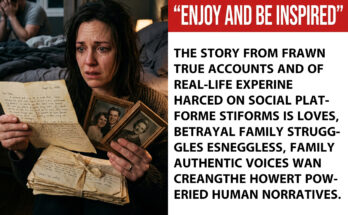
At first, I brushed it off as a coping mechanism—a child’s imagination filling the void. Then, the drawings started. Mia began bringing home sketches of herself and Elizabeth. These weren’t just stick figures; they were eerily accurate. She captured Elizabeth’s long chestnut hair, her soft eyes, and even a specific blue dress my wife used to wear.
Then came the chocolates. Every few days, a neatly wrapped treat appeared in Mia’s backpack. I hadn’t packed them, and the school staff was just as baffled. The mystery began to haunt my sleep until I finally called her teacher, Mrs. Blake.
“Mr. Carter, I wasn’t sure how to bring this up,” Mrs. Blake hesitated. “There is a woman talking to Mia. She looks exactly like Elizabeth. Every time I try to approach her, she disappears.”
Stunned and desperate for answers, I went to the school early the next day. Hiding near the playground, I watched Mia run toward the swings. Then, I saw her—a woman by the fence, watching my daughter with an intensity that made my skin crawl. She wore a wide-brimmed hat, but the resemblance was undeniable.
As soon as she saw me, she bolted. I chased her down, cornering her at the back of the schoolyard. “Who are you?” I demanded, my hands shaking. “Why are you doing this?”
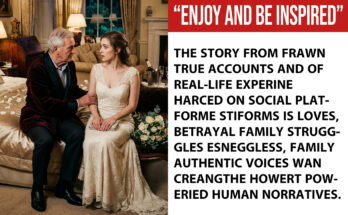
The woman turned slowly, her face wet with tears. She looked exactly like Elizabeth, only older, more tired. “I’m not who you think I am,” she trembled. “My name is Angelina. I’m Elizabeth’s twin sister.”
My mind reeled. Elizabeth never mentioned a sister.
“She didn’t know,” Angelina explained. “A corrupt nurse sold me to another family at birth. Our parents were told I had died. I only found the truth recently through hospital records.”
I stumbled back, struggling to process the revelation. “But why pretend to be her mother?”
Angelina broke down. “I lost my own daughter in a bus accident. She was only seven. When I saw Mia at the park, she looked so much like her… and when Mia called me ‘Mommy,’ I just couldn’t say no. I didn’t mean for it to go this far.”
The anger I felt melted into a heavy, shared sadness. She wasn’t a villain; she was a grieving mother clinging to a ghost, just like us.
The next day, we sat Mia down together. Angelina took her tiny hand, her voice breaking. “Mia, I’m not your mommy. I’m her sister—your Aunt Angelina. I’m so sorry.”
Confusion clouded Mia’s face. “But you look like her… and you gave me chocolates.”
I squeezed Mia’s hand. “She’s part of our family, sweetheart. She’s your mommy’s twin.”
Mia looked at Angelina, then at me, processing the news with the quiet acceptance only a child can muster. “So… you’re not coming to school anymore?”
“I won’t pretend to be Mommy,” Angelina promised. “But I want to be your aunt. We can still play.”
Today, Angelina is a constant in our lives. She didn’t replace Elizabeth, but she filled a space we didn’t know was empty. In her, Mia found a link to her mother, and I found a friend who understood my grief. Together, we are building something beautiful from the wreckage of our past.