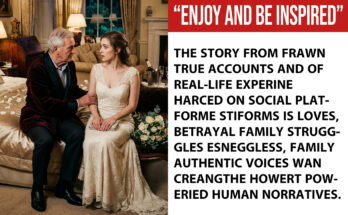
Two days after burying my husband, my mother-in-law slammed the door in my face. Her last words echoed: “You and your child mean nothing to me.” I stood in the hallway, clutching my three-week-old son, Noah, with nothing but a suitcase, a diaper bag, and Caleb’s hoodie.
I whispered, “Where am I supposed to go?” Deborah’s eyes held no warmth. She glanced at Noah, twisted her mouth, and snapped, “Not my problem.” Then the lock clicked.
I walked away, numb. Caleb’s hoodie was the only comfort—it still smelled like him.
Caleb and I had struggled for years to conceive. Doctors, tests, tears in bathroom stalls. When I finally got pregnant, we cried together on the floor. He whispered promises to the baby he hadn’t met yet.
When Noah was born, he carried a large birthmark across half his face. The room fell silent, but Caleb kissed him and said, “Hey, buddy. We’ve been waiting for you.” Noah was loved without question.
Deborah, however, stared too long. She muttered things like, “You never know what really happened,” planting seeds of doubt. Caleb told me to ignore her. He was wrong.
At 27, Caleb died of a heart attack. One moment he was fine, the next I was frozen by a phone call. The funeral blurred past me. Deborah wailed loudly, grief performed for an audience.
A week later, she showed her true self. She barged into our apartment—tied to her family’s name—and said flatly, “You need to leave.”
I begged, “Please, I just need time.” She sneered at Noah: “He probably isn’t even Caleb’s. You trapped my son.” Then she threatened to call the police.
So I left.
The following weeks were brutal. I slept on friends’ couches, cheap motels when I could afford them. Every time Noah cried, I felt like I was failing him. Every stare at his birthmark made me want to vanish.
One afternoon, drenched by a car splash, I broke down on the sidewalk. A young woman rushed over. Her name was Harper. She listened as I poured out everything—Caleb’s death, Deborah’s cruelty, my desperation. Then she said, “I’m a lawyer. I can help you.”
Days later, Deborah called with syrup in her voice: “Mia, I want you and the baby to come for dinner. I don’t want us to be enemies.”
Against my better judgment, I went. Dinner was warm, candles lit, food on the table. Deborah cooed at Noah, calling him “my precious grandson.” For a moment, I believed her.
Then she revealed her motive: “Caleb saved money for a house. He left it to you. But I think we should divide it. After all, I raised him.”
Her mask slipped. “I deserve most of it. You were just his wife. I’m his mother.”
I demanded to see the papers. She threatened, “If you don’t agree, I’ll fight until you’re broke. You’ll never see a dollar.”
Shaking, I called Harper. She went to work immediately. Deborah twisted the story, painted me as a gold digger, even hinted at grandparent rights. But Harper didn’t flinch. She followed the paper trail, gathered proof, and fought back.
Finally, Deborah lost. Caleb’s money was mine—because he wanted it that way.
I signed papers for a small house. Nothing fancy, just a safe place with sunlight streaming through the windows. Noah blinked up at me, his birthmark glowing softly. For the first time, I thought, “We made it.”
I whispered thanks—to Harper for showing up, to myself for surviving, and to Caleb, whose love built a roof over our heads even after death.
Deborah never apologized. But I realized I didn’t need her to. Love doesn’t end when someone dies—it transforms. Caleb’s love lived on in Noah, in the choices he made to protect us.
Family isn’t blood. Family is who shows up, who fights for you when you can’t fight alone. Harper became family by choice. And now, when I rock Noah to sleep, I tell him about his father—about how love protected us, even when the world felt cruel.
Because that’s what real families do. They protect. They fight. They show up.