The day my son begged me not to call the police was the day I realized my family hadn’t simply been trying to steal my house.
They had been preparing to steal the rest of my life.
I was seventy-two years old, sitting at a polished dining table in my son’s suburban home, staring at a photograph of a beautiful two-story mansion.
My daughter-in-law, Ashley, had just pushed it across the table.
My son, Daniel, looked as though he might be sick.
And Ashley’s father, George, kept glancing toward the front door.
“Mom, please,” Daniel whispered, gripping my wrist.
“Whatever happens, don’t call the police.”
I pulled my hand away.
“Why would I need to call the police?”
Nobody answered.
Outside, the Sunday afternoon sunshine poured through the windows.
Somewhere in the backyard, my grandchildren, Lucy and Ben, were laughing.
It should have been an ordinary family gathering.
Instead, I was about to discover a secret that would destroy everything I believed about the people I loved.
“Margaret,” George began, straightening his expensive jacket, “there are certain financial arrangements you may not fully understand.”
I looked at him.
“Then explain them.”
Ashley shifted uncomfortably.
Her mother, Patricia, suddenly became fascinated by her coffee cup.
I turned the photograph over.
An address was printed on the back.
27 Willowmere Drive.
Beneath it, in smaller lettering, was a reference number.
I recognized the address immediately.
Three months earlier, Ashley had shown me that very house on her phone.
She’d described it as her family’s dream home.
Six bedrooms.
Five bathrooms.
A swimming pool.
Three-car garage.
A neighborhood where the average household earned more in one year than Robert and I had once earned in five.
I’d smiled politely and told her it was beautiful.
Then I’d asked how they planned to afford it.
Ashley had laughed.
“Oh, Margaret.
You wouldn’t understand how these things work.”
Now the photograph lay in front of me.
And for some reason, everyone looked terrified.
“Have you bought this house?”
I asked.
Daniel closed his eyes.
Ashley lifted her chin.
“We’ve signed a purchase agreement.”
“Congratulations,” I replied slowly.
“Then why are we discussing my house?”
George cleared his throat.
“The transaction requires some temporary financial cooperation from the family.”
I felt something cold spread through my stomach.
“What kind of cooperation?”
Ashley leaned forward.
“Your house is sitting there with hundreds of thousands of dollars in equity.
It’s ridiculous not to use it.”
“It’s my home.”
“It’s an asset!”
“To whom?”
She opened her mouth, then stopped.
I turned toward Daniel.
“Look at me.”
He didn’t.
“Daniel.”
Finally, he raised his eyes.
“What have you done?”
His lips trembled.
“We thought we could repay everything once your house sold.”
For several seconds, I couldn’t speak.
Then I asked the only question that mattered.
“What exactly did you borrow against a house you don’t own?”
George reached for a thick folder.
He removed a document and placed it in front of me.
My name appeared at the top.
MARGARET E.
HALE.
My address appeared beneath it.
And halfway down the first page were the words:
PROPERTY OWNER AUTHORIZATION AND COLLATERAL CONSENT.
I looked at the signature.
It resembled mine.
But I had never signed that document.
“That’s not my signature,” I said.
George tried to smile.
“Margaret, let’s not get emotional.”
I looked directly at him.
“Did someone forge my name?”
Nobody answered.
Then Ashley slammed her palm against the table.
“We did what was necessary for our children’s future!”
I stood so abruptly that my chair scraped against the floor.
Daniel reached for me again.
“Mom, please!”
I stared at my only son.
The little boy I’d taught to ride a bicycle.
The teenager whose broken heart I’d held together after his first girlfriend left him.
The young man Robert and I had sacrificed so much to educate.
And now he was looking at me as though I were the problem.
I pulled out my phone.
That’s when George said something that made me freeze.
“Before you do anything foolish, Margaret, there’s something you need to know about Robert’s estate.”
I slowly lowered the phone.
“My husband’s estate?”
George removed a yellowed envelope.
The paper was old, its edges softened by time.
A date was written across the front.
October 14, 2019.
Three days before my husband died.
George unfolded a document and slid it toward me.
There were several paragraphs of legal language, followed by a signature at the bottom.
Not Robert’s.
Not mine.
Ashley’s.
And beside her name were four words that made my blood run cold.
ACKNOWLEDGED AND RECEIVED IN FULL.
I looked up.
“What is this?”
George leaned back.
“Proof that certain arrangements were made before your husband passed away.”
I stared at the paper.
Then at Ashley.
And for the first time since Robert’s funeral, I felt the unmistakable sensation that my husband was trying to tell me something from beyond the grave.
Something he had never been able to explain while he was alive.
Something my family desperately wanted to keep buried.
Chapter 2: The House That Held Our Entire Life
To understand why I refused to surrender my home, you have to understand what it represented.
Robert and I bought the house in 1988.
We were young, exhausted, and embarrassingly optimistic.
Daniel was five years old.
The house had peeling wallpaper, cracked bathroom tiles, a leaking basement window, and a furnace that sounded like a tractor trying to climb a mountain.
The real estate agent called it “a property with tremendous potential.”
Robert called it “a beautiful disaster.”
I called it ours.
We had exactly $1,400 left in savings after closing.
I remember standing in the empty living room that first evening, surrounded by cardboard boxes, wondering whether we’d made the biggest mistake of our lives.
Robert came up behind me and wrapped his arms around my waist.
“One day,” he whispered, “we’re going to fill this place with so many good memories that nobody will remember how ugly it looked when we bought it.”
He was right.
We painted walls after putting Daniel to bed.
We repaired broken windows ourselves.
I worked in the accounting office of a community college.
Robert worked for the city maintenance department and took additional construction jobs whenever money was tight.
Every dollar mattered.
There were years when we couldn’t afford vacations.
Years when Christmas presents were modest.
Years when Robert’s boots had holes in them because Daniel needed new shoes.
But we never missed a mortgage payment.
When Daniel turned sixteen, Robert converted the basement into a small recreation room so our son could invite his friends over.
When Daniel graduated from college, we hosted a celebration in the backyard.
When Lucy was born, Robert planted a white dogwood tree beneath the living room window.
And when Ben arrived, he built a wooden swing beneath the old maple.
Every corner of that house told a story.
The house wasn’t simply where we lived.
It was the physical evidence of everything we’d survived together.
We paid off the mortgage in 2014.
I still remember the afternoon Robert came home carrying the final payment confirmation.
He held it above his head like a championship trophy.
“Mrs.
Hale,” he announced, “we are officially free!”
I laughed so hard I cried.
He took me dancing in the kitchen.
We didn’t have champagne, so we toasted with orange juice.
Then he made me promise something.
“Whatever happens, Margaret, don’t let anyone convince you that you owe them this house.”
I frowned.
“Why would anyone do that?”
He kissed my forehead.
“Because some people see a home.
Others see a number.”
At the time, I thought he was simply being philosophical.
Seven years later, his words would return to me with devastating clarity.
Robert died after a long battle with pancreatic cancer.
His final months were difficult.
There were medications, appointments, exhausted mornings, and nights when I sat beside his bed listening to him breathe.
Daniel visited.
Ashley visited.
Sometimes George and Patricia came by.
I was grateful for every bit of help.
At least, I thought I was.
Robert died on October 17, 2019.
After the funeral, I discovered something unexpected while settling his affairs.
Several years earlier, he had transferred his remaining interest in the house to me, with my knowledge and approval, as part of our estate planning.
The updated deed listed me as the sole owner.
There was no mortgage.
No outstanding home-equity loan.
No hidden lien that I knew of.
The attorney who handled our documents assured me everything was in order.
I was seventy-two now, but I wasn’t confused or incapable.
I still balanced my accounts every month.
I drove myself wherever I needed to go.
I managed my garden, attended church, volunteered at the library, and spoiled my grandchildren whenever their parents allowed it.
I was a widow, not an abandoned piece of furniture waiting to be moved.
Unfortunately, Ashley never seemed to understand the difference.
Chapter 3: The First Warning
The first time Ashley suggested selling my house, she was almost charming.
We were sitting in my kitchen.
She’d brought over blueberry muffins and a glossy magazine featuring luxury condominiums.
“Margaret, have you ever considered downsizing?”
I smiled.
“To what?”
“Something easier to maintain.
Maybe a nice two-bedroom condo near us.”
I glanced around the kitchen.
“I like it here.”
“Of course.
But it’s a lot of space for one person.”
“Robert and I worked hard for this space.”
She gave me a patient smile.
“Nobody’s questioning that.”
But she was.
Over the following months, the suggestions became more frequent.
A newspaper article about seniors falling on stairs.
A brochure advertising retirement communities.
A casual remark about how dangerous it could be for an elderly woman to live alone.
Then one afternoon, she started measuring my dining room.
“What are you doing?”
I asked.
She looked startled.
“Just getting an idea of the layout.”
“Why?”
“We’ve been talking about how we might rearrange things.”
I put down my gardening gloves.
“We?”
She quickly changed the subject.
I mentioned the incident to Daniel.
He sighed.
“Mom, Ashley’s a real estate marketing professional.
She notices these things.”
“She was measuring my dining room.”
“She was probably just curious.”
I wanted to believe him.
So I let it go.
That was my first mistake.
My second was assuming Daniel would tell me if something serious was happening.
Instead, the pressure increased.
Ashley began complaining that Lucy and Ben needed larger bedrooms.
Daniel mentioned wanting a private office.
George made comments about property values.
Patricia told me that retirement communities offered wonderful activities.
Eventually, everything erupted during a Sunday visit to my home.
Ashley arrived with Daniel and immediately started talking about listing my property.
I told her no.
She argued.
I repeated myself.
Then she shouted, “You’re seventy-two!
What could you possibly need such a big house for?”
I could still hear the sharp crack of her hand against my dining table.
Daniel stepped between us.
“Mom, Ashley only thinks we should make better use of the space.”
“Daniel,” I replied, “stop letting your wife speak for you.”
Ashley stepped closer.
“We’re trying to secure our future!
You’ve already lived your life!”
Something inside me twisted.
I poured myself a glass of water, trying to remain calm.
“And I spent decades working to pay for that life.”
Daniel begged us both to stop.
Then Ashley laughed.
“She’d rather DIE in this house than give her own son anything!”
I looked at Daniel.
He said nothing.
Not a word.
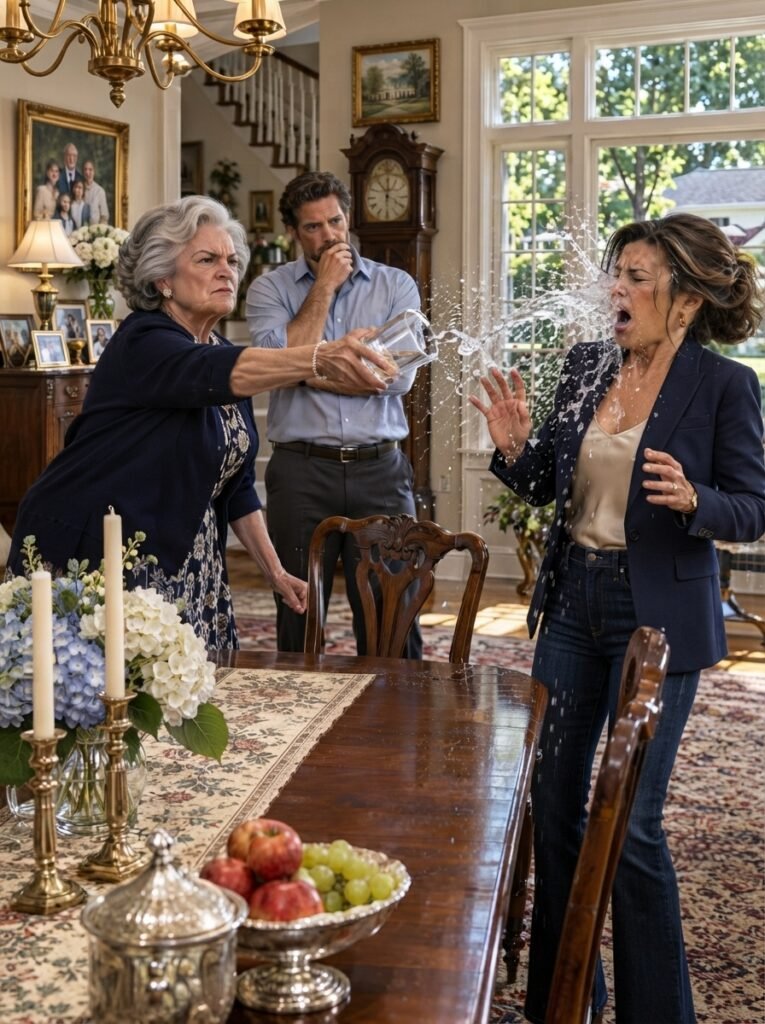
I raised the glass and splashed the water into Ashley’s face.
She screamed.
Her cream-colored blouse became soaked.
Daniel stared at me as though I’d committed some unforgivable crime.
“Mom, you didn’t have to do that!”
“Neither did she.”
I pointed toward the door.
“Leave.
Both of you.”
After they left, I sat alone at the table.
I wasn’t proud of throwing the water.
But I was even less proud of how long I’d allowed myself to be treated like an inconvenience.
The next morning, Daniel called.
He wanted me to apologize.
Ashley was embarrassed.
Ashley was upset.
Ashley felt disrespected.
I listened quietly.
Then I asked, “And how does Ashley feel about what she said to me?”
Silence.
“Mom, let’s not make this bigger than it needs to be.”
I closed my eyes.
“Daniel, my mind is open.
My house isn’t available.”
Four days later, a woman named Lauren Mitchell appeared at my door.
She wore a navy blazer and carried a tablet.
“Mrs.
Hale?
I’m here from Northfield Residential to complete your preliminary home valuation.”
I stared at her.
“My what?”
She explained that Ashley had contacted the agency about placing my house on the market in spring.
The asking price had already been discussed.
There were plans for staging.
According to Ashley, I was delighted about moving into a condominium.
I felt physically sick.
“Miss Mitchell,” I said carefully, “my home is not for sale.”
Her expression changed.
“You’re not planning to move?”
“No.”
“Your daughter-in-law indicated—”
“My daughter-in-law doesn’t own this property.”
Lauren immediately apologized.
I asked her to record my objection in writing.
Then I called Daniel.
He admitted knowing Ashley had contacted real estate agents.
But he called it “exploring options.”
I ended the conversation and drove straight to my friend Claire’s house.
Claire had known me for thirty-five years.
She listened without interrupting.
Then she said, “Margaret, you need to stop waiting for Daniel to protect you from Ashley.”
I looked down at my hands.
“He’s my son.”
“I know.”
“I raised him.”
“I know that too.”
Her voice softened.
“But raising someone doesn’t mean they can never betray you.”
I didn’t want to believe her.
Yet four days later, at that disastrous Sunday brunch, I would discover that Claire had understood the situation far better than I had.
Chapter 4: The Document From the Dead
Back at Daniel’s dining table, I stared at the document George had removed from the old envelope.
The heading read:
ACKNOWLEDGMENT OF NOTICE AND FINANCIAL DISCLOSURE.
Below it was Robert’s name.
Then several lines about family obligations, financial transfers, and the management of certain funds.
At the bottom was Ashley’s signature.
October 14, 2019.
Three days before Robert died.
I looked up.
“Why did Ashley sign a document concerning my husband’s estate?”
George folded his hands.
“Robert wanted certain family matters handled privately.”
“Then why wasn’t I told?”
“He believed you were under considerable emotional strain.”
I felt my face grow hot.
“You mean because my husband was dying?”
George didn’t answer.
I studied the document again.
Several paragraphs were missing from the copy.
The pages appeared to have been reproduced separately.
“Where’s the original?”
George hesitated.
“In secure storage.”
“Whose storage?”
“Mine.”
I laughed once.
It wasn’t a pleasant sound.
“How convenient.”
Ashley leaned forward.
“Margaret, the important thing is that Robert knew we were going to need help eventually.”
I looked at her.
“Robert knew you planned to buy a million-dollar house seven years after his death?”
She looked away.
Daniel whispered, “Mom—”
“Don’t.”
The room became silent.
I slowly picked up the photograph of the mansion.
“How much is this place?”
George answered reluctantly.
“One million, one hundred and eighty thousand dollars.”
I stared at him.
Daniel and Ashley lived in a comfortable home worth considerably less.
Daniel earned a decent salary in commercial sales.
Ashley worked in real estate marketing.
They weren’t poor.
But they certainly didn’t have that kind of money.
“How much have you put down?”
Daniel swallowed.
“Ninety-two thousand.”
“Where did that money come from?”
Ashley answered too quickly.
“Our savings.”
I looked at my son.
“Daniel?”
His face crumpled.
“We borrowed some.”
“From whom?”
George reached for the papers.
“Margaret, these arrangements are complicated.”
“No,” I said.
“You’re trying to make them complicated.
I asked a simple question.”
Then I noticed another document beneath the first.
A preliminary loan application.
It listed my name as a property guarantor.
My home address appeared under proposed collateral.
And on the final page was a copy of my driver’s license.
I stopped breathing.
“Where did you get this?”
Ashley frowned.
“What?”
“My driver’s license.”
She looked at Daniel.
He looked at the wall.
I remembered the previous Christmas.
Daniel had offered to help renew my car registration online.
He’d asked to photograph my license.
I had handed it over without hesitation.
A perfectly ordinary favor between a mother and her son.
Now that photograph appeared in a financial application I had never authorized.
I could barely hear my own voice.
“Daniel, did you give these people my personal information?”
He began crying.
“Mom, I never wanted it to go this far.”
Something inside me shattered.
The betrayal wasn’t that my daughter-in-law wanted my house.
It was that my own son had quietly provided the keys to my identity.
I stood.
“I’m leaving.”
Ashley jumped up.
“You can’t just walk away!
There are contracts!”
I turned toward her.
“Then you should have read them before signing.”
George raised his voice.
“Margaret, the bank already knows about the arrangement.
Making accusations now could cause serious complications for everyone.”
I looked directly at him.
“Then I suggest everyone prepare to explain themselves.”
I picked up my purse.
Patricia suddenly spoke.
“Margaret, wait.”
Her voice sounded strained.
She glanced toward her husband.
Then she said something strange.
“Please make sure you keep copies of everything you’ve seen.”
George snapped, “Patricia!”
She fell silent.
I studied her face.
There was fear in her eyes.
Real fear.
I walked out without another word.
But as I reached my car, I heard footsteps behind me.
Patricia came hurrying down the driveway.
She pressed a small folded paper into my hand.
“Don’t read this here,” she whispered.
“Patricia, what—”
“Just promise me.”
Then she returned to the house.
I sat in my car and unfolded the paper.
Five words were written in trembling handwriting.
ASK WHO REALLY OWNS WILLOWMERE.
Chapter 5: The Man Who Knew My Husband
Monday morning, I called a lawyer.
Not the attorney who had handled our original estate planning.
He’d retired several years earlier.
Instead, Claire recommended a woman named Naomi Brooks, who specialized in property disputes and elder financial exploitation.
Naomi was in her late forties, with sharp gray eyes and a voice that made every sentence sound deliberate.
She listened to my story without interrupting.
When I finished, she asked one question.
“Mrs.
Hale, do you have the original deed to your home?”
“Yes.”
“Good.
We’ll verify the recorded title and check for any unauthorized filings.”
She asked whether I had signed a power of attorney.
“No.”
“Ever given Daniel authority to borrow against the house?”
“Absolutely not.”
“Authorized Ashley to represent you in a property transaction?”
“No.”
Naomi leaned back.
“Then we start by preserving evidence, notifying the relevant institutions, and securing your records.”
I told her about the photograph, the apparent forged signature, and the document from Robert’s final days.
Her expression sharpened.
“What was the date?”
“October fourteenth, 2019.”
She tapped her pen against the desk.
“Who prepared it?”
“George claims he has the original.”
“What does George do professionally?”
“He’s a financial consultant.”
Naomi stopped writing.
“Was he ever involved in your husband’s investments?”
I hesitated.
“Occasionally.
Robert didn’t like him much.”
“Do you know why?”
I thought back.
During Robert’s final year, he’d become increasingly uncomfortable whenever George visited.
Once, after a family dinner, Robert had said, “That man could sell umbrellas to people standing in the desert.”
I laughed at the memory.
But Naomi didn’t.
“Did Robert ever use George as an adviser?”
“I don’t think so.”
She wrote something down.
Then she asked about the bank.
I explained that George had insisted the bank already knew about the arrangement.
Naomi’s eyebrows rose.
“We’ll find out precisely what that means.”
Over the following two days, we uncovered several disturbing facts.
First, my home was still recorded solely in my name.
There was no completed sale.
No legitimate mortgage had been placed against it.
But a private lending company had received an application using my property as proposed security.
The application contained a copied identification document and a signature that appeared to be mine.
More frighteningly, the packet included a statement claiming I was considering a “transition to supervised residential living.”
I stared at that phrase.
“Supervised living?”
Naomi nodded.
“Someone is trying to establish a narrative that you’re no longer comfortable or safe in your own home.”
I remembered Ashley’s repeated comments about my age.
The newspaper articles about falling.
The brochures.
The accusations that I was stubborn.
Then I remembered the water.
Ashley screaming.
Daniel telling me I’d reacted inappropriately.
“Naomi,” I whispered, “what if the argument in my dining room wasn’t just an argument?”
She looked at me.
“What do you mean?”
“What if Ashley wanted me to lose my temper?”
Naomi was silent for several seconds.
Then she said, “We should investigate that possibility.”
The next revelation was even worse.
The down payment for the Willowmere property hadn’t come entirely from Daniel and Ashley’s savings.
A substantial portion had originated in an account established years earlier for Lucy and Ben.
An education trust.
Created by Robert.
I stared at Naomi.
“I didn’t know Robert had created a separate trust.”
She nodded.
“Apparently, it was funded with part of his personal savings and a small insurance benefit.
Daniel was appointed to manage the accounts after Robert’s death, subject to the trust’s restrictions.”
I remembered Robert telling me he’d made sure the children would have help with college.
I’d assumed he meant ordinary savings accounts.
He’d never explained the details while he was ill.
“How much money?”
I asked.
Naomi hesitated.
“The documents suggest approximately one hundred and eighty thousand dollars was originally allocated between the two children.”
I felt my hands go numb.
“Where is it now?”
“We’re requesting the complete records.”
I stared out the window.
Robert had worked overtime for decades.
He’d saved money instead of buying himself new things.
And some of those savings had been intended for the grandchildren he adored.
Someone had reached into my dead husband’s final gift to our grandchildren and used it to purchase a luxury house.
I began to cry.
Naomi handed me a tissue.
Then her phone rang.
She listened for a moment.
Her expression changed.
When she hung up, she looked at me.
“Mrs.
Hale, there’s someone I think you need to meet.”
“Who?”
“A retired attorney named Thomas Whitmore.”
I frowned.
“Why?”
Naomi placed her pen down.
“Because he says your husband visited his office shortly before he died.”
I stared at her.
“Robert was barely able to walk.”
“Apparently, he insisted.”
“What did he want?”
Naomi hesitated.
“He wanted to make sure that if anyone ever tried to take your house, someone would know where to find the truth.”
Chapter 6: Robert’s Final Appointment
Thomas Whitmore lived in a small brick house near the edge of town.
He was eighty-one, recently retired, and moved with the careful slowness of a man who had spent his life sitting behind desks.
When Naomi and I arrived, he greeted us with a warmth that nearly broke my heart.
“Margaret,” he said softly, “you look exactly as Robert described you.”
I swallowed.
“You knew my husband?”
Thomas smiled sadly.
“Longer than you might imagine.”
He led us into a study filled with books.
On a side table sat an old wooden box.
Inside were several letters, photographs, and a sealed envelope.
Thomas sat across from me.
“Robert came to see me on October tenth, 2019.
Seven days before his death.”
I closed my eyes.
During that week, Robert had been weak.
He slept most afternoons.
Yet he’d told me he was going to visit an old friend.
I’d offered to drive him.
He insisted Daniel would take him.
“Daniel brought him?”
I asked.
Thomas shook his head.
“No.
A taxi did.”
That surprised me.
Thomas continued.
“Robert was frightened, Margaret.
Not for himself.
He knew he was dying.”
My throat tightened.
“He was frightened for you.”
I looked down.
“Why?”
Thomas removed a folder.
“Several months earlier, Robert discovered irregular withdrawals from an account he had been managing for your grandchildren.”
I stared at him.
“He confronted Daniel?”
“Yes.”
“What happened?”
Thomas sighed.
“Daniel claimed he’d borrowed the money temporarily.
He said he was under financial pressure and intended to repay it.”
I thought of my son crying at the brunch table.
“We never knew.”
“Robert didn’t want to burden you while you were caring for him.”
Tears blurred my vision.
Thomas continued.
“He insisted Daniel restore the money.
When that didn’t happen, Robert began gathering records.”
“Why didn’t he tell me?”
“He was ashamed.”
“Of what?”
“That his son was stealing from his own children.”
I covered my mouth.
Thomas opened the folder.
“George had become involved by then.
He proposed restructuring several accounts.
Robert refused.”
“What about Ashley?”
Thomas paused.
“She knew.”
I felt cold.
“How do you know?”
“Because on October fourteenth, she signed a written acknowledgment.”
My heart began racing.
“The document from Sunday brunch?”
Thomas nodded.
“But I suspect the version you saw was incomplete.”
He handed me another copy.
This one contained five pages.
The document George had shown me contained only two.
I began reading.
The first page summarized the unauthorized withdrawals.
The second identified Daniel as the person responsible for several transfers.
The third described George’s attempt to arrange repayment through a proposed property transaction.
Then I reached the fourth page.
Robert had written a statement.
“My wife, Margaret Eleanor Hale, has not consented to and must not be represented as consenting to any transfer, guarantee, loan, or financial transaction involving her home.”
I stared at the sentence.
My husband had been dying.
Yet he was still trying to protect me.
I turned the page.
Ashley’s signature appeared at the bottom.
But now I understood what it meant.
She hadn’t been receiving permission to use our property.
She had been acknowledging written notice that Robert expressly refused to permit it.
Thomas pointed to another paragraph.
“Ashley was present when Daniel agreed to restore the money.
She acknowledged receiving a copy of Robert’s instructions.”
I looked up.
“George deliberately left those pages out.”
“That appears to be what happened.”
I felt anger rise through my grief.
“Why did Robert trust you with this?”
Thomas hesitated.
“Because he knew George had copies of some of the financial records, and he was concerned they might be misused.”
He handed me a letter.
Robert’s handwriting filled the page.
My darling Margaret,
If you’re reading this, it means something has happened that I prayed would never happen.
You have always been the strongest person I’ve known.
But strength doesn’t mean you should have to fight the people you love.
I wanted to believe Daniel would make things right.
I wanted to believe that becoming a father would teach him the responsibility I tried so hard to show him.
I was afraid that if I told you everything while I was dying, your final memories of me would be filled with arguments and disappointment.
Perhaps that was selfish.
Perhaps I should have trusted you with the truth.
But I need you to understand one thing.
Your home belongs to you.
Your future belongs to you.
Your life does not become less valuable because mine is ending.
Never let our son, or anyone else, make you forget that.
With all my love,
Robert.
I pressed the letter against my chest.
For seven years, I had believed my husband’s final act had been holding my hand as he took his last breath.
I was wrong.
He had been protecting me even when he could barely protect himself.
Then Thomas said something that made me look up.
“Margaret, there’s another part.”
I wiped my eyes.
“What part?”
He took out a small brass key.
“Robert asked me to give you this if the situation ever reached this point.”
I stared at it.
It was old, worn, and strangely familiar.
“Where does it go?”
Thomas smiled sadly.
“He said you’d know.”
I turned the key over.
A tiny number had been engraved on its handle.
17.
And suddenly I remembered something Robert had said in the hospital.
Something I’d dismissed as confusion caused by medication.
“Margaret,” he’d whispered, “if the house ever feels wrong, remember the seventeenth step.”
At the time, I’d thought he meant the staircase.
Now I wasn’t so sure.
Chapter 7: The Seventeenth Step
I returned home that evening with Robert’s letter folded inside my purse.
The house was quiet.
The grandfather clock in the hallway ticked steadily.
The dogwood tree outside the living room window swayed in the wind.
I stood in the center of the house and whispered, “What were you trying to tell me, Robert?”
The seventeenth step.
Our main staircase had fourteen steps.
The basement stairs had twelve.
I counted both twice.
Nothing.
Then I remembered the old wooden staircase leading from the garage to the storage loft.
Robert had built it himself.
Seventeen steps.
I hurried outside.
The garage smelled of cedar shavings, motor oil, and decades of old memories.
Robert’s workbench remained exactly as he’d left it.
His toolbox sat beneath the window.
His collection of screws occupied rows of labeled containers.
I climbed the loft stairs.
One.
Two.
Three.
By the time I reached seventeen, my knees were aching.
The final step creaked.
I examined the wooden riser.
There was a tiny brass fitting near one corner.
I knelt and inserted the key.
It turned.
A narrow compartment opened beneath the step.
Inside was a metal box.
My hands began trembling.
I carried it downstairs and placed it on Robert’s workbench.
The lid opened easily.
Inside were documents, a small flash drive, photographs, and a thick envelope addressed to me.
I sat on an old stool.
Then I began reading.
The first folder contained records of Daniel’s financial problems.
A failed business investment.
An expensive refinancing arrangement.
Several private loans.
And a series of transfers from the grandchildren’s education accounts.
The more I read, the worse it became.
Robert had discovered that Daniel’s debts were far larger than anyone realized.
He’d also learned that George had been advising him on questionable property transactions.
Together, they had been moving money between accounts, claiming each transfer was temporary.
Robert had warned them to stop.
They hadn’t.
The second folder contained photographs of documents.
Some were copies of checks.
Others were letters.
Then I found a photograph of my driver’s license from seven years earlier.
I stared at it.
It was an older license.
One that had expired before Robert died.
Why would Robert have a copy?
Attached was a handwritten note.
“Daniel copied Margaret’s identification without permission.
October 2019.”
I felt sick.
This hadn’t started with the mansion.
It hadn’t even started after Robert’s death.
My son had been collecting my personal information while his father was dying.
I opened the next envelope.
Inside was a typed statement signed by Robert.
He described confronting Daniel about unauthorized withdrawals.
Then he described a conversation that made my hands shake.
Daniel had asked whether Robert could arrange for my house to be used as collateral for a temporary business loan.
Robert refused.
Daniel argued that the property would eventually become his anyway.
Robert answered that he had no right to promise it.
My eyes filled.
I could almost hear my husband’s voice.
Firm.
Quiet.
Unmovable.
Then I reached the final paragraph.
“Daniel suggested that Margaret might not be capable of managing the house alone after my death and that arrangements could be made on her behalf.”
I read it twice.
Then a third time.
Seven years ago.
While Robert was still alive.
While I spent my days preparing soup and washing my husband’s blankets.
While I tried to keep him comfortable through unbearable pain.
My own son had already been discussing how to take control of my home after his father’s death.
I covered my face and sobbed.
Not because I was afraid.
Because I remembered every sacrifice we’d made for Daniel.
Every sleepless night.
Every birthday cake.
Every school concert.
Every moment Robert had looked at our son with pride.
Eventually, I forced myself to continue.
The flash drive contained audio files.
I borrowed an old laptop from the guest room and opened the first recording.
Robert’s voice filled the garage.
Weak.
Breathless.
But unmistakable.
“Daniel, I need you to understand something.”
A younger version of my son’s voice answered.
“Dad, you’re making this harder than it needs to be.”
“You’re not touching your mother’s house.”
“We’re only talking about using the equity temporarily.”
“She hasn’t agreed.”
“She doesn’t understand these transactions.”
“Then you explain them honestly.”
A pause.
Then Daniel said something that made my entire body go cold.
“Once you’re gone, Dad, she won’t have much choice.”
I stopped the recording.
For a long time, I couldn’t move.
My husband had heard those words.
He’d known.
And he’d spent the last days of his life trying to make sure I would never be trapped by them.
But the next recording revealed something unexpected.
A woman’s voice.
Not Ashley’s.
Not mine.
Patricia’s.
“Robert,” she whispered, “I think George is doing something terrible.”
I leaned toward the computer.
Robert asked, “What do you know?”
Patricia began crying.
Then she said:
“He’s done this before.”
Chapter 8: Patricia’s Confession
I called Patricia the next morning.
She answered on the third ring.
“Margaret?”
“Why did you warn me about Willowmere?”
Silence.
Then she whispered, “You found the documents?”
“Some of them.”
Another silence.
“Are you alone?”
“Yes.”
“I can’t explain over the phone.”
We arranged to meet at a small diner twenty minutes outside town.
Patricia arrived wearing sunglasses, despite the cloudy weather.
She looked older than she had at Sunday brunch.
Her hands shook as she removed her coat.
“George doesn’t know I’m here,” she said.
I didn’t bother pretending this was a friendly conversation.
“How long have you known what your husband was doing?”
She closed her eyes.
“Longer than I can forgive myself for.”
I waited.
Patricia stared into her coffee.
“George used to work with private property investors.
He specialized in complicated transactions involving distressed owners.”
“That sounds respectable.”
“It was supposed to be.”
She swallowed.
“Then I began noticing patterns.”
“What patterns?”
“Older homeowners.
Recently widowed people.
Families under financial pressure.”
My skin prickled.
“He would find relatives who wanted access to property equity.
Sometimes the relatives convinced the owners to sign.
Sometimes signatures were questioned.”
I thought of my forged documents.
“You’re telling me your husband has been doing this for years?”
Patricia nodded.
“Not every transaction was illegal.
But some were.
And I was afraid of what would happen if I asked too many questions.”
“Why didn’t you report him?”
Tears filled her eyes.
“Because I was a coward.”
I said nothing.
She deserved the silence.
Then she reached into her purse.
“I started keeping copies.”
She handed me a flash drive.
“Names.
Transactions.
Emails.
Everything I could collect.”
I stared at it.
“Why give this to me now?”
“Because I watched my daughter become exactly like her father.”
Her voice cracked.
“When Ashley married Daniel, I thought she’d be different.
But George convinced them that financial success was the only thing that mattered.”
“That doesn’t excuse her.”
“I know.”
She wiped her cheeks.
“Then Robert became ill.
George saw an opportunity.”
My hands tightened around my coffee cup.
“What opportunity?”
“Robert had been saving money for Lucy and Ben.
Daniel needed help covering investment losses.
George suggested a temporary arrangement.”
“Using the children’s money?”
“Yes.”
“And when Robert found out?”
“Everything changed.”
Patricia leaned closer.
“Robert confronted George.
He threatened to report him if the money wasn’t restored.”
I remembered the recording.
“What happened next?”
“George promised to arrange repayment.
But there was never enough money.”
I stared at her.
“So they waited for Robert to die.”
Patricia began crying harder.
“I think that’s what they did.”
The diner suddenly felt too warm.
I took a slow breath.
“And Willowmere?”
She looked toward the windows.
“That house isn’t what you think.”
I remembered her note.
ASK WHO REALLY OWNS WILLOWMERE.
“Explain.”
Patricia pulled out another document.
The property was being marketed through a company called Silver Finch Holdings.
The name meant nothing to me.
But Patricia’s expression was grim.
“George has an ownership interest in that company.”
I blinked.
“Your husband owns the mansion?”
“Through a business structure, yes.
Not necessarily all of it, but enough to benefit from the transaction.”
I stared at her.
“Daniel and Ashley are buying a house from George?”
Patricia nodded.
“At an inflated price.”
The truth struck me like a physical blow.
The mansion wasn’t simply an expensive dream home.
It was part of a scheme to move money.
George could receive proceeds from the sale.
Daniel and Ashley would acquire the property.
And my home would supposedly guarantee the financing.
I looked down at the documents.
“Why would Daniel agree to that?”
Patricia whispered, “Because he owes George money.”
“How much?”
Her face crumpled.
“More than four hundred thousand dollars.”
I sat back.
My son had somehow buried himself under debt.
And rather than admit his mistakes, he’d allowed his wife and father-in-law to build an elaborate scheme around my home.
“Does Ashley know everything?”
Patricia hesitated.
“I don’t know how much she knows about the company’s ownership.”
“But she knows about the forged signature?”
Patricia looked at her coffee.
I had my answer.
Then she said something that made me sit forward again.
“Margaret, there’s another reason you need to move quickly.”
“What?”
“George is preparing legal paperwork claiming you’re no longer able to manage your affairs.”
My mouth went dry.
“On what basis?”
Patricia hesitated.
“Ashley recorded the incident when you threw water at her.”
I remembered Daniel standing between us.
His phone had been in his shirt pocket.
I’d thought nothing of it.
Patricia continued.
“They want to present the argument as evidence that you’ve become aggressive and unstable.”
I felt sick.
The humiliation, the insults, the repeated pressure—all of it could be used to support a story that I was incapable of protecting myself.
I stood.
Patricia grabbed my hand.
“Margaret, please believe me.
I’m trying to help.”
I looked at her.
“Then do something that actually matters.”
“What?”
“Tell the truth when someone with authority asks you.”
For the first time, she met my eyes.
“I will.”
I picked up my purse.
Then Patricia whispered, “There’s something else about Robert’s final appointment.”
I stopped.
“What?”
Her face turned pale.
“George wasn’t supposed to know Robert had recorded those conversations.”
A cold sensation moved through me.
“But somehow he found out.”
I stared at her.
“How?”
She shook her head.
“I don’t know.”
Then she whispered:
“But the day before Robert died, someone went through his room looking for something.”
Chapter 9: The Night Before Goodbye
I drove home with Patricia’s words echoing inside my head.
Someone had searched Robert’s room.
The day before he died.
I remembered that day vividly.
October 16, 2019.
Robert had been unusually restless.
He kept asking where I’d placed his blue sweater.
Not because he was cold.
He said there was something in the pocket.
I searched the closet.
The sweater wasn’t there.
Daniel told me he’d taken some laundry home.
I’d accepted the explanation.
Now I wondered what had really happened.
I pulled into my driveway and sat behind the steering wheel.
For seven years, I’d grieved a man while trusting the people who had stood beside me at his funeral.
Had they been watching me the entire time?
Waiting for the right opportunity?
I entered the house and went straight to Robert’s bedroom closet.
His clothes had been donated years ago.
But one drawer still held old photographs, a watch, and a few letters.
At the bottom was a folded receipt from a dry cleaner.
Dated October 15, 2019.
The item description read:
BLUE WOOL SWEATER.
I stared at it.
Robert had asked about that sweater on the sixteenth.
Yet someone had taken it to be cleaned the previous day.
I checked the receipt carefully.
The customer name was printed in small letters.
D.
HALE.
Daniel.
A wave of anger rose through me.
I called Naomi.
She listened carefully.
“Keep the receipt,” she said.
“Don’t confront him.”
“I want to ask him what he did.”
“I understand.”
“No, Naomi.
I don’t think you do.”
My voice broke.
“I sat beside my husband while he was dying.
I watched him struggle to breathe.
I held his hand when he was frightened.
And now I’m discovering that my son was searching his clothes and collecting my documents.”
Naomi’s voice softened.
“Then let’s make sure we find out exactly why.”
That afternoon, I received a text from Daniel.
Mom, Ashley and I are worried about you.
We think you should speak with someone about how you’ve been behaving.
I stared at the screen.
Then another message appeared.
We love you.
Please don’t make us take steps to protect you.
My hands went cold.
There it was.
The threat Patricia had warned me about.
I forwarded both messages to Naomi.
Then I did something I’d never imagined doing.
I changed every lock on my house.
I also arranged additional exterior cameras and asked my bank to strengthen the security on my accounts.
The locksmith arrived before sunset.
While he worked, I stood in the hallway looking at Robert’s photograph.
I remembered him laughing in that same doorway.
I remembered the smell of his coffee.
The way he always left his reading glasses on the kitchen counter.
I whispered, “I wish you were here.”
For a moment, the silence was unbearable.
Then my phone rang.
It was Lucy.
My granddaughter was twelve now, bright and observant, with Robert’s gray-blue eyes.
“Grandma?”
“Hello, sweetheart.”
Her voice sounded strange.
“Are you mad at us?”
My heart broke.
“Of course not.”
“Dad says you’re upset with everybody.”
“I’m upset about some grown-up things.
None of this is your fault.”
She hesitated.
“Grandma, can I tell you something?”
“Anything.”
“Mom and Dad have been fighting.”
I closed my eyes.
“I’m sorry, honey.”
“Dad said you were supposed to sign papers, but you wouldn’t.”
I remained quiet.
Then Lucy whispered, “I heard Grandpa George say they needed to make you look confused.”
My heart started pounding.
“When did he say that?”
“Last week.”
“Who was there?”
“Mom.
Dad.
Grandpa George.”
I forced myself to stay calm.
“Lucy, listen carefully.
You don’t need to get involved in any grown-up arguments.”
“But Grandma—”
“I love you.
And you haven’t done anything wrong.”
She began crying.
“I don’t want them to take your house.”
Tears filled my eyes.
“They won’t, sweetheart.”
She sniffled.
Then she said something unexpected.
“Grandma, I think I have something you should see.”
“What?”
“A video.”
I froze.
“What video?”
“I was making a movie with Ben’s tablet.
I left it recording when Mom and Dad came into the kitchen.”
I gripped the phone.
“What did you hear?”
Lucy’s voice became barely audible.
“Dad said Grandma had already signed the papers, and Mom said you hadn’t.
Then Dad told her nobody would be able to prove the difference.”
I closed my eyes.
“Lucy, sweetheart, don’t tell anyone about that recording right now.
I’ll have someone help us handle it safely.”
There was a long silence.
Then she whispered, “Grandma?”
“Yes?”
“Is Daddy going to jail?”
I couldn’t answer.
Because for the first time, I knew that possibility was real.
Chapter 10: The Daughter-in-Law Who Finally Broke
Three days later, Ashley appeared at my house.
She rang the doorbell repeatedly.
I watched her through the camera.
She looked exhausted.
Her hair was pulled into a messy ponytail, and she wasn’t wearing makeup.
I spoke through the door.
“What do you want?”
“Margaret, please.
We need to talk.”
“Call my lawyer.”
“Please.
It’s about Lucy and Ben.”
That stopped me.
I called Naomi.
She advised me to keep the conversation brief and, if I chose to speak with Ashley, not to discuss documents or agree to anything.
I opened the door but remained in the entryway.
Ashley looked around.
“You changed the locks.”
“Yes.”
“Daniel was hurt.”
I almost laughed.
“How unfortunate.”
She swallowed.
“Margaret, I know you hate me.”
“I don’t hate you, Ashley.
But I don’t trust you.”
Tears filled her eyes.
“I made mistakes.”
“You tried to arrange the sale of my home without my permission.”
“I thought Daniel had discussed it with you.”
I looked at her.
“Don’t insult my intelligence.”
She lowered her eyes.
For several seconds, neither of us spoke.
Then she whispered, “I didn’t know George was selling us his own property.”
I studied her face.
She looked genuinely shaken.
“Your mother told you?”
Ashley nodded.
“She told me everything.”
“And now you’re here because the scheme has fallen apart?”
She flinched.
“I came because Daniel is threatening to take the children if I tell anyone what happened.”
I felt the anger drain from my face.
“Explain.”
Ashley began crying.
She said Daniel had accumulated enormous debts through failed investments.
George offered to help.
At first, the plan seemed simple.
Sell my large home.
Use some of the proceeds to help Daniel and Ashley purchase Willowmere.
Move me into a condominium.
Everybody would supposedly benefit.
But when I refused, Daniel grew desperate.
“He said you’d come around eventually,” Ashley whispered.
“Did he tell you to contact the real estate agency?”
She nodded.
“Yes.”
“Did you know my signature was forged?”
Ashley closed her eyes.
“Not at first.”
I waited.
“When I found out, he said it was only a preliminary document.
He promised nothing would happen without your approval.”
I stared at her.
“And you believed him?”
She began crying harder.
“I wanted to.”
That sentence told me more than any apology could have.
She had wanted the mansion.
Wanted the social status.
Wanted the money.
And she’d been willing to ignore warning signs until the consequences became impossible to avoid.
“Did Daniel forge my signature?”
I asked.
Ashley looked away.
“Margaret—”
“Answer me.”
She whispered, “Yes.”
My heart seemed to stop.
“Did you see him do it?”
She nodded.
I gripped the doorframe.
For several seconds, I couldn’t breathe.
Then I asked, “Why didn’t you stop him?”
Ashley covered her face.
“Because I thought we’d fix everything before anyone found out.”
I stared at her.
“You gambled with my home because you thought you could fix it later?”
She said nothing.
I thought about throwing another glass of water.
Instead, I stepped aside and pointed toward the porch bench.
“Sit down.”
She obeyed.
I sat several feet away.
“Listen carefully, Ashley.
I love Lucy and Ben.
I will always love them.
But loving those children doesn’t mean I will participate in a crime to protect their parents.”
She nodded through tears.
“If you want to help them, tell the truth.”
She looked at me.
“Daniel will hate me.”
I felt something inside me harden.
“Then perhaps you should think about how it feels to be betrayed by someone you love.”
Ashley lowered her head.
For the first time since I’d known her, she didn’t argue.
Before she left, she said, “There’s something you should know.”
“What?”
“Daniel didn’t just want to borrow against your house.”
I stared at her.
“What else?”
She swallowed.
“He was planning to ask the court to appoint someone to manage your finances.”
I closed my eyes.
Ashley continued.
“George said if they could show you were becoming unsafe, it might help.”
“Unsafe?”
“The argument.
The water.
Your age.
They were collecting examples.”
I looked at her.
“And you participated?”
Tears slid down her cheeks.
“Yes.”
I stood.
“Then you need to tell my lawyer every detail.”
She nodded.
As she walked away, I felt no satisfaction.
Only exhaustion.
Because beneath the anger was the terrible knowledge that the young woman I’d welcomed into my family had allowed herself to become part of something cruel.
But the next revelation would show that Ashley wasn’t even the person I should have feared most.
Chapter 11: The Evidence Nobody Expected
Naomi moved quickly.
With the help of financial investigators and the appropriate legal authorities, the suspicious loan application, disputed signatures, and education trust withdrawals were examined.
The institutions involved began reviewing the transactions.
The private lender halted further action while the disputed authorization was investigated.
The property sale stalled.
And a formal investigation began.
I gave a statement.
So did Patricia.
Eventually, Ashley provided information through her own attorney.
But the most important evidence came from someone nobody had considered.
Lucy.
My granddaughter had recorded part of a conversation between Daniel and Ashley.
The recording wasn’t perfect.
There were background noises, and Ben could be heard asking where his toy dinosaur had gone.
But Daniel’s voice was clear.
“Mom won’t sign.”
Ashley answered, “Then we stop.”
“No.
We’ve already committed.”
“Daniel, this is getting dangerous.”
“She’ll never know the difference once everything is done.”
“That’s your mother’s signature!”
“Nobody’s going to prove anything.”
The recording stopped shortly afterward.
When Naomi played it for me, I felt as though someone had reached inside my chest and squeezed my heart.
I recognized Daniel’s voice.
His impatient tone.
The familiar way he emphasized words when he thought he was the smartest person in the room.
It was the same voice that had once called me from college to ask how to wash a sweater without shrinking it.
The same voice that had whispered, “I love you, Mom,” when Robert died.
And now it was calmly discussing how to steal my home.
Naomi stopped the recording.
“Margaret?”
I stared at the screen.
“Do what you need to do.”
She nodded.
The next several weeks were brutal.
Daniel called repeatedly.
I didn’t answer.
He left messages accusing Ashley of betraying him.
He blamed George.
He blamed his business partners.
He blamed the economy.
Eventually, he blamed me.
“If you’d just helped us,” he shouted into one voicemail, “none of this would have happened!”
I listened once.
Then I saved it with the other evidence.
Claire came by almost every evening.
Sometimes we drank tea.
Sometimes we sat without speaking.
One night, she found me staring at an old family photograph.
Daniel was eight in the picture.
Robert stood behind him, smiling proudly.
I touched the glass.
“Where did I go wrong?”
Claire sat beside me.
“Margaret, people make choices.”
“I raised him to be better.”
“And he knows better.”
I began crying.
“He was such a sweet little boy.”
Claire put her arm around me.
“That boy was real.
So is the man he’s become.
You don’t have to erase one truth to accept the other.”
I leaned against her shoulder.
For the first time, I allowed myself to grieve the living son I’d lost.
Then Naomi called with news.
Investigators had discovered that the Willowmere transaction wasn’t the first questionable deal associated with George’s business.
There were other properties.
Other families.
Other elderly homeowners.
Some had lost substantial amounts of money.
One widow had been moved into assisted living after relatives persuaded her to sign documents she barely understood.
Another had discovered unauthorized loans against her property.
The pattern was disturbing.
George had spent years cultivating relationships with financially desperate relatives of elderly homeowners.
He offered solutions.
Temporary loans.
Property restructurings.
Bridge financing.
Promises that everyone would be better off afterward.
But the arrangements often benefited companies connected to him.
My family hadn’t stumbled into an isolated act of greed.
They had become involved in a system designed to exploit people who trusted their relatives.
I felt physically ill.
Then Naomi added something unexpected.
“Margaret, one of the older files contains a familiar name.”
“Whose?”
She hesitated.
“Robert Hale.”
I sat upright.
“My husband?”
“Yes.”
“What does it say?”
“Apparently, Robert filed a complaint years ago.”
I gripped the phone.
“Against George?”
“Yes.”
I closed my eyes.
Robert hadn’t simply discovered Daniel’s theft.
He’d tried to expose the larger operation.
And someone had made sure I never knew.
Chapter 12: The Truth About Robert’s Last Days
Thomas Whitmore came to my house the following Saturday.
He brought a second folder.
“Margaret,” he said, “there’s something I should have given you sooner.”
I stared at him.
“More secrets?”
His face tightened.
“Robert asked me to wait until you had legal support.
He feared that if you confronted Daniel without evidence, the documents might disappear.”
I looked at the folder.
“What is it?”
“His final complaint and the correspondence that followed.”
I opened it.
Robert had written to a financial regulatory office about suspicious property transactions associated with George.
He had also contacted an attorney who specialized in financial misconduct.
The complaint described several transactions Robert believed deserved investigation.
Among the documents were copies of emails between Daniel and George.
One message made me stop.
Daniel had written:
Dad knows about the accounts.
We need to make sure Mom doesn’t get involved.
George replied:
Let me handle Robert.
You focus on keeping Margaret calm.
I read it twice.
My husband had been ill.
Vulnerable.
Fighting for every additional day.
And these men had treated him as an obstacle.
Thomas continued.
“Robert suspected George had used confidential information from family relationships to facilitate transactions.”
I looked at him.
“Did George ever threaten him?”
Thomas hesitated.
“Robert believed someone had entered his room and searched through his belongings.”
I remembered the missing blue sweater.
“Daniel.”
“Robert suspected him.”
I felt tears fill my eyes.
Thomas pointed to a final letter.
It had been written two days before Robert died.
The handwriting was shaky.
But the words were clear.
“I am not afraid of dying.
I am afraid of leaving Margaret surrounded by people who think love gives them ownership of her life.”
I covered my mouth.
Thomas waited.
When I finally looked up, I asked, “Why didn’t Robert tell me?”
He sighed.
“I asked him that.”
“What did he say?”
Thomas’s eyes filled.
“He said you had spent your whole life carrying everybody else.
He wanted you to have one final week in which you didn’t have to carry this.”
I broke down.
The grief I’d carried for seven years opened again.
I remembered Robert’s final smile.
His hand tightening around mine.
The way he’d whispered, “Promise me you’ll keep living.”
I’d thought he was asking me not to disappear into widowhood.
Now I understood there was another meaning.
He wanted me to remain free.
Thomas waited while I cried.
Then he said, “Margaret, Robert also left a formal statement with his attorney about the disputed money.”
I wiped my cheeks.
“Why?”
“He believed Daniel might someday try to use family pressure to obtain more.”
I stared at him.
“Did he know Daniel would go this far?”
“No.
But he knew the danger was real.”
Thomas looked toward Robert’s photograph.
“Your husband wanted to protect you.
He couldn’t make Daniel become an honest man.
But he could preserve the truth.”
I sat quietly.
Then Thomas said something that changed the direction of the entire investigation.
“There’s another person who may have known about the earlier transactions.”
“Who?”
He hesitated.
“Claire.”
I stared at him.
“My friend Claire?”
Thomas nodded slowly.
“Robert listed her as someone he trusted to help you if necessary.”
I felt relief.
Of course.
Claire had always been dependable.
But Thomas wasn’t finished.
He pointed to a document.
“She also witnessed one of the letters.”
I looked down.
Claire’s name appeared beside a signature.
Dated October 15, 2019.
One day before Robert’s final full day of consciousness.
I frowned.
“Claire never told me.”
Thomas watched my face.
“Maybe she thought you knew.”
I shook my head.
“No.”
He hesitated.
“Then perhaps you should ask her.”
For the first time since all this began, I felt a strange uneasiness about the woman I trusted most.
Not because I believed Claire had betrayed me.
But because she had known something about Robert’s final days that she’d never mentioned.
And I was beginning to understand how dangerous secrets could become.
Chapter 13: The Friend Who Kept Her Promise
Claire arrived that evening carrying a casserole.
She found me waiting in the kitchen with Thomas’s document on the table.
She looked at it.
Then she closed her eyes.
“Oh, Margaret.”
I folded my arms.
“You knew.”
She sat down slowly.
“Yes.”
“How much?”
She looked at me.
“Enough to be worried.”
I felt my voice rise.
“Robert told you Daniel was stealing money?”
“Yes.”
“And you never said a word?”
Tears filled her eyes.
“Robert asked me not to tell you while he was dying.”
“He’s been dead for seven years.”
Claire flinched.
I hated hurting her.
But I needed answers.
She took a slow breath.
“After the funeral, I tried to convince Daniel to tell you the truth.”
I stared at her.
“What happened?”
“He promised to repay the money.
George claimed everything was being resolved.”
“And you believed them?”
“At first.”
She wiped her eyes.
“Then I began watching.”
I sat down.
Claire continued.
“I knew Robert had preserved documents.
I knew Thomas had copies.
But I didn’t know how much Daniel continued to owe.”
“Why didn’t you warn me?”
“Because I was afraid you’d lose your son immediately after losing your husband.”
I stared at her.
“That wasn’t your decision to make.”
“I know.”
She began crying.
“I know that now.”
For several minutes, neither of us spoke.
Then Claire reached for my hand.
“Margaret, I made a mistake.
I thought I was protecting you from pain.
But I was really postponing it.”
I looked at her.
“Robert did the same thing.”
She nodded.
“Yes.”
I thought about the years we’d spent together.
Our lunches.
Our holidays.
The times Claire had helped me through loneliness.
The countless moments she’d told me I deserved happiness.
Then I remembered her warning after Ashley tried to arrange the sale.
You need to stop waiting for Daniel to protect you.
“You knew what he was capable of,” I whispered.
Claire nodded.
“I knew he had already betrayed Robert.”
I looked away.
For a while, I couldn’t decide whether to feel angry or grateful.
Finally, I said, “No more secrets.”
Claire squeezed my hand.
“No more secrets.”
Then she reached into her purse.
“I brought you something.”
It was a small envelope.
Inside was a photograph of Robert standing beside Thomas outside a building.
Robert looked frail.
He was leaning on a cane.
But he was smiling.
On the back, he’d written:
Margaret will be all right.
She just needs to remember who she is.
I stared at the photograph.
Claire whispered, “He made me promise one more thing.”
“What?”
“That if Daniel ever tried to take your independence, I would stand beside you.”
I wiped away a tear.
“And will you?”
She nodded.
“Until the end.”
I looked at her for a long moment.
Then I reached across the table.
And took her hand.
Forgiveness didn’t erase the damage.
But for the first time in weeks, I felt I was no longer standing alone.
Chapter 14: The Day the Truth Entered the Courtroom
The investigation eventually resulted in criminal charges relating to the financial transactions.
George faced allegations involving fraud and misuse of financial documents.
Daniel faced charges connected to forged authorization records and the improper handling of trust funds.
Ashley, after obtaining independent legal advice, cooperated with investigators.
Patricia also provided records.
The legal proceedings would take time.
But the immediate threat to my home had been stopped.
My deed remained in my name.
The disputed financing had not created a valid mortgage against my property.
And the attempted effort to portray me as incapable of managing my affairs faced serious scrutiny.
There was a court hearing concerning the proposed protective arrangements.
I attended with Naomi.
Daniel sat across the room.
He looked smaller than I remembered.
His expensive suit hung awkwardly on his shoulders.
His face was pale.
For one terrible second, I wanted to go to him.
To smooth his hair.
To tell him everything would be all right.
The instinct was so powerful that I had to grip the edge of my chair.
Then I remembered the recording.
Once you’re gone, Dad, she won’t have much choice.
I remained seated.
During the hearing, the court reviewed the relevant evidence, including the concerns raised about my capacity.
I answered questions clearly.
I explained how I managed my accounts.
How I maintained my home.
How I paid bills, handled appointments, and made decisions.
When asked about the incident with Ashley, I told the truth.
“Yes,” I said, “I threw water at my daughter-in-law during an argument.
I regret doing that.”
Then I continued.
“But one angry reaction does not mean I’ve lost the ability to understand my finances or make decisions about my property.”
Naomi introduced relevant documentation.
The messages Daniel had sent.
The disputed financial authorization.
Evidence that preparations to sell my home had begun without my consent.
The court did not treat my age as proof of incapacity.
Nor did it accept the family’s concerns without examining the surrounding circumstances.
When the hearing ended, the attempt to obtain control over my affairs had failed.
Outside the courtroom, Daniel approached me.
“Mom.”
I stopped.
Naomi remained nearby.
Daniel’s eyes filled.
“Please.
Can we talk?”
I looked at him.
“About what?”
He swallowed.
“I’m sorry.”
I’d waited weeks to hear those words.
Yet they felt strangely empty.
“Are you sorry you hurt me, Daniel?”
He began crying.
“Of course.”
“Or are you sorry you got caught?”
He flinched.
I took a slow breath.
“Your father trusted you.”
Daniel covered his face.
“He loved you more than anything.”
“I know.”
“No,” I whispered.
“I don’t think you do.”
He looked at me.
I continued.
“Your father spent his final days trying to protect me from the person he loved most.”
Daniel began sobbing.
“Mom, please.”
I felt tears sliding down my cheeks.
“I would have helped you if you’d come to me honestly.
I might not have been able to solve every problem, but I would have listened.”
He nodded desperately.
“Then help me now.”
I stared at him.
There it was again.
The request.
The expectation.
The belief that I would sacrifice myself to rescue him from the consequences of his own choices.
I shook my head.
“I love you, Daniel.”
He reached toward me.
“But I won’t lie for you.”
His hand fell.
“I won’t give you my home.”
He began crying harder.
“And I won’t let you use my love as permission to hurt me.”
For a moment, he looked exactly like the frightened little boy I’d once held during thunderstorms.
Then I turned and walked away.
That was the day I understood that loving someone and rescuing them are not always the same thing.
Chapter 15: The Hidden Cost of Greed
Over the following months, the financial picture became clearer.
George’s involvement in property transactions was far more extensive than I’d originally understood.
Investigators examined several deals involving elderly property owners and relatives who had been persuaded to participate in questionable borrowing arrangements.
Some transactions had legitimate paperwork.
Others involved disputed consent, misleading representations, or unexplained financial transfers.
The cases were complicated.
But one fact became increasingly clear.
George had made money by turning family pressure into financial opportunity.
He knew exactly how to identify people who were vulnerable to emotional manipulation.
A widow afraid of disappointing her children.
An elderly father who wanted to help his daughter.
A grandmother who couldn’t bear the thought of her grandchildren struggling.
He understood that families could pressure people in ways ordinary strangers never could.
And Daniel had brought him straight to my front door.
As part of the investigation, records of Lucy and Ben’s trust accounts were examined.
The money taken from those accounts had been used in several transactions, including payments connected to Daniel’s debts.
The ninety-two-thousand-dollar down payment for Willowmere included funds that should never have been used for that purpose.
I sat with Naomi as she explained the findings.
“Will the children get their money back?”
I asked.
“We’re pursuing every available avenue for recovery.”
I looked at the account statements.
Robert had spent years saving that money.
He’d wanted Lucy and Ben to have opportunities we hadn’t been able to give Daniel.
Music lessons.
College expenses.
A little security when they became adults.
I remembered him holding newborn Lucy in his arms.
“She’s going to do amazing things,” he’d whispered.
Now his son had taken money meant for that little girl.
I pressed my fingers against my eyes.
“How could Daniel do this?”
Naomi didn’t offer easy explanations.
She simply said, “He made choices that harmed people who trusted him.”
Ashley eventually contacted me through her attorney.
She wanted to apologize.
At first, I refused.
Then I thought about Lucy and Ben.
The children were frightened.
Their parents’ marriage was unraveling.
The house they’d grown up in might need to be sold to address debts and legal obligations.
I didn’t want the children to believe they had lost their grandmother too.
So I agreed to meet Ashley in Naomi’s office.
She arrived looking exhausted.
“Margaret,” she whispered, “I don’t expect you to forgive me.”
I sat quietly.
She continued.
“I was cruel to you.
I treated your home like it was something I deserved.
I convinced myself that because you were older, your life mattered less than ours.”
Her voice broke.
“I was wrong.”
I looked at her.
“Yes, you were.”
Tears filled her eyes.
“I wanted that house so badly.
I wanted people to think we’d succeeded.
And when Daniel told me there was a way, I didn’t ask enough questions.”
“You knew enough to stop.”
She nodded.
“I did.”
For several seconds, the room was silent.
Then I asked, “What are you going to teach Lucy and Ben about this?”
Ashley looked up.
I continued.
“Because those children are watching.
They’re learning what happens when adults decide that wanting something gives them the right to take it.”
She began crying.
“I don’t know how to fix what I’ve done.”
“You start by telling them the truth in a way they can understand.”
She nodded.
“And you stop using them as an excuse.”
Ashley wiped her cheeks.
I leaned forward.
“I will always be their grandmother.
But I won’t become the solution to every mistake you make.”
She whispered, “I understand.”
For the first time, I believed she might actually mean it.
Not because she’d become a different person overnight.
But because she had finally stopped pretending she’d done nothing wrong.
Chapter 16: The Mansion That Never Became Theirs
Willowmere never became Daniel and Ashley’s home.
The transaction collapsed amid the financial investigation and the discovery of the disputed funding arrangements.
The mansion remained an elegant collection of stone walls, polished floors, and empty rooms.
A dream built on money that wasn’t theirs.
I drove past it once.
Just once.
I parked across the street and looked through the gates.
The house was beautiful.
There was no denying that.
Sunlight reflected off the windows.
A fountain stood in the circular driveway.
Tall trees surrounded the property.
For a moment, I tried to imagine Lucy and Ben running across the lawn.
Then I imagined Robert.
His worn work boots.
His calloused hands.
The way he’d saved every spare dollar to pay off our modest home.
And I realized something.
That mansion would never have impressed him.
He would have looked at the property and asked one question.
“Can they afford it?”
If the answer was no, he would have walked away.
Robert understood something Daniel never seemed to learn.
A beautiful house purchased at the cost of your integrity isn’t a dream.
It’s a prison with expensive windows.
I started my car.
And drove home.
My house was exactly as I’d left it.
The familiar brick exterior.
The porch swing.
The flowers beside the walkway.
The white dogwood tree Robert had planted.
I stepped inside.
For the first time in months, I felt the tension leave my shoulders.
Nobody was measuring rooms.
Nobody was discussing property values.
Nobody was telling me I was too old to live there.
The silence belonged to me.
I made coffee and carried it into the garden.
Robert’s old wooden bench stood beneath the maple tree.
I sat down.
A breeze moved through the leaves.
And I cried.
Not because I’d lost my house.
Because I’d almost lost myself trying to preserve a relationship with someone who no longer respected me.
I thought about the years ahead.
I didn’t know how many I had.
Nobody does.
But I knew one thing.
Whatever time remained would be mine to live.
Not Daniel’s.
Not Ashley’s.
Not George’s.
Mine.
Chapter 17: A Letter From the Past
Six months after the first Sunday brunch, Thomas Whitmore contacted me again.
He sounded unusually excited.
“Margaret, I’ve found something.”
I smiled sadly.
“Thomas, I’m beginning to think my husband spent his final year hiding documents all over the state.”
Thomas chuckled.
“Robert was thorough.”
“What did you find?”
“A sealed packet in the archived materials from his original estate file.”
I frowned.
“More financial records?”
“No.”
His voice softened.
“Something personal.”
I drove to his house that afternoon.
He handed me a thick envelope.
My name was written across the front in Robert’s handwriting.
I recognized every curve.
Every letter.
My hands began trembling.
“When did he write this?”
Thomas looked down.
“The date on the envelope is October fifteenth, 2019.”
Two days before Robert died.
I carefully opened it.
Inside was a letter and a small photograph.
The photograph showed our house in 1988.
The paint was peeling.
The front lawn was mostly dirt.
Daniel stood on the porch holding a red balloon.
Robert and I were laughing.
I pressed the picture against my heart.
Then I unfolded the letter.
My Margaret,
You once told me that a house becomes a home when people inside it feel safe.
I’ve spent nearly forty years watching you make people feel safe.
You did it for Daniel.
You did it for me.
You did it for neighbors who needed help, students who needed encouragement, and strangers who had nowhere else to turn.
I’ve loved you through every version of our life.
The young woman who worried about paying the mortgage.
The mother who stayed awake through Daniel’s fevers.
The wife who held my hand when the doctors gave us terrible news.
And now the woman who will soon have to learn to live without me.
I wish I could spare you that loneliness.
I wish I could give you another twenty years.
But I cannot.
What I can give you is the truth.
You never needed me to make you strong.
You were strong long before I met you.
I know you will want to forgive Daniel.
And perhaps one day you will.
But please remember this:
Forgiveness does not require surrender.
Love does not require obedience.
And being a mother does not mean you must disappear so your child can have more room.
If you ever decide to leave our house, let it be because you want a new adventure.
Not because someone has convinced you that your old one is over.
I will love you in every room, every garden, every sunrise.
Your Robert.
I held the letter against my chest.
I cried until I couldn’t see the words.
Thomas sat quietly.
Eventually, I looked up.
“Why did he leave this with you instead of giving it to me?”
Thomas smiled.
“He said you’d need it when you finally understood that protecting yourself wasn’t the same thing as abandoning your family.”
I stared at him.
“Did he really say that?”
Thomas nodded.
Then he reached beneath the table.
“Margaret, there’s one final document.”
I laughed weakly through my tears.
“Of course there is.”
But when he placed it in front of me, my smile disappeared.
It wasn’t a letter.
It wasn’t an account statement.
It was a legal document concerning a property transaction from years earlier.
A transaction I’d never heard about.
And the name listed as the original beneficiary wasn’t mine.
It wasn’t Daniel’s.
It wasn’t Ashley’s.
It was Lucy’s.
Chapter 18: The Inheritance Nobody Knew Existed
I stared at the document.
“Lucy?”
Thomas nodded.
“Robert had been planning something.”
I looked down.
The papers described a small investment account and a future property-related arrangement.
It wasn’t the grand mansion at Willowmere.
It was a modest parcel of land near a lake outside town.
I recognized the location.
Robert and I had once taken Daniel fishing there when he was little.
There had been a rundown cottage beside the water.
We’d talked about buying it someday.
But life had always required the money for more important things.
Thomas explained that Robert had quietly purchased the property through a legitimate transaction several years before his death.
He’d intended it as a long-term family investment.
Eventually, he’d arranged for it to be held for Lucy and Ben through a separate structure, with provisions designed to prevent premature access.
I stared at him.
“Robert bought the lake cottage?”
Thomas nodded.
“Yes.”
“Why didn’t he tell me?”
“He planned to surprise you when the repairs were finished.”
My eyes filled.
Thomas continued.
“But when he became ill, the project stopped.
He focused on making sure the children would be protected.”
I looked at the photograph attached to the file.
The cottage was small.
Weathered.
Surrounded by trees.
It looked nothing like Willowmere.
Yet somehow, it was infinitely more beautiful.
Thomas smiled.
“Robert loved that place.”
I touched the picture.
“I know.”
Then he handed me another letter.
“There’s more.”
I opened it.
Robert had written instructions concerning the property.
He hoped Lucy and Ben might one day use it as a place to gather.
A place where they could remember their grandparents.
A place that couldn’t easily be converted into quick spending money by anyone eager for a larger house.
I felt a strange sense of peace.
Robert had never cared about luxury.
He cared about continuity.
Family.
The things that remained after people were gone.
But Thomas’s expression suddenly became serious.
“Margaret, I need to tell you something about the financial investigation.”
I looked up.
“What?”
“The authorities have been reviewing the documents connected to the lake property.”
My heart sank.
“Don’t tell me Daniel tried to use that too.”
Thomas hesitated.
“He appears to have made inquiries.”
I closed my eyes.
“Of course he did.”
“But he couldn’t access it.”
“Why?”
Thomas smiled.
“Because Robert anticipated that someone might eventually try.”
I stared at him.
“What did he do?”
“He placed the property under independent management with strict restrictions on withdrawals and transfers.”
I looked down at the documents.
“And Daniel didn’t know?”
“Not the details.”
For the first time in months, I laughed.
A genuine laugh.
Robert had spent his life quietly fixing things.
Broken fences.
Leaking pipes.
Loose stairs.
And even while dying, he’d found a way to protect one small piece of our family’s future.
But Thomas hadn’t finished.
“Margaret, there’s a final provision.”
I raised my eyes.
“What provision?”
“If the children eventually become entitled to the property, the documents express Robert’s wish that they understand why it was protected.”
I smiled sadly.
“Because he wanted them to have something lasting.”
Thomas nodded.
“Yes.”
Then he pointed to an additional letter.
“It also names the person Robert trusted to explain it to them.”
I looked down.
My breath caught.
The name wasn’t Daniel’s.
It wasn’t Ashley’s.
It was mine.
Robert had trusted me to tell our grandchildren the truth about what mattered.
And for the first time, I knew exactly how I wanted to do it.
Chapter 19: The Birthday Nobody Expected
Lucy turned thirteen the following spring.
Her parents were dealing with the consequences of the investigation, and their marriage remained uncertain.
But I wanted her birthday to be beautiful.
So I invited her and Ben to spend the weekend with me.
Ashley agreed.
Daniel was not involved in arranging the visit.
I baked Lucy’s favorite chocolate cake.
I decorated the dining room with yellow flowers.
I wrapped a small silver bracelet and placed it beside her plate.
But I had one more surprise.
After breakfast, I drove the children toward the lake.
Lucy watched the passing trees.
“Grandma, where are we going?”
“Somewhere your grandfather loved.”
Ben leaned forward from the back seat.
“Is it a secret?”
I smiled.
“It was.”
We arrived at the cottage just before noon.
Over the previous months, I’d arranged for necessary repairs and safety improvements with the help of the independent property manager.
The porch had been rebuilt.
The roof repaired.
The windows cleaned.
The little garden restored.
Nothing extravagant.
Just a quiet wooden cottage overlooking the water.
Lucy stepped out of the car.
“Grandma, whose house is this?”
I swallowed.
“Your grandfather bought it years ago.”
She stared.
“Grandpa Robert?”
I nodded.
Ben ran toward the porch.
“Can we go inside?”
“Of course.”
The cottage smelled of fresh paint and pine.
In the living room stood an old rocking chair I’d brought from our house.
On the mantel was a photograph of Robert holding Lucy when she was a baby.
She picked it up.
“Why is this here?”
I sat beside her.
“Because your grandfather wanted this place to be part of your future.”
Her eyes widened.
“Mine?”
“Yours and Ben’s, when the time comes.”
Ben stopped examining the fireplace.
“Really?”
I smiled.
“Really.”
Lucy looked around.
Then she whispered, “Did Grandpa know what Daddy would do?”
My heart tightened.
I considered lying.
Telling her everything was fine.
Protecting her from an uncomfortable truth.
But I’d learned what secrets could do.
So I answered carefully.
“Your grandfather knew that people sometimes make bad choices.
He wanted to make sure you and Ben had something protected for your future.”
Lucy looked down.
“Do you still love Daddy?”
I felt tears fill my eyes.
“Yes.”
“Even after everything?”
“Yes.”
She thought for a moment.
“Then why don’t you help him?”
I took her hand.
“Because helping someone doesn’t always mean giving them what they ask for.”
She frowned.
I continued.
“Sometimes helping means telling the truth.
Sometimes it means letting someone face the consequences of their decisions.”
Ben climbed onto the couch.
“Like when I broke Mom’s lamp and blamed the dog?”
I laughed.
“Exactly.”
Lucy smiled faintly.
Then she looked at the photograph again.
“Grandpa would have liked this.”
I wrapped my arm around her.
“He would have loved it.”
We spent the afternoon by the lake.
Ben threw stones into the water.
Lucy took photographs of the trees.
I sat on the porch and watched them.
For a few precious hours, the world felt gentle again.
But that evening, after the children had fallen asleep, I received a phone call that would reveal the last secret of the entire ordeal.
And this time, it wasn’t about money.
Chapter 20: The Name Behind the Mansion
The call came from Patricia.
Her voice sounded strange.
“Margaret, I need to tell you something.”
I stepped onto the porch.
“What’s happened?”
“George’s attorneys have been reviewing records from the Willowmere company.”
I closed my eyes.
“Patricia, I don’t want to hear another excuse for him.”
“It’s not an excuse.”
She took a breath.
“There’s something about the company that bought the property.”
I remembered the mansion.
Silver Finch Holdings.
The complicated ownership.
The inflated purchase price.
“What about it?”
“George wasn’t the person who originally arranged the transaction.”
I frowned.
“What do you mean?”
“He became involved later.
The company was already connected to another investor.”
“Who?”
Patricia hesitated.
“Daniel.”
I gripped the porch railing.
“My son?”
“Yes.”
I stared into the darkness.
“But Daniel told everyone George was helping him buy the house.”
“I know.”
“You’re saying Daniel owned part of the company that was selling it?”
“Through an indirect interest.”
My head began spinning.
The meaning came slowly.
Daniel wasn’t simply trying to buy an expensive mansion.
He was connected to the company that would profit from selling it.
He had positioned himself on both sides of the transaction.
I sat down.
“Why would he do that?”
Patricia’s voice broke.
“Because the sale could have generated money for the company as well as debt proceeds.
George believed they could use complicated financing to settle obligations.”
I stared at the lake.
“Daniel planned to benefit from a sale funded partly through my home.”
“Yes.”
I thought of my son crying at Sunday brunch.
The way he’d blamed George.
The way Ashley had described him as desperate and frightened.
He had been desperate.
But he hadn’t been powerless.
He had helped build the scheme.
“Does Ashley know?”
“Not everything.”
I closed my eyes.
Patricia continued.
“George has admitted that Daniel brought the original proposal to him.”
For several seconds, I couldn’t speak.
Then I whispered, “So it wasn’t George’s idea to use my house?”
Patricia paused.
“No.”
I gripped the railing.
“Whose idea was it?”
Her voice trembled.
“Daniel’s.”
I closed my eyes.
Suddenly, every memory rearranged itself.
Ashley measuring my dining room.
Daniel dismissing my concerns.
George talking about equity.
The forged documents.
The threats about my mental capacity.
The mansion.
My son had presented himself as the helpless husband caught between his demanding wife and stubborn mother.
But he had been at the center of the plan.
I thanked Patricia and ended the call.
Then I sat alone beneath the stars.
For a long time, I thought about the little boy Robert and I had raised.
I remembered his first bicycle.
His graduation.
His wedding.
The day he held Lucy for the first time.
Then I remembered Robert’s recording.
Once you’re gone, Dad, she won’t have much choice.
The words no longer sounded like frustration.
They sounded like a plan.
And that realization hurt more than anything else.
Chapter 21: The Final Conversation
Several weeks later, Daniel asked to see me.
The criminal proceedings were still ongoing.
His attorney had advised him not to discuss disputed financial matters without counsel.
Naomi helped arrange a brief meeting with appropriate boundaries.
I agreed because there was one question I needed to ask.
We met in a quiet office.
Daniel looked exhausted.
His hair had begun turning gray around the temples.
He sat across from me and folded his hands.
“Mom.”
I nodded.
For a moment, neither of us spoke.
Then I asked, “Was Willowmere your idea?”
His face changed.
He looked down.
I waited.
Finally, he whispered, “I thought it could solve everything.”
I felt tears fill my eyes.
“Everything?”
“The debts.
The business losses.
Our problems.”
“And my house?”
He swallowed.
“I thought you’d agree eventually.”
“Why?”
He looked at me helplessly.
“Because you’re my mother.”
There it was.
The answer.
Not a complicated financial explanation.
Not a misunderstanding.
Not George’s manipulation.
Just the assumption that motherhood meant unlimited sacrifice.
I leaned forward.
“Daniel, your father and I gave you everything we reasonably could.”
“I know.”
“We paid for your education.
We helped you buy your first car.
We gave you money for your wedding.
We watched your children.
We supported you when your business struggled.”
His eyes filled.
“And when did it become not enough?”
He began crying.
“I don’t know.”
I studied his face.
For the first time, I believed him.
Perhaps he genuinely didn’t know when gratitude had turned into entitlement.
Perhaps it had happened gradually.
One loan.
One favor.
One compromise.
Until he stopped seeing me as a person and began seeing me as a resource.
I took a slow breath.
“Your father knew.”
Daniel froze.
“What?”
“He knew about the money.”
My son’s face went pale.
“He knew about the records.
He knew about George.
He knew you were collecting my personal information.”
Daniel covered his mouth.
I continued.
“He spent his final days trying to protect me from you.”
Daniel began sobbing.
I waited.
Eventually, he whispered, “I loved Dad.”
“I know.”
“I never wanted to hurt him.”
“But you did.”
He nodded.
Tears fell onto his hands.
Then he looked up.
“Do you hate me?”
I felt something twist painfully inside my chest.
“No.”
He began crying harder.
“But I no longer trust you.”
He lowered his head.
I reached into my purse.
Inside was a photograph of Robert holding Daniel when he was six.
I placed it on the table.
Daniel stared at it.
“Your father loved you,” I said.
He picked up the photograph with shaking hands.
“And I love you.”
He looked at me.
“But love isn’t a blank check.”
His face crumpled.
I stood.
“Whatever happens next, you need to become someone your children can trust.”
He whispered, “Can you ever forgive me?”
I looked at him for a long moment.
“Maybe someday.”
Then I added:
“But forgiveness won’t return my keys to your hands.”
I walked out.
And for the first time, I didn’t feel guilty for leaving my son to face his own decisions.
Chapter 22: The Truth That Was Waiting All Along
Almost a year after Ashley first tried to arrange the sale of my home, the legal matters were moving toward their next stages.
The financial investigation had exposed serious wrongdoing.
Some assets had been restrained or recovered.
The education trust accounts were being addressed through the legal process.
The mansion transaction had collapsed.
My house remained mine.
And the people who had tried to take it were facing consequences I could never have imagined when Ashley first opened that condominium brochure.
Yet one question still bothered me.
Why had Robert hidden so much?
I understood his fear.
I understood his desire to protect me.
But I couldn’t stop wondering whether he’d left something else behind.
Something I hadn’t found.
One afternoon, while organizing the metal box from the garage, I discovered a tiny folded slip of paper tucked beneath the lining.
Robert’s handwriting appeared on it.
“The most important thing isn’t in the box.”
I frowned.
Below the sentence was another line.
“Look where we celebrated being free.”
I stared at the words.
Then I remembered.
The kitchen.
The day we paid off the mortgage.
Orange juice.
Music.
Dancing.
I hurried downstairs.
I searched the cabinets.
The drawers.
The shelves.
Nothing.
Then I remembered the old wooden clock above the kitchen doorway.
Robert had made it for our twentieth anniversary.
On the back, he’d carved a small heart.
I took it down.
There was a narrow opening behind the wooden panel.
Inside lay a sealed envelope.
My hands began trembling.
I opened it.
There was a photograph.
Robert and me.
Dancing in the kitchen.
And a letter.
My dearest Margaret,
If you found this, then you’re exactly where I hoped you’d be.
Home.
I know I’ve asked you to keep living.
I know I’ve asked you to protect yourself.
But there’s something else I need you to remember.
You once told me that you regretted spending so much of your life taking care of everybody else.
I told you that loving people was never wasted time.
I still believe that.
But I also believe you’ve earned the right to choose what happens next.
So I’m leaving you one final gift.
Not money.
Not property.
Not another obligation.
A promise.
If you ever find yourself standing in our kitchen feeling alone, imagine me standing beside you.
Imagine the music.
Imagine us dancing.
And remember this:
You were never just Daniel’s mother.
You were never just my wife.
You were Margaret Eleanor Hale—a whole, extraordinary person long before either of us came into your life.
Please don’t spend the rest of your days proving your worth to people who refuse to see it.
Live.
Love.
Laugh.
Travel.
Plant flowers.
Make new friends.
And if you fall in love again, don’t you dare feel guilty.
I want you happy.
Always.
Your Robert.
I sat on the kitchen floor and cried.
Then I laughed.
Because even after seven years, Robert somehow knew exactly what I needed to hear.
For a long time, I stayed there with his letter in my hands.
Eventually, I stood.
I turned on the old radio.
A familiar song filled the kitchen.
The same song we’d danced to when we paid off the mortgage.
I closed my eyes.
And danced.
Alone.
But not lonely.
Epilogue: The Woman Who Finally Chose Herself
Two years after the first Sunday brunch, my life looked very different.
The legal cases had produced consequences for those involved, including restitution obligations and criminal penalties determined through the proceedings.
Daniel’s choices had cost him far more than money.
Ashley had begun rebuilding her life.
Patricia had separated from George and continued cooperating with the authorities.
Lucy and Ben were growing into thoughtful, resilient young people.
Their protected interests were being supervised carefully.
And I was still living in my house.
My beautiful, imperfect, memory-filled house.
But something remarkable had happened.
I no longer felt trapped inside it.
I traveled with Claire.
I visited places Robert and I had always meant to see.
I joined a gardening club.
I began volunteering with an organization that helped older adults understand financial exploitation and protect their property.
I even spoke at a community event about what had happened to me.
At first, I was nervous.
Then I looked across the room.
Dozens of people were listening.
Some were older.
Some were younger.
Some were caregivers.
Some were adult children.
I took a deep breath.
“My name is Margaret Hale,” I began.
“And at seventy-two years old, my family tried to convince me that my life was almost over.”
The room became silent.
I smiled.
“They were wrong.”
Then I told my story.
Not to humiliate anyone.
Not to seek revenge.
But because I knew there were other people sitting alone in beautiful houses, wondering whether they were selfish for wanting to remain independent.
Other mothers whose children treated their sacrifices as obligations.
Other widows who were afraid to say no.
Other people who needed someone to remind them that growing older didn’t make them less important.
At the end of my talk, a woman approached me.
She looked about eighty.
Her hands trembled.
“My daughter wants me to sell my house,” she whispered.
I took her hand.
“Do you want to sell it?”
She shook her head.
“Then start there,” I said gently.
“You deserve to make that decision with good information and without pressure.”
Tears filled her eyes.
“Thank you.”
I hugged her.
And in that moment, I understood something Robert had known long before I did.
The greatest inheritance wasn’t a house.
It wasn’t money.
It wasn’t a lake cottage.
It was the courage to remain yourself, even when the people closest to you wanted you to become someone smaller.
That evening, I returned home.
Lucy and Ben were spending the weekend with me.
We made pizza.
We watched an old movie.
Then Ben asked whether we could go to the lake cottage the next morning.
“Of course,” I said.
Lucy smiled.
“Grandma, do you ever wish things had turned out differently?”
I looked at her.
“What do you mean?”
“With Dad.”
I was quiet for a moment.
Then I said, “Every day.”
She lowered her eyes.
I took her hand.
“But wishing something had been different doesn’t mean I should pretend it didn’t happen.”
She nodded slowly.
Then she hugged me.
“I love you, Grandma.”
I held her close.
“I love you too.”
Later that night, after the children had gone to bed, I stepped into the garden.
The air was cool.
The maple tree rustled overhead.
Robert’s wooden bench stood beneath the stars.
I sat down.
And for the first time in years, I felt completely at peace.
I thought about Daniel.
I hoped that one day he would understand the damage he’d caused.
I hoped he would become a better father.
A better man.
Perhaps someday we would find a way to build a relationship based on honesty rather than obligation.
But I no longer measured my happiness by whether that happened.
My life wasn’t on hold while I waited for someone else to change.
I looked toward the house.
The windows glowed warmly.
The garden smelled of jasmine.
Somewhere inside, the grandfather clock chimed.
Then I smiled.
Because the most unexpected part of this entire story wasn’t that my son had tried to steal my home.
It wasn’t that my daughter-in-law had betrayed me.
It wasn’t even that Robert had left behind evidence that helped expose the truth.
The most astonishing discovery was that the woman everyone thought was too old to begin again had only just started living for herself.
I stood, brushed the soil from my hands, and walked toward the house.
At the back door, I paused.
Robert’s words returned to me.
You were never just my wife.
You were never just Daniel’s mother.
You were Margaret Eleanor Hale.
I smiled.
“Yes, Robert,” I whispered.
“I finally understand.”
Then I stepped inside.
And closed the door.
Not because I was shutting out the world.
But because, at seventy-four years old, I had finally learned the difference between protecting my home and imprisoning myself inside it.
This house had witnessed my marriage, my motherhood, my grief, and my betrayal.
Now it would witness something nobody had expected.
My freedom.
And this time, nobody was taking it away.
THE END.