I kissed his head, handed him a cookie, and said, “Let’s do it one more time, sweetheart. Grandma will record it so you can hear how good you are.”
My name is Marlene. I am seventy-one, and every Sunday since my husband, Earl, passed away, my grandson Tommy spends the afternoon at my house. Earl and I bought the house in 1973. Tommy’s height marks are still penciled inside the pantry door, one above the other, from the years when he insisted on measuring himself after lunch.
That Sunday, we were making peanut butter crackers when Tommy sat up straight and folded his hands in his lap.
“Grandma, can we practice my lines?”
“Of course, baby. What play is it?”
He looked toward the den, where the television was on low. “It’s not a play.”
Then he said, in a small careful voice, “Grandma forgets my name sometimes. Grandma left me alone at the park. I feel scared when I sleep at Grandma’s house.”
The knife stopped in the peanut butter jar.
I have never forgotten that child’s name. I have never left him anywhere. When he sleeps at my house, he uses his daddy’s old room with the airplane lamp on.
Every morning he asks for two more minutes under the covers, even when he is already awake.
I kept my voice quiet. “Who taught you those lines, Tommy?”
“Mommy. It’s a game called Court.” He reached for a cracker. “She said if I say it perfect to the judge, we get the lake money. What’s the lake money, Grandma?”
The lake money was the cabin on Route 9 that Earl left me, free and clear. Crystal, Tommy’s mother, had called it “a waste of a view” at every Thanksgiving for six years. I had never thought of that as more than an irritating opinion. She had never asked me to sell it outright, but she had made it clear she believed it should belong to Kevin and her instead of sitting in my name.
I put the phone on the counter between the sugar canister and the radio. Tommy taught me how to use the voice memo app himself the previous Christmas. He had been very patient while I learned which button to press. His mother had laughed about it at the time, as if my difficulty with the phone were another harmless old-person story.
“Just like before,” I said. “Can you say them again?”
Tommy repeated every line. He did not stumble once.
When he finished, I asked, “And what does Mommy say happens if you forget the lines?”
He looked down at the cracker in his hand. “She practices with me in the car until I cry.”
There was nothing clever to say to that. I told him he could take his cookie into the den and watch cartoons. He did, leaving me alone with the phone recording and the half-made crackers.
I stood at the counter for a minute. Then I called Lorraine.
Lorraine has been my friend since our boys were in diapers. She listened without interrupting while I told her what Tommy had said. When I finished, she asked, “Do you want me to come over?”
“No. I need to know what to do first.”
“My daughter Denise may know where to start.”
Denise is a family law attorney two towns over. By Tuesday morning, I was sitting in her office with my phone and a box of tissues I did not need. I had finished crying before I got there. I was more frightened by how ordinary Crystal had made the whole thing sound than by the petition itself.
Denise listened to the recording twice. The first time, she watched the phone. The second time, she wrote things down.
When it ended, she asked, “Do you know if they’ve filed anything?”
“No one told me anything.”
She searched the court records that afternoon and found the petition. It used phrases such as “diminished capacity,” “unsafe environment,” and “in the child’s best interest.” There was a hearing date three weeks away. Kevin’s signature was beneath Crystal’s.
That hurt worse than the rest of it put together. Kevin had learned to write at the same kitchen table where I had helped him with spelling words. I still knew the shape of his handwriting, even after all these years.
Denise set the papers down. “We can call them. We can ask what they want and try to resolve this quietly.”
“They want the cabin.”
“That may be what this is about, but the court will look at the allegations.”
I pressed my thumb against the edge of the phone. “Crystal spent weeks rehearsing my grandbaby in a car until he cried. She wants a courtroom. She should get one.”
Denise studied me for a moment. “Then we need to be careful. Tommy cannot be made responsible for proving anything.”
“I know. I don’t want him in the middle any more than he already is.”
“Good. Tell me everything you remember, and do not fill in what you do not know.”
So I told her about the Sundays, the airplane lamp, the park story, and the cabin. I told her what Tommy had said and exactly what I had asked him. She made a note of each detail and told me not to question him about the case again.
For three weeks, I said nothing to Crystal or Kevin. I hosted Sunday as I always did. Tommy still came over, though he was quieter when his mother dropped him off. I sent Crystal home with pot pie in my good Tupperware. She patted my hand and spoke slowly, as though I were already gone.
“You look tired, Marlene,” she said one Sunday.
“I am tired.”
Her hand stayed on mine. “This is hard for everyone.”
“Then don’t make Tommy carry it.”
Her expression shifted, but only for a second. “I don’t know what you mean.”
Kevin was standing by the door. He looked at me, then at Crystal.
“Mom, we should go,” he said.
Crystal took the container from the counter. “We’ll see you next Sunday.”
I almost told him then. I almost asked why he had signed his name. But Denise had told me not to turn the house into another place where Tommy had to answer adult questions, and I wanted to follow at least one piece of good advice.
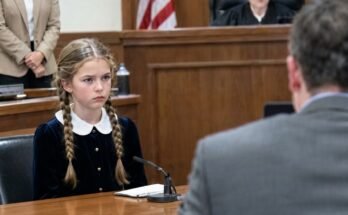
The hearing was yesterday. Crystal wore a gray suit and held Kevin’s arm. She dabbed her dry eyes with a tissue, though I did not see any tears. Tommy was not in the courtroom. Children give their statements privately, which was exactly what Crystal had been counting on.
Their lawyer spoke first. The word “wandering” was used. The park story was told beautifully, with pauses in all the right places. I sat beside Denise and kept my hands folded in my lap.
Then the judge looked at me over her glasses. “Mrs. Whitfield, is there anything you wish to say?”
“No, Your Honor,” I said. “But my grandson does.”
I took out my phone and laid it on the table. Denise leaned toward the microphone.
“Your Honor, this was recorded in Mrs. Whitfield’s kitchen three Sundays ago.”
The judge looked at Denise. “Was the child aware he was being recorded?”
“He was told it was so he could hear how he sounded,” Denise said. “The recording also includes Mrs. Whitfield asking what would happen if he forgot the lines.”
The judge nodded once. “Play it.”
Tommy’s little voice filled the courtroom, folded hands and all. I watched Crystal’s face while her own words came out of her son’s mouth.
“Grandma forgets my name sometimes,” Tommy said. “Grandma left me alone at the park. I feel scared when I sleep at Grandma’s house.”
Crystal’s fingers tightened around the tissue.
Then the recording continued.
“Who taught you those lines, Tommy?” I asked.
“Mommy. It’s a game called Court. She said if I say it perfect to the judge, we get the lake money. What’s the lake money, Grandma?”
No one moved until the recording reached the next question.
“And what does Mommy say happens if you forget the lines?”
Tommy answered, “She practices with me in the car until I cry.”
I heard that last sentence again in the courtroom, and it was harder than hearing it in my kitchen. At home, I had been able to send him to cartoons. There, I had to sit while everyone understood what it meant.
The judge stopped the recording. She looked at Crystal first.
“Is that your son speaking?”
Crystal swallowed. “Yes. But he doesn’t understand what he is saying.”
“That is not my question.”
“Yes, Your Honor.”
The judge turned to Kevin. “Did you sign this petition?”
Kevin’s arm fell away from Crystal’s. “Yes.”
“Did you personally witness the events described in it?”
He looked at the table. “No. Crystal told me.”
Crystal turned toward him. “Kevin.”
He rubbed his forehead. “You said Mom was getting worse. You said Tommy wasn’t safe there.”
“He isn’t safe there,” Crystal said. “You heard him. He said he was scared.”
Denise stood. “Your Honor, the recording shows the statements were supplied to the child. It also gives context for the alleged fear. Mrs. Whitfield has denied the park incident and the claims about forgetting Tommy’s name.”
The judge raised a hand. “I understand.”
She asked Crystal whether there were any other witnesses or records supporting the allegations. Crystal’s lawyer asked for a short break. The judge allowed it, and Denise leaned close to me.
“Do not speak to them during the break,” she said.
“I wasn’t planning to.”
That was not entirely true. I wanted to ask Crystal how she could sit beside her own child and call this protection. I wanted to ask Kevin why the cabin was worth signing his name to a lie. I wanted to ask both of them whether they remembered the height marks in my pantry.
Instead, I drank water and waited.
When the hearing resumed, Crystal’s lawyer said they were no longer asking the court to restrict my time with Tommy based on the allegations in the petition. Denise objected to the wording, and the judge asked them to be precise. After a short exchange, the petition was dismissed.
There was no dramatic speech. The judge did not call anyone a monster. She simply explained that a court could not make a decision about my care of Tommy based on statements the child had been coached to repeat, especially when the adults seeking relief could not support the claims themselves.
She also said Tommy should not be asked to repeat the lines again.
That was the part I needed most.
Outside the courtroom, Kevin caught up with me near the entrance.
“Mom, can we talk?”
Denise stopped, but I nodded.
Kevin looked exhausted. “I didn’t know she was making him practice until he cried.”
“You signed the petition.”
“I know.”
“You signed your name under words about me.”
He stared at the floor. “I thought you were going to give her the cabin.”
Crystal came through the doors behind him. “This isn’t about the cabin.”
I looked at her. “Then why did Tommy say it was?”
She did not answer.
Kevin closed his eyes. “Crystal, stop.”
It was the first time he had said anything to her that sounded like a choice.
I told him I would not discuss the cabin that day. I told him I was not going to punish Tommy for what the adults had put in his mouth. I also told him that trust would not come back because a petition had been dismissed.
“Can I still bring him Sunday?” Kevin asked.
“You can ask him what he wants when he is not being listened to by anyone else. And you can stop asking him to choose sides.”
He nodded. Crystal said nothing.
Tommy came over this afternoon. He walked into the kitchen, looked at the crackers, and asked whether he could use the airplane lamp even though it was still daylight. I told him yes.
He climbed onto the stool and watched me spread peanut butter. After a while, he said, “Grandma, are we still playing Court?”
“No, sweetheart,” I said. “We are done with that game.”
“Did I do something bad?”
I put the knife down and turned toward him. “No. You told me what happened. That was not bad. The grown-ups made a bad choice.”
He considered that. “Can we play cards instead?”
“Yes. But you have to let me win once.”
“You always say that, and then you don’t let me win.”
He was smiling when he said it. I was grateful for the ordinary complaint.
The cabin on Route 9 is still mine. I have not decided what I will do with it, and I will not decide because someone tries to frighten a child into helping them get it. Kevin knows that now. Crystal knows it too.
I am still angry with my son. I am still hurt that he believed a story about me without asking whether it was true. I am not sure how long it will take before he can come into my kitchen without both of us remembering his signature on that petition.
But Tommy slept in the airplane room again tonight. Before he went upstairs, he asked for two more minutes under the covers, even though he was already yawning. I gave him five.