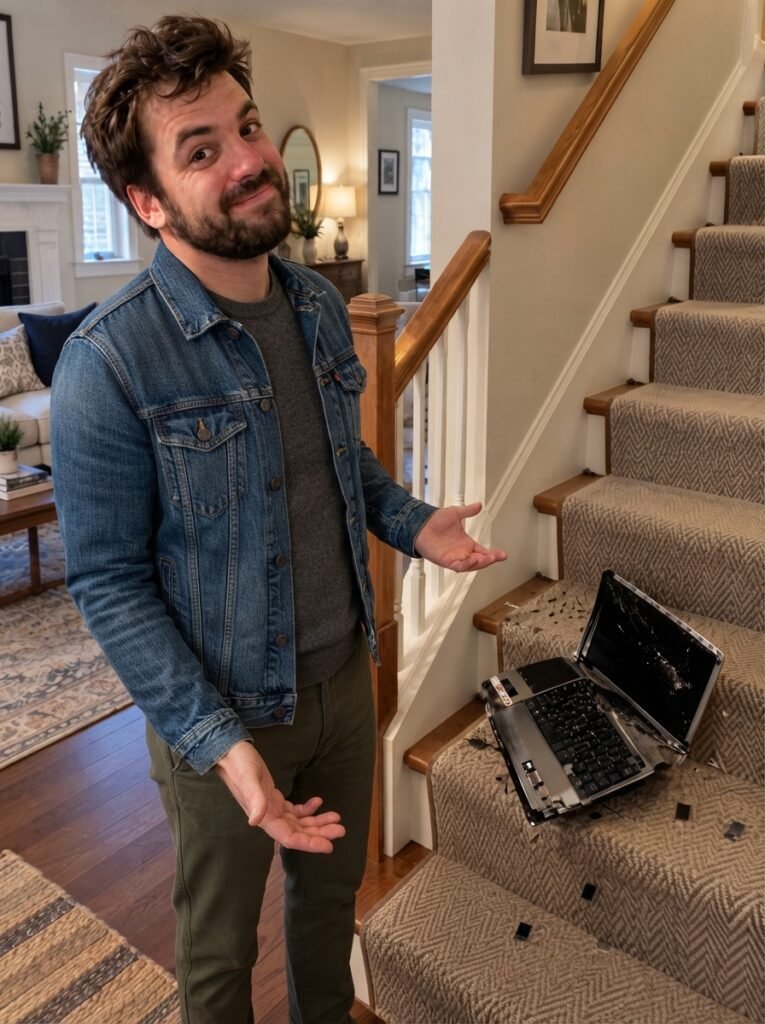
My laptop struck two stairs and landed dead at my feet while Grant stood above me smiling. Years of work might have vanished with it, but our 8-year-old daughter had heard what he said afterward. Then Ellie came downstairs carrying a school project and announced that her father needed to see it too.
For one foolish second, I smiled at my husband.
“Thank you. I almost forgot it.”
Grant stood halfway down the stairs with my laptop open in his hands.
I was already late.
Grant stood halfway down the stairs with my laptop open in his hands.
My adviser expected me on campus at eight, and I’d spent most of the weekend revising two chapters of my biology dissertation. I’d slept four hours, burned one piece of toast, packed Ellie’s lunch twice because I forgot I’d already done it, and left my laptop upstairs.
Grant had found it.
I’d spent most of the weekend revising two chapters of my biology dissertation.
I reached for the railing.
Then he stumbled.
At least, that was what it was supposed to look like.
The laptop left his hands, struck one stair, bounced against another and landed screen-down at my feet.
“Grant!”
I dropped beside it.
The laptop left his hands, struck one stair, bounced against another and landed screen-down at my feet.
The hinge was bent. One corner had split open.
I pressed the power button.
Nothing.
Again.
Nothing.
My Friday draft was safe, but none of the weekend corrections were backed up. I’d planned to do that before leaving that morning.
The hinge was bent. One corner had split open.
“Please.”
I pressed the button again.
Grant came down the remaining stairs.
I looked up.
He was smiling.
Not nervously.
Not like someone who’d just made an expensive mistake.
He was smiling.
“You did that on purpose.”
He shrugged.
“Maybe now you’ll stop wasting everybody’s time.”
I stared at him.
“What?”
“Women aren’t supposed to be smart, Rachel. Go make me some breakfast.”
“Maybe now you’ll stop wasting everybody’s time.”
Then he walked past me toward the kitchen.
I sat on the bottom step with the broken laptop across my knees.
Nine years earlier, I’d left graduate school after finding out I was pregnant.
I told myself it was temporary.
Nine years earlier, I’d left graduate school after finding out I was pregnant.
Grant agreed.
“After the baby,” he’d promised.
Then Ellie was born, and temporary stretched.
There were feedings, laundry, doctor’s appointments, daycare waiting lists, grocery runs, and the kind of exhaustion that made reading a scientific paper feel like decoding a foreign language underwater.
Then Ellie was born, and temporary stretched.
Grant told me there was no rush.
“Our daughter needs a mother.”
When Ellie started school, I went back.
By then, Grant had changed his opinion.
“Women in labs can play scientist all they want. Ellie needs you here.”
So I made sure I was there.
“Our daughter needs a mother.”
I studied after Ellie went to bed.
I wrote at the little desk upstairs.
Meetings were scheduled strictly during school hours.
Dinner was cooked and cleared before the laptop ever opened.
I tried to make earning a doctorate so invisible that nobody could accuse it of taking anything from them.
Dinner was cooked and cleared before the laptop ever opened.
Grant still complained.
And now my computer was broken at my feet.
“Mommy?”
I wiped my face quickly.
Ellie stood near the top of the stairs in her pajamas.
She was holding a rolled piece of poster board.
“I’m okay, sweetheart.”
She was holding a rolled piece of poster board.
She came down.
“Why are you crying?”
“I’m just having a bad morning.”
She saw the laptop.
“Dad broke it?”
From the kitchen, a cabinet door closed.
“I’ll handle it, baby,” I said.
“I’m just having a bad morning.”
Ellie stopped in front of me.
“You need to look at this.”
“I’m a little busy right now, sweetheart. I’m sorry.”
“No, Mommy.” She unrolled the poster. “You need to see it now. It’s important.”
At the top, in huge blue letters, she’d written:
WHEN I GROW UP, I WANT TO BE LIKE MY MOM
“You need to look at this.”
I forgot about the laptop for a second.
There was a photograph of me in the center, one Ellie must have taken from the box in my desk.
Around it she’d drawn green circles that looked vaguely like cells.
Underneath were four sentences in her careful handwriting.
There was a photograph of me in the center.
She studies cells.
She works really hard.
She helps me when I don’t understand stuff.
She says questions make you smarter.
I read them twice.
“You made this?”
“It’s my hero project.”
She says questions make you smarter.
“For school?”
She nodded.
“It’s supposed to be a surprise.”
That explained why I’d heard so much whispering between Ellie and her teacher at pickup Friday.
I touched the corner of the poster.
“It’s beautiful, sweetheart.”
“It’s supposed to be a surprise.”
She smiled.
“I used the picture where you look like a scientist.”
Despite everything, I laughed.
“I am a scientist.”
She pointed to the bottom of the poster.
One section was blank.
“I used the picture where you look like a scientist.”
The printed prompt said:
WHAT SHOULD YOUR HERO DO WHEN SOMEONE SAYS THEY CAN’T DO SOMETHING?
“I didn’t know what to write, Mommy.”
“We can think about it tonight.”
Ellie shook her head.
“I know now.”
“I didn’t know what to write, Mommy.”
She lowered her voice.
“And Daddy needs to see it too.”
Before I could stop her, she marched into the kitchen.
I followed with the damaged laptop.
Grant was putting bread in the toaster.
“What’s that?” he asked.
“My hero project.”
“And Daddy needs to see it too.”
Ellie held it up.
Grant read the title.
The words wiped the smile from his face.
“You picked your mother?”
“Yes.”
He looked at me.
“Did you help her make this?”
“I didn’t know it existed.”
“You picked your mother?”
“Mrs. Palmer said it had to be a surprise,” Ellie explained.
Grant glanced over the poster.
“That’s nice, honey.”
“I need help with the last part, Daddy.”
“I’m getting ready for work.”
“I need help with the last part, Daddy.”
“But you know the answer.”
Grant paused.
Ellie read the prompt aloud.
“What should your hero do when someone says they can’t do something?”
Grant looked at me.
Then at Ellie.
“She shouldn’t listen to them,” he said.
“What should your hero do when someone says they can’t do something?”
Ellie nodded thoughtfully.
“Even if it’s Dad?”
“What?”
“You said girls aren’t supposed to be smart.”
Grant’s hand stopped above the toaster.
“That was a joke.”
Ellie looked at me.
“Mom was crying.”
“You said girls aren’t supposed to be smart.”
“Adults joke differently.”
Ellie considered this.
“Then I don’t get it.”
Neither did Grant, apparently.
He pulled his coffee mug from the cabinet.
“Just write that you shouldn’t listen when people tell you that you can’t do something.”
“Adults joke differently.”
Ellie sat at the kitchen table.
She printed slowly beneath the prompt:
DON’T LISTEN. KEEP TRYING.
Grant watched every letter appear.
Then he looked at me.
I said nothing.
“Ellie, go get your shoes.”
DON’T LISTEN. KEEP TRYING.
She kept writing.
“Ellie.”
She looked up at me.
“Do I ignore him now?”
Grant’s head snapped toward her.
“No, sweetheart,” I said. “Go get your shoes.”
“Okay.”
“Do I ignore him now?”
She capped her marker and ran upstairs.
Grant waited until she was gone.
“You think that’s funny?” he snapped.
“No.”
“You’ve been filling her head with this stuff.”
“She made the poster without me.”
“She’s eight.”
“You think that’s funny?”
“Exactly.” I picked up the broken laptop. “She heard you.”
Grant grabbed his keys.
“You always make everything bigger than it is.”
Grant wasn’t dismissing my degree. He was practical.
“She heard you.”
I wasn’t exhausted. I needed better time management.
And if I ever considered leaving, there was Ellie.
That morning, standing beneath a poster declaring me her hero, I wondered what exactly I thought I had been protecting her from.
I needed better time management.
I dropped Ellie at school.
Before she got out, she carefully flattened the poster across her knees.
“Mom?”
“Yeah?”
“Are you still going to school?”
She carefully flattened the poster across her knees.
I looked at the damaged laptop on the passenger floor.
“Yes, baby.”
“Okay.”
That was all she needed.
At the university, I carried the laptop straight to my adviser’s office.
That was all she needed.
She took one look at it.
“What happened?”
Normally, I would’ve softened the answer.
An accident at home.
A bad morning.
Computer trouble.
Normally, I would’ve softened the answer.
Instead I said, “My husband broke it because he wanted me to stop.”
She stared at me.
“On purpose?”
“Yes.”
It was strange hearing myself say it without protecting him.
We spent the next hour figuring out what remained.
“My husband broke it because he wanted me to stop.”
The Friday version was safe.
Several files were on the university server.
A technician thought he might recover more from the drive.
But my weekend revisions were gone.
Two days of work.
Not nine years.
My weekend revisions were gone.
My adviser pulled up the Friday draft.
“We can rebuild the edits.”
I looked at the pages.
“We?”
“I’m not rewriting your dissertation for you.”
For the first time that day, I smiled.
“We can rebuild the edits.”
Then she asked, “Do you still want to?”
I thought of Ellie’s poster.
DON’T LISTEN. KEEP TRYING.
“Yes.”
I worked until school pickup.
That evening, I borrowed a university laptop and set it on the dining table.
“Do you still want to?”
For years, I’d kept my studying upstairs after everyone went to bed.
Not that night.
Ellie did math homework beside me.
Grant came home at six.
He saw the computer.
“Seriously?”
He saw the computer.
“I have to redo what I lost,” I said.
He dropped his work bag onto a chair.
Then he pulled out a binder and set it beside my laptop.
“I need you to check something.”
I looked at the cover.
“I need you to check something.”
It was the certification course Grant had been taking for work.
For months, I’d helped him through the statistics sections.
He hated charts.
He hated formulas.
He’d sit beside me after dinner and say, “You understand this stuff. Just show me.”
He hated charts.
I’d taken those evenings as proof that, underneath everything he said, he respected what I could do.
Now I wondered if I’d misunderstood.
“I need this checked before tomorrow,” he said.
“No.”
Grant stared at me.
“What?”
“I have to redo my corrections.”
I wondered if I’d misunderstood.
“This will take you twenty minutes.”
“Then you can do it.”
“Rachel, this matters for my job.”
I looked at his binder beside my borrowed laptop.
His studying mattered because it belonged to his future. Mine was something I was supposed to squeeze around breakfast.
“Rachel, this matters for my job.”
“Then you should study.”
His voice sharpened.
“You know I’m terrible at those charts.”
Ellie looked up from her worksheet.
“Mom’s good at charts.”
“Then you should study.”
Grant answered without thinking.
“I know.”
Ellie stopped erasing.
She looked at him.
“But you said girls aren’t supposed to be smart.”
Grant shut his eyes.
“Ellie…”
“But you said girls aren’t supposed to be smart.”
She pointed at his binder.
“Mom has to be smart to help you.”
“Go finish your homework.”
“But which one is it?”
“Enough.”
Ellie flinched.
I closed my laptop.
“Don’t yell at her.”
“Mom has to be smart to help you.”
“Then stop involving her in our problems.”
I looked at my daughter.
At the pencil she’d stopped moving.
At the way she was watching both of us now.
I had stayed because I didn’t want to put Ellie in the middle of a broken home.
“Then stop involving her in our problems.”
She was already there.
“I didn’t involve her,” I said. “She was already involved. I just kept telling myself she wasn’t.”
Grant laughed once.
“So what now? You’re going to blow up our family over a computer?”
I looked at the borrowed laptop.
Then at his binder.
“You’re going to blow up our family over a computer?”
“The laptop is just the first thing you broke that made noise.”
He stared at me.
I didn’t add anything.
I called my sister.
That night, Ellie and I packed enough for a few days.
“You’re actually leaving?”
“The laptop is just the first thing you broke that made noise.”
“For now.”
“Because I dropped a laptop?”
“You didn’t drop it.”
“You can’t prove that.”
I zipped my bag.
“I don’t need to prove it to you. You were there.”
“You didn’t drop it.”
He stood in the doorway.
“What about Ellie?”
I stopped.
That question would have worked yesterday.
Maybe that was why he asked it.
I walked downstairs.
“What about Ellie?”
Ellie waited beside her backpack, still holding her hero poster.
“Is Dad mad about your school stuff?” she asked.
I crouched in front of her.
“Dad is responsible for what he said. You don’t have to fix it.”
“Is Dad mad about your school stuff?”
She looked toward the stairs.
Then back at me.
“Are you still doing your science book?”
“Yes.”
“At Auntie’s?”
“At Auntie’s.”
She nodded.
“Okay.”
“Are you still doing your science book?”
Two days later, I sat at my sister’s dining table rebuilding a section I’d already written once.
Ellie colored beside me.
Her hero poster lay facedown between us because she’d brought it home from school.
I noticed another drawing on the back.
Ellie colored beside me.
Two stick figures in white coats.
Two tables.
Two computers.
I pointed.
“What’s this?”
“My job.”
“Why are there two desks?”
Ellie kept coloring.
“One’s yours.”
“What’s this?”
I looked at the borrowed laptop in front of me.
Then at Ellie’s crayons spreading across the other half of the table.
For years, I’d tried to make my work take up no room.
I moved her pencil cup six inches to the side.
Then I opened my dissertation again.
For years, I’d tried to make my work take up no room.
Grant called that evening.
“I need that certification finished.”
“Then finish it.”
“Rachel…”
“It’s your homework.”
I hung up.
Ellie looked over from her drawing.
“Like mine is mine?”
“Exactly.”
“It’s your homework.”
She went back to coloring.
I went back to my dissertation.
An hour later, I finally reconstructed the section I’d lost.
Not perfectly.
Not yet.
But the words were mine again.
I finally reconstructed the section I’d lost.
Ellie leaned across the table.
“Did you finish?”
“That part… yes.”
“Good.”
She turned her poster over and studied the two desks she’d drawn.
“Did you finish?”
Then she pushed her crayons aside.
“You need more room, Mom.”
Before I could answer, she gathered her pencils into one cup and moved her homework to the other end of the table.
I pulled the laptop closer.
“You need more room, Mom.”