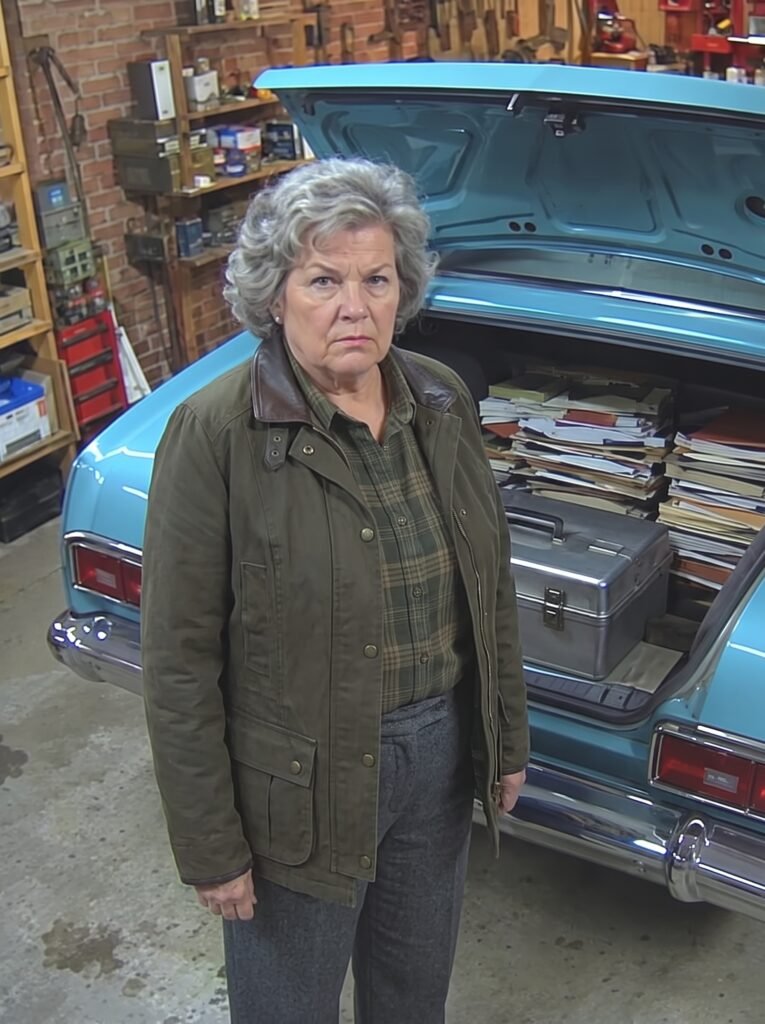
The trunk was lined with a thick moving blanket, and beneath it sat three sealed metal boxes, the kind you’d buy for fireproof document storage, along with a manila envelope thick enough to hold what looked like a hundred pages.
My hands trembled as I lifted the first box out and set it on the concrete floor of the storage unit. It wasn’t locked — Robert had left it deliberately open for me, the latch simply resting closed. Inside were deeds. Property deeds, at least a dozen of them, for parcels of land I’d never heard mentioned in twenty-seven years of marriage. Wyoming. Montana. A commercial lot in Austin that, based on the purchase date scrawled in Robert’s handwriting, he’d bought nearly fifteen years earlier.
The second box held stock certificates — old-fashioned paper ones, the kind companies rarely issue anymore, for a private holding company I didn’t recognize by name, alongside a folder of shareholder statements showing values that made my knees weak enough that I had to sit down on the concrete beside the car.
The third box held cash. Not an obscene amount, but enough — bundled hundred-dollar bills, neatly wrapped, totaling what I’d later count as just over forty thousand dollars.
I opened the manila envelope last, my hands shaking so badly I nearly tore the letter inside.
Ellie,
By now you’ve found the boxes, and I imagine you’re sitting somewhere trying to make sense of it, wondering how the man everyone believes died six million dollars in debt somehow left you a trunk full of assets worth considerably more than that. Let me explain, because you deserve the truth, all of it, even the parts I should have told you years ago.
The debt is real. The logistics company really is drowning, has been for three years, and when I go, that debt goes with the company — it’s structured as an LLC, Ellie, separate from us personally, separate from everything in this trunk. The creditors can chase the company into bankruptcy. They cannot touch what’s in these boxes, because none of it was ever legally connected to Hale Logistics. I made certain of that a long time ago, back when I first started noticing the signs of what was coming.
I started building this — call it a lifeboat, though I hate the word — almost fifteen years ago, not long after Mark graduated college and started asking me, more and more directly, what he stood to inherit. I want you to understand something painful, Ellie, because I think some part of you already suspects it. Our sons have not been the men we raised them to be for a long time. I watched it happen slowly. The way Mark started calculating my worth instead of asking about my health. The way Lucas stopped visiting unless there was a birthday or holiday attached to a gift he expected. I told myself it was a phase. It was not a phase.
Three years ago, I overheard Mark on the phone with Lucas, thinking I was upstairs and out of earshot. He was discussing, quite calmly, how long I “realistically” had left, and what portion of the estate he expected once I was gone. He used the word “estate,” Ellie, like I was already a line item in a spreadsheet. That was the day I called my lawyer and started making sure that whatever debt eventually swallowed the company would not touch what was actually meant for you.
I let the debt become public, let it become the story everyone believed, on purpose. I wanted to see who would stay if they thought there was nothing left to gain. I suspect, given that you’re reading this alone, that you already know the answer.
This is yours, Ellie. All of it. Deeds, stock, cash — it’s all been legally separated from the company for over a decade, structured through a trust my lawyer, Daniel Wren, can walk you through whenever you’re ready. His number is on the back of this letter.
I am sorrier than I know how to say that I let you sit through a funeral believing you’d been left with nothing but debt and two sons who couldn’t be bothered to show up. That was never true. You have never had nothing, Ellie. You have simply, finally, been given the chance to see clearly who has actually loved you all along — and who was only ever loving what they thought you and I could give them.
I love you. I always did, every day, even on the days I was too consumed with protecting this secret to say it properly.
—Robert
I sat on the cold concrete floor of that storage unit for a long time after I finished reading, the letter trembling in my hands, tears falling onto pages that already carried the weight of fifteen years of careful, quiet protection.
Robert hadn’t died leaving me with nothing. He’d died leaving me with everything that actually mattered — a fortune our sons knew nothing about, and the bitter, clarifying knowledge of exactly what kind of men they’d become while I wasn’t looking closely enough to notice.
I thought of Mark’s voice on the phone the night before the funeral. We don’t have time to attend a poor man’s funeral.
I wiped my eyes, folded the letter carefully back into its envelope, and began loading the boxes into my car.
Whatever came next, I intended to face it with my eyes open — and for the first time since Robert’s death, I no longer felt alone in the world he’d left behind for me.
Daniel Wren’s office sat on the fourteenth floor of a glass building downtown, and when I called him the following morning, he answered on the second ring, as though he’d been waiting for my call for longer than I realized.
“Mrs. Hale,” he said, his voice carrying a warmth I hadn’t expected from a man I’d never met. “I was wondering when I’d hear from you. Robert asked me to give you whatever time you needed before reaching out. I’m glad you found the letter.”
“You knew,” I said. “This whole time. You knew what was in that trunk.”
“I drafted the trust myself, twelve years ago,” he confirmed. “Robert was very particular about the structure. He wanted it airtight, completely separate from the company, completely protected from creditors, and completely private until he was gone.” A pause. “He also wanted it kept from your sons. Those were his exact instructions, Mrs. Hale, and I want you to understand I pushed back on that, more than once, over the years. I told him it seemed harsh.”
“What did he say?”
“He said harsh was watching your children calculate your death like a business transaction, and that he wasn’t going to reward that kind of harshness with early inheritance.”
I sat in my car outside the storage facility, the trunk full of boxes still beside me, and felt something in my chest tighten at hearing, secondhand, just how clearly Robert had seen what I’d spent years refusing to fully acknowledge.
“I need you to walk me through everything,” I said. “All of it. The trust, the assets, what happens next.”
“I can do better than that,” Daniel said. “Come to my office this afternoon. Bring the letter. There’s actually one more piece Robert wanted you to have, something I’ve been keeping in my safe for exactly this conversation.”
The “one more piece” turned out to be a video, recorded on Daniel’s office computer eighteen months before Robert’s death, back when the stroke that killed him was still an unknown, unscheduled tragedy waiting somewhere in the future.
Robert appeared on the screen looking healthier than I’d seen him in his final year, sitting in this same office, addressing the camera with the same steady calm he’d carried through every crisis in our marriage.
“Ellie, if you’re watching this, I’m gone, and Daniel has walked you through the trust. I wanted you to hear this part directly from me, not just read it in a letter, because I think some things land differently in a voice than they do on paper.”
He leaned forward slightly, his expression softening.
“I know this is going to hurt you. Learning what our sons really are — it’s going to hurt worse than my death did, I suspect, because losing me is losing something you already knew you had. Losing the version of Mark and Lucas you thought you raised, that’s a different kind of grief. I’m sorry I couldn’t protect you from that part.”
“But I need you to hear this clearly: what’s in that trust isn’t just money. It’s a chance for you to finally live a life that isn’t built around managing everyone else’s expectations of you. You spent twenty-seven years managing mine, managing the boys’, managing the company’s reputation whenever things got difficult. I watched you shrink a little more every year, Ellie, and I never said anything, because I didn’t know how, and because some selfish part of me liked having you there, steady and constant, managing everything so I didn’t have to.”
“That ends now. Whatever you do with what’s in that trunk — travel, invest, give it all away, buy a house on a beach somewhere and never think about logistics or debt or difficult sons again — I want you to do it for yourself. Not for anyone else. You’ve earned that, more than anyone I’ve ever known.”
The recording ended there, the screen going dark, and I sat in Daniel Wren’s office with tears streaming silently down my face, mourning my husband properly for what felt like the first time since his death — not the funeral kind of mourning, performed and public, but the real kind, private and raw and finally, fully honest.
Mark called four days later. I hadn’t told him about the trust. I hadn’t told either of my sons anything since Robert’s funeral, content to let the silence between us stretch as long as it needed to.
“Mom,” Mark said, his voice carrying a warmth that hadn’t been present in his voice in years, not since he was a teenager asking me for help with homework instead of calculating inheritance timelines with his brother over the phone. “I’ve been thinking about everything. About Dad. About how things ended. I feel terrible about the funeral, honestly. I think Lucas and I panicked when we heard about the debt, and we handled it badly. Really badly.”
“You didn’t attend your father’s funeral,” I said quietly. “There’s no version of ‘handled it badly’ that covers that.”
“I know,” he said quickly. “I know, Mom, and I’m sorry. I really am. I’ve been thinking, maybe we could all get together. Talk things through. Figure out how to move forward as a family.”
I sat with the phone against my ear, thinking of Robert’s voice on that recording, of the letter that had described, in painful detail, exactly this kind of call — the recalibration once someone suspected there might, after all, be something left to gain.
“How did you hear about the trust, Mark?” I asked.
There was a pause, just long enough to answer the question before he even tried to.
“I don’t know what you’re talking about,” he said, but the words came too fast, too rehearsed.
“Daniel Wren’s assistant mentioned someone from the family called his office yesterday asking about your father’s estate,” I said, which was true — Daniel had told me himself, warning me this call might be coming. “That would have to be you or your brother, since I certainly didn’t make that call.”
The silence on the line stretched long enough that I had my answer before Mark finally spoke again, his voice losing all pretense of warmth.
“Fine. Yes. We heard there might be more to the estate than the company debt. Look, Mom, can you blame us for wanting to know the full picture before deciding whether to reconcile? That seems reasonable to me.”
“Reconcile,” I repeated slowly. “Is that what you’d call it. Reconciling.”
“Mom—”
“Your father left you both a letter as well,” I said, cutting him off, my voice steadier than I expected. “Daniel has it in his office. He’ll release it to you whenever you’re ready to hear what your father actually thought of the two of you, in his own words, written before he died. I think you should read it before you call me again.”
I hung up before Mark could respond, sitting in my kitchen — Robert’s kitchen, our kitchen, now simply mine — and felt, for the first time since the funeral, something that resembled genuine peace instead of grief.
Mark and Lucas showed up at Daniel Wren’s office together three days later, and Daniel called to tell me they’d requested to see their father’s letter — the one written specifically for them, sealed separately from mine, sitting in the same trust documents that had been waiting for exactly this moment.
“Do you want to be there when they read it?” Daniel asked.
I thought about it for a long moment, staring out my kitchen window at the garden Robert had never quite finished planting, the one I’d started tending myself in the weeks since his death, slowly bringing it back to life with hands that had spent twenty-seven years managing other people’s needs instead of anything truly her own.
“No,” I said finally. “I think this is between them and their father. I’ve had my letter. They deserve theirs, without me standing there deciding how to feel about it for them.”
I learned what the letter said secondhand, weeks later, when Lucas finally called — not to ask for anything, for the first time in longer than I could remember, but simply to talk.
“He wrote that he loved us,” Lucas said, his voice rough in a way I hadn’t heard since he was a boy, crying over a scraped knee before he learned that vulnerability wasn’t something our family particularly rewarded. “That he was proud of us once, a long time ago, before we became people who called our own mother’s grief ‘the poor man’s funeral.'” A long pause. “He wrote that he hoped, someday, we’d become men worth what he’d tried to teach us, but that he wasn’t going to bankroll the wait. That some inheritances have to be earned in character before they’re deserved in money.”
“How are you feeling about all of it?” I asked, careful, unsure yet how much honesty this new version of my son could hold.
“Ashamed,” Lucas admitted. “Really ashamed, Mom. I keep thinking about that phone call. About what you must have felt hearing us say that, the night before we buried him. I don’t know how to undo that.”
“You can’t undo it,” I said honestly. “I’m not going to pretend otherwise, Lucas. What’s said can’t be unsaid, and what wasn’t done — showing up, being there — can’t retroactively be done either. But you can decide, from here forward, what kind of relationship we actually build, if any. That part is still unwritten.”
It took the better part of a year to understand what “unwritten” actually meant for my family. Mark, I eventually realized, was not interested in the slow, uncomfortable work of genuine repair — his calls grew less frequent once it became clear the trust money wasn’t going to arrive through simple reconciliation, and eventually stopped altogether, the way people do when a relationship no longer serves the purpose they’d hoped it might.
Lucas was different. He started small — a weekly phone call that had nothing to do with money, asking about my garden, about how I was sleeping, about whether I’d finally gotten around to reading the novel Robert had left half-finished on his nightstand. He drove up for a weekend three months after that first honest conversation, and we sat on the back porch together, not discussing the trust at all, just existing in each other’s company the way we used to before ambition and entitlement had quietly, gradually replaced whatever closeness we’d once shared.
It wasn’t the reconciliation Mark had originally proposed — quick, transactional, aimed at access rather than repair. It was slower, harder, genuinely uncertain in a way that made it feel real for the first time in years.
I used the trust the way Robert had hoped I would — not extravagantly, not carelessly, but deliberately, in service of a life that finally belonged entirely to me. I sold the commercial lot in Austin and used part of the proceeds to fund a scholarship in Robert’s name at the local community college, for students studying logistics and supply chain management, the field he’d loved even as it eventually broke him. I kept the land in Montana, visiting it that first summer alone, standing in a field of wildflowers Robert had apparently purchased fifteen years earlier for no reason except, as his letter had put it, wanting somewhere beautiful waiting for me whenever I finally needed it.
I traveled, finally, to places Robert and I had always talked about and never found time for — Portugal in the spring, Japan in autumn, the kind of trips that had once felt impossibly indulgent and now simply felt like living.
Two years after his death, I stood at his grave on the anniversary, no longer alone the way I’d been at his funeral — Lucas beside me, his own daughter, four years old now, holding my hand and asking careful, curious questions about the grandfather she’d never met.
“He sounds like he was really smart,” she said, looking at the headstone with the particular seriousness only small children manage.
“He was,” I said. “He saw things other people missed. Even the hard things. Especially the hard things.”
Lucas squeezed my shoulder, and I felt, for the first time since that terrible, empty morning in the chapel, that the story Robert had left behind wasn’t really about debt, or betrayal, or even the sons who’d failed him in his final year.
It was about a man who’d spent fifteen quiet years protecting the one person who’d never once calculated what she stood to gain from loving him — and who had, in his own careful, deliberate way, made absolutely certain that love was the last thing standing, long after everything else had fallen away.
THE END