I told him my phone was broken.
That was a lie.
I was ashamed to say the truth.
He handed me his phone, and I called the bank.
After answering several security questions, I asked for my current balance.
The woman on the other end paused.
“Mr. Hayes, which account are you referring to?”
“My checking account.”
“There are two checking accounts associated with your profile.”
My stomach tightened.
“I only have one.”
There was another pause.
Then she explained that my monthly pension deposits had been redirected.
Three thousand five hundred dollars every month.
A new account had been opened.
Javier had authority over it.
Large withdrawals had been made.
Thousands.
Then thousands more.
Charges at restaurants.
Designer stores.
Electronics.
Liquor stores.
A down payment on a used pickup truck.
Cash withdrawals I had never authorized.
I gripped Mr. Kowalski’s kitchen counter.
“How much is gone?”
The bank employee hesitated.
That hesitation told me more than the number.
When she finally gave it to me, I felt physically sick.
It was not simply my pension.
Money had been transferred out of savings as well.
Money Elena and I had built together over decades.
Money meant for property taxes.
Medical bills.
Emergencies.
Money I had promised myself would never become a burden on my children.
By the time I walked home, anger had replaced shock.
Javier was sitting in my living room when he returned that evening.
My television was mounted on the wall behind him.
Except it was not my television anymore.
He had replaced my modest old set with an enormous seventy-five-inch screen bought with my money.
I stood in front of him.
“You’re stealing from me.”
Gabriela froze near the kitchen.
Javier slowly lowered his drink.
“What did you say?”
“I called the bank.”
His eyes changed.
That was the first time I saw the real man underneath the helpful son-in-law.
I stepped closer.
“You redirected my pension. You opened accounts using that power of attorney. You took money from my savings.”
Javier stood.
He was nearly twenty years younger than me and several inches taller.
“That money is paying household expenses.”
“Steakhouses are household expenses?”
“Watch yourself.”
“That pickup truck outside is a household expense?”
His jaw tightened.
I pointed toward the door.
“Pack your things. Both of you. You leave tonight.”
Gabriela whispered, “Dad…”
Javier moved before I saw it coming.
He grabbed my shirt near the collar and slammed me backward into the hallway wall.
Pain exploded through my shoulder.
My head struck the drywall.
For several seconds, the room spun.
Javier pressed his forearm against my chest.
“Listen to me, old man.”
I could smell whiskey on his breath.
“You signed documents giving me control.”
“Not ownership.”
“You think anyone cares about the difference?”
My heart was pounding.
He leaned closer.
“With that power of attorney and the right doctor, I can prove you can’t manage your affairs anymore.”
I stared at him.
“A nursing home costs a lot less than letting you sit here wasting money.”
Then he smiled.
“This house will be mine once they declare you incapable.”
Gabriela heard every word.
She stood less than ten feet away.
She saw my torn shirt.
She saw the red mark forming across my shoulder.
She saw the fear in my face.
I looked directly at my daughter.
“Gabriela.”
She lowered her eyes.
And walked into the kitchen.
That hurt more than being slammed into the wall.
For the next two weeks, Javier took complete control.
The locks were changed.
The landline disappeared.
Mail went directly into a locked box he kept in their bedroom.
He started introducing himself to people as my “financial caretaker.”
When a neighbor asked why I had stopped attending Sunday breakfast at the firehouse, Javier answered before I could.
“Robert’s memory is getting worse.”
He repeated the lie constantly.
To Gabriela.
To neighbors.
To a delivery driver.
Even to me.
“You forgot.”
“You’re confused.”
“That never happened.”
“You’re imagining things.”
At first I argued.
Then I started doubting myself.
That is the part people do not understand about being trapped by someone who controls everything around you.
The abuse is not always a punch.
Sometimes it is hearing the same lie so often that you begin wondering whether your own memory can still be trusted.
Then Javier found out I had spoken to Mr. Kowalski.
That was when the garage became my prison.
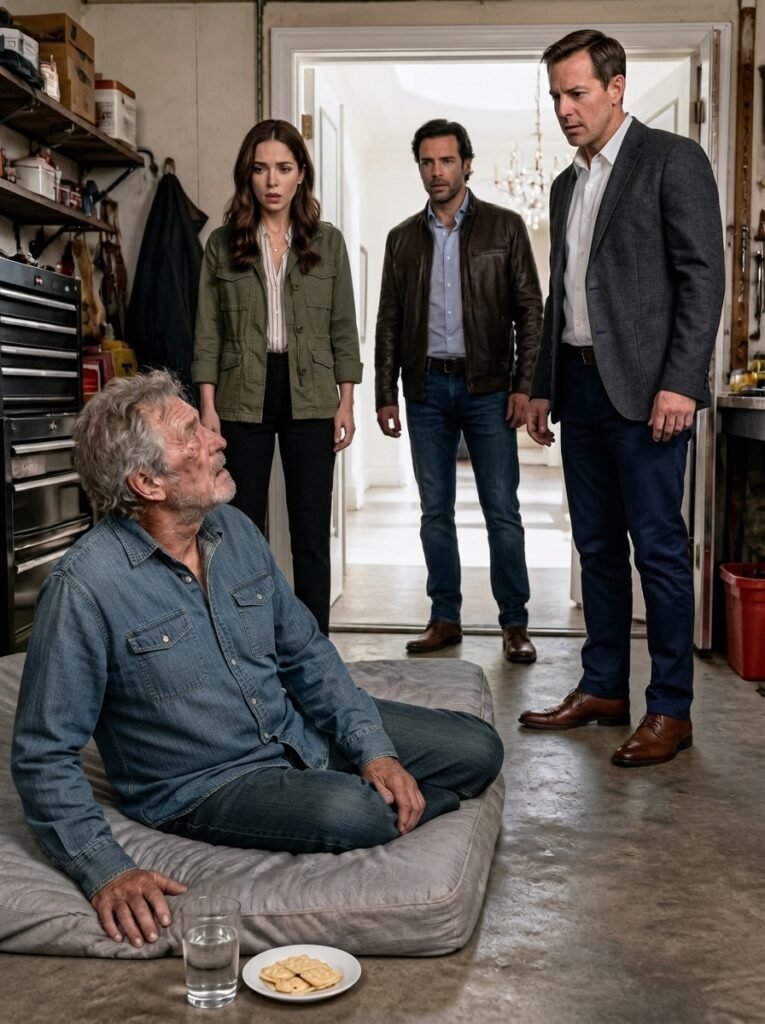
He dragged the mattress from a guest bedroom and dropped it onto the concrete.
“You want to behave like an ungrateful child? You can live like one.”
Gabriela stood by the laundry room.
“Javier, maybe this is too much.”
He turned toward her.
“Whose side are you on?”
She immediately became silent.
He took my house key.
He locked the interior garage door.
He left the side door bolted from outside.
Sometimes he allowed me into the house to shower.
Sometimes he did not.
Food became another weapon.
If I complained, dinner disappeared.
If I asked about my pension, I received crackers.
Once, after I told him Daniel would discover what he was doing, Javier grabbed my arm and twisted it behind my back.
“Daniel barely visits.”
“That doesn’t mean he won’t come.”
“He has a wife. Children. A career. He has his own life.”
Then he whispered something I still remember perfectly.
“You could disappear into a nursing facility tomorrow, and your son wouldn’t know until Christmas.”
Two days later, Daniel showed up.
Unannounced.
He lived almost three hours away in Wisconsin and usually called before visiting.
That afternoon, he did not.
He later told me he had been trying to reach me for nearly two weeks.
My phone went straight to voicemail.
Gabriela kept texting excuses.
Dad is sleeping.
Dad isn’t feeling social.
Dad’s memory is getting worse.
Finally, Daniel decided something was wrong.
He drove down without telling anyone.
When he reached the house, the front door was locked.
He heard voices near the garage.
Then he heard Javier.
“Your pension is mine now, Robert!”
Daniel had pulled out his phone almost instinctively.
He pressed record before entering.
That decision changed everything.
When he stepped inside and saw me, his first instinct was rage.
I knew my son.
I saw it in his face.
He wanted to hit Javier.
Instead, something colder replaced the anger.
He crouched beside me.
“Dad, listen to me.”
I could barely speak.
Daniel leaned close enough that only I could hear him.
“Don’t say anything yet.”
I frowned.
His hand tightened around his phone.
“I recorded him.”
My heart stopped.
Behind Daniel, Javier suddenly appeared.
“What the hell are you doing here?”
Daniel stood.
For half a second, I expected him to explode.
Instead, he smiled.
That frightened Javier more.
“I came to check on Dad.”
“He’s fine.”
Daniel looked at the mattress.
“Sure looks fine.”
“He’s been confused lately. Aggressive too. We’ve been trying to help him.”
Daniel glanced at me.
Then at Javier.
“Is that what happened to his face?”
“He fell.”
I almost laughed.
Javier continued without hesitation.
“He’s becoming unstable.”
Daniel nodded slowly.
“So you’re managing his finances?”
“Somebody has to.”
“And his pension?”
Javier crossed his arms.
“That’s family business.”
Daniel lifted his eyebrows.
“I’m family.”
Javier made the mistake of becoming arrogant.
He always became careless when he thought he had won.
“Your father signed the documents, Daniel. Legally, I control what needs controlling.”
Daniel looked at the garage around us.
“Does that include locking him in here?”
Gabriela appeared behind her husband.
Her face went pale when she saw her brother.
“Daniel…”
He looked at her.
For several seconds, neither spoke.
Then Daniel said, “You knew?”
Tears filled her eyes.
She opened her mouth.
Nothing came out.
That was answer enough.
Daniel turned back to Javier.
“What exactly are you planning to do?”
“Nothing that concerns you.”
“You just said Dad is unstable.”
“He is.”
“So what happens next?”
Javier shrugged.
And then, incredibly, he confessed.
Not because Daniel forced him.
Because Javier wanted to brag.
“We get him evaluated. Once a doctor agrees he can’t manage himself, Gabriela petitions for guardianship. The money gets protected. The house stays in the family.”
Daniel stared at him.
“You mean your family.”
Javier smirked.
“Call it whatever you want.”
“And if Dad refuses?”
Javier looked directly at me.
“He won’t have much choice.”
Daniel’s phone was still recording inside his shirt pocket.
Every word.
Every threat.
Every lie.
Then Daniel said something I did not expect.
“Okay.”
I stared at him.
Javier blinked.
“Okay?”
Daniel nodded.
“Dad obviously needs help. Maybe you’re right.”
The betrayal hit me so hard that for a moment I forgot about the recording.
Then Daniel looked at me.
Just once.
A tiny movement of his eyes.
Wait.
That was what he was telling me.
So I waited.
Daniel left twenty minutes later.
Javier laughed after his car disappeared.
“See?”
He looked down at me.
“Even your own son knows you’re finished.”
What Javier did not know was that Daniel had driven only three blocks.
He parked outside Mr. Kowalski’s house.
From there, he made four phone calls.
The first was to the police.
The second was to an attorney specializing in elder abuse and financial exploitation.
The third was to my bank’s fraud department.
The fourth was to one of my oldest friends, retired Battalion Chief Michael Donnelly.
By six o’clock that evening, people were moving faster than Javier could have imagined.
But Daniel still did not return.
He wanted evidence before confrontation.
Not accusations.
Not emotion.
Evidence.
The next morning, two police officers arrived.
Javier immediately switched personalities.
He was calm.
Concerned.
Helpful.
“My father-in-law has been experiencing confusion,” he explained. “We’re worried about dementia.”
One officer asked to speak with me alone.
Javier objected.
That was his second mistake.
The officer’s expression hardened.
“We weren’t asking permission.”
They found me in the garage.
They photographed my injuries.
They photographed the mattress.
The locked interior door.
The lack of food.
The bucket.
The crackers.
When they asked why I was there, I told them everything.
For the first time in weeks, I said it without Javier standing over me.
Then the officer asked about the bruises.
I told the truth.
Daniel arrived ten minutes later with the recording.
Javier’s face changed the moment he saw him.
“You called the cops?”
Daniel did not answer.
He handed his phone to the officer.
The garage became completely silent while the recording played.
Javier’s own voice echoed from the speaker.
“Your pension is mine now, Robert…”
Then:
“This house will be mine once they declare you incapable.”
Then his plan for guardianship.
Then his admission that he controlled the accounts.
Javier stopped pretending.
“That recording is illegal!”
The attorney standing beside Daniel shook his head.
“No, it isn’t.”
Javier turned toward Gabriela.
“Tell them he’s confused!”
Everybody looked at her.
My daughter began shaking.
“Gabriela,” Javier snapped.
She looked at him.
Then at me.
Her eyes landed on my bruised face.
Something inside her finally broke.
“He’s not confused.”
Javier went still.
Gabriela covered her mouth and began crying.
“My father isn’t confused.”
“Shut up.”
“You took his phone.”
“Gabriela.”
“You took his debit card. You redirected his pension. You made me tell Daniel that Dad didn’t want visitors.”
“Stop talking.”
“You locked him in the garage.”
Javier grabbed her arm.
Daniel immediately stepped forward.
“So help me, Javier—”
The officers intervened before anything else happened.
One pulled Javier’s hand away from Gabriela.
The other told him to step back.
Javier began shouting.
Everything happened quickly after that.
He was escorted outside.
Then placed in handcuffs.
I watched from the doorway of my own garage as my son-in-law was put into the back seat of a patrol car.
I expected to feel victorious.
Instead, I felt exhausted.
Because seeing Javier arrested did not erase the part that hurt most.
My daughter had watched.
For weeks.
Gabriela sat at my kitchen table afterward.
The same table where I had signed the power of attorney.
She cried until her eyes were swollen.
“I’m sorry, Dad.”
I said nothing.
“He told me we’d both end up homeless if I went against him.”
Still nothing.
“He said you would forgive me.”
That finally made me look at her.
“You watched him hurt me.”
She lowered her head.
“I know.”
“You saw him lock me outside.”
“I know.”
“You helped him tell Daniel I was losing my mind.”
Her shoulders shook.
“I know.”
“Why?”
She pressed both hands against her face.
“I was afraid of him.”
That was the first explanation she gave me that I believed.
But believing it did not mean forgiving it.
Not yet.
The investigation uncovered more than any of us expected.
The power of attorney Javier gave me was not the same version filed with the bank.
Several pages had been substituted.
My signature had been copied onto documents I had never seen.
The paperwork gave Javier far more financial authority than the document he had originally explained to me.
The bank found transfers from savings.
Credit card applications in my name.
A home equity application that had thankfully not been completed.
He had even contacted two assisted-living facilities asking what documentation was required to admit an elderly person who “could no longer make decisions independently.”
Then came the detail that made the detective stare at Javier’s file for several seconds without speaking.
Javier had scheduled a cognitive evaluation for me.
Not with my regular physician.
With a doctor nearly forty miles away.
Daniel’s attorney discovered that Javier had already begun preparing guardianship paperwork.
He had written that I suffered from memory loss, paranoia, aggression and inability to manage money.
Every symptom described the exact behavior Javier had been provoking and then documenting.
When I demanded my debit card, I was “aggressive.”
When I accused him of stealing, I was “paranoid.”
When I could not remember transactions he had secretly made, I was “confused.”
It had all been planned.
Months in advance.
My house was worth nearly six hundred thousand dollars.
My pension would continue for the rest of my life.
My savings were substantial.
Javier had not simply moved in because he lost his job.
He had moved in because he saw an opportunity.
Daniel discovered something else.
The eviction story was mostly a lie.
Javier had lost his apartment, but not because he had been unemployed.
He had spent months gambling online and borrowing money.
He owed thousands.
Some of the withdrawals from my account had gone toward those debts.
The expensive television and truck had been camouflage.
The rest was disappearing into accounts and payments we had never known existed.
When Daniel showed me the documents, I stared at them for a long time.
Then I asked the question I had been afraid to ask.
“Did Gabriela know about that too?”
“No.”
“You’re sure?”
“Yes.”
“How?”
“Because Javier had debts in her name too.”
I closed my eyes.
My daughter had betrayed me.
But she had also been living with a man who had manipulated and financially trapped her.
Two truths could exist at the same time.
That realization did not make reconciliation easy.
It simply made it possible.
The criminal case moved forward.
Financial exploitation of an elderly person.
Forgery.
Fraud.
Unlawful restraint.
Assault.
Other charges followed after investigators reviewed the banking records and documents.
Javier’s attorney tried to argue that everything had been a family misunderstanding.
Then prosecutors played Daniel’s recording.
That argument collapsed.
Javier’s own voice described his plan better than any witness ever could.
His attorney then claimed I had voluntarily allowed him to manage my money.
The bank records destroyed that defense.
Investigators showed exactly when my pension routing changed, where the money went and how many transactions benefited Javier personally.
Then came the photographs from the garage.
And Gabriela’s statement.
And the altered legal documents.
The case was no longer about one argument between an old man and his son-in-law.
It was about a deliberate attempt to steal a man’s finances, isolate him, manufacture evidence of incompetence and eventually take control of his home.
Three weeks after Javier’s arrest, I returned to the firehouse where I had spent much of my career.
I almost did not go.
Daniel insisted.
When we walked through the door, conversations stopped.
Then Michael Donnelly stood.
One by one, men I had served beside got to their feet.
Some were retired.
Some were still working.
Nobody said anything dramatic.
Michael just walked over and hugged me.
I broke down.
Not in the garage.
Not with the police.
Not when the bank explained how much money was gone.
There.
In the firehouse.
Because for weeks Javier had convinced me I was weak.
Confused.
Helpless.
The men in that room reminded me who I had been before he entered my house.
Daniel stood beside me until I stopped crying.
Months later, much of my stolen money was recovered.
The truck was seized.
Several fraudulent purchases were reversed.
Accounts were frozen.
Not every dollar came back.
But enough did.
More importantly, the power of attorney was revoked.
Every lock in my house was replaced.
My bank established additional security restrictions.
Daniel became my emergency contact, but I refused to give anybody unrestricted control over my finances again.
Not even him.
Daniel agreed immediately.
“Good,” he said. “I don’t want control. I just want you safe.”
That sentence told me the difference between help and control.
Gabriela moved into a small apartment after separating from Javier.
For a while, I could barely speak to her.
She came to the house every Sunday.
Sometimes I let her inside.
Sometimes I did not.
She never argued.
She started counseling.
She cooperated fully with prosecutors.
She gave statements about Javier’s manipulation, threats and financial abuse.
One Sunday, almost six months after everything happened, she sat across from me at the kitchen table.
“I keep wanting to explain why I didn’t stop him.”
I looked at her.
“But every explanation sounds like I’m asking you to excuse me.”
I waited.
She swallowed.
“So I’m not going to do that anymore.”
For the first time, she did not say she had been scared.
She did not blame Javier.
She did not ask me to forgive her.
She simply said:
“I failed you.”
My eyes burned.
She continued.
“You were my father. You opened your home to me. And when you needed me to protect you, I looked away because protecting you would have made my life harder.”
Tears ran down her cheeks.
“I don’t know if you’ll ever forgive me. But I want you to know that I finally understand what I did.”
That was the first day I reached across the table and took my daughter’s hand.
Forgiveness did not happen all at once.
It rarely does.
But it started there.
Javier eventually accepted a plea agreement after prosecutors made it clear Daniel’s recording, the bank records and the forged documents would all be presented at trial.
The last time I saw him in person was in court.
He looked smaller.
That surprised me.
For months, he had seemed enormous.
Powerful.
Impossible to fight.
But sitting beside his attorney in a plain shirt, unable to control who spoke or what evidence was shown, he looked ordinary.
The judge asked whether I wanted to make a statement.
I stood.
My hands were shaking, but my voice was not.
“For thirty-eight years, I walked into burning buildings.”
Javier stared at the table.
“I thought I understood danger.”
The courtroom remained silent.
“But danger does not always kick down your door. Sometimes it carries suitcases into your house. Sometimes it calls you Dad. Sometimes it offers to pay your bills.”
Gabriela began crying behind me.
I continued.
“Mr. Javier did not only steal money from me. He tried to steal my independence. He tried to make me doubt my own mind. He tried to convince the people around me that I was no longer capable of deciding what happened to my life.”
Then I looked directly at him.
“For a while, it worked.”
He finally raised his eyes.
“But you made one mistake.”
Daniel was seated in the second row.
I looked toward him.
“You thought isolation meant nobody was coming.”
Javier’s jaw tightened.
“My son came.”
Daniel lowered his head.
“And when he heard what you were doing, he did something I had forgotten how to do.”
I paused.
“He listened.”
The courtroom was completely silent.
“He listened before he acted. He collected the truth. And once the truth had a voice, you could no longer bury it.”
I sat down.
That was the last thing I ever said to Javier.
A year after the afternoon Daniel found me in the garage, he returned to the house with his wife and my two grandchildren.
It was another hot August day.
Almost exactly one year later.
My grandson ran through the hallway carrying a plastic firefighter helmet.
My granddaughter was in the kitchen stealing cookies.
Gabriela arrived later carrying potato salad.
Things between us were still imperfect.
Maybe they always would be.
But she came through the front door.
She did not have a key.
Not yet.
Trust takes longer to rebuild than a bank account.
Still, I opened the door and let her in.
That mattered.
After dinner, Daniel and I sat on the back porch.
The house was noisy behind us.
Children laughing.
Gabriela arguing with her brother over whether he had ruined the burgers.
For years after Elena died, silence had filled that house.
Now it sounded alive again.
Daniel took a drink and looked toward the garage.
“You ever think about selling the place?”
I followed his eyes.
“Yes.”
“Going to?”
“No.”
He smiled.
“Why not?”
I thought about the mattress.
The locked door.
The hot concrete.
The humiliation.
Then I thought about what happened afterward.
Police photographs.
Bank investigators.
Court hearings.
My daughter asking for forgiveness.
My son standing beside me.
The men at the firehouse rising to their feet.
“No,” I said. “I’m keeping it.”
Daniel nodded.
We sat quietly for another minute.
Then he asked, “Do you still have nightmares?”
“Sometimes.”
He looked at me.
“You should’ve called me sooner, Dad.”
I laughed softly.
“With what phone?”
He winced.
“You know what I mean.”
I did.
I looked through the kitchen window at Gabriela.
“She was my daughter.”
Daniel said nothing.
“I kept thinking she would eventually stop him.”
He leaned back in his chair.
“And when she didn’t?”
“I was ashamed.”
“Of what?”
“Of needing help.”
Daniel stared at me as if I had said something ridiculous.
“You ran into burning buildings for forty years.”
“Thirty-eight.”
“Fine. Thirty-eight. You spent your life helping strangers on the worst day of their lives. And you thought needing somebody else made you weak?”
I smiled.
“When you say it like that…”
“I’m saying it exactly like that.”
We both laughed.
Then Daniel became serious.
“Dad.”
“What?”
“If anything like that ever happens again, you call me.”
“I know.”
“I mean it.”
“I know.”
He pointed at me.
“I don’t care if it’s two in the morning.”
“Daniel.”
“I don’t care if I’m in another country.”
“Daniel.”
“I don’t care—”
“I know.”
He finally stopped.
Then I said something I had not told him before.
“When you walked into that garage, I thought you were going to hit him.”
Daniel’s face tightened.
“I almost did.”
“I know.”
“I wanted to.”
“I know that too.”
He looked at his hands.
“But if I had…”
“You might’ve been the one in handcuffs.”
He nodded.
“And Javier would’ve said you attacked the man caring for your confused father.”
Daniel exhaled.
“That’s why I recorded him.”
I smiled.
“No.”
He looked at me.
“You recorded him because you were smarter than both of us in that moment.”
Daniel shook his head.
Then he laughed.
Inside, my granddaughter shouted for Grandpa.
I stood slowly.
My knees did not work as well as they once had.
But they worked.
That mattered.
As I reached the door, Daniel called after me.
“Dad?”
I turned.
He raised his phone.
“I still have the recording.”
For a second, hearing that sent a chill down my spine.
Then I said, “Keep it.”
“Why?”
“Because someday I might forget something important.”
Daniel’s smile disappeared.
I pointed toward the phone.
“And if I do, I want you to remind me.”
“Remind you of what?”
I looked back at the garage.
Not at the door Javier had locked.
Not at the concrete floor.
Not at the place where he had tried to reduce my entire life to weakness and dependency.
I thought instead about the moment my son stepped through that doorway.
“You remind me that being trapped isn’t the same thing as being defeated.”
Daniel did not speak.
I opened the kitchen door.
My granddaughter ran straight toward me.
I caught her in my arms.
Behind her, Gabriela was laughing.
The smell of hamburgers filled the room.
The house was mine.
My pension was mine.
My choices were mine.
My life was mine.
And no signature, no locked door, no forged document and no frightened man pretending to have power over me would ever change that again.
Because Javier had misunderstood one thing from the beginning.
He believed that taking my money would make me dependent.
He believed isolating me would make me invisible.
He believed bruising my body would make me obedient.
Most of all, he believed that once he convinced everyone I was incapable, nobody would believe a sixty-eight-year-old man over the younger man supposedly “taking care” of him.
For several terrible weeks, his plan almost worked.
Almost.
But abuse survives in silence.
And Javier made the mistake of confessing when he thought nobody important was listening.
My son was listening.
His phone was listening.
And in the end, that tiny recording captured what no forged document, fabricated diagnosis or carefully rehearsed lie could erase.
The truth.
The truth that Javier had stolen my money.
The truth that he had imprisoned me inside my own property.
The truth that he had planned to have me declared incapable.
The truth that he wanted my house.
And the truth that I had never been the helpless old man he needed everyone to believe I was.
I had simply been isolated.
There is a difference.
I know that now.
So does Gabriela.
So does Daniel.
And somewhere behind locked doors that Javier can no longer open whenever he pleases, I imagine he knows it too.
He thought my house would become his once I lost control of my life.
Instead, his own voice gave me my life back.