I looked directly at him.
“No.”
He laughed once.
Short.
Cold.
Almost amused.
“You don’t have a signal out here.”
I said nothing.
“Sarah’s in Oregon.”
Still nothing.
“Your nearest neighbor is a mile away.”
His smile widened.
“And you’ve spent two years pushing everyone else away.”
That hurt because part of it was true.
After Margaret died, I stopped attending church regularly.
Stopped visiting friends.
Stopped answering calls.
Grief had turned the outside world into something exhausting.
Michael had noticed.
He had simply interpreted my loneliness as leverage.
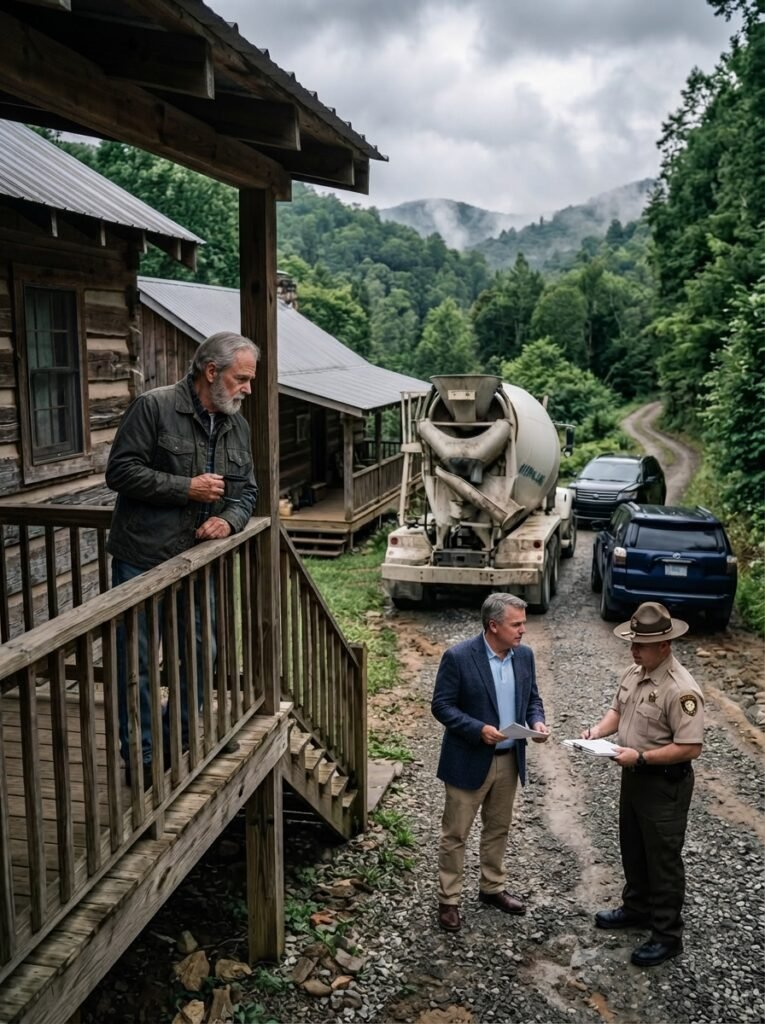
“I brought food,” he continued. “Water too.”
“You planning to camp?”
“I took two weeks off work.”
He tapped the contract against his palm.
“Eventually, you’ll understand I can wait longer than you can.”
My coffee trembled against the rim of the mug.
Michael noticed.
And smiled.
That smile changed everything.
Fear disappeared.
In its place came something much quieter.
Clarity.
I set my coffee on the porch railing.
“You’re right about one thing.”
Michael raised his eyebrows.
“I did isolate myself after your mother died.”
“Then you understand your situation.”
“I understand that you counted on my grief.”
His face hardened.
“Call it whatever you want.”
Then he pointed toward the truck.
“It moves when you sign.”
I stepped inside.
Closed the door.
Locked it.
Michael probably assumed I was checking my pantry.
Maybe reading the paperwork.
Maybe panicking.
Instead, I climbed the stairs.
Margaret used to tease me about keeping things years after they had stopped being useful.
Old tools.
Camping equipment.
Road maps printed before half the highways had been widened.
And one satellite phone.
We had bought it years earlier for trips into the Great Smoky Mountains after getting caught in a storm during a hiking trip with no cell reception.
Margaret had laughed when I refused to throw it away.
“You know we own regular phones now, right?”
“You never know when we might need it.”
“Then put it somewhere you’ll remember.”
I had.
Cardboard box.
Upstairs closet.
Behind my winter coats.
My hands shook as I pulled it out.
For several seconds, the screen stayed black.
My heart sank.
Then a weak light appeared.
I carried it to the bedroom window.
Waited.
One bar.
Then two.
My first thought was Sarah.
But Sarah was thousands of miles away in Oregon.
I needed somebody close.
Somebody Michael could not intimidate.
Somebody who would understand what he had done.
I called Harry Collins.
Harry lived about a mile down the county road.
More importantly, he had spent thirty years with the Knox County Sheriff’s Office before retiring.
He answered on the fourth ring.
“Harry, it’s David.”
A pause.
“David? What are you calling me on?”
“Doesn’t matter. I need you to listen carefully.”
I told him everything.
Michael.
The concrete truck.
The contract.
The blocked road.
The threat that I would stay trapped until I signed.
Harry did not interrupt.
When I finished, he was silent for several seconds.
“Your son blocked you inside your own property?”
“Yes.”
“And he told you the truck stays until you transfer the land?”
“Yes.”
“Stay in the house.”
“I’m not planning to fight him.”
“Good. Lock every door. Don’t tell him you contacted anybody.”
“There’s something else.”
“What?”
“The porch camera.”
Harry’s voice changed.
“What about it?”
“It may have recorded everything.”
“Do not touch that system.”
“I wasn’t going to.”
“I mean it, David. Don’t delete anything, don’t stop anything, don’t even restart it. Preserve it exactly the way it is.”
After we disconnected, I went into the small office beside the bedroom.
Margaret had insisted on putting security cameras around the house after tools disappeared from our barn years before.
At the time, I thought she was overreacting.
Now the green light on the monitor looked like salvation.
Camera one showed the porch.
Camera two showed the barn.
Camera three covered the driveway.
The driveway angle was nearly perfect.
Michael.
The truck.
The contract.
Even the place where he had pointed toward the road and told me I would eventually run out of options.
I sat down.
For the first time that morning, I breathed.
Outside, Michael leaned against the concrete truck.
Confident.
Waiting.
He had no idea his entire performance had been recorded.
Twenty-eight minutes later, I heard engines.
Michael heard them too.
Harry’s pickup appeared first around the bend.
Two marked county cruisers followed.
Michael straightened immediately.
The contract slipped slightly in his hand.
Harry parked on the roadside and climbed out.
The first deputy walked toward Michael.
“Sir,” he said, looking from Michael to the truck, “is this your vehicle?”
Michael recovered quickly.
“No. It belongs to a contractor.”
“Did you arrange for it to be placed here?”
Michael hesitated.
“It’s a family matter.”
“That wasn’t my question.”
Michael glanced toward the house.
I watched from the window.
“Yes,” he finally said. “I arranged it.”
“Why?”
“My father and I are discussing a property transfer.”
The deputy looked at the truck again.
“You’re discussing it by blocking the only road?”
Michael’s expression changed.
“I think this is being misunderstood.”
That sentence would become his favorite over the next hour.
Harry saw me through the window and raised one hand.
I came downstairs.
When I stepped onto the porch, Michael turned toward me.
The look he gave me was not embarrassment.
It was betrayal.
As if I had broken some agreement by refusing to be helpless.
“You called the police?”
“I called Harry.”
“You said you didn’t have a signal.”
“I didn’t.”
His eyes narrowed.
Then he understood.
The satellite phone.
Margaret had remembered it.
So had I.
One of the deputies came toward me.
“Mr. Bennett, did your son prevent you from leaving the property?”
“Yes.”
“Did you tell him you wanted the road cleared?”
“Yes.”
“What did he say?”
“That he would move the truck after I signed the land over to him.”
Michael stepped forward.
“That is not what happened.”
The deputy turned.
“Sir, stay where you are.”
“I’m his son.”
“That doesn’t change the instruction.”
Michael looked furious.
I could see the moment he realized his suit, his job, and his confident tone were not going to control the conversation.
He switched strategies.
“Dad is grieving,” he said. “He’s been depressed since my mother died. He doesn’t understand what I’m trying to do for him.”
I stared at him.
There are betrayals that happen loudly.
And there are betrayals where somebody takes your pain and uses it to discredit your mind.
That one hurt worse.
Harry stepped beside me.
“You want to show them the camera?”
I nodded.
Michael went pale.
“What camera?”
I almost smiled.
“The one your mother insisted we install.”
Ten minutes later, all of us stood inside my office.
I played the footage.
Michael’s own voice filled the room.
“Sign the land over to me, and the truck moves.”
Then:
“You don’t have a signal out here.”
Then:
“I took two weeks off work.”
Then the worst part.
“Eventually, you’ll understand that I can wait longer than you can.”
Nobody spoke when the recording stopped.
The deputy looked at Michael.
Michael looked at the floor.
Then he did something I did not expect.
He blamed Margaret.
“Mom always made him paranoid.”
I stood so quickly my chair hit the wall.
“Do not bring your mother into this.”
For the first time all morning, I raised my voice.
Michael flinched.
I pointed toward the monitor.
“Your mother spent forty-three years building this life with me. You will not stand in her house after trying to trap me here and blame her for protecting it.”
His face reddened.
“I’m trying to keep the property in the family.”
“You’re trying to take it from the family.”
“That land is going to be mine someday anyway!”
The room went silent.
Michael realized what he had said.
Too late.
Harry stared at him.
The deputy slowly asked, “Why would it be yours?”
Michael looked away.
I answered.
“It wouldn’t.”
Michael snapped his head toward me.
“What?”
“Your mother and I changed the estate plan six years ago.”
He stared.
I had never seen genuine shock on his face before.
Not even when the police arrived.
“What are you talking about?”
“After you asked Margaret for money the third time and never paid it back, we changed things.”
His mouth opened.
Closed.
“The property was never going directly to you.”
“That’s impossible.”
“Your mother was very clear.”
Michael’s breathing changed.
The deputy noticed too.
“Mr. Bennett,” he asked me, “do you have an attorney?”
“Yes.”
“Call him.”
This time I used Harry’s phone.
My attorney, Thomas Greene, arrived a little over an hour later.
By then, deputies had forced the contractor to move the concrete truck.
That created another surprise.
The driver had not been told the truth.
Michael had hired the truck through an acquaintance and claimed he needed it parked across the drive because of “private construction work.”
The driver thought he was waiting for instructions.
He had no idea he was helping block an elderly man inside his own property.
Once he understood, he handed the deputies Michael’s messages voluntarily.
Michael had written:
Park sideways.
Do not move until I tell you.
No one gets through.
That was when the situation stopped looking like a heated family disagreement.
It looked planned.
Thomas arrived carrying a leather briefcase and wearing the expression he reserved for people who had created their own legal disasters.
He had known Margaret almost twenty years.
When he saw Michael, there was no warmth in his face.
“Where’s the contract?”
Michael folded his arms.
“It’s private.”
Thomas looked at the deputy.
The deputy looked at Michael.
Michael handed it over.
Thomas read the first page.
Then the second.
Then stopped.
“David, did you write any of this?”
“No.”
“Did you agree to any of this?”
“No.”
Thomas turned the document around.
“This transfers the entire property and all development rights immediately.”
My stomach tightened.
Michael had told me I could stay.
The contract said otherwise.
Thomas continued.
“It also gives the new owner authority to require you to vacate under several conditions.”
I looked at Michael.
“You said I could live here.”
“You could.”
“That’s not what this says.”
“It’s standard language.”
Thomas laughed once.
“No, it isn’t.”
He flipped another page.
“And this waiver attempts to state that David executed the transfer voluntarily, without coercion.”
Harry muttered something I will not repeat.
Michael’s face went pale again.
But Thomas was not finished.
“Where did you get this?”
“I had someone prepare it.”
“Who?”
“My attorney.”
Thomas studied the document.
“No lawyer signed this.”
Michael said nothing.
Then Thomas pointed toward the bottom.
“There’s a notary block.”
I leaned closer.
A name was already printed below it.
The space for my signature was blank.
But the notary section had been completed in advance.
Thomas took a photograph.
“Deputy, I suggest you find out whether this notary knows her stamp is being used.”
Michael exploded.
“You’re making this into something it isn’t!”
“No,” I said quietly.
“You did that when you parked a truck across my road.”
His anger turned toward me.
“You have no idea what I’m dealing with.”
“Then tell me.”
For a moment, he said nothing.
“Tell me, Michael.”
His shoulders dropped slightly.
And the first crack appeared.
He owed money.
A lot of it.
Not from one bad investment.
From several.
A commercial real estate deal outside Nashville had collapsed.
He had borrowed against his house.
Then against retirement accounts.
Then privately.
He had hidden most of it from his wife, Rebecca.
The developer purchasing land around my property had offered Michael a finder’s fee if he could assemble enough adjoining acreage.
My property was the missing piece.
Without it, the planned access road became much more expensive.
With it, Michael stood to receive enough money to stop the financial collapse.
“How much?” I asked.
He did not answer.
Thomas asked instead.
“How much were they offering you?”
Michael stared at the floor.
“Two hundred thousand.”
Harry swore under his breath.
I felt something inside me go cold.
“You tried to buy my land for less than half its value so you could turn around and collect two hundred thousand dollars from a developer?”
“It wasn’t like that.”
“That is exactly what it was.”
“I was going to make things right later.”
“With whose money?”
Michael had no answer.
Then headlights appeared again at the edge of the property.
A rental car.
The vehicle stopped near the porch.
A woman stepped out.
Sarah.
For a moment, I thought I was imagining her.
She had been in Oregon the night before.
“Dad!”
She ran toward me.
I barely had time to open my arms.
When she hugged me, something I had been holding inside since Margaret died finally broke.
“What are you doing here?” I whispered.
“Harry called me.”
I looked over her shoulder.
Harry gave a tiny shrug.
“I may be retired, but I still know how to make two phone calls at once.”
Sarah pulled back.
Her eyes found Michael.
The expression on her face changed instantly.
“You blocked Dad inside the property?”
Michael looked exhausted.
“Sarah, you don’t understand.”
“I understand enough.”
“No, you don’t.”
“You tried to force him to sign over Mom’s home.”
“I was trying to solve a problem.”
“Your problem.”
Michael stepped toward her.
Sarah did not move.
Then she said something that shocked both of us.
“You asked me to help you declare Dad incompetent.”
My head turned.
“What?”
Michael froze.
Sarah looked at me, tears already rising in her eyes.
“Three months ago.”
“Sarah…”
“He called me and said you were forgetting things. That you were confused. That maybe we should talk to a lawyer about managing your finances.”
I stared at Michael.
He did not deny it.
Sarah continued.
“I told him I wanted a medical evaluation first. He became angry. Then he stopped bringing it up.”
Michael rubbed both hands over his face.
“I was trying to protect him.”
“From what?” Sarah shouted. “Owning his own home?”
The deputy quietly asked Sarah to explain everything from the beginning.
She did.
The calls.
Michael’s questions about my bank accounts.
His questions about whether I had updated my will after Margaret died.
His claim that I sometimes forgot appointments.
His suggestion that we might need control over the property before I “made some irrational decision.”
Thomas wrote down every word.
I felt sick.
The truck had not been the beginning.
It had only been the first part I could see.
For months, Michael had been building a story in which I was lonely, confused, unstable and incapable.
If I signed voluntarily, perfect.
If I refused, perhaps he hoped to convince people I no longer understood what was best for me.
Margaret had once told me something about Michael during one of his worst financial periods.
“He doesn’t become dangerous when he’s angry, David. He becomes dangerous when he convinces himself his need is more important than everyone else’s rights.”
At the time, I thought she was being too hard on him.
Now her words returned with painful precision.
The deputy eventually separated Michael from the rest of us.
I will not pretend I felt triumphant when they placed him in the back of a cruiser.
I felt empty.
He was still my son.
I remembered carrying him on my shoulders.
Teaching him to drive.
Standing beside him at graduation.
Watching Margaret cry at his wedding.
Love does not disappear just because someone does something unforgivable.
Sometimes that makes betrayal worse.
Michael looked at me through the open cruiser door.
“Dad.”
I stopped.
His voice cracked.
“Please.”
That one word nearly destroyed me.
I walked closer.
“You should have asked me for help.”
“I did.”
“No. You asked me for land.”
He lowered his head.
“I was desperate.”
“So you decided I was expendable.”
“That’s not fair.”
“Neither was trapping me in my home.”
He looked toward the house.
“I was going to move the truck.”
“When?”
He said nothing.
“When I signed?”
Silence.
“That’s your answer.”
The deputy closed the door.
The cruiser drove away.
For the first time since dawn, the driveway was clear.
But I did not feel free.
Not yet.
The next few weeks revealed more.
The notary whose name appeared on Michael’s contract had never met me.
She had notarized documents for Michael’s business in the past but denied authorizing her information for that transfer.
The developer admitted Michael had been negotiating as if he already controlled my acreage.
Emails showed he had promised them an agreement within thirty days.
In one message, he had written:
My father will come around. He doesn’t have many options.
That sentence stayed with me.
Not because it was cruel.
Because it explained everything.
Michael had not seen me as his father.
He had seen me as an obstacle with limited options.
Thomas helped me strengthen every legal protection around the property.
Sarah stayed for nearly three weeks.
She cleaned the garden with me.
Repaired a broken gate.
Made Margaret’s chicken casserole badly enough that we both laughed until Sarah started crying.
One evening, we sat on the porch.
“I should have come sooner,” she said.
“You had a life.”
“So did you.”
I looked toward the hills.
“I stopped living much of it after your mother died.”
Sarah took my hand.
“Then start again.”
That was harder to hear than it sounds.
Grief can become a house of its own.
You know where everything is.
You know which floorboards creak.
You know exactly how the silence sounds.
Eventually, leaving grief behind can feel like leaving the person you lost.
But Margaret had never asked me to stop living.
Quite the opposite.
So I started small.
Coffee with Harry.
Sunday service.
Lunch in Knoxville.
I called old friends whose numbers I had ignored.
I hired help for the heavier work around the property.
And I finally cleaned Margaret’s gardening tools.
I did not throw them away.
I just stopped treating dust as a form of loyalty.
Six months after the truck incident, Michael asked to see me.
By then, the criminal case had moved through the courts.
On advice from Thomas, I will not describe every legal detail, but Michael accepted responsibility rather than forcing a trial.
There were penalties.
Restitution.
Court supervision.
Mandatory counseling.
And strict orders about contacting me.
But eventually, through attorneys, he asked whether I would agree to one supervised meeting.
Sarah thought I should refuse.
Harry did too.
I almost did.
Then I remembered Margaret.
Not because she would have forgiven everything.
She wouldn’t have.
But she had always believed people should be forced to face the damage they caused.
So I agreed.
We met in a conference room at Thomas’s office.
Michael looked older.
Not dramatically.
Just enough that I noticed.
His expensive watch was gone.
So was the confident business posture.
For several moments, neither of us spoke.
Then he said, “Rebecca left.”
I nodded.
Sarah had told me.
“She took the kids.”
“I know.”
“I lost my job.”
“I know that too.”
He looked at me.
“I kept thinking you’d feel sorry for me.”
“I do.”
That surprised him.
“I feel sorry that my son became a man who thought desperation gave him permission to imprison his father.”
His eyes filled.
“I didn’t think of it as imprisoning you.”
“That was part of the problem.”
He looked down.
“I kept telling myself you would sign.”
“And what if I hadn’t found the phone?”
He said nothing.
“What would you have done after two days?”
Silence.
“Three?”
His hands tightened.
“A week?”
Finally, he whispered, “I don’t know.”
“Yes, you do.”
Michael started crying.
Not loudly.
Just quietly enough that I almost looked away.
“I was drowning, Dad.”
“I would have helped you.”
“You wouldn’t have given me the property.”
“No.”
“That’s what I needed.”
“No. That’s what you wanted.”
He covered his face.
I waited.
Then I told him something I had wanted to say since the morning of the truck.
“Your mother knew about your debt problems.”
Michael looked up.
“She knew?”
“Some of them.”
“She never said anything.”
“She asked me to help you without rescuing you.”
His face collapsed.
“That sounds like Mom.”
“It does.”
I reached into my coat and placed an envelope on the table.
Michael stared at it.
“What’s that?”
“A copy of a letter she wrote before she died.”
His hands shook as he opened it.
Margaret had written separate letters to both children during her final months.
Michael had never received his because I could not bring myself to open the box where she had stored them.
After everything that happened, Sarah and I found them.
Michael read silently.
Then stopped halfway.
Tears dropped onto the paper.
I knew the paragraph.
I had read it dozens of times.
Margaret had written:
Michael, you have always been ambitious, and ambition can build beautiful things. But promise me you will never become so afraid of losing that you start taking what was never yours.
He pressed the letter against the table.
“I’m sorry.”
I believed he meant it.
But apologies and trust are not the same thing.
“I forgive you for being desperate,” I said.
He looked up.
“I’m not ready to forgive what you chose to do with that desperation.”
He nodded slowly.
“That’s fair.”
“It isn’t punishment.”
“I know.”
“If we ever rebuild anything, it happens slowly.”
“I understand.”
“And the property?”
He swallowed.
“I’ll never ask again.”
“No. You won’t.”
There was one more thing he did not know.
Margaret and I had not left the land directly to either child.
Years earlier, we created a family trust.
After my death, Sarah and Michael would each receive benefits from it, but neither could force the sale alone.
A conservation restriction would protect much of the acreage from large-scale development.
Margaret had insisted on it.
“This land raised our children,” she had told me. “It should not become the thing that destroys them.”
She had seen farther than I did.
Again.
A year after that terrible morning, I stood near the same gravel driveway holding another cup of coffee.
No trucks.
No deputies.
No contract.
Just birds in the oak trees and mist lifting from the Tennessee hills.
Sarah had returned with her husband and children for Margaret’s birthday.
We planted a row of hydrangeas near the garden.
Harry came over carrying barbecue.
And sometime after noon, another car appeared.
Michael stepped out.
He had permission to visit.
For the first time in almost two years, Sarah did not immediately walk away from him.
The grandchildren ran toward the rope swing.
Michael stood beside me watching them.
“That thing still holds?”
“I replaced the rope.”
He smiled faintly.
“Mom would’ve said you should replace the branch too.”
“Your mother thought every structure was one storm away from collapse.”
“She usually wasn’t wrong.”
“No.”
We stood quietly.
Then Michael looked toward the end of the driveway.
“I still dream about that truck.”
“So do I.”
“I keep seeing myself standing there.”
I looked at him.
“What do you see now?”
He thought for a long moment.
“Someone who believed being scared made him entitled.”
That was the first thing he had said in a year that made me believe change might be possible.
I nodded.
“Keep seeing him.”
Michael looked confused.
“So you remember not to become him again.”
His eyes lowered.
“I will.”
We walked toward the house.
Near the porch, Sarah was showing her daughter one of Margaret’s old recipe cards.
The little girl asked whose handwriting it was.
Sarah smiled.
“That was your grandmother.”
I stopped walking.
For so long, I had believed keeping Margaret’s memory alive meant keeping everything exactly as she had left it.
The gloves.
The mug.
The empty chair.
The untouched garden tools.
But standing there with my children, damaged and imperfect and still trying to find their way back toward each other, I finally understood something.
Margaret had never been trapped inside that house.
She was in Sarah’s laugh.
In Michael’s stubbornness.
In the hydrangeas.
In the recipe cards.
In the stupid satellite phone she once teased me for keeping.
And in one final decision she had made years before any of us knew we would need it.
That evening, after everyone left, I walked upstairs.
I opened the closet.
The cardboard box was still there.
So was the satellite phone.
I picked it up and smiled.
Then I carried it downstairs.
Not because I expected to need rescuing again.
But because some things are worth keeping.
Not out of fear.
Out of gratitude.
Michael had believed my grief had made me weak.
He had believed age had made me helpless.
He had believed isolation meant I had no options.
What he forgot was that Margaret and I had spent more than forty years building that life together.
And people who spend decades building something learn how to protect it.
Sometimes protection looks like a lawyer.
Sometimes it looks like a camera.
Sometimes it looks like an old friend driving down a country road with two sheriff’s cruisers behind him.
And sometimes it looks like a forgotten phone hidden behind winter coats.
I still live in the Tennessee house.
The oak tree is still standing.
The garden grows every spring.
Margaret’s blue mug is still on the shelf, although now I actually use it.
And no one has ever blocked my driveway again.
Because the morning my son tried to trap me inside my own home taught all of us one lesson Michael will never forget:
A grieving father may be lonely.
He may be quiet.
He may even look vulnerable.
But that does not mean he has surrendered.
And the moment you mistake silence for weakness may be the exact moment you discover how much strength was waiting behind the door.