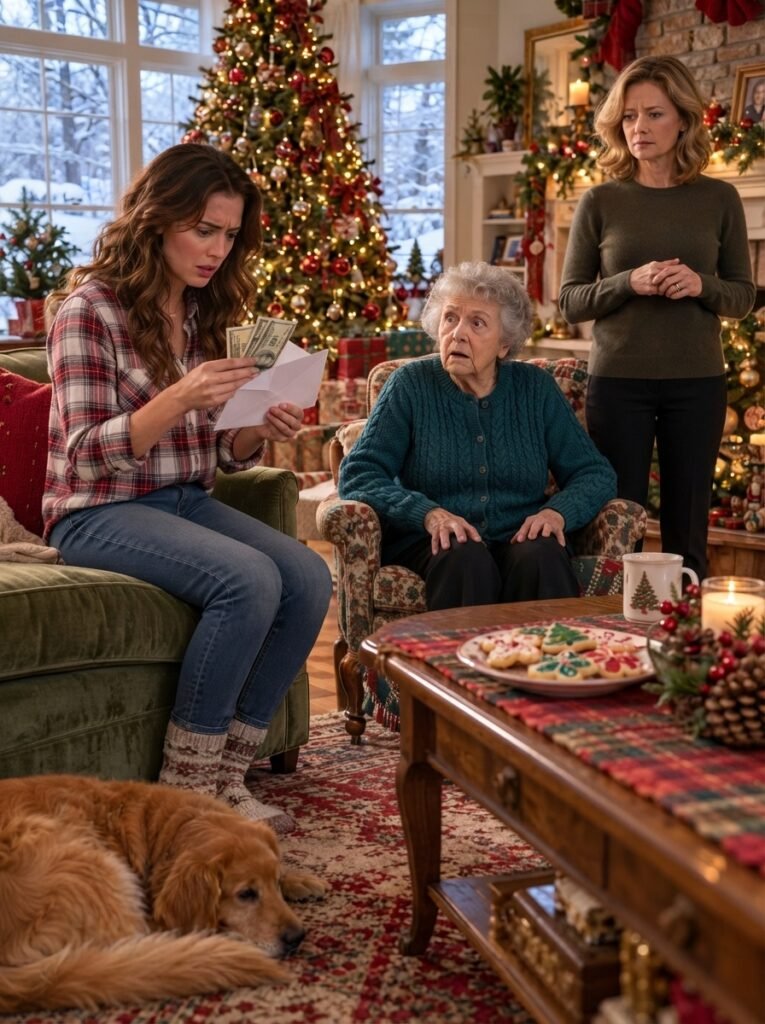
The first time I saw my mother look genuinely terrified, I was holding five hundred dollars in my hands.
It was Christmas afternoon in Syracuse, New York, and twenty-four years of family tradition had just shattered in front of me.
My grandmother, Ruth Walsh, had been giving me an envelope every Christmas since I was five years old.
Inside, there was always a twenty-dollar bill and a handwritten letter.
The money never changed.
The letters did.
They followed me through scraped knees, terrible school pictures, first heartbreaks, high school graduation, and the day I became a certified union pipefitter.
But that Christmas, when I opened the envelope, there was no letter.
Instead, five crisp hundred-dollar bills rested against a Christmas card decorated with a red cardinal.
“Grandma!”
I laughed.
“What did you do, rob a bank?”
She didn’t laugh.
Her smile disappeared so suddenly that I felt something cold move through my chest.
She stared at the money.
Then at the empty envelope.
Then directly at my mother.
“That’s not what I put in there.”
My mother, Elaine Mercer, was standing beside the Christmas tree, arranging sugar cookies on a platter.
For one brief second, her hands stopped moving.
Then she smiled.
“Oh, Mom,” she said lightly.
“Remember Tuesday?
We put money in everyone’s cards.
You said you wanted to do something extra special this year.”
Grandma’s expression hardened.
She was eighty-one, barely five feet tall, and stubborn enough to argue with a snowplow driver about where he deposited snow.
She handled her own finances, completed crossword puzzles before breakfast, and remembered things everyone else had forgotten.
She had never once forgotten what she put in my Christmas envelope.
“No, Elaine,” she said quietly.
“That’s not what I put in Nola’s envelope.”
My mother crossed the room.
“You’re exhausted.
Come get some water.”
She placed one hand on Grandma’s shoulder and guided her toward the kitchen.
My stepfather, Frank, looked up from the coffee maker instruction manual he’d been studying.
“She’s eighty-one, sweetheart,” he said with a sympathetic smile.
“People get mixed up.”
I wanted to believe him.
Frank had been my father in every way that mattered since I was five.
He taught me to change a tire, attended my softball games, and spent an entire Saturday helping me prepare for my first welding certification.
He was dependable, patient, and steady.
But something about his smile that afternoon bothered me.
It was the kind of smile people use when they want a conversation to end.
I looked down at the envelope again.
For twenty-four Christmases, Grandma had given me twenty dollars and a letter.
This year, someone had replaced both with five hundred dollars.
And my grandmother was frightened.
I was twenty-nine that Christmas.
My life was ordinary enough that I never imagined my family could be hiding something extraordinary.
I worked on industrial boilers and steam lines in hospitals, schools, and university buildings.
I rented a small apartment on Syracuse’s east side, drove a ten-year-old pickup, and usually came home smelling faintly of metal and machine oil.
My name was Nola Mercer.
At least, that’s what everyone called me.
Legally, I was Nola Claire Keating.
Keating was my biological father’s surname.
According to my mother, he’d died in a motorcycle accident when I was three.
She said he’d been troubled, that his relatives had rejected us, and that she’d destroyed his photographs because remembering him was too painful.
Whenever I asked questions, she became upset.
Eventually, I stopped asking.
Frank married her when I was five.
I called him Dad.
There had never been any reason not to.
Until Christmas.
Mom and Grandma remained in the kitchen for nearly twenty minutes.
When they returned, Grandma looked smaller.
She had her rosary wrapped tightly around one hand.
Mom stayed close to her for the rest of the afternoon, bringing her coffee, adjusting her blanket, and answering questions before she could speak.
By the time I was leaving, I felt sick with uneasiness.
I bent down to kiss Grandma goodbye.
She grabbed my wrist.
Her fingers were astonishingly strong.
“Come see me alone, sweetheart,” she whispered.
I stared at her.
“Grandma?”
Her eyes flicked toward the doorway.
Mom was watching us.
“The roads are getting icy, Nola,” she said.
“You should head home.”
Grandma squeezed my wrist one final time.
And when she released me, there were tears in her eyes.
I didn’t sleep that night.
Every time I closed my eyes, I saw her face.
The next morning, I called.
Mom answered Grandma’s phone.
“She’s resting,” she said immediately.
“Can I speak to her?”
“Not right now.”
“Mom, why are you at Grandma’s house?”
A pause.
“Because she’s been confused lately.”
“Since when?”
“Nola, please don’t start.”
“I’m not starting anything.
I just want to talk to her.”
My mother’s voice hardened.
“You got five hundred dollars for Christmas.
Why can’t you just be grateful?”
I looked at my old shoebox sitting on the bedroom shelf.
Twenty-four letters.
Twenty-four years of someone telling me I mattered.
“Because Grandma didn’t give me five hundred dollars,” I said.
“Somebody else did.”
The line went silent.
Then Mom said something strange.
“Your grandmother doesn’t understand what she could ruin.”
Before I could respond, she hung up.
I stood there holding my phone, listening to the dead connection.
That sentence changed everything.
Two days after Christmas, I drove to Grandma’s house without telling anyone.
Fresh snow covered the driveway.
The ceramic snowman beside her front steps had lost its red scarf, and her porch light was still on despite the afternoon sunshine.
She opened the door before I knocked twice.
When she saw me alone, relief washed across her face.
“Thank God.”
She pulled me inside and locked the deadbolt.
“Grandma, what’s happening?”
“Did your mother come with you?”
“No.”
“Did Frank?”
“No.”
She nodded.
“Good.”
Her hands trembled as she led me into the kitchen.
A pot of coffee sat untouched on the counter.
She opened a drawer beneath the silverware organizer and removed an old photograph.
The corners were yellowed.
It showed a dark-haired man holding a toddler.
Beside him stood a young woman with long brown hair.
I recognized the woman immediately.
Or thought I did.
“Mom?”
Grandma didn’t answer.
I studied the man.
He had dark eyebrows, a narrow nose, and a crooked smile.
My stomach tightened.
His eyes looked like mine.
“That’s my father?”
Grandma nodded.
“Thomas Keating.”
I ran my thumb over the photograph.
For twenty-six years, I’d believed every image of this man had been destroyed.
“Why did Mom tell me there weren’t any pictures?”
“Because she didn’t want you asking questions.”
“About what?”
Grandma sat slowly.
Her eyes filled.
“Oh, sweetheart.
I should have told you years ago.”
“Told me what?”
She reached across the table and gripped my hand.
“Your father didn’t die in a motorcycle accident.”
The kitchen seemed to tilt.
“What?”
“There was an accident.
But he survived.”
I stared at her.
“You’re telling me he’s alive?”
She lowered her eyes.
“Yes.”
The word barely reached me.
I heard the refrigerator humming.
The radiator clicking.
A car passing outside.
Everything sounded impossibly normal.
“My father is alive?”
Grandma nodded again.
“Where is he?”
She opened her mouth.
Then a car door slammed outside.
Her expression changed instantly.
“Oh, Lord.”
A fist struck the front door.
“Nola!”
My mother’s voice.
“Nola, I know you’re in there!”
Grandma stood so quickly her chair scraped against the tile.
“Put the photograph away.”
“Grandma—”
“Now!”
I slipped it into my coat pocket.
The pounding continued.
“Mom!
Open this door!”
Grandma looked at me with naked fear.
“Whatever happens next,” she whispered, “don’t let anyone convince you that you’re imagining things.”
Then she unlocked the door.
My mother entered like a winter storm.
Her cheeks were red from the cold, and her hair was escaping its carefully arranged ponytail.
She looked at Grandma.
Then at me.
“What have you told her?”
“Enough,” Grandma answered.
Mom closed her eyes.
“Oh, God.”
“She says my father is alive,” I said.
Mom looked at me.
The expression on her face wasn’t anger.
It was grief.
“Sweetheart—”
“Don’t sweetheart me.
Is it true?”
She leaned against the kitchen counter.
For several seconds, she seemed unable to speak.
Finally, she whispered, “Yes.”
I felt as though she’d struck me.
“Twenty-six years?”
“Nola, you don’t understand.”
“Then explain it.”
She rubbed both hands over her face.
“Your father was involved in something terrible.”
“What?”
“A fire.”
I remembered nothing about a fire.
Mom had never mentioned one.
“He was convicted,” she continued.
“People died.
He went to prison.”
The words came slowly, each one worse than the last.
“Prison?”
“Yes.”
“For what?”
She looked at Grandma.
Grandma stared back.
“Tell her the whole truth, Elaine,” she said.
Mom’s voice broke.
“I don’t know the whole truth anymore.”
I looked between them.
“How can you not know?”
Mom reached for my hand.
I pulled away.
She flinched.
“Frank said it was better if you believed Thomas had died.
You were little.
You’d already been through so much.”
“What had I been through?”
Neither answered.
A terrible silence filled the kitchen.
Then Grandma said, “She deserves to know about Clara.”
Mom turned white.
“Don’t.”
“Elaine—”
“Please.”
I looked at Grandma.
“Who’s Clara?”
Before she could answer, Mom said, “Your grandmother is confused about details.
We need to talk about this carefully.”
“Stop telling me she’s confused!”
My voice echoed through the house.
Grandma began crying.
That frightened me more than anything.
She had cried when Grandpa died.
She had cried when I graduated.
But I’d never seen her cry out of fear.
I reached for my coat.
Mom stepped toward me.
“Where are you going?”
“To find my father.”
Her face crumpled.
“Nola, please don’t.”
“Why?”
“Because sometimes the truth destroys more than the lie.”
I opened the door.
“Then you should have thought about that before lying to me for twenty-six years.”
I walked out into the snow.
The photograph stayed beside my bed that night.
I must have picked it up fifty times.
Thomas Keating.
The name felt unfamiliar and strangely intimate.
I studied the young woman beside him.
She looked like my mother, but something was different.
Her smile was wider.
Her face softer.
And above her left eyebrow was a tiny crescent-shaped scar.
Mom didn’t have a scar there.
I turned the photograph over.
On the back, in faded blue ink, someone had written:
C., Tommy, and our little miracle.
August 1998.
C.
Claire?
Clara?
I remembered Grandma beginning to say something about Clara before my mother stopped her.
At two in the morning, I opened my laptop.
I searched Thomas Keating Syracuse fire 1999.
Several old newspaper references appeared.
Most were inaccessible without subscriptions.
Then I found a digitized headline from the Syracuse Herald-Journal archives.
FORMER BUILDING TECHNICIAN CONVICTED IN MAPLE STREET CENTER FIRE.
My hands went cold.
The article was dated September 14, 2001.
Thomas Keating, thirty-two, had been convicted in connection with a February 1999 fire at the Maple Street Community Center.
The blaze had killed two people.
Investigators claimed that Keating had knowingly disabled a boiler’s safety system and ignored warnings about combustible materials stored nearby.
He had maintained his innocence.
A photograph accompanied the article.
Thomas stood outside a courthouse, handcuffed, with his head lowered.
Even in the grainy image, I recognized his face.
My father’s face.
He had received a sentence of twenty-two years.
I read the article three times.
Then another.
And another.
Finally, I found a later report.
Thomas Keating had been released on parole in 2017.
My father had been free for eight years.
Eight years during which I had graduated from my apprenticeship, bought my pickup, earned promotions, and celebrated birthdays.
Eight years when he could have contacted me.
Had he tried?
Or had he really wanted nothing to do with me?
I kept searching.
An archived article mentioned the names of the people killed in the fire.
Victor Lyle, a night custodian.
And Clara Walsh Keating, thirty-one.
I stopped breathing.
Keating.
I enlarged the photograph again.
The woman beside Thomas.
The woman who looked like my mother but wasn’t quite my mother.
I whispered, “Clara.”
Then I searched her name.
The first result made my heart drop.
Clara Walsh Keating was the eldest daughter of Martin and Ruth Walsh.
My grandparents.
The article listed a surviving younger sister.
Elaine Walsh.
My mother.
I sat motionless.
Clara had been my mother’s sister.
And Thomas Keating’s wife.
Then what did that make me?
I didn’t go to work the next morning.
I drove to the Onondaga County Public Library and spent four hours reading newspaper archives.
I learned that the Maple Street Community Center had served working-class families for decades.
It offered after-school programs, community meals, and free childcare.
Thomas had been its maintenance supervisor.
Clara worked part-time in its administrative office.
The fire began shortly after seven on a Thursday evening.
Witnesses described an explosion in the basement boiler room.
Flames spread through a rear corridor.
Two adults died.
One small child was rescued.
The child’s name wasn’t included.
But the age was.
Three.
I stared at the screen.
I had been three years old.
My eyes moved to the next sentence.
The rescued child had suffered smoke inhalation and minor burns.
I looked down at my left forearm.
A pale, irregular scar crossed the skin just beneath my elbow.
Mom always said I’d burned myself on a camping stove when I was six.
I rubbed the scar with my thumb.
Suddenly, I remembered something.
Not a complete memory.
Just fragments.
A roaring sound.
Heat against my face.
Someone screaming.
A woman singing.
I pushed away from the computer.
My pulse hammered.
All my life, I’d suffered occasional nightmares about being trapped in a dark room while something thundered beneath the floor.
Mom said they were ordinary childhood dreams.
What if they were memories?
I printed everything I could find.
Then I drove to the union hall.
Our local had maintained records going back generations, including old safety complaints and contractor disputes.
I wasn’t expecting much.
But our retired business agent, Walter “Red” Harlan, knew the Maple Street case.
He was seventy-four, wore hearing aids, and still smelled faintly of pipe tobacco despite having quit twenty years earlier.
When I mentioned Thomas Keating, his face changed.
“Where’d you hear that name?”
“He’s my father.”
Red slowly removed his glasses.
“Well, I’ll be damned.”
“You knew him?”
“Everybody knew Tommy Keating.”
“Was he dangerous?”
Red looked offended.
“Tommy?”
“He was convicted of killing two people.”
Red stared at me.
Then he said something I would remember for the rest of my life.
“A jury can convict a man, Nola.
That doesn’t mean they got the right man.”
Red took me into a storage room behind the union office.
Steel filing cabinets lined the walls.
He pulled a drawer open and searched through folders.
“Tommy was a good mechanic,” he said.
“Better than most.
Wouldn’t sign off on anything unsafe.”
“Then why did they convict him?”
“Because somebody had to take the fall.”
He found a folder.
Inside was an old union grievance.
Thomas had filed it three days before the fire.
The complaint concerned repeated pressure to operate a gas-fired boiler despite a defective safety shutoff and an improperly installed bypass assembly.
Red tapped the page.
“He wanted the building closed until repairs were made.”
“Who refused?”
“The city inspector.”
I read the signature at the bottom.
F.
Mercer.
My stomach turned.
Frank Mercer.
My stepfather.
The man who taught me to weld.
The man who attended every school concert.
The man who made pancakes on snowy Saturdays.
I stared at the signature.
“Frank worked as a city inspector?”
Red nodded.
“Before he went into private consulting.”
I knew Frank had been involved in building inspections years ago.
But he’d never mentioned Maple Street.
Never mentioned Thomas Keating.
Never mentioned the fire.
“Was Frank involved in the investigation?”
I asked.
Red’s expression darkened.
“He signed the final inspection report.”
“What did it say?”
“That everything was operating safely before the fire.”
I looked down at Thomas’s complaint.
Three days earlier, he’d reported that it wasn’t.
Something inside me began to rearrange itself.
“Red, do you have copies of the technical drawings?”
He searched another cabinet.
Eventually, he found an old set of blueprints and maintenance photographs.
I spread them across the desk.
For nearly an hour, I studied the boiler connections.
One photograph showed an unauthorized bypass pipe.
Another showed the same section after the fire.
As a pipefitter, I knew exactly what I was looking at.
The configuration in the official report didn’t match the original installation.
Someone had changed the system.
More importantly, the report described a safety device that could not have operated correctly in that configuration.
“Red,” I whispered, “this inspection doesn’t make sense.”
He leaned closer.
“How so?”
I pointed to the diagram.
“The report says Thomas disabled the safety shutoff.
But this bypass was installed before his last inspection request.
If Frank approved the system, he approved the dangerous modification.”
Red grew very quiet.
Then he opened another folder.
Inside was a photograph of Thomas standing outside the community center, smiling beside three fellow workers.
Red handed it to me.
“He spent years writing letters from prison,” he said.
“To who?”
“People who might listen.”
I swallowed.
“Did he ever write to his family?”
Red looked at me for a long moment.
“Every Christmas, Nola.”
The room seemed to lose its air.
“What?”
“Every Christmas.
I know because he used to ask me whether I’d heard anything about his little girl.”
My fingers tightened around the photograph.
“He thought his daughter was dead.”
I stared at him.
Red’s eyes filled with sadness.
“That’s what they told him.”
I left the union hall shaking.
My father hadn’t simply been told I didn’t want him.
He’d been told I was dead.
I drove to the nearest parking lot, turned off the engine, and sat there until my breathing steadied.
Somewhere in New York, a man had spent twenty-six years believing his child was buried.
And I had spent the same twenty-six years believing he was.
It was monstrous.
I called Grandma.
She answered on the third ring.
“Nola?”
“Did Thomas think I died in the fire?”
Silence.
Then a broken whisper.
“Yes.”
“Who told him?”
She began crying.
“Grandma, please.”
“Elaine signed the papers.”
“What papers?”
“I didn’t know everything at the time.
Your grandfather said it was necessary.
He said people would get hurt if we didn’t.”
“Who would get hurt?”
“You.”
I gripped the steering wheel.
“Where is Thomas now?”
She hesitated.
“Grandma.”
“Utica,” she finally said.
“He lives outside Utica.”
“Do you have an address?”
“Yes.”
“Give it to me.”
There was a long silence.
Then she whispered, “I already wrote it down.”
My heart thudded.
“Where?”
“In your Christmas letter.”
I closed my eyes.
“What else was in that letter?”
“A photograph.
Copies of documents.
A small brass key.”
“To what?”
“Your grandfather’s safe-deposit box.”
I leaned forward until my forehead rested against the steering wheel.
“Why now?”
Grandma’s voice trembled.
“Because I found something in October that made me realize how badly I’d failed you.”
“What?”
“An old inspection file.”
I straightened.
“Frank’s?”
“Yes.”
“Grandma, did Frank know Thomas was my father?”
She laughed once, a terrible sound.
“Oh, sweetheart.”
Then she said, “Frank knew Thomas Keating before you were born.”
I drove to Utica the following afternoon.
Grandma gave me an address for a modest house on the edge of town.
I parked across the street and sat watching the front porch.
A plastic cardinal hung from the railing.
There was a small garden beneath the window, its flower beds covered with snow.
My father lived there.
For several minutes, I couldn’t move.
What did you say to someone whose existence had been erased from your life?
Hello, I’m your daughter.
Sorry it took me twenty-six years.
Finally, I crossed the street.
My hand shook as I knocked.
Footsteps approached.
The door opened.
The man standing there was older than the photograph.
His hair had gone mostly silver.
Deep lines bordered his eyes.
He wore jeans, a faded flannel shirt, and a worn leather watch.
But his face was unmistakable.
He looked at me.
Then his hand moved to the doorframe.
“Nola?”
He said my name as though it might break if spoken too loudly.
I nodded.
He stared.
For a moment, I thought he might collapse.
Then he whispered, “You’re alive.”
Something inside me gave way.
I had imagined anger.
Questions.
Accusations.
Instead, I stepped forward and wrapped my arms around a stranger.
He held me as though he had been waiting his entire life.
And in a way, he had.
We stood in the doorway crying while snow drifted around our feet.
Eventually, he led me inside.
The house smelled of coffee and sawdust.
He made wooden birdhouses, he explained, and volunteered at a community repair workshop.
On the mantel stood a photograph of a little girl.
Me.
At two years old.
Wearing a yellow dress.
I stared at it.
“Where did you get that?”
“Your mother took it.”
I looked at him sharply.
“Elaine?”
He shook his head.
“No.”
Then he swallowed.
“Clara.”
The name hung between us.
“Who was Clara?”
I asked.
His eyes filled.
“My wife.”
I sat down.
“And she was my…?”
He couldn’t finish.
He didn’t need to.
“Clara was your mother, Nola.”
The words struck harder than anything I’d heard so far.
Elaine wasn’t my biological mother.
She was my aunt.
The woman who had raised me.
The woman who tucked me into bed, braided my hair, helped with homework, and cried at my graduation.
My aunt.
I pressed a hand against my mouth.
Thomas sat beside me.
“I’m sorry.”
“For what?”
“For not finding you.”
“You thought I was dead.”
“I should have questioned it.”
“How could you?”
He looked at the photograph on the mantel.
“I used to dream you were alive.
Sometimes I’d wake up convinced I’d heard you calling me.”
His voice broke.
“Then I’d remember what they told me.”
I reached for his hand.
“Who told you?”
He stared at the floor.
“Elaine brought me the documents.”
My chest tightened.
“She told you I died?”
He nodded.
“And that Clara was gone.
She said there was nothing left for me to fight for.”
I looked at his worn hands.
“Why didn’t you tell people you were innocent?”
“I did.
For years.”
He opened a drawer and removed a stack of letters.
Appeals.
Requests for records.
Petitions for reconsideration.
Twenty years of paper.
“They called me a liar until I started wondering whether anyone would ever believe me.”
I examined one letter.
It was addressed to Elaine.
Another to Ruth.
Another to Frank.
Every envelope had been returned unopened.
Then Thomas showed me a small wooden box.
Inside were birthday cards.
Twenty-nine of them.
One for every year of my life.
Some were written before my supposed death.
Others afterward.
“Why did you keep writing them?”
I whispered.
He smiled sadly.
“Because writing to you was the only way I could still be your dad.”
I began crying again.
He placed the box in front of me.
“I don’t expect you to call me anything,” he said.
“I know another man raised you.”
I looked at him.
“His name is Frank.”
Thomas went completely still.
“Frank Mercer?”
“Yes.”
The color drained from his face.
He stared at me.
Then he whispered something that made every hair on my arms rise.
“Frank Mercer is the reason I went to prison.”
Thomas told me everything he knew.
He had worked at Maple Street for six years.
The community center’s heating system was old and dangerously neglected.
Management had hired an outside contractor to make inexpensive modifications rather than replace failing equipment.
Thomas objected repeatedly.
He filed complaints.
He requested inspections.
He refused to restart the boiler without repairs.
Frank Mercer was the inspector assigned to review the system.
At first, Thomas thought Frank was simply careless.
Then he discovered that Frank had a financial connection to the contractor through a consulting partnership.
If the city condemned the equipment, both men stood to lose money.
“The last time I saw Frank before the fire,” Thomas said, “he told me I worried too much.”
I thought of Frank teaching me to weld.
Always check your work twice, sweetheart.
Never trust somebody else’s signature.
I’d heard those words hundreds of times.
Now they sounded obscene.
“What happened the night of the fire?”
I asked.
Thomas stared into his coffee.
“Clara went back to the center to collect paperwork.
She had you with her because the babysitter canceled.”
He swallowed.
“I was on my way there when I got a call about an explosion.”
He had reached the building as firefighters were carrying people outside.
Someone told him Clara hadn’t made it.
Someone else told him a child had been taken to the hospital.
He was arrested before he could find out which hospital.
Three days later, Elaine brought him devastating news.
His daughter had died from complications.
The medical records she showed him appeared official.
He begged to see the body.
Elaine told him Nola had already been cremated.
He had no reason to suspect the documents were false.
By the time the criminal trial began, Thomas had lost everything.
His wife.
His daughter.
His job.
His reputation.
The prosecution argued that he’d tampered with the boiler out of resentment toward management.
Frank testified about the supposedly altered safety mechanisms.
Thomas was convicted.
“Elaine said she was afraid of me,” he explained.
“Said she couldn’t bear to look at the man responsible for her sister’s death.”
“Did you believe she hated you?”
“Of course.”
“But she knew I was alive.”
He nodded.
I stared at the table.
“Why would she do that?”
Thomas looked toward the photograph on the mantel.
“I’ve asked myself that question for twenty-six years.”
Then he said something unexpected.
“Your grandmother contacted me in October.”
I looked up.
“What?”
“She called out of nowhere.
Said she’d discovered documents that could prove what really happened.”
“Did she tell you I was alive?”
His expression softened.
“Yes.”
“Then why didn’t you come find me?”
“She begged me not to.
Said you had to hear the truth from her first.”
I swallowed.
“Why?”
Thomas looked troubled.
“She said there was something else.
Something about your mother.”
He paused.
“She said the truth was bigger than either of us understood.”
I returned to Syracuse with a box of birthday cards and more questions than I’d brought.
That night, I read every letter Thomas had written.
The early ones were hopeful.
The later ones were heartbreaking.
On my ninth birthday, he’d written:
I wonder if you would have liked the snow.
Your mother loved winter, even when she complained about the cold.
On my sixteenth:
I hope you would have known how much you were loved.
I hope the world would have been kind to you.
On my twenty-fifth:
I don’t know if there’s an afterlife, sweetheart.
But if there is, and if you’re somewhere beyond this world, I hope you know your father never stopped trying to find a way back to you.
I laid the letters across my bedroom floor.
Twenty-nine years of love.
Twenty-nine years of grief.
I thought of Grandma’s shoebox.
Twenty-four letters from a woman who had watched me grow.
Two separate collections.
One written to a living child.
One written to a child believed dead.
I put them side by side.
And I understood something that made me furious.
My family hadn’t simply hidden the truth from me.
They had stolen an entire lifetime from two people.
The next morning, I called my mother.
“I met Thomas.”
There was a sharp intake of breath.
Then silence.
“Mom?”
She began crying.
“Where are you?”
“Home.”
“Is Frank there?”
“No.”
“Good.”
I sat upright.
“Why?”
Her voice dropped.
“Don’t tell him you found Thomas.”
My blood went cold.
“Why not?”
“Because I need to explain something before Frank finds out.”
“Then come here.”
“I can’t.”
“Why?”
She whispered, “He checks my phone.”
I stared at the wall.
The woman who had always seemed to control every family conversation suddenly sounded terrified.
“Nola,” she continued, “I know you hate me right now.”
“I don’t know what I feel.”
“I love you.”
I closed my eyes.
“Then why did you lie?”
She sobbed quietly.
“Because I thought it was the only way to keep you.”
A car engine sounded through the phone.
Her breathing changed.
“He’s home.”
“Mom—”
“Please don’t trust anything he tells you.”
The call ended.
The next several days were a blur.
I went to work because I needed something familiar.
But ordinary sounds had changed.
Every clank of metal reminded me of the Maple Street boiler.
Every inspection form reminded me of Frank.
Every parent collecting a child from school made me think of Thomas.
I couldn’t stop wondering how many times Frank had looked at me across our dinner table while knowing the man whose life he’d destroyed was sitting in prison.
One afternoon, my supervisor found me staring at a steam-pressure gauge.
“Nola, you okay?”
I told him I needed a few days off.
He didn’t ask questions.
I drove directly to Grandma’s bank.
She had authorized me to access a safe-deposit box jointly held in her name and Grandpa’s.
But the bank manager explained that I needed the key.
The key Grandma said she’d placed in my Christmas envelope.
The key someone had removed.
I called her.
She sounded weak.
“Grandma, can you get another key?”
“I have one.”
“You do?”
“A spare.”
“Where?”
She hesitated.
“In my sewing basket.”
I was halfway to her house when she called back.
“Don’t come here.”
“Why?”
“Frank’s with me.”
My stomach tightened.
“What does he want?”
“He says I’m upsetting you.”
I heard a muffled male voice.
Then Grandma whispered, “I found something important, sweetheart.”
“What?”
“A name.
A woman named Margaret Bell.”
“Who is she?”
Grandma began to answer.
Then the call disconnected.
I tried calling back.
No answer.
I drove faster.
When I arrived, Frank’s SUV was in the driveway.
The front door stood open.
I stepped inside.
“Grandma?”
Voices came from the living room.
Frank was standing beside the fireplace.
Grandma sat on the couch, pale and trembling.
My mother stood near the window.
All three turned when I entered.
Frank smiled.
“Nola!
We were just talking about you.”
I didn’t return the smile.
“Grandma, are you okay?”
She nodded.
But her eyes told me otherwise.
Frank stepped forward.
“Sweetheart, I know you’ve been upset.
Your grandmother’s been revisiting some painful memories.”
I looked at him.
“Like Thomas Keating?”
The smile vanished.
Mom closed her eyes.
Grandma gripped her rosary.
Frank stared at me.
“Where did you hear that name?”
“I met him.”
The room went silent.
Then Frank laughed.
A short, sharp sound.
“Oh, Nola.”
It was the laugh adults use when children say something foolish.
“You really shouldn’t have done that.”
“Why?”
“He’s a convicted criminal.”
“He says you falsified the safety reports.”
Frank’s eyes narrowed.
“That man’s always blamed other people.”
“I saw the original complaint.”
“What complaint?”
“The one he filed three days before the fire.”
Frank’s expression changed.
Only slightly.
But I saw it.
“You don’t understand the technical circumstances.”
I almost laughed.
“Frank, I’m a certified pipefitter.
I understand the technical circumstances very well.”
My mother’s hand flew to her mouth.
Grandma stared at me with something like pride.
Frank took one slow step forward.
“Be careful what you’re accusing me of.”
I stood my ground.
“Then tell me why a boiler you declared safe exploded three days later.”
For several seconds, nobody moved.
Then Grandma spoke.
“Because Frank was paid to make the problem disappear.”
Frank turned toward her.
“Ruth.”
She didn’t flinch.
“I found the checks.”
My heart hammered.
“What checks?”
Grandma looked at me.
“Your grandfather kept records.
Frank was receiving consulting payments from the contractor who installed that bypass.”
Frank’s jaw tightened.
“You’re confused.”
Grandma stood.
“Don’t you dare.”
Her voice shook, but it was strong.
“I may be old, Frank Mercer.
But I am not stupid.”
Then she said something I had never expected.
“And I’m done helping you bury my family.”
Frank left without another word.
The moment his car disappeared, Mom sank into a chair.
Grandma began shaking.
I locked the door.
For a while, nobody spoke.
Finally, I turned toward my mother.
“Tell me everything.”
She stared at the floor.
“I don’t know where to begin.”
“Start with Clara.”
Her face crumpled.
“My sister.”
“My mother.”
Mom began crying.
I had spent years watching her cry whenever I asked about my biological father.
Now I wondered how much of that grief had been real.
All of it, perhaps.
Just not for the reasons she’d given me.
“Clara was five years older than me,” she said.
“She was beautiful and fearless and infuriating.”
A small smile trembled across her mouth.
“She could fix anything.
Cars.
Appliances.
Broken jewelry.
She met Tommy when he was repairing the heating system at our church.”
I looked at my hands.
Mechanic’s hands.
Like his.
Like hers.
“She loved you more than anything,” Mom whispered.
“Then why did you tell me you were my mother?”
Grandma closed her eyes.
Mom wiped her cheeks.
“After the fire, you were in the hospital for several days.
Tommy was arrested.
Clara was gone.
I was twenty-five, and suddenly everyone was talking about foster care and custody.”
“Grandma was here.”
“Your grandfather was ill.
Grandma couldn’t manage everything by herself.”
She looked at me.
“I was already taking care of you.
You’d call for me at night.
You couldn’t sleep unless I sat beside your bed.”
I remembered a vague image of a younger woman singing in the dark.
Mom continued.
“I didn’t plan to become your mother.
It just happened.”
“But you lied.”
“Yes.”
“About Thomas.”
“Yes.”
“About Clara.”
Her voice broke.
“Yes.”
“Why?”
She covered her face.
“Because Frank told me Thomas would come after you.”
I stared at her.
“What?”
“He said Thomas was dangerous.
That he’d deliberately caused the fire.
That if he ever regained custody, he’d take you away.”
“Thomas was in prison.”
“Frank said he’d get out someday.”
I folded my arms.
“And you believed him?”
She looked at me with exhausted eyes.
“At first.”
I waited.
Then she whispered, “Later, I started finding things.”
“What things?”
“Bank statements.
Payments.
Reports.
Frank had been lying about Maple Street.”
“Why didn’t you tell anyone?”
“Because by then, I’d signed things too.”
The silence was terrible.
“What things?”
Mom stared at Grandma.
Grandma looked away.
“Custody papers,” Mom whispered.
“A declaration that Thomas had voluntarily surrendered his rights.”
I felt sick.
“He never signed anything like that.”
“I know.”
“Then you forged his signature?”
Tears ran down her face.
“Frank prepared the paperwork.
I signed the statements.”
I stepped backward.
All those Sunday dinners.
All those birthday cakes.
All those years of being told how fortunate I was to have such a loving family.
And beneath them, a lie large enough to swallow us all.
“Did you know they told Thomas I was dead?”
Mom didn’t answer.
That was answer enough.
I turned away.
She reached for me.
“Nola, please.”
“Don’t.”
My voice was barely audible.
“Don’t touch me right now.”
Grandma began crying.
“I should have stopped it,” she whispered.
“I should have stopped all of it.”
I looked at both women.
“Why didn’t you?”
Grandma’s reply was devastating.
“Because we were afraid of losing you.”
I shook my head.
“You didn’t protect me from losing my family.
You made sure I lost them.”
I stayed away from both of them for four days.
I barely ate.
I went through Thomas’s letters again.
I studied Maple Street records late into the night.
And I remembered things I’d never questioned before.
Frank insisted that I never use his old laptop.
He hated unexpected visitors.
He kept a locked cabinet in the basement.
Every few weeks, he took overnight trips for what he called consulting work.
Whenever I asked where he went, he gave vague answers about contractors and insurance companies.
I began wondering whether he’d ever stopped hiding things.
Then Grandma called.
“Nola, I have the key.”
I drove to her house.
She was waiting at the kitchen table with a tiny brass key and an old envelope.
Inside the envelope was a photograph of Clara.
Not the family picture I’d already seen.
A photograph of Clara standing alone outside the community center.
She wore jeans, work boots, and a yellow sweater.
A small toolbox sat beside her.
She was laughing.
I stared at her face.
Something deep inside me ached.
“She looks like me,” I whispered.
Grandma smiled through her tears.
“You have her smile.”
I touched the photograph.
“Tell me about her.”
Grandma drew a shaky breath.
“She was stubborn.
Independent.
Kind to people who had nothing.
She thought rules should protect people, not protect the powerful.”
She reached for my hand.
“She would have loved the woman you’ve become.”
I started crying.
Grandma squeezed my fingers.
“There’s something else.”
She slid a folded document toward me.
It was a photocopy of a bank payment ledger.
Dates.
Amounts.
An account number.
A recurring payee.
M.
Bell — Residential Care Services.
The payments began in 1999.
They continued every month.
For twenty-six years.
“Who’s Margaret Bell?”
I asked.
Grandma shook her head.
“I don’t know.”
“Who made the payments?”
“Frank.”
My pulse quickened.
“Could she be a witness?”
“Maybe.”
“Why would Frank pay her for twenty-six years?”
Grandma looked at me.
“That’s what I want you to find out.”
Then she placed something else on the table.
A yellowed page from a medical file.
The ink was fading.
A patient had been transferred after the Maple Street fire.
Female.
Approximately thirty years old.
Severe inhalation injury.
Traumatic brain injury.
Identity uncertain.
I read the destination.
A long-term care facility outside Rochester.
“Where did you get this?”
“An old hospital clerk contacted me in October.
She said she had kept copies because something about the transfer bothered her.”
“Why did she call you now?”
“She saw your name in a newspaper article about your union’s apprenticeship program.
She recognized Keating.”
I stared at the page.
“Did she know my family?”
“She remembered a man named Frank Mercer requesting sealed records.”
The room went quiet.
I looked at the payment ledger.
M.
Bell.
Residential Care Services.
The medical transfer.
A woman with no confirmed identity.
My mind raced.
“Grandma, I think Margaret Bell knows something about the fire.”
She nodded.
“Then we need to find her.”
The safe-deposit box contained three folders, a cassette tape, and a thin notebook belonging to my grandfather.
I went to the bank with Grandma the following morning.
She sat beside me as I opened the box.
The first folder held copies of payments from the contractor responsible for Maple Street’s boiler modifications.
Several checks had been deposited into a consulting account controlled by Frank.
The second folder contained correspondence between Frank and a city official.
Their messages discussed altered maintenance records and the need to “resolve liability exposure.”
The third folder was worse.
It held a copy of Thomas’s supposed custody waiver.
I examined the signature.
It looked nothing like the handwriting in his letters.
Attached was a notarized statement claiming that Nola Claire Keating had died following the Maple Street fire.
My hands began shaking.
“They made you disappear twice,” Grandma whispered.
I looked at her.
“What?”
“Once from your father’s life.”
She touched my cheek.
“And once from the truth.”
The cassette was labeled February 1999.
I borrowed an old player from Red.
That evening, Thomas came to my apartment.
I hadn’t seen him since our meeting in Utica.
He looked nervous.
“I don’t want to make things harder for you,” he said.
I handed him a cup of coffee.
“You’re not.”
Then I showed him the documents.
His expression darkened as he examined the forged custody waiver.
“I never signed this.”
“I know.”
He studied the payment ledger.
“Frank took money to approve the boiler.”
“Looks that way.”
“What about this?”
He pointed to the cassette.
I pressed play.
At first, there was only static.
Then a woman’s voice.
Clear.
Angry.
“I told you that bypass wasn’t safe.”
A man’s voice answered.
“Clara, you don’t understand how these contracts work.”
My heart stopped.
Clara.
My mother.
I looked at Thomas.
His face had gone pale.
“That’s her,” he whispered.
The tape continued.
“You signed off on equipment you knew could fail,” Clara said.
The man sighed.
“Your husband needs to stop making trouble.”
“Tommy’s trying to keep people alive.”
“Nobody’s in danger.”
“You don’t know that.”
Then Clara said something that turned my blood cold.
“I’ve made copies of everything, Frank.
If anything happens at Maple Street, I’m going straight to the district attorney.”
The tape ended.
Thomas covered his face.
I sat frozen.
My mother’s voice.
The voice I’d forgotten.
The woman who had died in that building had known exactly what Frank was doing.
And she’d threatened to expose him.
I looked at Thomas.
“She recorded him.”
He nodded.
“She always carried a little tape recorder.
Used it for notes.”
“Did anyone know about this recording?”
“No.”
I stared at the cassette.
For twenty-six years, proof that Frank had knowingly approved dangerous equipment had been sitting in a bank.
But something still bothered me.
“Grandpa had this.
Why didn’t he use it?”
Thomas looked away.
Grandma’s voice echoed in my memory.
We were afraid of losing you.
I realized that Grandpa hadn’t merely kept evidence.
He had buried it.
The next day, I hired an attorney.
Her name was Rebecca Shaw.
She was a former prosecutor who specialized in wrongful convictions and complex fraud cases.
I brought everything.
The inspection reports.
The union grievance.
The payment records.
The forged custody paperwork.
The cassette recording.
Rebecca listened without interrupting.
When I finished, she remained quiet for a long moment.
Then she said, “Nola, this isn’t just a family secret.”
“I know.”
“This could involve fraud, obstruction of justice, false testimony, and potentially more serious crimes.”
I swallowed.
“Can we reopen Thomas’s case?”
“We can begin the process of seeking a conviction review.
I can’t promise the outcome.”
“What about Frank?”
Rebecca looked directly at me.
“Do not confront him again.”
“Why?”
“Because we don’t yet know what he’s willing to do to protect himself.”
The warning frightened me.
I wanted Frank to be guilty of nothing worse than cowardice.
I wanted the man who had taught me how to tie my work boots to have some explanation.
But the evidence was accumulating.
And his behavior was changing.
He called me six times that evening.
I didn’t answer.
Then a text arrived.
We need to talk like adults.
Your mother is very upset.
Another followed.
You don’t understand what Thomas did to this family.
Then:
Remember who raised you.
I stared at those words.
For twenty-four years, I had believed Frank’s love was simple.
Now I wondered whether it had been another way of keeping me close enough to control.
I replied once.
I remember everything you did for me, Dad.
That’s why this hurts so much.
He didn’t respond.
Three days later, Grandma was hospitalized.
My mother called at six in the morning.
“She fell.”
I was dressed before she finished speaking.
At the hospital, Grandma lay in bed with an oxygen tube beneath her nose.
She’d suffered a mild cardiac episode, the doctor explained, but was stable.
Mom sat beside the window.
Her face looked hollow.
Frank was nowhere in sight.
I took Grandma’s hand.
“Hey, troublemaker.”
She smiled weakly.
“You’re late.”
I laughed through tears.
“Sorry.
Traffic.”
She squeezed my fingers.
Then she looked toward my mother.
“Elaine, give us a minute.”
Mom stood without arguing.
When the door closed, Grandma turned toward me.
“I need you to understand something.”
“Don’t talk like that.”
“Listen.”
Her voice was weak but steady.
“I loved you.
Every day.
Every Christmas.
Every letter.”
I started crying.
“I know.”
“But loving someone doesn’t make every choice right.”
She swallowed.
“Your grandfather knew about Frank’s payments.
He believed exposing the truth would ruin our family.
I listened to him.”
“Grandma—”
“No.
I need to say it.”
Her eyes filled.
“I knew Thomas was innocent before he finished serving his sentence.”
My hand went cold.
“You knew?”
She nodded.
“Not everything.
But enough.”
I looked away.
The pain was almost unbearable.
“Why didn’t you tell me?”
“Because I was ashamed.”
“Of what?”
“Of choosing peace over courage.”
I sat silently.
Grandma reached beneath her pillow.
She pulled out a small folded paper.
“I wrote another letter.”
I took it.
“Why?”
“Because I wasn’t sure I’d get the chance to say this.”
My hands trembled as I unfolded it.
Her familiar handwriting filled the page.
My dearest Nola,
There are people who will tell you that a family survives by keeping its secrets.
They are wrong.
A family survives when its people are brave enough to tell the truth, even when the truth costs them everything.
I spent too many years believing silence was kindness.
It wasn’t.
It was fear dressed up as love.
You were the best part of every Christmas I lived to see.
Please don’t let my mistakes teach you to be afraid of your own life.
Love always, Grandma.
I pressed the paper against my chest.
Grandma watched me.
Then she whispered, “Find Margaret Bell.”
I looked up.
“Why?”
Her eyes filled with something I couldn’t identify.
Hope.
Fear.
Regret.
“Because I think she may know what happened to Clara.”
Rebecca’s investigator traced the payments to a residential care network that had changed ownership several times.
Most of the old facilities had closed.
One remained.
A quiet long-term nursing center near Lake Ontario.
The name Margaret Bell appeared in its archived billing system.
The investigator found something strange.
Margaret Bell had no ordinary admission records.
Her file began in March 1999.
One month after Maple Street.
There was no family contact listed.
No verified birth certificate.
No photograph available for public release.
Only a billing contact.
Frank Mercer.
I stared at the report.
“Why would Frank pay for this woman?”
Rebecca folded her hands.
“She may have witnessed something.
She may have been injured because of the fire.
We shouldn’t assume more without evidence.”
“Can we see her?”
“Not without authorization.”
“Then how do we get it?”
Rebecca looked at me.
“We need to establish who she is.”
I remembered the medical transfer sheet.
The unidentified woman.
The traumatic brain injury.
The sealed records.
My heartbeat accelerated.
“What if Margaret Bell isn’t her real name?”
Rebecca nodded slowly.
“That’s exactly what we’re investigating.”
She arranged for Thomas’s legal team to request the old hospital records through the appropriate channels.
Meanwhile, she contacted authorities about the documents and recording.
It moved more slowly than I wanted.
Everything moved slowly.
I wanted answers immediately.
But Rebecca kept reminding me that evidence had to be handled properly, especially if we hoped to overturn Thomas’s conviction.
Then something happened that changed the investigation.
A retired hospital records clerk named Marian Ellis agreed to speak with us.
She was eighty-three and lived in a small assisted-living apartment outside Auburn.
Grandma accompanied me.
Marian greeted us with tea and lemon cookies.
Her hands shook as she opened an old folder.
“I should have come forward years ago,” she said.
Grandma’s eyes filled.
“So should I.”
Marian looked at me.
“You have your mother’s eyes.”
I froze.
“Clara’s?”
She nodded.
Then she removed a hospital intake sheet.
“After the fire, a woman arrived with severe smoke injuries and a head injury.
She was unconscious.”
I stared at the document.
“The unidentified patient?”
“Yes.”
“What happened to her?”
Marian lowered her gaze.
“A man came and requested that her records be transferred under a new identity.”
My mouth went dry.
“Frank Mercer?”
She nodded.
“He said it was necessary because the woman was involved in a criminal investigation.”
“Did you believe him?”
“At first.”
“What changed?”
Marian’s eyes filled.
“I saw the newspaper report.”
“About the fire?”
“Yes.”
She looked at Grandma.
“The report said Clara Walsh Keating had died.”
My chest tightened.
“And?”
Marian’s voice dropped.
“The woman we transferred had Clara Keating’s wedding ring.”
Nobody moved.
I felt the room spinning.
“Are you saying Clara survived the fire?”
Marian nodded slowly.
“She was alive when she left our hospital.”
“Then where did she go?”
Marian looked at the document.
“The transfer destination was changed twice.
I never found out.”
Grandma began crying.
I reached for the table.
For twenty-six years, I’d believed my biological mother had died in the fire.
Now a hospital employee was telling me she’d survived.
I looked at Marian.
“Do you know whether she was still alive afterward?”
Marian shook her head.
“I’m sorry, sweetheart.”
Then she reached across the table and touched my hand.
“But someone went to a great deal of trouble to make sure nobody could find her.”
I drove home barely aware of the road.
One question repeated in my mind.
Could my mother still be alive?
Not Elaine.
Clara.
The woman in the yellow sweater.
The woman whose voice I’d heard on the cassette.
The woman who had threatened to expose Frank’s negligence.
For twenty-six years, Frank had paid bills for someone named Margaret Bell.
A woman with no verified identity.
A woman admitted one month after Clara supposedly died.
It seemed impossible.
But every impossible thing I’d discovered had turned out to be true.
When I reached my apartment, Thomas was waiting.
I’d called him from Marian’s house.
He stood as I entered.
His face was gray.
“Tell me.”
I placed the documents on the table.
He read them silently.
Then he sat down hard.
“No.”
He shook his head.
“No, Nola.”
“Thomas—”
“Don’t.”
His voice broke.
“Please don’t give me hope unless you’re sure.”
I sat beside him.
“I’m not sure.”
He stared at the medical form.
“Clara…”
He pressed his hands over his face.
I had never seen grief look like that.
Twenty-six years of loss.
And now the terrifying possibility that the loss had been manufactured.
I took his hand.
“We’re going to find out.”
He looked at me.
“How?”
I thought of the recurring payments.
The fake identity.
The facility near Lake Ontario.
Then I thought of Frank.
The man who had been paying to keep a woman hidden for twenty-six years.
“We start with the person who knows,” I said.
Rebecca warned me not to confront Frank.
I listened.
Then I did something different.
I gave the investigators everything.
The payment ledger.
The medical transfer sheet.
The recorded conversation.
The suspicious inspection reports.
The forged custody waiver.
And the original photograph of Clara.
Authorities began examining the evidence.
Rebecca also filed a petition to review Thomas’s conviction.
It was the beginning of a long process.
But finally, something was moving.
Two weeks later, investigators obtained records showing that Frank had authorized recurring payments for Margaret Bell.
They also found a second billing account.
It belonged to a private trust established years earlier.
The beneficiary was listed as Nola Claire Keating.
I stared at the paperwork.
“What trust?”
Rebecca looked troubled.
“Your biological mother’s estate.”
“I didn’t know Clara had an estate.”
“She and Thomas had acquired a small life insurance policy and some property.
After the fire, litigation produced additional compensation.”
“How much?”
Rebecca slid a document across the table.
I read the number.
Then read it again.
$1.8 million.
I couldn’t speak.
“The funds were supposed to be preserved for your benefit,” Rebecca explained.
“But I never saw any of this.”
“No.”
“Who controlled it?”
Rebecca hesitated.
“Frank Mercer.”
My throat tightened.
He had told me countless times that money wasn’t everything.
He’d insisted I learn to manage bills carefully.
He’d bought me a used bicycle instead of a new one because, he said, children needed to appreciate what they had.
And all along, money belonging to me had been sitting under his control.
“Where is it?”
Rebecca’s silence answered.
The trust had been depleted.
Some funds had paid for my upbringing.
Other withdrawals funded properties and consulting businesses.
And hundreds of thousands had gone toward long-term residential care for Margaret Bell.
I stared at the transactions.
Frank hadn’t merely stolen my past.
He’d spent my future keeping part of that past hidden.
My mother came to my apartment that evening.
She looked ten years older than she had at Christmas.
I let her inside.
For a while, we sat in silence.
Then I placed the trust documents on the table.
“Did you know?”
She stared at them.
Her eyes filled.
“Not at first.”
“When did you find out?”
“About twelve years ago.”
I laughed bitterly.
“Twelve years?”
“Nola—”
“Twelve years, Mom?”
She flinched at the word.
Mom.
I’d called her that without thinking.
Her face crumpled.
“Please don’t stop calling me that.”
I looked away.
“I don’t know what to call you anymore.”
She began crying.
“I raised you.”
“I know.”
“I loved you.”
“I know.”
“I still love you.”
I turned toward her.
“Then help me understand.”
For the first time, she told me about her marriage to Frank.
After the fire, she had been overwhelmed.
Clara was supposedly dead.
Thomas was awaiting trial.
My grandfather’s health was deteriorating.
Grandma struggled to cope.
Frank appeared to be the only person who could manage the legal and financial chaos.
He knew lawyers.
He understood insurance.
He promised to protect me.
Elaine believed him.
By the time she discovered discrepancies in the records, they were married.
And I called Frank Dad.
“He said if I exposed what happened, you’d be taken away,” she whispered.
“He said I could be prosecuted for signing the custody papers.”
“That was true.”
“Yes.”
“So you stayed silent.”
She nodded.
I could see how fear had trapped her.
But I also knew fear didn’t erase responsibility.
“Did you know about Margaret Bell?”
Mom shook her head.
“I saw the payments once.
Frank said they were legal settlement expenses.”
“Did you ever ask questions?”
“I did.”
“What happened?”
Her hands trembled.
“He told me Clara’s death was partly my fault.”
I stared at her.
“What?”
Mom began shaking.
“He said I should have kept Clara and you away from Maple Street.
He said I’d encouraged her to challenge the inspectors.”
She covered her face.
“For years, I believed him.”
I thought of a young woman carrying a grieving toddler.
A frightened aunt being told she was responsible for losing her sister.
It didn’t excuse her lies.
But it explained why Frank’s words had held so much power.
“Mom,” I said quietly, “you have to tell the investigators what you know.”
She nodded.
“I will.”
“Everything.”
“Everything.”
Then she reached into her purse.
She removed a folded Christmas card.
A red cardinal decorated the front.
I recognized it immediately.
Grandma’s original card.
Mom placed it on the table.
“I never destroyed it.”
My breath caught.
Inside was a twenty-dollar bill.
And a letter.
Grandma’s handwriting filled several pages.
There was also a copy of Thomas’s address, the photograph, and a note about the safe-deposit box.
“Why did you take it?”
I whispered.
Mom looked at me.
“Because Frank saw Grandma preparing it.”
My stomach tightened.
“He knew?”
She nodded.
“He told me to replace it with money.”
“Five hundred dollars?”
“He said you wouldn’t ask questions if the gift was generous enough.”
I stared at the envelope.
Five hundred dollars.
The price someone had placed on my silence.
“Why didn’t you tell me?”
Mom’s voice broke.
“Because by then I was afraid of what he would do if he found out you knew.”
I looked at her.
“What did he do to make you so afraid?”
She opened her mouth.
Then stopped.
Finally, she whispered, “He told me Clara was alive.”
I couldn’t move.
“What?”
Mom began crying.
“It happened years ago.
During an argument.
I told him I was leaving him.”
She wiped her cheeks.
“He said if I walked away, I’d never see you again.”
I stared at her.
“And then?”
“He said Clara hadn’t died immediately after the fire.”
My pulse thundered.
“He told you that?”
She nodded.
“He said she’d been transferred to another facility, but her brain injury was severe.
He said she couldn’t speak or recognize anyone.”
“Where?”
“He wouldn’t tell me.”
“Did you believe him?”
“I didn’t know what to believe.”
“Did you try to find her?”
She shook her head.
I stood.
My chair scraped across the floor.
“Mom!”
“I was afraid!”
“She’s your sister!”
Mom began sobbing.
“I know!”
I turned away.
Every part of me wanted to scream.
To break something.
To demand how she could have left her own sister somewhere unknown for years.
But beneath the anger was a terrifying hope.
Clara might be alive.
I faced Mom again.
“You’re coming with me.”
“Where?”
“To Rebecca.”
She hesitated.
“Tonight.”
I picked up my coat.
“You’re going to tell her everything.”
The next few weeks unfolded with an intensity I could hardly bear.
Elaine gave a formal statement.
Investigators questioned former contractors, city employees, and people who had worked at Maple Street.
A financial examination uncovered concealed payments and falsified documents.
Thomas’s attorneys identified serious inconsistencies in the original prosecution.
And Rebecca obtained a court order permitting further investigation into Margaret Bell’s identity.
One morning in late February, my phone rang.
It was Rebecca.
“Nola, are you alone?”
My heart jumped.
“Yes.”
“I need you to sit down.”
I lowered myself onto the couch.
“What happened?”
“We’ve confirmed that Margaret Bell was admitted under an assumed identity in March 1999.”
I closed my eyes.
“And?”
“The original referral was authorized by Frank Mercer.”
I gripped the phone.
“Rebecca.”
She paused.
“The patient is still living at the facility.”
I stopped breathing.
“Still living?”
“Yes.”
I looked toward the window.
Snow drifted past the glass.
“And her identity?”
Rebecca spoke gently.
“The medical team has agreed to review the evidence and arrange appropriate identification procedures.”
“Is it Clara?”
“We’re not legally certain yet.”
“But you think it is.”
Another pause.
“Yes, Nola.
We do.”
I began crying.
For several minutes, I couldn’t speak.
Rebecca waited.
Then she said, “There’s something else.”
“What?”
“Frank has been arrested.”
I stared ahead.
“For what?”
“Investigators have charged him with offenses related to the financial records and forged documents.
Other parts of the investigation are ongoing.”
I looked at the old Christmas envelope on my coffee table.
For twenty-six years, Frank had controlled the story.
Now, for the first time, he couldn’t.
The day I visited the care facility, Lake Ontario was the color of steel.
Thomas drove.
My mother sat in the back seat.
Nobody spoke much.
The building stood behind a row of bare maple trees.
It looked ordinary.
White siding.
A low brick entrance.
A small garden covered in snow.
I hated how ordinary it looked.
How could the place containing the greatest secret of my life resemble any other nursing home?
Rebecca met us outside.
A physician and social worker were waiting.
They explained that Margaret Bell had significant cognitive and communication impairments.
She required assistance with daily activities.
Her memories were inconsistent.
Her speech was limited.
But she was responsive to familiar voices, music, and photographs.
I listened carefully.
Then I asked the question I’d been afraid to ask.
“Does she know who she is?”
The physician hesitated.
“She has occasionally used the name Clara.”
Thomas covered his mouth.
The doctor continued.
“We’re still reviewing records and establishing identity.
She has a long history of neurological injury.”
I nodded.
“Can we see her?”
We were led down a quiet hallway.
Soft music played from a nearby room.
Somewhere, a television murmured.
A nurse stopped outside Room 114.
I stared at the number.
One hundred fourteen.
A number that had appeared in an old handwritten note among Grandma’s papers.
The nurse opened the door.
Inside, an elderly-looking woman sat near the window.
Her hair was mostly silver.
Her body was thin.
A knitted blanket covered her knees.
She was watching birds outside.
I could see only her profile.
The nurse spoke softly.
“Margaret?
You have visitors.”
The woman turned.
And the world stopped.
Her face was older.
Her features had changed with time and illness.
But above her left eyebrow was a small crescent-shaped scar.
The same scar in the photograph.
I made a sound I didn’t recognize.
Thomas stumbled forward.
“Clara?”
The woman stared at him.
Her eyes widened.
For a moment, nothing happened.
Then her lips moved.
“T…
Tommy?”
Thomas dropped to his knees beside her chair.
He took her hands.
“Oh, sweetheart.”
His voice broke.
“It’s me.”
Tears ran down his face.
Clara stared at him.
Her fingers moved against his palms.
Then she made a small sound.
Not quite a word.
Not quite a cry.
I watched the two people who had been torn apart twenty-six years earlier looking into each other’s faces.
Thomas leaned forward and kissed her forehead.
“I looked for you,” he whispered.
“I never stopped loving you.”
Clara began crying.
Then she looked past him.
At me.
Her expression changed.
She stared at my face.
At my hair.
At my eyes.
I stepped forward slowly.
“Hi.”
My voice trembled.
“My name is Nola.”
She made a small sound.
I knelt beside her.
“I think…”
My throat closed.
I tried again.
“I think you’re my mother.”
Clara looked at me.
Her hand lifted.
Slowly.
Painfully.
She touched my cheek.
Then she whispered one word.
“Baby.”
I broke.
I wrapped my arms around her as gently as I could.
She held me.
Her hands were weak.
But she held me.
And for the first time in twenty-six years, I was in my mother’s arms.
The weeks afterward were filled with things I’d never imagined.
DNA testing and records review confirmed Clara’s identity and our biological relationship.
Thomas’s lawyers moved forward with their challenge to his conviction.
Investigators continued examining Frank’s role in the Maple Street fire, the falsified records, and the years of financial transactions.
It wasn’t simple.
It wasn’t quick.
And nothing could return the years we’d lost.
But the truth was finally visible.
Frank’s attorneys argued that he had arranged Clara’s care because he believed she was vulnerable and needed protection.
The financial records told a darker story.
He had concealed her identity while controlling money belonging to her and me.
The investigation later found evidence that he had knowingly approved dangerous equipment at Maple Street and had misrepresented key facts during the original proceedings.
His criminal case continued through the courts.
I didn’t attend every hearing.
Some days I couldn’t bear to look at him.
The man who had raised me had also helped destroy my biological parents’ lives.
That contradiction was almost impossible to understand.
I had loved him.
He had loved me in his own way.
But love didn’t erase what he’d done.
And it didn’t make him safe.
One afternoon, Rebecca asked whether I wanted to submit a victim impact statement.
I spent three nights writing it.
I described Thomas’s birthday cards.
Grandma’s Christmas letters.
Clara’s stolen identity.
My own childhood memories.
Then I wrote:
“You told me that being a father meant showing up.
But a father doesn’t earn the right to steal another man’s place by making him disappear.”
I signed my name.
Nola Claire Keating.
For the first time, I felt proud of every part of it.
My relationship with Elaine was harder to repair.
I didn’t hate her.
That would have been simpler.
I loved her.
She had raised me.
She’d sat beside my hospital bed when I had pneumonia.
She’d driven through a snowstorm to bring me soup.
She’d cried when I moved into my first apartment.
Those memories were real.
So were her lies.
We began seeing a family therapist.
Some sessions were painful enough that I couldn’t speak afterward.
I told her how much she’d hurt me.
She told me about the fear, the manipulation, and the choices she wished she could undo.
I didn’t forgive her immediately.
I didn’t pretend everything was fine.
But I allowed her to begin earning back my trust.
One afternoon, she visited Clara with me.
I’d been nervous about bringing them together.
Elaine stood in the doorway for nearly a minute.
Clara was sitting by the window.
When she saw her sister, something changed in her face.
“Ellie?”
Elaine covered her mouth.
That had been Clara’s childhood nickname for her.
She walked forward.
“Hi, Clara.”
Clara reached for her.
Elaine sank beside the chair and began sobbing.
“I’m sorry.”
She repeated it over and over.
“I’m so sorry.”
Clara looked at her.
For a moment, I expected anger.
But Clara simply touched her sister’s hair.
“Ellie.”
That was all.
It didn’t erase the past.
It wasn’t forgiveness in any simple sense.
But it was the beginning of something.
Spring arrived slowly.
The snow melted.
The air smelled of wet earth.
Grandma grew stronger.
Thomas began visiting Syracuse more often.
Sometimes we worked together in my garage.
He taught me an old technique for soldering copper joints.
I showed him the newer tools I used at work.
He laughed when I corrected him.
“You’re bossy,” he said.
“Runs in the family.”
He smiled.
“It certainly does.”
Clara continued receiving care.
Her speech improved gradually with therapy, though some memories remained fragmented.
I visited every weekend.
Sometimes she knew me immediately.
Sometimes she needed to hear my name.
Sometimes we simply sat together listening to music.
I learned that love didn’t always require conversation.
One afternoon, I brought her a small wooden cardinal Thomas had carved.
She held it in her lap.
Then she looked at me and smiled.
“Christmas,” she whispered.
“Yes.”
She touched the bird.
Then my hand.
“Letter.”
I stared at her.
“What letter?”
She repeated the word.
“Letter.”
I assumed she meant Grandma’s Christmas tradition.
But when I told Grandma about it, her face changed.
She became very still.
“What did Clara say?”
“Just ‘letter.'”
Grandma looked toward the window.
Then she asked me to bring the shoebox containing her old Christmas letters.
I thought it was strange.
But I did.
It was June when I carried the shoebox into Grandma’s living room.
The green couch was still there.
The Christmas tree was gone.
Sunlight came through the windows, falling across the faded carpet.
Grandma sat beside me.
She opened the box.
Twenty-four envelopes lay inside.
Each held a twenty-dollar bill I’d eventually removed and spent, and a letter I’d saved.
Grandma ran her fingers over the paper.
“Do you remember your first Christmas letter?”
I nodded.
“You wrote about my bicycle.”
She smiled.
“I did.”
“Why?”
“Because you’d fallen three times that summer and kept getting back up.”
I laughed softly.
She opened another.
The letter from my sixteenth Christmas.
Then another.
My graduation.
My apprenticeship.
My first promotion.
I looked at her.
“Grandma, what’s going on?”
She hesitated.
Then she reached into the box and removed a small envelope I’d never seen.
It was tucked beneath the cardboard lining.
The paper was yellowed.
On the front, in unfamiliar handwriting, was my name.
Nola.
Grandma’s eyes filled.
“I promised Clara I’d give you this when you were old enough.”
I stared at her.
“Clara wrote me a letter?”
Grandma nodded.
“Before the fire.”
My hands shook.
“Why didn’t you give it to me?”
She closed her eyes.
“Because I couldn’t bear to explain where it came from.”
I looked at the envelope.
For twenty-six years, my mother’s words had been sitting beneath Grandma’s letters.
Waiting.
I carefully opened it.
Inside was a single sheet of stationery decorated with tiny blue flowers.
The handwriting was uneven and cheerful.
I began reading.
My darling Nola,
You’re only two years old as I write this, and you have already decided that the world belongs to you.
You insist on putting your own shoes on, even when you get them on the wrong feet.
You say “I do it” approximately a hundred times a day, and you think the moon follows our car because it likes you.
I laughed through tears.
Your daddy says you’re going to be an engineer.
I say you’ll be anything you decide to be, provided nobody ever convinces you that being a girl means being less capable.
I don’t know what your life will look like when you’re grown.
I don’t know who you’ll love, where you’ll live, or what kind of woman you’ll become.
But I hope you always remember three things.
You are loved.
You are braver than you know.
And if the world ever tells you that you don’t belong somewhere, I hope you’ll look it straight in the eye and make room for yourself.
Love, Mommy.
I couldn’t see the page through my tears.
For years, I’d worked in boiler rooms surrounded by men who sometimes doubted I belonged.
I’d learned to speak up.
To trust my skills.
To refuse to be intimidated.
And here was my mother, twenty-six years earlier, telling me exactly that.
I pressed the letter against my heart.
Grandma held me while I cried.
Eventually, I asked, “Why did you keep it underneath the others?”
She looked at the shoebox.
“Because every Christmas, when I wrote you a letter, I wanted you to have a little piece of the love your mother would have given you.”
I looked at the twenty-four envelopes.
For the first time, I understood.
Grandma hadn’t simply created a tradition.
She had been trying to keep my mother’s voice alive.
By late summer, Thomas’s conviction had been vacated following the review of newly uncovered evidence and serious defects in the original case.
There were still legal proceedings ahead.
But his name was no longer attached to the same judgment that had defined his life for decades.
When he called to tell me, he was crying.
“I wish Clara understood all of it,” he said.
“She understands more than you think.”
We drove to see her that weekend.
Thomas brought the legal paperwork.
Clara examined it carefully.
She couldn’t read every line without help.
But when Thomas explained that the court had set aside his conviction, she reached for his face.
“Good,” she whispered.
Then she kissed him.
I turned toward the window and cried quietly.
I had spent my whole life wondering what having a biological father might have been like.
Now I was watching my parents find one another again.
Older.
Changed.
Scarred.
But still capable of love.
That September, my mother asked me to have dinner with her.
Just the two of us.
We went to a small diner outside Syracuse.
She looked nervous as we sat down.
“I have something to tell you,” she said.
My stomach tightened.
After everything, those words still frightened me.
She reached into her purse and removed a small velvet pouch.
Inside was a silver bracelet.
Simple.
Worn.
With a tiny engraved cardinal.
“Clara gave me this when I turned eighteen,” Elaine said.
I looked at it.
“She told me that if I ever had a daughter, I should give it to her.”
Her eyes filled.
“I never had children of my own.”
I swallowed.
“But then I had you.”
She placed the bracelet on the table.
“I know I wasn’t the mother you thought I was.
And I know I failed you in ways I can never undo.”
I looked at her.
“But you were my mother,” I said quietly.
She began crying.
“You still are.
Just not the only one.”
For a moment, she couldn’t speak.
Then she nodded.
“That’s more kindness than I deserve.”
I picked up the bracelet.
“Maybe.”
I smiled sadly.
“But I’m not giving you a free pass.”
She laughed through tears.
“I wouldn’t expect you to.”
I put the bracelet around my wrist.
It fit perfectly.
As Christmas approached again, I found myself thinking about the previous year.
The five hundred dollars.
Grandma’s frightened expression.
Mom’s practiced smile.
Frank telling me everyone got confused eventually.
One envelope had changed everything.
My family had been broken apart by secrets.
But it hadn’t been destroyed by the truth.
The truth had hurt.
Terribly.
It had exposed betrayal.
Destroyed illusions.
Forced us to confront years of cowardice and silence.
Yet it had also given me something I’d never imagined possible.
A father.
A mother.
A real history.
And the chance to decide what family meant to me.
For Christmas that year, I invited everyone to my apartment.
Grandma.
Elaine.
Thomas.
And Clara, accompanied by a caregiver.
I worried it would be awkward.
It was.
At first.
Elaine fussed over the food.
Thomas kept adjusting the thermostat.
Grandma criticized my gravy.
Clara watched the Christmas tree with quiet fascination.
But eventually, people relaxed.
Thomas helped me carry dishes.
Elaine played Bing Crosby.
Grandma sat beside Clara and showed her photographs.
For a while, the room felt peaceful.
Then Grandma reached into her handbag.
“Oh, I nearly forgot.”
She handed me an envelope.
My name appeared on the front in her familiar slanting handwriting.
I stared at it.
Everyone grew quiet.
Grandma smiled.
“Go on.”
I opened it.
Inside was a twenty-dollar bill.
And a letter.
I laughed.
Then cried.
Then laughed again.
Grandma watched me with shining eyes.
“Some traditions,” she said, “are worth keeping.”
I unfolded the letter.
It was shorter than usual.
My dearest Nola,
Last Christmas, I watched you open an envelope that didn’t contain the truth I wanted you to have.
I thought I had lost my chance to make things right.
This year, I know something I should have understood long ago.
The truth doesn’t always return what was stolen.
But it can open the door to a life that lies would have kept locked forever.
I am proud of your courage.
I am proud of your compassion.
And most of all, I am proud that you chose to become your own person instead of letting our mistakes decide who you would be.
Love always, Grandma.
I pressed the letter against my chest.
Then Clara reached toward me.
She held a folded sheet of paper.
The caregiver smiled.
“She worked on this all week.”
I took it carefully.
On the page was a drawing.
A red cardinal.
Below it, in shaky handwriting, were four words.
Merry Christmas, my girl.
I looked at Clara.
She smiled.
And then, very softly, she sang the beginning of a lullaby.
I recognized the melody.
Not from any song I’d heard as an adult.
From the fragments of my childhood.
The sound I’d remembered beneath the roar of the fire.
The woman singing while everything around us burned.
I began crying so hard I could barely breathe.
Thomas moved closer.
Elaine placed a hand on my shoulder.
Grandma watched through her tears.
And Clara kept singing.
For twenty-six years, I had carried that melody inside me without knowing where it belonged.
Now I knew.
It belonged to my mother.
To the woman who had survived.
To the voice someone had tried to erase.
Later that night, after everyone had gone home, I sat alone beside the Christmas tree.
The old shoebox lay open on the floor.
Grandma’s letters were stacked neatly beside Thomas’s birthday cards.
Clara’s two handwritten notes rested on top.
I thought of the girl I’d been a year earlier.
The woman who’d opened a Christmas envelope and assumed the strangest thing about it was the amount of money inside.
I wished I could go back and tell her what was coming.
I wished I could prepare her for the heartbreak.
But then I realized something.
If I’d known how much the truth would hurt, perhaps I would have been too afraid to look for it.
And then Thomas might still be living alone in Utica, believing his daughter was dead.
Clara might still be sitting behind a window under another woman’s name.
Grandma might have carried her guilt to the grave.
Elaine might never have found the courage to leave Frank.
And I might have spent my whole life believing that love required silence.
I picked up Grandma’s newest letter.
Then I looked at the red cardinal Clara had drawn.
For the first time, the story of my family felt like it belonged to me.
Not because I’d found a perfect ending.
There was no perfect ending for twenty-six stolen years.
There were memories we’d never recover.
Holidays we’d never get back.
First words, first steps, birthdays, graduations, and ordinary Tuesdays that had vanished forever.
But there was tomorrow.
There were still mornings when Thomas could call to ask how my truck was running.
Still afternoons when Clara could hold my hand.
Still Sunday dinners when Elaine and I could practice telling each other the truth.
Still Christmases when Grandma could give me twenty dollars and a letter.
I put everything back into the shoebox.
All the letters.
All the cards.
All the things people had written because they loved a little girl named Nola.
Then I took out the envelope containing five hundred dollars from the previous Christmas.
I’d never spent it.
I had kept it as evidence.
Five crisp hundred-dollar bills.
An ordinary Christmas card.
A gift intended to make me stop asking questions.
I looked at the money one last time.
Then I put it in a separate envelope marked for the legal proceedings.
It belonged to the past.
Not to me.
The next morning, I drove to the lake.
Clara was waiting by the window when I arrived.
Thomas stood beside her.
When she saw me, her face brightened.
“Nola.”
My heart lifted.
It was the first time she’d said my name clearly without being prompted.
I hurried over.
“Hi, Mom.”
She smiled.
Then she reached for my hand.
And I realized that the greatest surprise of my life wasn’t that my father had survived, or that my stepfather had betrayed us, or even that the woman I’d believed was dead had been alive all along.
It was that after twenty-six years of being told our family was gone, we were finally sitting together in the same room.
Thomas took Clara’s other hand.
Sunlight spilled across the floor.
Outside, birds gathered on the bare branches.
Clara watched them for a moment.
Then she looked at me and spoke slowly.
Three words.
Words I’d waited my whole life to hear.
“My little miracle.”
I laughed through my tears.
And for the first time, I didn’t feel like the missing piece of somebody else’s story.
I felt whole.
Because the truth my grandmother had tried to give me that Christmas wasn’t simply about who my father was.
It wasn’t about money.
Or even about the lies.
It was about the extraordinary, stubborn, impossible way love can survive even when people try to bury it.
And sometimes, the smallest envelope can hold the key to an entire life.
THE END.