The night my mother locked my twelve-year-old daughter out of our house, she made one terrible mistake: she assumed my father had taken all his secrets to the grave.
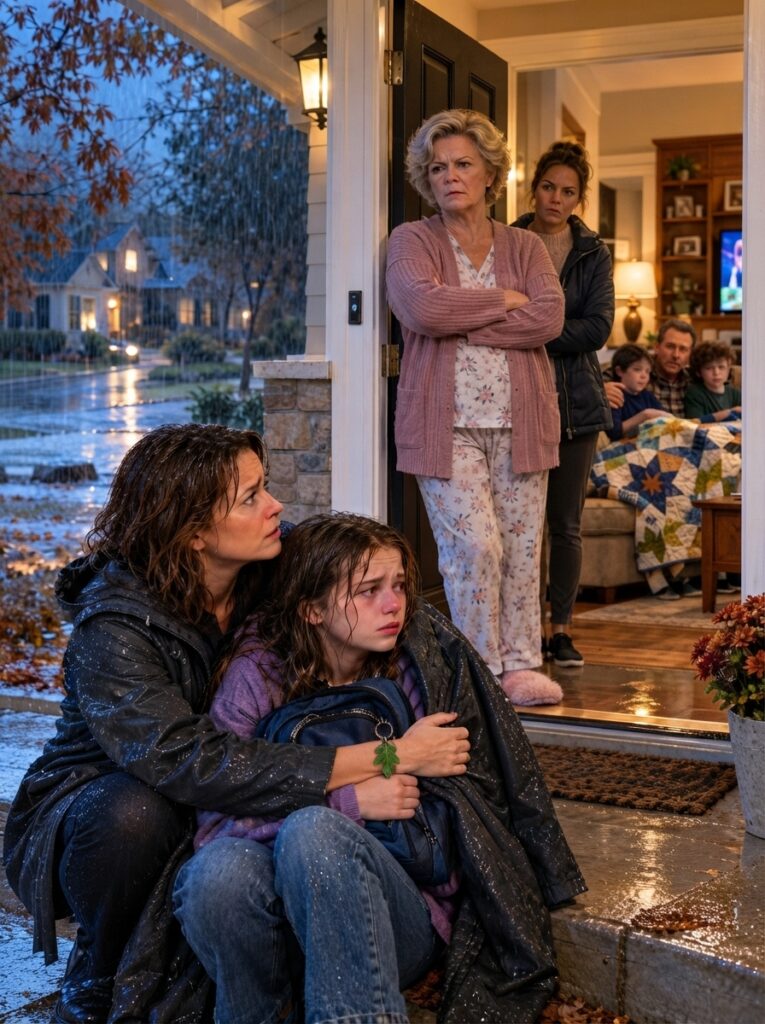
Clara had been sitting outside for almost three hours when I found her.
Three hours in a November storm.
Three hours beneath a narrow porch awning that did almost nothing to protect her from the freezing rain.
Three hours while her grandmother, her aunt, and her two cousins sat comfortably inside the house my father had spent his life maintaining.
When I pulled into the driveway, my daughter was curled against the brick wall, her backpack clutched to her chest.
Her dark hair hung in wet strands against her cheeks.
Her lips had turned pale, and her small hands were trembling.
But what broke my heart wasn’t the cold.
It was what she said when she saw me.
“I’m sorry, Mom.
I couldn’t make Grandpa’s key work.”
She held up the little brass key attached to a green metal oak leaf.
My father had given it to her two Christmases earlier.
He had told her that as long as she had that key, she would always have a place to come home to.
Now he was dead.
And apparently, his promise had died with him.
I knelt in the rain and gathered my daughter into my arms.
“You didn’t do anything wrong, sweetheart.”
“But Grandma said—”
“Whatever Grandma said, you did nothing wrong.”
Clara buried her face against my shoulder.
Behind us, the front door opened.
My mother stood beneath the warm porch light in her pink slippers, looking irritated rather than concerned.
“Rachel, there’s no need to make a scene.”
I slowly stood.
“Why was my daughter locked outside?”
She crossed her arms.
“We changed the locks.”
I stared at her.
“You changed the locks?”
“Yes.”
“Without telling me?”
My younger sister, Dana, appeared behind her.
She wore the expensive gray cardigan I’d bought her for Christmas.
Her dark hair was piled into a careless bun, and she had a glass of wine in one hand.
“Mom, we discussed this,” Dana said.
“No,” I replied.
“You discussed something.
I wasn’t included.”
Mother lifted her chin.
“We took a vote, Rachel.
Dana and her children need more room.
You and Clara need to find somewhere else.”
The words seemed to hang between us.
I glanced through the open doorway.
The television was playing in the living room.
Dana’s two children were sprawled across the couch, laughing at something on the screen.
Across their knees lay a blue-and-yellow patchwork quilt.
The quilt my dying father had sewn with Clara.
The last thing they had made together.
I looked back at my mother.
“You voted a child out of her own home?”
“Oh, don’t be dramatic.”
“She was outside for three hours.”
“She could have waited at a neighbor’s house.”
“She’s twelve.”
“And you’re forty.
Surely you can afford an apartment.”
I studied the woman who had raised me.
For most of my life, I’d believed that if I explained myself calmly enough, worked hard enough, sacrificed enough, my mother might eventually recognize my worth.
But something happened while I stood there with my shivering daughter.
I stopped wanting her approval.
“All right,” I said.
Mother blinked.
“What?”
“All right.”
“You’re not going to argue?”
I wrapped my coat around Clara.
“No.”
Dana looked almost disappointed.
“Well, you can’t blame us.
We’ve been trying to tell you for months—”
I held up my hand.
“Don’t.”
Then I helped Clara into my car.
I didn’t know it yet, but that quiet departure would become the beginning of the most extraordinary, painful, and ultimately beautiful chapter of my life.
Because forty-eight hours later, my father’s attorney would show me two documents.
The first would prove my mother had no authority to throw us out.
The second would expose a betrayal that had begun long before my father died.
And the final secret, hidden in the most ordinary object in our family, would change far more than the ownership of one house.
I am Rachel Moore, forty years old, divorced, and a hospital case manager in Richmond, Virginia.
My entire professional life was built around helping people find their way home.
When someone left the hospital, I coordinated what happened next.
Could the patient afford medication?
Was there electricity in the apartment?
Could an elderly woman safely climb three flights of stairs?
Was someone available to help a man recovering from surgery?
Doctors decided when people were medically ready to leave.
I helped determine whether they had somewhere safe to go.
For twelve years, I had watched families make promises they couldn’t keep.
Children who swore they would care for aging parents and then stopped answering the telephone.
Spouses who quietly admitted they couldn’t manage another night of interrupted sleep.
Elderly people who insisted everything was fine because they were too proud to ask for help.
I thought I understood what a safe home meant.
I simply hadn’t realized that my own daughter was living in a house where her security depended on keeping other people happy.
Clara’s father, Michael, and I had divorced when she was four.
There was no affair.
No explosive confrontation.
No scandal.
We had married young, discovered we wanted different things, and gradually become two people who made better co-parents than spouses.
Michael worked in commercial insurance and lived twenty minutes away.
Clara spent most school weeks with me and alternating weekends with him.
We communicated regularly, attended school conferences together, and never used our daughter to punish each other.
Our marriage had ended.
Our responsibility to Clara hadn’t.
She was a wonderfully unusual little girl.
She loved sketching old buildings, collecting strange buttons, and inventing elaborate stories about the people who had lived in abandoned houses.
She could spend an entire afternoon drawing the same tree from different angles.
She hated loud arguments.
She remembered every promise.
And she had adored my father from the moment she was old enough to recognize his voice.
His name was Arthur Moore.
Dad had repaired elevators for thirty-six years.
Office towers, hotels, hospitals, shopping centers, apartment buildings.
He understood machines in a way that seemed almost magical.
Sometimes he’d stand beside an elevator shaft, close his eyes, and listen.
Ten seconds later, he’d say, “Worn bearing,” or “Bad contactor,” or “Somebody skipped the maintenance schedule.”
He was almost always right.
At home, he was quieter.
Dad wasn’t the sort of man who made grand speeches about love.
He fixed your car without mentioning it.
He sharpened the kitchen knives when they became dull.
He replaced a broken porch step before anybody noticed it had become dangerous.
He showed affection through things that kept other people safe.
When I was little, he would carry me into his workshop and let me sit on an overturned bucket while he repaired appliances for neighbors who couldn’t afford professional service.
He had a favorite saying.
“Rachel, if something is broken, you don’t always have to throw it away.
Sometimes you just need to understand why it stopped working.”
For years, I believed he meant machines.
It took losing him to understand that he had been talking about people, too.
When Clara turned ten, she discovered an old ring of retired keys hanging beside his workbench.
None of them opened our house.
Some belonged to elevator service panels that no longer existed.
Others came from buildings that had been demolished.
“Grandpa, why do you keep useless keys?” she asked.
Dad looked at her for a long moment.
Then he smiled.
“A key isn’t useless just because the lock changes.
Sometimes it reminds you what used to open.”
Clara loved that answer.
That Christmas, he gave her a house key attached to a small green metal oak leaf.
“Our tree out front,” he said.
The oak tree had stood in our yard for decades.
Dad had built Clara a tire swing on one of its thick branches when she was six.
He had measured the ropes three times, tested the knots, and insisted on putting a thick layer of mulch beneath it.
Clara had laughed at his caution.
“Grandpa, it’s just a swing!”
He’d laughed back.
“That’s what people say right before they land on their bottoms.”
She carried that key everywhere.
Even after Dad became too weak to join her in the yard, she would show it to him when she returned from school.
“Still got my key, Grandpa.”
He’d smile.
“Good girl.”
Then came the illness.
Dad had survived lymphoma years earlier, but treatment had taken a toll on his body.
In his final year, congestive heart failure slowly robbed him of the strength he’d once taken for granted.
The man who could climb service ladders carrying forty pounds of equipment eventually needed help crossing his bedroom.
I reduced my hospital hours for six months.
I managed his medications, oxygen equipment, insurance appeals, cardiology appointments, and dietary restrictions.
Some nights, I slept in the recliner beside his bed because I was frightened of what might happen if he woke struggling to breathe.
Mother told relatives how exhausting caregiving had become.
I never corrected her.
She was his wife.
She was grieving the man she had married.
At least, that was what I told myself.
Meanwhile, Clara became Dad’s little shadow.
She did homework beside his recliner.
She made his tea with one spoonful of honey.
She read him chapters from books he’d once read to her.
And during those long months, they completed a quilt together.
Blue fabric for the evening sky.
Yellow stars.
Green oak leaves.
Crooked seams that wandered like country roads.
Dad’s hands often shook too much to thread a needle, so Clara threaded it for him.
He’d hold the fabric while she guided the stitches.
They worked slowly.
Sometimes they managed only one square in an entire afternoon.
But Dad never complained.
“This is good work,” he told her.
“Things made with love don’t have to be perfect.”
When the quilt was finished, he wrapped it around her shoulders.
“There,” he said.
“Now you can take a little piece of me wherever you go.”
He died three months later.
Seventeen months before my mother changed the locks.
At his funeral, Clara slipped a small drawing into his jacket pocket before the casket closed.
It showed the two of them sitting beneath the oak tree.
Underneath, she’d written:
Grandpa, I promise I’ll always remember where home is.
I had to leave the room after reading it.
Grief did strange things to our family.
Mother became impatient and easily offended.
I assumed it was because she missed Dad.
My younger sister, Dana, became increasingly dependent on her.
I assumed that was because Dana had never handled responsibility particularly well.
Dana was three years younger than I was.
She had always been the lively one.
The pretty one.
The one who turned minor inconveniences into family emergencies.
When Dana wrecked her first car at seventeen, Dad repaired the damage and Mother said she was lucky nobody had been hurt.
When I received a parking ticket at nineteen, Mother lectured me for an hour about responsibility.
When Dana lost a job, she needed encouragement.
When I worked overtime, I was neglecting my family.
When Dana needed money, she was struggling.
When I needed help, I was being dramatic.
The rules had always been different.
Dad tried to balance things, but he hated arguments and often settled disagreements by quietly helping me afterward.
As a teenager, I thought that meant he couldn’t stand up to Mother.
As an adult, I would discover there were other reasons for his silence.
Six months after his death, Dana separated from her husband, Eric.
She arrived with two children, several suitcases, and a story about how Eric had become impossible to live with.
Mother immediately invited her to stay.
“Just until she gets back on her feet.”
I agreed.
I remembered how difficult my own divorce had been.
I wanted to help.
At first, the arrangement seemed manageable.
Dana’s son Tyler was eleven.
Her daughter Madison was nine.
They took over Dad’s old study.
Clara helped them organize their belongings.
I bought extra groceries and rearranged our schedules.
But gradually, the house began changing.
Dad’s workshop became a storage room.
His favorite chair disappeared into the garage.
Dana’s gaming system occupied the living room.
Her children’s toys and clothes spread into the hallway.
Then Clara’s belongings began disappearing.
Her watercolor supplies were removed from the dining-room cabinet.
Her books were moved into boxes.
One afternoon, she came upstairs holding a framed photograph of Dad.
“Mom, why was this in the trash?”
My stomach tightened.
It was a photograph of Dad in his workshop, wearing his old blue work shirt.
I confronted Dana.
“Oh, for heaven’s sake,” she said.
“I was clearing out clutter.”
“That photograph belongs to Clara.”
“Then she should keep it in her room.”
“She did.
You moved it.”
Dana gave an exaggerated sigh.
“Rachel, we can’t turn this entire house into a museum.”
A week later, Clara’s quilt disappeared.
I found Tyler watching television beneath it.
When I took it upstairs, Mother accused me of embarrassing Dana.
“She has enough problems without you being territorial over a blanket.”
I stood in the kitchen holding the quilt against my chest.
“Dad made this with Clara.”
Mother looked away.
“Your father made plenty of things.”
Her indifference stunned me.
But I said nothing.
Because I had spent forty years believing peace was something I was personally responsible for maintaining.
So I compromised.
Clara could practice her flute only when Dana’s children weren’t watching television.
She had to keep her art supplies in her bedroom.
She stopped inviting friends over because Dana complained about noise.
Each concession seemed small.
Each argument seemed avoidable.
And every time I considered moving out, I imagined Dad’s workshop, the oak tree, and Clara sitting beside his recliner.
I told myself that staying was preserving his memory.
In reality, I was teaching my daughter that love meant accepting less and less space until there was nowhere left to stand.
I didn’t realize how far things had gone until one afternoon in October.
I came home early and heard Dana speaking on the telephone in the kitchen.
“No, she doesn’t know anything about the paperwork,” she said.
I stopped in the hallway.
“Mom’s handling it.
Rachel isn’t going to be a problem.”
There was a pause.
Then Dana laughed.
“Trust me.
She’s spent her entire life letting people walk all over her.
Why would she suddenly grow a backbone now?”
I stepped into the kitchen.
“What paperwork?”
Dana spun around.
For a fraction of a second, I saw fear in her eyes.
Then she smiled.
“School paperwork.
Tyler’s enrollment stuff.”
“Why would I be a problem?”
She shrugged.
“Because you make everything complicated.”
I wanted to question her further.
But my phone rang.
A patient had been admitted unexpectedly, and the hospital needed information from a recent discharge.
I left the kitchen.
By the following morning, the conversation had become another unpleasant memory I’d convinced myself wasn’t worth pursuing.
That was my second mistake.
The first had been believing that people who shared my blood necessarily wanted what was best for me.
The second was assuming that because I wasn’t hiding anything, nobody else was.
The Thursday storm arrived just before four in the afternoon.
Gray clouds rolled over Richmond, followed by driving rain that rattled the hospital windows.
I was scheduled to finish at five-thirty.
Instead, an elderly patient’s discharge collapsed when his son failed to arrive.
Another patient needed emergency authorization for home oxygen, and a third family demanded a meeting about rehabilitation coverage.
At six, my coworker Jasmine brought me coffee.
“You look terrible,” she said.
“Thank you.
That’s exactly the encouragement I needed.”
She smiled.
“Go home, Rachel.
These people aren’t all going to disappear if you leave.”
“I just need to finish two things.”
She raised an eyebrow.
“That’s what you said an hour ago.”
I put my phone in my desk drawer before joining a particularly difficult family conference.
By the time I retrieved it, the clock above my desk read 7:15 p.m.
Seven missed calls.
All from Clara.
There were also three text messages.
Mom, the key isn’t working.
Grandma won’t let me in.
Please come get me.
The last message had arrived at 6:42.
I’m really cold.
I called her immediately.
“Mom?”
Her voice was small and shaky.
“Where are you, sweetheart?”
“At home.”
“Are you inside?”
“No.”
My stomach dropped.
“Where’s Grandma?”
“Inside.”
“Did you ring the bell?”
“Yes.”
“What did she say?”
Clara hesitated.
“She said I needed to learn that things were changing.”
I remember gripping the edge of my desk.
“How long have you been outside?”
“Since the bus dropped me off.”
“Clara, honey, listen carefully.
I’m coming right now.”
I grabbed my coat.
Jasmine caught me near the elevator.
“What’s wrong?”
“My daughter is locked out of our house.”
“What?”
“My mother changed the locks.”
Jasmine looked at me as though she’d misheard.
“Your mother?”
I nodded.
She took one look at my face.
“Go.
I’ll finish the discharge notes.”
I don’t remember much about the drive.
Only the rain.
The red brake lights.
My hands shaking against the steering wheel.
And the terrible thought that kept repeating in my head.
My daughter called seven times, and nobody answered except the people who wanted to hurt her.
When I reached the house, everything unfolded exactly as I’d described: Clara beneath the awning, Mother at the doorway, Dana behind her, and the announcement of a family vote.
But there was one detail I didn’t understand until later.
When Mother told us to leave, Dana wasn’t looking at Clara.
She was looking past me, toward the garage.
And just before I drove away, I saw a man standing beside a dark SUV parked two houses down.
He wore a tan raincoat and was talking into his phone.
At the time, I assumed he was waiting for someone.
I would remember his face three days later.
By then, I would know why he had been watching our house.
I drove Clara to a hotel near the hospital.
The clerk looked at us with sympathetic confusion.
I was wearing damp scrubs beneath my coat.
Clara looked like she’d fallen into a swimming pool.
“Two nights?” he asked.
I swallowed.
“Let’s start with two.”
Upstairs, I turned the heat up, wrapped Clara in dry towels, and ordered soup from the hotel kitchen.
She sat on the bed beneath a thick white blanket, holding Grandpa’s key.
I watched her fingers move over the little green oak leaf.
“Mom?”
“Yes, sweetheart?”
“Did Grandma stop loving us?”
The question hurt worse than anything my mother had said.
I sat beside her.
“I don’t know what’s happening inside Grandma’s heart.”
“Maybe I did something wrong.”
“No.”
“But Aunt Dana said I was making everything harder.”
I turned toward her.
“When did she say that?”
Clara stared down at her hands.
“Last week.
She said Grandma was stressed because you kept acting like the house belonged to us.”
I felt my throat tighten.
“Why didn’t you tell me?”
“Because you always look tired when you get home.”
That sentence nearly destroyed me.
My twelve-year-old daughter had been protecting me from the truth because she thought I couldn’t bear one more problem.
I took her hands.
“Listen carefully, Clara.
You never have to hide something that’s hurting you just to make my life easier.”
She nodded.
“And no adult gets to make you feel guilty for needing a safe home.”
“But Grandpa said it would always be our home.”
I looked at the key.
“I know.”
“Was he wrong?”
I couldn’t answer immediately.
Then I said the only thing I knew was true.
“Your grandfather loved you more than anything.
Whatever happens to that house, nobody can take that away.”
She leaned against me.
After she fell asleep, I called Michael.
I told him everything.
He was silent for so long I thought the call had dropped.
Then he said, very quietly, “She left our daughter outside in that weather?”
“Yes.”
“Rachel, you should have called me.”
“I know.”
“No.
I don’t mean to criticize you.
I mean you never have to handle something like this alone.”
I closed my eyes.
Those words sounded strange.
For years, I had been the person everybody called.
Now someone was offering to carry part of the weight.
Michael arranged to pick Clara up the following morning and take her to his house for the weekend.
He also promised to contact a pediatrician if she showed signs of illness after being so cold.
“Rachel,” he said before hanging up, “don’t go back there alone.”
“Why?”
“Because people who change locks while a child is at school aren’t interested in having a reasonable conversation.”
I looked at the hotel room door.
He was right.
At eleven that night, my mother sent a text.
I hope you’ve calmed down.
We can discuss a reasonable date for you to collect your things.
Dana followed with another message.
Please don’t make this ugly.
Mom’s health can’t handle stress.
I stared at the screen.
Then I turned off my phone.
For the first time in my life, I let their emergencies remain theirs.
The next morning, Clara woke with a mild fever.
It wasn’t serious, according to the pediatrician Michael arranged to see her, but she was exhausted.
When her father arrived, she ran into his arms.
I watched him carry her overnight bag to his car.
She paused before getting inside.
“Mom?”
“Yes?”
“Can we get Grandpa’s quilt?”
I forced a smile.
“Of course.”
“Don’t let Aunt Dana throw it away.”
“I won’t.”
She held my gaze.
“Promise?”
“I promise.”
After they left, I returned to the hotel room and cried.
Not loudly.
Not dramatically.
I sat on the edge of the bed with my hands over my face and cried the way people do when they’ve been strong for so long that their bodies finally refuse to cooperate.
Then I remembered something.
My father had used the same attorney for more than twenty years.
His name was Leonard Whitcomb.
He had handled Dad’s estate paperwork, our family’s wills, and several legal matters involving the elevator company.
I found his office number in my contacts.
When his assistant answered, I explained who I was.
Within minutes, Leonard himself was on the telephone.
“Rachel?
Is everything all right?”
“No.”
He listened as I described the changed locks.
When I mentioned that Clara had been left outside, his voice changed.
“How long?”
“Almost three hours.”
There was a pause.
“Can you come to my office tomorrow morning?”
“Yes.”
“Bring your identification and any documents you have concerning the house.”
“I don’t have any.
Mom handled everything after Dad died.”
Another silence.
Then he said something I didn’t understand.
“That’s interesting, Rachel.
Because your father was very particular about who was supposed to handle that house.”
I sat upright.
“What do you mean?”
“I’d rather explain in person.”
“Leonard, am I about to discover we don’t have anywhere to live?”
“No,” he said firmly.
“Quite the opposite.”
Leonard Whitcomb’s office occupied the second floor of an old brick building near downtown Richmond.
He was seventy-one, silver-haired, and meticulous.
Dad had trusted him completely.
When I arrived Saturday morning, Leonard greeted me at the door himself.
He offered coffee.
I declined.
He didn’t insist.
Instead, he led me into his private office and opened a thick blue folder.
“Before we discuss your mother,” he said, “tell me what you understand about ownership of the house.”
I frowned.
“Dad and Mom bought it together.”
“Originally, yes.”
“After Dad died, I assumed it belonged to Mom.”
“Why?”
“Because she was his wife.”
Leonard leaned back.
“Marriage doesn’t automatically answer every question about property ownership.
Your father took specific steps to arrange what happened to the house.”
He placed a recorded deed and several trust documents in front of me.
The paperwork was dense.
Legal descriptions.
Property identification numbers.
Names and dates.
I recognized Dad’s signature.
Then I noticed another name.
Mine.
Beneath the heading Beneficiary.
“Why am I listed here?”
Leonard folded his hands.
“Because your father transferred the house into a trust before he died.
The trust names you as the primary beneficiary of the property and the successor trustee.”
I stared at him.
“What about Mom?”
“Judith has a personal right to occupy the house during her lifetime, subject to certain conditions.
It isn’t an ownership interest she can sell, transfer, or use to exclude the other people protected by the trust.”
He showed me the relevant provisions.
Dad had arranged for Mother to remain in the house.
But he had expressly protected my right, and Clara’s right, to live there as well.
Mother could not unilaterally remove us.
She could not change the locks to deny our access.
And she could not give Dana authority to displace us.
“Your mother signed an acknowledgment of these terms,” Leonard said.
I stared at the signature.
Judith Moore.
Dated almost two years earlier.
“She knew?”
“She signed the document.
Whether she understood it is another question.”
“She told me the house was hers.”
“That was not an accurate description of the arrangement.”
My face grew hot.
“Then she can’t force us out?”
“No.
And by deliberately excluding you and your minor daughter, she may have violated the conditions of her own occupancy rights.”
He looked directly at me.
“But I want you to understand something.
We will handle this properly.
We won’t imitate what your mother did by changing locks or physically forcing people out.”
I nodded.
“Of course.”
“Your father expected that you would want to proceed carefully.”
Something about his tone caught my attention.
“Expected?”
Leonard hesitated.
Then he reached into the folder and removed a sealed envelope.
My name was written across the front.
In Dad’s handwriting.
My heart seemed to stop.
“Arthur left this with me,” Leonard said.
“He gave me specific instructions about when I should deliver it.”
I touched the envelope.
“When?”
“If you were ever excluded from the family home.
Especially if Clara was involved.”
I looked up sharply.
“Dad knew?”
Leonard’s expression was deeply sad.
“He was worried it might happen.”
My hands shook as I opened the envelope.
Inside was a letter.
The first sentence made my eyes fill with tears.
“Rachel, if you’re reading this, your mother has finally done what I feared she would.”
I pressed my fingers against my mouth.
The letter continued.
I know you, sweetheart.
You will try to understand everyone.
You will wonder whether you should have worked less, helped more, spoken differently, or kept quiet.
Please stop.
You have spent your entire life earning a place in a family where your place should never have been questioned.
The house is not a reward for being obedient.
It is your home.
And if anyone ever uses Clara’s safety to control you, I want you to remember something I should have taught you much earlier.
“Peace purchased with a child’s fear is not peace.
It is surrender.”
I began crying.
Leonard quietly passed me a tissue.
I read the next paragraph.
There are things I should have told you while I was alive.
I kept hoping I could solve them without hurting you.
That was my mistake.
Leonard has the papers.
Trust him.
And remember the little green oak leaf.
I read the last line three times.
“The key?”
I whispered.
Leonard looked puzzled.
“What key?”
“Clara’s house key.
The one Dad gave her.”
Leonard slowly shook his head.
“Arthur never explained that part to me.”
Then he removed a second document from the folder.
“This is what I need to show you next.”
Before I could read it, my phone rang.
MOM.
I almost ignored the call.
Leonard glanced at the screen.
“Would you like to answer?”
I hesitated.
Then I put the phone on speaker.
“Rachel!”
Mother snapped immediately.
“Dana says somebody from a lawyer’s office called about the house.
What are you doing?”
“Finding out what Dad actually left us.”
“What is that supposed to mean?”
Leonard leaned forward.
“Good morning, Judith.
This is Leonard Whitcomb.”
The silence was immediate.
Then my mother said, “Leonard?”
“Yes.
Rachel is here with me.”
“Well, this is a private family matter.”
“I understand your position,” he said calmly.
“However, the house is trust property, and I believe we need to review your obligations.”
“My obligations?”
“Particularly the agreement you signed regarding Rachel and Clara.”
Another silence.
Then Mother said something extraordinary.
“That agreement doesn’t count anymore.”
Leonard’s eyes narrowed.
“Why would you believe that?”
“Because Dana said we had it taken care of.”
I felt something twist inside my stomach.
Leonard sat very still.
“Judith, who is ‘we’?”
My mother didn’t answer.
Then the call ended.
Leonard stared at the phone.
And for the first time since I’d entered his office, I saw genuine alarm cross his face.
“Rachel,” he said, reaching for the second document, “I think we need to move faster than I originally planned.”
The second document was titled:
NOTICE OF PROPOSED TRANSFER OF REAL PROPERTY.
My mother’s name appeared near the top.
Dana’s was listed beneath it.
The proposed sale price was $685,000.
I stared at the page.
“Sale?”
Leonard nodded grimly.
“Someone has been trying to sell your father’s house.”
I felt as though the chair had disappeared beneath me.
“They can’t.”
“No.
They can’t legally convey this property under the authority they’re claiming.”
“Then why is there a sale document?”
“Because someone has represented to a prospective buyer that Judith controls the property.”
He showed me an attached letter.
It was supposedly signed by me.
The signature was a surprisingly good imitation.
But it wasn’t mine.
According to the document, I had voluntarily relinquished my beneficial interest in the house and consented to Mother’s proposed sale.
My breath caught.
“That’s a forgery.”
“I suspected as much.”
“Where did you get it?”
“A title company contacted my office yesterday.
My firm was listed in the trust documents, and their examiner questioned whether this supposed consent was authentic.”
I looked at the date.
The document had been signed three weeks earlier.
Three weeks.
While I was working hospital shifts, preparing Clara’s school lunches, buying groceries, and trying to keep our fractured family together, my mother and sister had been arranging to sell the house beneath our feet.
“How far has this gone?”
“Far enough that we need to act immediately.”
Leonard explained that a real estate intermediary had been marketing the property through a private investor network.
A buyer had submitted an offer.
And an advance payment had reportedly been made to an account controlled by Dana.
The legitimate title review had stopped the transaction from closing, but Leonard was concerned someone might attempt additional fraudulent filings.
“That explains the locks,” I whispered.
Leonard looked at me.
“They weren’t simply making room for Dana.”
“No.”
I remembered the conversation I’d overheard in October.
Mom’s handling it.
Rachel isn’t going to be a problem.
I remembered Dana watching the garage as we left.
The man in the tan raincoat.
And suddenly, everything connected.
They hadn’t just wanted us out of the house.
They needed us out before somebody discovered who actually had the authority to sell it.
Leonard contacted the title company and prepared formal notices disputing the documents.
He also contacted an attorney who handled property litigation.
“We’ll seek appropriate relief to protect your access to the home and prevent unauthorized transfers,” he explained.
“If your mother refuses to cooperate, we’ll ask the court to intervene.”
I nodded.
“Do whatever is necessary.”
He paused.
“Rachel, there is another practical issue.
Your father granted Judith occupancy rights because he didn’t want her left without a home.
But those rights came with responsibilities, including the obligation not to exclude you and Clara.”
“Can we make her leave?”
“Possibly, after following the procedures in the trust and obtaining any required court orders.
But first, we need to protect you and stop the attempted sale.”
I looked down at Dad’s letter.
“Why didn’t he tell me any of this?”
Leonard removed his glasses.
“Arthur didn’t want you fighting with your mother while he was dying.”
I shook my head.
“He should have trusted me.”
“Perhaps,” Leonard said gently.
“But I think he was afraid you would try to protect everyone except yourself.”
That sounded painfully accurate.
Before I left, Leonard asked about Clara’s oak-leaf keychain.
I described it.
He considered this for a moment.
“Arthur once asked me to arrange safekeeping for several personal records.
He said his old service keys mattered more than people realized.”
“What records?”
“He never gave me the details.
He was still organizing them when his health worsened.”
I felt a flicker of unease.
“Could there be more documents?”
“Possibly.”
He closed the folder.
“Your father was a careful man, Rachel.
Sometimes frustratingly careful.”
Then he added, “Whatever that key means, I suspect Arthur wanted Clara to help you discover it.”
By Monday morning, my mother had called fourteen times.
Dana had sent six texts.
The tone of her messages shifted rapidly.
First came indignation.
You’re humiliating Mom.
Then accusation.
You always thought you were better than us.
Then negotiation.
We can work something out if you stop involving lawyers.
Finally, just after midnight:
Rachel, please call me.
This is serious.
I didn’t answer.
I was sitting at Michael’s kitchen table while Clara slept upstairs.
He’d insisted I stay with them until I had a more permanent arrangement.
His wife, Rebecca, was visiting her parents that weekend, but she’d called to tell me I was welcome for as long as necessary.
That kindness made me cry more than I expected.
Michael poured coffee into two mugs.
“You know what worries me?” he asked.
“What?”
“Not the house.”
I looked at him.
“Clara.”
He nodded.
“She asked me twice whether she could be sent away from here, too.”
I closed my eyes.
“God.”
“She doesn’t trust doors anymore, Rachel.”
The words settled heavily between us.
I thought about all the patients I’d helped who were afraid to leave the hospital because they didn’t feel safe at home.
I had always understood that security was more than a roof and four walls.
Now my own daughter was teaching me just how fragile it could be.
“I want her back in that house,” I said.
“But I don’t want her living with people she’s afraid of.”
“Then don’t make the house the goal.”
I looked up.
“Make her safety the goal,” Michael said.
“Whatever happens to the building.”
It was the clearest advice anyone had given me.
The following morning, I met Leonard again.
This time, Michael came with me.
Leonard had located the man in the tan raincoat.
His name was Grant Weller.
He was a real estate intermediary who specialized in purchasing distressed properties.
He had been communicating with Dana for almost two months.
The documents showed that Dana had represented herself as an authorized family representative with power to arrange the sale.
Weller claimed he had relied on documents she supplied.
The prospective buyer’s attorney was cooperating with Leonard’s investigation.
But the most disturbing discovery was a copy of the proposed distribution of sale proceeds.
After fees, supposed debts, and an unexplained “family reimbursement,” Dana expected to receive more than $250,000.
Mother would receive another substantial payment.
My name was nowhere on the distribution schedule.
Neither was Clara’s.
I studied the figures.
“She was going to give Dana a quarter of a million dollars?”
Leonard nodded.
“And possibly more.”
“Why?”
He looked uncomfortable.
“I think you should speak with your sister’s husband.”
“Eric?”
“Yes.”
“He’s barely spoken to us since the separation.”
“That may be because he was trying to protect himself.”
Eric agreed to meet me at a coffee shop the following afternoon.
He arrived looking exhausted.
He was a decent man who worked in information technology, quiet and somewhat awkward, with a habit of polishing his glasses whenever he was nervous.
When Dana had announced their separation, she’d claimed Eric was controlling and emotionally unavailable.
I had accepted her explanation.
I was beginning to understand how dangerous that habit had become.
Eric sat across from me.
“How’s Clara?”
“She’s recovering.”
He shook his head.
“What Judith did was unforgivable.”
I watched him carefully.
“Why did you and Dana really separate?”
He stared into his coffee.
“She told you I stopped supporting the family, didn’t she?”
“Something like that.”
He gave a bitter laugh.
“Rachel, I discovered she’d opened credit accounts without telling me.
She’d been moving money around for almost a year.”
“How much?”
“Nearly ninety thousand dollars, between personal loans and credit cards.”
I stared at him.
“What?”
“She kept telling me everything was temporary.
A business opportunity.
An investment.
Then I found out she’d been using our children’s college savings.”
I felt sick.
“She said you two were arguing about your work schedule.”
“We were.
But mainly because I was working extra hours trying to pay bills I didn’t know existed.”
He took a folder from his bag.
“I didn’t want the kids dragged into a financial war.
That’s why I kept quiet.”
Inside were bank statements, loan applications, and correspondence from a collection agency.
Several documents referenced a property on Oakridge Lane.
My father’s address.
“Why is Dad’s house on these papers?”
Eric looked at me.
“Dana told me Judith was selling it.”
I felt the blood drain from my face.
“When?”
“Before she moved in.”
I froze.
Before she moved in.
The separation had happened six months after Dad’s death.
Dana had arrived supposedly needing temporary shelter.
But according to Eric, she’d already been talking about selling the house.
“Rachel,” he said carefully, “I think Dana moved in because she believed she could get control of the property.”
I shook my head.
“No.
Mom invited her because—”
I stopped.
Because what?
Because Dana needed help?
Because she was going through a divorce?
Or because my mother and sister needed somebody inside the house who could slowly push us out?
Eric reached across the table.
“There’s something else.”
He hesitated.
“Dana said your father had promised her something before he died.”
My pulse quickened.
“What?”
“She said he’d told her there was money hidden somewhere in the property.
Money he didn’t want Judith knowing about.”
I stared at him.
“That’s ridiculous.”
“Maybe.
But she became obsessed with finding his old records.”
Suddenly I remembered the workshop.
The boxes.
The papers I’d noticed missing.
The way Dana had taken over Dad’s study before moving gradually into every other room.
And the quilt.
The quilt that had disappeared from Clara’s bedroom.
“What kind of records?”
I asked.
Eric shrugged.
“She kept talking about an old building, some sort of elevator business, and something Arthur had bought years ago.”
He frowned.
“I assumed she was inventing another story to justify borrowing money.”
I sat absolutely still.
Because Dad had once mentioned something about a building.
Years earlier.
At the time, I’d thought he was talking about a repair job.
He’d said, “One day, Rachel, I want to show you a place where nobody has to be afraid of being turned away.”
I’d laughed.
“Are you secretly building a castle, Dad?”
He’d smiled.
“Nothing that fancy.”
I hadn’t asked another question.
Now I wished desperately that I had.
On Tuesday morning, Leonard obtained an agreement preserving the property’s status while the disputed documents were investigated.
No legitimate closing could proceed under the purported consent bearing my forged signature.
He was also pursuing a court order concerning our access and Mother’s breach of the occupancy agreement.
Meanwhile, an attorney representing the buyer confirmed that the transaction had been suspended.
Dana was furious.
She called from an unfamiliar number.
I answered before recognizing her voice.
“Rachel, do you have any idea what you’ve done?”
I was standing in the hospital parking garage.
“Yes.”
“You’ve destroyed everything!”
“That depends on what you were trying to accomplish.”
“Mom was going to sell the house and help me start over!”
“It’s not her house to sell.”
“You’re unbelievable.
You don’t even need that place!”
“My daughter lived there.”
“She can live with Michael.”
I closed my eyes.
There it was.
The truth, delivered without shame.
To Dana, Clara wasn’t a child who deserved security.
She was an inconvenience with another possible address.
“You left her outside in a storm,” I said.
“I didn’t leave her anywhere.
Mom handled the locks.”
“You knew.”
Dana said nothing.
“Did you know Clara would be locked out?”
“I knew you needed to move.”
“Did you know she’d be standing there after school?”
“Stop twisting everything!”
I took a slow breath.
“I’m going to ask you one question, Dana.”
“What?”
“Did you forge my signature?”
Silence.
Then she laughed.
“You’re being ridiculous.”
“Did you?”
“Mom said Dad wanted us to share everything.”
“That isn’t an answer.”
“You’re destroying this family over paperwork!”
I looked at the concrete floor.
“No, Dana.
You tried to sell my daughter’s home without our consent.”
Her voice became sharp.
“You think you’ve won because some old lawyer waved a piece of paper around?”
I didn’t answer.
Then she said something that made my skin crawl.
“You’d better hope you find whatever Dad hid before somebody else does.”
The line went dead.
I stood motionless.
Until that moment, I had believed the forged sale was the whole scheme.
Now I understood something else.
Dana had been searching for a secret.
And she thought I knew what it was.
That evening, Clara and I sat on Michael’s living-room floor.
She was drawing the oak tree.
Michael had gone to pick up dinner.
I studied her picture.
“You remember Grandpa’s workshop?”
Clara nodded.
“Of course.”
“Did he ever show you anything unusual?
A special box?
A locked drawer?”
She stopped drawing.
“Why?”
“I’m trying to find some things he may have left.”
Clara thought for a moment.
“He had a blue metal cabinet.”
“I remember.”
“He told me not to lose the little leaf.”
I frowned.
“What little leaf?”
She held up her keychain.
“This one.”
I leaned closer.
It was a small green metal oak leaf, about the size of a quarter.
The paint had chipped along one edge.
“I thought he meant because it was a gift,” she said.
“So did I.”
Clara turned it over.
Then she pointed to a tiny seam along its edge.
“Grandpa said he made it himself.”
I studied it.
At first, it looked like an ordinary souvenir keychain.
But Dad had never done anything ordinary when he could make it slightly more complicated.
There was a nearly invisible notch beside the stem.
I pressed it gently with my fingernail.
Nothing happened.
Clara frowned.
“He always used to turn it when he talked about the key.”
“Turn it?”
She nodded.
“Like this.”
She rotated the leaf halfway around its center.
There was a faint click.
A tiny panel opened.
Inside was a second key.
Not a house key.
A narrow silver key with a square head, carefully fitted into a hidden recess.
Clara gasped.
“Mom!”
I stared at it.
My father had given my daughter a keychain containing another key.
A key nobody knew existed.
And suddenly, I remembered the last line of his letter.
Remember the little green oak leaf.
I pulled the second key free.
Along its metal shaft were three tiny stamped characters.
A-17.
My heart began to pound.
Clara looked up at me.
“What does it open?”
I thought about Dad’s old workshop.
The blue cabinet.
The missing records.
And Dana’s strange warning.
“I think,” I whispered, “your grandfather was trying to tell us something.”
The following morning, Leonard arranged for me to collect our belongings from the house.
He came with me.
Michael accompanied us as well.
A uniformed officer was present for the civil standby, although everyone understood that the officer wasn’t there to decide who owned the property.
When Mother opened the door, she looked as though she’d aged ten years.
Dana stood behind her.
Neither smiled.
“You brought the police?”
Mother demanded.
“I brought witnesses,” I replied.
Leonard explained that we were collecting Clara’s belongings and certain personal effects.
Mother reluctantly stepped aside.
The house smelled exactly as it always had.
Coffee.
Furniture polish.
The faint scent of cedar from Dad’s workshop.
For one painful moment, I wanted to go backward in time.
I wanted Dad in his recliner.
Clara sitting beside him with her sewing basket.
Mother humming in the kitchen before bitterness seemed to become her only language.
But then I saw Clara’s empty bedroom.
Her drawings had been removed from the walls.
Her books were stacked in cardboard boxes.
And her bed was covered with Dana’s extra clothing.
I stood in the doorway.
Something inside me went still.
This wasn’t an impulsive decision made during a family argument.
They had been preparing to erase us.
I took photographs.
Then I packed Clara’s belongings.
Michael carried the boxes downstairs while Leonard documented what we removed.
When I entered Dad’s workshop, I found the old blue cabinet beneath his workbench.
Its paint was chipped.
The handle was scratched.
A rusty lock hung from the front.
I took the tiny silver key from the oak-leaf keychain.
A-17.
My hands trembled as I slipped it into the lock.
It turned.
The cabinet opened.
Inside were several ordinary maintenance manuals, a folded canvas tool roll, and a narrow metal document box.
I lifted the box onto the workbench.
It wasn’t locked.
Inside lay a photograph, a set of papers wrapped in plastic, and a small digital recorder.
The photograph showed Dad standing in front of a three-story brick building.
Beside him stood an older Black man with a broad smile and paint on his overalls.
I recognized him.
Malcolm Hayes.
Dad’s closest friend from the elevator company.
Across the bottom of the photograph, Dad had written:
Oak Leaf House.
The beginning.
I unfolded the first document.
It was a property record.
The address was 17 Alder Street, Richmond, Virginia.
The next page was a financial statement from an account I’d never seen.
Then another.
And another.
At the top of the final document were the words:
OAK LEAF HOUSING TRUST.
I sat down hard on Dad’s old stool.
“What is this?”
I whispered.
Behind me, someone gasped.
Dana.
She stood in the workshop doorway.
Her face had gone completely white.
“Where did you get that?”
I looked at her.
“From Dad’s cabinet.”
Her eyes dropped to the silver key.
Then she took a step forward.
“Rachel, give me those papers.”
I stood.
“No.”
“You don’t understand what you’re holding.”
“Then explain it.”
She glanced toward the hallway.
“That money was supposed to help all of us.”
I stared at her.
“What money?”
Dana stopped speaking.
Leonard appeared behind her.
“Is there a problem?”
She stepped backward.
“No.”
But her eyes remained fixed on the documents.
And for the first time in my life, I saw my sister look genuinely afraid of me.
Malcolm Hayes lived twenty minutes outside Richmond.
He arrived at Leonard’s office that afternoon carrying a leather briefcase and wearing the same blue work jacket I’d seen him wear at Dad’s funeral.
When he saw me, his eyes filled.
“Lord, Rachel.
You look just like Arthur when you’re angry.”
I almost laughed.
Then I began crying.
Malcolm hugged me.
“I’m sorry, sweetheart.
I should have called you sooner.”
We sat together around Leonard’s conference table.
The documents from Dad’s cabinet lay between us.
Malcolm touched the photograph.
“Your father and I worked together for thirty-six years,” he said.
“But most people never knew what he did after hours.”
I frowned.
“What do you mean?”
He smiled sadly.
“Arthur didn’t just repair elevators.
He designed things.”
I remembered Dad sketching mechanical diagrams on graph paper.
He was always building small devices in his workshop.
I had assumed they were simply hobbies.
“Years ago,” Malcolm continued, “he developed a diagnostic safety system that could identify certain elevator faults before they became dangerous.
He worked with engineers to test it and eventually licensed the design through a small company.”
I stared at him.
“Dad invented something?”
Malcolm nodded.
“He helped invent something.
And he was very careful about how the money was handled.”
“How much money?”
Malcolm exchanged a glance with Leonard.
Then he opened his briefcase.
“Your father received payments over a number of years.
Some went toward household expenses, medical care, and taxes.
But much of it was invested.”
My heart began pounding.
“Invested where?”
Malcolm slid a photograph toward me.
It showed the brick building on Alder Street.
“Here.”
I looked down.
The building had tall windows, an old freight entrance, and a faded sign above the door.
“That used to be our company’s maintenance annex,” Malcolm said.
“Arthur bought it after the business moved.
He planned to turn it into housing.”
“Housing?”
“For people who needed a safe place after leaving hospitals.
Families who couldn’t afford accessible apartments.
People who needed a bridge between discharge and permanent housing.”
I couldn’t speak.
My entire career had been devoted to helping people find exactly those things.
Malcolm smiled gently.
“He was proud of the work you did, Rachel.
More proud than you can imagine.”
I wiped my eyes.
“He never told me.”
“He wanted it to be a surprise.
Then he got sick.”
Malcolm explained that Dad had quietly worked with architects and contractors to renovate the building.
Accessible bathrooms.
Wide doorways.
Emergency call systems.
An elevator modernized to accommodate wheelchairs.
Twelve small apartments designed for people who needed temporary stability.
He called it Oak Leaf House.
But Dad’s illness had delayed the project.
After he died, Malcolm continued supervising the remaining work using money already allocated to the separate housing trust.
The property had no connection to Mother’s occupancy rights in our family home.
That was when Leonard handed me another document.
“Arthur named you to oversee the housing trust once its development conditions were satisfied.”
My breath caught.
“Me?”
“Yes.
The trust includes funding for completing the renovation and supporting its initial operations.”
I stared at the papers.
According to the latest accounting, the trust held the building and approximately $2.4 million in invested and reserved funds.
Not all of it was available for spending.
Much of it was committed to construction, maintenance, insurance, and future residents.
But it was more money than I had ever imagined Dad possessing.
I looked at Malcolm.
“Why didn’t he tell Mom?”
Malcolm’s expression changed.
“Rachel, your father tried to tell her about the project.”
I froze.
“What?”
“She wanted him to sell the building.”
My stomach tightened.
“Why?”
“Because she believed the money should go to Dana.”
He paused.
“Your father refused.”
I remembered Dana’s warning.
You’d better hope you find whatever Dad hid before somebody else does.
Now I understood.
She had known there was another property.
But she hadn’t known how to gain control of it.
“After Arthur died,” Malcolm continued, “Judith asked me whether the building could be sold.
I told her it wasn’t hers.
She was furious.”
I stared down at the photograph.
All those months, I’d believed Mom was simply grieving.
Instead, she had been angry that Dad’s money was protected from her control.
Leonard cleared his throat.
“Rachel, I need to explain one final document.”
I looked up.
He placed a trust schedule in front of me.
“Your father didn’t establish Oak Leaf House solely for patients leaving the hospital.”
I frowned.
“What do you mean?”
Leonard pointed to a clause in the charitable purpose statement.
“It also provides for families displaced through domestic conflict, financial exploitation, or unsafe living arrangements.”
I thought about Clara outside in the storm.
Then I noticed something beneath the list of purposes.
A handwritten dedication.
For Clara, and every child who should never have to wonder whether someone will open the door.
My vision blurred.
“How could Dad have known?”
Malcolm reached for the small digital recorder.
“He didn’t know exactly what would happen.
But he knew your mother was becoming increasingly controlling.
He saw how Dana treated you.
And he was frightened that after he died, there would be nobody left to intervene.”
He placed the recorder in front of me.
“Arthur wanted you to hear this yourself.”
I pressed play.
Static whispered through the speaker.
Then Dad’s voice filled the conference room.
Weak.
Raspy.
Unmistakably his.
“Hey, sweetheart.”
I covered my mouth.
“If you’re listening to this, I guess Leonard and Malcolm finally got you to stop working long enough to hear what I had to say.”
Malcolm smiled through his tears.
Dad coughed.
“I’ve spent my life fixing elevators.
Funny thing about those machines.
People think the important part is going up.”
He paused.
“But when something goes wrong, the most important thing is making sure everybody can get out safely.”
I began crying.
“Rachel, I watched you spend your life finding safe places for strangers.
You never asked whether they deserved help.
You just helped.”
His voice weakened.
“I wanted to build something that would let you keep doing that.”
Another pause.
“And if things ever become difficult with your mother, remember that you don’t have to earn the right to be safe.”
He drew a shaky breath.
“Tell Clara I love her.”
Then, softly:
“And tell her Grandpa kept his promise.
She will always have a key to a place where she belongs.”
The recording ended.
For a long time, nobody spoke.
The legal dispute over our original house continued for several months.
There was no magical courtroom moment in which the judge struck a gavel and handed me everything.
Real life was messier.
There were motions, meetings, sworn statements, and expenses.
But the documents were clear.
Dad had protected my interest in the house.
Mother had signed the occupancy agreement.
She had violated its terms.
And my signature on the proposed sale documents was not authentic.
When investigators examined the financial records, they uncovered transfers connected to Dana’s personal debts and the attempted property sale.
Dana eventually admitted she’d signed my name without permission.
She claimed she believed Mother had the authority to sell the house and that my consent was a meaningless technicality.
The explanation did not excuse what she’d done.
She faced criminal charges related to the forged documents and entered a plea agreement that included restitution and probation.
Eric obtained a revised custody arrangement, and his children gradually adjusted to spending more time with him.
The court proceedings concerning Mother’s occupancy rights took longer.
Ultimately, after mediation and a formal settlement, she agreed to relinquish her conditional right to occupy the house.
She would leave voluntarily by a specified date.
In return, we resolved the remaining property dispute without prolonging the litigation.
I did not force her onto the street.
She had somewhere else to go.
That, too, was something I’d learned.
During the investigation, Leonard discovered that Mother had an apartment she had inherited from her own aunt several years earlier.
She had been renting it out.
The rental income had helped fund Dana’s spending.
My mother had possessed another home the entire time she insisted Clara and I had to leave ours.
I remember the day I confronted her.
We met in Leonard’s office.
She looked smaller than I remembered.
Her hair was neatly styled.
Her handbag sat on her knees.
“Your father always favored you,” she said bitterly.
I shook my head.
“No, Mom.
Dad noticed what I was doing.”
“That’s not fair.”
“Neither was leaving Clara in the rain.”
She looked away.
“I didn’t think she’d be outside so long.”
“You knew she’d be coming home from school.”
“I thought you’d answer your phone.”
I stared at her.
“And if I had?
What did you expect me to do?”
She said nothing.
“Leave work?
Come pick her up?
Tell her Grandma didn’t want her anymore?”
Tears gathered in Mother’s eyes.
“Dana needed help.”
I nodded slowly.
“And apparently, that meant Clara didn’t deserve a home.”
Mother began crying.
For forty years, her tears had been enough to make me apologize.
This time, I simply sat there.
When she reached across the table, I moved my hand.
“Rachel, I’m still your mother.”
“I know.”
“Surely that means something.”
“It does.”
I took a breath.
“It means you should have known better.”
She lowered her head.
I wanted to hate her.
Sometimes I did.
But mostly, I felt an enormous sadness for the woman she had chosen to become.
I didn’t forgive her that day.
I didn’t promise we would ever return to the relationship we’d had before.
I simply told her that Clara’s safety came first.
And for once, I meant it without qualification.
Six months after the storm, Clara and I moved back into the family house.
Before we returned, I had the locks professionally replaced.
This time, I made sure my daughter had a working key.
We cleaned the rooms.
Repainted Clara’s bedroom.
Returned Dad’s photograph to its place beside the staircase.
And carefully spread the blue-and-yellow quilt across her bed.
That evening, Clara stood beneath the oak tree.
The tire swing moved gently in the spring breeze.
“Mom?”
“Yes?”
“Do you think Grandpa knew we’d be okay?”
I looked at the house.
Then at the green oak leaf hanging from her fingers.
“I think he hoped we’d figure out how to be.”
She considered that.
Then she smiled.
“That’s a very Grandpa answer.”
I laughed.
For the first time in months, the sound came easily.
But our story wasn’t finished.
Not even close.
Because the most astonishing discovery was still waiting at Oak Leaf House.
By early summer, the building on Alder Street was ready for its first residents.
Malcolm had worked tirelessly with contractors, accountants, accessibility specialists, and a nonprofit housing organization.
I had helped develop the referral procedures, eligibility standards, and transition plans.
We weren’t going to solve Richmond’s housing problems with twelve apartments.
But twelve safe apartments could change twelve lives at a time.
And those lives mattered.
On the morning of the opening, I took Clara with me.
She wore a yellow dress and carried her grandfather’s quilt in a canvas bag.
We walked through the restored brick entrance together.
The lobby was warm and bright.
Wide windows allowed sunlight to spill across the floor.
A small bench stood beside the elevator.
On the wall hung a photograph of Dad wearing his blue work shirt.
Beneath it was a plaque.
ARTHUR MOORE — FOUNDER
Every person deserves somewhere safe to land.
Clara touched the plaque.
“He really built this?”
“Yes, sweetheart.”
“For people who need homes?”
“That’s right.”
She was quiet for a moment.
Then she said, “I think Grandpa would like that.”
I nodded.
But when Malcolm approached us, he was holding another envelope.
“There’s something Arthur asked me to save until the building was ready,” he said.
I smiled through sudden tears.
“That man really loved leaving surprises.”
Malcolm chuckled.
“He certainly did.”
Then he handed the envelope to Clara.
Not me.
Her.
On the front, in Dad’s handwriting, were the words:
For my little oak leaf, when the doors finally open.
Clara looked at me.
“Can I?”
“Of course.”
She carefully opened the envelope.
Inside was a photograph of Dad standing beside a newly installed elevator.
And a letter.
Clara read the first lines silently.
Then her expression changed.
“Mom?”
“What is it?”
She handed me the page.
Dad had written:
My darling Clara,
Someday, when you’re older, you’ll understand why grown-ups sometimes fail to protect the people they love.
I hope your mother teaches you something I learned much too late: love should never require you to make yourself smaller.
I’ve left a special responsibility for you in the Oak Leaf Housing Trust.
When you are old enough, you will have the opportunity to help decide how this place serves the children and families who need it.
But there is something I want you to understand before that day comes.
This building isn’t really my greatest gift to you.
Your mother is.
My eyes filled.
Then I read the final paragraph.
“Rachel has spent her whole life opening doors for other people, Clara.
I built this place because I wanted the world to give her a chance to walk through one herself.”
I couldn’t finish reading aloud.
Clara threw her arms around me.
We stood together in the lobby of the building my father had quietly created.
And I thought that was the end of his surprises.
I was wrong.
Malcolm approached us again.
“Rachel, there’s one last thing.”
He reached into his jacket pocket.
A small brass key.
Attached to another green oak leaf.
Identical to Clara’s.
I stared at it.
“Where did you get that?”
“Arthur made two.”
“Two?”
Malcolm nodded.
“One for Clara.
One for you.”
He placed it in my hand.
Then he pointed toward a hallway at the rear of the building.
“Come with me.”
We followed him past the elevator and through a pair of wooden doors.
At the end of the hallway was a small apartment.
The number on the door was 101.
Malcolm stopped.
“Arthur finished this one before he became too sick to continue visiting.”
I looked at him.
“Why this apartment?”
He smiled gently.
“Open it.”
My hands shook as I slipped the key into the lock.
The door swung inward.
Sunlight poured through wide windows.
There was a comfortable living room, a small kitchen, and a balcony overlooking a courtyard.
Everything was accessible.
Everything was thoughtfully arranged.
But what stopped me wasn’t the furniture.
It was the wall.
Across one entire wall hung photographs.
Not of Dad.
Not of the building.
Photographs of people.
Elderly patients.
Single parents.
Children.
People whose names I recognized.
My hand flew to my mouth.
These were people I’d helped during my years as a hospital case manager.
Some had struggled with transportation.
Some had needed temporary housing.
Some had been frightened to leave the hospital because they had nowhere safe to go.
Beneath each photograph was a short handwritten note describing help received from an anonymous community assistance fund.
I turned toward Malcolm.
“What is this?”
His eyes were shining.
“Your father asked us to quietly support a small emergency assistance program while he was developing Oak Leaf House.”
I stared at him.
“What program?”
Malcolm smiled.
“The one your hospital’s social work department partnered with for emergency patient support.”
I stepped backward.
“No.”
He nodded.
My knees suddenly felt weak.
For years, I’d helped patients access emergency funding from a local charitable account.
Sometimes it paid for medical transportation.
Sometimes short-term lodging.
Sometimes a deposit on an apartment.
I had never known the private donor’s identity.
The program was administered independently, and I had never handled its donations.
But I remembered the relief on patients’ faces when they learned help had been approved.
I remembered thanking the anonymous donors in my monthly reports.
I remembered telling coworkers that whoever funded those grants must understand how frightening it was to leave a hospital without a safe place to go.
The donor had been my father.
All along.
The man I’d believed was simply an exhausted elevator mechanic spending his final years in a recliner had been quietly helping me save strangers.
He’d listened when I came home talking about patients who needed transportation or temporary shelter.
Then he’d found a way to help them.
Without taking credit.
Without telling me.
Without asking for gratitude.
I covered my face.
“Why didn’t he say anything?”
Malcolm placed a hand on my shoulder.
“Because he knew you, Rachel.”
I looked at him through tears.
“He knew that if you thought it was his money, you’d worry about taking too much.
He wanted you to keep doing your job without feeling beholden to him.”
I glanced around the apartment.
Then I noticed one final photograph.
It sat on a small wooden table beside the window.
A picture of Dad holding Clara as a baby.
Behind them stood the oak tree.
On the back, written in his familiar handwriting, were six words.
“The door was always yours, Rachel.”
I sat down and cried.
Not because of the money.
Not because of the house.
Not because I’d finally defeated my mother and sister.
I cried because I realized that during all those years when I’d felt invisible, somebody had been watching.
Somebody had noticed every sacrifice.
Somebody had understood how hard I’d worked.
And somebody had loved me enough to build a future I hadn’t dared imagine for myself.
Clara sat beside me and took my hand.
“Mom?”
“Yes, sweetheart?”
“Are these happy tears?”
I laughed through them.
“Yes.”
She smiled.
“Good.”
Then she looked around the apartment.
“Can we let somebody live here?”
I wiped my eyes.
“Of course.”
“Somebody who really needs it?”
“Yes.”
She thought for a moment.
“Maybe a mom and a little girl.”
My throat tightened.
“That sounds perfect.”
Three weeks later, the first family moved into Apartment 101.
A mother named Elena and her eight-year-old daughter, Sophie.
Elena had been recovering from surgery when her landlord sold the building she’d lived in for six years.
Without family nearby, she had faced the prospect of leaving the hospital with nowhere appropriate to recover.
Our housing partners arranged a temporary placement at Oak Leaf House.
When she arrived, Sophie stood in the doorway staring at the small furnished living room.
“Is this really for us?” she asked.
Elena looked at me.
Her eyes were filled with the same desperate uncertainty I’d seen in countless hospital rooms.
“For now,” I told her.
“And we’ll help you work toward a permanent place.”
Sophie pointed to the bed through the open bedroom door.
“Do I get to sleep inside?”
I felt Clara’s hand tighten around mine.
I crouched beside Sophie.
“Yes, sweetheart.”
“Even if I make a mistake?”
My heart broke.
I looked at Elena, who was trying not to cry.
Then I gave Sophie the answer every child should hear.
“You don’t have to be perfect to deserve a safe place to sleep.”
Clara stepped forward.
She was carrying the blue-and-yellow quilt.
The one she had made with Grandpa.
She hesitated.
Then she held it out.
“This is for you.”
I stared at her.
“Clara, sweetheart, that’s—”
“I know, Mom.”
She looked at me.
“Grandpa said things made with love don’t have to be perfect.”
Then she turned to Sophie.
“My grandpa made this with me.
He said it was for keeping people warm.”
Sophie touched the little fabric stars.
“It’s beautiful.”
Clara smiled.
“I think he’d want you to have it for a while.”
Elena covered her mouth.
And as the two girls carried the quilt into the apartment, I finally understood something my father had been trying to teach me all my life.
Home isn’t something you earn by being useful, obedient, or endlessly forgiving.
Home is the place where your safety matters before your usefulness does.
My mother had believed that changing the locks would take everything from us.
My sister had believed that selling the house would make her rich.
Neither had understood what Arthur Moore had truly left behind.
He left me a home.
He left Clara a promise.
He left a building that could help families who had nowhere else to turn.
But above all, he left us the courage to stop asking permission to belong.
And the little green oak-leaf keychain my daughter had clutched in the rain?
She still carries it.
Not because she’s afraid of being locked out again.
But because she knows that somewhere in Richmond, twelve doors now open to people who desperately need them.
Sometimes Clara visits Oak Leaf House after school.
She helps decorate the common room.
She draws pictures with the children.
And every spring, she helps Malcolm plant a young oak tree in the courtyard.
On the first anniversary of the night my mother changed the locks, Clara and I stood beneath the old oak tree in our own front yard.
The evening was cool.
The tire swing moved gently in the breeze.
Our house glowed warmly behind us.
Clara held out her hand.
In her palm lay the old brass key.
The one that no longer opened our front door.
“Mom, should we throw this away?”
I smiled.
“No, sweetheart.”
“Why?”
I closed her fingers around it.
“Because Grandpa was right.”
She looked up at me.
“A key isn’t useless just because the lock changes.”
Clara grinned.
Then she took my hand and led me toward the house.
At the front door, she reached into her pocket and pulled out her new key.
She unlocked it herself.
Warm light spilled across the porch.
And for the first time in longer than I could remember, I walked into my own home without wondering whether I was welcome.
The End.