The morning I discovered my family had stolen my identity, my father was standing in the front yard of the house I owned, screaming at a real estate sign.
But the most terrifying discovery wasn’t the forged signature.
It wasn’t the $238,000 loan someone had secretly taken against my property.
And it wasn’t even the fact that my mother had helped orchestrate everything.
It was a document hidden among the loan papers—a document proving my family hadn’t merely planned to steal my house.
They had planned to destroy my entire life and make me take the blame for a crime I knew nothing about.
And the person who eventually exposed their plan was someone I never would have expected.
But I’m getting ahead of myself.
Let me start with the glass of iced tea.
My name is Claire Van Doren.
I was thirty-six years old that Mother’s Day, living in a modest apartment in Des Moines, Iowa, working as a hospital billing auditor, and making monthly mortgage payments on a beautiful old house forty miles away in Pella.
A house my parents lived in.
A house my younger brother treated like his personal kingdom.
A house that belonged to me.
Five years earlier, my parents had nearly lost the property after my father’s construction business collapsed.
He’d spent decades building custom homes around Marion County, earning a reputation as a dependable contractor and a devoted church elder.
Then a series of bad investments, unpaid subcontractors, and increasingly reckless financial decisions brought everything crashing down.
I was thirty-one when he called me crying.
Actually crying.
“Claire,” he said, his voice breaking, “they’re going to take the house.”
It was the first time I had heard my father sound frightened.
So I did what I’d always done.
I fixed the problem.
I used $67,000 from my savings for the down payment and closing costs, qualified for a mortgage, and purchased the property through a properly documented sale.
The house was appraised, inspected, and transferred into my name.
My parents could remain there as long as we could make the arrangement work.
They would pay utilities and routine expenses.
I would cover the mortgage.
Dad called me his miracle.
Mom hugged me so tightly I could barely breathe.
My brother Tyler, who was twenty-nine then, barely acknowledged what I’d done.
“Well,” he said, “you’ve got a decent job.
It’s not like you’re struggling.”
That should have told me everything.
Instead, I spent five years convincing myself I was lucky to have a family worth sacrificing for.
By the time Mother’s Day arrived, I had paid tens of thousands of dollars in principal, interest, insurance, and maintenance.
I’d replaced the furnace.
Paid for roof repairs.
Had the hardwood floors refinished.
And sent money when Mom insisted the kitchen appliances were embarrassing.
Yet whenever anyone complimented the house, Dad smiled and said, “We’ve worked hard to keep this place.”
We.
Such a small word.
Such an enormous lie.
That Mother’s Day, Mom cooked one of her elaborate Sunday dinners.
Glazed ham, scalloped potatoes, green beans with bacon, fresh dinner rolls, and Dutch apple pie.
The dining room smelled like butter and cinnamon.
Sunlight poured through the lace curtains.
The tulips outside the windows were blooming beautifully.
It should have been a peaceful afternoon.
Instead, Mom had placed a manila envelope on the sideboard.
Several yellow tabs stuck out from the papers inside.
SIGN HERE.
I knew immediately what it was.
Two weeks earlier, Tyler had appeared at my Des Moines apartment with a nearly identical envelope.
He hadn’t visited me in six years.
But suddenly he wanted to talk about family.
“Dad deserves to own his own home,” he told me, sliding the papers across my kitchen counter.
I read the first page.
Then the second.
Then I looked at him.
“Tyler, this transfers the house to Dad.”
“Exactly.”
“But the mortgage stays in my name.”
He shrugged.
“You’re already paying it.”
“So you want me to keep paying for a house I no longer own?”
“God, Claire.
Why do you always make everything about money?”
I stared at him.
“Whose idea was this?”
“Everybody’s.”
“Everybody?”
“Mom, Dad, me.
We all agree.”
Apparently, the only person whose agreement didn’t matter was me.
I told him I’d think about it.
Then, after he left, I called Ruth Becker, the realtor who had helped me purchase the property.
“If they push this again,” Ruth warned, “don’t sign anything.
And if you decide you’ve had enough, I’ll help you sell.”
I thanked her.
I didn’t know how soon I’d need her.
Now, sitting in my parents’ dining room, I understood that the envelope beside the family photographs wasn’t a coincidence.
It was the real purpose of Mother’s Day dinner.
Mom smiled sweetly.
“After dessert, we’ll have a little family discussion.”
“About the house?”
I asked.
Her smile faltered.
“Don’t start, Claire.”
I said nothing.
Then she pointed toward the oak armchair at the head of the table.
“Go ahead and sit there, sweetheart.
Tyler won’t mind.”
I sat down.
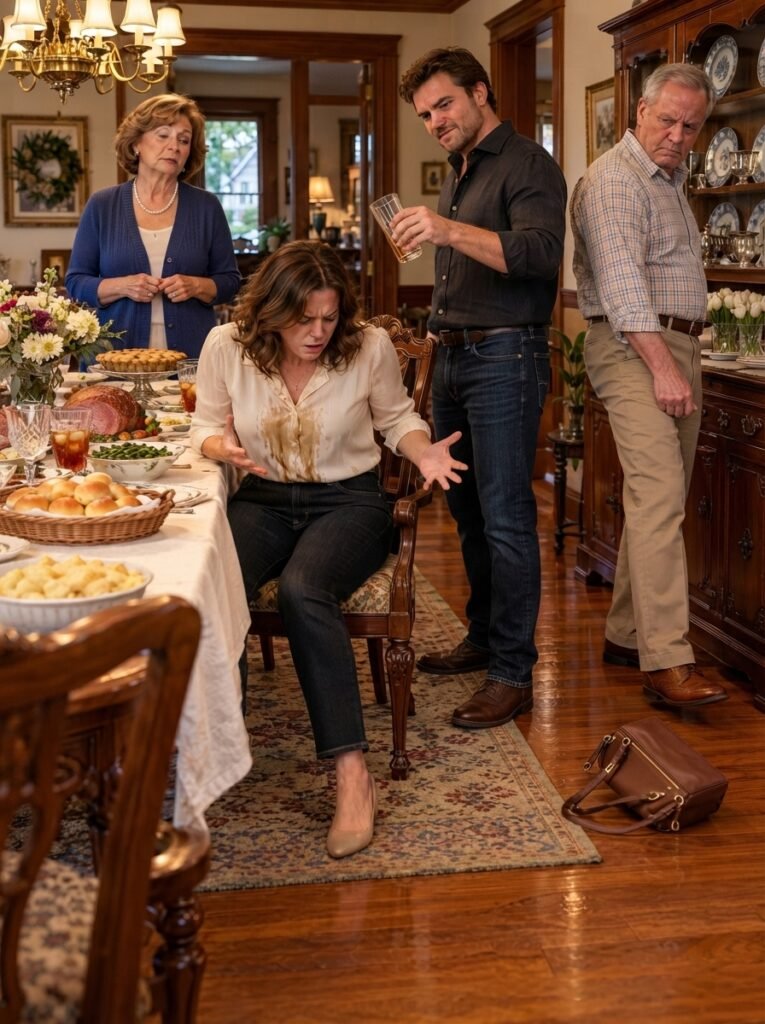
Three minutes later, my brother entered carrying a glass of iced tea.
He stopped when he saw me.
“That’s my chair.”
“Mom told me to sit here.”
His expression twisted.
“Get up.”
“Tyler, seriously?”
He walked closer.
For a moment, I thought he was simply trying to intimidate me.
Then he tilted his glass.
Ice-cold tea poured directly into my lap.
The shock stole my breath.
Liquid soaked through my blouse and jeans.
Ice cubes bounced across my knees and scattered onto the polished hardwood.
I stared at him.
“Are you insane?”
He smiled.
“I told you.
That’s my chair.”
I looked toward my father.
Surely he would intervene.
“Tyler!”
Dad snapped.
Relief flashed through me.
Then Dad pointed toward the table.
“You’re getting tea on your mother’s tablecloth.”
My mother grabbed a napkin and began blotting the cloth.
Not my clothes.
The tablecloth.
I stood up, trembling.
“Did all of you seriously just watch him do that?”
Dad sighed.
“Here we go.”
I reached for my purse.
His foot shot out.
He kicked my handbag so hard it skidded beneath the sideboard.
“Always playing the victim,” he muttered.
Mom shook her head.
“Claire, honey, stop being so sensitive.
There are sweatpants in the hall closet.”
Tyler sat down and began eating ham.
The room went strangely quiet.
I could hear the ticking grandfather clock.
The faint hum of the refrigerator.
Ice melting against the floor.
And something inside me finally changed.
I didn’t shout.
I didn’t demand an apology.
I bent down, retrieved my purse, and straightened.
“Thank you for dinner.”
Mom blinked.
“Claire, don’t be dramatic.”
“I’m not.”
I looked at Tyler.
He was chewing with his mouth open.
Then I looked at Dad.
He had already returned to his potatoes.
Three people sitting comfortably in a house they couldn’t have kept without me.
And not one of them cared that I was standing there humiliated and soaking wet.
I walked out.
Nobody followed.
Nobody apologized.
Nobody even called to ask whether I’d made it home safely.
At 9:14 that evening, I sent Ruth Becker a message.
**List the house.
I’m ready.**
Her answer arrived three minutes later.
I’ll take care of it.
At 7:03 Monday morning, my phone began ringing.
Dad.
I let it ring.
Thirty seconds later, Mom called.
Then Tyler.
By 7:15, I had seventeen missed calls.
Tyler sent a text entirely in capital letters.
WHAT THE HELL DID YOU DO?
I was sitting at my kitchen counter, drinking coffee.
For the first time in years, I wasn’t afraid of their anger.
At 7:22, Dad left a voicemail.
“Claire!
There is a FOR SALE sign in my front yard!
You need to take it down immediately!”
Another voicemail followed.
“You don’t get to make decisions about this family without discussing them!”
Then Mom called.
I answered.
“Good morning.”
“Claire, sweetheart, there’s been some terrible misunderstanding.”
“No misunderstanding.”
“Honey, people are going to see that sign.”
“That’s generally the idea.”
She lowered her voice.
“Your father is very upset.”
“I’m sure he is.”
“Where are we supposed to live?”
I took another sip of coffee.
“Maybe Tyler has some ideas.”
“Don’t be cruel.”
That stopped me.
Cruel.
After everything that happened the previous evening, she was calling me cruel.
“Mom, Tyler poured a drink on me, Dad kicked my purse, and you told me to stop being sensitive.”
“Your brother was frustrated.”
“He’s thirty-four.”
“Families forgive.”
“Families also respect each other.”
She became quiet.
Then she said something that made my stomach tighten.
“Claire, you need to understand that some things have already been decided.”
“What things?”
A pause.
“Just come over tonight.
We’ll explain.”
“No.”
“Claire—”
“I’ll communicate through Ruth.”
I hung up.
At 9:26, Ruth called.
Her voice was different.
Not cheerful.
Not professional.
Alarmed.
“Claire, are you sitting down?”
“Why?”
“I pulled the preliminary property records this morning.
There’s something wrong.”
I set down my mug.
“What kind of wrong?”
“Someone recorded a deed six weeks ago.”
“A deed?”
“Transferring ownership from you to your father.”
The room seemed to tilt.
“That’s impossible.”
“I wish it were.”
“Ruth, I didn’t sign anything.”
“I know.
And there’s more.”
I pressed the phone against my ear.
“A lender recorded a second mortgage against the property.
Two hundred thirty-eight thousand dollars.”
I couldn’t speak.
My original mortgage was still active.
I was still making payments.
And somehow someone had borrowed almost a quarter of a million dollars using the equity I’d spent five years building.
“Claire?”
“I’m here.”
Ruth inhaled shakily.
“Your father’s signature is on the loan documents.”
“Of course it is.”
“But the deed transferring ownership to him also has your signature.”
I stared at the wall.
“No.”
“Claire—”
“No, Ruth.
I never signed that deed.”
“I believe you.”
Then she said the words that changed everything.
“Somebody forged your name.”
I drove to Ruth’s office that afternoon.
She had printed the recorded documents and spread them across a conference table.
The deed looked official.
My full legal name.
The correct property description.
The correct parcel number.
Even the approximate date I’d purchased the house.
And near the bottom, a signature that looked disturbingly similar to mine.
CLAIRE E.
VAN DOREN.
I studied it.
The capital C was almost perfect.
The V had the same dramatic downward stroke I used when signing checks.
But the final n was wrong.
I always finished my signature with a small upward hook.
This one ended flat.
It was a tiny difference.
Maybe nobody else would have noticed.
But I noticed.
Because someone who had known me for years had practiced writing my name.
Ruth sat across from me.
“There’s also a notarization.”
I examined the seal.
Margaret Pike.
The name triggered a memory.
“Margaret Pike?”
“You know her?”
“She worked at the bank years ago.
She used to notarize documents for my father’s construction company.”
Ruth opened her laptop.
“Her commission expired four years ago.”
I looked up.
“What?”
“According to the state records, she wasn’t an active notary when this deed was supposedly signed.”
I felt cold all over.
Ruth leaned forward.
“Claire, you need an attorney.
Immediately.”
By three o’clock, I was sitting across from Nora Price, a real estate attorney in Des Moines.
Nora was in her early forties, with dark hair pulled into a practical bun and the expression of a woman who didn’t waste time pretending bad news was good.
She reviewed the paperwork silently.
Then she removed her glasses.
“First, don’t sign anything your family gives you.”
“I won’t.”
“Second, don’t confront them about the details of what we know yet.”
“Why?”
“Because I want to preserve the evidence before anyone has the chance to explain it away.”
She tapped the second mortgage.
“This is serious.
If your signature was forged, you may be dealing with real estate fraud, identity theft, and loan fraud.”
“Can I still sell the house?”
“Not cleanly until we resolve the title issue.”
My heart sank.
“So they win?”
Nora shook her head.
“No.
A fraudulent document doesn’t become legitimate simply because someone records it.
But proving fraud and clearing the title can take time.”
She looked directly at me.
“And Claire, whoever did this may have committed more crimes than you realize.”
We began gathering evidence.
I gave her bank statements proving I’d made every mortgage payment.
My original closing documents.
Tax records.
Insurance payments.
The messages Tyler had sent me two weeks earlier.
I also found the photograph I’d taken of his first envelope, including the transfer deed he wanted me to sign.
Nora studied it closely.
“Interesting.”
“What?”
“This unsigned document and the recorded deed aren’t identical.”
I leaned forward.
She pointed to a paragraph.
“The version Tyler brought you was a straightforward transfer.
The recorded version includes additional language authorizing a financial transaction.”
I frowned.
“Meaning?”
“Someone needed to make it appear that you had approved more than just transferring the house.”
I remembered Mom’s words.
Some things have already been decided.
And suddenly, I understood that the dinner invitation hadn’t simply been an attempt to pressure me.
They were trying to get me to sign paperwork after the fraudulent transaction had already happened.
They wanted a genuine signature to help cover a forged one.
My hands began shaking.
Nora noticed.
“Claire, breathe.
We’re going to work through this.”
I looked at her.
“How far could they have gone?”
She didn’t answer immediately.
That frightened me more than anything.
Over the next several days, my family became increasingly aggressive.
Dad called twenty-three times on Tuesday.
Mom sent a message saying I was humiliating them in front of their church community.
Tyler left a voicemail threatening to “make things ugly.”
I saved everything.
At Nora’s suggestion, I stopped answering their calls and communicated only in writing.
On Wednesday morning, Dad sent an email.
CLAIRE,
YOU HAVE FORGOTTEN EVERYTHING YOUR FAMILY HAS DONE FOR YOU.
YOUR MOTHER AND I RAISED YOU, FED YOU, EDUCATED YOU, AND GAVE YOU A HOME.
YOU CANNOT THROW US OUT LIKE TRASH.
YOUR BROTHER MADE A MISTAKE AT DINNER.
GET OVER IT.
DAD
I read it three times.
Then I printed it.
At work, I could barely concentrate.
Normally, hospital billing audits gave me a satisfying sense of order.
Every charge had a date.
Every procedure had documentation.
Every payment had a source.
If something didn’t add up, there was a reason.
But my family had spent decades teaching me to ignore things that didn’t add up.
Dad borrowing money and never repaying it.
Mom making excuses whenever Tyler lost another job.
My parents insisting they were barely surviving while purchasing expensive things for him.
And the constant refrain whenever I questioned anything.
You’re too sensitive.
You’re imagining things.
Stop making everything about yourself.
I started thinking about my grandmother, Violet Van Doren.
Grandma Violet had lived in the Pella house before my parents.
She was a formidable woman with silver hair, sharp blue eyes, and a habit of speaking the truth whether people wanted to hear it or not.
She loved tulips.
Apple pie.
Old hymns.
And crossword puzzles she completed in ink.
When I was little, she let me sit beside her at the dining table and help knead bread.
Tyler wasn’t interested.
He preferred watching television with Dad.
Grandma never scolded me for asking questions.
“Curiosity is not disrespect, Claire,” she told me once.
“Remember that.”
She died when I was twelve.
Mom said Grandma had left very little money.
A few pieces of furniture.
Some jewelry.
The house, which had already been placed into Dad’s hands.
I’d never questioned the story.
But after discovering the forged deed, I began wondering what else I’d accepted without proof.
On Thursday, I called my aunt Marian.
She was Grandma Violet’s youngest daughter and Dad’s sister.
She lived in Cedar Rapids and had become distant from the family years ago.
We exchanged Christmas cards but rarely spoke.
When she answered, she sounded surprised.
“Claire?”
“Aunt Marian, I need to ask you something about Grandma.”
A long silence followed.
“What about her?”
“Do you know anything about her estate?”
Another pause.
“Why are you asking?”
I told her about the house.
The forged deed.
The loan.
The Mother’s Day dinner.
She listened without interrupting.
When I finished, I heard her exhale.
“Oh, Claire.”
Something in her voice frightened me.
“What?”
“I hoped this would never happen again.”
Again.
The word struck me like a slap.
“What do you mean, again?”
She was silent for so long I thought the call had disconnected.
Then she said quietly:
“Your parents told you Grandma left you nothing, didn’t they?”
I couldn’t answer.
“Claire,” she continued, “your grandmother left you considerably more than you were ever told.”
Aunt Marian arrived at my apartment Saturday morning carrying a battered leather briefcase.
She was seventy-one, with Grandma Violet’s blue eyes and the same uncompromising way of looking at people.
She didn’t bother with small talk.
She sat at my kitchen table and opened the case.
Inside were old letters, bank statements, photocopies, and a folder labeled VIOLET VAN DOREN ESTATE.
“Before I show you anything,” she said, “I need you to understand why I haven’t talked about this before.”
I nodded.
“When your grandmother died, your father was named executor.
I trusted him.
We all did.”
She swallowed.
“That was my mistake.”
She handed me a copy of Grandma’s will.
I read slowly.
The house wasn’t specifically bequeathed to me.
Dad had inherited the property through a family arrangement established before Grandma’s death.
But there was something else.
A trust.
Created for my education and eventual financial independence.
The original funding amount was $84,000.
I stared at the number.
“What’s this?”
“Your grandmother established a custodial investment account for you.
She wanted you to have money for college, graduate school, or whatever life you chose.”
I shook my head.
“I didn’t have a college fund.”
“I know.”
“I worked through college.
I took out student loans.”
Marian nodded.
Tears filled my eyes.
“I worked nights at a grocery store, Aunt Marian.
I ate ramen because I couldn’t afford groceries.”
“I know, sweetheart.”
“Where did the money go?”
She handed me another document.
The account had been emptied over several years.
The withdrawals were listed as educational expenses and family support disbursements.
Some entries contained my name.
One even carried a signature supposedly made by me when I was seventeen.
I stared at it.
The same capital C.
The same exaggerated V.
The same incorrect final stroke.
The same person who forged my signature on the house had apparently been doing it for nearly twenty years.
My stomach twisted.
“Why didn’t you tell me?”
Marian looked devastated.
“I challenged your father when I first noticed inconsistencies.
He produced paperwork showing the account had been administered properly.
Your mother insisted she’d handled all the expenses.
They told me you knew.”
“I never knew.”
“I realize that now.”
“Why didn’t you call me?”
“I should have.
I was afraid of tearing the family apart.
Your father accused me of trying to steal from his daughter.
Then your mother told everyone I was becoming confused.”
She stared down at her hands.
“They made me doubt myself.”
I knew that feeling.
I knew it intimately.
Marian wiped her eyes.
“Years later, I requested old records.
The account had already been closed.
I saved everything I could find because something never felt right.”
I examined the withdrawals.
One payment was for $12,500.
Another for $19,800.
Several were made around the time Tyler started college.
Then I saw a familiar company name.
VAN DOREN RESIDENTIAL SERVICES.
Dad’s old construction business.
“Why was my education trust paying my father’s company?”
Marian’s face hardened.
“That’s exactly what I asked him.”
My mind raced.
Mom had always claimed Tyler received scholarships and that Dad’s business covered the rest of his education.
I had worked two jobs.
Tyler had driven a new pickup.
I paid my own rent.
He had lived in an apartment near campus that Mom called an investment in his future.
I looked at the paperwork again.
My grandmother’s gift to me had helped finance the life my brother enjoyed.
And my parents had let me believe Grandma left me nothing.
I began crying.
Not delicate tears.
Not quiet sadness.
The kind of crying that comes from realizing the past itself has been stolen from you.
Marian moved beside me.
“I’m so sorry.”
I gripped her hand.
“Why did they hate me?”
She shook her head.
“I don’t think they hated you.”
“Then what was it?”
Her answer came slowly.
“They discovered you would keep giving as long as they kept telling you that a good daughter should.”
I looked at the old signature again.
It no longer seemed like a mistake.
It looked like a pattern.
And patterns were something I understood.
On Monday, Nora arranged for a forensic document examiner to review the signatures.
She also contacted the lender, Evergreen Community Credit, and notified its fraud department that I disputed the deed and the second mortgage.
The response was immediate.
The lender agreed to investigate and preserve its records.
Its representative initially sounded skeptical.
“Ms.
Van Doren, we have a notarized transfer deed.”
“And I have proof I was forty miles away at work when I supposedly signed it.”
That got his attention.
My hospital employer maintained electronic access logs.
On the afternoon the deed claimed I’d visited a notary in Pella, I’d been attending an audit meeting in Des Moines.
I had a calendar invitation.
Badge records.
And five colleagues who could confirm I hadn’t left the building.
Nora collected everything.
Then she discovered something else.
The disputed mortgage proceeds had been transferred into an account belonging to a limited liability company called Orchard House Community Development.
I had never heard of it.
Neither had Ruth.
But the company’s registered agent was listed as a local accounting service.
Its managing member was someone I knew very well.
Evelyn Van Doren.
My mother.
I stared at the company records on Nora’s screen.
“Mom owns a company?”
“She’s listed as the managing member.”
“She doesn’t run a business.”
“Apparently, she does.”
“She volunteers at church.
She organizes bake sales.”
Nora turned toward me.
“Claire, people can have more complicated financial lives than their families realize.”
The company had been formed eight months earlier.
Its stated purpose was residential property development and charitable housing support.
That sounded vaguely familiar.
Then I remembered.
Mom had been talking for months about a community initiative called Hearth House.
She described it as a project helping struggling single mothers find temporary housing.
The church had hosted several fundraising dinners.
Mom had appeared in the local newspaper beside other volunteers.
I’d even donated $500.
She’d thanked me by saying, “It’s nice when you remember people less fortunate than yourself.”
Now the records showed that Orchard House Community Development had received a substantial portion of the money borrowed against my property.
I felt sick.
“She used my house to finance her charity?”
Nora remained cautious.
“We know funds went to the company.
We don’t yet know what happened afterward.”
I went home and opened my laptop.
Within twenty minutes, I found Hearth House’s promotional website.
Photographs showed Mom smiling with donors.
She wore a pearl necklace and the lavender blazer I’d bought her for Christmas.
Beneath her picture was a caption.
EVELYN VAN DOREN — FOUNDER AND COMMUNITY ADVOCATE.
The website described her as a woman who believed every mother deserved a safe place to call home.
I stared at the screen.
Every mother deserved a safe home.
Apparently, every daughter didn’t.
I scrolled farther.
An upcoming fundraising celebration was scheduled for Friday evening.
Mom would receive a community leadership award.
Her project had supposedly secured enough private financing to begin renovating a property near downtown Pella.
A property purchased with money tied to my stolen identity.
I called Nora.
“There’s something you need to see.”
The next morning, I went to work determined to function normally.
I had three hospital accounts to reconcile.
One involved a patient charged twice for imaging.
Another included an incorrect insurance adjustment.
The third contained a vendor invoice that had been duplicated under two slightly different company names.
I caught it because the amounts were identical.
Even the cents matched.
As I stared at those figures, something clicked.
A fraudster could change a company name.
Create a new invoice.
Invent a charitable purpose.
But money still moved from one account to another.
And when people became careless, their records betrayed them.
I opened a personal notebook.
Not my employer’s systems.
Not confidential patient information.
Just the publicly available records and documents Nora had given me.
I began building a timeline.
Eight months earlier, Mom formed Orchard House.
Six months earlier, Hearth House announced a major expansion.
Three months earlier, Mom told the church the project had received a private funding commitment.
Six weeks earlier, someone forged my signature on a property deed.
Then Evergreen Community Credit advanced $238,000.
The timing was too perfect.
I called Nora with my observations.
“Can we trace the money?”
“Through the appropriate legal process, yes.
The lender is already reviewing the transaction.
We may also need subpoenas.”
“There’s something else.”
“What?”
“Orchard House sounds like a charitable development company, but what if the construction expenses weren’t legitimate?”
“Why do you ask?”
“Because Tyler used to operate a contracting company.”
Nora paused.
“What’s it called?”
“Van Doren Home Solutions.”
“Is it still active?”
“I thought it closed after his divorce.”
“I’ll check.”
That afternoon, she called back.
“Claire, I found something.”
Tyler’s old company had been administratively dissolved.
But six months earlier, another company had been registered.
Hearthstone Renovation Services.
Its listed office address was a small mailbox rental location in Ottumwa.
Its owner?
Tyler Van Doren.
Nora had also obtained a preliminary transaction summary from the lender’s fraud team.
The summary showed that Orchard House had transferred a large payment to Hearthstone shortly after the mortgage proceeds arrived.
I closed my eyes.
“How much?”
“One hundred sixty-four thousand dollars.”
I opened them.
“Tyler received $164,000?”
“His company did, yes.
We still need to verify the basis for the payment.”
I thought about the way Tyler had poured tea into my lap.
The smug smile.
The calmness.
The way Dad protected him.
The way Mom dismissed my humiliation.
**They hadn’t just wanted the house.
They’d already turned it into money.**
And now they needed me to stop asking questions.
That evening, someone knocked on my apartment door.
I looked through the peephole.
It was Tyler’s ex-wife.
Amanda.
I hadn’t seen her since their divorce the previous September.
She stood in the hallway wearing jeans and a denim jacket, her blonde hair tied back, looking as if she’d spent a week deciding whether to come.
I opened the door.
“Amanda?”
“Hi, Claire.”
“Is something wrong?”
She glanced over her shoulder.
“Can we talk?”
I let her in.
She refused coffee.
Refused water.
Just sat at my kitchen table gripping her handbag.
“I saw the house listing,” she said.
“Everybody seems to have.”
She gave a humorless smile.
“Tyler’s furious.”
“I noticed.”
“Claire, I need to ask you something.
Has your family ever told you why Tyler and I divorced?”
I hesitated.
“Mom said you wanted a different lifestyle.”
Amanda laughed bitterly.
“That’s one way to describe it.”
I sat across from her.
“What happened?”
She opened her handbag.
Inside was a small flash drive.
“I found something last summer.
Tyler was using my financial information to apply for business credit.”
My stomach dropped.
“He forged your signature?”
“More than once.”
She looked at me steadily.
“When I confronted him, he said I was being dramatic.
Your mother told me marriage meant trusting my husband.”
I swallowed.
“That sounds familiar.”
Amanda continued.
“I started documenting things.
Emails, contracts, bank notices.
I needed proof before I could leave.”
“Did you go to the police?”
“I spoke with an attorney.
Eventually, the disputed accounts were closed and the divorce settlement addressed some of the losses.”
She lowered her eyes.
“But there was something else.”
“What?”
“Tyler kept talking about a plan his parents were working on.”
I leaned forward.
“What plan?”
“Something involving your grandmother’s house.”
My skin prickled.
“He told me Claire would take care of it.”
Amanda nodded.
“He said you always did.”
Silence settled between us.
Then she slid the flash drive across the table.
“This contains copies of some documents I saved.
I never knew whether they’d matter.
But after I saw the real estate listing, I thought you should have them.”
I stared at the drive.
“Why didn’t you tell me sooner?”
Her eyes filled with tears.
“Because I was ashamed.
I thought you’d believe your brother.
And I was afraid of what he might do if he found out I’d kept copies.”
I reached across the table.
“I’m sorry.”
She shook her head.
“No.
I’m sorry I didn’t warn you.”
Before she left, Amanda touched my arm.
“Claire, there’s something you need to understand.”
“What?”
“Your brother isn’t the smartest person in that family.”
I frowned.
“Who is?”
Amanda looked directly into my eyes.
“Your mother.”
Nora and I reviewed Amanda’s documents the next day.
Many were ordinary financial records.
Some were copies of business emails.
Others contained draft contracts and handwritten notes.
Amanda had also saved messages Tyler had sent from a shared computer before their divorce.
They painted an increasingly disturbing picture.
Mom had helped Tyler establish Hearthstone Renovation Services.
She had introduced him to investors through the church.
And she had repeatedly advised him to keep important financial discussions away from his personal phone.
One message stood out.
It was from Evelyn to Tyler.
DON’T WORRY ABOUT YOUR SISTER.
SHE’LL SIGN WHEN THE TIME COMES.
SHE ALWAYS DOES.
Tyler replied:
WHAT IF SHE DOESN’T?
Mom answered:
THEN WE HANDLE IT THE OTHER WAY.
I read the exchange several times.
The date was nine months earlier.
Long before the forged deed.
Long before Mother’s Day.
Long before I’d begun questioning the mortgage.
“What does ‘the other way’ mean?”
I asked.
Nora’s expression was grim.
“We need more context.”
Amanda had saved an additional document titled FAMILY ASSET PROTECTION STRATEGY.
It contained several pages describing the Pella house as a family-controlled asset.
My name appeared repeatedly.
One paragraph suggested that legal ownership should be “regularized” to reflect the family’s historical interest.
Another proposed using the property’s equity to capitalize Hearth House.
But the most disturbing language concerned me personally.
The document described me as:
“Emotionally reactive, financially controlling, and potentially resistant to reasonable family arrangements.”
I stared at the words.
Emotionally reactive.
Financially controlling.
They weren’t just insults.
They were building a story about me.
A story in which I was unstable.
Selfish.
Difficult.
Someone whose objections could be dismissed because she couldn’t be trusted.
Nora noticed my expression.
“Claire?”
“That’s why they kept saying I was too sensitive.”
“Possibly.”
“They’ve been describing me this way for years.”
She nodded.
“And now someone may have put those descriptions into formal documents.”
I turned another page.
There was a line about obtaining evidence of my “unreasonable conduct.”
I felt my stomach tighten.
Then I remembered Mother’s Day.
Tyler deliberately pouring the tea.
Dad kicking my purse.
Mom calmly telling me not to overreact.
I looked at Nora.
“That dinner wasn’t spontaneous.”
She waited.
“They wanted me to lose my temper.”
“Why?”
I remembered the way Tyler had approached me with his glass.
Slowly.
Almost carefully.
Like someone performing an action he had already rehearsed.
“What if they wanted me to hit him?”
Nora leaned back.
“Claire, that’s an allegation we’ll need evidence to support.”
I nodded.
But I knew.
I could feel it.
**They hadn’t simply humiliated me that evening.
They had tried to provoke a reaction they could use against me.**
And suddenly, the most frightening part of the whole evening wasn’t Tyler’s cruelty.
It was how calm he had been.
Friday evening, Mom received her community leadership award.
I didn’t attend.
Instead, I sat in Nora’s office while she reviewed an updated packet from the lender.
The investigation had uncovered serious irregularities.
The notary’s seal appeared to have been reproduced.
The identity verification records contained inconsistent information.
And the application file included an email address supposedly belonging to me.
I stared at it.
claire.vandoren.records@a private email provider.
It wasn’t my address.
I’d never seen it before.
Someone had created an account in my name.
The lender had also found several documents submitted through that account.
A copy of my driver’s license.
An income statement.
And a letter authorizing the transfer of the house to Dad.
The driver’s license scan looked authentic.
Then I remembered something.
Last Christmas, Mom had asked me to send her a photograph of my license.
She said the church needed identification for a volunteer background check.
I’d sent it without questioning her.
My throat tightened.
“She used my driver’s license.”
Nora nodded.
“It’s possible.
We’re documenting that.”
I felt the walls closing in.
“How long has she been planning this?”
“Long enough to prepare a convincing file.”
Then Nora handed me another page.
“There’s something else.”
It was a letter submitted as part of the loan application.
The letter stated that I had agreed to transfer the property voluntarily because my parents had historically maintained it.
It claimed that I had experienced periods of emotional instability.
That I sometimes made contradictory financial decisions.
And that my family was assisting me in simplifying my responsibilities.
At the bottom was a familiar signature.
CLAIRE E.
VAN DOREN.
Again, the same wrong final stroke.
I read the letter twice.
Then a third time.
They hadn’t simply forged my name.
They had forged a confession that made me appear incapable of managing my own affairs.
Nora watched me.
“Claire, there’s no reason to believe this would automatically deprive you of your rights.
But someone was clearly trying to create a damaging record.”
I could barely speak.
“Why would my own mother do this?”
Nora didn’t answer.
Instead, she pushed another document toward me.
It was a draft statement.
Apparently intended for use if I disputed the transfer.
The first paragraph accused me of manipulating an elderly couple’s housing situation.
The second alleged that I had voluntarily transferred ownership and was now denying the agreement out of spite.
The third referred to the need for an independent review of my financial conduct.
I looked up.
“They were prepared for me to challenge them.”
“Yes.”
“And they planned to claim I was lying.”
“That appears to be the strategy.”
Then my eyes fell on a handwritten note copied along the margin.
Five words.
Written in my mother’s unmistakable handwriting.
MAKE HER REACTION THE STORY.
I suddenly understood Mother’s Day.
Tyler’s glass.
Dad’s kick.
Mom’s sigh.
They’d wanted a scene.
They’d wanted me screaming, throwing something, perhaps striking my brother.
Then they could show everyone how unstable I was.
How dangerous.
How cruel to my aging parents.
And maybe, just maybe, they thought they could use that story to discredit my challenge to the forged documents.
But I’d walked away.
I’d thanked them for dinner.
And they’d lost their chance.
At least, that’s what I believed.
Then Nora’s phone rang.
It was the lender’s fraud investigator.
She listened silently.
Her expression changed.
“Please send that to me immediately,” she said.
When she ended the call, she looked at me.
“Claire, the lender has discovered something in the supporting materials.”
“What?”
“A draft complaint.”
“About what?”
She hesitated.
Then said:
“Your mother had prepared allegations accusing you of committing the fraud yourself.”
I felt as if someone had struck me in the chest.
“What?”
Nora turned her computer toward me.
The document was titled PRELIMINARY FRAUD CONCERN REPORT.
It described me as a hospital billing auditor with specialized knowledge of financial systems.
It suggested I had used that knowledge to manipulate a family property transaction.
According to the draft, I had pressured my aging parents into participating in a complicated refinancing arrangement.
Then I had supposedly threatened to accuse them of fraud when they resisted giving me additional money.
It was absurd.
Every word.
Yet the document was written carefully.
It used the language of financial misconduct.
It described me as sophisticated.
It emphasized my profession.
It even mentioned my experience identifying irregular billing patterns.
“They’re using my job against me,” I whispered.
Nora nodded.
“They appear to have prepared a version of events that makes you the responsible party.”
“But they created the fake deed!”
“Which is why we’re preserving everything.”
I stared at the screen.
For years, my parents had praised my intelligence whenever they needed help.
They’d asked me to review insurance paperwork.
Correct billing errors.
Explain tax notices.
Negotiate hospital charges.
Now they wanted to use those same skills to portray me as a criminal mastermind.
I covered my mouth.
Then I began laughing.
Not because anything was funny.
Because the betrayal was so enormous that my mind couldn’t process it any other way.
Nora waited.
Finally, I said, “They weren’t just going to take my house.”
“No.”
“They were going to let me get blamed for what they did.”
She looked at me carefully.
“Claire, that’s a reasonable concern given this draft.
But we need to establish exactly who created it and how it was intended to be used.”
I nodded.
Then my phone lit up.
A message from Mom.
CLAIRE, EVERYONE AT THE FUNDRAISER ASKED ABOUT YOU TONIGHT.
IT’S SAD THAT YOU’VE CHOSEN TO HURT YOUR FAMILY INSTEAD OF SUPPORTING SOMETHING GOOD.
I stared at it.
Another message arrived.
YOUR FATHER IS GETTING OLDER.
IF SOMETHING HAPPENS TO HIM BECAUSE OF THIS STRESS, I HOPE YOU CAN LIVE WITH YOURSELF.
For the first time, I didn’t feel guilty.
I felt clear.
I typed one sentence.
Please communicate with my attorney.
Then I blocked her number.
The following week, the investigation expanded.
Nora helped me make a formal police report.
The lender continued its fraud review.
The title insurance company became involved.
An application for temporary court relief was filed to prevent further transfers or encumbrances while ownership was disputed.
The documents alone wouldn’t solve everything.
There would be interviews.
Hearings.
Financial tracing.
Possibly months of uncertainty.
But something important had changed.
My family no longer controlled the story.
Evidence did.
And evidence wasn’t interested in protecting Tyler’s feelings.
Three days later, Detective Daniel Mercer called.
He worked financial crime cases for the county.
He asked me to come in for an interview.
I arrived carrying a thick binder.
Original mortgage statements.
The unsigned deed Tyler had brought me.
The forged recorded deed.
Proof of my whereabouts on the supposed signing date.
Text messages.
Emails.
And the records Aunt Marian had preserved from my grandmother’s estate.
Mercer spent nearly two hours reviewing everything.
He was a quiet man in his fifties with a gray mustache and a habit of tapping his pen when something bothered him.
Finally, he leaned back.
“Ms.
Van Doren, did your mother have access to your personal documents?”
“Yes.”
“Your Social Security number?”
“Probably.
She kept old school and tax paperwork.”
“Copies of your identification?”
“Yes.”
“Your bank information?”
“Some of it.”
He nodded slowly.
“What about your signature?”
I almost laughed.
“She’s my mother.
She’s seen me sign things my whole life.”
Mercer tapped the deed.
“We’re looking into who prepared and submitted these documents.
The lender has also provided transaction records.”
“Have you spoken to my parents?”
“Interviews are ongoing.”
I hesitated.
“Detective, can I ask you something?”
“Of course.”
“How does a family reach the point where they do this?”
He considered the question.
“I’ve investigated situations where relatives convince themselves they’re entitled to things that belong to someone else.”
I looked down.
“They always said I was selfish.”
He nodded toward the binder.
“You’re the one who made the mortgage payments?”
“Every month.”
“Then that seems like an unusual definition of selfish.”
It was such a simple observation.
But I nearly cried.
Because for the first time in years, someone was looking at the facts without asking me to excuse my family.
The first major breakthrough came from an unexpected place.
Aunt Marian called late Wednesday afternoon.
“Claire, I’ve been thinking about your grandmother’s old dining chair.”
I was confused.
“What chair?”
“The oak armchair at the head of the table.”
My stomach tightened.
“Tyler’s chair?”
“It wasn’t Tyler’s.”
I closed my eyes.
“Of course it wasn’t.”
“Your grandmother had it made by a carpenter in Newton.
She used to keep some personal papers tucked into the underside of the seat.”
I sat upright.
“What kind of papers?”
“Letters, mostly.
Old receipts.
Things she didn’t want your grandfather throwing away.”
I pictured the chair.
The broad oak arms.
The carved back.
The worn upholstery.
And Tyler’s possessive fury whenever anyone sat there.
“Do you think something’s hidden in it?”
“I don’t know.
But your grandmother always called it her thinking chair.”
My heart began pounding.
“Why would Tyler care so much about it?”
Marian paused.
“That’s a very good question.”
I called Nora immediately.
She advised me not to enter the house or attempt to retrieve anything without arranging it properly.
The situation was already legally complicated.
I didn’t need to create another dispute.
Instead, we asked Detective Mercer whether the chair might be relevant.
He listened.
Then said something I hadn’t expected.
“We’re already interested in that dining room.”
“Why?”
“Because your brother told us the incident never happened.”
I froze.
“What?”
“He claims you became angry over a family discussion and left voluntarily.”
My jaw tightened.
“He poured tea on me.”
“Your father says you spilled your own drink.”
I couldn’t believe it.
“And Mom?”
Mercer hesitated.
“Your mother says she doesn’t remember exactly how it happened.”
I sat in stunned silence.
They were lying.
All three of them.
About something so small.
Something I’d witnessed with my own eyes.
I thought about the draft document.
MAKE HER REACTION THE STORY.
They were following their plan.
Then Mercer added:
“Your brother also mentioned that a camera records activity in parts of the dining area.”
My breath caught.
“A camera?”
“Apparently, it was installed last year.”
I remembered seeing a small black device near the china cabinet once.
Mom had said it monitored the back door.
I hadn’t thought twice about it.
“Detective,” I whispered, “if there’s a camera, it recorded what Tyler did.”
“That’s what we’re trying to establish.”
I gripped the phone.
For the first time, my family’s obsession with proving I was unstable might become the thing that exposed them.
The recording was obtained through the investigation.
And what it showed was worse than I imagined.
I didn’t see it immediately.
Nora watched it first.
Then Detective Mercer arranged for me to review the relevant footage with them.
I entered the room expecting to see Tyler pouring tea into my lap.
I expected to see Dad kicking my purse.
I expected to hear Mom tell me to stop being sensitive.
I didn’t expect to see what happened before I arrived.
The timestamp showed 2:41 p.m.
The dining room was empty.
Then Mom entered carrying the manila envelope.
She placed it on the sideboard.
Straightened the yellow tabs.
Adjusted the black pen.
A minute later, Tyler walked in.
“Do you think she’ll sign?” he asked.
Mom shook her head.
“Not unless we make her understand she doesn’t have another choice.”
Tyler rubbed his jaw.
“What if she starts asking about the loan?”
“Then she doesn’t know as much as we think.”
Dad entered.
He looked worried.
“Evelyn, this is getting out of hand.”
Mom turned toward him.
“Martin, we’ve already discussed this.”
“I don’t like it.”
“You didn’t mind the money.”
Dad said nothing.
Mom continued.
“We need Claire to cooperate.
And if she refuses, we need people to understand why.”
Tyler glanced toward the camera.
“Are you sure this thing records?”
“Yes.”
“What if she just leaves?”
Mom adjusted the envelope again.
“Then we create a reason for her to react.”
My hands turned cold.
On the screen, Dad looked uncomfortable.
“Evelyn, don’t start a fight at the dinner table.”
Mom gave him a look that silenced him.
“No one is starting a fight.
Tyler’s just going to insist on his chair.”
Tyler laughed.
“What if she won’t move?”
Mom shrugged.
“Then she’ll behave exactly the way she’s always behaved when she doesn’t get her way.”
I stared at the screen.
My mother.
The woman who had taught me to tie my shoes.
Who’d packed my school lunches.
Who’d held me when I had the flu.
Was calmly planning to humiliate me.
Then Tyler asked a question.
“What if she doesn’t yell?”
Mom smiled.
“Everyone has a breaking point, sweetheart.”
The recording continued.
At 4:18 p.m., I appeared.
Smiling.
Carrying flowers for Mom.
Wearing the cream blouse she’d given me for Christmas.
I watched myself hug her.
I watched her smile.
I watched Tyler enter with the glass.
I watched the tea pour over my lap.
I watched Dad kick my purse.
And I watched myself stand, retrieve my handbag, and say:
“Thank you for dinner.”
For several seconds after I left, nobody spoke.
Then Tyler slammed his fork down.
“She didn’t do anything!”
Mom looked furious.
Dad rubbed his forehead.
“I told you this was a bad idea.”
Tyler gestured toward the door.
“Now what?”
Mom picked up the manila envelope.
Her voice was cold.
“Then we use the other documents.”
I stared at the frozen image.
Nora gently touched my arm.
“Claire?”
I couldn’t speak.
Because the woman on that screen wasn’t the mother I’d imagined.
She was someone I’d never truly known.
Someone who could smile at her daughter while preparing to ruin her.
The recording changed everything.
It didn’t automatically resolve the fraud allegations.
But it directly contradicted my family’s account of Mother’s Day.
It also established that the confrontation had been planned.
The investigators took a much closer look at the false statements surrounding the property transaction.
And the lender’s internal review uncovered another critical detail.
The money had not all gone into a charitable project.
Of the $238,000 advanced, approximately $164,000 had been paid to Tyler’s company.
Another large portion had been transferred to an account controlled by Orchard House.
But the supporting invoices didn’t match the work supposedly completed.
Several contractors listed in the documents denied performing the projects.
One invoice described extensive renovation work at a building whose interior was still untouched.
Another charged for materials that were never delivered.
A third contained a vendor address matching Tyler’s mailbox rental office.
The charitable housing project had been used as a convincing explanation for moving money out of the loan.
The most painful part was discovering how many people had trusted Mom.
Church volunteers.
Retired couples.
Local business owners.
Women who believed Hearth House might provide shelter when they needed it.
Mom had looked them in the eyes and promised to help vulnerable families.
Meanwhile, she’d used her own daughter’s identity to secure financing.
Nora explained that legitimate project expenditures, donor contributions, and loan proceeds would need to be separated carefully.
“We don’t want innocent people harmed by this investigation,” she said.
I agreed.
I wasn’t interested in destroying Hearth House.
I wanted the people who had abused it held responsible.
Then another detail emerged.
The fake email account created in my name had been accessed multiple times from an internet connection associated with my parents’ house.
Some access records also corresponded to devices investigators were examining.
The more evidence they gathered, the harder it became to maintain the story that I had orchestrated the transaction.
Still, Mom refused to admit anything.
Through an attorney, she claimed misunderstandings had occurred.
Dad insisted he believed the transfers were authorized.
Tyler blamed the loan broker.
Each of them described a different version of events.
And each version contained the same convenient assumption.
Claire was supposed to fix everything.
This time, I didn’t.
Six weeks after Mother’s Day, Nora called me into her office.
She had been reviewing records from Grandma Violet’s old trust with an estate attorney.
There were still unanswered questions about the educational funds, and the older transactions might require a separate legal process.
But they’d identified something important.
Several withdrawals from the trust appeared to have gone directly into Dad’s struggling construction company.
Others had been used for Tyler’s education and living expenses.
There were also records of transfers to Mom’s personal accounts.
Yet no one had produced documentation showing the money had been spent for my benefit.
I sat quietly while Nora explained.
“We may be able to pursue additional claims.
But recovering funds from transactions this old could be difficult.
There are questions about records, timing, and applicable limitations.”
I nodded.
I understood.
Justice didn’t always mean every stolen dollar came back.
But knowing the truth mattered.
Then Nora handed me a letter.
It was written in Grandma Violet’s careful cursive.
Aunt Marian had found it inside an old envelope with the trust records.
Across the top, Grandma had written:
For Claire, when she is old enough to understand.
My throat tightened.
I unfolded it.
My dearest Claire,
You are only twelve as I write this, and I hope you have many years before you need to understand why I am putting these thoughts on paper.
You have always been a child who notices when other people are hurting.
That is a beautiful gift.
But I worry because you also believe it is your responsibility to make everyone happy.
It is not.
You are allowed to have dreams that belong only to you.
You are allowed to say no.
You are allowed to leave a room where people are unkind.
And most importantly, you must never confuse being needed with being loved.
I have arranged for money to help you begin your adult life.
Use it for your education, your home, your adventures, or whatever future makes you happy.
Do not let anyone tell you that you owe them your happiness because they raised you.
A child is not a debt.
And love is not a bill that comes due.
All my love,
Grandma Violet
I couldn’t finish reading it aloud.
Tears fell onto the page.
For years, I’d believed I was failing my family whenever I refused their demands.
Grandma had understood the danger before I was old enough to recognize it.
She’d tried to protect me.
And the people she’d trusted to honor her wishes had betrayed both of us.
I held the letter against my chest.
Then I whispered:
“I’m sorry, Grandma.”
Nora waited quietly.
I wiped my eyes.
“I’m not going to let them do this to me anymore.”
The months that followed were exhausting.
I learned more about property records and title disputes than I had ever wanted to know.
Nora worked with the lender, its insurer, and the relevant parties to challenge the fraudulent deed and resolve the disputed mortgage.
The court issued interim orders while the ownership questions were addressed.
The lender eventually acknowledged serious problems with the transaction and entered into a process to remove the disputed encumbrance without requiring me to repay money I had never received.
The recorded transfer was challenged and ultimately set aside through the legal proceedings.
My original mortgage remained my responsibility.
But the house was mine again on the public record.
Mine to keep.
Mine to sell.
Mine to leave empty if I wished.
And for the first time, I understood the significance of that freedom.
My family had spent years treating my property as their birthright.
They’d lived there.
Made decisions about it.
Argued over furniture.
Invited guests.
Spent money they expected me to replace.
And somewhere along the way, they’d stopped seeing me as its owner.
They saw me as a source of funding.
A signature.
A daughter whose affection could be used as collateral.
The financial investigation continued separately.
Tyler’s company records were examined.
Mom’s role in Orchard House was scrutinized.
Dad’s statements were compared against the documents he had signed.
There were interviews with notaries, loan officers, contractors, and church officials.
No single dramatic courtroom moment solved everything.
Real investigations rarely worked that way.
But slowly, the carefully constructed story began to collapse.
Tyler admitted he had known the deed was being prepared without my permission.
Dad acknowledged signing financing papers while knowing I had not personally approved the transaction.
And Mom?
Mom continued insisting she had acted for the good of the family.
Even after the evidence showed exactly what that meant.
The first time I saw my parents after the investigation began, we were at a legal meeting.
Dad looked older.
His shoulders had slumped.
The man who once commanded a room with his voice now stared at the floor.
Mom sat beside him in a blue cardigan.
Her hair was carefully styled.
Her hands rested neatly in her lap.
She looked exactly like the woman who had comforted me through childhood illnesses.
I hated how much that still hurt.
Tyler sat on the other side of the table.
He avoided my eyes.
Before the attorneys began, Dad cleared his throat.
“Claire.”
I looked at him.
“Can we talk?”
Nora glanced toward me.
I nodded.
Dad swallowed.
“We never meant for things to go this far.”
I stared at him.
“How far did you mean for them to go?”
He looked confused.
“What?”
“Did you mean to steal the house?
Or just borrow against it?”
“Claire—”
“Did you mean to forge my signature?
Or just pressure me until I signed?”
He lowered his eyes.
“Please.”
“Did you mean to humiliate me at dinner?
Or did you hope I’d hit Tyler so you could call me unstable?”
Mom stiffened.
“That’s enough.”
I turned toward her.
“No, Mom.
It isn’t.”
She drew herself upright.
“We were trying to protect this family.”
“From what?”
“From losing everything!”
I looked around the conference room.
“Whose everything?”
She opened her mouth.
Then closed it.
I leaned forward.
“Because you weren’t losing the house.
I was paying for it.”
Dad whispered, “Claire, please.”
I ignored him.
“You weren’t paying for Tyler’s company.
You used money from a loan secured against my property.”
Mom’s eyes flashed.
“Your brother needed a chance.”
“He’d already had plenty.”
“He made mistakes!”
“So did I, apparently.
My biggest mistake was trusting you.”
Her face hardened.
“You have no idea what it’s like to be a mother.”
The words struck deeply.
Not because I believed them.
Because she’d always known where to aim.
I took a breath.
“You’re right.
I don’t know what it’s like to be a mother.”
I looked directly at her.
**”But I know what it’s like to be your daughter.
And I wouldn’t wish that on anyone.”**
For the first time, she had no answer.
Eventually, my parents moved out of the house.
It wasn’t immediate.
The legal issues had to be addressed.
They needed time to collect their belongings and arrange another place to live.
I followed Nora’s advice, complied with the required procedures, and avoided direct confrontation.
Ruth managed the sale preparations.
My parents found a small rental outside town.
Tyler moved in with a friend while his legal troubles continued.
On the day the house finally became vacant, Ruth called me.
“It’s ready, Claire.”
I drove to Pella after work.
The evening sky was pale pink.
The tulips had finished blooming.
The porch paint was beginning to show the first signs of weathering.
I parked across the street and sat in my car.
For five years, I’d driven past that house and felt responsible for everyone inside.
Now the windows were dark.
There were no cars in the driveway.
No voices coming from the kitchen.
No one waiting to tell me what else I needed to do.
I stepped onto the porch.
Unlocked the front door.
And entered.
The house smelled faintly of furniture polish and old wood.
My parents had taken their belongings.
The walls were marked where family photographs once hung.
The kitchen counters were bare.
The dining room was empty.
Except for one thing.
The oak armchair.
Tyler’s precious chair.
It stood alone at the head of the table’s former location.
I stared at it.
For a long time, I couldn’t move.
Then I walked over and sat down.
The wood creaked softly beneath me.
Sunlight from the west window warmed my face.
I rested my hands on the carved arms.
And cried.
Not because I wanted the house back.
Not because I missed my family.
But because a little girl inside me was finally beginning to understand that she hadn’t deserved any of it.
The blame.
The humiliation.
The constant pressure to prove her love.
I could almost hear Grandma Violet’s voice.
You are allowed to leave a room where people are unkind.
I whispered into the empty house:
“I finally did, Grandma.”
Then I stood.
And something caught my eye.
A narrow seam beneath the chair’s upholstered seat.
I remembered Aunt Marian’s story.
Grandma used to hide papers there.
I crouched down.
The underside was covered with dark fabric.
Near one corner, a small wooden panel had been fitted into the frame.
It looked old.
Older than the upholstery.
I touched it.
The panel shifted.
My pulse quickened.
I removed it carefully.
Inside was a shallow compartment.
Mostly empty.
But tucked into one corner was a folded piece of paper.
It had yellowed with age.
I unfolded it.
It wasn’t a deed.
It wasn’t a bank statement.
It was a list written in Grandma’s handwriting.
At the top were three words.
THINGS TO REMEMBER.
Beneath them:
Keep the house warm.
Feed anyone who comes hungry.
Never let money decide who deserves kindness.
Don’t mistake silence for agreement.
Remember that the person who owns the chair isn’t necessarily the one sitting in it.
I stared at that final line.
My brother had poured iced tea into my lap because he believed the chair belonged to him.
My father had kicked my purse because he believed authority belonged to him.
My mother had forged my signature because she believed my future belonged to her.
But Grandma had understood something none of them did.
Ownership wasn’t the same as entitlement.
And authority wasn’t the same as love.
I folded the paper carefully.
Then I placed it in my purse.
For once, nobody kicked it away.
Two months later, the house sold.
The buyers were a young couple named Hannah and Michael Brooks.
They had two small children.
Hannah taught third grade.
Michael worked as an electrician.
During the showing, their six-year-old daughter ran into the dining room and asked where the Christmas tree would go.
Her little brother wanted to know if they could plant pumpkins in the backyard.
I watched from the porch while Ruth answered their questions.
The children were laughing.
Their parents looked nervous and hopeful.
They reminded me of everything a home was supposed to be.
I accepted their offer.
It wasn’t the highest one.
But it was fair.
And I liked knowing the house would be filled with laughter again.
At closing, I paid off my original mortgage.
After expenses, I had enough left to establish an emergency fund, invest for my future, and begin looking for a place of my own.
Not a spectacular mansion.
Not a luxury condominium.
Just somewhere peaceful.
A place where I could put my keys on the kitchen counter without waiting for someone to demand something from me.
I found a small craftsman-style house on the edge of Des Moines.
Two bedrooms.
A sunroom.
A little backyard.
A kitchen with yellow morning light.
It wasn’t nearly as grand as the Pella house.
But when I stepped through the front door, something extraordinary happened.
I felt safe.
Not obligated.
Not guilty.
Not afraid.
Just safe.
I bought it.
With my own money.
In my own name.
And this time, nobody else got a key.
The criminal cases continued after the property sale.
Tyler eventually entered a plea agreement involving his participation in the fraudulent financing and false business invoices.
Dad acknowledged wrongdoing connected to the documents he had signed and faced penalties and restitution obligations.
Mom’s case was more complicated.
The evidence indicated she had played a central role in preparing the false paperwork, coordinating the financing, and directing some of the money through Orchard House.
Her public reputation collapsed.
The church removed her from her leadership position.
The Hearth House project was placed under independent oversight while its finances were reviewed.
Volunteers worked to protect legitimate donations and salvage whatever charitable work could continue.
Some people defended Mom.
Others were furious.
A few accused me of being vindictive.
One woman stopped me outside a grocery store and said, “Your mother did so much good for this community.”
I looked at her.
“I’m glad she helped people.”
The woman blinked.
“Then why are you doing this?”
I answered quietly.
“Because helping strangers doesn’t give someone permission to hurt their daughter.”
She had no reply.
For weeks, I struggled with that distinction myself.
I didn’t want to become someone who celebrated another person’s suffering.
I didn’t want revenge to define the rest of my life.
But accountability wasn’t revenge.
Consequences weren’t cruelty.
And refusing to protect people from the results of their choices wasn’t betrayal.
It was simply refusing to participate in the lie anymore.
Almost a year after Mother’s Day, I received a letter from Dad.
It arrived at my new house in a plain white envelope.
His handwriting looked smaller than I remembered.
Claire,
I don’t know whether you’ll read this.
I have spent a lot of time thinking about what happened.
I keep remembering that dinner.
I remember watching Tyler pour tea on you.
I remember kicking your purse.
And I remember the look on your face.
For years, I told myself I was protecting our family.
But the truth is, I was protecting the people who were easiest for me to please.
Your brother needed constant rescuing.
Your mother always had another explanation.
You were the strong one.
So I let you carry things that should never have been yours.
I don’t expect forgiveness.
I just want you to know that I finally understand what you meant.
The house was yours.
And you deserved better than what we gave you.
Dad
I read it twice.
Then I placed it in a drawer.
I didn’t call.
I didn’t write back.
Not immediately.
Some wounds don’t close because the person who caused them finally admits they exist.
But I was grateful he’d stopped pretending the wound was imaginary.
It was a beginning.
Not necessarily a reconciliation.
Just a beginning.
By the following spring, my life looked completely different.
I had started therapy.
Made new friends.
Joined a weekend hiking group.
And begun volunteering with a local organization that helped people experiencing financial abuse.
I discovered that many victims weren’t people who lacked intelligence.
They were people who trusted someone.
A parent.
A spouse.
A sibling.
A person who knew exactly which emotional buttons to press.
I met women who had been convinced they were selfish for keeping their paychecks.
Men whose relatives had taken out loans in their names.
Older people pressured into signing away their property.
Every story was different.
But the language was painfully familiar.
You owe us.
We’re family.
Don’t be dramatic.
Stop being so sensitive.
I began telling people something I’d needed to hear years earlier.
Love does not require surrendering your financial independence.
And kindness does not mean permitting theft.
One afternoon, after a volunteer workshop, I received a call from Aunt Marian.
“Claire, are you sitting down?”
I laughed nervously.
“Why does everyone keep asking me that?”
She didn’t laugh.
“I’ve received something from the estate attorney.”
My stomach tightened.
“About Grandma’s trust?”
“Yes.”
I had assumed we’d already uncovered everything.
But Marian explained that additional archival records had been located during the investigation of the old custodial account.
One document was different from the others.
It wasn’t simply a withdrawal record.
It was an internal letter, written years earlier by the accountant who had handled some of Grandma’s financial affairs.
The accountant had questioned whether certain distributions were legitimate.
He had also noted that someone repeatedly requested copies of my signature for comparison.
The requests didn’t come from Dad.
They came from Mom.
I closed my eyes.
More confirmation.
More evidence.
But Marian wasn’t finished.
“Claire, there’s something else.”
“What?”
“The accountant kept copies of correspondence between your mother and a financial adviser.”
I felt a familiar chill.
“About what?”
“The original trust.”
I waited.
Marian’s voice softened.
“I think you need to read this yourself.”
The document arrived by secure email the next morning.
I opened it at my kitchen table.
At first, it looked like an ordinary correspondence file.
There were notes about trust distributions.
Questions regarding expenditures.
Requests for beneficiary acknowledgments.
Then I reached a letter dated shortly after my eighteenth birthday.
It was written by a financial adviser who had questioned the remaining balance in the custodial account.
The adviser stated that certain withdrawals appeared inconsistent with the account’s original purpose.
He asked for confirmation that I had received the funds or had knowingly approved their use.
Mom’s response was attached.
She claimed I’d been informed.
She claimed I’d agreed.
She claimed the money had supported my education and general welfare.
Then came the line that made my breath stop.
“Claire understands that supporting the family now will ensure her own security later.”
I stared at the sentence.
All those years ago, Mom had already been using the same promise.
Give now.
Sacrifice now.
Trust us now.
Your turn will come later.
Except my turn never came.
There was always another emergency.
Another expense.
Another reason Tyler needed help.
Another reason Dad couldn’t afford something.
Another explanation for why Mom deserved more.
I kept reading.
Then I noticed an attached page containing several examples of my signature.
Some were genuine.
Others were practice attempts.
The differences were subtle.
But I recognized the same flat ending on the final n.
The same mistake from the forged property deed.
It was as though the person had been practicing for decades without ever mastering that final little stroke.
I began shaking.
Not because the handwriting was unfamiliar.
Because it wasn’t.
Mom had helped me practice cursive when I was a child.
She’d sat beside me at the kitchen table, guiding my hand.
She’d taught me how to form the capital C.
How to connect the letters.
How to sign my last name.
And now I was looking at evidence that the skill she’d taught me had become a tool she used against me.
I closed the file.
For a long time, I sat staring out at my backyard.
Then I whispered:
“Twenty years.”
She hadn’t made one terrible decision in a moment of panic.
She hadn’t simply followed Dad or Tyler.
She had repeated the same deception over and over.
And every time I’d questioned something, she’d told me I was too sensitive.
I thought that was the final truth.
But I was wrong.
Because three days later, Amanda called me again.
And what she told me made every previous discovery feel like preparation for something much worse.
“Claire,” Amanda said, “I need to see you.”
Her voice trembled.
I immediately sat upright.
“What’s wrong?”
“I found something in an old storage box.”
“From Tyler?”
“Yes.”
“Can you send it to Nora?”
“I already did.”
I heard her swallow.
“There’s something I need to tell you first.”
I waited.
Amanda had sounded frightened before.
But never like this.
“Tyler used to keep a folder on his computer called Contingency.”
The word sent a chill through me.
“Contingency for what?”
“I thought it was business-related.”
“And?”
“There were documents about the property.
Financial statements.
Copies of identification.”
I closed my eyes.
“More forgery?”
“Claire, there was a life insurance application.”
I went completely still.
“What?”
“It had your name on it.”
My heart began pounding.
Amanda continued.
“It listed a policy for two million dollars.”
I gripped the edge of the table.
“That’s impossible.
I’ve never applied for life insurance through Tyler.”
“I know.”
“Who was the beneficiary?”
Amanda began crying.
“Your mother.”
For several seconds, I couldn’t breathe.
A life insurance policy.
In my name.
With Mom listed as beneficiary.
I forced myself to speak.
“Amanda, was it active?”
“I don’t know.
Some documents are only drafts.
Nora said she needs to verify everything.”
I pressed a hand against my chest.
“Why would they want insurance on me?”
Amanda went quiet.
Then she said:
“Claire, there was another document in the folder.”
I waited.
“It was a financial plan.”
“What kind?”
“It included the house, Tyler’s business debts, and something labeled ‘insurance recovery scenario.'”
The room seemed to shrink around me.
My family had forged my signature.
Borrowed against my house.
Prepared allegations to blame me for the fraud.
And now there were papers suggesting they had considered the financial consequences of my death.
I felt physically sick.
I called Nora immediately.
She had already received Amanda’s files.
“Claire,” she said, “I need you to stay calm.
We have a draft application and planning materials.
We do not yet have evidence that any policy was issued, or that anyone intended to harm you.”
I nodded even though she couldn’t see me.
“Can you check?”
“We’re taking this seriously.
I’ll coordinate with the investigators.”
I looked out my window.
The street was quiet.
A neighbor walked a golden retriever.
Children rode bicycles past the driveway.
Everything looked ordinary.
But something inside me had changed again.
Because I finally understood that I didn’t know the limits of what my family had been willing to do.
And the thought terrified me.
Investigators confirmed that no two-million-dollar policy had been issued.
The application in Tyler’s files was incomplete.
The planning documents were disturbing, but they did not establish that anyone had taken steps to harm me.
I was relieved.
Then angry.
Then ashamed of feeling relieved.
How had my relationship with my family deteriorated so badly that discovering they hadn’t successfully insured my life felt like good news?
Nora helped me understand the distinction between frightening possibilities and provable facts.
“We have to be careful,” she said.
“We should not turn unanswered questions into accusations.
The evidence is serious enough without exaggerating it.”
She was right.
The verified wrongdoing was already enormous.
The stolen identity.
The forged property documents.
The disputed mortgage.
The misuse of financing.
The false statements.
The planned confrontation.
The attempted effort to make me appear responsible.
I didn’t need to imagine anything worse.
But the insurance documents forced me to confront a question I’d been avoiding.
Why had my family been so desperate to control every part of my financial life?
The answer came from an unexpected conversation with Dad.
By then, he was cooperating with investigators and had retained separate counsel.
He asked through Nora whether I would agree to one supervised conversation.
I hesitated for several days.
Then agreed.
We met in a conference room.
Dad looked exhausted.
He didn’t try to hug me.
He simply sat across from me and said:
“Your mother didn’t want me to tell you this.”
I felt a chill.
“Tell me what?”
He rubbed his hands together.
“When my construction business failed, we owed more money than you knew.”
“I figured.”
“Much more.”
“How much?”
He lowered his head.
“Enough that your mother believed we could never recover.”
I stared at him.
“So you let me buy the house.”
“Yes.”
“And kept pretending it was yours.”
He nodded.
“Yes.”
I leaned forward.
“Dad, why did you let Mom use my name?”
His eyes filled with tears.
“Because she’d convinced herself everything would collapse if we didn’t.”
“That’s not an answer.”
He swallowed.
“She said you were the only one with stable credit.
She said Tyler would eventually rebuild the business and repay everything.”
I shook my head.
“Tyler has been ‘eventually’ repaying things his entire adult life.”
Dad didn’t argue.
Then I asked:
“What about the insurance application?”
His face changed.
He looked genuinely startled.
“What insurance application?”
I watched him carefully.
“You didn’t know?”
“No.”
I studied his expression.
For once, I believed him.
He seemed frightened.
“Claire, what insurance?”
I didn’t answer immediately.
Because something was becoming clear.
Dad had participated in the fraud.
He had lied.
He had allowed Mom and Tyler to use me.
But even he might not have known the full extent of their planning.
That realization didn’t excuse him.
It made everything more complicated.
Then Dad said something that shocked me.
“Your mother has always been afraid of running out of money.”
I stared at him.
“Everybody is afraid of that sometimes.”
He nodded.
“But Evelyn is different.
When she’s frightened, she starts planning.
And once she’s made a plan, she convinces herself anyone who disagrees is the enemy.”
I thought about the Mother’s Day recording.
Mom calmly arranging the envelope.
Explaining how they’d provoke me.
Smiling when Tyler asked what happened if I resisted.
Then Dad whispered:
“Claire, I spent forty years mistaking your mother’s certainty for wisdom.”
I looked at him.
“And I spent thirty-six years mistaking her control for love.”
Eventually, the final financial findings became clearer.
The insurance application had never been completed.
There was no confirmed policy to collect.
The so-called recovery scenario was one of several speculative plans stored among Tyler’s papers.
Investigators found no evidence of a plan to physically harm me.
But the files did show something chilling in a different way.
My family had treated my life like a collection of assets.
My income.
My credit.
My property.
My future earnings.
Even hypothetical insurance proceeds.
Everything was something that could be calculated.
Transferred.
Borrowed against.
Or used to solve somebody else’s problem.
Except my happiness.
That never appeared in a single spreadsheet.
My dreams weren’t listed.
My sacrifices weren’t acknowledged.
My feelings were described as obstacles.
For years, I’d wondered why my parents couldn’t appreciate what I’d done.
Now I understood.
People who see you as an endless resource eventually stop recognizing what it costs you to keep giving.
They weren’t grateful because they’d come to believe my support was automatic.
Like electricity.
Running water.
A monthly bank deposit.
And when I’d finally said no, they treated it as a malfunction.
Something to correct.
Something to punish.
Something to control.
I couldn’t change how they saw me.
But I could change what I allowed.
And I had.
Two years after Mother’s Day, I hosted my first family-style Thanksgiving dinner.
Not with Mom.
Not with Dad.
Not with Tyler.
With people who had earned a place in my life.
Aunt Marian came early to help.
Amanda brought sweet potatoes and her famous pumpkin cheesecake.
Ruth arrived with flowers.
Nora stopped by briefly with homemade cranberry sauce before heading to her own family’s celebration.
A few friends from work joined us.
We crowded around my dining table.
It wasn’t antique oak.
It wasn’t expensive.
I’d bought it secondhand and refinished it myself.
There were eight chairs.
None of them belonged to one particular person.
When Amanda’s little nephew asked where he should sit, I smiled.
“Anywhere you like, sweetheart.”
He chose the chair at the head of the table.
Nobody objected.
Nobody demanded that he move.
Nobody poured anything on him.
I looked around at the faces surrounding me.
People laughing.
Passing dishes.
Asking one another about their lives.
Nobody keeping score.
Nobody demanding payment for affection.
I felt my throat tighten.
Aunt Marian noticed.
“You okay, honey?”
I nodded.
“Better than okay.”
She squeezed my hand.
Then raised her glass.
“To Grandma Violet.”
Everyone followed.
“To Grandma Violet.”
I smiled through tears.
“To the woman who taught me that love isn’t a debt.”
We drank.
Then Ruth laughed.
“And to Claire, who finally learned how to say no.”
Everyone cheered.
I laughed too.
Because for the first time, saying no hadn’t cost me my family.
It had shown me who my family really was.
After dinner, I carried plates into the kitchen.
Amanda followed with the leftovers.
She was quieter than usual.
“Everything okay?”
I asked.
She nodded.
Then hesitated.
“Claire, there’s something I’ve wanted to tell you.”
I smiled.
“You’re starting to sound like everyone else in this story.”
She laughed softly.
“This one’s good.
I promise.”
I leaned against the counter.
“Okay.”
Amanda reached into her handbag.
She took out a small photograph.
It showed Grandma Violet standing in front of the Pella house many years ago.
Beside her stood a little girl with brown hair and a gap-toothed smile.
Me.
I stared at it.
“Where did you get this?”
“Your grandmother gave it to Tyler years ago.
He kept it in an old box.”
I took the picture carefully.
Grandma had one hand on my shoulder.
We were standing beside the tulips.
On the back, in her handwriting, were seven words.
For Claire, who will always find her way.
Tears blurred my vision.
“I’ve never seen this.”
Amanda smiled.
“There’s another one.”
She handed me a second photograph.
This one showed Grandma sitting in the oak armchair.
I was curled up beside her, reading a book.
Tyler wasn’t in the picture.
Neither were Mom or Dad.
Just Grandma and me.
I stared at it.
Then laughed through my tears.
“She always let me sit there.”
Amanda nodded.
“I know.”
I looked up.
“How?”
Amanda hesitated.
“Because she told me.”
I froze.
“What?”
Amanda took a breath.
“Claire, I met your grandmother once before I married Tyler.
It was at a family gathering when I was little.
My mother knew her through church.”
I stared at her.
“Grandma died when I was twelve.”
“I know.
I was a child too.”
Amanda smiled sadly.
“She gave me a cookie and told me you were the kindest girl she’d ever known.”
My throat tightened.
“She said that?”
Amanda nodded.
“She said she hoped you’d learn to be as kind to yourself as you were to everybody else.”
I looked down at the photograph.
For years, I’d wondered whether Grandma would have been disappointed in how long I’d tolerated everything.
Now, looking at her smiling face, I knew.
She wouldn’t have been disappointed.
She would have understood.
And she would have been proud that I’d finally walked away.
But then Amanda reached into her handbag one last time.
“I also brought something else.”
She placed a small envelope on the counter.
It had arrived among Tyler’s belongings after he cleared out his storage unit.
Inside was an old handwritten note.
At first, I thought it was another message from Grandma.
It wasn’t.
It was from Mom.
Dated seventeen years earlier.
The words were brief.
But they explained something I’d never understood.
Something that had haunted me since childhood.
The note read:
“Tyler must never know where the money came from.
Claire will always do what she thinks is right, especially if she believes it’s for the family.
We need to make certain she continues believing that.”
I stared at it.
Then I turned to Amanda.
“Seventeen years?”
She nodded.
“Your brother kept it because he thought it proved your mother loved him more.”
I felt my stomach twist.
Amanda continued.
“But I think it proves something else.”
“What?”
“Your mother knew exactly what kind of person you were.”
I looked down at the words.
Claire will always do what she thinks is right.
For years, that had been my greatest weakness.
Or so I’d believed.
Then Amanda said something I’ll never forget.
**”They didn’t choose you because you were weak, Claire.
They chose you because you were good.
They just never imagined you’d learn that being good doesn’t mean being obedient.”**
I looked at the people laughing in my dining room.
At the warm lights.
At the plates piled with food.
At the chairs occupied by people who wanted nothing from me except my company.
And I finally understood.
My family had spent decades believing they knew exactly how my story would end.
The obedient daughter.
The endless provider.
The convenient scapegoat.
The woman who always forgave.
They’d planned around that version of me.
Built schemes around her.
Forged her signature.
Used her money.
And prepared to sacrifice her reputation to protect themselves.
But they’d made one fatal mistake.
They assumed the woman who walked out of that dining room soaked in iced tea would still be the same woman when she returned.
She wasn’t.
And there was one last surprise waiting for me.
The following spring, I received an invitation to speak at a community financial literacy event.
The organizers wanted me to discuss financial exploitation within families.
I’d been hesitant to share my experience publicly.
I didn’t want attention.
I didn’t want sympathy.
But eventually I agreed.
The event took place in a small conference hall.
About eighty people attended.
Some were older adults.
Some were financial counselors.
Some were people who simply wanted to learn how to protect themselves.
I stood behind the podium, my hands trembling slightly.
Then I began.
“I used to believe that if I loved my family enough, they would eventually treat me with the same kindness.”
The room went quiet.
“I was wrong.”
I told them about the house.
Not every private detail.
Not every painful memory.
But enough.
The forged signature.
The mortgage.
The warning signs I’d ignored.
The importance of preserving documents and seeking independent legal advice.
I told them that financial abuse didn’t always come from strangers.
Sometimes it came from people who knew your birthday.
People who knew your childhood fears.
People who could make you feel guilty with a single sentence.
Then I looked across the audience.
And saw a familiar face.
Dad.
He sat in the last row.
Alone.
His hands folded in his lap.
My heart skipped.
I hadn’t known he would be there.
For a moment, I considered stopping.
Then I continued.
“One of the hardest things I’ve learned is that forgiveness and access are not the same.”
I paused.
“You can forgive someone and still refuse to give them your house keys.”
A few people nodded.
“You can love someone and still refuse to pay their debts.”
More nods.
“And you can understand why someone hurt you without allowing them to hurt you again.”
I looked toward the back row.
Dad was crying.
I kept speaking.
At the end, the audience stood and applauded.
I felt overwhelmed.
Then people began approaching to share their stories.
A woman told me she’d discovered her son had opened a credit card in her name.
A man said his brother had pressured their mother into changing her will.
Another woman admitted she’d spent years supporting relatives who treated her terribly.
I listened.
I hugged a few people.
I gave others the contact information for appropriate support services.
Then the crowd thinned.
Dad remained near the back.
I walked toward him.
He stood.
“Claire.”
“Hi, Dad.”
He looked at me for a long moment.
Then whispered:
“I’m proud of you.”
I felt my chest tighten.
Those were words I’d spent most of my life wanting to hear.
But strangely, I no longer needed them.
“Thank you,” I said.
He nodded.
“I wish I’d been the father you deserved.”
I looked at him.
“So do I.”
He lowered his eyes.
Then reached into his jacket.
For one terrible second, I thought he was about to hand me another envelope.
Another form.
Another request.
Instead, he held out a small photograph.
It showed my grandmother standing in front of the house.
The same photograph Amanda had given me.
Except this copy had something written across the bottom.
Dad’s handwriting.
Four words.
SHE WAS RIGHT ABOUT YOU.
I looked up.
“What does that mean?”
Dad’s eyes filled with tears.
“Your grandmother used to tell me that one day you’d be stronger than all of us.”
I swallowed.
He continued.
“I thought she meant you’d become successful.
Make money.
Own a nice house.”
He shook his head.
“But that wasn’t what she meant.”
“What did she mean?”
Dad looked at me.
“She meant you’d be strong enough to stop letting us use you.”
For a moment, neither of us spoke.
Then he did something he’d never done in my entire life.
He stepped aside.
He didn’t ask me for anything.
Didn’t demand forgiveness.
Didn’t tell me I owed him a conversation.
He simply opened the door.
And let me decide whether to stay or leave.
I walked outside.
The afternoon sunshine warmed my face.
My car was parked beneath a flowering tree.
For a few seconds, I stood in the parking lot holding Grandma’s photograph.
Then I smiled.
Because I finally understood the true meaning of everything that had happened.
The house had never been the most valuable thing my family tried to steal.
Not the equity.
Not the savings.
Not even the inheritance.
It was my belief that I had the right to live my own life.
And in the end, that was the one thing they couldn’t take.
I got into my car.
Started the engine.
And drove home.
To my little craftsman house.
To my sunroom.
To my garden.
To the kitchen table where every chair was available to anyone who came with kindness.
And as I pulled into my driveway, I remembered Tyler’s furious voice that Mother’s Day.
“THAT’S MY CHAIR!”
I laughed.
Because he had been wrong about so many things.
The chair wasn’t his.
The house wasn’t his.
My money wasn’t his.
And my life had never belonged to him—or to either of our parents.
I stepped inside, hung my keys beside the door, and looked around my beautiful, peaceful home.
Then I said something aloud that I’d never truly believed before.
“This is mine.”
Not because a document proved it.
Not because somebody had given me permission.
But because I had finally built a life nobody else could claim.
And this time, there wasn’t a single person waiting to tell me where I was allowed to sit.
THE END.