Fine: $500.
I called the HOA management number.
A receptionist answered.
I explained that I did not live in Pine Hollow.
There was silence.
Then keyboard clicking.
Then:
“Sir, what is your Pine Hollow address?”
“I don’t have one.”
“Then why did you receive a violation?”
“That is exactly what I’m trying to find out.”
I emailed them my deed.
My survey.
County parcel maps.
Nothing happened.
A week later, a second notice arrived.
$1,000.
Then $2,500.
Brenda signed that one personally.
I drove to the HOA meeting.
They tried to stop me at the clubhouse door because I wasn’t a resident.
I held up their fine.
“You can’t fine me and then tell me I’m not part of your association.”
That got me inside.
Brenda sat behind a folding table with four board members beside her.
She wore a cream jacket, pearl earrings, and the same expression she wore every time she drove through my property.
I placed the survey on the table.
“This is the county line.”
Nobody spoke.
“This is Pine Hollow.”
I pointed.
“This is my land.”
I moved my finger.
“This is my driveway.”
Brenda leaned back.
“We have documentation regarding historical access.”
“Show it to me.”
“That material is confidential.”
I almost laughed.
“An easement across my property is confidential from the property owner?”
“You’re being disruptive.”
“I’m being specific.”
One board member—a thin man named Martin—looked down at the survey longer than the others.
For a second, I thought he might say something.
Brenda spoke first.
“The gate is a fire hazard.”
“The fire department has my combination.”
“You’re obstructing residents.”
“They’re trespassing.”
“You’re creating a dangerous situation.”
“No, Brenda. You are.”
Her face hardened.
The meeting ended five minutes later.
The fines kept coming.
So did the damage.
My gate was struck six times in two months.
Then eight.
Then ten.
I kept replacing boards because, stupidly, I still believed there was a difference between unreasonable people and dangerous ones.
I thought eventually the police, county, lawyers, insurance companies—some institution—would make Brenda understand that my land was not hers.
I underestimated how far she was willing to go.
That brings me back to 11:30 that night.
The crack of cedar.
The engines.
The laughter.
I raced down my driveway with the flashlight bouncing in my hand.
Halfway to the gate, I saw headlights moving through my pasture.
Not one vehicle.
Three.
My stomach dropped.
Brenda hadn’t simply broken through the gate.
She had brought people with her.
The vehicles had crossed the damaged entrance and were tearing across my property in a loose convoy, swinging wide around puddles, chewing ruts into dry pasture.
“HEY!”
My voice disappeared into the night.
I ran harder.
“STOP!”
Brake lights glowed ahead.
The lead vehicle stopped.
Silver Lexus.
Of course.
The other two vehicles slowed behind it.
I got close enough to see the shattered remains of my gate hanging from one hinge.
Close enough to see deep tire marks carved into the ground.
Close enough to know exactly what had happened.
I stepped into the center of the driveway.
“Turn around!”
For one second, everything became strangely quiet.
The Lexus idled twenty or thirty yards away.
I expected the window to lower.
Maybe Brenda would scream.
Maybe she’d threaten another fine.
Maybe one of her friends would record me and claim I was harassing them.
Instead, the high beams came on.
White light exploded in my face.
I lifted one hand instinctively.
Then the engine revved.
Hard.
I froze.
There are moments when your brain recognizes danger before the rest of your body accepts it.
The Lexus moved.
Fast.
Not rolling.
Not creeping.
Accelerating.
Straight at me.
I jumped.
There was no time to think.
I threw myself into the brush beside the driveway.
Thorns caught my shirt.
My left foot slipped.
The Lexus tore past.
Its mirror slammed into my shoulder with enough force to spin me sideways.
I hit the ground.
My flashlight flew.
For several seconds, I couldn’t breathe.
The next two vehicles raced past.
Someone inside one of them laughed.
Actually laughed.
Then they vanished toward the county road.
I lay in the weeds staring at the stars.
My shoulder burned.
Blood ran down my forearm from the thorns.
And one thought moved through my mind with terrifying clarity.
Brenda had known I was standing there.
She had turned her lights on me.
She had accelerated.
Whatever this had been before, it wasn’t an argument about a driveway anymore.
I called the sheriff’s office.
Deputies arrived forty minutes later.
They photographed the broken gate.
The tracks.
My shoulder.
I told them everything.
A deputy named Harris listened carefully, but his answer made my jaw clench.
“Did you clearly see her face behind the wheel?”
“The headlights were in my eyes.”
“So you can’t positively identify the driver.”
“It was her Lexus.”
“You’re sure?”
“I’ve watched that vehicle cross this property for months.”
He exhaled.
“Jack, I’m not saying nothing happened.”
“It nearly happened to my spine.”
“I understand. But without video showing who was driving, this gets complicated.”
“Complicated?”
“Property dispute. Trespassing. Damage. Possible reckless conduct. You’ve also got an ongoing HOA issue.”
“I’m not in the HOA.”
“I know.”
“Then why does everyone keep calling this an HOA dispute?”
He looked uncomfortable.
The older deputy beside him glanced at my gate.
“Maybe for now,” he said, “leave it open.”
I stared at him.
“What?”
“Just until things cool down.”
“You want me to reward people for breaking onto my property?”
“I’m saying we don’t want anybody getting hurt.”
I looked toward the brush where I had landed.
“A little late for that.”
They filed a report.
Then they left.
The next morning, my shoulder had turned purple.
My mood was worse.
At 10:14 a certified letter arrived.
Pine Hollow HOA.
I opened it at the kitchen counter.
DEMAND FOR CORRECTIVE ACTION.
The letter accused me of creating “unsafe access conditions.”
It demanded removal of my gate.
It threatened legal action.
And at the bottom, in bold:
ASSESSMENT: $5,000.
Signed,
Brenda.
I read it twice.
Then once more.
Something inside me changed.
The rage didn’t disappear.
It froze.
That afternoon, I stood among the splintered cedar boards scattered across the driveway.
I had spent months arguing.
Calling.
Documenting.
Repairing.
Explaining.
I was finished explaining.
I called an old friend from my construction days.
“Still have access to heavy structural material?”
There was a pause.
“What are you building, Jack?”
“A gate.”
He laughed.
Then he heard my tone.
“Oh.”
The materials arrived Tuesday.
Heavy steel.
Reinforcement.
Concrete.
Everything necessary to build something that behaved less like a decorative country gate and more like a permanent boundary.
I wasn’t interested in another repair.
I wanted the next gate to stay exactly where I put it.
For three days, I worked.
I established the barrier entirely inside my surveyed property line.
I made sure it was visible from a reasonable stopping distance.
I installed additional warning signs farther up the drive.
PRIVATE PROPERTY.
STOP.
NO TRESPASSING.
GATE AHEAD.
I photographed everything.
Every sign.
Every measurement.
Every stage of construction.
That mattered.
Because Brenda had taught me something.
When you are dealing with someone willing to rewrite reality, documentation matters almost as much as steel.
The finished structure was brutally strong.
But I didn’t want it looking like a fortress.
So I reused cedar from the old gates as cladding.
From a distance, the replacement looked familiar.
Rustic.
Wooden.
Almost identical to what had been there before.
Underneath was another story.
I also upgraded security around the entrance and installed three motion-activated 4K cameras in nearby trees.
One faced the road.
One captured the gate.
One looked back toward the driveway.
The recordings automatically uploaded away from the property.
Nobody was destroying those files with a baseball bat.
Then I waited.
Saturday passed.
Sunday.
Monday.
Tuesday.
Nothing.
For the first time in months, nobody crossed my land.
I started wondering whether Brenda had finally understood.
That hope lasted until Friday afternoon.
I was sitting on the porch with black coffee when I heard an engine climbing the lower road.
High RPM.
Fast.
Aggressive.
I stood.
Dust appeared through the trees.
Then sunlight flashed off silver paint.
My stomach tightened.
The Lexus.
Brenda was back.
And she wasn’t slowing down.
I grabbed the binoculars from the porch rail.
The SUV came around the lower bend trailing a cloud of pale dust.
Forty miles per hour.
Maybe forty-five.
Far too fast for gravel.
Far too fast for the warning signs she was passing.
Through the windshield I saw her.
Brenda.
Both hands on the wheel.
Eyes forward.
Then her mouth moved into a smile.
She knew the gate was there.
She expected the usual result.
Cheap wood cracking.
Latch snapping.
Jack repairing it again.
Her world returning to the order she preferred.
I felt suddenly cold.
“Brake,” I whispered.
She didn’t.
The Lexus passed the first warning sign.
Then the second.
Still accelerating.
“Brenda…”
She hit the gas.
The SUV lunged.
For months, she had trained herself to believe the gate would surrender before she did.
Ten seconds.
Maybe less.
The silver Lexus covered the final stretch.
The wooden appearance fooled her completely.
She aimed straight at the center.
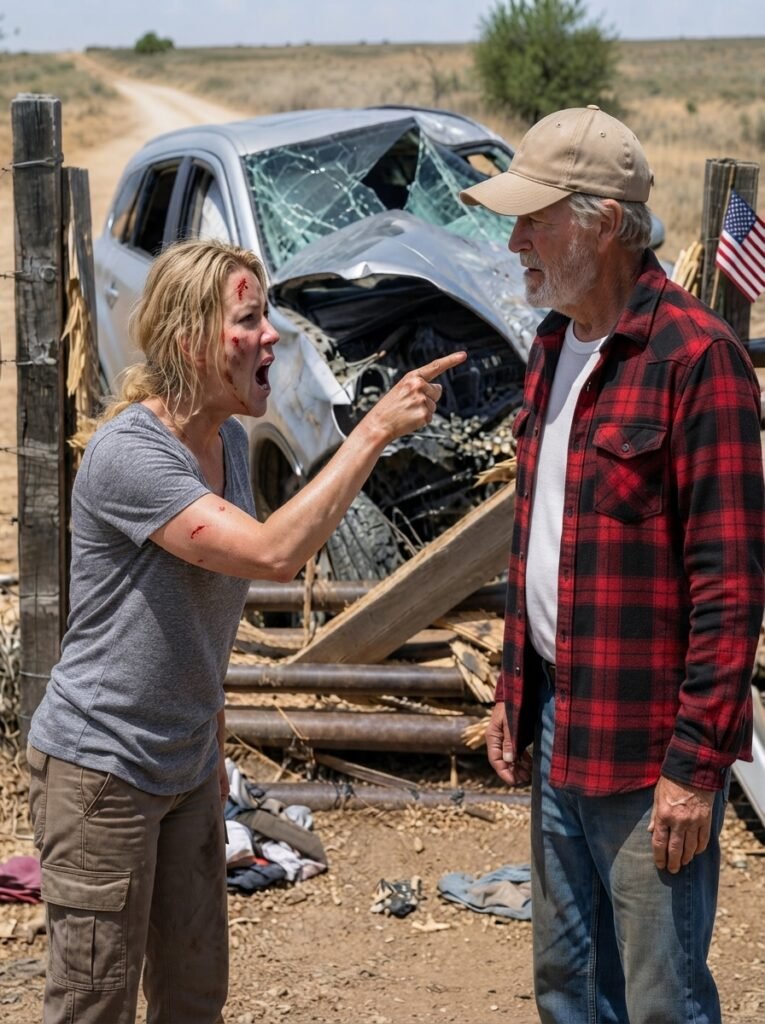
Then impact.
The sound was nothing like the earlier crashes.
It was deeper.
A violent metallic concussion that punched across the valley.
The front of the Lexus collapsed.
The hood buckled upward.
Plastic exploded.
The windshield turned white with fractures.
The SUV’s rear lifted violently before slamming back down.
An airbag burst inside.
Then everything stopped.
No engine.
No screaming.
No laughter.
Just dust moving through sunlight.
Dead silent.
My coffee cup slipped from my hand and shattered on the porch.
For one horrible second, I couldn’t move.
I had imagined Brenda finally being stopped.
I had imagined a damaged bumper.
A destroyed radiator.
Maybe the humiliation of calling a tow truck.
I had not imagined that sound.
Then instinct took over.
I ran.
“BRENDA!”
The distance from my porch to the gate had never felt so long.
By the time I reached the lower drive, dust still hung over everything.
The Lexus sat crushed against the gate.
The barrier had barely shifted.
The front of the vehicle looked demolished.
I approached carefully.
“Brenda!”
No response.
My heart slammed.
Then I saw movement inside.
Her airbag had deployed.
She was conscious.
Blinking.
Blood ran from a cut near her hairline.
“Don’t move,” I shouted. “I’m calling 911.”
Her eyes found me.
Confusion came first.
Then recognition.
Then fury.
“You…”
“Stay still.”
“You did this.”
I pulled out my phone.
“No, Brenda.”
“You did this!”
“You drove into a closed gate.”
She fumbled at her seat belt.
“Don’t get out. Ambulance is coming.”
“You trapped me!”
“I have cameras.”
That stopped her.
Only for a second.
But I saw it.
Her face changed.
“What?”
“Three cameras.”
The fury drained into something else.
Fear.
Sirens arrived seventeen minutes later.
Fire department.
Ambulance.
Sheriff’s vehicles.
Deputy Harris stepped out of the first cruiser.
He saw the Lexus.
Then the gate.
Then me.
His face said everything.
“Jack.”
“She drove straight into it.”
Brenda started screaming from inside the vehicle.
“He tried to kill me!”
Harris looked toward her.
“He disguised it! He set a trap!”
Paramedics began evaluating her.
I stood back.
“I have video.”
Harris looked at me immediately.
“From today?”
“Everything.”
His tone changed.
“Don’t touch the cameras.”
“I don’t need to. Files are backed up.”
Another deputy began photographing the scene.
Within minutes, the road filled with emergency vehicles.
Pine Hollow residents appeared beyond my boundary.
Phones came out.
Rumors traveled faster than sirens.
I heard somebody say I had dropped a concrete wall across a public road.
Someone else said Brenda had been impaled.
Another claimed there had been an explosion.
None of that was true.
Brenda was taken to the hospital conscious.
Her injuries were painful, but not life-threatening.
Before the ambulance left, she pointed at me through the open doors.
“You’re going to prison!”
I said nothing.
Harris walked over.
“Jack, I need the footage.”
“Absolutely.”
“And documentation on this gate.”
“I have permits, survey records, photographs, warning signs, construction photos, everything.”
His eyebrows rose.
“You planned for this.”
“I planned for another lawsuit.”
That answer mattered.
Because by sunset, Brenda had already begun telling a very different story.
According to her statement, she had been driving slowly toward what she believed was a lightweight gate when a hidden “industrial barricade” caused a deliberate collision.
She claimed she was using an established community access route.
She claimed there were no adequate warnings.
She claimed I had intentionally created a deadly trap.
Then Harris watched the video.
The first camera showed Brenda entering my private drive.
It showed the large sign.
STOP.
PRIVATE PROPERTY.
NO TRESPASSING.
It showed her driving past it.
The second camera showed the Lexus accelerating.
The third captured the final seconds.
There was no braking.
Not even a brief flash of brake lights.
Harris watched it twice.
Then he looked at me.
“She accelerated.”
“I know.”
“After the warning sign.”
“Yes.”
He rewound.
Watched again.
Then he asked a question I hadn’t expected.
“Do you still have footage from the night you said she almost hit you?”
My throat tightened.
“Yes.”
I had installed an older camera near the house months before—not positioned well enough to identify the driver clearly that night, but it had captured part of the convoy and the Lexus leaving.
It wasn’t enough on its own.
Combined with everything else, however, it suddenly mattered.
Especially when deputies inspected Brenda’s Lexus.
The passenger-side mirror had been replaced recently.
The repair invoice was still in the glove compartment.
Date?
Two days after the night I was struck.
That was when the story began to unravel.
The next morning, Pine Hollow exploded.
Half the neighborhood blamed me.
The other half blamed Brenda.
Someone uploaded cellphone video of the wrecked Lexus to a local Facebook group.
Within hours, thousands of people were arguing.
MONSTER HOMEOWNER BUILDS HIDDEN DEATH GATE.
HOA KAREN FINALLY MEETS IMMOVABLE OBJECT.
RETIRED BUILDER SETS REVENGE TRAP.
I hated all of it.
People wanted a villain and a hero.
Reality was uglier.
I had built a strong gate because my weaker gates kept being destroyed.
Brenda had driven into it because months of getting away with intimidation convinced her nothing could stop her.
That should have been the end.
It wasn’t.
Two days later, an attorney representing Pine Hollow HOA arrived at my property.
His name was Daniel Reeves.
Gray suit.
Calm voice.
Expensive shoes that hated my gravel.
“I’d like to discuss a potential resolution.”
“You’re representing Brenda?”
“The association.”
“She is the association.”
“Not necessarily.”
Interesting.
We sat on my porch.
He placed a folder on the table.
“The HOA’s current position is that this incident involves disputed access rights.”
“There are no disputed access rights.”
“Ms. Brenda maintains—”
“I don’t care what Brenda maintains.”
He looked toward the lower driveway.
“The association has correspondence describing that route as an emergency access easement.”
“Show me the recorded easement.”
Silence.
“County recording number?”
Nothing.
“Title document?”
Nothing.
“Subdivision plat?”
Nothing.
Reeves closed the folder.
“You’ve researched this.”
“I’ve owned property before.”
He stared at me for several seconds.
Then he said something unexpected.
“Mr. Jack, have you ever been provided with a document titled the Pine Hollow Secondary Access Agreement?”
“No.”
His expression changed.
Barely.
But enough.
“What agreement?”
“I’ll need to review some materials.”
“Daniel.”
He stood.
“I’ll contact you.”
Three hours later, Martin—the quiet HOA board member from the clubhouse meeting—called me.
His voice shook.
“We need to talk.”
“About what?”
“Not on the phone.”
He arrived after dark.
No suit.
No HOA badge.
No confidence.
He carried a banker’s box.
I let him inside.
He placed it on my kitchen table.
“What is this?”
“Copies.”
“Of?”
“Everything Brenda didn’t want you to see.”
I looked at him.
Martin sat.
Then he told me the hidden part of the story.
The shortcuts had never really been about traffic.
Not originally.
When Pine Hollow was being developed six years earlier, the original plans included a second official exit on the subdivision’s western side.
That second exit mattered.
It was part of the traffic plan used during approval.
But construction costs rose.
Land negotiations stalled.
The developer eventually eliminated the secondary road from the final build.
That should have triggered new traffic reviews.
Instead, someone submitted documents implying Pine Hollow had secondary emergency access across what was now my parcel.
Except no such easement had ever been finalized.
No owner had signed it.
No payment had been made.
No document had been recorded.
“So why did Brenda keep saying it existed?” I asked.
Martin swallowed.
“Because she knew it didn’t.”
The room went quiet.
He opened the box.
Meeting minutes.
Emails.
Old maps.
Internal HOA messages.
I read one.
Then another.
Then another.
My anger returned slowly.
Brenda had been warned by the HOA’s previous attorney almost two years earlier that residents had no legal right to cross my land.
The attorney’s language was crystal clear:
PRIVATE PARCEL. NO RECORDED ACCESS EASEMENT. ASSOCIATION SHOULD IMMEDIATELY CEASE REPRESENTING ROUTE AS COMMUNITY ACCESS.
Brenda had replied by email.
Then we make it community access through continued use.
I looked up.
“What does that mean?”
Martin rubbed his face.
“She thought if residents used the road long enough, aggressively enough, she could later argue some kind of established right.”
“That’s not how this works.”
“I know.”
“She encouraged trespassing deliberately?”
Martin nodded.
My stomach tightened.
“What about the fines?”
He pulled out another stack.
The HOA management company had repeatedly told Brenda I was outside their jurisdiction.
She ordered them to send notices anyway.
One email read:
Keep pressure on him. He’s one man. Eventually he’ll stop fighting.
I leaned back.
For months, I had thought Brenda was entitled.
She was worse.
She was strategic.
Then Martin handed me the final document.
It was an email from three weeks earlier.
Subject:
ACCESS PROBLEM.
Brenda had written to two board members.
If Jack keeps rebuilding the gate, we remove it permanently. Once the route stays open, residents will normalize it. Don’t put details in official minutes.
My hands went cold.
“Why are you giving me this?”
Martin stared at the floor.
“Because I was in one of the cars that night.”
Silence.
“What?”
“The night you were almost hit.”
My chair scraped backward.
Martin raised both hands.
“I wasn’t driving.”
“You were there.”
“Yes.”
“You laughed?”
“No.”
“One of you did.”
“I know.”
My jaw tightened.
He looked terrified.
“Brenda told us we were going to drive through and prove the access point couldn’t be blocked. She said you’d yell. She said not to engage.”
“You watched her drive at me.”
“I saw you jump.”
“And you did nothing.”
His eyes filled.
“I’ve thought about that every night.”
I stood.
“Get out.”
“I’m going to the sheriff tomorrow.”
“Get out.”
“Jack—”
“Take your box or leave it. But get off my property.”
He left the box.
The sheriff’s investigation changed rapidly after that.
Martin gave a statement.
Then another board member cooperated.
Then one of the drivers from the midnight convoy hired an attorney and gave his own version.
Suddenly Brenda’s story wasn’t about one angry homeowner and one unfortunate crash.
It was about repeated trespassing.
Property damage.
False HOA enforcement.
A coordinated effort to pressure a landowner into surrendering private access.
And the night I had nearly been run down.
Brenda’s attorney stopped returning reporters’ calls.
The HOA issued a statement saying Brenda had acted “outside the authority granted to the board.”
Brenda responded by accusing the board of betrayal.
Then came the civil hearing.
Her lawyers focused heavily on my gate.
They showed photographs of the crushed Lexus.
They used words like concealed.
Reinforced.
Hazard.
Deliberate.
My attorney let them talk.
Then he stood.
“Mr. Jack, why did you build a stronger gate?”
“Because Brenda destroyed the weaker ones.”
“How many times?”
“Twelve incidents of damage or forced entry that I documented.”
“Why use wood on the exterior?”
“To match the existing appearance.”
“Was the gate hidden?”
“No.”
“Warning signs?”
“Multiple.”
“Visible?”
“Yes.”
“Did you invite Brenda onto the property?”
“No.”
“Did you tell her the driveway was private?”
“Repeatedly.”
“Did she know there was a gate?”
“She had destroyed versions of it several times.”
My attorney turned toward the screen.
“Your Honor, we would like to play the final forty seconds before impact.”
The courtroom darkened.
The video began.
Silver Lexus.
Dust.
Warning sign.
Acceleration.
Second sign.
More acceleration.
Gate.
Impact.
Nobody spoke.
Then he played footage from earlier months.
Brenda striking the wooden gate.
Again.
And again.
One clip showed her getting out afterward, examining damage, returning to her Lexus, and driving through.
Another showed her pushing the damaged gate aside.
Another showed her photographing my PRIVATE PROPERTY sign.
That photograph became devastating.
Because she could no longer credibly say she didn’t know.
The judge stared at Brenda.
“Ms. Brenda, did you take this photograph?”
Her attorney whispered urgently.
She answered.
“Yes.”
“Then as of this date, you clearly knew the owner considered the road private.”
“I believed he was wrong.”
“Believing a property owner is wrong does not authorize you to drive through his gate.”
Her face went rigid.
Then came Martin’s emails.
The previous attorney’s warning.
The instruction to “keep pressure on him.”
The message about normalizing access.
Brenda stopped looking at me.
The civil claims against me collapsed one by one.
The HOA fines were declared unenforceable.
The association formally acknowledged it had no jurisdiction over my parcel.
Pine Hollow was ordered to stop representing my road as community access.
Brenda was removed as HOA president before the week ended.
But even that wasn’t the final twist.
Three months after the crash, Deputy Harris called.
“Jack, you busy?”
“I’m retired. I specialize in pretending to be busy.”
He didn’t laugh.
“We recovered something.”
“What?”
“When Brenda’s insurance company examined data from the Lexus, they pulled vehicle information related to several earlier incidents.”
I sat down.
“And?”
“The night you were almost hit.”
My grip tightened around the phone.
“What about it?”
“They can establish the vehicle was being operated at the location and approximate time.”
“That still doesn’t prove she drove.”
“No.”
He paused.
“But Martin’s statement does.”
I said nothing.
“And there’s more.”
Of course there was.
“There was an audio file.”
“What audio file?”
“Brenda had been using a dashboard system that stored short clips connected with voice commands and certain vehicle events.”
My stomach dropped.
“Harris…”
“We heard what happened before she accelerated toward you.”
I couldn’t speak.
“What did she say?”
He was quiet for several seconds.
Then:
“She said, ‘Let’s see him stand there now.’”
Everything inside me went still.
For months, part of me had wondered whether I had misunderstood.
Whether she had panicked.
Whether gravel had slipped under her tires.
Whether she had intended to scare me but lost control.
Human beings do strange things when something terrible almost happens.
We search for softer explanations.
The audio erased mine.
She had seen me.
She had known.
And she had accelerated anyway.
The criminal case moved slowly after that.
I won’t pretend it was satisfying.
Real courtrooms aren’t like television.
There are postponements.
Motions.
Arguments over evidence.
Lawyers negotiating language.
Months where nothing seems to happen.
But eventually Brenda stood before a judge without her HOA title, without her board, without a neighborhood willing to repeat her version of events.
She did not look powerful anymore.
She looked small.
Not physically.
In every other way.
The woman who once slapped fake fines on my mailbox because she believed I would eventually surrender was now being forced to answer for decisions she had made when she thought nobody could tell her no.
The wrecked Lexus had been totaled.
Insurance refused portions of her claim after reviewing the footage.
The HOA’s carrier launched its own investigation.
Several Pine Hollow residents sued the association over assessments and legal expenses linked to Brenda’s actions.
Martin resigned from the board.
He sent me a handwritten apology months later.
I never answered.
Maybe someday I will.
Maybe I won’t.
The gate remained.
I repaired the cedar exterior where the Lexus had struck it.
The steel underneath needed almost nothing.
I added brighter reflective markers.
Then, because I never wanted anyone claiming confusion again, I placed a large sign beside it.
PRIVATE PROPERTY.
NO PUBLIC ACCESS.
THIS IS NOT A PINE HOLLOW ROAD.
For the next six months, not one vehicle tried to cross.
Funny how quickly an “essential community easement” becomes unnecessary once consequences become real.
Then one Saturday morning, I heard a truck stop at the gate.
My shoulders tightened automatically.
Old reflex.
I walked down.
A Pine Hollow resident stood outside his pickup.
Young guy.
Maybe thirty.
I recognized him vaguely.
He held an envelope.
“You Jack?”
“Yes.”
He glanced at the gate.
Then at me.
“I just wanted to give you this.”
“What is it?”
“Money.”
“I don’t want your money.”
“It’s not from the HOA.”
He placed the envelope on the post.
“A few families collected it.”
“For what?”
He looked embarrassed.
“Your old gates.”
I stared at him.
“We didn’t drive through them,” he said quickly. “But we knew people were doing it. We heard Brenda say you were crazy. We believed her. Some of us joked about you.”
I said nothing.
He looked toward Pine Hollow.
“The videos changed things.”
“What videos?”
“The ones from court. Somebody got copies.”
Of course they did.
He rubbed the back of his neck.
“We saw the signs. We saw her hitting the gate. We saw you repairing it. Then we saw the email about pressuring you.”
He looked at me again.
“We should’ve asked questions.”
That was probably the first useful thing anyone from Pine Hollow had said to me in two years.
I picked up the envelope.
“I’ll donate it to the volunteer fire department.”
He smiled.
“Fair enough.”
Then he walked back to his truck.
Before climbing inside, he stopped.
“Jack?”
“Yeah?”
“For what it’s worth, Pine Hollow voted last week.”
“On what?”
“No more HOA president serving more than two years.”
I laughed.
First time the whole situation had made me laugh in months.
“Good policy.”
He drove away.
Life got quiet after that.
Actual quiet.
The kind I had imagined when I bought the land.
Deer returned to the lower pasture.
Dust settled on the private road because fewer tires disturbed it.
At night, I could sit on the porch and hear coyotes instead of engines.
But sometimes, around 11:30, if headlights appear on the distant county road, my body still reacts before my mind does.
I remember the Lexus.
I remember jumping into the brush.
I remember that mirror striking my shoulder.
And I remember Friday afternoon.
The dust cloud.
The acceleration.
The impact.
People who hear the story usually ask the same question.
“Did you know she would hit the new gate?”
No.
I knew she might come back.
I knew she might complain.
Sue.
Threaten.
Damage something.
I hoped the cameras would finally give me the evidence the deputies said they needed.
But I never truly believed a person would see multiple warning signs, recognize a closed gate on someone else’s land, remember destroying earlier versions of that gate, and decide the correct response was to press harder on the accelerator.
That decision belonged to Brenda.
Every decision before it belonged to her too.
The first shortcut.
The first warning she ignored.
The first gate she damaged.
The fake fines.
The HOA letters.
The midnight convoy.
The moment she aimed her Lexus at me.
The emails telling the board to pressure me.
The photograph proving she knew the property was private.
The sentence recorded before she accelerated that night.
And finally, the last run down my driveway.
People called my gate revenge.
It wasn’t.
Revenge would have meant chasing Brenda into Pine Hollow.
Breaking her property because she broke mine.
Threatening her because she threatened me.
I never did.
I built a boundary on my own land.
Brenda simply spent so long believing boundaries were optional that when she finally met one that didn’t move, she had no idea what to do.
There’s one last thing I haven’t told many people.
About eight months after everything ended, another certified envelope arrived.
For half a second, seeing it in the mailbox made my blood pressure jump.
Then I saw the sender.
Pine Hollow Homeowners Association.
I almost threw it away unopened.
Instead, I carried it to the porch.
Inside was a single-page letter.
No fine.
No threat.
No invented violation.
It was signed by the new HOA president.
Mr. Jack,
The Pine Hollow Homeowners Association formally acknowledges that your driveway, gate, and surrounding parcel are private property and are not subject to HOA authority.
The association has updated all resident maps and emergency documents to remove any reference to access through your land.
We regret the conduct of prior leadership.
I read the letter twice.
Then I noticed something handwritten at the bottom.
One sentence.
Not official.
No letterhead language.
Just ink.
We should have listened when you told us the truth the first time.
I sat there for a long while.
The sun was dropping behind the hills.
Wind moved through the cedar trees.
Somewhere near the gate, a camera clicked as a deer crossed the driveway.
That sentence bothered me more than I expected.
Because that had been the entire story.
Not the gate.
Not the Lexus.
Not even Brenda.
The truth had been available from the beginning.
Survey lines existed.
Records existed.
Signs existed.
Warnings existed.
Brenda simply believed repetition could replace truth.
Say “community easement” enough times and perhaps private land becomes public.
Call a gate dangerous enough times and perhaps trespassing becomes safety.
Send enough official-looking fines and perhaps someone outside your authority starts believing you control them.
Gather enough neighbors and perhaps intimidation becomes legitimacy.
But reality has a stubborn quality.
A property line does not move because somebody dislikes it.
A deed does not rewrite itself because an HOA president raises her voice.
And steel does not become cedar simply because someone expects it to break.
That was Brenda’s real mistake.
She wasn’t defeated by a gate.
She was defeated by certainty.
Her certainty that nobody would challenge her.
Her certainty that the police would dismiss everything as a neighborhood disagreement.
Her certainty that HOA letterhead could frighten me.
Her certainty that the board would protect her.
Her certainty that residents would keep believing her.
Her certainty that every barrier I built would collapse the moment she hit it hard enough.
Then one Friday afternoon, she drove forty-five miles an hour toward what she thought was one more weak thing standing in her way.
She smiled.
She accelerated.
And for the first time in a very long time—
the thing in front of Brenda did not move.
The valley went silent.
The dust settled.
The cameras kept recording.
And the woman who had spent months insisting my boundary didn’t exist finally had to face something she could no longer smash through.
Not steel.
Not concrete.
Not even the law.
The truth.
And unlike every cedar gate she had destroyed before it—
that one stayed standing.