Call 911 in a lot of American counties today and the first thing you hear is not what’s your emergency, it’s what is the address of your emergency. Somewhere along the way, the people who train call takers worked out that a line can drop at any second and the address is the single thing that still sends help if it does. So, schools started teaching it to children. Say your street. Say your number. Say it again. A dispatcher can do everything else after that.
The boy in this story did exactly what he was taught. He did it under a blanket in the dark with his mouth against the phone so the man on the other side of his bedroom door wouldn’t hear him. He said his address four times. And the woman on the other end of the line knew that address better than almost anyone alive because she had eaten Thanksgiving dinner there every year for a decade. My name is Nathan. Some stories are about a crime. This one is about a voice.
The one he lost that night and the call his father made to get it back. Daryl Ellison had spent most of his life with his hands cold. The cold came with the building. Ellison Custom Meat sat on the edge of State Road 56 outside Hollis Creek, Indiana. A long cinder block plant with a gravel lot, a loading dock that faced the cornfields, and a hanging room kept at 34 degrees all year. His grandfather had poured the floor in 1958. His father had added the smokehouse.
The story is far from over. Type “YES” and I’ll share the rest.
Part 3
Daryl had added a credit card machine and a website that his son had built for him one rainy weekend. And he considered that his greatest contribution to the family business. Farmers brought him steers and hogs, and deer hunters brought him whatever they had shot in November. And Daryl turned all of it into something a family could eat. He was good at it in the quiet, unbothered way that men are good at work they have done since they were tall enough to see over the cutting table.
He knew where a carcass wanted to come apart. He knew that a dull knife was more dangerous than a sharp one because a dull knife made you push. His grandfather had taught him one rule about the hanging room, and he had repeated it to every teenager who ever worked a summer for him. Never turn your back on a hanging side. 200 lb on a rail can swing when you least expect it and it will not apologize.
He was 42 that fall, broad through the shoulders with a beard he kept short because the health inspector liked it short and a laugh that came out of him sideways when he did not expect to be amused. He was also a sergeant first class in the Indiana Army National Guard, which was the part of his life that did not fit neatly inside the cinder block. He had joined at 19 to pay for a college degree he never finished.
And he had stayed because he liked the man and because it felt like owing something and paying it back in installments. He had been deployed twice before. The orders for the third came in March, 10 months in Kuwait with a sustainment unit, moving fuel and parts and food across a desert that did not care about any of it. His wife Stacy took the news the way she took most things practically.
She was a pharmacy technician on the overnight shift at the hospital in Lindley, 26 mi north, most nights of the week, and she had already started building a calendar on the refrigerator before he finished telling her who would drive Micah to track practice, who would cover the plant, who would mow. She was small and quick, and she never sat down while there was something left to do. Daryl had married her 19 years earlier in the yard of her mother’s house.
And across those years, he could not remember her asking anybody for help, which was exactly why it surprised him when she said she had already asked her sister. Becky Haynes was Stacy’s older sister by 6 years, and in Brandon County, she was something close to famous. She had worked at the Brandon County Emergency Communications Center for 16 years, most of them on nights. And for the last five, she had been the overnight shift supervisor. People in town knew her voice before they knew her face.
In 2019, she had stayed on the line for 52 minutes with a school bus driver whose bus had slid off County Road 300 into a flooded ditch talking her through getting 19 children onto the roof. And the newspaper in Lindley had run her picture on the front page with the headline, “The voice that kept them calm.” The clipping hung framed in the hallway of the Ellison house because Stacy was proud of her and so was everybody else. Becky’s husband was a different kind of famous.
Heath Haynes ran Hannes towing and salvage on the south end of town, 8 acres of crushed cars behind a chainlink fence with two flatbed wreckers and a roll back that he kept polished like a parade float. He was big and loud and generous with other people’s money. The kind of man who bought a round for the whole bar and then asked to borrow $40 in the parking lot. He coached little league for one season and quit after a parent complained about his language.
He had gone bankrupt once with a car a lot and once with a bait shop. Everybody in Hollis Creek liked Heath for about the first hour. Daryl had never fully liked him, but he had never had a reason not to either, and that distinction would matter later. Becky’s going to check on Michael when I’m at work, Stacy said. And Heath asked if he could park his boat in the pole barn over the winter. I told him yes. Daryl looked up from his coffee.
The pole barn sat behind the house a 100 yards back along the fence line. A steel building his father had put up for the farm equipment they no longer owned. It held a riding mower, a smoker trailer, and a lot of empty air. His boat, Daryl said he doesn’t have room at the yard. He’ll come and go. It’s fine. It was fine, he told himself. Family was family. Their son was the best thing either of them had ever done.
Micah Ellison was 14, all elbows and knees in that stretch of boyhood where a kid grows 2 in between Christmas and spring break and eats like a field hand. He ran the quarter mile on the junior varsity track team and was faster than he was disciplined. He liked engines, old movies, and the kind of internet videos where a man restores a rusted tool to perfect condition over 20 silent minutes.
He was a quiet kid at school and a loud kid at home, and he could imitate his father’s voice so exactly that he had once ordered 40 lb of breakfast sausage from the plant supplier over the phone as a joke. When Micah was five, Daryl had taught him the address, not the way most parents teach it, singing it once and moving on. He had marched it with him around the kitchen table like a cadence. 5719 Pel Road, Hollis Creek, Indiana. 5719 Pel Road.
They had done it so many times that Stacy had banned it after dinner. By first grade, Micah could say it backward. By second grade, he could say it in the voices of half a dozen cartoon characters. It had been a game. Daryl had never once imagined it as anything else. The night before he left for the armory, Daryl found his son in the hanging room. The boy was not supposed to be in there without him, but he had a key.
And sometimes he went in just to stand in the cold and the quiet and think. Daryl found him sitting on an upturned bucket in his hoodie, his breath showing. You’re going to freeze, Daryl said. It’s good for your brain, Micah said. There’s a video. Daryl sat down on the next bucket. Neither of them spoke. The rails ticked overhead. The compressor hummed. Dad. Micah said, “Why does Uncle Heath need our barn? He doesn’t even have a boat. I’ve been to the yard a hundred times. There’s no boat.” Daryl thought about it.
Then he made the kind of decision a man makes the night before he leaves for 10 months. When he has a 100 things to finish and no room for one more problem. Maybe he bought one, he said. Keep an eye on the place for me. You’re the man of the house. That sentence would follow him for years.
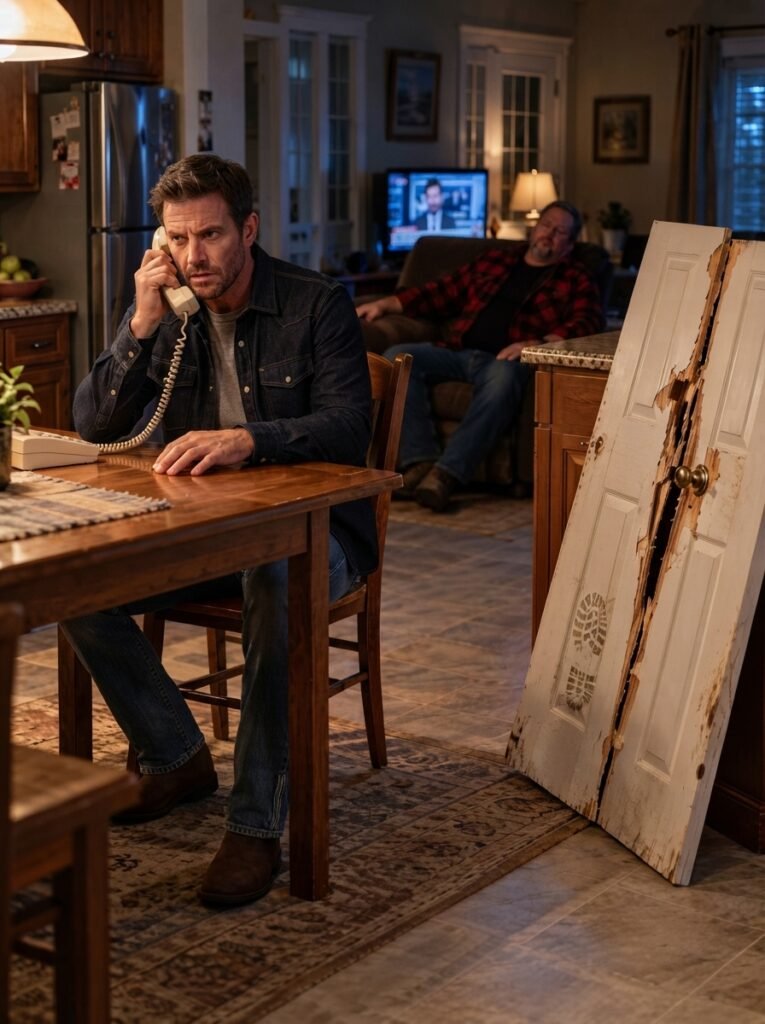
He would remember the cold of that room and the steam of his son’s breath and the way the boy nodded very seriously, like he had just been handed a job. 10 months later, Daryl Ellison would stand in his sister-in-law’s kitchen at 3:12 in the morning and dial 911 on her own phone. But before that, he had to leave. And while he was gone, his son was going to find out exactly what Uncle Heath kept in that barn. The first truck came on a Tuesday in late April.
A few weeks after Daryl’s unit flew out of Indianapolis, Micah heard it before he saw it. Stacy was at work, the house was dark and he was in bed at a little after 1:00 in the morning watching a video about restoring a hand plane when the sound of a diesel engine came up the gravel lane and went past the house toward the back of the property. Headlights swept across his ceiling. He got up and looked out his window.
His room was on the second floor at the back of the house and from there he could see the pole barn sitting at the end of the fence line under its single yellow security light. A flatbed wrecker was backing up to the big sliding door. Haynes towing it sat on the side in gold letters. There was a car on the bed that was not a boat. He watched Uncle Heath get out of the cab, unlock the barn, and roll the door open.
Another man climbed out of the passenger side. someone Micah didn’t recognize, thin with a ball cap. They winched the car off the bed and pushed it inside, and the door rolled shut. And then for almost two hours, the barn’s windows flickered with a blue white light, and Micah heard faint across the yard. The high wine of a power saw biting into metal. In the morning, he walked out to the barn before school. It was locked with a new padlock, a heavy brass one he had never seen before.
The gravel by the door was dark with fresh oil, and there were small curls of shiny metal in it, like shavings off a pencil sharpener. He picked one up and put it in his pocket. He told his mother that afternoon. Stacy was asleep until 2, the way she always was after a shift, and when she came down to the kitchen in her robe, he was already sitting at the table with the metal curl in front of him like evidence.
Uncle Heath was in the barn all night with a car, he said. And a saw. Stacy rubbed her eyes. He’s doing some work for a customer. Becky told me he needed a quiet place. Honey, it’s fine. At 1:00 in the morning, Keith keeps strange hours. You know that. She kissed the top of his head and went to make coffee and that was the end of it as far as she was concerned. The trucks kept coming. Not every night, but a couple of nights a week. Always after midnight.
Always when Stacy was at work. Sometimes it was the wrecker with one car. Sometimes it was the roll back with two. Micah started keeping track without meaning to. He noticed that the cars always came in with their back and sagging a little wrong and left in the morning on the same truck headed south. He looked it up. He watched a handful of videos and read a news article from the Lley paper. And by the second week of May, he knew exactly what Uncle Heath was doing. Catalytic converters.
Every car has one, a canister bolted into the exhaust underneath, and inside the canister is a honeycomb coated in platinum, palladium, and roodium. A single converter off the right kind of car could sell to the wrong kind of scrap buyer for a few hundred, sometimes more than a thousand. Thieves in half a dozen counties had been sliding under cars in church parking lots and apartment complexes, and sawing them off in 90 seconds.
The Lley Paper said more than 500 had been stolen in the region since January and the Brandon County Sheriff’s Office had formed a task force. The article quoted a detective named Joy Pierce. “We will find where they’re being cut,” she said. “Somebody has a building. Somebody had a building. It was Micah’s father’s.” He tried to tell his father.
He typed out a long message one night on a video call app and then deleted it because his father was half a planet away, eight hours ahead, sleeping in a tint in the heat, and there was nothing he could do about it from there except worry. Micah had been told he was the man of the house. He decided a man of the house would get proof first.
On a Friday night in the first week of June, he climbed up into the hoft of