That evening, after we returned to my apartment, a video call came through from Kendra’s account. I almost ignored it. Then I saw Mason’s face.
He was holding his mother’s tablet close to his nose. The room behind him was dark, and the blanket above his head made it look as though he had built a small tent around himself.
“Aunt Leah, e, are you coming back for Christmas?”
The question caught me off guard. Christmas was months away, but children do not always measure time the way adults do. He was asking whether I would still be part of his life.
“Of course. I love you,” I said. “You can always call me.”
“Mom says you’re never coming back.”
I took a breath.
“Your mom is upset right now. That doesn’t change how I feel about you.”
He looked towards something outside the camera.
“I have to go,” he whispered.
The screen went black.
I sat for a long time with the tablet call still visible in my recent activity. I knew that the court process would affect Mason even though he had done nothing wrong. I also knew that keeping him out of the middle would be difficult. Adults had already begun using his name to influence my decisions.
The next morning, the sheriff’s office served the temporary order. My phone rang at 10:15. I was scrambling eggs in the small kitchen while Grandpa worked on a large print crossword at the table.
Travis’s name appeared on the screen. I answered. He was shouting before I could say hello.
“Why are the deputies at our door?”
The story isn’t over yet. Type “LOVE” if you’d like me to post the rest.
Part 2:
Behind his voice, I heard Kendra speaking quickly, Mason crying, and another person giving instructions in a calm official tone.
I turned off the stove.
“Because it’s grandpa’s house,” I said.
“You did this to us.”
“Grandpa filed the petition. I drove him to the courthouse.”
“There are deputies in the kitchen. They’re telling us we have an hour to pack and leave with the kids. Leah, an hour.”
I did not know what to say to that. I imagined the children watching strangers in uniforms enter the home they had known. I imagined Mason trying to understand why his greatgrandfather’s bedroom was suddenly important to everyone.
Then Travis’s voice changed. The anger faded, and underneath it, I heard the frightened boy he had been when our mother left.
“Where are we supposed to go?”
I braced my elbow against the counter. My hand was shaking.
“Kendra’s mother lives in the valley,” I said. “You have a car. You’ll find somewhere to stay.”
Kendra shouted in the background that I would never see the children again. Travis ended the call.
I placed the phone face down and slid down the cabinet until I was sitting on the kitchen floor. I had imagined the order being served. I had prepared myself for arguments and accusations. I had not prepared myself for the sound of my brother asking where his children would sleep.
Grandpa rose slowly from the table. He walked over and rested his hand on the top of my head just as he had when I was a little girl. He did not tell me I had done the right thing. He did not tell me to stop crying. He simply stayed there until I could breathe normally again.
Later that afternoon, Gene Puit called. He lived across the road from Grandpa and had worked in the railroad shops with him for three decades. He was 80 with bad knees and a voice that sounded like gravel moving in a truck bed.
“I thought you’d want to know what happened,” he said.
He had watched from his porch as the deputies remained in the driveway while Travis and Kendra packed their vehicles. Kendra had filmed the officers and argued with them. Travis carried boxes. Mason stood near the front steps looking confused.
At one point, a woman arrived with a rolling suitcase. A deputy spoke to her and showed her the order. She returned to her car and drove away. Jean thought she might have been a guest who had expected to stay in the rented room.
“Your sister-in-law spent a lot of time on her phone after that,” he said. “Maybe cancing reservations.”
Then he became quiet.
“Lah, I need to tell you something. I called the house in November. The garage light was on every night, and I thought it was strange. Kindra answered Frank’s phone. She told me he was fine, just staying up late to work on things.”
Jean said he had considered walking over. The road was icy, his knees hurt, and he convinced himself it was not his business.
“I should have crossed the road,” he said.
I told him that grandpa was coming home now.
“They’re gone,” Jean replied. “The porch light is off. Bring him back.”
We arrived at the house shortly after 5. Jean stood on his porch in a heavy parker and raised one arm in greeting. I waved back.
The house was cold. The thermostat displayed a message saying it was controlled by an app. I found the reset switch, cleared the old setting, and set the temperature to 70°. The furnace started.
Grandpa stood in the hallway with his walker and closed his eyes. I had seen him do that in my apartment when the heat first came on. I wondered how many times he had listened to the furnace in this house and known it was working while he remained in the garage.
When the warm air began moving through the vents, he walked down the hallway toward his bedroom. I followed at a distance but did not take his arm. He had asked to go home. He deserved to enter his own room without being treated like a visitor.
The room looked like a hotel suite after a guest had checked out. The bed was neatly made. A card with the wireless password sat on the nightstand. Two empty water bottles were in the trash. A phone charger remained plugged into the wall.
Grandma’s quilt lay across the mattress. There was a brown coffee stain near the center, almost the size of my hand. It had dried into the pale blue fabric.
Grandpa sat on the edge of the bed and placed his palm beside it. He looked at the quilt, then at the empty closet. For a while, he did not move. Then he covered his eyes with his other hand and began to cry.
I sat beside him. I did not try to make him feel better. There are moments when comfort is not a sentence. It is simply the decision to remain beside someone while the truth catches up with them.
When he finished, he took a handkerchief from his pocket and wiped his face.
“Get me my screwdriver,” he said.
I knew which one he meant. It was a flathead with a wooden handle hanging from the third peg on the left. Grandpa had painted an outline around it years earlier. I went to the garage and brought it back.
He asked me to remove the brass slide bolt from the kitchen side of the door. I loosened the four screws one at a time. They came out easily. The bolt had not been installed long ago. The bright metal and fresh screw holes had told me that already.
I handed it to him. He turned it over in his palm, then walked to the workbench and dropped it into a coffee can full of loose hardware. It made a small metallic sound as it landed.
“That’s where it belongs,” he said.
Jean came over at 7 with a pot of chicken soup. We ate at the kitchen table, the three of us, with the radio playing softly in the background. Grandpa complained that the soup needed more pepper. Jean told him he had never been satisfied with anyone else’s cooking.
For the first time since I had arrived, the kitchen sounded like the kitchen I remembered.
I slept in my old bedroom that night. The room still had a poster from a band I no longer listen to and a small mark on the wall where I had once thrown a shoe at a spider. I lay awake listening to the furnace and the occasional creek of the house.
At 6:00 the next morning, an email from the court arrived.
Kendra had filed a response.
Chapter 7. The story she told.
The response was 11 pages long. Kendra described herself as Frank’s full-time unpaid caregiver for 18 months. She said she had given up employment opportunities and personal time to keep him safe.
She claimed that he suffered from dementia, wandered at night, and sometimes tried to leave the house in unsuitable clothing. According to her statement, the garage had been his preferred place. She said he enjoyed spending time there and that she had brought him blankets when he wanted to rest.
She included a type care log with entries describing meals, medication reminders, and cheerful conversations. She attached photographs of food she had prepared and of grandpa sitting at the table.
The final section accused me of manipulating an elderly man after 2 years of absence because I wanted control of his property.
I read the document at the kitchen table while the house was still quiet. By the time I reached the last page, I could feel my jaw tightening. I wanted to answer every sentence. I wanted to list every fact she had omitted. I wanted to tell the court that a person who truly cared for an older relative would not put him in an unheated garage and rent out his bedroom.
But the response had to be handled carefully. The case was not a family argument on social media. It was a legal proceeding involving my grandfather’s safety and rights.
I put the papers down and walked around the block. The snow had hardened overnight. Cars moved slowly along the road and the neighborhood looked peaceful in the early light. I passed the houses where grandpa had known every neighbor for decades. I thought about how easily a quiet street could hide a difficult life.
Over the next 12 days, Kendra posted a long message online. She wrote about a sister-in-law who had disappeared for 2 years and then returned to take an elderly man away from the only family members who had cared for him.
People from my high school commented. Some said they were shocked. Others offered sympathy. A few asked why I had not visited more often.
I drafted a response with the screenshots ready. The listing, the booking calendar, the photographs of grandma’s quilt, and the review from the traveling nurse would have made the situation difficult to explain away.
Again, my finger hovered over the button. Then I closed the application.
The evidence was not for strangers in a comment section. It belonged in the court record where it could be examined properly. It was also grandpa’s evidence, not mine. He would decide how much of his private life should become public.
During that period, an adult protective services investigator named Patrice Hall visited the house. She spoke with grandpa alone at the kitchen table for nearly an hour while I waited in my car. I could see her through the window, leaning forward as he spoke. Sometimes she wrote notes. Sometimes she simply listened.
Afterward, she walked through the garage with him. She photographed the cot, the camping toilet, the thermometer, and the screw holes where the bolt had been attached. I had deliberately left the cot in place so the investigator could see the conditions for herself.
Patrice asked me a few questions about the night I found him and about the hospital visit. I answered as accurately as I could. I did not guess about things I had not witnessed.
When she finished, she shook Grandpa’s hand.
“Thank you for speaking with me, Mr. for Hollis,” she said. “I know that wasn’t easy.”
He gave a small shrug.
“It took a granddaughter with a car,” he replied.
Patrice smiled, but she did not dismiss what he had said. She explained that the investigation would continue and that she might need to contact him again.
2 days later, Kendra sent me a private message. It was polite, almost business-like. She said everyone had been under pressure. She said she was willing to remove the rental listing and return the master bedroom to Frank if I could persuade him to withdraw the petition.
She wanted the family to heal. She asked me to think about Mason.
I read it twice, then showed it to Grandpa. He used his magnifying glass and studied every line.
“She is offering me my own bedroom,” he said.
He handed the phone back. I did not answer for him. I did not tell him what I thought she deserved. He had already made his decision and he was allowed to consider any offer without pressure from me.
He placed the magnifying glass on the table.
“An apology would have sounded different,” he said.
That was all.
During the same week, I contacted a home care agency. Grandpa needed some help with showers, shopping, and tasks that were difficult because of his hip and eyesight. We arranged for an aid to visit three mornings a week.
Grandpa insisted on paying from his own account. I offered to cover the cost. He refused.
“I have a pension,” he said. “I can pay for help.”
I had to stop myself from reaching for my wallet. It was harder than I expected. I had spent years trying to solve problems with money, and I was learning that helping someone did not mean taking away every responsibility they wanted to keep.
The aid’s name was Marlene. She was patient and practical. She asked Grandpa how he preferred things done rather than assuming she knew. She learned where he kept his towels and which mug he liked for tea. She also understood that he wanted to do as much as possible for himself.
After her first visit, he told me she was all right. From him, that was an excellent review.
Chapter 8. The hearing.
The morning of the hearing, grandpa came out of his bedroom wearing the dark suit he had worn to grandma’s funeral. He carried a blue tie in his hand.
“Your grandmother always handled this part,” he said.
I tied it the way she had taught me when I was 12. My hands were not steady, so I had to start over once.
Grandpa watched patiently.
“You’ve got it,” he said.
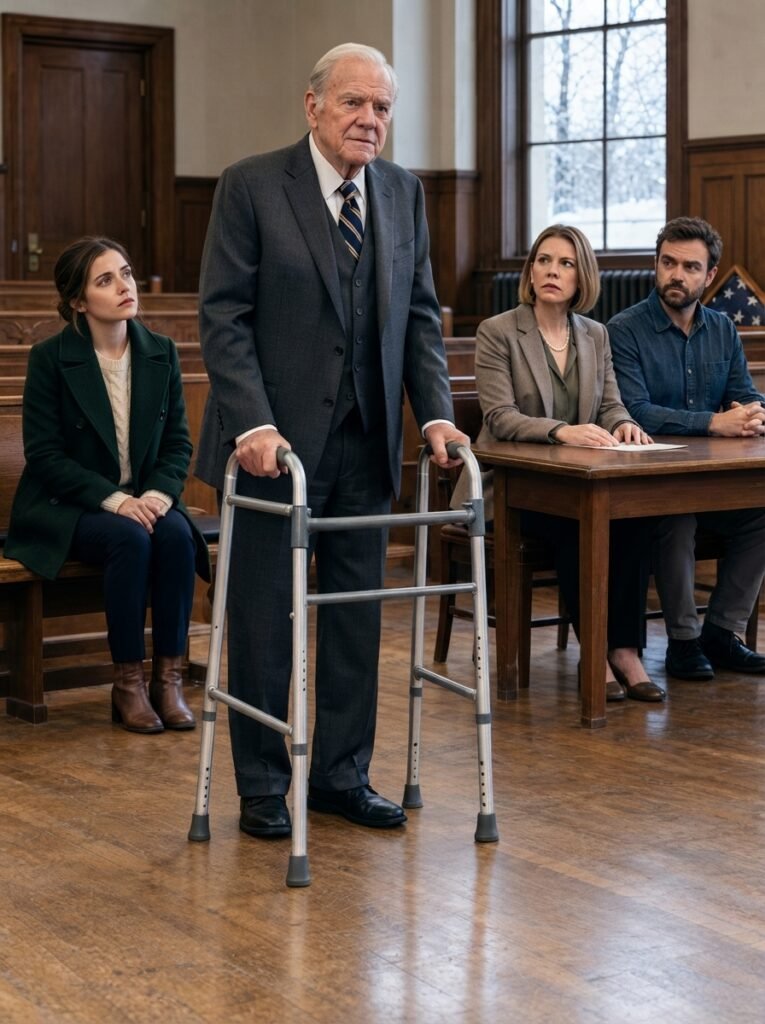
The hearing took place in a small courtroom on the second floor of the courthouse. The room had wood paneling, fluorescent lights, and a radiator that clicked whenever the heat came on.
Denise Rower sat beside Grandpa at the petitioner’s table. I sat in the first row with Jean, who had put on a sport coat that smelled faintly of cedar.
Across the aisle, Kendra sat with a thick binder. Her hair was pulled back neatly, and she wore a cardigan I had never seen before. Travis sat beside her. He did not look at us.
Kendra spoke first. She was composed, organized, and persuasive. I had to admit that she had prepared carefully. She described the time she had spent helping Grandpa and the sacrifices she claimed to have made. She said he had become increasingly difficult to manage.
She told the commissioner that he sometimes got up at night and tried to go outside. She said the garage was where he liked to spend his time.
“He had always been a workshop man,” she explained.
She had placed blankets there because he wanted to be near his tools. She showed the care log and photographs of meals. She described the grocery shopping, the medication reminders, and the appointments she said she had arranged.
Then she turned toward me.
“His granddaughter was not here for 2 years,” she said. “Now she has returned and wants his home. That’s what this is really about.”
She reached into her binder and removed a sheet of lined paper. It appeared to have been torn from a notebook. The words were written in Kendra’s handwriting.
“I agreed to sleep in the garage while we have guests.”
Below them was Grandpa’s signature written in large uneven letters. Kendra held it up.
“He chose this,” she said. “He signed it. Nobody forced him.”
The commissioner asked to see the paper. The clerk carried it forward. After examining it, the commissioner turned toward Grandpa.
“Mr. Hollis, is this your signature?”
Grandpa stood using his walker.
“Yes, ma’am. That’s my name.”
“Do you remember signing it?”
“Idol. It was October 3rd. Kendra told me a family was coming for a hockey tournament. She said they needed the big bedroom for three nights and asked if I could sleep in my shop. I agreed to three nights.”
He paused.
“It’s January now.”
The room became quiet.
Grandpa continued. He described the heater being removed, the doorbolt, and the nights he had to knock before entering his own kitchen. He explained that he sometimes stopped knocking because it was humiliating to ask permission to use a bathroom in the house he owned.
He did not raise his voice. He did not call anyone names. He spoke slowly and clearly, looking at the commissioner rather than at Kendra.
The commissioner asked him several questions.
“What is today’s date?”
He answered.
“Where do you live?”
He gave his address and said he had lived there since 1974.
“Who pays the utility bills?”
“Ido, every month from my pension.”
“Do you leave the house at night and become lost?”
“I get up to use the bathroom, ma’am. I suppose that is something most 83-year-old men do. I’m not wandering around looking for another house. I’m looking for the toilet.”
A quiet laugh moved through the room.
The commissioner asked whether he understood the order he had requested and whether he wanted Kendra and Travis to stay away from his property.
“Yes,” he said. “I understand. I want my home back.”
Then he said something I will remember as long as I live.
“I’m 83. I’m slower than I used to be and my eyes don’t work as well as they did, but I’m not gone.”
Denise presented the documents one at a time. She introduced the emergency department records showing hypothermia, dehydration, and the pressure injury on Grandpa’s hip. She submitted Dr. Ma’s letter, including the cognitive screening result, and his conclusion that Grandpa retained decision-making capacity.
She showed the photograph of the garage thermometer and the image of the bolt attached to the kitchen door. She submitted the online rental listing, including the picture of grandma’s quilt on the bed. She presented the booking calendar and the review written by the traveling nurse who had seen an older man in the garage.
The sheriff’s welfare check report was also included. It showed that Grandpa had answered the deputy’s questions accurately and had stated clearly that he wanted to remain with me.
Jean was called as a witness. He stood with one hand on the back of the chair and described the garage light he had seen night after night. He explained that he had called the house in November and been told grandpa was fine and simply enjoyed working late. He admitted that he had not crossed the road to check for himself.
“I should have,” he said. “Frank is my friend.”
Kendra’s final argument was that the rental income had been used for household expenses. She said the money had helped pay for food, utilities, and grandpa’s care.
The commissioner looked over her glasses.
“Mr. Hollis testified that he pays the utilities himself. Do you have records showing how the rental income was spent?”
Kendra opened her binder, searched briefly, and closed it.
“Not with me,” she said.
The commissioner then turned to Travis.
“Mr. Hollis, you lived in the home. Did you know your grandfather was sleeping in the garage during January?”
Kendra turned toward him. I watched her face as she waited for his answer.
Travis stared at the table. His hands were folded and his shoulders looked tense. The room seemed to hold its breath.
“Yes, ma’am,” he said quietly.
It was only two words, but they changed everything.
Kendra turned away from him. The commissioner wrote something down and reviewed the papers in front of her.
When she announced her decision, her voice was measured in formal. She granted the full protection order for one year. Kendra and Travis were prohibited from entering Grandpa’s home. The order also prevented them from selling, transferring, or borrowing against his property.
Grandpa had asked that the order not forbid all contact. He wanted the possibility of seeing Mason and hearing from his greatgrandson. The commissioner respected that request while keeping the property restrictions in place.
Kendra was also required to provide a full accounting of the money received from renting rooms in the house and the use of grandpa’s funds while she had access to his debit card. The commissioner noted that adult protective services had an open investigation and that the agency would receive a copy of the order.
Kendra spoke loudly.
“That is my children’s home.”
The commissioner removed her glasses.
“It’s Mr. Hollis’s home,” she replied.
Out in the hallway, Kendra walked straight to the elevator. She pressed the button several times and did not look back.
Travis remained beside the water fountain. Grandpa looked at him. Travis looked back. Neither spoke for a moment.
Then Grandpa said, “You can call me. Use your own phone, not hers.”
Travis nodded. He turned toward me.
“Can we talk outside?”
I looked at Grandpa. He gave me a small nod. I handed Gene the car keys so he could take Grandpa downstairs and get the heater running.
Travis and I walked to the parking garage across the street. The garage was open on the sides and the wind came straight through from the river. My phone showed 30°. I noticed the number because I had become unable to look at a temperature display without remembering the cot.
Travis leaned against a concrete pillar. For the first time in years, he spoke honestly about his life. He said they were buried in credit card debt. Kendra handled the bills because he could not bear to look at them. He worked nights and slept during the day. Some weeks he barely saw his children.
“I’m tired, Leah,” he said. “I’ve been tired for 2 years.”
I listened. Then he asked me to help. He wanted me to speak with Grandpa after a few months and persuade him to allow them back into the house or at least to withdraw the order.
He wanted me to co-sign a lease because his credit was damaged and Kendra’s was worse. He asked whether I could continue sending money each month.
“For the kids,” he said. “Not for her, for Mason.”
I stood in the cold with the keys in my hand. I wanted to say yes. I wanted to make the problem disappear. I imagined Mason’s face on the video call and thought about how easy it would be to send a check, sign a lease, and smooth things over.
I had spent years believing that if I gave enough, nobody would have to be unhappy with me.
Travis saw my hesitation.
“You left,” he said. “I stayed.”
The sentence landed exactly where he intended.
I looked at him.
“You’re right. I left. I sent money from the other side of the world and told myself that was the same as being present. It wasn’t.”
He looked surprised. I do not think he expected me to agree.
“But you stayed,” I continued. “And you told yourself that being in the house meant you were taking care of him. We were both wrong about some things. Only one of us let him sleep behind a locked door.”
He opened his mouth, but no answer came.
I took a breath.
“I’m not sending money through you anymore. I’m not co-signing a lease. I’m not asking Grandpa to give up any part of his home. If you want to see him, you call him and arrange it on his terms.”
I opened the payment application. I removed Kendra as a recipient and blocked her number. Then I showed Travis that I had arranged to pay the home care agency directly for any expenses Grandpa’s pension did not cover.
“The $10,000 I sent is not something I’m going to chase,” I said. “But I will not keep paying to avoid asking questions.”
He stared at the screen.
“And Mason?” he asked.
“Bring him on Sundays. You come with him. Grandpa’s house. Grandpa’s rules. He decides when the visit begins and when it ends.”
Travis looked down. He did not hug me. He did not apologize. He walked to his truck and drove away.
I sat in my car for several minutes with the engine running. My hands shook on the steering wheel. I had wanted a different ending to that conversation, but a boundary is not a punishment simply because someone dislikes it.
When I reached Jean’s house, Grandpa was sitting at the kitchen table eating a cinnamon roll. He looked up.
“Everything all right?”
“Not exactly,” I said. “But it’s settled for now.”
He nodded and offered me half his cinnamon roll.
Chapter nine. What came after?
The order did not make the family whole. It did not erase the months grandpa had spent in the garage. And it did not return the money I had sent. It did not make Travis understand what he had done or make Kendra accept responsibility.
What it did was give grandpa room to live in his own home again.
I gave up the apartment near Airway Heights. The landlord allowed me to transfer the lease to a young airman and his wife who needed somewhere to live. When my furniture finally arrived from Ohio, I moved it into my old bedroom and grandma’s sewing room.
The commute to Fairchild took about 25 minutes. I drove it every morning, then returned home in the afternoon. The home care aid came three mornings each week. Grandpa paid her himself and complained about the cost, which I took as a reassuring sign that his confidence was returning.
He also began making small decisions that had seemed impossible during the first few days. He chose his own meals. He decided when he wanted to shower. He told Marlene where he kept things and corrected her when she put a tool in the wrong place.
Sometimes he wanted help. Sometimes he wanted to be left alone. I learned to ask rather than assume.
In March, Adult Protective Services completed its investigation. The agency found that the neglect and exploitation were substantiated. I did not know every detail of what would happen next for Kendra. That part belonged to the legal process and I had no desire to turn it into a personal campaign.
Kendra submitted the accounting required by the court. It showed more than $11,000 in rental payments deposited into her personal account since October.
Grandpa hired an elder law attorney on the north side. The attorney had known Jean for years and had once gone fishing with him. He began handling the financial questions. I did not ask for a report every week. Grandpa was the client. It was his money, his property, and his decision about how to proceed.
The family group chat became quiet. Kendra’s public post eventually disappeared.
Carol mailed Grandpa a card saying she was sorry and that she had not understood what was happening. Grandpa read it, placed it on the kitchen counter, and said nothing. He did not send an angry reply. He did not tell me to call her. He simply continued with his day.
I learned that he did not need every relative to understand what had happened. He needed a safe home, people who respected him, and the freedom to decide who came through his front door.
On the third Sunday in March, his phone rang. It was Travis calling from his own number.
Grandpa looked at the screen for a long moment before answering. They spoke briefly. I could not hear the conversation from the next room and I did not try to listen.
After the call, Grandpa said Travis wanted to visit that afternoon.
“Do you want him to come?” I asked.
“Let him come.”
Travis arrived alone. He stood in the kitchen with his hands in his pockets, looking as though he had forgotten what to do with himself. Grandpa allowed the silence to stretch.
Eventually, Travis went outside and repaired the loose railing on the porch. It had been unstable since autumn. Nobody asked him to fix it. He simply found the tools and began working.
Grandpa watched him through the window. When Travis finished, he came inside and put the tools away.
“See you next Sunday,” Grandpa said.
It was not forgiveness. It was not a promise that everything would return to how it had been. It was an invitation to try again, one Sunday at a time.
The following week, Travis brought Mason. Mason ran through the house, then stopped at the garage entrance.
“Great grandpa,” he called. “Can we work in here?”
Grandpa smiled.
“That’s what the place is for.”
Chapter 10. The workshop again.
By April, the garage had become a workshop again. The orange space heater stood in its old corner, connected to the outlet near the workbench. The overhead light was on. The radio played a mariners’s game, and the dial thermometer showed 64°.
Grandpa sat on his stool with his magnifying lamp pulled close. Mason stood on an overturned bucket beside him, watching as he placed a bicycle wheel into a trueing stand.
“See this?” Grandpa asked.
Mason leaned forward.
“It’s not straight,” he said.
“Good. Your eyes are working. Now we find out why.”
Grandpa showed him how to check the spokes and make small adjustments. He explained that turning a spoke too far could pull the wheel out of alignment in the other direction.
“Quarter turn at a time,” he said. “Measure twice, turn once, then measure again.”
Mason repeated the instruction as though it were a secret code.
Travis sat on the porch with his phone, giving them space. Sometimes he looked through the window. He did not come into the garage unless grandpa called him.
There were still difficult moments. Travis did not become a different person overnight. He and Grandpa were learning how to speak to each other again, and some conversations ended awkwardly, but he had begun to show up when he said he would.
That mattered.
Kendra did not return to the house. The court order remained in place. I did not know what she told people about us, and I stopped checking. Her version of events no longer determined what happened inside Grandpa’s home.
The camping cot stayed in the garage until the weather warmed. I had not wanted to remove it before the investigator photographed the conditions. Later, I folded it carefully. Its aluminum legs collapsed with a sharp snap and the canvas rolled around the frame.
I carried it to the curb and placed a cardboard sign on it that read, “Free.”
A teenager from down the road took it within an hour. He said he planned to go camping at Priest Lake with friends in June. I wished him a good trip.
That was where the cot belonged, beside a lake under the open sky, used by someone who had chosen to sleep outdoors.
Grandma’s quilt needed more attention. The coffee stain had set into the pale fabric. Grandpa did not want to throw it away, and I did not want to attempt a repair that might damage the stitching.
We took it to the quilting circle at his church. For women in their 70s spent two Tuesdays working on the stain. They used careful hands and patient methods, and they did not promise that the mark would disappear completely.
When they returned the quilt, the stain was almost impossible to see. You could find the place if you knew where to look, but the pale blue fabric had been restored.
Grandpa spread it across his bed himself. He smoothed the circles with both hands and adjusted the corners. Then he stepped back to look at it.
“ROF would have liked that,” he said.
I stood beside him.
“She would have liked the whole room being yours again.”
He nodded.
A few days later, Mason went inside to get a snack. Grandpa set the bicycle wheel down and wiped his hands on a rag.
“Your grandmother used to say a house is warm because somebody keeps it warm,” he said.
“I remember.”
“It’s true.”
“I know, Grandpa.”
He grunted.
“I’m keeping it.”
I understood that he was not talking only about the temperature. He meant the furnace, certainly. He meant the kitchen, the workshop, the bedroom, and the quilt. But he also meant the people who noticed when something was wrong.
The neighbor who finally crossed the road. The doctor who listened. The social worker who made a report. The deputy who asked grandpa questions instead of accepting someone else’s description of him. The advocate who let him write his own statement. The grandson who had begun to visit on Sundays.
A warm house was not a building with a thermostat set to 70. It was a place where a person could speak and be heard.
Chapter 11. The light out front.
One evening, after the sun slipped behind the pines, I went out to the front porch. The air was cool but not bitter. A few clouds moved above the rooftops and the street was quiet.
I reached for the porch light switch and turned it on. The bulb flickered once, then stayed bright.
Grandpa had always left that light on. When I was a child, I thought it was because he worried about the mail carrier or the neighbors coming home late. He said it was easier for people to find the house if they could see the light from the road.
After he and grandma took us in, the porch light became part of my idea of home. It was there when I returned from school, when I came back from a friend’s house, and when I left for my first assignment.
On the night I returned from overseas, the light had been off. I had sat in the rental car with the engine running, holding a pie, and wondering why the house looked so unfamiliar. I had not known that the person who once kept the light burning for everyone had been sleeping in a cold garage.
I thought about the first thing Kendra had said to me at the door. I thought about how casually she had explained it, as though moving an old man into a garage were a normal household arrangement.
I also thought about my own responsibility. I had been away. I had sent money without asking enough questions. I had accepted reassuring messages because they allowed me to continue my work without worrying. I had believed that paying for care was the same as checking whether care was being given.
I could not change those choices. I could only make different ones now.
From inside the garage, I heard Grandpa laugh at something Mason said. The radio announcer called a play. A tool tapped lightly against the workbench.
I stayed on the porch for another minute.
When I came inside, Grandpa was explaining to Mason why the wheel had to spin evenly. Mason was listening with the serious concentration of a child who knew he was being taught something important.
Travis was in the kitchen washing a mug. He glanced at me, then returned to the sink.
We did not discuss the hearing. We did not pretend the past had disappeared. There were things he still needed to answer for, and there were conversations that would take longer than a few Sundays.
But Grandpa was home.
That was the fact I returned to whenever I felt the family beginning to pull in different directions again. His home was his. His decisions were his. His life did not belong to the person who controlled his phone, his bank card, or the story told to the neighbors.
A few weeks earlier, Grandpa had asked me whether I remembered the red toolbox he used to keep beneath the workbench. I found it in a storage cabinet. The paint was scratched and one latch was stiff, but it still held the tools he had used for years.
He was pleased to see it.
“Thought that was gone,” he said.
“It was only put away.”
He considered that.
“Things get put away when people don’t use them,” he said. “Doesn’t mean they’re finished.”
I thought about the workshop, the quilt, the porch light, and even the family. Some things could be repaired. Some things could not be returned to their former condition. But it was possible to begin again without pretending nothing had happened.
Grandpa never made a speech about forgiveness. He did not tell me that I had saved him. He did not call himself brave. He continued to complain about the cost of groceries, the noise of the furnace, and the way Mason left tools on the bench.
He also continued to leave the porch light on.
One night, as I was getting ready for bed, he called from the hallway.
“La girl?”
“Yes?”
“Thanks for coming home early.”
I stood still.
“I wish I’d come sooner,” I said.
He shook his head.
“You came when you came. What matters is what you do now.”
Then he went into his bedroom and closed the door.
I remained in the hallway for a moment, listening to the house. The furnace hummed. The refrigerator clicked. Somewhere outside, a car passed over the wet road.
I turned off the kitchen light and went to bed.
The porch light stayed on.
Epilogue: A place to belong.
People sometimes ask whether I would have included Travis’s name on the petition if I had known how much it would hurt him. I still think about that question.
I know he was overwhelmed. I know he was working nights, struggling with debt, and avoiding problems he did not know how to face. I know he felt abandoned when I left for the Air Force. And I know he had spent years believing that I could come and go while he carried the family responsibilities.
Those things are true.
It is also true that he knew Grandpa was sleeping in the garage. He knew the door was bolted. He knew the room was being rented. When the commissioner asked him directly, he admitted it.
I cannot make those facts disappear because I understand his pain.
I have also thought about Kendra’s offer to return the bedroom if grandpa withdrew the case. She offered to give him something that had always belonged to him. She framed it as a generous compromise, but it was not hers to grant.
The house was not a reward for good behavior. The bedroom was not a favor. The quilt was not a decoration that could be moved wherever a paying guest wanted it. Grandpa had earned the right to live in his own home long before any of us were born.
I think about the money, too. $10,000 is a lot of money. I could have used it for my apartment, for savings, or for a dozen things I postponed while telling myself I was helping. I do not know whether the money will ever be returned.
I used to believe that asking where it went would make me seem unkind. Now I understand that a question is not an accusation when it is asked honestly. It is sometimes the first step toward protecting someone.
I have learned to distinguish help from control. Help makes room for the other person’s wishes. Control replaces them. Help asks what someone needs. Control decides what is convenient and calls it necessary.
Grandpa needed assistance after his surgery. He needed someone to drive him to appointments, prepare meals when he was tired, and make sure he did not fall. He did not need to lose his bedroom, his privacy, his money, or the right to open his own kitchen door.
He needed people to remember that being old is not the same as being absent.
On Sundays, Mason still comes over. Sometimes Travis brings him. Sometimes they arrive separately. Grandpa decides what they work on. They have repaired a bicycle, tightened the loose handle on a garden cart, and built a small shelf for Mason’s school projects.
The boy is learning to use tools carefully. Grandpa is learning to let someone else hold the flashlight.
A few times, Mason has asked about the camping cot. Grandpa tells him it was an uncomfortable thing to sleep on and that it is much better beside a lake than in a garage. Mason always agrees.
The workshop is warm now. The thermometer works. The radio plays. The orange heater stands where it used to stand. And the workbench is covered with projects again.
The kitchen door opens freely from both sides.
Grandma’s quilt rests on Grandpa’s bed. The circles are still joined together, one loop crossing another just as she stitched them. The repaired place is difficult to see. I know where it is because I watched the women work on it.
I sometimes stand in the doorway and look at the quilt before I leave for work. It reminds me that damage does not always mean something is ruined. But repair requires attention. It requires patience. It requires the person who caused the damage to stop pretending it never happened.
I do not know what the future relationship between Travis and Grandpa will look like. I hope it becomes stronger, but I will not force it. Grandpa gets to decide what he can forgive and when. Mason deserves to love his great-grandfather without being asked to take sides.
As for me, I have stopped measuring my love by the amount of money I send. I call, I visit, I ask questions, I listen when grandpa says he wants to do something himself, and I offer my arm when he asks for it.
Some evenings I still drive home from Fairchild and turn onto the road where I grew up. The houses are familiar. The pines stand dark against the sky and the porch light is visible before I reach the driveway.
It is a small light. It cannot solve every problem. It cannot make a person tell the truth or guarantee that every family member will do the right thing.
But it tells anyone coming down the road that the house is here.
And inside it, the man who once kept that light burning for everyone is finally sleeping in his own bed.
If you were in my position, would you have named both Travis and Kendra in the petition? Or would you have held only Kendra responsible? I still believe Grandpa had the right to make that choice himself.
Tell me what you think. And if this story reminded you that older people deserve dignity, independence, and protection, share it with someone who needs to hear that message.