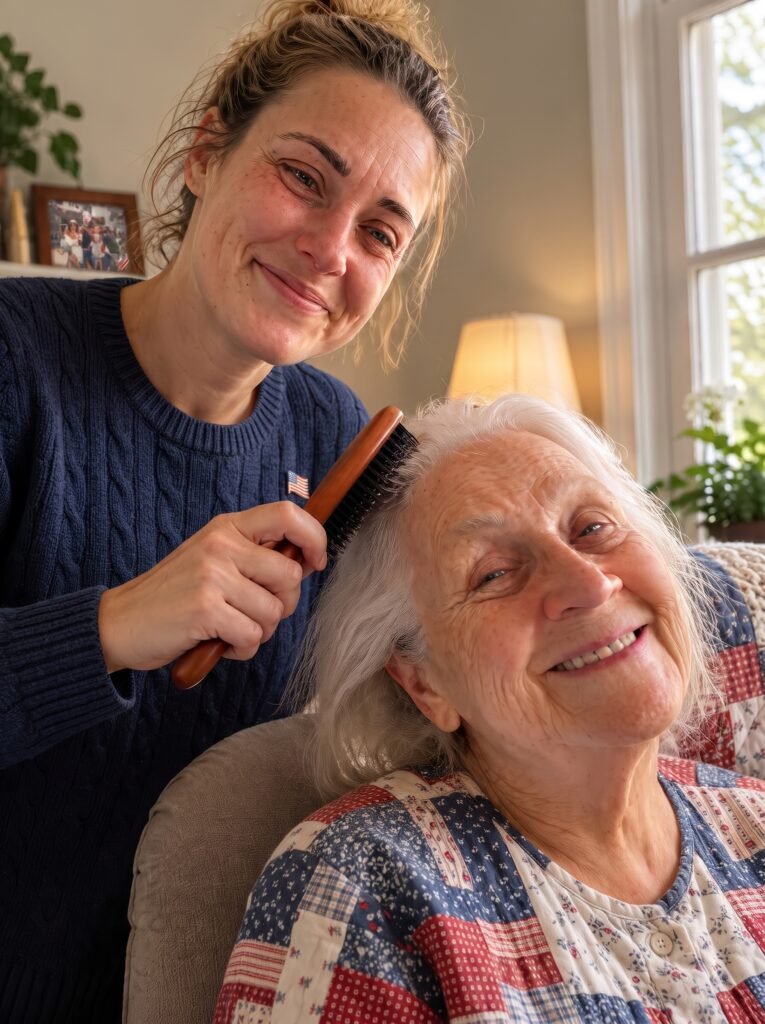
My mom has Alzheimer’s and thinks I’m her caregiver. Yesterday, I braided her hair the way she used to braid mine before school. When I started crying, she took my hand and whispered, “Want me to tell you a secret? But promise you won’t tell my daughter.”
I almost dropped the hairbrush.
“Of course,” I whispered.
Mom glanced toward the bedroom door.
“I think my husband is having an affair with my nurse.”
My fingers went cold.
Because I’d seen them together when I was 14.
And for nearly 28 years, my father had convinced me I was wrong.
“I’m Ruth,” Mom told me the first morning I came to help her. “Are you the girl who’s here to take care of me?”
“I’m Annie.”
Her face brightened.
“My daughter’s named Annie, too. Such a pretty name.”
I smiled, although it hurt.
“I’m glad you think so.”
Mom is 71 now.
Her Alzheimer’s has progressed to the point where she often believes she’s living decades in the past.
Sometimes she asks whether her daughter has finished her homework.
Other times, she worries because Annie hasn’t come home from school.
She never seems to understand that the woman making her breakfast is the little girl she’s waiting for.
Three months ago, her longtime nurse, Linda, resigned.
Dad was 74, exhausted, and finally willing to admit he couldn’t manage Mom’s daily care alone.
He called me after years of telling me my visits upset her.
“Your mother needs you now, Annie.”
I nearly laughed at the words.
I’d needed her for most of my life.
But I came.
At first, everything overwhelmed me.
Mom sometimes refused her medicine, misplaced her slippers, or asked the same question ten times in an hour.
Then I discovered that brushing her hair calmed her.
It was something we used to do together when I was little.
Before school, Mom would sit me between her knees and carefully divide my hair into three sections.
When she finished, I’d turn around and pretend to braid hers.
“You’ll get better with practice,” she’d say.
I hadn’t touched her hair in years.
Yesterday, when I asked if I could braid it, she handed me the brush without hesitation.
“Only if you promise not to pull.”
I laughed.
“Deal.”
Halfway through the braid, she looked at me in the mirror.
“What did you say your name was, sweetheart?”
“Annie.”
“That’s right. Like my girl.”
I tried to smile.
But I remembered how Mom used to kiss the top of my head when she finished my braids.
How she’d stand at the front door until I disappeared down the sidewalk.
And how, one day, all of that stopped.
A tear landed on her shoulder.
“Why are you crying, honey?”
“I miss my mom.”
She took my hand.
“Want me to tell you a secret? But promise you won’t tell my daughter.”
I nodded.
Then she told me about Dad and Linda.
I was 14 when I saw them kissing in our kitchen.
I’d come home early because school had let out after a power outage.
I heard Linda laughing before I reached the doorway.
She had her arms around Dad’s neck.
His hand rested against her cheek.
Then he kissed her.
I stood there until Linda noticed me.
She stepped away so quickly that she knocked a spoon off the counter.
“Annie,” Dad said. “You’re home early.”
I looked from him to Linda.
“Why were you kissing her?”
Dad’s expression changed.
“You misunderstood what you saw.”
“I saw you.”
“Linda was explaining something about your mother’s care. She’s been under tremendous pressure, and I was comforting her.”
Linda nodded.
“Your father’s right, Annie. I’m sorry if it looked strange.”
I wanted to believe them.
Mom had been struggling with a health condition that left her exhausted and frequently confined to bed.
Linda had been hired to help while Dad worked.
Our house already felt frighteningly different.
I didn’t want my father to be another thing I couldn’t trust.
“Please don’t upset your mother with this,” Dad said. “She’s not well enough for misunderstandings.”
So I said nothing.
The next morning, Mom braided my hair before school.
She was having a good day.
Her hands moved through my hair with their old confidence.
At the school gate, she caught the loop of my backpack.
“Come straight home today, Annie. I’ve got a secret, and I promised myself you’d hear it first.”
I grinned.
“What kind of secret?”
She smiled.
“You’ll find out after school.”
But when I got home, Dad was waiting on the porch.
“Your mother’s had a difficult afternoon,” he said.
“Is she okay?”
“She’s resting. She became terribly upset when we mentioned your name.”
I stared at him.
“My name?”
He sighed.
“She’s been getting confused. Seeing you seems to make her anxious right now.”
“Did I do something?”
“No, honey. But sometimes loving someone means giving them space.”
That evening, I stood outside Mom’s bedroom and listened.
I could hear her talking to Linda.
I knocked.
The voices stopped.
Then Dad came down the hallway.
“Annie, we discussed this.”
“I just want to say good night.”
“She’s finally calm. Please don’t start again.”
I went to bed without seeing her.
The next day, Linda told me Mom had slept better.
“Your father was right,” she said gently. “Short visits are best for now.”
I believed her.
She was the nurse.
And I was a frightened teenager.
The restrictions didn’t happen all at once.
At first, Dad allowed me to visit Mom for 15 minutes after school.
Then Linda began telling me Mom was too tired.
Sometimes her bedroom door was locked.
Dad explained that Mom needed privacy during her care or that Linda had locked it while helping her rest.
I hated those locked doors.
But whenever I protested, Dad reminded me that Mom’s condition was serious.
“Do you want to make her worse?”
Of course I didn’t.
I started leaving notes outside her room instead.
“I love you, Mom.”
“I got an A on my history test.”
“I miss our Saturday pancakes.”
Sometimes Linda said she’d read them aloud.
Mom never answered.
By the time I was 16, I’d stopped knocking every afternoon.
By 18, I’d convinced myself Mom was happier when I stayed away.
I moved out for college and built a life that didn’t include much of the house I’d grown up in.
Dad occasionally invited me over, but my visits were carefully arranged around Mom’s rest periods.
Sometimes I saw her for only a few minutes.
Other times, I drove home without seeing her at all.
Aunt Margaret questioned the arrangement more than once.
“Your mother always loved having you around,” she told me. “Are you sure she doesn’t want visitors?”
“Dad says she gets overwhelmed.”
Margaret frowned.
“Your father says a lot of things.”
I should have asked what she meant.
Instead, I defended him.
He’d spent years caring for Mom. I thought he deserved my trust.
Much later, Mom developed Alzheimer’s.
By then, our relationship had already been reduced to brief visits and awkward conversations.
As her memory declined, Dad told me she often forgot who I was.
I believed that, too.
And eventually, it became true.
Yesterday, Mom was still holding my hand when she spoke about the affair.
“I’ve seen the way David looks at Linda,” she whispered.
I couldn’t move.
“Have you asked him about it?”
“He says I’m imagining things.”
“Do you believe him?”
Mom shook her head.
“No. But I can’t prove anything.”
I swallowed.
“What makes you think something happened?”
She looked toward the door again.
“My daughter saw them together once.”
My heart began pounding.
“Your daughter?”
“Annie. She was just a girl.”
I gripped the brush.
“What happened?”
“David told her she misunderstood. After that, he started saying visits with me were upsetting her.”
Mom’s voice trembled.
“He told me Annie didn’t like seeing me sick.”
I stared at her reflection.
For years, I’d believed my mother couldn’t bear having me around.
Now I was hearing the other half of the story.
“Did you believe him?” I asked.
“At first, I thought perhaps she was frightened. I was sick so often. Children shouldn’t have to see their mothers that way.”
She rubbed her thumb across my knuckles.
“But I kept asking for her. Every day.”
I couldn’t speak.
“David said she needed time. Linda said the same thing. Then Annie stopped coming to my door.”
Mom looked down.
“I thought she’d given up on me.”
A sob escaped before I could stop it.
Mom squeezed my hand.
“Oh, sweetheart. Don’t cry.”
“Did you ever try to tell her?”
“Of course.”
Her answer came so quickly that I looked up.
“I wrote her letters. David said he’d give them to her when she was ready.”
I had never received a single letter.
“Did he?”
Mom’s face tightened.
“I don’t know.”
She was quiet for a moment.
Then she said something I’ll never forget.
“I wanted to tell Annie that I believed her. That she hadn’t done anything wrong.”
I covered my mouth.
“Why didn’t you?”
“Every time I asked to see her, David said she didn’t want to come.”
She looked at me helplessly.
“I couldn’t make my daughter come home.”
I leaned forward and wrapped my arms around her.
She patted my back.
“There, there. Whatever’s troubling you, it can’t be as bad as you think.”
I held her tighter.
“Mom,” I whispered, “Annie never stopped loving you.”
She pulled back.
“How do you know?”
I wanted to tell her everything.
That I was the little girl she’d waited for.
That I’d believed every lie.
That I’d spent years missing her while she sat in a bedroom only a few steps away.
Instead, I said, “Because I’m Annie.”
Mom studied my face.
For one wonderful second, I thought she understood.
Then she smiled politely.
“That’s what you told me earlier, dear.”
My heart sank.
“But my Annie is still a schoolgirl.”
After Mom fell asleep, I called Aunt Margaret.
“Did Mom ever write me letters?”
Aunt Margaret was silent.
“Why?”
“She says she did.”
Another pause.
“Annie, I remember your mother asking your father to mail some letters when you went to college. He told me you weren’t answering them.”
I closed my eyes.
“I never got them.”
Aunt Margaret’s voice hardened.
“Then we need to ask David what happened.”
Dad was in the kitchen when I arrived that evening.
He looked surprised to see Aunt Margaret with me.
“What’s going on?”
I put Mom’s hairbrush on the table.
“I know about you and Linda.”
He went still.
“Annie, that was a long time ago.”
“So it happened?”
He looked away.
I felt something inside me break.
“You told me I imagined it.”
“You were 14.”
“And you let me believe I was hurting Mom every time I tried to see her.”
Dad pushed back his chair.
“Your mother was very ill. You don’t understand what those years were like.”
“Then explain them.”
He looked toward Aunt Margaret.
“Are we really doing this in front of my sister-in-law?”
“Yes,” she said. “We are.”
I asked him about the letters.
At first, he claimed he couldn’t remember.
Then I told him Mom had remembered writing them.
His face changed.
“They weren’t going to help anything,” he muttered.
My stomach dropped.
“You had them?”
He didn’t answer.
“Dad.”
He rubbed his forehead.
“I thought it was better if you didn’t read them.”
“Better for whom?”
He stared at the table.
“Linda and I made a mistake. Your mother suspected it. I thought if you two started talking about what you saw, the whole family would fall apart.”
I could barely hear him over my heartbeat.
“So you kept us apart.”
“I didn’t mean for it to go on so long.”
“But it did.”
He nodded.
“Linda helped me at first. She told you the visits were stressful. After a while, you stopped asking.”
I felt sick.
“And what did you tell Mom?”
He closed his eyes.
“That you were frightened by her illness.”
Aunt Margaret made a small sound beside me.
I looked at the man I’d trusted all my life.
“You watched us miss each other for years.”
“I stayed,” he said suddenly. “I took care of your mother. I didn’t abandon her.”
“You stayed in the house,” I answered. “You made sure I couldn’t be part of her life.”
His eyes filled.
“I was ashamed.”
“You were afraid of being caught.”
He didn’t deny it.
Dad brought me the letters the following morning.
There were 11 of them in a shoebox at the back of his closet.
Some envelopes had yellowed. Others were addressed to my college dorm.
None had been mailed.
I opened the first one with shaking hands.
“My darling Annie, Your father says you need some distance while I’m unwell. I understand that you may be frightened, but I need you to know something. You never have to protect me by staying away.”
“I love you on my good days and my bad days. I love you when I’m strong enough to make your breakfast and when I need someone to bring mine.”
“Please don’t ever think you’re the reason I’m sad. The saddest part of being sick is not getting to see you.”
I couldn’t finish reading.
Aunt Margaret sat beside me until I could breathe normally again.
Then we made a plan.
Dad would no longer decide when I could visit Mom or what information I received about her care.
Aunt Margaret would help me arrange an independent review of Mom’s needs and her existing care arrangements.
Dad agreed to step back.
He had no choice if he wanted me to remain involved.
When Uncle Robert came over that evening, I told him what Dad had admitted.
For the first time, the family heard the truth from someone other than David.
Dad tried to apologize.
I told him I wasn’t ready to forgive him.
Maybe someday I would be.
But forgiveness wouldn’t give Mom and me those years back.
The next morning, I brought the first letter into Mom’s bedroom.
She was sitting by the window, watching a bird on the fence.
“Good morning, Ruth.”
She smiled.
“Good morning, Annie. Have you come to help me today?”
“Yes.”
“You’re very kind.”
I sat beside her.
“Would you like me to read you something?”
She nodded.
I read the letter slowly.
When I reached the line about how much she missed her daughter, Mom began to cry.
“Oh,” she whispered. “That poor woman.”
I wiped her cheek.
“She loved her daughter very much.”
“Of course she did.”
Mom looked at the paper.
“Did her daughter ever come back?”
I took her hand.
“Yes.”
Her face softened.
“That’s good.”
I turned her chair toward the mirror and picked up the brush.
“Would you like a braid?”
She smiled.
“My daughter used to love having her hair braided.”
“I know.”
I divided her silver hair into three sections.
As I worked, Mom began humming the little song she’d sung when I was a child.
I hadn’t heard it in years.
When I tied the ribbon at the end, she reached behind her and touched my hand.
“Do you think my daughter knows I love her?”
I leaned down and kissed the top of her head.
“Yes, Mom,” I whispered. “She knows now.”
Mom didn’t say my name.
She didn’t suddenly remember the years we’d lost.
But she held on to my hand.
And this time, nobody was standing between us.
If someone you trusted kept you apart from a loved one for years, could you forgive them for the time you lost, or would that betrayal be impossible to forgive?
But here is the real question: If someone you trusted kept you apart from a loved one for years, could you forgive them for the time you lost, or are some betrayals too painful to forgive, no matter how deeply they regret them?