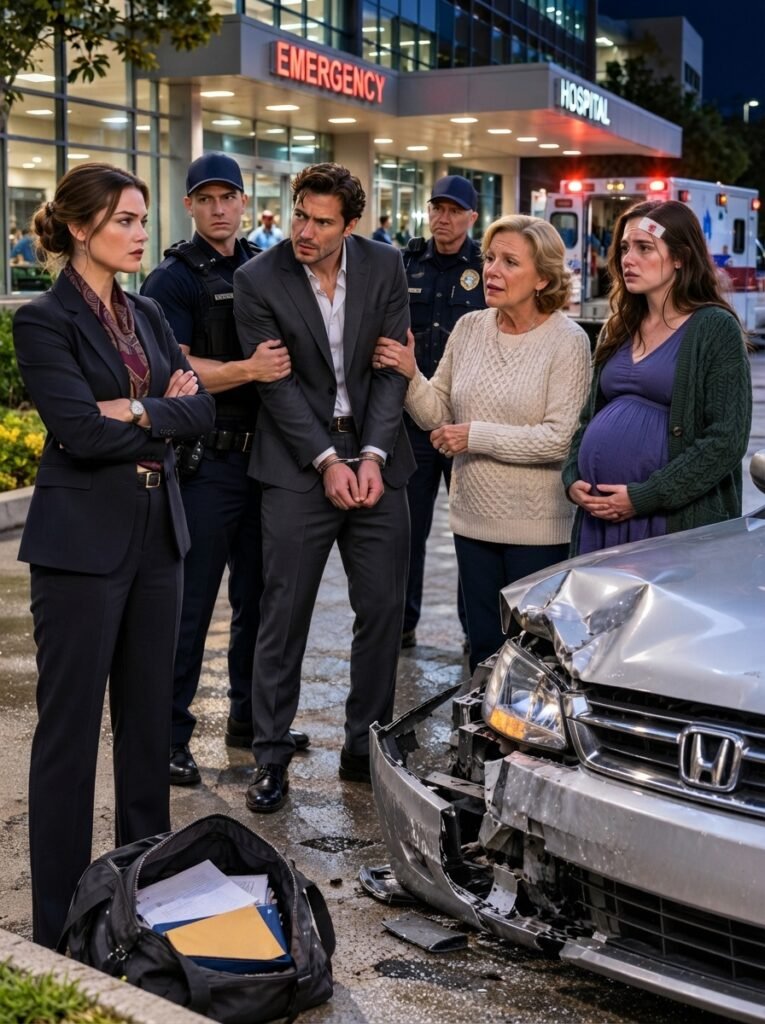
The man who answered my father’s phone told me there was blood on the kitchen floor.
Before I could ask whose blood it was, my husband started screaming from the other end of the hospital corridor.
“TESSA!
DON’T GO TO YOUR FATHER’S HOUSE!”
Two police officers tightened their grip on his arms.
His pregnant mistress stood beside him with a bandage across her forehead.
My mother-in-law was crying into an expensive silk scarf.
And somewhere outside, my silver Honda Accord sat with its front end crushed beyond recognition.
Ten minutes earlier, everyone had been begging me to lie about a car accident.
Now they were begging me not to discover what had happened to my father.
I looked at Officer Mercer, then at the unfamiliar man speaking through my father’s phone.
“Who is this?”
I whispered.
“Mrs.
Weller, my name is Deputy Thomas Reeves.
I’m at your father’s residence.
We found signs of a struggle, and your father is missing.”
My knees weakened.
“Missing?”
“His back door was open.
His phone was underneath the kitchen table.
There’s blood on the floor, and we believe someone may have taken him against his will.”
I could hear voices behind him.
A police radio.
Footsteps.
Someone asking whether the upstairs rooms had been cleared.
Then Reeves asked a question that would haunt me for months.
“Mrs.
Weller, does your husband know where your father is?”
I looked across the corridor.
Bennett Weller, the man I’d loved for seven years, stopped struggling.
For one terrible second, our eyes met.
And I saw the answer before he ever opened his mouth.
He knew.
God help me, he knew exactly what had happened to my father.
1. The Night My Marriage Ended
An hour earlier, I’d still believed I had an ordinary marriage.
Not a perfect one, certainly.
Bennett had been distant lately.
He’d spent too many evenings at the office, answered too many calls behind closed doors, and developed an irritating habit of turning his phone facedown whenever I entered a room.
But ordinary marriages went through difficult periods.
That’s what I’d told myself.
I’m Tessa Arden Weller, thirty-four years old, a forensic accountant at a regional consulting firm in Columbus, Ohio.
My job involves finding financial discrepancies that other people desperately hope will remain invisible.
I can look at a company’s books and recognize a fabricated vendor within minutes.
I can trace money through complicated transactions, identify forged reimbursement claims, and reconstruct years of suspicious activity from fragments of old bank statements.
But apparently, I couldn’t recognize a liar sleeping beside me.
That evening, I’d been finishing a late assignment when an unfamiliar number called.
“Mrs.
Weller?”
“Speaking.”
“This is Officer Daniel Mercer with the Columbus Police Department.
Do you own a silver Honda Accord?”
My stomach tightened.
“Yes.
Why?”
“There’s been a motor vehicle collision.
Your car is currently at Riverside Medical Center.
We need to speak with you.”
I immediately thought of Bennett.
He sometimes borrowed my car when his SUV needed maintenance, although he normally asked.
“Is my husband hurt?”
There was a pause.
“Ma’am, it’s better if you come down.”
I drove my coworker’s borrowed sedan through a cold October drizzle, gripping the steering wheel so hard that my knuckles ached.
The emergency entrance was crowded with ambulances and police vehicles.
Then I saw Bennett.
He was standing between two officers, his hands cuffed in front of him.
Beside him stood his mother, Doreen, and a young woman with a bandage on her forehead.
The woman was pregnant.
Very pregnant.
Bennett’s face changed when he noticed me.
Not relief.
Not shame.
Calculation.
“Tessa,” he said quickly.
“Thank God.”
Doreen hurried forward, her diamond earrings flashing beneath the fluorescent lights.
“Sweetheart, we need your help.”
“What happened?”
She took both my hands.
“There’s been an unfortunate misunderstanding.”
Behind her, the pregnant woman stared at the floor.
Officer Mercer approached.
“Mrs.
Weller, can you confirm who had permission to operate your vehicle tonight?”
Before I could answer, Doreen squeezed my fingers.
“Tell him you were driving, honey.”
I blinked.
“What?”
“Just say you were driving.”
Bennett nodded urgently.
“It’s the simplest solution.”
I looked from one face to another.
“My car was in our driveway when I left for work this morning.”
“Exactly,” Bennett replied.
“Just explain that you borrowed it earlier.”
“Borrowed my own car?”
He exhaled angrily.
“Don’t start playing games, Tessa.”
Doreen leaned toward me.
“Mara’s already been through enough tonight.
She’s carrying Bennett’s baby.
She doesn’t need legal problems on top of everything else.”
The world seemed to tilt.
Bennett’s baby.
I looked at the young woman.
“Mara Ellis?”
She raised her eyes.
I’d heard that name dozens of times.
Mara worked part-time for Harborcrest Facility Services, the commercial cleaning company Bennett and I owned with my father.
At least, that was what I’d been told.
“How far along are you?”
I asked.
“Almost six months,” she whispered.
Six months.
I thought about our anniversary dinner in May, when Bennett had surprised me with a weekend in Chicago.
I thought about him kissing my forehead before leaving for work.
I thought about the nights I’d waited up because he was supposedly handling staffing emergencies.
And suddenly, those memories became unbearable.
Doreen moved closer.
“Whatever happened between you and Bennett, this child is innocent.”
I slowly pulled my hands away.
“Then maybe someone should have considered that before stealing my car.”
Bennett’s jaw tightened.
“One statement, Tessa.
That’s all I’m asking.”
“You’re asking me to lie to the police.”
“I’m asking you to protect this family!”
I stared at him.
“Which family, Bennett?
Mine or hers?”
For the first time, Mara began to cry.
Officer Mercer stepped between us.
“Mrs.
Weller, I need a clear answer.
Did you authorize anyone to drive your vehicle?”
“No.”
“Would you be willing to provide a formal statement?”
“Absolutely.”
Bennett lunged forward.
“Tessa, don’t you dare!”
The officers restrained him.
I looked straight at Mercer.
“My husband took my car without permission, gave it to his pregnant mistress, and now he wants me to claim responsibility for the accident.”
Doreen made a strangled noise.
“You’re destroying your marriage!”
I turned toward her.
“No, Doreen.
Your son took care of that.”
Then I added something that made Bennett go completely pale.
“And I want my car searched.”
2. The Documents That Shouldn’t Have Existed
My Honda looked like it had been crushed by an enormous fist.
The hood had folded upward.
The driver’s-side headlight hung from exposed wires.
Broken plastic littered the pavement beneath its front bumper.
I had purchased that car after my first major promotion.
My father, Henry Arden, had accompanied me to the dealership.
“Buy something reliable,” he’d said.
“Not something that looks pretty and quits when you need it.”
He’d always been like that.
Practical.
Gentle.
A man who believed showing up mattered more than making promises.
Seeing the car destroyed brought tears to my eyes.
But those tears disappeared when Officer Mercer opened the trunk.
Inside was a black canvas duffel bag.
Mara had mentioned it during questioning.
According to her, Bennett had ordered her to deliver it to his mother and specifically instructed her not to look inside.
Mercer carefully removed a sweatshirt, a sealed envelope, and a thick blue folder.
He opened the folder beneath the parking lot lights.
Then he stopped.
“Mrs.
Weller, I’d like you to look at something.”
The first page bore a title:
ASSIGNMENT OF MEMBERSHIP INTEREST — HARBORCREST FACILITY SERVICES LLC.
I recognized our company’s name immediately.
What I didn’t recognize was the transaction underneath it.
According to the document, I had transferred my entire forty-percent ownership interest in Harborcrest to Bennett.
For one dollar.
The signature at the bottom looked exactly like mine.
But the date was March 14.
I remembered March 14 clearly.
I’d been conducting an audit at a hospital network three hundred miles away.
“I didn’t sign this,” I said.
Mercer turned another page.
There was a second ownership transfer.
My father’s twenty-percent interest.
Also supposedly transferred to Bennett.
Also for one dollar.
Then came a medical letter.
It claimed that I suffered from recurring paranoid episodes, irrational suspicions, and impaired judgment that made me incapable of managing complicated financial decisions.
The physician’s name was Dr.
Leland Voss.
I’d never met him.
I’d never been diagnosed with any of those conditions.
And no legitimate psychiatrist had evaluated me for the purpose described in that letter.
At the back of the folder was a laminated identification card bearing my photograph.
My name.
My driver’s license number.
The same license I’d reported missing in March.
I remembered Bennett helping me search our bedroom.
I remembered him reassuring me that everyone misplaced things.
I remembered apologizing for being careless.
He had stolen my identification, then comforted me while I looked for it.
Mercer examined the final document.
It was a preliminary purchase offer from Kestrel Commercial Services.
The company wanted to acquire Harborcrest for $410,000.
Bennett had apparently been preparing to sell the business while removing my father and me from the ownership records.
But the more I studied the paperwork, the less sense it made.
Harborcrest had annual revenue exceeding three million dollars.
Even allowing for liabilities, $410,000 seemed suspiciously low.
There were additional pages missing from the offer.
And the signatures appeared on documents that had never been presented to me.
“This isn’t just an affair,” I whispered.
Mercer looked at me.
“What do you mean?”
“Someone’s trying to steal our business.”
He photographed the documents, preserving their positions and recording what he’d found.
Then he picked up the small envelope.
Inside was a photograph.
My father’s house.
Taken from outside his kitchen window.
Dad was sitting at his table, reading the newspaper.
On the back, someone had written three words in thick black ink.
AFTER THE SALE.
My blood turned cold.
“Why would Bennett have a photograph of my father?”
Mercer didn’t answer.
He examined the envelope carefully, then radioed another officer.
Back inside, Bennett was demanding to see me.
Doreen was crying.
And Mara, who had been sitting quietly near the emergency department, suddenly rushed forward.
“Tessa, listen to me.
There’s something you need to know.”
Bennett shouted her name.
She ignored him.
“He lied to me too,” she whispered.
“He said your father agreed to everything.”
“Agreed to what?”
“The company.
The house.
All of it.”
My phone rang before she could explain.
Dad’s name appeared on the screen.
I answered.
But the voice wasn’t his.
It was Deputy Reeves.
And when he told me my father was missing, I felt the last remaining piece of my old life collapse.
3. The House with the Open Door
By midnight, my father’s quiet suburban street was filled with flashing emergency lights.
Officer Mercer had arranged for a detective to meet me there after the call from Deputy Reeves.
Bennett remained at the hospital while officers sorted through the collision, his interference, and the newly discovered evidence.
I barely remembered the drive.
Dad’s house sat at the end of a cul-de-sac beneath two enormous maple trees.
He’d planted one the year I was born.
The other had been my mother’s favorite.
Mom died when I was sixteen, leaving Dad to raise a teenage daughter who thought the world had ended.
He never remarried.
He never complained.
He just kept showing up.
He attended my graduation, helped me move into my first apartment, and stood beside me at my wedding.
He’d even invested $60,000 of his retirement savings when Bennett wanted to establish Harborcrest.
“Your husband has a good head for business,” he’d told me.
I remembered those words as I approached the police tape.
A female detective intercepted me on the sidewalk.
“Mrs.
Weller?
I’m Detective Evelyn Brooks.”
She was in her early forties, with dark hair tied into a low ponytail and an expression that suggested she didn’t waste words.
“Have you found him?”
“Not yet.”
“Is the blood his?”
“We’re still testing it.”
“How much?”
She hesitated.
“Enough that we’re concerned.
But not enough to tell us what happened.”
Inside, the kitchen looked almost normal.
Dad’s favorite mug sat beside the coffeemaker.
A half-eaten sandwich rested on a plate.
His reading glasses lay on the table.
But one chair was overturned.
A cabinet door hung open.
And a dark stain spread across the pale tile near the back entrance.
I recognized the mug.
It said WORLD’S OKAYEST DAD.
I’d given it to him for Father’s Day as a joke.
He used it every morning.
My throat tightened.
“Someone was here with him,” I whispered.
Detective Brooks nodded.
“We found signs that at least two other people may have entered the house.”
“Was anything stolen?”
“We’re checking.”
Then I noticed something.
Dad’s small wall safe stood open behind a framed photograph in the hallway.
He kept important documents there.
Retirement papers.
Insurance policies.
My mother’s wedding ring.
The ring was still in its little velvet box.
But the folder containing his Harborcrest ownership documents was missing.
“That’s what they wanted,” I said.
Brooks followed my gaze.
“The company paperwork?”
I nodded.
“And something else.”
Beneath Dad’s overturned chair, partly hidden by the leg, lay a torn piece of yellow paper.
I pointed it out without touching it.
A crime-scene technician photographed and collected it.
Only three handwritten words were visible.
SECOND LEDGER — BASEMENT.
I recognized Dad’s handwriting.
Brooks looked at me.
“Does your father keep business records in the basement?”
“He keeps everything in the basement.”
She gave instructions to another officer.
I stood in the kitchen, staring at the empty chair.
Then my phone vibrated.
A message from an unknown number.
It contained a photograph of Dad.
He was sitting in what appeared to be a small room with beige walls.
His hands were bound.
A fresh bruise marked his cheek.
Underneath was a message:
STOP THE SALE INVESTIGATION OR YOUR FATHER WON’T COME HOME.
I showed Brooks.
Her face hardened.
“Don’t respond.”
Another message arrived.
YOU HAVE UNTIL FRIDAY AT NOON.
Friday was less than thirty-six hours away.
I looked at my father’s photograph.
And for the first time in my life, I understood that there were things more frightening than losing everything.
There was the possibility of losing the one person who had never abandoned me.
4. The Lawyer Who Asked the Right Question
At seven the next morning, I sat across from my attorney, Naomi Price, wearing yesterday’s clothes.
Naomi had been my closest friend since graduate school.
She was also a business litigation attorney who possessed two remarkable qualities: an excellent memory and a complete inability to tolerate nonsense.
She listened without interrupting as I explained the crash, Mara’s pregnancy, the forged documents, and my father’s disappearance.
When I finished, she stared at me for several seconds.
Then she said, “Tessa, your husband is either the stupidest criminal I’ve ever heard of, or we’re looking at something considerably bigger than a fraudulent business sale.”
I rubbed my exhausted eyes.
“What makes you say that?”
“The price.”
She turned her laptop toward me.
“Harborcrest reported $3.2 million in revenue last year.
Your husband has been courting additional medical-facility contracts.
Why would he sell it for $410,000?”
“Maybe the company has debts I don’t know about.”
“Then why manufacture psychiatric evidence against you?
Why forge two ownership transfers?
And why photograph your father through his kitchen window?”
I had no answer.
Naomi leaned forward.
“The money they’re trying to steal may not be the company’s purchase price.”
“What else would it be?”
“Access.
Contracts.
Records.
Something the buyer wants that isn’t reflected on the balance sheet.”
She asked permission to review the Harborcrest records that I could lawfully access as a member.
I opened my laptop.
Bennett had always controlled operations, but as a forty-percent owner, I’d received financial statements, tax returns, and quarterly reports.
Usually, I’d reviewed them for consistency.
I’d never had reason to suspect my husband was hiding an entirely different set of accounts.
Naomi watched while I pulled up the company’s vendor register.
I started checking entries.
At first, everything looked normal.
Cleaning supplies.
Uniform contracts.
Equipment leasing.
Payroll.
Then I noticed a recurring payment to a company called Meridian Compliance Partners.
It was listed as a consulting service.
The monthly amount varied, usually between $18,000 and $24,000.
“Do you recognize them?”
Naomi asked.
“No.”
“Does Harborcrest need compliance consultants?”
“Sometimes.
But not at that rate.”
I searched the vendor’s business registration.
The address belonged to a mailbox service in Cleveland.
The registered agent was an attorney whose office handled hundreds of companies.
That wasn’t inherently illegal.
But it was a warning.
I followed the available transaction references.
Meridian received payments from Harborcrest, then appeared in another set of documents as a subcontractor for several medical clinics.
Something about the transactions bothered me.
The same invoice numbers appeared in different places.
Different dates.
Different descriptions.
My stomach tightened.
“This is impossible.”
“What?”
“These invoices have been used more than once.”
I opened another file.
An invoice for cleaning equipment had been entered as a consulting expense three weeks later.
Then a nearly identical amount appeared in a payment to a third company.
“He’s moving money through related entities,” I said.
Naomi leaned closer.
“Can you prove they’re related?”
“Not yet.”
She studied my face.
“Can you identify a pattern?”
I checked six months of payments.
Then twelve.
Finally, I stopped typing.
“Naomi.”
“What is it?”
“There’s over $1.8 million in transactions I can’t reconcile.”
She went very still.
“How much?”
“At least $1.8 million.
Maybe more.”
Our entire marriage suddenly seemed to shrink around that number.
Bennett had complained about equipment expenses.
He’d postponed our vacation because the business supposedly needed cash.
He’d asked my father to delay his annual profit distribution.
And all along, enormous sums had been moving through companies I’d never heard of.
Naomi closed the laptop.
“We need law enforcement and a forensic preservation plan before you touch anything else.”
“I’m a forensic accountant.”
“You’re also the victim.
And your husband may have anticipated that you’d eventually check these records.”
She placed a hand over mine.
“Tessa, listen carefully.
Don’t confront him.
Don’t move company money.
Don’t delete anything.
We preserve what you can legitimately access, and we let investigators obtain the rest.”
I nodded.
Then she asked a question that changed everything.
“Who introduced Bennett to you?”
I frowned.
“What?”
“Think about it.
How did you meet?”
“At a charity fundraiser.
Seven years ago.”
“Who invited you?”
I opened my mouth.
Then stopped.
It had been Doreen.
She’d met my father at a community business luncheon and invited both of us.
Bennett had been standing beside the dessert table when we arrived.
He’d offered me a glass of wine.
We’d talked for three hours.
I’d always called it fate.
Naomi watched the color drain from my face.
“Why are you asking?”
“Because if the fraud started before Harborcrest existed, we may need to find out whether your marriage was part of the plan.”
I shook my head immediately.
“No.”
“Tessa—”
“No.
Bennett might be a liar and a thief, but we had a life together.
Seven years.
He couldn’t have planned seven years.”
Naomi didn’t argue.
She simply said, “I hope you’re right.”
5. The Mistress Who Was Afraid to Go Home
Mara Ellis called me that afternoon.
I almost ignored the unfamiliar number.
Then a message appeared.
PLEASE.
I’M AFRAID THEY’LL HURT MY BABY.
I called Naomi before responding.
An hour later, Mara met us in a private room at the police station, accompanied by a victim-services advocate.
She wore an oversized gray sweatshirt and had dark circles beneath her eyes.
Without makeup, she looked terribly young.
Her forehead was bruised.
One hand remained on her belly.
I hated that I noticed the pregnancy before anything else.
Every movement she made reminded me of the betrayal.
“I’m sorry,” she whispered as soon as I sat down.
I stared at her.
“For which part?”
Tears filled her eyes.
“All of it.”
Naomi placed a legal pad on the table.
“We’re not here to negotiate forgiveness, Mara.
We’re here because you said you had information.”
Mara nodded.
“I met Bennett about eighteen months ago.
He hired me to handle customer accounts.”
“When did the affair begin?”
I asked.
She looked down.
“Eleven months ago.”
I felt the answer like a blow.
Nearly a year.
Not a drunken mistake.
Not a brief lapse in judgment.
An entire hidden relationship.
“He told me your marriage was over,” she continued.
“He said you stayed together for business reasons.”
I laughed bitterly.
“That’s convenient.”
“I know.”
“He slept in my bed every night.”
Mara started crying.
“I didn’t know that at first.”
“But you found out.”
She nodded.
“And you stayed.”
“Yes.”
The honesty hurt more than an excuse would have.
I leaned back.
“Then tell me why I should believe anything you say now.”
Mara reached into her purse and removed a small photograph.
It showed Bennett standing outside a brick office building with Doreen and a man I didn’t recognize.
The three were smiling.
“Because I heard them talking about your father.”
My body went rigid.
“When?”
“Monday night.
Bennett thought I’d gone home.”
She swallowed.
“They said Henry had found the original books.
Doreen was furious.
She said he was going to ruin everything.”
“What original books?”
“I don’t know.
But Bennett said they needed to get him out of the way before Friday.”
My mouth went dry.
“Did they say where they’d take him?”
Mara shook her head.
“They mentioned a place called Cedar Hollow.”
Naomi wrote it down.
“Was that a town?”
“I thought it was.
But I wasn’t sure.”
I leaned forward.
“What happened yesterday?”
Mara wiped her cheeks.
“Bennett picked me up around six.
He said he needed me to deliver some documents to his mother.”
“In my car.”
“Yes.”
“Why?”
“He said his SUV was being serviced.”
I closed my eyes.
The lies were almost identical to the excuses he’d given me.
“He handed me the black bag,” Mara continued.
“He said to drive straight to Doreen’s house.
No stops.”
“Then what?”
“While I was driving, my phone rang.
It was your father.”
I stared at her.
“My father?”
“He told me not to deliver the bag.”
The room went silent.
Mara clasped her shaking hands.
“He said I was carrying evidence.
He told me to go directly to the police.”
“How did he get your number?”
“I don’t know.”
“Did he sound frightened?”
“Yes.”
She swallowed.
“Then he said something strange.”
Naomi put down her pen.
“What?”
Mara looked directly at me.
“He said, ‘If anything happens to me, tell Tessa the accident was never supposed to be hers.'”
I felt cold spread through my chest.
“What accident?”
“That’s what I asked.
But the call disconnected.”
She looked toward the door.
“I got scared.
I thought Bennett might be following me.
I tried calling your father back.”
“Did he answer?”
“No.”
“What happened next?”
Mara’s breathing became uneven.
“I was approaching an intersection when I pressed the brake pedal.”
She paused.
“It went almost to the floor.”
Naomi straightened.
“Are you saying the brakes failed?”
Mara nodded.
“I pumped them.
Nothing happened.
A truck was crossing ahead of me.
I turned hard because I thought I was going to hit it.”
Her hands trembled.
“The car jumped the curb and struck a concrete utility barrier.”
For a moment, nobody spoke.
Then she whispered, “I thought my baby was going to die.”
I looked at Naomi.
Her expression had changed completely.
The collision might not have been an accident.
And if Mara was telling the truth, my husband had placed his pregnant mistress inside my car knowing something terrible might happen.
“Why did Doreen want me to say I was driving?”
I asked.
Mara wiped away another tear.
“I heard her telling Bennett they could use the accident to prove you were unstable.”
“Unstable?”
“The medical letter.
She said if you accepted responsibility, they could claim you’d been behaving recklessly.”
I remembered the fabricated psychiatric evaluation.
The stolen license.
The transfer documents.
The photograph of my father.
One lie had been prepared to support another.
If I’d confessed, they might have used my own statement to destroy my credibility while they stole the company.
Mara lowered her voice.
“There’s one more thing.”
I waited.
“On Monday, Doreen told Bennett that after Friday, there wouldn’t be any more problems with your father.”
My throat tightened.
“What does that mean?”
“I don’t know.
But Bennett asked whether it had to be permanent.”
Naomi’s pen stopped moving.
Mara closed her eyes.
“And Doreen said, ‘It does if we want to keep what belongs to us.'”
6. The Secret Beneath the Basement Stairs
The police search of Dad’s house continued into the evening.
I wasn’t permitted to wander through the active crime scene, but Detective Brooks called as soon as investigators found something important.
The yellow scrap of paper had led them to a storage compartment behind the basement staircase.
Dad had built it years earlier to keep Christmas decorations away from moisture.
I’d forgotten it existed.
Inside, beneath old photographs and a box of broken ornaments, they discovered a locked metal case.
The case contained a portable storage drive, several notebooks, and a sealed letter addressed to me.
Brooks arranged for the digital evidence to be preserved and examined.
The letter, once processed, was released to me.
I opened it at Naomi’s office with my hands shaking.
Dad’s handwriting filled three pages.
My dearest Tessa,
If you’re reading this, something has gone terribly wrong.
First, I need you to understand that I love you more than anything in this world.
Every decision I’ve made since the day you were born has been about keeping you safe.
I owe you an apology.
I knew Bennett was hiding something.
I should have told you sooner.
I kept hoping I could gather enough evidence to protect you without breaking your heart.
I was wrong.
I stopped reading.
Tears blurred the ink.
Naomi waited quietly.
I forced myself to continue.
Dad explained that he’d become suspicious after Harborcrest repeatedly delayed his profit distributions.
He’d asked Bennett for financial records.
Bennett supplied incomplete statements.
Dad began comparing the information with public filings and the company’s contracts.
He discovered that several vendors were connected to a network of medical consulting businesses.
One name appeared repeatedly.
Kestrel Commercial Services.
Dad had traced the company to an entity registered in Delaware.
Behind it was another holding company.
And behind that was a trust.
The final controlling party was not identified in the letter.
But Dad had discovered something much more disturbing.
Harborcrest had been used to obtain access to confidential administrative records from medical facilities.
Those records were supposed to support legitimate cleaning contracts, billing, and staff scheduling.
Instead, information had apparently been copied and passed to outside businesses.
Names.
Addresses.
Insurance details.
Emergency contacts.
Records that could be exploited to impersonate vulnerable patients and manufacture financial or legal authorizations.
Dad wrote:
Bennett may believe this is only about money, but Doreen understands exactly what these people are doing.
I’ve found evidence that some of the individuals listed in the records later lost control of bank accounts or property.
I don’t know how extensive the damage is.
I only know we have to stop it.
My heart hammered.
I turned to the final page.
There was one more paragraph.
And it frightened me more than everything else.
Tessa, if they tell you I agreed to sell the company or surrender my ownership, don’t believe them.
I signed nothing.
I have never agreed to any sale.
And please remember that the people who hurt you most are sometimes the ones who insist they’re protecting you.
Below that, Dad had written:
Ask Naomi about the 2018 amendment.
It’s the one thing Bennett doesn’t know I kept.
I looked up.
“Do you know what he means?”
Naomi frowned.
“An amendment to what?”
“The company’s operating agreement, maybe.”
She opened the folder containing our original documents.
I remembered the 2018 amendment.
Vaguely.
Harborcrest had been struggling with cash flow.
Dad had requested additional protections for his investment before approving a line of credit.
At the time, I’d trusted Naomi’s predecessor to prepare the paperwork.
Naomi searched through the files.
Then she stopped.
“Oh, Bennett,” she murmured.
“What?”
She turned a page toward me.
The amendment required approval from members holding at least eighty percent of the ownership interests before any sale of substantially all company assets.
Bennett owned forty percent.
I owned forty.
Dad owned twenty.
Without me or Dad, he couldn’t approve a sale.
Even if someone forged one of our signatures, the other ownership interest remained an obstacle unless both transfers were accepted as valid.
“That’s why he needed both signatures,” I whispered.
Naomi nodded.
“Exactly.”
But she was still reading.
“There’s something else.”
The amendment required notice to all members and gave the company an opportunity to challenge any disputed ownership change before a major transaction could close.
Bennett hadn’t merely overlooked a technicality.
He’d deliberately avoided the procedures designed to prevent exactly this kind of fraud.
Naomi leaned back.
“Your father was right.
This could help us stop the sale, assuming we can establish the authentic ownership records.”
I looked at Dad’s letter again.
For years, he’d worried that he hadn’t contributed enough to Harborcrest.
He’d called his twenty percent a small investment in our future.
Now I understood why he’d insisted on retaining it.
He hadn’t simply invested money.
He’d built a safeguard around my future without ever expecting to need it.
7. The Woman Behind Kestrel
The first major break came on Thursday morning.
Investigators identified several related businesses receiving money from Harborcrest.
One entity managed residential care properties.
Another provided medical record administration.
A third held property interests connected to facilities across Ohio and Pennsylvania.
Kestrel Commercial Services appeared near the center of the network.
The police had begun coordinating with financial-crime investigators, while Naomi pursued civil relief to prevent the company from being sold during the ownership dispute.
Then Naomi called me into her office.
“I found the person controlling Kestrel.”
I hurried inside.
She had a corporate ownership report displayed on her monitor.
At first, the names meant nothing.
Kestrel Holdings.
Northbridge Management.
Ashfield Family Trust.
Then I saw the name of a trustee.
Doreen Weller.
I read it twice.
“She owns the buyer?”
“She appears to control it through a trust and holding companies.”
I lowered myself into a chair.
My mother-in-law had spent years pretending she couldn’t understand business.
She called spreadsheets “those computer money things.”
She asked Bennett to explain simple banking transactions.
She laughed whenever anyone discussed complicated legal matters.
Once, she’d told me that women who worried too much about money forgot how to enjoy life.
Meanwhile, she had apparently been managing an elaborate network of businesses.
Naomi continued.
“Kestrel isn’t just buying Harborcrest.
Related entities have purchased interests in several medical-service contractors.”
“Why?”
“That remains to be determined.
But the transactions could give the network control over contracts, records, equipment, and outstanding receivables.”
I looked at Doreen’s name.
For seven years, she’d greeted me with hugs.
She’d brought homemade soup when I had pneumonia.
She’d helped decorate our first house.
She’d called me the daughter she’d always wanted.
And she’d stood in the hospital demanding I accept responsibility for a crash involving her son’s pregnant mistress.
My stomach turned.
“She was never trying to protect Mara.”
Naomi shook her head.
“From what you’ve described, I doubt that was her priority.”
“She wanted the documents delivered.”
“Possibly.”
“And if Mara died?”
Naomi didn’t answer.
She didn’t need to.
My phone rang.
Detective Brooks.
“We’ve identified a location that may be connected to the name Cedar Hollow.”
My heart jumped.
“Where?”
“An assisted-living property outside Mansfield.
Cedar Hollow Residential Care.”
“Is Dad there?”
“We don’t know.”
“Then I’m coming.”
“Tessa, you cannot participate in a police operation.”
“He’s my father.”
“I understand.
But if someone is holding him, we need to approach carefully.”
I pressed my fingers against my forehead.
“Please find him.”
“We’re working on it.”
Before hanging up, she added something that made my breath catch.
“There’s another detail.
Cedar Hollow’s management company is connected to Kestrel.”
I looked through Naomi’s office window.
Traffic moved along the street below.
People carried coffee, hurried to meetings, and talked into their phones.
The world continued as though nothing had changed.
But my father’s name was now connected to a company controlled by the woman who had once called me family.
And Friday’s deadline was getting closer.
8. A Mother’s Voice, a Stranger’s Threat
At 3:17 p.m.
Thursday, Doreen called me.
I stared at her name on my screen.
For years, she’d insisted I answer immediately whenever she called.
“Family doesn’t ignore family,” she liked to say.
Now the word family made me sick.
I let the call go to voicemail.
She called again.
Then a third time.
Naomi looked up from her desk.
“Answer it on speaker.
I’ll listen.”
I pressed the green button.
“Tessa, sweetheart.”
Doreen’s voice sounded warm and familiar.
The same voice that had comforted me after my grandmother died.
The same voice that had wished me happy birthday every year.
“Hello, Doreen.”
“I’ve been worried sick about you.”
“That’s interesting.”
She sighed.
“Darling, I know you’re upset about Bennett and Mara, but please don’t let jealousy make you irrational.”
I almost laughed.
“Jealousy?”
“Men make mistakes.”
“Your son forged my signature.”
A pause.
“You shouldn’t believe everything the police tell you.”
“I saw the documents.”
“Documents can be misunderstood.”
“And my father’s disappearance?”
The silence stretched.
Then her voice changed.
Not dramatically.
Just enough to make the skin on my arms prickle.
“Your father has been making some very unfortunate decisions.”
I gripped the phone.
“Where is he?”
“Henry has always been stubborn.”
“Where is my father?”
“Let’s not raise our voices.”
“Doreen.”
She sighed.
“There’s a way to resolve this without destroying everyone’s lives.”
Naomi began writing.
“What way?”
I asked.
“Withdraw your allegations regarding the business documents.
Stop interfering with the Kestrel transaction.
And sign a statement acknowledging that the ownership transfer was voluntary.”
My chest tightened.
“And then?”
“Then Henry can come home.”
I closed my eyes.
For a moment, I imagined doing exactly what she wanted.
Signing anything.
Giving away every dollar.
Walking barefoot through broken glass if it meant bringing Dad home safely.
But then I remembered his letter.
The people who hurt you most are sometimes the ones who insist they’re protecting you.
“What guarantee do I have?”
“You have my word.”
I stared at the wall.
“Your word?”
“Tessa—”
“You lied to me for years.
You helped your son hide an affair.
You asked me to confess to a crime I didn’t commit.”
“You’re being emotional.”
“My father is missing!”
Her tone turned icy.
“Then perhaps you should think carefully about what matters more: your pride or his life.”
A second later, the call ended.
Naomi immediately contacted Detective Brooks and provided the recording she’d made with my knowledge, subject to the investigators’ handling and legal review.
Brooks called back.
“That was important, Tessa.”
“Can you arrest her?”
“We’re working with prosecutors.
We need to locate your father, and we need to make sure we don’t put him in greater danger.”
I stared at the phone.
“She isn’t afraid.”
“No,” Brooks said quietly.
“People who have controlled others for a long time often make the mistake of assuming that control is permanent.”
“Then help me prove she’s wrong.”
9. The Empty Room at Cedar Hollow
By Friday morning, investigators had obtained further evidence connecting Cedar Hollow Residential Care to the medical-service network.
A welfare check and follow-up investigation revealed something alarming.
The facility had been operating with fewer staff members than its records claimed.
Some patient admissions didn’t match legitimate referral records.
And a locked wing contained rooms that were listed as temporarily unavailable for renovations.
Dad wasn’t there.
But someone had been.
A nurse named Esther Greene told investigators she’d seen an older man brought into the building Wednesday evening.
He had a bruised cheek and appeared frightened.
The men escorting him claimed he was a confused family member receiving temporary observation.
Esther wasn’t convinced.
“He asked me to call his daughter,” she later told Detective Brooks.
“He said someone had stolen her company.”
Before she could ask further questions, a supervisor ordered her away.
The next morning, the man was gone.
Esther remembered one other detail.
“One of the men called him Henry.”
When Brooks told me, I began crying.
It was the first confirmation that my father had been alive after his disappearance.
“Where did they move him?”
“We’re trying to establish that.”
“Please.”
“Tessa, we’re tracing the vehicles that entered and left the property.
Esther has agreed to provide a statement.”
I sat down beside my office window.
My coworkers had offered to help with anything I needed.
My supervisor had told me to take as much personal leave as necessary.
People who barely knew Dad had brought food, sent messages, and offered rides.
Meanwhile, the family I’d married into was using my father’s life as a bargaining chip.
At 9:42 a.m., a forensic vehicle examiner confirmed another devastating detail.
The damage to my Honda’s braking system was inconsistent with the collision alone.
Investigators had identified evidence suggesting that a brake line had been deliberately compromised before Mara drove the car.
The precise sequence still required forensic reconstruction.
But the possibility of intentional sabotage had become a central part of the investigation.
I thought of Mara’s frightened face.
Her hand resting over her belly.
Her desperate explanation that she’d pressed the pedal and nothing had happened.
Bennett had handed her the keys.
Doreen had expected the bag.
And someone had interfered with the brakes.
A pregnant woman and her unborn child had been placed in mortal danger to protect a financial conspiracy.
I had every reason to resent Mara for the affair.
But she didn’t deserve to die.
Neither did her baby.
And neither did my father.
At 10:08 a.m., Naomi received an urgent call.
Investigators had traced a vehicle that left Cedar Hollow to a second property.
An abandoned rehabilitation annex on land owned by a company associated with Ashfield Family Trust.
The same trust connected to Doreen.
Detective Brooks called.
“We’re preparing to enter the property.”
“Is Dad there?”
“We don’t know yet.”
“Please call me the moment you find out.”
“I will.”
I stood by Naomi’s window and watched the clock.
10:23.
10:31.
10:47.
Every minute felt like an entire year.
Friday’s deadline was noon.
At 11:06, my phone rang.
It was Detective Brooks.
“Tessa, we found your father.”
I couldn’t speak.
“He’s alive.”
I covered my mouth.
My knees gave way, and Naomi caught my shoulders before I hit the floor.
Brooks continued.
“He’s conscious.
He’s being evaluated by paramedics.
We’re transporting him to the hospital.”
“Can I see him?”
“Yes.
As soon as the medical team clears visitors.”
“Is he hurt?”
“He’s bruised, dehydrated, and exhausted.
But he’s talking.”
I began sobbing.
Not quietly.
Not gracefully.
I cried like a child who had spent an entire night lost in the woods and finally heard someone calling her name.
Naomi held me.
For seven years, I’d believed Bennett was the person who would catch me if I fell.
That morning, I learned how wrong I’d been.
10. What My Father Had Discovered
Dad looked smaller in the hospital bed.
His white hair was disheveled.
Purple bruising marked the side of his face.
An IV line ran into his arm.
But when I stepped into the room, he smiled.
“There’s my girl.”
I rushed to him.
“Dad.”
I wrapped my arms around him as carefully as I could.
He pressed his cheek against my hair.
“I’m sorry, sweetheart.”
I pulled back.
“Don’t.”
“I should’ve told you.”
“You’re alive.
That’s all I care about.”
His eyes filled with tears.
“Your mother would have been furious with me.”
I laughed through my crying.
“Mom was furious with you whenever you tried fixing the plumbing without turning off the water.”
“That’s true.”
For a moment, we were simply father and daughter again.
Then his smile faded.
“Did you find the basement case?”
“Yes.”
“The notebooks?”
“Yes.”
“Good.”
He looked toward the door.
“Then you know some of it.”
I took his hand.
“Tell me the rest.”
Dad drew a long breath.
“A few months ago, I noticed Harborcrest had been billing certain medical clients for work nobody seemed to be doing.”
I listened.
“At first, I thought Bennett had hired dishonest subcontractors.
That happens.
Companies grow, and sometimes people take advantage.”
He looked ashamed.
“I wanted to believe he was innocent.”
“So did I.”
Dad squeezed my hand.
“But when I followed the payments, I found companies controlled by Doreen.”
“Did Bennett know?”
“Oh, he knew about the money.
I don’t know whether he understood everything his mother was doing.”
“What was she doing?”
Dad looked toward the window.
“Taking advantage of people who couldn’t easily defend themselves.”
He explained that the scheme involved more than fraudulent cleaning invoices.
Through businesses providing administrative services to medical and residential-care facilities, Doreen’s network had gained access to information about elderly and vulnerable patients.
According to the records Dad had found, some of those individuals later became subjects of suspicious legal and financial transactions.
Consultants produced questionable competency evaluations.
Representatives sought control of accounts.
Property ownership changed hands under circumstances that deserved investigation.
Money then moved among related companies through inflated invoices and service contracts.
“Harborcrest was useful because nobody questioned cleaning contractors,” Dad said.
“They were already on the approved vendor lists.”
I thought about the forged psychiatric letter.
The duplicated invoices.
The missing identification.
“She was using the same methods on me.”
Dad nodded.
“When I told Bennett I’d found inconsistencies, he tried to convince me you were having problems.”
My breath caught.
“What kind of problems?”
“He said you were exhausted.
Suspicious.
That your work was making you paranoid.”
I felt sick.
“He showed me a medical letter,” Dad continued.
“I knew it wasn’t right.”
“Why?”
“Because it didn’t sound like you.
And because he wouldn’t tell me who’d evaluated you or when.”
I stared at my father.
He had been suspicious while I’d been defending Bennett.
Dad swallowed.
“I refused to sign anything.
Then Bennett asked me to sell my twenty percent.”
“For one dollar?”
“He said it was just a temporary restructuring.”
“Did you believe him?”
“No.”
Dad looked at me sadly.
“But I still couldn’t imagine he’d hurt you.”
“What happened Wednesday?”
He closed his eyes.
“Two men came to the house.
They said Bennett wanted to discuss the sale.”
“Did you let them in?”
“One claimed to have paperwork from a lawyer.
I told them to leave.”
His fingers tightened around mine.
“Then one of them shoved me.”
I wanted to scream.
“They dragged me into a van.
At Cedar Hollow, they kept demanding to know where I’d hidden my records.”
“Did you tell them?”
“No.”
He smiled faintly.
“I told them I didn’t remember.”
I stared at him.
“Dad.”
“What?”
“You nearly got yourself killed.”
“I know.”
His smile disappeared.
“But I couldn’t let them take everything from you.”
I leaned forward and kissed his forehead.
“I don’t care about the money.”
“I know, sweetheart.”
He looked directly into my eyes.
“That’s exactly why I knew you were worth protecting.”
A nurse entered to check his blood pressure.
Before she left, Dad asked for a moment alone with me.
Then he lowered his voice.
“There’s something you need to understand about Bennett.”
My stomach tightened.
“What?”
“When I started asking questions, I checked some old paperwork.”
“What paperwork?”
“The documents from when you first met.”
I frowned.
“Dad, what does that have to do with anything?”
He glanced toward the door.
“Because I don’t think your meeting was an accident.”
The room seemed to become very quiet.
“What are you saying?”
“I’m saying Doreen knew exactly who you were before you ever met Bennett.”
I shook my head.
“Of course she did.
She invited us to that fundraiser.”
Dad closed his eyes.
“No, honey.”
His voice trembled.
“She’d been asking questions about you for almost a year before that.”
11. Seven Years of Lies
I had thought there was nothing left Bennett could do to hurt me.
I was wrong.
Three days after Dad’s rescue, Detective Brooks contacted Naomi with news that investigators had recovered records from an electronic device seized during their investigation.
Among the files were background reports.
Financial profiles.
Personal histories.
And a folder bearing my maiden name.
ARDEN — TESSA.
Naomi accompanied me to a meeting where Detective Brooks explained what investigators had discovered.
The folder had been created months before I’d met Bennett.
Inside were details about my education, employment, family finances, and professional contacts.
There was information about Dad’s retirement savings.
There was a description of the house he’d owned for thirty years.
There were copies of photographs from my old social media accounts.
One document contained a summary of my professional qualifications.
Another described me as a promising candidate for a long-term relationship with Bennett.
My stomach twisted.
“What does that mean?”
Brooks looked uncomfortable.
“The records suggest your mother-in-law researched you before arranging your introduction.”
I shook my head.
“She met my father through a business luncheon.”
“According to these files, that meeting may also have been arranged.”
Naomi placed her hand on my shoulder.
“Keep reading.”
A note attached to my profile contained several observations.
Financially responsible.
Strong professional reputation.
Established family support.
Compliance and accounting expertise.
Then a final sentence.
Potential long-term value through financial legitimacy and healthcare-sector connections.
My heart seemed to stop.
I remembered that first fundraiser.
Doreen laughing at my jokes.
Bennett bringing me a glass of wine.
His insistence that we had so much in common.
His perfectly timed questions about my work.
I’d found him thoughtful.
Interested.
Different from the men I’d dated before.
Three weeks later, he’d brought flowers to my office.
Six months after that, he’d asked me to move in with him.
Two years later, we were married.
I thought about our wedding photographs.
The way Bennett had cried during our vows.
The way Doreen had held my hands and called me her daughter.
The thousands of ordinary moments that had formed the foundation of my life.
I stared at the document.
“Was any of it real?”
No one answered.
I turned to another page.
It contained a timeline.
Meet father.
Confirm investment capacity.
Establish relationship.
Develop family trust.
There was even a note about using Bennett’s future business as a possible route for expanding the existing services network.
My vision blurred.
I hadn’t simply married a man who later betrayed me.
His mother had identified me as someone useful before he’d ever asked me for my phone number.
I pushed the folder away.
“I need some air.”
Outside, the afternoon was bright and cold.
I stood beneath the bare branches of a maple tree, trying to breathe.
Naomi came out a few minutes later.
“Tessa.”
“Don’t tell me I should have noticed.”
“I wasn’t going to.”
“I spent seven years with him.”
“I know.”
“I loved him.”
“I know.”
I turned toward her.
“He knew how my mother died.
He knew how much my father meant to me.
He knew every fear I’ve ever had.”
My voice broke.
“And I told him all those things because I thought he was safe.”
Naomi hugged me.
For a long time, I couldn’t stop crying.
The affair had humiliated me.
The forged documents had frightened me.
But this was different.
This meant someone had studied my life, learned my vulnerabilities, and deliberately stepped inside them.
Eventually, I pulled away.
“Why did Doreen choose me?”
Naomi looked toward the building.
“I think your father knows more than he’s told you.”
12. The Secret My Father Carried for Eighteen Years
Dad was recovering at home when I visited him that evening.
He had a blanket over his knees and a cup of tea beside his chair.
I placed the recovered background report on the coffee table.
He read the first page.
His face turned gray.
“Where did you get this?”
“From the investigation.”
He lowered the paper.
“Oh, Tessa.”
“Why did Doreen know so much about us before I met Bennett?”
Dad looked away.
For the first time in my life, I saw something I couldn’t remember ever seeing in him.
Shame.
“Dad?”
He stared toward the photograph of my mother above the fireplace.
Her name was Evelyn Arden.
She’d had dark hair, green eyes, and a laugh that made strangers smile.
She was forty-two when she died.
For eighteen years, I’d believed her death was a tragic highway accident.
A vehicle malfunction.
A terrible morning.
An event with no explanation beyond bad luck.
Dad took a slow breath.
“Your mother was an accountant too, sweetheart.”
“I know.”
“Not just any accountant.”
He folded his hands.
“In her last year, she was investigating suspicious financial activity involving a group of residential-care facilities.”
I went still.
“What group?”
He didn’t answer immediately.
Then he said a name I’d already seen in the recovered business records.
“Ashfield.”
A chill traveled down my spine.
“Ashfield Family Trust?”
“The original company was Ashfield Patient Services.”
I stared at him.
“What does that have to do with Mom?”
Dad’s eyes filled with tears.
“Your mother discovered evidence that people were being charged for services they never received.
Some had property transactions they didn’t understand.
Others had signed documents that didn’t match their actual circumstances.”
I could barely hear him.
“Did she report it?”
“She was preparing to.”
“What happened?”
Dad looked toward Mom’s photograph again.
“She died before she could testify.”
I stood up.
“No.”
“Tessa—”
“No.
You’re telling me my mother died while investigating the same kind of fraud Doreen is involved in?”
He nodded.
I backed away.
“Why didn’t you tell me?”
“Because there was no proof her death was connected.”
“What about the accident?”
“The investigators said a brake component had failed.
The vehicle struck a highway barrier.”
I felt the room spin.
Mara’s frightened voice returned to me.
I pressed the brake pedal.
It went almost to the floor.
I gripped the edge of the table.
“Dad.”
He covered his face.
“I know.”
“Mom’s brakes.”
He nodded.
“The official investigation found no evidence of sabotage.
I had suspicions, but suspicions weren’t proof.”
I stared at him.
“And Doreen?”
Dad looked up.
“At the time, the company had a different management structure.
Doreen used her maiden name.”
“Ashfield?”
“Yes.”
I sat down slowly.
Eighteen years.
For eighteen years, I’d thought my mother had died because of a random mechanical failure.
Now an investigation involving Doreen’s network had uncovered evidence of a similar attempt against Mara.
And my husband had deliberately placed her inside my car.
“Did you know Doreen was connected to Ashfield when you met her?”
“No.
She introduced herself as Doreen Weller.
I didn’t recognize her.
We’d never met in person during Evelyn’s investigation.”
“Then when did you find out?”
“Three months ago.
When I traced the trust.”
I stared at him.
“Three months?”
He nodded miserably.
“I tried to find the old accident records.
I contacted a retired investigator.
I didn’t want to frighten you without proof.”
“Why didn’t you tell me?”
“Because I couldn’t bear the thought of breaking your heart over something I might never be able to establish.”
Tears ran down his cheeks.
“I had already lost Evelyn.
I thought if I could uncover the truth quietly, I might protect you.”
I wanted to be angry.
Part of me was angry.
He’d made decisions about my life without giving me the truth.
But sitting in front of me was a man who had spent eighteen years wondering whether his wife had been murdered.
A man who had raised their daughter alone.
A man who had just survived being kidnapped because he refused to surrender evidence.
I moved beside him.
“Dad, you should have told me.”
“I know.”
“We could have done this together.”
“I know, honey.”
He began to cry.
And I held him.
For the first time, I understood that the strongest person I’d ever known had been carrying a burden he didn’t know how to put down.
Then Dad reached for the drawer beside his chair.
He removed an old envelope.
“I kept this.”
Inside was a handwritten note from Mom.
It had been dated three days before her death.
The paper was faded.
Her handwriting was unmistakable.
It read:
If anything happens to me, Henry, please don’t let them convince you I imagined what I found.
The records are real.
The signatures are real.
And the woman controlling Ashfield knows exactly what she’s doing.
Beneath those words, Mom had written a name.
Doreen Ashfield.
I stared at it until the letters blurred.
My mother had been trying to expose Doreen eighteen years before I married her son.
And suddenly, the most horrifying possibility of all became clear.
Doreen hadn’t chosen me by coincidence.
She’d known exactly whose daughter I was.
13. The Confession That Changed the Case
Bennett finally agreed to cooperate with investigators after receiving legal advice.
By then, detectives had obtained records connecting him to the disputed ownership transfers and communications surrounding the planned sale.
Financial investigators were also examining the movement of money through Doreen’s network.
The evidence didn’t depend entirely on Bennett’s account.
But his cooperation provided details that investigators had not yet established.
Naomi informed me when the prosecutor was prepared to discuss the developments.
According to Bennett’s statements, Doreen had introduced us deliberately.
She had told him I came from a respectable family and had valuable professional connections.
At first, he claimed, he believed she was simply helping him meet someone suitable.
I didn’t know whether that was true.
I wasn’t inclined to give him the benefit of the doubt.
But by the time Harborcrest was established, Bennett admitted that he knew his mother expected the company to support her broader business operations.
He knew certain payments weren’t legitimate.
He knew false records had been created.
And he knew my ownership interest stood between his mother and the transaction she wanted.
The forged signatures had been arranged with assistance from someone experienced in producing fraudulent documents.
The psychiatric letter had been prepared to undermine me if I challenged the transfers.
Bennett also acknowledged receiving warnings that Mara might disclose damaging information.
He claimed he hadn’t personally damaged my car.
Investigators were examining that claim against the physical evidence and communications recovered from the people involved.
Then came the detail I would never forget.
A message from Bennett to Doreen, sent three days before the crash.
“What if Tessa finds out before Friday?”
Doreen’s reply:
“Then we do what we did before.
You know the procedure.”
The words sent a chill through me.
The investigation into my mother’s death was reopened.
Old records were located.
Financial transactions from Ashfield’s earlier operations were compared with evidence from the current case.
A former associate of Doreen’s, confronted with new evidence, eventually provided information about the earlier investigation.
The process took months.
There were interviews, forensic reviews, subpoenas, and hearings.
Some allegations were easier to prove than others.
But the investigation uncovered evidence supporting the conclusion that my mother’s vehicle had been deliberately sabotaged.
A payment made shortly before her death was traced to a man who had worked on the car.
His later statements, combined with old records and the evidence surrounding Doreen’s actions, became central to the renewed criminal case.
I remember the day Detective Brooks told me.
We were sitting in a quiet conference room.
She placed a folder on the table.
“Tessa, I want you to understand that the case is still proceeding through the legal system.
But we have substantial new evidence about your mother’s death.”
I looked at the folder.
“Was it Doreen?”
Brooks chose her words carefully.
“The evidence indicates that Doreen arranged for the vehicle to be tampered with after your mother uncovered financial wrongdoing.”
I closed my eyes.
Eighteen years of birthdays.
Eighteen Christmases.
My graduation.
My wedding.
Every moment when I’d looked for my mother in a crowd and remembered she wouldn’t be there.
It hadn’t been an unavoidable tragedy.
Someone had made a decision.
Someone had chosen money over a woman’s life.
And years later, that same woman had welcomed me into her family with open arms.
I sat silently for a long time.
Then I asked the question that mattered most.
“Did Bennett know what happened to my mother when he married me?”
Brooks looked down at the folder.
“His account is that he learned about it later.
We’re continuing to examine what he knew and when.”
It wasn’t the answer I wanted.
I wanted certainty.
I wanted a clear line separating every lie from every truth.
But I’d spent my career working with evidence.
I knew better than to confuse what I feared with what I could prove.
Still, one thing had become undeniable.
The woman who helped destroy my mother’s life had spent years trying to destroy mine.
14. The Woman Who Thought She Owned Us
The legal proceedings lasted longer than I wanted.
There were months when I woke up furious because the world seemed to be moving too slowly.
There were days when I couldn’t bear to look at another document.
And there were nights when I dreamed about my mother standing beside a damaged car, asking me why nobody had come to help her.
Therapy helped.
So did Naomi.
So did the simple fact that Dad was alive.
Harborcrest’s disputed sale was stopped through court proceedings.
Independent oversight was established while the financial investigation continued, and the ownership records were eventually corrected to reflect the legitimate interests.
The company’s workers were not responsible for what Bennett and Doreen had done.
Many were hardworking people who had spent years cleaning offices, schools, and medical facilities.
They deserved to be paid.
They deserved honest management.
And they deserved not to lose their livelihoods because a few people had treated the business like a private bank account.
I worked with Naomi, outside accountants, and the appointed professionals to preserve what could be saved.
The fraudulent vendors were investigated.
Questionable contracts were terminated or suspended.
Legitimate customers were informed of necessary changes.
And the company began the difficult process of becoming something respectable again.
Mara cooperated with investigators.
Her pregnancy continued safely after the crash.
She admitted that she’d made terrible choices, including continuing the affair after learning Bennett was still living with me as my husband.
I didn’t pretend those choices hadn’t hurt me.
But I also understood that she had ultimately helped expose a conspiracy that might have killed her.
When her baby girl was born, she sent a photograph through Naomi.
A tiny child wrapped in a yellow blanket.
Her eyes were closed.
One little hand rested beside her cheek.
I stared at the photograph for several minutes.
Then I sent back a short message.
She’s beautiful.
I hope you both have a peaceful life.
That was all.
I didn’t become Mara’s friend.
I didn’t become the baby’s aunt.
I didn’t suddenly forgive the affair.
But I stopped wishing that everyone connected to Bennett would suffer.
The child had done nothing wrong.
Bennett eventually pleaded guilty to charges arising from the financial fraud and related conduct, while other aspects of the case continued through separate proceedings.
Doreen fought the accusations.
She hired expensive attorneys.
She blamed Bennett.
She blamed former associates.
She even tried to portray my father as an angry investor who had fabricated accusations because he disliked his daughter’s marriage.
But the evidence kept growing.
Financial records.
Electronic messages.
Witness statements.
The fraudulent medical evaluations.
The forged ownership transfers.
Evidence concerning the interference with my car.
And the reopened investigation into my mother’s death.
When Doreen was eventually convicted of multiple offenses, including serious charges stemming from the old case, I sat in the courtroom beside Dad.
She looked smaller than I remembered.
Without her expensive jewelry and perfectly styled hair, she seemed like an ordinary elderly woman.
That frightened me in a different way.
I’d expected evil to reveal itself somehow.
Instead, it had spent years bringing casseroles to family dinners.
Doreen looked toward me before being led away.
For one second, I saw the woman who had helped me choose wedding flowers.
Then her expression hardened.
“You ruined my family,” she said.
I stood.
My hands were shaking, but my voice was steady.
“No, Doreen.
You destroyed two families.
Mine was simply the one that survived you.”
She looked away.
I sat back down.
And for the first time in years, I felt no need to explain myself to her.
15. The Final Page
Almost a year after the crash, Detective Brooks contacted me again.
I thought the call concerned another financial victim.
By then, investigators had identified numerous people who’d been harmed by Doreen’s network, and I was helping a restitution effort review records.
But Brooks sounded different.
“Tessa, there’s something from the older case I think you should see.”
I met her the next afternoon.
She placed a document folder on the table.
Inside was a copy of a handwritten note recovered from Doreen’s archived records.
It was dated eighteen years earlier.
Just days after my mother’s death.
The note contained my father’s name.
Our old address.
And my name.
Tessa Arden — age sixteen.
I stared at it.
Below my name was a sentence that made me feel as though someone had opened a door beneath my feet.
“Daughter may become a problem if she follows mother’s profession.
Monitor family.
Reassess when adult.”
For several seconds, I couldn’t move.
Doreen hadn’t merely remembered me from my mother’s investigation.
She hadn’t stumbled upon me years later and recognized an opportunity.
She had been watching my life since I was sixteen.
My college years.
My career.
My father’s finances.
My professional success.
All those details had been collected before Bennett approached me at the fundraiser.
I thought about the first night we met.
The wine.
The laughter.
The way he had asked whether I believed in fate.
I had smiled and told him I did.
Now I knew what had really happened.
It wasn’t fate.
It was planning.
Doreen had waited until I became an adult with a respectable career, financial stability, and professional connections.
Then she had sent her son into my life.
For seven years, she’d allowed me to believe I was loved.
When I became inconvenient, she’d prepared forged documents to discredit me.
And when my father began uncovering her crimes, she’d tried to make him disappear.
I stared at the final page.
Then I noticed one last handwritten line.
It was dated shortly before the fundraiser where I’d met Bennett.
“Bennett must ensure she never finds Evelyn’s original records.”
My mother.
Evelyn Arden.
Her name was there, preserved in the calculations of the woman who had helped take her life.
I began to cry.
Not because I felt defeated.
Because at last, I understood what had frightened Doreen for eighteen years.
It wasn’t my father’s investment.
It wasn’t the value of Harborcrest.
It wasn’t even the money she’d stolen.
It was the possibility that Evelyn Arden’s daughter would grow up and discover the truth.
And that was exactly what had happened.
I looked at Detective Brooks.
“Can I keep a copy?”
She nodded.
When I returned home, I placed it beside my mother’s photograph.
Then I called Dad.
“Are you free this weekend?”
“For you?
Always.”
“I want to visit Mom.”
There was a pause.
“Of course, sweetheart.”
I looked out the window.
For the first time, the future didn’t feel like something I had to fear.
It felt like something I could choose.
16. The Life I Chose
On a beautiful Saturday morning, Dad and I drove to the cemetery where my mother was buried.
The autumn leaves had turned gold.
The air smelled of damp earth and distant woodsmoke.
Dad carried white roses.
I carried a small folder.
We stood beside Mom’s grave for a long time.
Her name was carved into the stone.
EVELYN ARDEN
Beloved Wife and Mother.
I knelt and placed my hand against the cool marble.
“Hi, Mom.”
My voice trembled.
“I finally know what happened.”
Dad stood beside me, his hand resting on my shoulder.
I swallowed.
“For eighteen years, I thought losing you was the worst thing that ever happened to us.
Then I thought losing my marriage was.”
I looked at her name.
“But I was wrong.”
Tears slid down my cheeks.
“The worst thing was that somebody tried to make us believe we were powerless.”
I opened the folder.
Inside were copies of documents from the investigation, along with the first report from the restitution effort helping the people harmed by Doreen’s businesses.
I had helped establish a small nonprofit initiative in Mom’s honor.
Its purpose was simple.
Provide independent financial guidance to vulnerable people and help families recognize suspicious transactions before their savings or homes disappeared.
The first year, we helped eleven families.
It wasn’t a fortune.
It wasn’t a dramatic public victory.
But it mattered.
Dad knelt beside me.
“Your mother would have loved that,” he whispered.
I smiled through my tears.
“I hope so.”
We stayed until the afternoon sunlight began slipping behind the trees.
On the drive home, Dad asked whether I regretted anything.
I thought about Bennett.
About Mara.
About the hospital corridor where my life had fallen apart.
About the terrible moment when Doreen had begged me to accept responsibility for an accident I hadn’t caused.
Then I shook my head.
“I regret trusting the wrong people.”
Dad nodded.
“But I don’t regret telling the truth.”
He smiled.
“That’s my girl.”
That evening, I returned to my house.
It was smaller than the one I’d shared with Bennett.
The kitchen needed painting.
The porch steps creaked.
And the backyard was barely large enough for a garden.
But every room belonged to a life I’d chosen for myself.
I placed my keys on the little ceramic dish beside the entrance.
The same dish I’d once used in our old bedroom.
For a moment, I remembered my missing driver’s license.
Bennett helping me search.
His gentle smile.
The lies hiding behind his kindness.
Then I looked around my new home.
There were no forged documents waiting for my signature.
No secret phone calls.
No mother-in-law deciding what I should believe.
No husband asking me to sacrifice my integrity to protect his mistakes.
Just quiet.
And freedom.
I walked to the window and watched the last light disappear over the rooftops.
Somewhere, people were still rebuilding their lives after Doreen’s crimes.
Somewhere, Mara was raising her daughter.
Somewhere, Bennett was confronting the consequences of choices he’d spent years refusing to acknowledge.
And my father was alive, probably watching baseball in his favorite chair.
I took a deep breath.
For seven years, I’d believed that being a good wife meant protecting my husband.
For much longer, I’d believed that love meant forgiving people, even when they hurt me.
But my mother had left me a different lesson.
Love without honesty isn’t safety.
Loyalty without boundaries isn’t devotion.
And forgiveness should never require a person to become an accomplice to their own destruction.
I thought about that terrible night at the hospital.
The police officers.
The ruined Honda.
The pregnant mistress.
The mother-in-law who had smiled while asking me to lie.
Doreen had believed that if she frightened me enough, I would surrender.
Bennett had believed that seven years of marriage meant I would protect him from consequences.
They were both wrong.
They had forgotten the most important thing about me.
I was Evelyn Arden’s daughter.
And somewhere beneath the grief, the betrayal, and the lies, I had inherited my mother’s determination to follow the evidence wherever it led.
I turned off the kitchen light.
Then I locked my front door.
Not because I was afraid.
But because, for the first time in my adult life, I finally understood that I had every right to decide who was allowed inside.
And the woman who had spent eighteen years trying to destroy my family had never imagined that the daughter of her first victim would become the person who finally brought her down.
THE END.