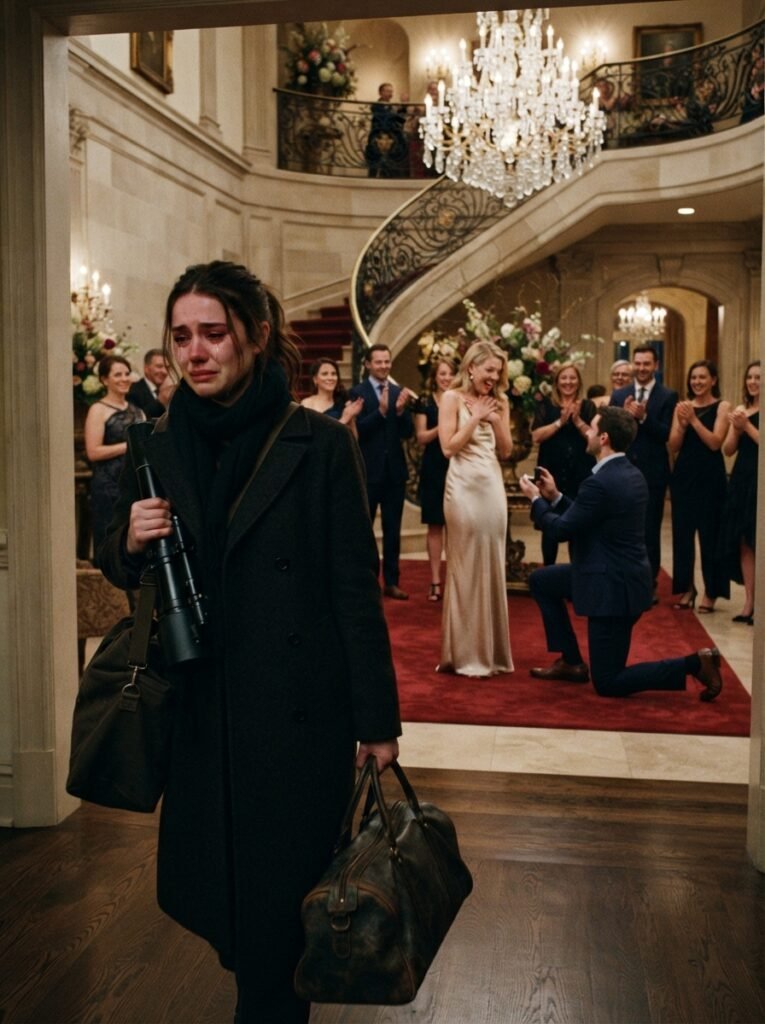
The day my boyfriend proposed to my stepsister, my entire family applauded—and I discovered that the woman I had buried sixteen years earlier might still be alive.
But that wasn’t the most terrifying discovery.
The most terrifying discovery was that the people who had stolen three years of my life had been stealing from my mother for sixteen.
And somehow, I had become the final piece of their plan.
My name is Mara Whitcomb.
I was twenty-nine years old, held a doctorate in applied mathematics, and worked at the Cascadia Propulsion Institute in Seattle.
For most of my life, I believed that if I worked hard enough, accomplished enough, and asked for little enough, the people I loved would eventually recognize my worth.
I was spectacularly wrong.
It started on a Thursday afternoon at exactly 3:42.
My computer had been running the same orbital simulation for nineteen hours.
Cold coffee sat beside my keyboard, and I was eating crackers from a vending machine when my supervisor, Dr.
Lillian Price, called.
“Mara, your security clearance has been approved.”
I stopped chewing.
“What?”
“Project Farpoint.
The selection committee wants you on-site tomorrow morning.
Transportation has already been arranged.”
My heart began racing.
For nearly eighteen months, I had been quietly participating in preliminary research for an experimental deep-space navigation initiative.
Most of the work was compartmentalized.
I knew only that my research into uncertainty propagation had attracted attention from people whose names never appeared on ordinary organizational charts.
Now they wanted me inside.
“How long will I be gone?”
“That depends on what the team finds.
Prepare to be unreachable for an extended period.”
I glanced at the calendar above my desk.
A weekend blocked off for a supposedly routine research exercise suddenly meant something entirely different.
“You’ll need your original identification documents,” Dr.
Price added.
“Not copies.”
And just like that, my excitement dimmed.
Those documents were still at my stepfather’s house.
Roland Greer had insisted on keeping my childhood records after my mother died.
He claimed they were safer in his fireproof safe, although I had discovered years later that most were stored in an ordinary wooden desk.
At twenty-nine, I was perfectly capable of managing my own paperwork.
Yet some childish part of me had avoided collecting those documents because returning to that house always meant another reminder that I didn’t really belong there.
“I’ll retrieve them tonight,” I said.
“Good.
And Mara?”
“Yes?”
“Congratulations.
You earned this.”
Three simple words.
You earned this.
I hadn’t realized how badly I needed to hear them.
My first thought was to tell Julian.
Julian Beckett had been my boyfriend for three years.
He was thirty-two, handsome in the polished way of men who knew exactly how cameras worked, and the cofounder of a rapidly expanding aerospace media company.
His business partner was Roland.
Their public face was my stepsister, Corinne.
She had a million-plus followers, a talent for making complicated subjects sound exciting, and an award-winning presentation on orbital prediction systems.
A presentation I had practically written.
Whenever Julian needed technical help, he called me.
Whenever he needed a polished investor pitch, I helped.
Whenever he wanted to spend a weekend together, something more important usually came up.
For months, I’d convinced myself that was simply what ambitious relationships looked like.
I had even imagined marrying him.
That Thursday, I intended to tell him about the assignment, at least as much as I was permitted to disclose, before leaving.
Instead, I drove to the Greer residence.
And walked into the destruction of everything I’d believed.
The first thing I noticed was the smell of roses.
The second was the red carpet runner.
The third was Julian.
My boyfriend was kneeling before my stepsister, holding an engagement ring, while my entire family watched.
Corinne stood beside the fireplace in a cream silk dress.
Alison, my stepmother, was crying.
Roland smiled from the couch.
My stepbrother Owen stood near the staircase with his phone.
A photographer circled the couple, capturing the perfect moment.
“Say yes!” someone shouted.
Corinne laughed through her tears.
Then Julian saw me.
The joy vanished from his face.
“Mara?”
He sounded irritated.
“What are you doing here?”
I looked from him to the ring.
Then to Corinne.
Then to my family.
Nobody seemed particularly surprised.
That was the moment I understood.
They had all known.
Alison approached me, wearing the soothing expression she used when explaining something unpleasant to a child.
“Sweetheart, we were going to tell you privately afterward.”
“After what?”
I asked.
“After my boyfriend became my brother-in-law?”
Corinne started crying harder.
“Mara, please.
We never meant to hurt you.”
“How long?”
Julian stood.
“This isn’t how I wanted you to find out.”
“How long, Julian?”
He glanced at Roland.
“Almost a year.”
The words entered my chest like a knife.
A year.
For nearly twelve months, I’d kissed him goodbye, defended him to my friends, and helped make his company successful while he secretly built a relationship with my stepsister.
“Corinne understands me,” Julian said.
“She’s involved in the future I’m creating.
You barely have time for anything except your research.”
I stared at him.
“Your research presentations came from my work.”
He shrugged.
“We all contributed.”
Roland cleared his throat.
“Mara, you’re a successful scientist.
Corinne needs stability, and this marriage benefits the company.
I expect you to behave maturely.”
I looked around the room.
They weren’t ashamed.
They weren’t frightened.
They were annoyed that my pain was interrupting their celebration.
Then I noticed the telescope.
My mother’s telescope.
The old brass-and-steel instrument stood beside the fireplace, wrapped in blinking lights.
Plastic decorations were taped to its focusing mechanism.
A narrow scratch ran along the barrel.
My mother had made that scratch when she carried it up three flights of stairs during our final apartment move.
I remembered her laughing as she showed me the damage.
“Well, sweetheart,” she’d said, “now we’ll always know which telescope is ours.”
She had shown me Saturn’s rings through that instrument.
She had taught me to recognize Orion.
She had told me that the universe was full of things people couldn’t see until they learned where to look.
And now my family had turned the last precious piece of her life into a decoration for my humiliation.
I walked across the room.
“Mara, don’t,” Corinne protested.
I began removing the lights.
Alison sighed.
“Really?
You’re going to ruin everyone’s happiness over some antique?”
Roland’s expression hardened.
“Your mother has been gone sixteen years.
It’s time to stop treating everything she owned like a sacred object.”
I removed the last strip of tape.
Then I looked directly at him.
“You don’t get to decide what my mother left me means.”
For once, Roland had no answer.
I collapsed the tripod and carried the telescope upstairs.
My childhood bedroom smelled of cedar polish and abandoned memories.
I collected my birth certificate, Social Security card, academic records, and the envelope containing my mother’s photographs.
Then I discovered something strange.
A yellowed inventory sheet lay beneath my old school folders.
It listed items collected after my mother’s funeral.
One entry caught my attention.
WHITCOMB OBSERVATIONAL ARCHIVE — VOLUMES I–IV.
TRANSFERRED TO R.
GREER FOR SAFEKEEPING.
I frowned.
Roland had told me those notebooks were destroyed in the accident that killed her.
Why had he documented taking possession of them afterward?
I folded the paper and slipped it into my bag.
Downstairs, Julian blocked the hallway.
“You’re seriously leaving because you’re jealous?”
I placed my house key on the console table.
“No, Julian.”
I looked at the man I’d loved for three years.
“I’m leaving because there’s no one here worth saying goodbye to.”
Roland warned that I would regret abandoning my family.
Alison demanded that I apologize to Corinne.
Corinne continued crying.
Owen glanced up from his phone.
I walked outside.
A government SUV was waiting at the curb.
The driver checked my identification and opened the rear door.
I placed my mother’s telescope carefully inside.
As we pulled away, my phone began vibrating.
Julian.
Come back.
You’re embarrassing Corinne.
Don’t throw away everything we’ve built.
I sent one final message.
Our relationship is over.
Do not contact me again.
Then I turned off my phone.
I thought I was leaving the worst day of my life behind.
I didn’t know I was driving directly toward a truth that would make that engagement party seem almost insignificant.
Chapter 2: A Photograph Taken Three Years After a Funeral
Two hours later, our SUV passed through the gates of a military airfield.
Searchlights swept across the concrete.
Armed security personnel inspected our credentials.
Beyond a row of hangars, a transport aircraft waited with its engines humming.
A tall man with silver at his temples approached.
“Dr.
Whitcomb?”
“Yes.”
“Commander Elias Shaw.
Director of Project Farpoint.”
He shook my hand firmly.
“I’ve been looking forward to meeting you.”
After the afternoon I’d endured, his professional courtesy felt almost overwhelming.
He noticed the telescope beside my luggage.
“Personal equipment?”
“It belonged to my mother.”
Something flickered across his face.
“Your surname is Whitcomb?”
“Yes.”
He studied me more carefully.
“Was your mother Dr.
Ruth Whitcomb?
The observational mathematician?”
I blinked.
“You knew her?”
His expression changed.
Not with ordinary recognition.
With something closer to alarm.
“Come with me.”
Instead of boarding the aircraft, he led me into a secured conference room beside the hangar.
He asked the security officer outside to close the door.
“Dr.
Whitcomb, before we proceed, there’s a historical file I believe you need to see.”
He opened a locked case and removed a thin gray folder.
Across the front was my mother’s name.
RUTH WHITCOMB.
Beneath it was a date.
A date from three years after her funeral.
My hands went cold.
“What is this?”
Shaw opened the folder.
The first photograph showed a woman standing in front of an experimental spacecraft beside a younger Elias Shaw.
She wore a white laboratory coat.
Her dark hair was cut shorter than I remembered.
A pale scar crossed one eyebrow.
But I recognized her instantly.
My mother.
Alive.
Standing.
Smiling.
Three years after I’d watched a coffin lowered into the ground.
“That’s impossible,” I whispered.
Shaw didn’t answer.
I seized the photograph.
“No.
That’s impossible.
My mother died when I was thirteen.”
“I’m aware of the official record.”
“Then explain this!”
My voice cracked so violently that I barely recognized it.
He pulled out a chair.
“Please sit down.”
“I don’t want to sit down!”
The room blurred.
For sixteen years, I’d carried memories of my mother’s funeral.
The black dress Alison selected.
The rain striking the cemetery canopy.
Roland’s hand pressing my shoulder while he told me to be brave.
I remembered the closed coffin.
The white roses.
The minister saying she was at peace.
Now I stared at photographic proof that she had been alive afterward.
Shaw spoke quietly.
“Your mother survived the incident that was reported as her death.”
I gripped the edge of the table.
“Where is she?”
He hesitated.
“There’s more you need to understand.”
“Where is my mother?”
Shaw took a breath.
Then he reached for a secure telephone.
He entered a sequence and waited.
A soft electronic tone filled the room.
A woman answered.
“Elias?”
My entire body went numb.
I knew that voice.
I had carried it inside me since childhood.
In dreams.
In old recordings.
In the fragments of memory I’d replayed whenever life became unbearable.
“Ruth,” Shaw said gently.
“Someone’s here.”
A silence followed.
Then the woman whispered, “Mara?”
I couldn’t speak.
“Mara, sweetheart?”
Tears spilled down my face.
“Mom?”
A strangled sound came through the speaker.
“Oh, my beautiful girl.”
I pressed a hand against my mouth.
“You’re alive?”
“Yes, baby.”
“Then why didn’t you come home?”
The silence that followed was worse than any answer.
Finally, she said, “Because I was told you didn’t want me to.”
My knees gave out.
Shaw caught the chair before I fell.
“What?”
My mother’s breathing trembled through the speaker.
“For years, I was told you knew I had survived.
I was told you’d chosen to stay with Roland and wanted no contact with me.”
I shook my head.
“No.
No, I thought you were dead.”
“I know that now.”
“Mom, I thought you were dead!”
Her sob broke through the secure connection.
“I never stopped trying to reach you, Mara.”
Shaw gently turned the speaker closer.
Then my mother said something that changed everything.
“Someone made certain that every letter I sent you disappeared.”
I stared at the old inventory sheet protruding from my bag.
And for the first time, I wondered whether Roland Greer had merely stolen my mother’s notebooks.
Or whether he had stolen sixteen years of our lives.
Chapter 3: The Woman Behind the Locked Door
The following morning, I was taken to a secure research facility several hundred miles from Seattle.
Its location was withheld even from me until after our aircraft landed.
The buildings were low and unremarkable, arranged between pine-covered hills and fences fitted with electronic sensors.
I barely noticed any of it.
All I could think about was my mother.
Commander Shaw explained the broad facts during the flight.
Sixteen years earlier, Ruth Whitcomb had been working on an advanced autonomous navigation system for deep-space vehicles.
Her research challenged a fundamental problem: how a spacecraft could determine where it was when communication with Earth became unreliable and small uncertainties accumulated over enormous distances.
She had developed a model that allowed onboard instruments to correct positional estimates using faint astronomical observations.
The work was valuable.
More valuable than she had realized.
“A private contractor attempted to obtain it,” Shaw told me.
“Your mother refused to surrender the underlying research.”
“What happened?”
“An explosion destroyed part of her laboratory.
She was critically injured.
Investigators suspected deliberate sabotage.”
“Roland told me she died in a highway accident.”
Shaw’s expression tightened.
“The laboratory was connected to a transportation facility.
The official family explanation was not accurate.”
“Did Roland know she survived?”
“We’re still establishing what he knew, and when.”
I looked out the aircraft window.
Below us, clouds drifted across mountains.
“Sixteen years,” I whispered.
Shaw said nothing.
At the facility, a medical officer took me down a quiet corridor.
At the end stood a gray door.
I could see someone through its narrow window.
A woman waiting with her hands clasped tightly together.
My breath caught.
The door opened.
And there she was.
My mother.
Older.
Thinner.
Silver threaded through her dark hair, and the scar I’d seen in the photograph cut through her left eyebrow.
But her eyes were the same.
The warm brown eyes that had watched me struggle through arithmetic homework.
The eyes that had looked through a telescope beside mine.
For one impossible moment, neither of us moved.
Then she whispered, “Mara.”
I crossed the room.
She opened her arms.
And sixteen years of grief collapsed in a single embrace.
I buried my face against her shoulder.
She smelled faintly of lavender soap.
I recognized it.
That nearly destroyed me.
“Mom,” I sobbed.
“Mom, where were you?”
She held me so tightly that I could barely breathe.
“I’m here.
I’m here now.”
“You were supposed to come back.”
“I know.”
“I waited.”
Her body shook.
“I know, sweetheart.”
“I waited for you every birthday.”
She pulled back just enough to see my face.
Tears ran down the lines beside her mouth.
“I am so sorry.”
For a while, we simply held each other.
But love doesn’t erase sixteen years of unanswered questions.
Eventually, I stepped away.
“You could have found me.”
Her face crumpled.
“You’re right.”
I had expected explanations.
Excuses.
Some extraordinary justification involving national security.
Instead, my mother agreed.
“I could have fought harder to reach you, Mara.
I trusted people I shouldn’t have trusted.
And every year I allowed myself to believe another reason that it was safer for you if I stayed away.”
“Safer for whom?”
She lowered her eyes.
“That’s the question I’ve asked myself ever since I learned the truth.”
We sat across from each other.
She told me about the explosion.
About waking in a military hospital months later.
About being moved into protective custody because investigators believed someone involved in her research had ordered the attack.
About the documents she had been shown.
Letters supposedly written by me.
Statements claiming I knew she was alive.
One even said I considered her a stranger who had abandoned me.
“I never wrote anything like that,” I whispered.
“I know.”
“Who gave you those letters?”
She hesitated.
“The protected-contact office received them through an intermediary.”
“Who?”
My mother looked at Commander Shaw.
He placed a sealed document on the table.
The authorized family liaison was listed beneath a government identification number.
ROLAND A.
GREER.
My stomach turned.
My mother covered my hand with hers.
“I believed you were safe with him.”
I remembered every Christmas morning when Roland gave Corinne expensive gifts while I received practical necessities.
Every time he dismissed my accomplishments.
Every occasion he told me I should be grateful that his family had taken me in.
And every year I had cried because I missed a woman who was still alive.
Roland hadn’t simply robbed me of a childhood with my mother.
He had made my mother believe that I had rejected her.
“Why?”
I asked.
My mother looked toward the telescope I’d brought into the room.
“Because he wanted something I refused to give him.”
“What?”
She touched the worn metal barrel.
“My life’s work.”
Then she looked directly at me.
“And Mara, he hasn’t stopped trying to steal it.”
Chapter 4: The Four Missing Notebooks
My mother asked to see the inventory sheet I’d found in my childhood bedroom.
I unfolded it carefully.
She read the list once.
Then again.
Her fingers tightened around the paper.
“Where did you get this?”
“Roland’s house.”
“Was it locked away?”
“No.
It was in my desk.”
She looked almost dizzy.
“After all these years, he kept a record.”
“What does it mean?”
My mother pointed to the fourth volume.
“Those notebooks contain different stages of my research.
The first three explain the mathematical framework.
The fourth contains the final correction method.”
“Correction for what?”
She took a pencil from the table.
“Imagine you’re navigating across an ocean using stars.
Every observation contains a little uncertainty.
Usually, you use more observations to reduce the error.”
I nodded.
“But a spacecraft traveling enormous distances faces a more complicated problem.
Some errors aren’t random.
They come from the instruments, their temperature, their orientation, even pressure from sunlight.”
She sketched several intersecting lines.
“If your model assumes those errors are independent when they’re not, every new observation can make your answer look more certain while actually making it more wrong.”
I leaned forward.
That problem sounded familiar.
“That’s what I’ve been working on,” I said.
“Correlated uncertainty in autonomous navigation.”
My mother froze.
“What?”
“My doctoral research.
The framework incorporates changing observational bias.”
Her pencil slipped from her fingers.
“Mara, did Roland know what you were studying?”
“Of course.
He liked telling people I was wasting my life on equations nobody understood.”
She looked at Shaw.
“How long has Beckett’s company been submitting technical proposals?”
“Six years,” he answered.
I suddenly remembered something.
Julian had first approached me at an aerospace conference three years earlier.
He’d asked thoughtful questions about my doctoral research.
He’d remembered my name.
He’d made me feel extraordinary.
At the time, I’d thought meeting him was fate.
Now I wondered whether it had been recruitment.
My mother swallowed.
“Roland had the first three volumes.
If he couldn’t make the method work, he would have needed someone to reconstruct the missing pieces.”
“You said he had all four.”
“He took four notebooks.
That doesn’t mean the fourth contained what he thought it did.”
She turned toward the telescope.
“There’s something I need to check.”
She examined the scratched barrel, then the focusing ring.
For the first time since we’d reunited, a small smile appeared.
“You kept it.”
“Of course.”
“Even after everything?”
“Especially after everything.”
Her eyes filled again.
She turned the focusing mechanism until the scratch aligned with a tiny indentation beneath the metal collar.
Then she pressed a nearly invisible catch.
Something clicked.
A narrow section of the barrel shifted.
I stared.
“There’s a compartment?”
“Your grandfather helped me modify it,” she said.
“He was a machinist.
He believed every valuable instrument should have a secret.”
Inside was a small sealed metal capsule.
My mother carefully removed it.
The capsule contained several strips of archival microfilm and a tiny memory module wrapped in protective foil.
I looked at her in astonishment.
“What is that?”
“Insurance.”
She smiled sadly.
“I knew someone was trying to obtain the research.
I wanted an independent record of my calculations and the laboratory’s access logs.”
Shaw stepped closer.
“Ruth, you never mentioned this.”
“I didn’t know where the telescope had gone.
Roland claimed it was destroyed.”
I remembered the blinking lights taped to the focusing mechanism.
A chill passed through me.
If I’d left that telescope at the engagement party, Julian and Roland might eventually have discovered what was inside.
Instead, they’d practically pushed me out the door with it.
My mother gave the capsule to a laboratory technician.
Within an hour, we were looking at the contents on a secure monitor.
There were scanned research pages.
Instrument calibration records.
A dated laboratory recording.
And an encrypted file labeled:
CONTINGENCY ARCHIVE — R.W. / M.W.
My initials.
I looked at my mother.
“Why is my name there?”
She didn’t answer immediately.
Instead, she asked the technician to open the recording.
An old laboratory appeared on the screen.
My mother stood beside a desk covered in notebooks.
Her voice sounded younger.
“This is Ruth Whitcomb.
Supplemental archive, October seventeenth.
I have reason to believe an unauthorized party has accessed my research.”
The camera shifted.
A man stepped into the frame.
Roland.
My heart stopped.
He looked younger, with darker hair and the same impatient expression.
“Ruth, you’re overreacting,” he said.
“All I’m asking is that you authorize the commercial license.”
“The company isn’t qualified.”
“They have funding.”
“That doesn’t mean they understand the system.”
Roland leaned toward her.
“You’re sitting on something worth hundreds of millions.”
My mother answered firmly.
“It’s worth more than that if people use it responsibly.
And it’s worth nothing if they use it to put lives at risk.”
Roland slammed a folder against the desk.
“You think you’re the only person capable of understanding your equations?”
“No,” she replied.
She glanced toward the camera.
“That’s precisely what worries me.”
The recording ended.
I stared at the black screen.
The man who had raised me had threatened my mother over her work.
And sixteen years later, he had built a company using my work.
I understood that the two betrayals were connected.
What I didn’t yet understand was how far he had gone.
Chapter 5: The Boyfriend Who Was Never an Accident
That afternoon, Commander Shaw introduced me to Dr.
Nadia Chen, a forensic systems analyst assigned to Project Farpoint.
Nadia was short, sharp-eyed, and spoke with the calm efficiency of someone who preferred evidence to excuses.
She showed me a series of technical documents displayed across three monitors.
“Recognize anything?”
I stepped closer.
The first document was a proposal submitted by Beckett Greer Aerospace Media to a commercial guidance-systems contractor.
My stomach tightened.
I recognized the equations.
Not because they resembled my research.
Because I had written them.
A paragraph describing correlated observational noise was taken almost word for word from a draft I’d sent Julian eleven months earlier.
Even the unusual variable notation was mine.
“I remember this,” I whispered.
Nadia opened another document.
“And this?”
A diagram I’d created during a sleepless weekend appeared.
Then another.
Then another.
Julian had asked me to simplify the mathematics for investors.
He had never told me the presentation would be submitted as proprietary corporate technology.
“How much did they make?”
I asked.
Nadia looked at Shaw.
He nodded.
“According to the contracts we’ve identified, the company’s revenue attributable to these technologies exceeds forty million dollars.
The total licensing exposure may be considerably larger.”
I gripped the back of a chair.
Forty million dollars.
Julian had once complained when I asked him to reimburse me for a seventy-dollar software subscription.
He’d laughed and told me not to be so transactional.
Meanwhile, he was selling my research.
“Why didn’t anyone tell me?”
I asked.
Nadia’s expression softened.
“Some of the copied material was incorporated into derivative systems.
Establishing ownership and the extent of misrepresentation required forensic comparisons.
We only recently obtained enough evidence to connect the company to your mother’s archive.”
She opened an access log.
“Look at this.”
The records showed that someone had accessed my academic research repository through credentials associated with a consulting account.
Julian’s company.
The first unusual access had occurred eight days before he introduced himself to me at that conference.
I stared at the timestamp.
Eight days.
He’d looked at my work before we’d met.
He’d researched me.
Then he’d approached me, charmed me, and persuaded me to trust him.
Our relationship hadn’t begun with a coincidence.
It had begun with a file search.
I remembered our first dinner.
Julian had ordered wine and asked why I loved mathematics.
I’d told him about my mother.
He’d listened so intently that I’d nearly cried.
Now I understood why.
He wasn’t trying to know me.
He was trying to learn what my mother had left behind.
My phone was returned to me temporarily, with instructions not to disclose anything about the facility.
There were eighty-seven missed calls.
Most came from Julian.
Several from Alison.
Nine from Roland.
Corinne had sent twelve messages.
The most recent read:
I know you’re upset, but Julian and I love each other.
Please don’t make everyone choose sides.
I almost laughed.
They’d already chosen.
Years ago.
I opened Julian’s messages.
One stood out.
We need to discuss the technical material you provided.
The company has obligations, and you can’t just disappear.
Another followed:
Roland says we should formalize your consulting arrangements.
Call me immediately.
Not an apology.
Not even concern.
He wanted to protect his access to my work.
I showed the messages to Nadia.
She photographed the screen for the evidence record.
“Don’t respond yet,” she said.
“We may need to preserve the communications.”
Then she looked at me carefully.
“Dr.
Whitcomb, there’s something else.”
She opened a corporate ownership chart.
Julian held thirty percent of the company.
Roland controlled fifty-five percent.
The remaining fifteen percent belonged to a holding entity established several months earlier.
Its listed manager was Corinne Greer.
“That’s why they’re getting married,” I said.
Nadia nodded.
“The engagement supports a pending ownership restructuring.
A major commercial transaction is scheduled for next week.”
“How major?”
“Potentially nine figures.”
I felt sick.
Roland hadn’t merely approved of Julian betraying me.
He had helped arrange a merger of family and business interests that would give Corinne a substantial financial stake.
My relationship was disposable.
My intellectual property was not.
They wanted the equations without the woman who’d written them.
But there was another problem.
An even more serious one.
Nadia displayed a simulation of a spacecraft approaching a small asteroid.
“This is the Farpoint vehicle,” she said.
“It’s already in flight.”
A thin blue line traced its expected course.
A red line diverged gradually.
The difference looked insignificant at first.
Then the lines separated by thousands of miles.
“Our spacecraft is approaching the most sensitive phase of its mission.
We need to validate its autonomous navigation software before an upcoming communication blackout.”
I studied the display.
“What produced the red trajectory?”
“A simulation using the commercial correction model licensed through a company linked to Beckett and Greer.”
I leaned closer.
A familiar expression appeared in the uncertainty calculation.
I recognized it.
I’d written that approximation years earlier, before discovering a flaw.
My throat tightened.
“That’s an obsolete version.”
Nadia looked at me.
“What?”
“The correction assumes the observational biases are independent after a calibration update.
They’re not.
Under certain conditions, the errors become correlated.”
“How significant?”
“Significant enough to make the navigation system think it’s becoming more accurate while the actual trajectory is getting worse.”
I stared at the growing separation between the two paths.
They hadn’t just stolen my research.
They had sold an unfinished version that could destroy a spacecraft.
And someone had concealed the flaw.
Chapter 6: The Message From the One Person Who Never Spoke
That evening, I sat beside my mother in the facility’s small garden.
Tall pines surrounded the fenced courtyard.
The sky had begun turning violet.
For the first time in sixteen years, we were looking at stars together.
Neither of us knew how to begin.
Finally, she said, “Do you remember the night we saw Saturn?”
I laughed softly through my tears.
“You made hot chocolate.”
“With too many marshmallows.”
“You said there was no such thing.”
She smiled.
For a moment, I was thirteen again.
Then the memories shifted.
I remembered standing beside her coffin.
“Mom,” I said, “did you ever stop looking for me?”
She went quiet.
“I stopped believing I was allowed to find you.”
“That’s different.”
“I know.”
She clasped her hands in her lap.
“I spent years recovering.
I was frightened.
People told me that contacting you could expose you to the people who tried to kill me.
Then they showed me letters saying you didn’t want contact.”
“Roland’s letters.”
“That’s what we believe.”
I looked away.
“I needed you.”
She began crying.
“I know.”
“I had nobody.”
“Mara—”
“When I graduated from high school, everyone else’s parents stood up and cheered.
Roland spent the ceremony checking business emails.
Alison complained about the parking.
Corinne had a dance recital, so they left before my name was called.”
My voice broke.
“I looked into the audience and pretended you were there.”
My mother covered her mouth.
“When I defended my dissertation, I saved an empty chair for you.”
She shook her head.
“I wish I’d been there.”
“Me too.”
We sat together until the first stars appeared.
Then my mother took my hand.
“I’m not going to ask you to forgive me because I’m alive.
I know being alive doesn’t excuse my absence.”
I looked at her.
“I want to forgive you.”
“You don’t have to decide tonight.”
Her honesty hurt more than another excuse would have.
But it also gave me something I hadn’t felt in years.
The possibility of trust.
My temporary phone vibrated.
An unknown number.
A single message appeared.
DON’T TRUST WHAT YOU SEE IN THEIR NEXT VIDEO.
I frowned.
Another message followed.
THEY’RE GOING TO MAKE YOU LOOK LIKE THE THIEF.
CHECK THE TIME STAMP ON THE PARTY RECORDING.
I showed Shaw.
He asked Nadia to trace the sender.
The number was linked to a disposable account.
No reliable identity.
A third message arrived.
ROLAND DIDN’T LOSE THE FOURTH NOTEBOOK.
HE HID IT IN THE HOUSE.
My pulse quickened.
Then came one more sentence.
AND JULIAN WASN’T THE ONE WHO FIRST PLANNED TO USE YOU.
I stared at the screen.
“Who is this?”
For nearly a minute, there was no reply.
Then a photograph arrived.
It showed the engagement party.
Julian was kneeling.
Corinne was crying.
Roland sat smiling.
And in the background, near the staircase, Owen held his phone at an unusual angle.
The photograph had been taken from behind him.
I enlarged the image.
On Owen’s screen was an application displaying an audio waveform.
He hadn’t been scrolling through social media.
He’d been recording.
My quiet, apparently indifferent stepbrother had captured everything.
A final message appeared.
I’M SORRY I LET YOU THINK I WAS JUST LIKE THEM.
—OWEN
I stared at his name.
Owen Greer had barely spoken to me in years.
He was twenty-four, quiet, and supposedly uninterested in the family business.
At dinners, he usually sat with headphones around his neck.
Roland called him lazy.
Alison said he lacked ambition.
Corinne treated him like a household assistant.
I had always assumed he simply didn’t care.
But perhaps I’d made the same mistake everyone else had.
Perhaps Owen had learned to survive in that family by letting them underestimate him.
I typed a response.
What are you trying to tell me?
Three dots appeared.
Disappeared.
Appeared again.
Then:
THE PROPOSAL WASN’T THE END OF THEIR PLAN, MARA.
IT WAS THE BEGINNING.
And below that:
THEY’RE GOING TO ANNOUNCE SOMETHING ABOUT YOU TOMORROW.
Chapter 7: The Video That Turned Me Into a Criminal
By eight the next morning, my name was everywhere.
Corinne had posted a video.
Its title was designed for maximum sympathy.
My Stepsister Tried to Destroy My Engagement Because She Couldn’t Handle Seeing Me Happy.
I watched it once.
That was enough.
The video began with Corinne crying into the camera.
She claimed she and Julian had fallen in love unexpectedly.
She said they’d tried to handle the situation respectfully.
Then the footage cut to me entering the house.
Except the editing removed everything Julian had said about his year-long affair.
It removed Roland’s comments about the marriage benefiting the company.
It removed my questions about the stolen research.
Instead, viewers saw me angrily removing decorations from the telescope.
Corinne’s voice trembled over the footage.
“Then she took valuable equipment belonging to our family’s company and left without permission.”
My blood went cold.
Valuable equipment?
My mother’s telescope?
Another clip showed me carrying my bag downstairs.
Corinne continued.
“We recently discovered that sensitive company documents may also be missing.
We hope Mara makes the right decision and returns what doesn’t belong to her.”
I stopped the video.
The accusation was unmistakable.
They were preparing to claim I’d stolen corporate research.
Research I’d actually written.
Nadia examined the footage.
“This is calculated.
They’re establishing a public narrative before filing their civil complaint.”
“Can they really do that?”
“Anyone can make an allegation.
Proving it is another matter.”
By noon, Julian’s company had issued a formal statement accusing an unnamed former consultant of improperly retaining proprietary technical materials.
My employer received a letter demanding preservation of my work-related files.
And Roland’s attorney had contacted my apartment building, seeking access to items supposedly owned by the family company.
I sat in the conference room, shaking with anger.
After everything they’d done, they still weren’t finished.
They wanted to destroy my reputation.
Maybe my career.
Maybe my freedom.
Shaw entered with Nadia and a government attorney, Rachel Monroe.
Rachel had steel-gray eyes and the patience of someone who had seen wealthy people mistake their influence for legal immunity.
“Dr.
Whitcomb,” she said, “we’re arranging independent counsel for you, and we’ve preserved the online statements.
Don’t engage publicly.”
“Everyone thinks I’m a thief.”
“Not everyone.”
She slid a tablet toward me.
The screen displayed an unedited recording from Owen.
In the original footage, Julian admitted that his relationship with Corinne had been developing for almost a year.
Roland explained that the marriage would strengthen the business.
And I asked who had written the company’s orbital modeling framework.
Roland answered:
“We all contributed.”
Rachel paused the video.
“That’s important because we have records showing he previously represented himself as the sole originator of the technology.”
I stared at Roland’s frozen face.
He had always spoken about family loyalty.
Yet he would apparently sacrifice anyone to protect his business.
Including me.
Including my mother.
I looked at Rachel.
“I want them stopped.”
“We need evidence that will survive scrutiny, not just a dramatic confrontation.”
She leaned closer.
“And we may have someone who can help us obtain it.”
My phone buzzed.
Owen.
I can get the fourth notebook.
I typed:
Don’t do anything dangerous.
His reply came quickly.
It’s already dangerous.
Then another:
Dad knows someone helped you.
He just doesn’t know it’s me.
I felt fear crawl up my spine.
Owen, leave the house.
Three dots appeared.
Then disappeared.
No response.
For the next hour, nobody could reach him.
At 2:17 p.m., a photograph arrived.
It showed an open fireproof safe.
Inside lay several bound notebooks, old letters, and a blue folder stamped with a government-style seal.
Beneath the photograph, Owen had written:
HE KEPT EVERYTHING.
Then my phone rang.
I answered immediately.
“Owen?”
For several seconds, all I heard was breathing.
Then his whisper.
“Mara, I found the letters Mom sent you.”
My eyes stung.
“How many?”
“Sixteen birthdays.
Christmases.
Your graduation.
There’s a whole stack.”
I pressed my hand against my mouth.
“Why are you telling me this?”
“Because I should’ve told you years ago.”
A door slammed somewhere behind him.
Owen stopped speaking.
A familiar voice sounded in the distance.
Roland.
“Owen?
What are you doing in my office?”
My stepbrother whispered one final sentence.
“Whatever happens, check the blue folder.”
The call ended.
Chapter 8: The Boy Nobody Took Seriously
For nine minutes, I couldn’t breathe normally.
Rachel contacted federal investigators already working on the company’s suspected intellectual-property theft and security violations.
They had been preparing to execute court-authorized searches.
Owen’s messages increased their concern for his immediate safety.
But concern didn’t magically produce an arrest warrant.
And being inside a secret facility didn’t make me feel powerful.
It made me feel trapped.
I wanted to go back.
I wanted to kick Roland’s door open.
I wanted to demand every letter he’d stolen.
Instead, I stared at my phone.
At 2:31, Owen finally replied.
I’m outside.
I nearly collapsed with relief.
He had escaped through the garage after Roland discovered the safe open.
Owen had not taken the original notebooks, but he had photographed several pages and recorded the contents of the blue folder.
He sent the files to Rachel through a secure evidence channel.
An hour later, we met him by video.
Owen sat in the back room of a lawyer’s office, pale and exhausted.
There was a dark bruise along his jaw.
“What happened to your face?”
I demanded.
He looked away.
“Dad wasn’t happy.”
“Did he hit you?”
Owen hesitated.
“Once.”
My chest tightened.
Roland had never struck me.
He’d preferred humiliation.
Coldness.
Withholding.
The kind of punishment that left no visible bruises.
Owen rubbed his hands together.
“I found out about the company two years ago.
Dad asked me to organize some old financial records because he thought I wasn’t smart enough to understand them.”
He laughed bitterly.
“Guess he forgot I studied accounting.”
He described irregular payments.
Consulting fees routed through shell companies.
Falsified research attribution.
One particularly suspicious expenditure involved a private intermediary who had handled communications between Roland and a protected government research program.
At first, Owen thought it was ordinary corporate corruption.
Then he discovered a folder labeled with my mother’s name.
Inside were letters.
Real letters, written by Ruth.
And responses supposedly written by me.
“I recognized your handwriting wasn’t right,” Owen said.
“I’ve seen your notes since I was a kid.”
“Why didn’t you tell me?”
His face crumpled.
“Because Dad caught me looking.
He told me the letters involved a federal investigation and that if I interfered, you’d lose your security clearance.”
I stared at him.
“You believed him?”
“For a while.”
He swallowed.
“Then I found out he’d lied about that too.”
Owen admitted he had initially helped Roland hide certain financial irregularities.
He had signed forms he shouldn’t have signed.
He was frightened of losing his family, his home, and his future.
“I’m not innocent, Mara,” he said.
“I should’ve come to you earlier.”
I watched him struggle for words.
“Why did you record the engagement?”
“Because Dad and Julian were talking about you like you were a problem they needed to eliminate.”
My blood chilled.
“Eliminate?”
“From the company.
From their future business plans.
They were going to use Corinne’s engagement to announce the new ownership structure, then accuse you of taking proprietary materials if you refused to sign a consulting agreement.”
He paused.
“But I think Dad wanted something else too.”
“What?”
“The telescope.”
I frowned.
“He never cared about it.”
“That’s what I thought.
Then I found an old letter from your mother asking him to preserve it because it contained a record.”
My breath caught.
He continued.
“Dad searched your old room while you were at college.
He never found anything.
He thought you’d moved the telescope somewhere else.”
I remembered the engagement party.
The telescope had been displayed prominently beside the fireplace.
“Why would he use it as a decoration?”
“Julian suggested it.
He thought seeing it would make you emotional enough to leave the room before you started asking questions.”
I shut my eyes.
They had used my mother’s telescope as bait.
And because they’d underestimated what it meant to me, I’d taken it with me.
Owen looked directly into the camera.
“Mara, there’s something else.
I think Roland knew Julian was dating you to get access to your research.”
I swallowed.
“How do you know?”
“Because there’s a payment in the ledger from three years ago.”
He held up a scanned document.
The description read:
SPECIALIZED RESEARCH ACCESS — CONSULTING ARRANGEMENT.
The recipient was a marketing firm Julian had controlled before creating his aerospace company.
A few days later, Julian had introduced himself to me at the conference.
The payment was substantial.
Twenty-five thousand dollars.
My stomach twisted.
Twenty-five thousand dollars.
Was that what my affection had been worth?
What my trust had cost?
I remembered Julian carrying soup to my apartment when I had the flu.
Julian holding my hand at my dissertation defense.
Julian telling me I was the smartest woman he’d ever met.
Had every tender moment been calculated?
I didn’t know.
Perhaps he’d genuinely cared for me in the limited way selfish people sometimes care for someone they are exploiting.
But he’d been willing to betray me anyway.
And that was the only answer that mattered.
Owen wiped his eyes.
“I can testify about the ledger and what I saw.
I know I should’ve done something earlier.”
I looked at him.
For years, I’d resented his silence.
Now I saw how fear had shaped both of our lives.
“Then do the right thing now,” I said.
He nodded.
“I will.”
After the call ended, Rachel opened the photographs from the blue folder.
There were contracts.
Correspondence.
Copies of my mother’s research.
And a draft agreement with a date several years after her supposed death.
Roland’s signature appeared at the bottom.
But the other signature wasn’t Ruth’s.
It belonged to an official who had authorized Roland to act as the family’s contact intermediary during the protective-custody period.
The name was familiar.
I had seen it in the historical file Shaw showed me.
I looked up.
“Commander?”
Shaw stepped toward the monitor.
His face went white.
The official who had approved Roland’s false family correspondence was someone Shaw had once trusted with his life.
“Daniel Mercer,” he whispered.
Then he looked at Rachel.
“We need to find him.”
Chapter 9: The Man Who Buried My Mother Twice
Daniel Mercer had retired from federal service eleven years earlier.
According to the records, he’d worked as a security coordinator during the investigation into the explosion that injured my mother.
He had overseen communications between protected witnesses and their families.
He had also authorized Roland Greer to serve as the intermediary responsible for passing correspondence to me.
Now investigators had discovered that Mercer received payments from a consulting company linked to Roland.
The amounts were carefully divided.
Never large enough to attract attention individually.
But together, they exceeded a million dollars.
The truth was horrifying.
Roland hadn’t necessarily controlled every person involved in my mother’s disappearance.
He hadn’t needed to.
He only needed to corrupt the small number of people responsible for keeping us connected.
Mercer had apparently supplied Roland with confidential information and helped authenticate forged correspondence.
When my mother asked whether I wanted to see her, Mercer told her I had refused.
When she wrote birthday letters, Roland kept them.
When she requested updates about my education, he provided carefully edited reports.
And when I asked questions about my mother’s death, Roland reminded me how painful the subject was for everyone.
My mother read the preliminary findings beside me.
Her face became very still.
“Elias,” she said, “I trusted Mercer.”
Shaw looked devastated.
“So did I.”
“You told me the family-contact arrangements were legitimate.”
“I relied on the records.”
“You didn’t speak to my daughter.”
He looked down.
“No.”
“Did you ever ask why I wasn’t allowed to?”
Shaw said nothing.
My mother’s voice hardened.
“Sixteen years, Elias.”
“I know.”
“No.
You don’t.”
She stood.
“You don’t know what it means to spend sixteen years believing your child has rejected you.
You don’t know what it means to discover someone manufactured that rejection and the people who were supposed to protect you never checked.”
Shaw accepted every word.
“I’m sorry, Ruth.”
“Sorry doesn’t give us those years back.”
He nodded.
“No.
It doesn’t.”
It was the first time I saw my mother truly angry.
Not frightened.
Not grieving.
Angry.
And I recognized myself in her.
For years, people had told me to control my emotions whenever I objected to being mistreated.
Now I watched a woman who had survived an explosion, a stolen identity, and sixteen years of separation refuse to make anyone comfortable with her pain.
I loved her for it.
That evening, investigators located Mercer at a private residence in Arizona.
He was taken into custody on charges related to the ongoing corruption investigation.
His attorney initially refused comment.
But the records recovered from his computers revealed something even darker.
Shortly before the laboratory explosion, Mercer had provided information about my mother’s schedule to a private contractor associated with Roland’s business interests.
The investigators believed the attack had been intended to destroy her research equipment and frighten her into cooperation.
Instead, the explosion nearly killed her.
When she survived, Mercer helped persuade the protective program that keeping her existence concealed from outsiders was essential.
Roland then exploited that secrecy.
I was thirteen.
My mother was recovering from catastrophic injuries.
And two men had used bureaucracy, fear, and forged letters to separate us.
They didn’t just hide the truth.
They turned our love for each other into the weapon that kept us apart.
But one question remained.
Why keep me?
Roland could have allowed relatives to raise me.
He could have withdrawn from my life completely.
Instead, he’d insisted on remaining my guardian.
He’d paid for necessities, controlled my documents, and monitored my education.
Why?
My mother opened the copy of her fourth notebook that Owen had photographed.
She turned to a page containing an unfamiliar notation.
Then she stopped.
“Mara.”
Something in her voice frightened me.
“What?”
“Do you remember the game we played with the telescope?”
I smiled faintly.
“The one where I tried to guess which star would disappear behind the apartment building first?”
“Before that.”
I thought for a moment.
“The crooked-star game?”
She nodded.
When I was twelve, I had noticed that our telescope gave slightly different measurements after it had been left in the cold.
My mother explained that small changes in temperature affected instruments.
I became fascinated.
I started drawing tiny arrows on graph paper to represent how observations shifted under different conditions.
I called the drawings crooked stars.
I was thirteen when I showed my mother a pattern that didn’t fit the explanation she’d given me.
I had almost forgotten it.
“Why?”
My mother turned the notebook toward me.
On the page, written in her precise handwriting, was a heading:
OBSERVATIONAL BIAS CORRECTION — INITIAL INSIGHT BY MARA WHITCOMB, AGE THIRTEEN.
I stared.
Below it was a drawing.
My drawing.
A cluster of uneven stars connected by arrows.
I recognized every line.
My mother touched the paper.
“You noticed something my entire research team had overlooked.”
I shook my head.
“I was a kid.”
“Yes.
A very observant one.”
She explained that my childhood measurements had suggested a way to distinguish genuine changes in position from changes caused by the instrument itself.
She’d spent months developing the mathematics behind that insight.
It became the foundation of her final correction method.
“The first three notebooks describe the system,” she said.
“But your observation led to the part that makes it reliable.”
I couldn’t stop staring at my thirteen-year-old drawing.
My mother smiled through tears.
“I meant to tell you when the paper was published.”
“But the explosion happened.”
“Yes.”
I remembered Roland telling me that my childhood astronomy drawings were nonsense.
He’d thrown several away.
He’d laughed when I said I wanted to become a mathematician.
He’d called my doctorate an expensive hobby.
And all along, he had known that my mother’s most important research had begun with something I noticed as a child.
He hadn’t kept me close because he loved me.
He’d kept me close because he believed that one day I might independently rediscover the missing solution.
Then he could use it.
Just as he’d used everything else.
My mother closed the notebook.
“Mara, there’s something I need you to understand.”
I looked at her.
“Your work wasn’t valuable because it belonged to me.”
She took my hands.
“My work became valuable because part of it began with you.”
For the first time since I’d entered the Greer house, I cried without shame.
Not because Julian had betrayed me.
Not because my family had lied.
But because the woman I’d mourned for sixteen years had believed in me long before anyone else did.
And she’d left proof.
Chapter 10: The Equation That Could Save a Spacecraft
At 1:06 the following morning, an alarm sounded inside the navigation laboratory.
Nadia appeared at my door.
“Mara, we need you.”
I followed her down the corridor.
The Farpoint spacecraft was approaching the region where its autonomous navigation system would take over during a temporary communication blackout.
The mission had been designed to study a small, unusually dark near-Earth asteroid nicknamed Vesper.
Its precise orbit remained difficult to predict because of limited observations and subtle forces acting on its irregular surface.
There was no confirmed collision threat.
But understanding objects like Vesper was essential to future planetary-defense missions.
The spacecraft carried instruments capable of mapping its surface and measuring its motion with extraordinary precision.
If Farpoint succeeded, it would help researchers predict the trajectories of similarly difficult objects.
If the navigation system failed, years of work and an irreplaceable observational opportunity could vanish.
Nadia displayed the latest validation results.
The system was diverging.
Not dramatically enough to trigger a conventional hardware alarm.
But enough to worry anyone who understood the mathematics.
“The navigation confidence keeps increasing,” she said, “while the independent tracking solution shows growing error.”
I stepped closer.
The same familiar pattern.
The more certain the system believed itself to be, the more wrong it became.
I knew exactly where to look.
The commercial algorithm had treated an instrument-bias correction as though it completely removed the shared error between observations.
But the instrument’s temperature and orientation were changing together.
The correction needed to track those relationships rather than resetting them.
“Can we replace the model?”
Nadia asked.
“Only after we validate the new one against independent observations.”
My mother approached the monitor.
“Show me the residuals.”
For the next several hours, we worked together.
Mother and daughter.
Separated for sixteen years.
United again by the same problem that had once brought us onto an apartment roof with a telescope.
We argued over notation.
She challenged my assumptions.
I corrected an error in one of her older derivations.
At one point, she laughed.
“You’ve become very stubborn.”
I looked at her.
“Wonder where I got that.”
She smiled.
We returned to the calculations.
The solution required more than simply applying my newer research.
We needed to reconstruct the full correction method from verified data, implement it independently, and show that it remained stable under the mission’s worst plausible conditions.
Dr.
Price joined us over a secure connection.
Engineers checked the software.
An independent verification team reran the simulations.
For hours, the monitor displayed trajectories, uncertainty envelopes, and warning messages.
Then, gradually, the red curve began moving toward the blue one.
Nadia leaned forward.
“Again.”
We ran another simulation.
Then another.
The result held.
The updated model no longer became falsely confident when the instrument conditions changed.
It recognized the uncertainty and adjusted the spacecraft’s navigation estimates appropriately.
A senior flight engineer looked toward us.
“That’s the behavior we need.”
But the final decision belonged to the mission operations board.
They reviewed the validation results and approved a controlled software update.
I sat beside my mother as the command sequence was prepared.
For the first time, I understood what she’d meant when she said that scientific work had consequences beyond publications and professional prestige.
An equation wasn’t just a symbol on paper.
Sometimes it determined whether a machine could find its way through millions of miles of darkness.
The uplink completed successfully.
The spacecraft acknowledged the new software.
Then the scheduled communication blackout began.
We wouldn’t know the final result until the vehicle reestablished contact.
My mother squeezed my hand.
“Whatever happens,” she whispered, “you did extraordinary work.”
I shook my head.
“We did.”
She smiled.
“Yes.
We did.”
But our victory in the laboratory was only half the battle.
Back in Seattle, Roland was preparing to announce the biggest deal of his career.
And he had no idea that the woman he’d spent sixteen years keeping hidden was coming back.
Chapter 11: The Night My Family Saw a Ghost
The company’s investor presentation was scheduled for Monday evening at a luxury hotel in downtown Seattle.
Roland had chosen a ballroom overlooking Elliott Bay.
He’d invited investors, industry journalists, executives, and several influential aerospace consultants.
Corinne was supposed to introduce the company’s next generation of autonomous navigation technology.
Julian would announce a major licensing partnership.
Roland would unveil the new ownership structure.
The entire presentation would be livestreamed.
Rachel explained that the evidence obtained so far supported multiple investigations, but certain technical ownership questions would still require litigation.
Owen had agreed to cooperate formally.
My mother had given investigators a sworn statement.
The original archive had been preserved and authenticated.
And the company’s public claims could now be compared against the research records.
“You aren’t obligated to attend,” Rachel told me.
I thought about all the birthdays I’d spent feeling invisible.
All the family dinners where my achievements were ignored.
All the times Julian had taken credit for my work.
Then I looked at my mother.
“I want to be there.”
She took my hand.
“So do I.”
We attended with our attorneys and investigators nearby.
No one announced our arrival.
We simply walked into the ballroom after Roland’s presentation had begun.
He stood beneath a giant screen displaying the company logo.
Julian waited beside him in an expensive navy suit.
Corinne sat in the front row wearing her engagement ring.
Alison smiled proudly.
Roland was telling the audience about the importance of family.
“Our company was built on trust,” he declared.
“On loyalty, innovation, and the belief that success belongs to people willing to take risks.”
I almost laughed.
Then he continued.
“We’re proud to announce a new proprietary navigation platform, developed entirely through our company’s internal research.”
My mother stiffened beside me.
Roland clicked to the next slide.
There it was.
The mathematical framework.
My framework.
With their company logo in the corner.
Roland smiled at the audience.
“This breakthrough represents years of original development under my leadership.”
I had heard enough.
“That’s an interesting claim,” I said.
My voice carried farther than I’d expected.
Several guests turned.
Roland looked toward the back of the ballroom.
His smile vanished.
“Mara?”
A ripple of whispers spread through the crowd.
Julian stepped forward.
“What are you doing here?”
“Listening,” I answered.
Corinne rose.
“Mara, please don’t start another scene.”
I looked at the screen.
“Roland, could you explain who developed the bias-correction framework you’re presenting?”
His jaw tightened.
“This is neither the time nor the place.”
“You said it was original internal research.”
Julian approached me.
“You’re embarrassing yourself again.”
I turned toward him.
“Did you know your company submitted my unpublished equations to a contractor?”
He stopped.
“Those were consulting materials.”
“Then why did your proposal list you as their original author?”
Several people began murmuring.
Roland raised his voice.
“Security, please escort this woman out.”
Before anyone moved, Rachel stepped forward.
“I’m Ms.
Whitcomb’s attorney.
We have notified the event organizers that she is here to dispute public claims concerning her intellectual property.”
Roland glared at her.
Then he saw the woman standing beside me.
My mother had remained partially behind another guest.
Now she stepped into the light.
The room seemed to stop breathing.
Roland stared.
His mouth opened.
Closed.
Opened again.
“Ruth?”
Alison turned.
Her champagne glass slipped from her hand.
It struck the floor and shattered.
Corinne stumbled backward.
Julian looked from my mother to Roland.
“What the hell is going on?”
My mother walked toward the stage.
She moved slowly because her injuries had never completely healed.
But her shoulders were straight.
Her voice was steady.
“Hello, Roland.”
He gripped the podium.
“That’s impossible.”
“Apparently not.”
His face drained of color.
“You were—”
“Dead?” she asked.
She stopped several feet from him.
“That’s what you told my daughter.”
A murmur swept through the room.
My mother looked at the audience.
“My name is Dr.
Ruth Whitcomb.
I developed the original research underlying this company’s claimed navigation system.”
She gestured toward the screen.
“Some of the mathematics being presented here was taken from my archived work.
Other sections were developed by my daughter, Dr.
Mara Whitcomb.”
Julian turned to Roland.
“You said she was dead.”
Roland didn’t answer.
My mother looked directly at him.
“For sixteen years, you told my daughter I was buried in a cemetery.
And you told me my daughter wanted nothing to do with me.”
Roland’s hands shook.
Alison rushed forward.
“This is outrageous!
We’re being publicly harassed by unstable people!”
My mother turned toward her.
“And you helped keep the letters, didn’t you, Alison?”
Alison went rigid.
I stared at her.
My mother continued.
“Investigators recovered copies of the correspondence from Daniel Mercer’s records.
Several were prepared using a household computer registered to you.”
Corinne looked at her mother in horror.
“Mom?”
Alison’s mouth trembled.
“We were protecting this family.”
I felt something inside me go cold.
Not remorse.
Not denial.
Protection.
That was the word she chose.
I stepped forward.
“Protecting us from what?
Having a mother who loved me?”
Alison looked at me with open resentment.
“You were always so ungrateful, Mara.
Roland took you in.
We fed you.
We gave you a home.”
I stared at her.
“You gave me a bedroom in a house where my mother was still alive, and then you spent sixteen years teaching me I should be grateful for being allowed to stay.”
She had no answer.
Owen emerged from the side of the ballroom.
Corinne stared at him.
“Owen?
What are you doing?”
He looked terrified.
But he kept walking.
He approached Rachel and handed her a sealed copy of the evidence he’d preserved.
Then he turned toward Roland.
“I’m done lying for you.”
Roland’s expression changed.
“Owen, you’re making a terrible mistake.”
Owen’s voice shook.
“No, Dad.
The mistake was believing you when you told me family loyalty meant hiding what you did.”
Rachel asked the event organizer to stop displaying the company’s technical materials.
The screen went dark.
Several investors began asking questions.
Journalists raised their phones.
A few guests quietly left.
The atmosphere changed from celebration to panic.
Julian grabbed Roland’s arm.
“You told me everything was legal!”
Roland shook him off.
“Keep your voice down.”
But the microphones were still live.
And the livestream was still running.
Chapter 12: The Bride Who Was Supposed to Take the Fall
Corinne stood beside the front row, trembling.
For a moment, I almost felt sorry for her.
Almost.
Then Julian looked at her.
“Corinne, tell them what happened.”
She stared at him.
“What?”
“Explain that Mara was an outside consultant.
Explain that you oversaw the presentation materials.”
Corinne’s face went pale.
“But you told me the research was yours.”
Julian looked toward Roland.
Roland remained silent.
Corinne slowly lowered her hand.
The diamond engagement ring flashed beneath the ballroom lights.
“Julian?”
He stepped closer.
“Just tell them you approved the technical content.”
Her eyes widened.
“You want me to say I approved it?”
“You’re the company’s public technical representative.”
“I’m not a mathematician!”
Julian’s jaw tightened.
“Corinne, don’t make this worse.”
And in that moment, I saw my stepsister understand something terrible.
The company had made her the face of its technical achievements.
Her name appeared on presentations.
She had accepted awards.
She had signed promotional certifications.
If the company was investigated, those documents would raise questions about her knowledge and responsibilities.
Julian and Roland had encouraged her to take credit because it helped the business.
Now they were encouraging her to take responsibility for work they knew she’d never performed.
Corinne looked at Roland.
“Dad, you said the scientists handled everything.”
Roland spoke sharply.
“Don’t discuss business matters in public.”
Tears filled her eyes.
“You told me the ownership agreement would protect me.”
“Corinne.”
“You told me marrying Julian would make us equal partners.”
“Enough!”
Her voice rose.
“You were going to blame me.”
The words echoed through the ballroom.
Julian reached for her hand.
She jerked away.
“Don’t touch me.”
For the first time, Corinne looked directly at me.
I expected another accusation.
Another performance.
Instead, she whispered, “Mara, I knew Julian was still with you when we started seeing each other.”
I swallowed.
She looked down.
“I told myself you didn’t love him enough.
That you cared more about work.
That you wouldn’t really be hurt.”
A tear slipped down her face.
“Then Dad said the business needed someone who could help Julian present the technology, and I thought…
I thought I was finally doing something important.”
She removed the engagement ring.
“I never asked where the equations came from.”
Julian stepped closer.
“Corinne, don’t do this.”
She looked at him with disgust.
“You let me take awards for work you knew I didn’t understand.”
Then she turned toward me.
“I’m sorry.”
I stood silently.
For years, Corinne had received praise for accomplishments she hadn’t earned.
She’d been encouraged to believe that being admired was the same as being talented.
Now that illusion had collapsed.
But her apology couldn’t undo what she’d done.
“I believe you’re sorry,” I said quietly.
“That doesn’t mean you didn’t make choices.”
She nodded, crying.
“I know.”
Then she handed the ring to Julian.
“I won’t marry you.”
He stared at it.
“You can’t be serious.”
She gave a broken laugh.
“Apparently, neither of us ever really knew what we were agreeing to.”
Behind her, Alison began shouting.
Roland ordered the microphones switched off.
But it was too late.
The investors had heard enough to suspend the announced transaction pending an independent review.
Several company representatives began speaking urgently with their lawyers.
And near the ballroom entrance, federal investigators approached Roland.
They identified themselves and informed him that court-authorized searches were being executed at company offices and other specified locations.
He was instructed not to interfere with the preservation of evidence.
For the first time in my life, Roland Greer looked small.
Not because he’d lost his money.
Not because he’d lost control of his company.
But because the people he’d spent years controlling had finally stopped obeying him.
He looked at my mother.
Then at me.
“Mara,” he said, his voice suddenly soft, “surely we can resolve this privately.”
I thought of my thirteenth birthday.
My high school graduation.
The empty chair at my dissertation defense.
The sixteen years of letters locked inside his safe.
Then I looked into his eyes.
“You had sixteen years to tell the truth, Roland.”
He swallowed.
“And you chose to lie every single day.”
I turned away.
This time, I didn’t need to run.
I didn’t need a government vehicle waiting outside.
I didn’t need anyone’s permission to leave.
My mother took my hand.
And together, we walked out of the ballroom.
Behind us, Roland’s perfect family finally fell apart.
But the last secret he had tried to bury was still waiting to be discovered.
Chapter 13: The Money My Mother Had Been Sending Me for Sixteen Years
Three weeks after the investor presentation, Rachel called with news that left me staring at my kitchen wall.
“Mara, investigators found additional financial records in the material recovered from Mercer’s office.”
I was living in a temporary apartment near the research facility while my mother completed the process of reclaiming her public identity.
We had begun doing ordinary things together.
Shopping for groceries.
Cooking dinner.
Arguing about which movies were worth watching.
It felt absurdly wonderful.
But the past kept finding us.
“What records?”
I asked.
Rachel hesitated.
“A trust account established by your mother shortly after she recovered from her injuries.”
My heart accelerated.
“What trust?”
“A confidential support trust.
It was intended to pay for your education, healthcare, living expenses, and eventual independence.”
I sat down.
Rachel continued.
“Your mother transferred substantial earnings into it over the years.
The funds came from legitimate research consulting and licensing income.”
“How much?”
“The trust received more than four million dollars over its lifetime.”
I stared at the floor.
Four million dollars.
My mother had spent sixteen years believing I was financially secure.
Meanwhile, Roland had told me I was lucky he paid for groceries.
I’d worked two jobs through college.
I’d graduated with student loans.
I’d skipped meals to afford textbooks.
And whenever I asked for help, Roland reminded me that his family had already done more than enough.
Rachel’s voice softened.
“Investigators believe a significant portion of the trust distributions were diverted through accounts controlled by Roland and Alison.”
I closed my eyes.
Suddenly, I remembered Corinne’s first luxury car.
Her expensive private-school tuition.
The European vacations.
The designer clothes.
The money Roland claimed came from his successful investments.
Then I remembered the winter I’d spent wearing shoes with holes in the soles because I couldn’t afford replacements.
I began to cry.
Not because of the money.
Because my mother had been trying to care for me.
And Roland had turned even that love into something he could steal.
When I told Ruth, she broke down.
“I asked whether you had enough,” she whispered.
“Every year, I asked.”
I hugged her.
“Mom, you couldn’t have known what they were doing.”
She shook her head.
“I should have demanded proof.”
“We both trusted the wrong people.”
She held my face between her hands.
“Then we’ll stop letting them decide what our lives look like.”
The financial evidence added serious allegations to the existing investigations.
Over the following months, prosecutors brought charges arising from the forged records, diverted funds, false statements, and other documented misconduct.
The civil cases over intellectual-property ownership proceeded separately.
Roland’s company collapsed under the weight of investigations, canceled agreements, and lawsuits.
Julian’s carefully cultivated reputation disintegrated.
The proposed marriage never happened.
Corinne returned her award after an independent review established that the technical work attributed to her was not hers.
She later cooperated with investigators and publicly corrected her statements about me.
I didn’t become her friend.
I didn’t pretend her apology erased her betrayal.
But I stopped needing her to suffer for me to feel whole.
Owen entered a cooperation agreement, acknowledged his own misconduct, and helped investigators reconstruct the financial transfers.
His decision to speak up didn’t erase his years of silence.
Still, I was grateful that, when it mattered most, he’d finally chosen the truth.
And my mother?
She testified.
So did I.
It wasn’t easy.
There were days when reopening the past felt like being wounded all over again.
But each authenticated document, each recovered letter, and each corrected record gave us something we’d been denied for sixteen years.
The truth.
Eventually, a court approved restitution arrangements relating to the misappropriated trust funds, while separate settlements resolved significant parts of the intellectual-property litigation.
The process took time.
There was no magical moment when a judge struck a gavel and returned everything we’d lost.
No amount of money could restore sixteen stolen birthdays, sixteen Christmas mornings, or the childhood I’d spent believing my mother was dead.
But for the first time, Roland could no longer use money to control our lives.
And I no longer measured my worth by how much of it he was willing to give me.
Chapter 14: The Last Message From Farpoint
Eleven months after the engagement party, I stood beside my mother in the control room of the Cascadia Propulsion Institute.
Farpoint had completed its encounter with Vesper.
The corrected navigation software had performed successfully throughout the mission’s critical phase.
The spacecraft returned detailed observations that would help scientists understand how small asteroids move through space.
Our research team celebrated when the final data arrived.
Dr.
Price hugged me.
Nadia cried.
Commander Shaw stood near the back of the room, quietly applauding.
He had accepted responsibility for the failures of oversight that had helped keep my mother and me apart.
He’d also supported an independent review and changes to the protected-contact procedures.
My mother hadn’t offered him easy forgiveness.
Neither had I.
But he’d helped bring the truth into the open.
After the celebration, Ruth handed me a small package.
“What is this?”
“Something I meant to give you sixteen years ago.”
Inside was a dark blue notebook.
The cover was worn.
On the first page, written in my mother’s handwriting, were the words:
THE WHITCOMB OBSERVATIONAL METHOD
Below them was a dedication.
For my daughter, Mara, who taught me that the smallest observations can reveal the greatest truths.
I stared at the page.
My mother smiled.
“Turn to the back.”
The final section contained my childhood star diagrams, followed by the calculations she’d developed from them.
Then came a dated statement documenting my original insight.
She had preserved my contribution before the accident.
Not as a sentimental gesture.
As part of the scientific record.
During the ownership investigation, that record had helped experts establish how the corrected method had developed and who had contributed to it.
But the notebook contained one more page.
An envelope.
My name was written across it.
I opened it carefully.
Inside was a letter.
My dearest Mara,
If you’re reading this, it means you have grown old enough to understand something I have been trying to teach you since the first night we looked at Saturn.
You will meet people who make you feel small because they cannot understand what makes you extraordinary.
Some will take credit for your work.
Some will mistake your kindness for weakness.
Some will tell you that love must be earned by making yourself useful.
Please don’t believe them.
You are not valuable because you can solve difficult equations.
You are not worthy of love because you are clever, successful, or helpful.
You were worthy of love the moment you entered this world.
And nothing anyone does can change that.
If I could give you one thing, it would be the certainty that you never have to beg for a place in someone’s life.
Love should never require you to disappear.
Love, Mom.
My vision blurred.
I pressed the letter against my chest.
For sixteen years, I had wondered what my mother might have said if she’d been there.
Now I knew.
She would have told me what I needed to hear long before Julian, Corinne, and Roland ever tried to convince me otherwise.
I looked at Ruth.
“There’s something I want to do.”
She smiled.
“What?”
I showed her an old photograph of us standing beside the telescope on our apartment roof.
“We should go back.”
And so we did.
One clear autumn evening, we returned to the neighborhood where we’d lived before everything changed.
The apartment building had been renovated.
The rooftop railing was different.
But the sky was the same.
We carried the telescope upstairs together.
My mother unfolded the tripod.
I adjusted the focusing mechanism.
The narrow scratch on the barrel caught the fading sunlight.
For a moment, we were thirteen and thirty-nine again.
Then Ruth stepped aside.
“Your turn, sweetheart.”
I looked through the eyepiece.
Saturn floated against a velvet-black sky.
Its rings were as beautiful as I remembered.
“Can you see it?” she asked.
I laughed softly.
“Yeah, Mom.”
She put her arm around my shoulders.
And for the first time in sixteen years, I wasn’t looking at the stars to feel close to someone I’d lost.
I was looking at them beside someone I’d found again.
A few months later, our research group received authorization to publish a nonclassified description of the correction method.
The historical record acknowledged Ruth Whitcomb’s original framework, my childhood observation, and the later mathematical development that made the Farpoint navigation solution possible.
During the small ceremony announcing the publication, my mother asked me to say a few words.
I stood at the podium.
For a moment, I thought about Julian.
About that diamond ring.
About Corinne’s tears.
About Roland smiling while the family applauded.
I remembered walking out of the house carrying my mother’s telescope, convinced that my life had just fallen apart.
Then I looked into the audience.
My mother sat in the front row.
Owen sat several seats away.
Dr.
Price and Nadia were beside them.
People who knew what I’d accomplished.
People who didn’t need me to become smaller so they could feel important.
I smiled.
“Almost a year ago,” I began, “I lost the people I thought were my family.”
The room went quiet.
“For a while, I believed I’d lost everything.”
I looked at my mother.
“But sometimes the moment that feels like the end of your life is really the moment you finally get your life back.”
My mother wiped her eyes.
I took a breath.
“Science teaches us that an observation can be misleading when we don’t understand the conditions surrounding it.
I’ve learned something similar about people.”
I paused.
“Being rejected by people who refuse to value you doesn’t mean you have no value.”
Applause filled the room.
And my mother stood.
She was the first person on her feet.
I saw her smiling through tears.
Afterward, she hugged me and whispered, “I’m so proud of you.”
I laughed.
“You’ve said that about twenty times today.”
“I have sixteen years to catch up on.”
We held each other.
Outside, the evening sky was darkening over Seattle.
Somewhere far beyond Earth, the Farpoint spacecraft continued its journey through the solar system, guided by mathematics that had begun with a curious little girl and her mother’s battered telescope.
And I thought about the strangest part of everything that had happened.
Roland had spent sixteen years stealing, lying, manipulating, and building an empire around research he never truly understood.
He’d spent three years arranging for Julian to get close enough to me to obtain the missing mathematics.
He’d encouraged my boyfriend to marry my stepsister because he believed I was no longer useful.
He’d displayed my mother’s telescope at their engagement party to remind me that I didn’t belong.
But that humiliation had made me take the telescope home.
Inside it was the evidence that helped expose him.
And the little girl he’d dismissed as worthless had become the scientist who helped finish the work he could never solve.
That was the irony Roland would have to live with.
The daughter he spent sixteen years trying to diminish was the one person who could complete the discovery he had spent sixteen years trying to steal.
He lost his company.
He lost his reputation.
He lost control of the family he’d used to protect his secrets.
And in the end, he couldn’t even claim credit for the one thing he’d wanted most.
I didn’t need to visit him.
I didn’t need to hear another explanation.
I didn’t need an apology that would never be enough.
I had something better.
My mother’s hand in mine.
My own name on my work.
A future no longer dictated by the people who had betrayed me.
And the freedom to decide who belonged in my life.
The day Julian proposed to Corinne, I walked away believing there was no one left to say goodbye to.
One year later, I finally understood that I hadn’t been walking away from my family.
I’d been walking toward the family that had been waiting for me all along.
THE END.