The twenty-seventh time my father called me, I finally understood that the man who had spent forty years making me feel worthless was terrified of losing the one thing he valued more than his family: control.
But what I didn’t know that morning was that my father’s cruelty had been hiding something far worse than favoritism.
There was a forged signature.
A stolen inheritance.
A secret that had been buried for eleven years.
And somewhere inside a stack of financial documents was proof that the eighteen-year-old boy my father had publicly humiliated was connected to something none of us understood.
It all began with a white envelope.
An empty white envelope.
And the graduation dinner that destroyed my family.
Six hours before everything fell apart, I’d watched my son, Nathaniel Calder, walk across the stage of his high school auditorium.
Nate was eighteen, tall and slightly awkward, with dark hair that never stayed combed and his mother’s gray-blue eyes.
He wasn’t the loudest kid in his class.
He didn’t play varsity football or drive an expensive car.
He liked taking things apart, figuring out why they stopped working, and putting them back together better than before.
When he was nine, he dismantled our broken dishwasher because he wanted to understand the pump.
When he was twelve, he built a working weather station from discarded electronics.
At sixteen, he’d started helping me troubleshoot electrical problems at Calder Electric, the contracting company I’d spent fifteen years building.
And now he’d earned a place at the University of Wisconsin–Milwaukee to study electrical engineering.
He had done it himself.
No expensive college consultant.
No family connections.
No special favors from his wealthy grandfather.
Just determination, late nights, and a secondhand laptop covered in stickers.
When the principal called his name, I stood so quickly that my folding chair nearly tipped backward.
“That’s my boy!”
I shouted.
Nate looked toward the audience.
For one beautiful second, his face lit up.
Later, while we were taking pictures outside, he hugged me.
“Thanks for everything, Dad.”
I laughed.
“You’re the one who did the work.”
He shook his head.
“No.
I mean everything.”
I hugged him tighter.
I had no idea how desperately I’d want to protect that smile before the night was over.
The graduation dinner was my mother’s idea.
Vanessa Calder had reserved a private room at an upscale Italian restaurant overlooking Milwaukee’s lakefront.
Twelve relatives attended.
My father, Hugh, sat at the head of the table.
My mother occupied the seat beside him.
My younger sister, Petra, arrived with her husband, Dennis, and their two children, sixteen-year-old Madison and fifteen-year-old Logan.
There were a few cousins, two older relatives, and my father’s younger brother, Uncle Rhett.
I paid for Nate’s dinner and mine, although my mother had repeatedly insisted the evening was her treat.
The room was elegant, with cream-colored tablecloths, polished silverware, and enormous windows overlooking Lake Michigan.
Nate wore the navy tie I’d bought him for graduation.
He’d been nervous about looking too formal.
“You look like an engineer already,” I told him.
He smiled.
“An engineer who can’t tie his own tie.”
“Every great engineer needs a specialty.”
For the first hour, everything seemed almost normal.
Then dessert arrived.
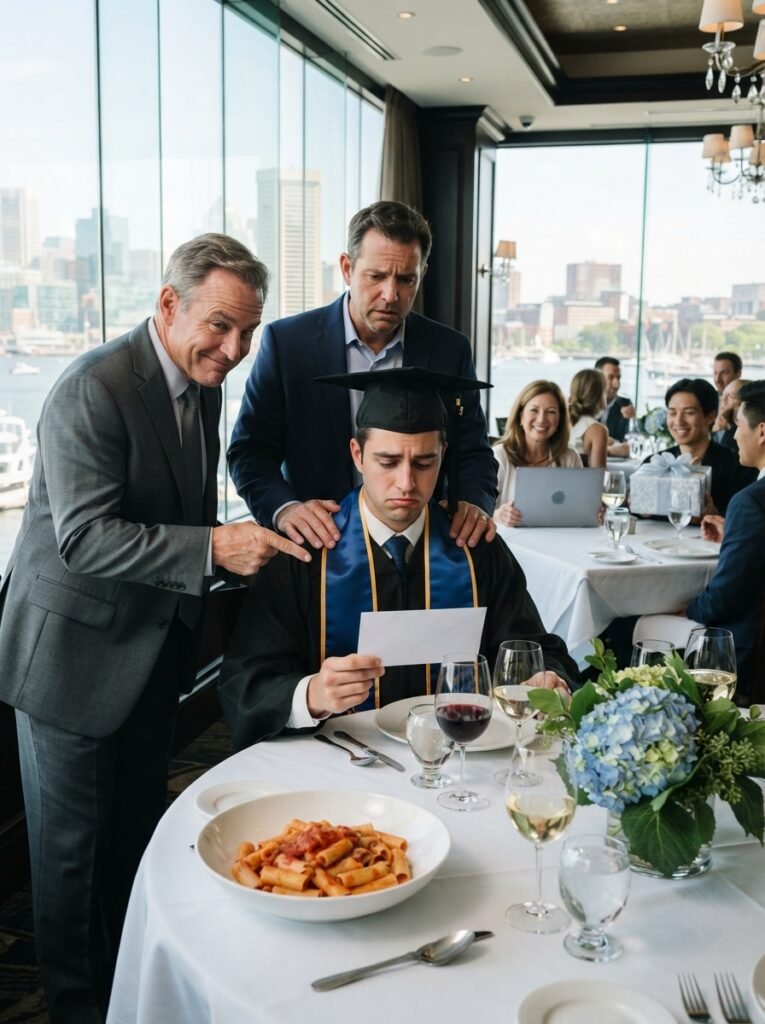
My father tapped his spoon against his water glass.
“Before everybody leaves,” he announced, “I have something special for the kids.”
He reached beneath his chair and produced two gift-wrapped boxes.
Madison and Logan leaned forward.
They tore through the wrapping paper.
Inside were brand-new laptops.
Expensive ones.
The kind Nate had spent months comparing online before deciding he couldn’t justify the price.
Madison squealed.
“Oh my God!
Grandpa!”
Logan almost knocked over his glass.
“These are incredible!”
My father laughed and handed each of them a greeting card.
Inside each card was a check for $1,500.
Everyone applauded.
Petra pressed her fingers to her chest.
“Dad, you are way too generous.”
My father beamed.
Then he looked at Nate.
“And I haven’t forgotten our graduate.”
He reached into his jacket pocket and withdrew a plain white envelope.
“Here you go, buddy.”
Nate accepted it with both hands.
“Thank you, Grandpa.”
He opened it carefully.
Slipped his fingers inside.
Paused.
Then checked again.
I watched him turn it upside down.
Nothing fell out.
Not a check.
Not a gift card.
Not even a note.
The envelope was completely empty.
For a moment, I assumed there had been a mistake.
But then I saw my father’s smile.
“He should be used to getting nothing from this family,” Hugh said.
A few people laughed.
I felt the blood drain from my face.
Dad leaned back, enjoying the attention.
“His father crawls through walls for a living and couldn’t even keep a wife.
What exactly are we celebrating?”
Nate’s mother had left when he was six.
My father knew that was the deepest wound either of us carried.
And he had just pressed his thumb into it.
Hard.
“He’s graduating,” I said quietly.
Dad waved dismissively.
“From public school.
Big accomplishment.”
He looked toward Petra’s children.
“These two are in gifted programs.
They’re going places.
A state university and a diploma anybody can get aren’t exactly impressive.”
Nate lowered his eyes.
My father chuckled.
“The apple doesn’t fall far.
And Bram’s tree never grew very tall.”
My name is Bram Calder.
I was forty years old, and I owned a successful licensed electrical contracting business with four employees and three trucks.
We handled residential renovations, commercial upgrades, and specialized safety installations.
My crews were booked months in advance.
But to my father, I was still a failure.
Because I worked with my hands.
Because I’d gotten divorced.
Because I hadn’t become the attorney, investment banker, or corporate executive he’d imagined raising.
Across the table, my mother stared at her plate.
Petra smiled faintly.
Her husband studied his phone.
And Nate sat perfectly still, holding an empty envelope that had somehow become heavier than every gift on that table.
I waited for someone to speak.
My mother.
My sister.
Anyone.
Nobody defended my son.
That silence was more painful than my father’s words.
I stood and placed my hand on Nate’s shoulder.
“We’re leaving.”
He rose immediately.
No tears.
No argument.
Just a quiet obedience that broke something inside me.
I slipped the empty envelope into my jacket pocket.
Then we walked out.
My father called after us.
“Don’t be so dramatic, Bram!
It’s a joke!”
I didn’t turn around.
Because I knew something he didn’t.
That dinner was going to be the last time he ever used my generosity as a weapon against my child.
We drove home in silence.
The city lights blurred past the windshield.
I kept thinking about the way Nate had carefully opened that envelope.
He hadn’t looked angry.
He’d looked prepared.
As though he’d expected humiliation and was simply relieved it was over.
Halfway home, he finally spoke.
“I knew it was going to be empty, Dad.”
My fingers tightened around the steering wheel.
“Why would you say that?”
He shrugged.
“Grandpa doesn’t like me.”
“That’s not true.”
Nate gave me a look.
Not disrespectful.
Not bitter.
Just tired.
“Dad.
Come on.”
I swallowed.
He looked out the window.
“Madison told me last week that Grandpa had gotten them laptops.
When I asked if he needed gift ideas for me, she said he told her not to worry about it.”
I didn’t answer.
“She wasn’t trying to be mean,” Nate added.
“I think she felt bad.”
“Then why didn’t you tell me?”
“Because I wanted tonight to be about graduating.
Not about Grandpa.”
That was when I understood how much my son had been protecting me.
I’d spent years believing I was shielding him from my family’s favoritism.
Meanwhile, he’d been quietly absorbing it so I wouldn’t have to fight.
At a red light, I reached across and squeezed his shoulder.
“Listen to me.
You’re going to build a life that man can’t even imagine.”
Nate managed a small smile.
“It won’t be the last envelope you open,” I told him.
He turned toward the window again.
But this time, I saw him wipe his cheek.
When we got home, Nate went straight to his room.
I heard his door close softly.
A while later, his desk lamp went out.
I stayed in the kitchen, staring at the white envelope on the table.
My father had spent most of my adult life reminding me that I wasn’t successful enough.
Yet whenever he needed something, I suddenly became indispensable.
Five years earlier, his rental duplex on Clement Avenue had developed serious electrical problems.
The wiring was outdated, the panels were dangerous, and his insurance company had threatened to cancel coverage unless the property was brought up to code.
He called me.
I spent fourteen months working weekends.
Replacing circuits.
Installing new panels.
Fixing dangerous connections.
Coordinating inspections.
The work was worth approximately $72,000.
I charged him nothing.
When the building finally passed inspection, he rented both units for $1,600 a month each.
He collected every dollar.
Then he called again.
His credit wasn’t strong enough to refinance the property.
Would I co-sign a $185,000 loan?
“Just until things stabilize,” he promised.
I agreed.
Later, my mother told me they were struggling financially.
Between medical expenses, property repairs, and taxes, they supposedly needed additional help.
So I arranged automatic transfers of $1,650 every month.
For three years.
Thirty-six payments.
$59,400.
And Petra?
She’d asked me to inspect the wiring in her Brookfield kitchen.
That “quick favor” turned into three weekends of work worth $28,000.
She thanked an imaginary contractor at her next dinner party.
I said nothing.
I kept telling myself that family wasn’t about keeping score.
But as I sat staring at Nate’s empty envelope, another thought began to form.
What if the people telling me not to keep score had been keeping one all along?
I opened my laptop.
Logged into my bank.
And started looking.
Every payment to my parents was there.
Exactly $1,650.
Month after month.
I opened the financial folder for the Clement Avenue property.
The original loan.
The refinancing paperwork.
The permits.
The account statements my father had occasionally forwarded when he wanted me to sign something.
Then I accessed an old account-sharing portal I’d been authorized to use as part of the loan arrangement.
The deposits were there.
But the outgoing transfers weren’t what I’d expected.
Money was leaving the account almost immediately.
And the recipient wasn’t the mortgage company.
It wasn’t the insurance provider.
It wasn’t a property management service.
I clicked the first transfer.
Then the second.
Then the third.
The same recipient appeared repeatedly.
PETRA CALDER DESIGN GROUP LLC.
My sister’s company.
For several seconds, I couldn’t breathe.
I opened another statement.
Another transfer.
Another month.
The payments were being routed to Petra.
Not used to support my parents.
Not used to protect the building.
Not used for anything my mother had described.
I felt sick.
I found myself remembering every time she’d said, “We hate asking, honey, but we’re really struggling.”
Every time she’d thanked me for being responsible.
Every time she’d told me my father was too proud to admit he needed help.
My phone lay beside the laptop.
I could have called them.
Demanded explanations.
Screamed.
Instead, I opened a new spreadsheet.
And began documenting everything.
By 11:18 p.m., I had enough evidence to know something was terribly wrong.
At 11:31, I canceled the automatic transfers.
At 11:42, I emailed my attorney, Mara Keene.
Mara had helped me incorporate Calder Electric years earlier.
She was sharp, patient, and spectacularly unimpressed by emotional blackmail.
I attached the records and wrote:
“I need you to review this.
I believe my parents have been misleading me about where my money is going.
There’s also a loan with my name on it.”
Then I sent my father one message.
“From now on, you can pay for your own family.”
I turned off the kitchen light.
For the first time in years, I went to bed without worrying about whether my parents could afford their next bill.
I worried about what else they’d hidden.
My phone began ringing at 6:12 the next morning.
Dad.
I ignored it.
He called again.
Then my mother.
Then Petra.
By seven o’clock, the calls were coming so quickly that my phone vibrated across the nightstand.
I walked downstairs, brewed coffee, and watched the screen light up again.
Nate appeared in the doorway wearing sweatpants and an old university T-shirt.
“Something wrong?”
“Your grandfather’s trying to reach me.”
Nate frowned.
“Because we left dinner?”
“I don’t think so.”
At 7:43, Dad left a voicemail.
His voice sounded nothing like it had the night before.
“Bram, answer your damn phone.
The bank’s frozen access to the new credit facility.
They say somebody raised concerns about the documentation.
Call me before this gets worse.”
I replayed the message.
New credit facility?
I knew about the original $185,000 loan.
I knew about the rental income.
I knew about the supposed financial shortfall.
But nobody had mentioned a new credit facility.
At 8:00, my father called for the twenty-seventh time.
I watched the phone ring until it stopped.
Ten minutes later, Mara called.
“Bram, are you sitting down?”
I looked toward Nate, who was pouring cereal into a bowl.
“Yes.”
“I’ve been reviewing the files you sent last night.
There’s something in the most recent property package that I need to discuss with you.”
“Did you find the transfers?”
“Oh, I found those.
But there’s a bigger problem.”
Her voice became very careful.
“Your father isn’t the only person whose signature appears on the latest paperwork.”
I frowned.
“What do you mean?”
She hesitated.
“Bram, did Nate sign anything for your father after his eighteenth birthday?”
I looked at my son.
He’d stopped pouring milk.
“No.”
“Are you certain?”
“Absolutely.”
Mara exhaled slowly.
“Then I think we have a serious problem.”
“What kind of problem?”
“The kind that could involve bank fraud, a forged signature, and a property your father may never have owned the way he told you he did.”
My heart began hammering.
“Mara, what property?”
“The Clement Avenue duplex.”
I stared at the kitchen wall.
She continued.
“And Bram?
There’s a name attached to the ownership records that I haven’t seen anywhere in the paperwork you gave me before.”
“Whose name?”
A pause.
Then three words that changed everything.
“Your grandmother’s trust.”
My grandmother, Helen Calder, had been dead for eleven years.
She was my father’s mother, a small, stubborn woman who wore gardening gloves until they fell apart and kept a battered toolbox beneath her kitchen sink.
She had taught me how to solder a wire when I was ten.
She had also been the only person in my childhood who never referred to me as a disappointment.
Whenever my father complained that I was wasting my potential by choosing a trade, Grandma Helen would say, “A man who can fix what’s broken is never useless.”
She’d died when Nate was seven.
And now, somehow, her name had appeared in paperwork connected to my father’s rental building.
“Mara,” I said, “Grandma left that building to Dad.”
“That’s what he told you.
But the recorded deed indicates she transferred it into an irrevocable trust in 2015.
Your father was named trustee.”
“What’s that got to do with Nate?”
“That’s what we need to establish.
The new financing package includes something called a beneficiary consent and continuation agreement.
It has Nate’s name and a signature that appears to be his.”
I looked at my son.
“Nate, come here.”
He approached slowly.
I put Mara on speaker.
“Did you sign a document for Grandpa about the Clement Avenue property?”
“No.”
“Anything about a trust?”
“No.
What’s going on?”
Mara didn’t answer immediately.
“Nate, have you signed any documents recently that your grandfather or aunt might have seen?”
He thought for a moment.
“College enrollment paperwork.
Financial aid forms.
A graduation scholarship application.”
“Did you give any of those to your aunt?”
Nate nodded.
“Aunt Petra asked for a copy of my scholarship application in April.”
My stomach sank.
“Why?”
“She said she wanted to check the formatting before I submitted it.”
Mara was silent for several seconds.
Then she asked Nate to email her the original application.
When he left the kitchen, she lowered her voice.
“Bram, don’t accuse anyone yet.
And don’t agree to sign anything your family sends you.”
“What exactly are they trying to do?”
“There’s a proposed $240,000 credit facility secured against the building.
The bank has flagged the documentation, and the preliminary records suggest substantial funds may already have been drawn.
We need the complete trust instrument before we can understand who had authority to approve it.”
“How much has been taken?”
“The latest figure I can verify is about $180,000.”
I gripped the edge of the counter.
“Where did it go?”
“We’re working on that.”
Then she added something that made my chest tighten.
“Bram, someone may have used your son’s identity to borrow money against property held for his benefit.”
I looked toward the hallway.
Nate was eighteen.
He was supposed to be worrying about roommates, textbooks, and whether he could afford a decent laptop for college.
Instead, his own grandfather might have involved him in a financial crime.
I thought about the empty envelope again.
I had believed my father had simply wanted to humiliate my son.
Now I wondered whether that humiliation had been a distraction from something much bigger.
By noon, the family group chat had become a battlefield.
My mother sent eight messages.
“Bram, your father is very upset.”
“Whatever happened at dinner was a misunderstanding.”
“Please don’t let this affect the business.”
“Your sister has children to think about.”
Then Petra called.
I answered because I wanted to hear what she’d say.
“Bram, what is wrong with you?”
“Hello to you too.”
“Do you have any idea what you’ve done?
Dad says the bank is reviewing everything.”
“Maybe the bank should.”
She went quiet.
Then her voice sharpened.
“You’ve always been jealous of me.”
I almost laughed.
“Petra, I’ve spent three years sending Mom and Dad money that appears to have ended up in your company’s account.
What exactly am I supposed to be jealous of?”
“Those were business arrangements.”
“What business arrangements?”
“You’re not entitled to know every detail of our finances.”
“Then you weren’t entitled to my money.”
She exhaled violently.
“Dad was right.
You have absolutely no sense of family loyalty.”
I looked at the empty envelope lying beside my computer.
“Funny.
That’s what I’m beginning to think about all of you.”
“Don’t pretend Nate is some innocent little victim.
He made everyone uncomfortable last night.”
My voice dropped.
“Be very careful what you say about my son.”
“Oh, please.
He sat there looking miserable like he wanted everyone to feel sorry for him.”
“He was opening an empty envelope while your children opened thousands of dollars in gifts.”
“That’s not my fault.”
“Then why were you smiling?”
Silence.
For one second, I thought she might apologize.
Instead, she said, “You don’t understand how much pressure Dad’s under.”
“Then maybe he should stop putting pressure on everybody else.”
I ended the call.
My hands were shaking.
Not with fear.
With the realization that the people I’d spent years helping were more concerned about losing access to my money than about what they’d done to my son.
That afternoon, I visited Uncle Rhett.
He lived in a modest ranch house outside Waukesha, surrounded by old maple trees and the wooden birdhouses he built in his retirement.
Rhett was sixty-eight, with silver hair, thick hands, and the permanently thoughtful expression of someone accustomed to repairing things without instructions.
He had been a union machinist for forty years.
My father had always treated him like the unsuccessful brother.
Maybe that’s why Rhett and I understood each other.
When he opened the door, he didn’t ask why I’d come.
He simply said, “I wondered how long it would take.”
I stood on his porch.
“How long what would take?”
He stepped aside.
“Come in, Bram.”
His kitchen smelled of coffee and cedar shavings.
We sat at a table covered with woodworking magazines.
He listened while I explained the transfers, the new financing, and the signature appearing under Nate’s name.
When I finished, Rhett rubbed his hands over his face.
“God help us.”
“You knew about the trust?”
He stared at the window.
“I knew your grandmother made one.
I didn’t know Hugh was still controlling everything.”
“What does that mean?”
Rhett stood, walked into the hallway, and returned carrying an old metal document box.
He placed it on the table.
“This belonged to your grandmother.”
The box was scratched and dented.
A piece of masking tape on the lid bore her handwriting.
FOR RHETT — IMPORTANT PAPERS.
He opened it.
Inside were yellowed letters, insurance documents, and a large sealed envelope.
“I was supposed to receive copies of the trust records after Hugh finished administering the estate,” Rhett said.
“He told me his attorney had everything settled.”
“Did you believe him?”
Rhett gave a bitter laugh.
“I wanted to.”
He turned the envelope over.
Written across the front were the words:
FOR THE CHILD WHO IS TOLD HE DESERVES NOTHING.
I stared at the handwriting.
Grandma Helen’s handwriting.
My throat tightened.
“What is that?”
“She wrote it shortly before she died.”
“To whom?”
Rhett looked at me.
“That’s something I think Nate should hear when we have the full documents in front of us.”
I leaned forward.
“Uncle Rhett, my son might have had his signature forged.
We don’t have time for family mysteries.”
“I know.”
His eyes filled with regret.
“I should’ve asked more questions years ago.
Your grandmother was worried about Hugh.
She said he mistook ownership for love.”
I looked down at the envelope.
“Can I take it?”
Rhett hesitated.
“Not yet.
I want Mara to verify the papers and the instructions first.
I’m not going to make another mistake because I trusted my own judgment over the documents.”
He closed the box.
Then he said something I would remember for the rest of my life.
“Bram, your grandmother didn’t leave those papers because she trusted Hugh.
She left them because she knew one day somebody would have to stand up to him.”
Over the following week, everything I thought I knew about my family’s finances began falling apart.
Mara worked with a forensic accountant named Theresa Hall.
Theresa was a former bank investigator who spoke quietly, took detailed notes, and seemed completely immune to intimidation.
She examined the payment history, corporate records, property filings, and documents associated with the financing.
By Wednesday, she’d prepared a preliminary report.
My monthly transfers had been routed through an account controlled by my parents.
Most of the money had gone to Petra’s company.
The original $185,000 loan remained active, and the rent from both apartments had been sufficient to cover its scheduled payments and ordinary property expenses in most of the periods reviewed.
There had been no legitimate reason for my mother to describe my monthly contributions as necessary mortgage support.
Worse, the new credit facility appeared to have been arranged using a consent document supposedly signed by Nate.
The money drawn against the property had gone into accounts associated with Petra’s business and a real estate project she was developing.
Theresa displayed the figures on her laptop.
“There’s one more thing.”
I rubbed my forehead.
“Of course there is.”
She turned the screen toward me.
A document appeared bearing the letterhead of Calder Electric.
My company.
At the bottom was a signature resembling mine.
I stared at it.
“What’s that?”
“An electrical safety certification submitted with the recent financing package.”
“I didn’t prepare this.”
“Are you certain?”
I looked closer.
The form listed electrical upgrades supposedly completed six weeks earlier.
It included my contractor license number.
My company address.
My signature.
And a statement that the building had been inspected and confirmed to meet the required electrical safety standards.
But I hadn’t worked on the Clement Avenue property in almost four years.
“That’s not my signature.”
Theresa nodded.
“We suspected as much.”
I felt my stomach twist.
“Someone forged my name on an electrical certification?”
“That’s what the evidence suggests.”
I stood and walked to the window.
Electrical safety wasn’t a formality to me.
It wasn’t a box someone checked to qualify for a loan.
Unsafe wiring killed people.
I’d seen what happened after electrical fires.
I’d walked through blackened kitchens where families had lost everything.
And now my professional reputation had apparently been used to support a financial transaction I hadn’t approved.
“Who signed it?”
I asked.
“We don’t know yet.”
“Was the building actually inspected?”
“We haven’t found a record of the claimed work.”
I turned back.
“Then I want a real inspection.”
Mara nodded.
“We’ll coordinate that with the proper authorities and the residents.”
I looked at the forged certificate again.
My family hadn’t just stolen from me.
They had put my name on a document that could endanger strangers.
That changed everything.
The next afternoon, Nate and I drove to Clement Avenue.
The duplex was a redbrick building on a quiet street lined with maple trees and closely spaced houses.
One unit had a green front door.
The other had a small porch with two rocking chairs.
I’d spent hundreds of hours there.
I could remember the layout of every panel, the difficult wiring runs, and the cold winter mornings when my fingers ached after working in the crawl space.
A woman named Alina Ortiz lived downstairs with her eleven-year-old son, Mateo.
She recognized me immediately.
“Mr.
Calder?”
“Bram.
Please.”
She smiled.
“You fixed our lights years ago.”
“I did.”
Her smile faded when I explained that I was reviewing some old electrical work and had concerns about recent documentation.
“Is something wrong with the building?”
“We’re trying to make sure everything is safe.”
Alina hesitated.
Then she said, “The lights have been flickering again.”
My stomach sank.
“How long?”
“A couple of months.
Sometimes the kitchen outlets stop working.
Your father said it was our appliances.”
“Did he send an electrician?”
“He sent somebody who looked at the breaker panel for ten minutes.
Then we got a notice saying a major electrical upgrade had been completed.”
I exchanged a glance with Nate.
“What upgrade?”
She disappeared into the kitchen and returned with a folded notice.
It claimed that extensive improvements had been performed and that a portion of the cost justified an upcoming rent increase.
I read it twice.
The amount listed for electrical improvements was $38,000.
My name appeared in the contractor section.
I hadn’t done the work.
Alina watched my face.
“That’s not right, is it?”
“No,” I said quietly.
“It’s not.”
She sat down heavily.
“My son has asthma.
I keep worrying about a fire.
But we can’t afford to move.
Every apartment around here costs more.”
Nate looked at Mateo’s schoolbooks stacked beside the couch.
One was a science workbook.
Another was a beginner’s robotics manual.
“You like building things?”
Nate asked.
Mateo nodded shyly.
“My robot keeps driving backward.”
Nate smiled.
“That usually means you’ve got something interesting happening with the motor connections.”
For the first time since graduation, I saw my son become animated.
Within minutes, he was kneeling on the living room rug with Mateo, studying a little homemade robot made from plastic wheels and recycled parts.
Alina looked at me.
“He’s a good kid.”
I swallowed.
“Yeah.
He is.”
Then she told me something that made the investigation even more urgent.
“Your father said somebody was interested in buying the building.
He told us if the sale went through, we might have to leave.”
“What buyer?”
“I don’t know.
He called it a redevelopment opportunity.”
I looked toward the window.
Across the street, a developer’s sign stood outside a vacant commercial property.
I’d noticed it when we arrived but hadn’t thought much about it.
Now another piece slid into place.
The forged paperwork.
The new credit facility.
The hidden trust.
The sudden urgency.
My father wasn’t simply trying to borrow more money.
He was preparing to profit from property whose ownership he might not control.
And the tenants could lose their homes in the process.
That evening, Nate asked me something I’d never expected.
“Dad, why did you keep helping Grandpa?”
We were sitting on the back steps.
The sun was setting behind the neighboring houses, turning the sky orange.
I thought about giving him the usual answer.
Because he was family.
Because he raised me.
Because people should help their parents.
Instead, I told him the truth.
“Because I thought if I did enough, he’d finally be proud of me.”
Nate looked at me.
“You own a company.
You help people.
You raised me by yourself.
What else does he want?”
I laughed without humor.
“I don’t think it was ever about what I accomplished.”
“Then what?”
I watched a bird settle on the fence.
“Maybe he needed me to believe I wasn’t good enough.
That way I’d keep trying to prove myself.”
Nate was quiet.
Then he said, “That’s a terrible way to treat somebody.”
“Yes, it is.”
He picked at a loose thread on his jeans.
“Sometimes I thought it was me.”
I turned toward him.
“What?”
“Why Grandpa liked Madison and Logan more.
I thought maybe I was boring.
Or not smart enough.”
My chest tightened.
“Nate—”
“Then I got into engineering school, and I thought maybe he’d finally say something nice.”
His voice cracked.
“But he didn’t.”
I put my arm around him.
For a while, neither of us spoke.
Then I said, “I’m sorry.”
He looked surprised.
“For what?”
“For letting you think you had to earn love from people who were determined not to give it.”
He leaned against my shoulder.
“You never made me feel that way, Dad.”
I closed my eyes.
That mattered more than every business award or bank balance I’d ever had.
The following Monday, Petra came to my office.
She arrived in a cream-colored blazer and expensive heels, carrying a leather handbag that probably cost more than my first work truck.
My receptionist, Janet, called me.
“Your sister’s here.
She says it’s urgent.”
I told Janet to send her in.
Petra entered without knocking.
“We need to talk.”
“Sit down.”
She remained standing.
“You’re ruining everything.”
I leaned back in my chair.
“Explain.”
“The bank won’t release the remaining funds.
Dad’s attorney is asking questions.
Dennis found out about the property financing, and now he’s furious.”
“Good.”
She stared at me.
“Good?”
“Someone should be asking questions.”
She crossed her arms.
“You’ve always enjoyed making me look bad.”
I almost smiled.
“Petra, I wired your kitchen for free.
How much effort do you think I’ve spent making you look good?”
Her face flushed.
“That was years ago.”
“The money Mom sent you was this year.”
She looked away.
I noticed.
For the first time since the investigation started, my sister appeared genuinely afraid.
“That money was supposed to be an investment,” she muttered.
“An investment in what?”
“My company.”
“Did you tell me that before I sent it?”
“No, because Mom said you’d never agree.”
“And she was right.”
Petra slammed her handbag onto a chair.
“You don’t understand.
The development project was supposed to make everyone rich.”
“What project?”
She hesitated.
Then she admitted that a private developer had been assembling properties near Clement Avenue.
My father’s duplex sat near a parcel the developer wanted for an access route and future expansion.
A completed deal could have generated a substantial payout.
But there were complications.
The trust.
The title.
The bank’s financing requirements.
And Nate.
I watched her carefully.
“Did you know my son was named in those documents?”
She went pale.
“That’s Dad’s business.”
“That’s not what I asked.”
“Bram, please.”
“Did you use Nate’s scholarship application to copy his signature?”
She stared at the floor.
The silence lasted long enough to become an answer.
Then she whispered, “I didn’t think anybody would get hurt.”
I felt something cold move through me.
“You used my son’s identity?”
“Nobody was supposed to know.”
“He’s eighteen, Petra.”
“I know.”
“He was applying for college.”
“I know!”
She suddenly began crying.
Real tears.
But they weren’t tears of remorse.
They were the tears of someone watching an elaborate plan collapse.
“Dad said it was just temporary.
We were going to fix everything after the sale.”
I stood.
“Get out.”
“Bram—”
“Get out of my office.”
She picked up her handbag with shaking hands.
At the door, she turned.
“Please don’t tell Dennis.”
I stared at her.
“You were willing to destroy my son’s future, and you’re worried about your marriage?”
She left without answering.
I called Mara immediately.
And for the first time, I realized we might have a witness who knew exactly how the forged documents had been created.
Dennis called me two days later.
He sounded exhausted.
“Bram, can we meet somewhere?”
We met at a diner near Brookfield, away from Petra and my parents.
Dennis arrived carrying a thick manila folder.
He ordered coffee but didn’t touch it.
“I owe you an apology,” he said.
“For what?”
“For sitting at that dinner and doing nothing.”
I looked at him.
He swallowed.
“When Hugh handed Nate that envelope, I wanted to say something.
But Petra squeezed my knee under the table and told me to leave it alone.”
“Then you should have ignored her.”
“I know.”
He looked down at his hands.
“Madison cried afterward.
She said she didn’t want the laptop because Grandpa had embarrassed Nate.
Petra told her she was being ungrateful.”
Something inside my chest shifted.
I’d spent the entire week remembering the laughter.
I’d forgotten that not everyone at the table had been laughing.
Dennis slid the folder toward me.
“There’s something else.”
Inside were bank statements, business records, and copies of messages between Petra and my father.
The messages were worse than anything I’d imagined.
One read:
“Make sure Bram doesn’t see the trust paperwork.
He’ll start asking questions.”
Another:
“We need the beneficiary signature before the lender’s deadline.”
And then, from Petra:
“I can get Nate’s signature from the college application.
It’s clean enough.”
I read that sentence three times.
Dennis watched me.
“She left her business laptop open.
I found those messages in a folder she thought she’d deleted.”
I looked up.
“Have you shown these to anyone?”
“Not yet.”
“Then you need your own attorney, Dennis.
And you need to preserve the original files.”
He nodded.
“I already called one.”
I sat back.
“Why are you giving them to me?”
Dennis’s face crumpled.
“Because Madison asked me something last night.”
“What?”
He wiped his eyes.
“She said, ‘Dad, if Grandma and Grandpa can do that to Nate, how do we know they actually love us?'”
I didn’t know what to say.
Dennis continued.
“I told her I didn’t know.
And then I realized that was the worst answer a father could give his child.”
He pushed the folder closer.
“I’m done protecting Petra from the consequences of what she’s done.”
For the first time since graduation, I saw someone else in the family choose honesty over loyalty to Hugh Calder.
It didn’t fix the past.
But it mattered.
Mara acted quickly.
She obtained the complete trust documents through the attorneys involved and worked with Rhett to verify the original records.
The bank’s fraud department began a formal review.
The disputed credit facility remained restricted while the suspicious signatures and supporting documents were investigated.
Mara also sought court orders to protect the trust property and its records while the ownership and trustee questions were resolved.
Meanwhile, the local building inspection authorities reviewed the electrical concerns at Clement Avenue.
Their findings were ugly.
Several supposed upgrades listed on the certification had never been completed.
Other work had been done improperly.
The residents were placed on a safety remediation plan, with temporary protections arranged while qualified contractors performed the required repairs.
I made sure my company stayed clear of any work that might compromise the investigation.
An independent electrical contractor handled the official repairs.
I still visited Alina and the upstairs tenant, Walter Pierce, to make sure they understood what was happening.
Walter was seventy-three, a retired postal worker who had lived upstairs for nine years.
He had a faded American flag hanging beside his front door and an old golden retriever named Duke.
One afternoon, he handed me a folder of rent receipts.
“Your father kept saying the place was losing money,” Walter told me.
“But he raised the rent every chance he got.”
“I know.”
Walter shook his head.
“Funny thing about people like that.
They always say they’re suffering while everybody else pays.”
His words stayed with me.
Because they described not only my father, but the entire system he’d built around himself.
He convinced people they owed him.
Then he convinced them their sacrifices were never enough.
The first time I spoke to my father after graduation was in Mara’s office.
He arrived with my mother and an attorney named Vincent Harrow.
Hugh wore his most expensive charcoal suit.
He looked irritated rather than frightened.
Until he saw the documents on the conference table.
Then his expression changed.
“Bram,” he began, “this has gone far enough.”
I didn’t answer.
Mara gestured toward the chairs.
“Please sit down.”
My father ignored her.
“We’re family.
We shouldn’t be doing this through lawyers.”
I looked at him.
“You didn’t think we were family when you humiliated Nate.”
He waved his hand.
“Oh, for God’s sake.
It was a joke.”
“Was forging his signature a joke?”
My mother inhaled sharply.
Hugh’s eyes flashed toward Mara.
“I don’t know what nonsense you’ve been telling my son.”
Mara opened a folder.
“We have serious questions regarding the beneficiary consent document, the electrical certification, and the transfer of funds associated with the property.”
Vincent leaned toward Hugh.
“Don’t respond to that.”
My father stiffened.
Then he pointed at me.
“You think you’re clever, don’t you?
You think because you have a few trucks and employees, you’re suddenly better than me?”
I looked at him calmly.
“No.”
That seemed to surprise him.
“I don’t think I’m better than you because I own a business.”
I paused.
“I think I’m better than you because I would never make a child feel worthless just to make myself feel important.”
My mother began crying.
“Bram, please.
Your father has worked his whole life.”
“So have I, Mom.”
“We made mistakes.”
“Did you make a mistake when you told me you needed money for the mortgage?”
She stared at the table.
“Did you make a mistake every month for three years?”
“Bram—”
“Did you know the money was going to Petra?”
Her silence answered me.
I felt something inside me settle.
Not anger.
Not grief.
Certainty.
For years, I’d wondered whether my mother was simply afraid of my father’s temper.
But she had known.
She had made the phone calls.
She had invented the emergencies.
She had thanked me for sacrifices she knew were benefiting Petra.
I looked at her.
“Why?”
She began sobbing.
“Petra was in trouble.
Her business was failing.
She had bills, Bram.
She had children.”
“So did I.”
My mother looked up.
“And Nate needed things too.”
She opened her mouth.
Closed it.
Then whispered, “We thought you’d understand.”
I leaned forward.
“You knew I’d understand.
That’s why you picked me.”
Hugh slammed his palm onto the table.
“Enough!
I won’t sit here while my own son lectures me!”
He stood.
Vincent grabbed his sleeve.
“Hugh, sit down.”
But Dad was staring at me.
“You’ve forgotten who gave you a roof over your head.”
I stood too.
“And you’ve forgotten who kept the roof on your rental property.”
For the first time in my life, my father had no immediate answer.
Then he said something that revealed more than he intended.
“That building was supposed to be mine.”
Mara looked up sharply.
“Supposed to be?”
Hugh froze.
Vincent closed his eyes.
And I understood that my father had just said the one thing he’d spent eleven years avoiding.
The court hearing took place three weeks later.
It wasn’t the final resolution of every financial dispute.
Mara had warned me that the investigation, restitution claims, and possible criminal proceedings could take months.
But the hearing would determine important temporary protections and clarify who had authority over the trust.
I arrived with Nate.
He wore the same navy tie he’d worn at graduation.
When I asked him why, he shrugged.
“Figured I’d get a better memory out of it.”
I almost cried.
Rhett was waiting outside the courtroom.
He carried Grandma Helen’s document box.
Mara stood beside him.
“Are you ready?” she asked.
I looked at Nate.
He nodded.
“Yeah.”
Inside, my father sat beside his attorney.
My mother looked pale.
Petra was seated several rows behind them.
Dennis sat on the opposite side of the room.
Madison and Logan hadn’t been brought into the legal proceedings.
For that, at least, I was grateful.
When the judge began reviewing the documents, the facts emerged one by one.
My grandmother had owned the Clement Avenue duplex outright decades earlier.
In 2015, shortly before her death, she had transferred the property into the Helen Calder Irrevocable Family Trust.
Hugh had been appointed the initial trustee.
He was responsible for managing the property, maintaining proper records, and acting in the beneficiary’s interests.
But he wasn’t entitled to treat the trust as his personal bank account.
Nor could he simply sell the property for his own benefit.
Mara presented the original trust provisions and the questionable continuation agreement.
The judge studied the documents.
Then she asked Hugh’s attorney a question.
“Why was a beneficiary consent document required in 2026?”
Vincent shifted in his chair.
“Because the beneficiary had reached the age specified for distribution.”
“And that age was?”
“Eighteen.”
The judge turned another page.
“Was the beneficiary informed of his interest?”
A long silence followed.
Mara stood.
“Your Honor, the beneficiary has stated under oath that he was never informed of the trust and never signed the continuation agreement.”
The judge looked toward Nate.
“Mr.
Calder, please stand.”
My son rose beside me.
“Can you state your full name?”
“Nathaniel James Calder.”
“How old are you?”
“Eighteen.”
“Did you know this trust existed before the current dispute?”
“No, ma’am.”
“Did you authorize anyone to sign a consent document on your behalf?”
“No, ma’am.”
“Did your grandfather ever explain that you might have rights concerning the Clement Avenue property?”
Nate looked toward Hugh.
Then back at the judge.
“No.
He told me I shouldn’t expect anything from the family.”
The room went silent.
The judge studied him for a moment.
Then she turned to the trust instrument.
What happened next felt almost impossible.
She read aloud the provision naming the beneficiary.
“The sole designated beneficiary of the real property and associated trust assets is Nathaniel James Calder.”
I stopped breathing.
Nate gripped the edge of the table.
The judge continued.
Under the terms of my grandmother’s trust, Nate was entitled to receive the trust property upon reaching eighteen.
And because he’d reached that age, Hugh’s authority to continue controlling the property was subject to the trust’s termination and distribution provisions.
There was also a successor-trustee provision naming Rhett to administer the final distribution if Hugh failed to do so.
Mara turned toward me.
I could barely speak.
“Grandma left the building to Nate?”
She nodded.
“Yes.”
I looked at my son.
His mouth was slightly open.
For eighteen years, he’d been treated as the least important grandchild.
And the man who’d handed him an empty envelope had been concealing a property interest that belonged to him.
My son hadn’t been excluded from his grandfather’s generosity.
His grandfather had been withholding something his great-grandmother had already given him.
But we weren’t finished.
Not even close.
The hearing revealed something else.
The trust property wasn’t limited to the duplex.
Attached to the recorded documents was a second parcel.
A narrow strip of land along the rear of the building.
I’d never paid much attention to it.
It looked like an overgrown service lot between the duplex and an old commercial property.
But it provided potential access to the larger redevelopment site.
And the developer’s proposal depended on obtaining rights over that strip.
The strip was held by the same trust.
My father had known.
Petra had known.
And neither of them had told us.
The developer’s preliminary offer, which included both the duplex and the strategically important access parcel, was worth far more than I’d expected.
The proposed deal exceeded $1.4 million.
The building itself wasn’t a mansion.
The value came partly from its location and the developer’s need for the adjoining land.
My father hadn’t been trying to protect a struggling rental property.
He’d been positioning himself to take control of a lucrative sale.
And the new credit facility had been used to provide Petra with money while everyone waited for the transaction.
The judge ordered the disputed documents and trust assets preserved and directed that the trust’s administration be placed under appropriate independent oversight pending further proceedings.
My father was no longer free to behave as though the property belonged to him.
The forged signatures remained the subject of separate investigation.
The financial accounting was only beginning.
But one truth was now beyond dispute.
Hugh Calder had spent years pretending to be the generous patriarch of our family while trying to profit from an inheritance intended for the grandson he openly despised.
Nate looked at me.
“Dad?”
“Yeah, buddy?”
“Is this real?”
I put my hand on his shoulder.
“Yeah.”
His eyes filled.
“Great-Grandma really left that to me?”
I nodded.
He looked toward Rhett.
“Why?”
Rhett reached beneath his chair.
And slowly lifted the old metal document box.
“Because,” he said, “she knew something about your grandfather that the rest of us kept refusing to see.”
Rhett opened the document box on a small table outside the courtroom.
My father had already left with his attorney.
My mother had followed him, crying.
Petra had disappeared before anyone could speak to her.
For the first time, the people who’d spent years controlling every family gathering were no longer the center of attention.
Nate was.
Rhett withdrew the sealed envelope with Grandma Helen’s handwriting.
FOR THE CHILD WHO IS TOLD HE DESERVES NOTHING.
He held it carefully.
“Your great-grandmother wrote this shortly before she died,” he told Nate.
“She wanted you to have it when you were old enough to understand.”
“Why didn’t Grandpa give it to me?”
Rhett’s face tightened.
“Because he didn’t want you to understand.”
He handed Nate the envelope.
Inside was a letter written on pale blue stationery.
Nate unfolded it.
His hands trembled.
He began reading aloud.
“My dear Nathaniel,
“If you’re reading this, I am probably no longer around to sit beside you and tell you how proud I am.
“I hope you’ve grown tall.
I hope you still ask a thousand questions.
And I hope you haven’t let anyone convince you that being gentle means being weak.”
Nate stopped.
His eyes filled.
I remembered Grandma Helen sitting at our kitchen table, helping seven-year-old Nate build a battery-powered toy car.
She’d called him her little inventor.
He continued.
“I have watched your father work harder than any young man I’ve known.
I have also watched my own son make him feel ashamed of that work.
“I wish I had corrected Hugh when he was younger.
“I didn’t.
“That failure belongs to me.
“But it must not become your inheritance.”
Nate wiped his face.
Rhett placed a hand on his back.
The letter continued.
“The Clement Avenue property has provided our family with income for many years.
I am leaving its future in your hands because I want it to be used for something better than keeping score.
“Your father has given you the most valuable thing a parent can give a child.
“He has shown you what it looks like to stay.
“Whatever happens, remember this:
“Money can buy a house.
“It cannot make a home.
“And the people who tell you that you are worth nothing are usually the people most frightened of discovering your worth.”
Nate’s voice broke.
He handed me the letter.
I read the final lines.
“You do not have to prove yourself to Hugh.
You do not have to prove yourself to Petra.
And you do not have to prove yourself to anyone who mistakes kindness for weakness.
“You are already enough.
“With all my love,
“Great-Grandma Helen.”
I couldn’t finish the last sentence aloud.
Because after forty years of trying to earn my father’s approval, I had just learned that my grandmother had seen everything.
The hard work.
The humiliation.
The endless need to be accepted.
And she’d left behind a way to protect the next generation.
I folded the letter carefully.
Nate hugged me.
Not because he’d inherited valuable property.
Not because a judge had recognized his rights.
But because, for the first time, he had proof that someone in our family had believed in him long before he accomplished anything.
The months that followed weren’t easy.
There was no magical moment when the judge struck a gavel and all our problems disappeared.
Real life doesn’t work that way.
The accounting took months.
The bank investigation uncovered additional irregularities.
The forged signatures became part of a formal criminal investigation.
Mara pursued restitution and the removal of the financial obligations that had been improperly imposed or misrepresented.
My father and Petra hired separate attorneys.
That told me more than any family argument could have.
They were no longer protecting each other.
They were protecting themselves.
My mother eventually gave a sworn statement admitting that she’d knowingly misrepresented the reason for my monthly payments.
She said Hugh had assured her the money would be returned after the development deal.
She also admitted that Petra’s financial problems had been much worse than I’d known.
Her company had accumulated substantial debt through failed renovation projects, expensive financing, and increasingly desperate attempts to maintain appearances.
The luxury handbags.
The impressive vacations.
The expensive home improvements.
Much of it had been paid for with borrowed money.
And when Petra needed more, my parents had turned toward the one person they’d trained to help without asking questions.
Me.
The court-supervised accounting eventually identified significant improper transfers from the trust, along with the money I’d personally contributed under false pretenses.
Claims were pursued against those responsible.
Some assets were frozen while the financial disputes continued.
My father was permanently removed from any role managing Nate’s trust property.
Petra was forced to confront the consequences of her involvement in the forged documents.
Dennis separated from her.
He didn’t make a spectacle of it.
He simply told me one afternoon, “I can’t teach my children honesty while pretending this was acceptable.”
I respected him for that.
Madison and Logan both apologized to Nate.
At first, Nate didn’t know how to respond.
Then Madison told him she’d kept the laptop in its box for weeks because every time she opened it, she remembered his face at dinner.
Nate said something that made me proud.
“You didn’t choose what Grandpa did.”
She started crying.
He hugged her.
And I realized my son had learned something that had taken me forty years to understand.
You can hold the person responsible for cruelty accountable without punishing everyone standing nearby.
By autumn, the disputed financing had been restructured under independent supervision, and the work to resolve the original loan was underway.
I wasn’t immediately released from every obligation.
But Mara made sure the process was documented, negotiated, and moving toward a lawful resolution.
I stopped paying my parents’ personal expenses.
No more automatic transfers.
No more unpaid renovations.
No more emergency checks disguised as family responsibilities.
My father sent me several letters.
The first was angry.
The second threatened to cut me out of his will.
The third accused me of turning Nate against him.
I didn’t respond.
Then came a fourth.
It was only three sentences.
“Bram, I know things have gotten out of hand.
Your mother misses you.
We should discuss how to move forward.”
There was no apology to Nate.
No acknowledgment of the forged documents.
No admission that he’d humiliated his grandson.
Just another request to move forward without looking backward.
I filed the letter with the others.
And went to work.
The most difficult decision wasn’t about my father.
It was about the duplex.
Nate had the right to receive the trust property, subject to the remaining legal and financial issues.
The developer was still interested.
There was enough money on the table to transform his future.
If the entire property could be sold under acceptable terms, Nate would have a considerable financial advantage before he even entered college.
One evening, we sat at the kitchen table reviewing the proposal.
“That’s a lot of money,” he said.
“It is.”
“I could pay for college.”
“More than college.”
He looked at the numbers.
Then at me.
“What happens to Alina and Mateo?”
I hesitated.
“The developer would probably replace the existing building eventually.
Any sale would have to address the tenants’ legal rights and relocation.”
“And Walter?”
“He’d have to find somewhere else if the building was demolished.”
Nate sat back.
He stared at the screen for a long time.
Then he closed the laptop.
“I don’t want to sell their home.”
I looked at him.
“Nate, you should understand what you’re turning down.”
“I do.”
“Money like that could change your life.”
He gave me a faint smile.
“Dad, you spent years giving Grandpa money because you thought you had to.
I don’t want to spend my life making decisions because I’m afraid I’ll never have enough.”
I was speechless.
He continued.
“Great-Grandma said the property should be used for something better than keeping score.”
He looked toward the window.
“Maybe we can figure out something better.”
And we did.
With the help of Mara, Rhett, and an independent real estate adviser, Nate negotiated a different arrangement.
The developer needed access across part of the narrow rear parcel.
After months of surveys, planning reviews, and negotiations, Nate agreed to sell a carefully defined interest in that land while retaining the duplex and protecting its continued residential use.
The arrangement wasn’t as lucrative as selling everything.
But it generated enough money, after the required expenses and financial obligations were addressed, to support a substantial renovation reserve and educational savings.
The duplex received new electrical systems, updated safety equipment, and other necessary improvements.
Alina and Mateo stayed.
So did Walter and Duke.
Nate established a modest annual scholarship through a separate fund using part of the available proceeds.
It was intended for local students pursuing skilled trades, engineering, and technical careers.
He named it the Helen Calder Scholarship.
When I asked him why, he shrugged.
“Great-Grandma thought people who build things matter.”
He smiled.
“I think she was right.”
One Saturday in late October, Nate and I visited the duplex after the final round of renovations.
The air smelled of fresh paint.
Walter was sitting on his porch with Duke asleep at his feet.
Alina had made cookies.
Mateo ran outside carrying a small wheeled robot.
“Nate!
Look!”
The robot rolled smoothly across the sidewalk, turned left, and stopped beside a flowerpot.
Nate laughed.
“You fixed the motor wiring!”
Mateo grinned.
“And I changed the code!”
Nate knelt beside him.
“That’s what I’m talking about.”
I stood near the porch, watching them.
For years, I’d looked at this building and remembered aching muscles, unpaid labor, and my father’s endless demands.
Now I saw something different.
People.
Families.
Possibilities.
The inheritance had become more than a legal victory.
It had become an opportunity to do something decent with money that had nearly been used to hurt people.
Rhett joined me on the steps.
“Your grandmother would be proud,” he said.
I smiled.
“Of Nate?”
“Of both of you.”
I looked away.
Rhett placed a hand on my shoulder.
“Bram, you spent a long time trying to make Hugh happy.”
“Too long.”
“Maybe.”
He watched Nate help Mateo adjust the little robot.
“But you raised a son who doesn’t need to make somebody else miserable to feel successful.”
I swallowed.
“That’s worth something.”
Rhett smiled.
“More than you know.”
I thought the worst revelations were behind us.
I was wrong.
The final surprise came in December.
Theresa Hall called and asked whether Nate and I could meet her and Mara.
She sounded unusually serious.
“There’s one last set of transactions I want you to see.”
We met at Mara’s office on a cold Friday afternoon.
Snow was collecting along the edges of the parking lot.
Nate had just finished his first semester at UWM.
He was tired, excited, and already talking about a project involving low-cost electrical monitoring equipment.
He’d also made friends.
Real friends.
Kids who thought his obsession with circuitry was interesting rather than embarrassing.
He was happy.
And that was something my father had never been able to give him.
Theresa greeted us with a thin folder.
“I finished reconciling the smaller withdrawals from the trust account,” she explained.
“Most of the major transactions have already been reviewed.
But there were several reimbursements that didn’t make sense at first.”
She opened the folder.
“Your grandfather had been using trust funds to reimburse personal purchases.”
I nodded.
“That doesn’t surprise me anymore.”
“This one might.”
She slid a receipt across the table.
I looked at it.
An electronics store.
Two high-end laptops.
Purchased shortly before graduation.
My heart stopped.
Theresa slid another document beside it.
A bank record showing reimbursement for the purchase from an account holding trust funds.
Then she showed us two canceled checks.
Each for $1,500.
Both ultimately funded through the same improper reimbursement process.
I stared at the papers.
My mind returned instantly to the Italian restaurant.
The white tablecloth.
Madison’s delighted expression.
Logan pumping his fist.
My father’s proud smile.
The applause.
And Nate sitting with an empty envelope in his hands.
I looked at Theresa.
“Are you telling me what I think you’re telling me?”
She nodded.
“The evidence indicates that the graduation gifts for Petra’s children were paid for using money taken from the trust intended for Nate.”
For several seconds, nobody spoke.
Then Nate let out a strange little laugh.
Not because it was funny.
Because it was almost impossible to believe.
“So Grandpa gave them presents with my money?”
Theresa nodded.
“That’s what the records show.”
Nate stared at the receipt.
“And gave me an empty envelope.”
I looked at him.
His eyes were wet, but his expression wasn’t angry.
It was something deeper.
A final understanding.
My father had stood before twelve relatives, pretending to be a generous grandfather.
He’d handed two children expensive gifts.
He’d deliberately humiliated the third.
And the money he’d used to display his generosity had belonged to the boy he’d decided deserved nothing.
He had stolen from Nate to reward his cousins, then mocked Nate for being empty-handed.
I’d spent months trying to understand why my father had been so cruel.
In that moment, I finally stopped trying.
Some actions don’t become understandable when you examine them closely enough.
They simply become undeniable.
Mara closed the folder.
“This evidence will be included in the final accounting and related proceedings.”
I nodded.
Nate looked down at the documents one more time.
Then he said something none of us expected.
“Can Madison and Logan keep the laptops?”
Theresa blinked.
“That’s not really the issue here.”
“I know,” Nate said.
“But I don’t want them to think I’m going to take their presents away.”
I watched my son.
He continued.
“They didn’t steal anything.
Grandpa did.”
Then he looked at me.
“Dad, I don’t want to become the kind of person who makes somebody else feel small just because I finally can.”
I put my arm around him.
And held on.
That Christmas, we didn’t go to my parents’ house.
There was no enormous dining table.
No expensive centerpiece.
No carefully arranged photographs designed to make our family look happier than it was.
Instead, we hosted dinner at our place.
Rhett came.
Dennis brought Madison and Logan.
Alina and Mateo stopped by with homemade cookies.
Walter sent a handwritten Christmas card featuring a photograph of Duke wearing reindeer antlers.
Janet from my office came for dessert.
The house was noisy, crowded, and imperfect.
Someone burned the rolls.
The dog knocked over a decoration.
Mateo spilled hot chocolate on the tablecloth.
And nobody cared.
After dinner, Nate handed Madison and Logan each a small wrapped package.
Inside were protective sleeves for their laptops and handwritten notes wishing them luck with school.
Madison looked at him.
“You’re really not mad at us?”
Nate smiled.
“No.”
She hugged him so tightly that he nearly dropped his drink.
I stood in the doorway watching them.
For the first time in years, a family gathering didn’t leave me exhausted.
Nobody was competing.
Nobody was keeping score.
Nobody was trying to make the smallest person in the room feel smaller.
Later that evening, after everyone had gone home, Nate and I sat at the kitchen table.
He was filling out an application for a summer engineering internship.
I was sorting through old paperwork when I found the white envelope.
The same one he’d received at graduation.
I’d kept it in the drawer all those months.
I turned it over in my hands.
“Hey, Nate.”
He looked up.
“Yeah?”
“Remember this?”
He recognized it immediately.
His expression softened.
“Can’t believe you kept that.”
“I almost threw it away.”
“Why didn’t you?”
I thought about it.
“Because I never wanted to forget the moment I realized I’d been teaching you to accept something you didn’t deserve.”
He considered that.
Then he reached across the table.
“Can I have it?”
I handed it to him.
He examined the envelope for a moment.
Then, without saying anything, he took a pen from beside his laptop.
He wrote something on the front.
Folded it closed.
And handed it back.
I looked down.
In Nate’s neat handwriting were five words.
“I was never worth nothing.”
My throat tightened.
He smiled.
“Put that somewhere you’ll see it.”
I nodded.
“Why?”
“Because I think you need to remember it too.”
I stared at him.
Then I understood.
For forty years, my father had taught me to confuse usefulness with worth.
He’d made me believe that love was something I could earn through sacrifice.
That if I worked harder, gave more, and complained less, eventually I’d deserve his respect.
But my son had learned a different lesson.
He understood that respect wasn’t something a person should have to purchase.
And love wasn’t something that could be withheld until somebody became convenient.
I looked at the envelope again.
Five words.
A lifetime of meaning.
My father eventually sent one final letter.
It arrived the following spring, almost a year after graduation.
His finances had been severely damaged by the legal proceedings and restitution obligations.
His reputation had suffered.
The family he once controlled no longer gathered around him simply because he demanded it.
The letter contained an apology.
Not a perfect one.
But an actual acknowledgment that he’d treated Nate cruelly and misused money he had no right to take.
I read it carefully.
Then I gave it to Nate.
“Do you want to answer him?”
My son thought for a long time.
“No.”
“Not even to tell him how you feel?”
Nate shook his head.
“I think he already knows.”
He handed the letter back.
“Maybe someday.
But not because he’s lonely or wants everything to go back to normal.”
I nodded.
“That’s fair.”
He stood and picked up his backpack.
“I’ve got class.”
At the door, he turned.
“Love you, Dad.”
“Love you too, buddy.”
He smiled and walked out into the morning sunshine.
I watched him drive away.
Then I looked toward the kitchen wall.
I’d framed the empty envelope.
Not because I wanted to remember the humiliation.
Not because I wanted to celebrate what my father had lost.
But because I wanted to remember what my son had found.
His dignity.
His voice.
His right to decide what family meant.
Underneath the envelope, I’d placed a small photograph.
Nate at eighteen, wearing his graduation gown.
His arm around my shoulders.
Both of us smiling.
Beside it was Grandma Helen’s letter, opened to the line that had changed the way I saw myself.
“You are already enough.”
My father had once looked at my son and told him he should be used to getting nothing from his family.
He’d said it in a room full of people.
He’d said it while handing out expensive gifts bought with money that belonged to Nate.
He’d believed that wealth gave him the right to decide who mattered.
But the greatest thing my son received that year wasn’t a property worth more than a million dollars.
It wasn’t the money recovered.
It wasn’t a scholarship fund or a future career.
It was the freedom to walk away from people who wanted him to feel worthless.
And the courage to build something better.
Years from now, my father may be remembered as the man who tried to take an inheritance from his own grandson.
But I hope Nate remembers something different.
I hope he remembers the tenants who kept their homes.
The little boy who learned to repair his first robot.
The cousins who discovered that kindness mattered more than expensive presents.
The great-grandmother who believed in him before he understood what believing in himself meant.
And the father who finally stopped begging for approval and learned how to give himself the respect he’d always deserved.
Because on the night my father handed Nate that empty envelope, he thought he was showing the whole family exactly how little my son was worth.
He never imagined that the empty envelope would expose everything he’d stolen.
And he certainly never imagined that the boy he’d tried to humiliate would become the one person wealthy enough, powerful enough, and compassionate enough to break the cycle he had spent a lifetime creating.
But the most important part wasn’t that my father lost control of the money.
It was that he lost control of our happiness.
And for the first time in my life, that happiness belonged entirely to us.
THE END.