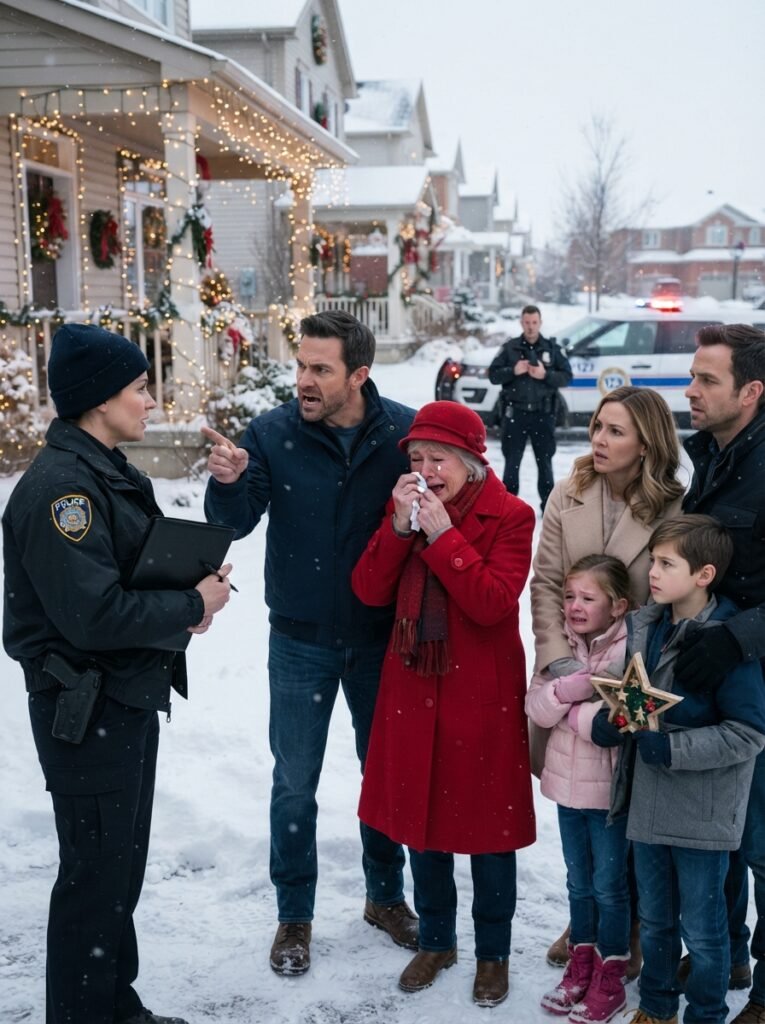
The first time I saw my mother cry because of something I’d done, she was standing on my front porch, staring at a police officer who had just asked her about a document signed on the day my daughter was born.
For thirty-eight years, I’d believed my mother’s tears were something I was responsible for preventing.
That morning, I finally understood they could also be evidence.
My name is Lance Wallace.
I’m an electrician, a husband, and the father of two children who deserved a much better Christmas than the one my parents gave them.
Until that December, I’d spent six years paying my parents’ bills.
$2,100 every month.
Seventy-two months. $151,200.
I paid their mortgage, electricity, groceries, insurance, and prescriptions.
My wife worked overtime at the hospital while we postponed buying a bigger home.
I told myself that taking care of my parents was what a good son did.
Then, on Christmas morning, my mother handed my seven-year-old daughter nothing while my brother’s children opened nearly $5,000 worth of presents.
That was the moment something inside me finally snapped.
But the cruelty of Christmas morning wasn’t the worst thing my family had done.
It was only the first loose thread.
And when I pulled it, I discovered that the people I’d been sacrificing everything to protect had been hiding a secret worth millions.
The Christmas tree in my parents’ living room was magnificent.
Twelve feet tall, covered in golden lights and red glass ornaments, with a glittering star that nearly touched the ceiling.
My mother, Yolanda, had spent weeks posting pictures of it on Facebook.
“Family is everything,” she’d written beneath one photograph.
Looking back, I almost admire the nerve it took to type those words.
My wife, Kendra, was working a Christmas shift at the emergency department, so I’d brought our children to my parents’ house myself.
Kayla, seven, wore a red velvet dress.
Simon, four, was bundled into a green sweater decorated with reindeer.
Both children had been excited all morning.
Especially Kayla.
For two weeks, she’d been carefully guarding a small clay star she’d made at school.
She’d painted it blue, added tiny gold dots around the edges, and written “Grandma” across the center.
She wrapped it herself.
Three times.
The first wrapping paper tore, the second didn’t look pretty enough, and the third was covered with crooked pieces of tape.
I told her it was perfect.
She smiled so hard that her eyes disappeared.
“Do you think Grandma will love it?”
“Of course she will, sweetheart.”
I believed that when I said it.
That was my first mistake of the day.
When we arrived, my brother Brian was already there with his wife, Melissa, and their two sons, Tyler and Connor.
Brian was forty-one, three years older than me, and somehow still treated like the crown prince of the Wallace family.
He had a successful-looking life.
A large SUV, an expensive watch, a house with a three-car garage, and a talent for turning every family gathering into a celebration of his accomplishments.
My mother adored him.
When Brian walked into a room, she practically glowed.
When I walked into a room, she usually remembered something that needed fixing.
That morning was no different.
“Lance, the kitchen faucet’s dripping again,” she said before I’d even taken off my coat.
“Merry Christmas to you too, Mom.”
She waved away my joke.
“Just look at it before you leave.”
Then she saw Brian.
“My handsome boy!”
She hurried across the room to hug him.
I should’ve known what was coming.
But children have a way of making you hopeful about people who’ve disappointed you for years.
I wanted my kids to have grandparents.
I wanted them to experience the big Christmas mornings I’d always imagined growing up.
So I smiled.
I helped Simon remove his coat.
I told Kayla she could give Grandma her present after breakfast.
And then the gift opening began.
Tyler received a brand-new iPhone.
Connor received another.
Then came a gaming console, wireless headphones, designer sneakers, gift cards, video games, and expensive accessories.
Wrapping paper flew everywhere.
My mother clapped and laughed.
Brian whistled appreciatively.
“Whoa, Mom!
You really went all out!”
“Anything for my grandbabies,” she said proudly.
Kayla sat beside me, holding Simon’s hand.
She watched her cousins open present after present.
When the pile finally disappeared, she looked toward the tree.
There was nothing left.
My mother stood and began collecting the wrapping paper.
Kayla waited another minute.
Then she approached her grandmother.
“Grandma?”
“Yes, sweetheart?”
“Is there another present somewhere?”
My mother didn’t even hesitate.
“No Christmas gifts this year, sweetheart.
Grandma’s on a very tight budget.”
I looked at the two iPhones.
Then at the gaming console.
Then at my daughter’s face.
She wasn’t angry.
That was what hurt the most.
She was confused.
“Did Grandma forget about us?” she whispered.
Before I could answer, my father spoke from his recliner.
“Stop teaching that girl to be jealous, Lance.”
My head turned.
“What?”
“Kids need to learn that they don’t always get everything they want.”
He kept watching football.
I felt heat rise behind my eyes.
“She’s seven, Dad.
She asked a question.”
“Then teach her to be grateful.”
Brian laughed.
“Come on, man.
Don’t make this weird.
They’re just presents.”
I looked at him.
“Then it shouldn’t bother you if we leave.”
My mother crossed her arms.
“You’re not going to ruin Christmas over some toys.”
“No,” I said.
“I’m going to make sure my children don’t have to sit here another minute feeling unwanted.”
Dad finally looked at me.
“Watch your tone in my house.”
Something about those words made me strangely calm.
“Your house?”
He frowned.
“What’s that supposed to mean?”
“Nothing.”
I stood.
“Kids, get your coats.”
My mother rolled her eyes.
“You’re being dramatic.”
Maybe I was.
But then I walked into the kitchen and saw something that made me forget every argument I’d planned to have.
Kayla’s blue clay star was lying inside a black trash bag.
Not on the mantel.
Not beside the tree.
In the trash.
A corner had chipped.
I carefully lifted it out.
Behind me, my daughter whispered, “Daddy?”
I turned.
She was watching the star in my hands.
I saw her understand.
And in that instant, I knew I would never again sacrifice my children’s happiness to purchase my parents’ approval.
The drive home was quiet.
Simon fell asleep in the back seat, clutching a candy cane he’d found in his coat pocket.
Kayla watched the Christmas lights passing outside her window.
I kept glancing at her in the rearview mirror.
Finally, she asked, “Daddy, did I do something wrong?”
“No, baby.”
“Then why didn’t Grandma get me anything?”
I swallowed.
“Sometimes grown-ups make bad choices.”
She thought about that.
“Like when Simon colored on the wall?”
Despite everything, I almost smiled.
“Something like that.”
“But Grandma knows better.”
I couldn’t answer.
Because she was right.
A few minutes later, Kayla spoke again.
“I made her a present.”
“I know.”
“Maybe it wasn’t good enough.”
That broke me.
I pulled into an empty grocery store parking lot and turned around.
“Kayla, look at me.”
Her eyes were shiny.
“Your present was beautiful.
It was thoughtful, and you worked hard on it.
Grandma was wrong to throw it away.
You weren’t wrong to make it.”
She nodded slowly.
I reached into my coat and took out the star.
“Let’s put this on our tree instead.”
She touched the chipped corner.
“Can we fix it?”
“Absolutely.”
“With the gold paint?”
“All the gold paint you want.”
She smiled.
And I made myself a promise.
No one was ever going to teach my daughter that love was something she had to earn by accepting humiliation.
What I didn’t tell Kayla was that I’d been in her position countless times.
When I was nine, Brian got a new bicycle for Christmas.
I got three pairs of socks.
When I was twelve, Brian’s baseball team went to a tournament in Florida.
My parents paid for his trip.
That same month, I was told they couldn’t afford the registration fee for my science camp.
When I graduated high school, Dad shook my hand.
When Brian graduated college, they threw a party for sixty people.
And whenever I complained, Mom always had the same explanation.
“Brian needs more support.
You’re the strong one.”
I spent years believing that strength meant never needing anything.
It took my daughter’s tears to teach me otherwise.
Six years before that Christmas, my father suffered a heart attack.
I was working on an electrical panel in a commercial building when my phone rang.
Mom was crying so hard I could barely understand her.
“Your father’s in the hospital.
They don’t know if he’s going to make it.”
I left my tools behind.
I drove straight to the hospital.
Dad survived, but he couldn’t return to his warehouse job.
The following months were difficult.
At least, that’s what I was told.
One evening, Mom called me and said they were three months behind on their mortgage.
“The bank’s threatening foreclosure,” she sobbed.
My stomach dropped.
Their house wasn’t luxurious, but it was the place where Brian and I had grown up.
It had a wide front porch, a beautiful oak tree in the yard, and a kitchen where my grandmother used to bake cinnamon rolls.
I couldn’t imagine my parents losing it.
“What do you need?”
I asked.
Mom hesitated.
“The mortgage is $1,240 a month.
And we’re struggling with utilities, insurance, and your father’s prescriptions.”
I looked at our family budget.
Kendra and I had recently welcomed Simon.
Kayla was still a toddler.
We weren’t wealthy.
But we were getting by.
“I’ll help,” I said.
Mom cried harder.
“Oh, Lance.
You’re saving us.”
I set up monthly transfers.
$1,240 for the mortgage.
Another $860 for everything else.
I thought it would last a few months.
Maybe a year.
Instead, it became six years.
Every time I asked whether their situation had improved, Mom found another reason they still needed help.
Medical bills.
Property taxes.
Insurance increases.
Unexpected repairs.
Kendra never complained.
Not once.
She simply adjusted our budget.
She picked up extra shifts at the hospital.
We postponed a vacation to Yellowstone.
We delayed replacing our aging kitchen appliances.
When our kids outgrew their bedrooms, we decided to stay in our small house for another few years.
Meanwhile, Brian bought a bigger SUV.
He remodeled his kitchen.
He took his family to Hawaii.
I assumed his finances were better than mine.
That wasn’t surprising.
Brian had always been considered the successful son.
What did surprise me was Mom’s insistence that I never tell him about the payments.
“Your brother would feel terrible knowing we needed help,” she said.
“Why?”
“He’s proud, Lance.
You know how he is.”
So I kept the arrangement secret.
At church, Mom told everyone that Dad’s pension covered their expenses.
Dad didn’t have a pension.
I knew that.
But I told myself she was protecting his dignity.
I never considered that she might have been protecting a crime.
Kendra came home from the hospital at 8:15 that Christmas night.
She looked exhausted.
Her blond hair was pulled into a messy bun, and there was a faint red mark across her nose from wearing a mask for most of her shift.
I had dinner waiting.
Chicken, roasted potatoes, and green beans.
She kissed the kids goodnight, then sat across from me at the kitchen table.
“Tell me what happened.”
I did.
Every detail.
The phones.
The expensive presents.
Dad’s accusation.
Kayla’s question.
The blue star in the trash.
When I finished, Kendra stared at the table.
Then she said something that changed my life.
“I worked Christmas Day so your mother could tell our daughter she didn’t deserve a present.”
I looked down.
“I’m sorry.”
“Don’t apologize to me.”
Her voice wasn’t angry.
That was worse.
It was tired.
“Lance, I’ve watched you spend six years trying to be good enough for people who decided you weren’t good enough when you were a little boy.”
I said nothing.
She reached across the table and took my hand.
“You are a wonderful son.
But you’re a father first.”
Something inside me gave way.
For years, I’d been waiting for permission to stop.
Kendra was reminding me that I didn’t need any.
At 9:40 p.m., I gathered my bank statements and called our bank.
The representative introduced herself as Nina Shah.
I explained that I wanted to cancel every recurring payment connected to my parents and remove my mother’s authorization from a credit card she’d been permitted to use for household emergencies.
Nina confirmed the transactions.
“Would you like these changes to take effect immediately?”
“Yes.”
She typed.
“All right, Mr.
Wallace.
I’m also seeing some linked authorization records that need verification.”
“Okay.”
There was a pause.
“Can you confirm the date you granted durable financial power of attorney to Yolanda Wallace?”
I frowned.
“What?”
“The durable power of attorney on file lists Yolanda Wallace as your authorized agent.”
“I never gave my mother power of attorney.”
Another pause.
“Sir, the document is dated August nineteenth, seven years ago.”
My heart began pounding.
August nineteenth.
Kayla’s birthday.
“That can’t be right.”
“Would you like me to initiate a dispute?”
“Yes.
But first, tell me what that authorization was used for.”
Nina’s voice changed.
“Mr.
Wallace, I can discuss the records associated with this bank.
Other transactions may require investigation.
But I’m seeing references to property-related accounts and a business entity connected to your name.”
“What business?”
“Wallace Family Ventures, LLC.”
I’d never heard of it.
Nina continued carefully.
“Sir, I strongly recommend that you place a fraud alert on your credit reports and contact our fraud department immediately.”
I stared at the papers in front of me.
“How much money are we talking about?”
“I can’t determine that from this screen.”
“Please.”
She hesitated.
Then she said, “I can tell you this is potentially much more serious than the recurring payments you called to cancel.”
The kitchen tilted around me.
I thought about the day Kayla was born.
Kendra had undergone an emergency C-section.
There had been complications.
I spent the entire day going between her recovery room and the neonatal unit, terrified that something would happen to either of them.
I hadn’t signed a power of attorney that day.
I hadn’t signed anything for my mother.
And whoever had created that document knew exactly how distracted I would have been.
When Kendra found me, I was sitting on the kitchen floor beside the dishwasher.
“Lance?”
I looked up.
She knelt beside me.
“What happened?”
I told her about the power of attorney.
About the company.
About the date.
She listened without interrupting.
Then she stood, opened the cabinet above the refrigerator, and retrieved a small fireproof box.
Inside were important family documents.
Birth certificates.
Insurance policies.
Our marriage certificate.
And Kayla’s hospital records.
Kendra laid them on the table.
“If someone used that day to take advantage of you,” she said, “we’re going to prove it.”
Then she asked, “Are you calling your mother?”
I shook my head.
“No.
I’m going to let her call me.”
The first call came at 12:20 a.m.
Mom left an angry voicemail.
“Lance, my card was declined.
Fix this immediately.”
At 12:47, she called again.
“Your father needs medication, and you’ve frozen everything!
What is wrong with you?”
By 2:00, she was threatening to disown me.
By 3:30, the threats had turned into pleading.
“Please, Lance.
We need to talk.”
At 5:16, she left a voicemail that made my hands shake.
Her voice was barely above a whisper.
“Lance, honey, whatever the bank told you, don’t do anything until I explain.
Your father doesn’t know everything.
Please don’t let strangers get involved.”
I played it twice.
Then I saved it.
I copied it to Kendra’s phone.
And when the sun rose, I drove to the police station on Third Street.
Officer Rachel Doyle met me in a small interview room.
She was in her early forties, with dark hair pulled tightly behind her head and the steady expression of someone who had heard thousands of stories and learned to believe only what the evidence supported.
I explained the Christmas argument.
Then the bank call.
Then the disputed authorization.
I showed her the statements, voicemails, and hospital documents.
She studied them carefully.
“Mr.
Wallace, do you recognize this business?”
She pointed to the printed information Nina had helped me obtain.
“Wallace Family Ventures?”
“No.”
“Have you ever authorized your mother to sign financial or property documents on your behalf?”
“No.”
“Have you ever inherited property?”
I hesitated.
“Not that I know of.”
Officer Doyle looked up.
“Not that you know of?”
“My grandmother died around the time my daughter was born.
Mom said her estate was exhausted by medical expenses.”
Officer Doyle made a note.
“Who handled the estate?”
“My mother.”
She nodded slowly.
Then she gave me a case number.
“Don’t confront anyone about the documents.
Don’t destroy anything.
If your family contacts you, preserve the messages.”
I thanked her.
As I stood, she added, “Mr.
Wallace?”
“Yes?”
“Sometimes the first thing someone reports isn’t the most serious thing we’ll find.”
I drove home feeling like the world I’d known had shifted several inches to the left.
But I had no idea how far it was about to move.
At 10:14 a.m., Mom’s seventy-third call lit up my screen.
At 10:15, the doorbell rang.
Brian’s SUV blocked my driveway.
My parents’ Buick was parked behind it.
A police cruiser stood at the curb.
I opened the door.
Brian marched toward me, pointing.
“He’s the one!
He’s been taking money from our parents!”
Behind him, Mom stood clutching her phone.
Dad looked pale.
Two police officers approached.
One was Officer Doyle.
Brian didn’t notice my expression.
“He got into their accounts!
He froze Mom’s card!
He’s trying to steal their house!”
I remained in the doorway.
Kendra stood behind me.
Officer Doyle raised one hand.
“Sir, stop shouting.”
Brian turned toward her.
“Are you going to arrest him?”
“Not before I understand what’s happened.”
She looked past him.
“Ma’am, are you Yolanda Wallace?”
My mother nodded.
“Yes.”
Officer Doyle opened her folder.
“Did you submit a durable power of attorney to financial institutions identifying yourself as your son’s legal agent?”
Mom froze.
Brian blinked.
“What power of attorney?”
Officer Doyle continued.
“The document is dated August nineteenth, seven years ago.
Did your son sign it in your presence?”
Mom’s mouth opened.
No words came out.
I stepped forward.
“That’s the day Kayla was born.”
Brian looked at me.
“So?”
“I was at the hospital with Kendra.
I never signed anything for Mom.”
My brother frowned.
Then he reached into his jacket.
“Wait a minute.”
He unfolded a document.
“Mom told me you signed these papers yourself.”
My stomach dropped.
“What papers?”
Brian held them out.
I saw my name.
My signature.
And the date.
August nineteenth.
The day I became a father.
Officer Doyle took the document.
She examined it, then looked at my mother.
“Mrs.
Wallace, where did your son sign this?”
Mom began shaking her head.
“I didn’t want things to get complicated.”
“Where did he sign it?”
My mother’s eyes filled with tears.
“Richard,” she whispered to my father.
“Please.”
Dad stared at the driveway.
Brian turned toward him.
“Dad?”
Nobody answered.
Officer Doyle’s voice remained calm.
“Mrs.
Wallace, I need you to understand that we’re investigating an allegation of financial identity misuse.
You are not required to answer questions here.
But you should not make any more statements about what your son supposedly authorized unless those statements are true.”
My mother suddenly began sobbing.
Brian stared at her.
“Mom, what did you do?”
That was the first time I’d ever heard my brother ask that question.
And for once, Mom had no answer ready.
The officers didn’t arrest anyone that morning.
Real investigations aren’t as fast as television makes them look.
Officer Doyle separated us, collected statements, and advised Mom and Dad to seek legal counsel.
Brian stood in my driveway after the cruiser left.
He looked as if someone had emptied a bucket of ice water over his head.
“What’s going on, Lance?”
“I wish I knew.”
He stared at the document in his hand.
“Mom said you wanted her to handle some property paperwork years ago.”
“What property?”
He hesitated.
“Grandma Evelyn’s.”
I felt the air leave my lungs.
Our grandmother, Evelyn Wallace, had been the one adult in my childhood who never made me feel like an inconvenience.
She was Dad’s mother.
A stubborn little woman with silver hair, sharp blue eyes, and a habit of wearing gardening gloves even when she wasn’t gardening.
She taught me to fix broken lamps.
She taught me how to bake cinnamon rolls.
And she taught me that a man’s character was measured by what he did when nobody was watching.
When I was thirteen, she caught Dad criticizing me for not earning a baseball trophy like Brian.
Evelyn set down her coffee.
“Richard, your younger boy spent Saturday fixing Mrs.
Hargrove’s porch light so she wouldn’t fall in the dark.
I’d be proud of that before I’d be proud of a trophy.”
Dad went silent.
I never forgot it.
Evelyn died a few weeks after Kayla was born.
Mom told me there wasn’t much left from her estate.
I believed her.
Now Brian was standing in my driveway talking about property.
“What paperwork?”
I demanded.
He swallowed.
“Something about the orchard.”
I stared at him.
“What orchard?”
He looked genuinely confused.
“Grandma’s land out near Briar Creek.”
“Brian, Grandma lived in a small house behind ours.”
“No.
She owned land, too.
Dad used to take me out there.”
He stopped.
I saw understanding spread across his face.
“He never took you?”
I slowly shook my head.
Brian looked away.
For the first time in my life, my brother seemed embarrassed by something he’d received.
He reached into his SUV and retrieved a worn manila envelope.
“Mom gave me these copies years ago.
Said to keep them with my business paperwork.”
Inside was the power of attorney.
There was also a document labeled:
ASSIGNMENT OF BENEFICIAL INTEREST.
I didn’t understand every legal term.
But one paragraph was unmistakable.
It stated that I had assigned certain inheritance rights to Wallace Family Ventures, LLC.
A company I had never heard of.
A company whose registered manager was my mother.
My signature appeared at the bottom.
I stared at it.
Then Brian spoke.
“Lance, I thought you knew.”
I looked up.
“What did you know, Brian?”
He swallowed.
“That Grandma left you part of her property.”
The driveway seemed to sway beneath my feet.
I heard Kendra open the front door behind me.
And I asked the question that would haunt me for months.
“How much property?”
Brian didn’t answer immediately.
When he finally did, his voice was almost inaudible.
“Fourteen acres.”
Two days later, I sat across from a probate attorney named Helen Mercer.
She was sixty-three, wore dark-framed glasses, and had the kind of precise handwriting you see in people who still send thank-you notes.
Officer Doyle had recommended that I obtain independent legal advice.
Kendra came with me.
We brought every document we’d collected.
Helen read silently for almost twenty minutes.
Then she removed her glasses.
“Mr.
Wallace, I need to ask you something.”
“Okay.”
“Did you know your grandmother established a trust before she died?”
“No.”
Helen looked at Kendra.
Then back at me.
“Did you know she owned the house where your parents live?”
I frowned.
“She lived in a small house behind it.”
“That isn’t what I asked.”
I felt my pulse accelerate.
“Are you saying Grandma owned my parents’ house?”
Helen turned a document toward us.
“The county records suggest she placed the property into a trust several years before her death.”
Kendra leaned forward.
“What kind of trust?”
“A family trust with provisions for her descendants.”
Helen paused.
“Your grandmother was apparently very deliberate about how she wanted her property distributed.”
I stared at the pages.
The words seemed to blur together.
For six years, I’d paid what I believed was my parents’ mortgage.
But now an attorney was telling me the house might not even belong to them.
“Can you find out what’s going on?”
Helen nodded.
“I can begin obtaining certified records and reviewing the trust documents.
But I need to warn you, this may involve more than a forged signature.”
She looked directly at me.
“If these documents are authentic, your mother may have used a fraudulent authorization to take control of assets that never belonged to her.”
Kendra squeezed my hand.
I thought of my grandmother.
Of her little kitchen.
Her cinnamon rolls.
The way she used to say, “Lance, don’t confuse being needed with being loved.”
I’d thought she was talking about fixing appliances.
Now I wasn’t so sure.
The next three weeks were the longest of my life.
Investigators requested financial records.
Helen searched property filings.
The bank opened a formal fraud investigation.
I placed security freezes on my credit reports.
And my family fell apart in ways I hadn’t known were possible.
Mom called constantly at first.
Then she started sending long messages.
She accused me of destroying the family.
She said I was humiliating her.
She claimed she had only ever tried to help.
One afternoon, she sent a photograph of herself crying in a hospital waiting room.
Underneath, she’d written:
“Your father may not survive this stress.
I hope you’re happy.”
I stared at the screen.
Then I forwarded it to Helen.
I didn’t respond.
That was new for me.
I had spent decades believing every crisis in my parents’ lives required my immediate attention.
Now I was learning that not every emergency was mine to solve, especially when someone had created it to control me.
Dad wasn’t much better.
He left one voicemail.
“Lance, I know your mother made mistakes, but family handles these things privately.”
I listened to it sitting in my truck outside a job site.
Then I called him back.
He answered immediately.
“Son.”
“Did you know?”
He was silent.
“Dad, did you know Mom had a power of attorney I never signed?”
“Lance, it’s complicated.”
“No.
It’s a yes-or-no question.”
He sighed.
“Your mother was trying to protect the family.”
“From what?”
“From losing everything.”
I stared through my windshield.
“Then why did she tell me you still had a mortgage?”
Dad didn’t answer.
I repeated the question.
Finally, he said, “You don’t understand what we went through.”
That was when I realized something.
He wasn’t denying it.
He was defending it.
“Did you know the mortgage payments I was making weren’t going to a lender?”
More silence.
I felt sick.
“Dad?”
His voice came out rough.
“Your mother said you’d never miss the money.”
I closed my eyes.
There it was.
Six years of overtime.
Six years of postponed plans.
Six years of Kendra working holidays.
Six years of my children living with less than we could have provided.
And my father had known.
“I missed every dollar, Dad.
You just never asked what it cost us.”
He started crying.
I hung up.
Brian came to my house the following Saturday.
Alone.
No SUV full of gifts.
No expensive watch.
Just my older brother standing on the porch with two cups of coffee.
“Can we talk?”
I almost told him no.
Instead, I let him in.
We sat at the kitchen table.
The same table where I’d first discovered the power of attorney.
Brian looked around.
“Your house is nice.”
I laughed without humor.
“You’ve been here a hundred times.”
“I know.”
He stared at his coffee.
“I guess I never really looked at it.”
I waited.
After a long silence, he said, “Melissa told me about Kayla.”
My jaw tightened.
“About Christmas?”
He nodded.
“She said Mom gave the boys all those presents and told Kayla there wasn’t anything for her.”
“You were there, Brian.”
“I know.”
“You laughed.”
He looked down.
“I know.”
I wanted to shout at him.
Instead, I said something I’d never said before.
“Do you know what it feels like to watch your child learn that her grandparents don’t love her as much as the other grandchildren?”
Brian rubbed his face.
“No.”
“Well, now you know what it feels like to be me.”
He flinched.
For a moment, he looked exactly like the boy who used to sit beside me in our parents’ backyard, telling me to stop complaining when Dad bought him another baseball glove.
“I was a jerk,” he said.
“Yes.”
“I’m sorry.”
I didn’t answer.
He took a deep breath.
“There’s something else.”
I looked up.
“My business.”
Brian owned a small logistics company.
He’d started it several years earlier, and from the outside, it appeared successful.
“What about it?”
“Mom helped me get it going.”
“I know.”
“She told me it was money from Grandma.”
My stomach tightened.
“How much?”
He looked miserable.
“Two hundred and fifty thousand dollars.”
I stared at him.
“Brian.”
“I thought it was her inheritance.”
“Grandma’s estate was supposed to be exhausted by medical bills.”
“That’s what Mom told you?”
“Yes.”
He shook his head.
“She told me Grandma left her investments.”
I sat back.
The room felt very quiet.
Mom had told us two different stories.
To Brian, she was a wealthy widow’s daughter generously sharing an inheritance.
To me, she was a frightened woman facing foreclosure.
And both stories had worked perfectly.
Brian swallowed.
“There’s more.”
“Of course there is.”
“She paid off a business loan for me two years ago.”
“How much?”
“Eighty thousand.”
I pressed my fingers against my eyes.
“Jesus, Brian.”
“I didn’t know.”
“Did you ever ask where the money came from?”
He didn’t answer.
That told me everything.
After a while, he said, “I’m going to give Helen all my records.”
I looked at him.
“Why?”
“Because if Mom stole from you to help me, I need to know.”
He paused.
“And because Tyler asked me something after Christmas.”
“What?”
Brian’s voice cracked.
“He asked why Grandma didn’t love Kayla.”
I stared at him.
“He said he didn’t want the phone anymore if that’s what it meant.”
For the first time, I saw something in my brother that looked like genuine shame.
He pushed his coffee away.
“I’m going to make this right, Lance.”
I wanted to believe him.
But trust isn’t repaired by one apology.
So I said, “Start by telling the truth.”
He nodded.
And, to his credit, he did.
The first major discovery came from the county recorder’s office.
Helen called us into her office on a cold Thursday afternoon.
Kendra sat beside me.
Helen placed several certified documents on the table.
“Your parents’ house was paid off fourteen years ago.”
I stared at her.
“What?”
“The mortgage was satisfied in full.
The lender recorded a release.”
I looked at Kendra.
She was gripping the arm of her chair.
“Then what was I paying?”
I asked.
Helen turned another page.
“Your monthly transfers went into an account controlled by your mother.
The account name was made to resemble a property servicing account, but it wasn’t a mortgage account.”
My mouth went dry.
“Six years?”
“Yes.”
“One hundred and fifty-one thousand dollars?”
“That’s the total amount you told us you transferred.
We’ll need to reconcile all payments and determine what portion is recoverable.”
I thought of every holiday shift Kendra had worked.
Every extra Saturday I spent on a construction site.
Every time Kayla asked why her friends had bigger bedrooms.
And I felt something inside me collapse.
There had never been a mortgage for me to save.
My parents had been living in a paid-off house while telling me they were one missed payment away from losing it.
Helen waited until I looked at her again.
“There’s another issue.”
She slid a trust document across the desk.
“This is an amendment your grandmother signed shortly after your daughter was born.”
I glanced at the date.
August twenty-third.
Four days after Kayla’s birth.
“Your grandmother revised the beneficiary provisions of her trust,” Helen explained.
“Why?”
“She had learned that you and Kendra had a daughter.”
I looked at the document.
Then I saw Kayla’s name.
KAYLA ELIZABETH WALLACE.
I stopped breathing.
“What is this?”
Helen’s expression softened.
“Your grandmother established a protected inheritance for your daughter.”
Kendra covered her mouth.
I kept reading.
The document described the family residence, certain investment assets, and a trust intended to provide long-term security for Kayla.
But there was another name.
SIMON JAMES WALLACE.
My son hadn’t even been born when Evelyn signed the amendment.
I looked up.
“How is Simon listed?”
Helen pointed to a later supplemental document.
“Your grandmother’s trust contained provisions for your future children.
After Simon was born, the successor trustee was required to update the beneficiary records.”
My heart pounded.
“Who was the successor trustee?”
Helen hesitated.
“Your mother.”
The room went silent.
Then she continued.
“The trust gave your parents certain rights to occupy the residence during their lifetimes, provided they complied with its conditions.
But beneficial ownership was reserved for your branch of the family.”
I stared at the document.
“You’re saying my children…”
“Yes.”
She folded her hands.
“Your children are the beneficiaries of the trust that owns your parents’ house.”
I couldn’t speak.
Kendra began crying.
Not loudly.
Just silent tears running down her face.
I thought of Christmas morning.
My father sitting in his recliner.
“Don’t take that tone in my house.”
My mother telling Kayla there was no money for presents.
And all that time, the house itself had been placed in trust for the very children they treated like outsiders.
I started laughing.
It wasn’t a happy laugh.
It was the sound a person makes when reality becomes too cruel to comprehend.
Helen waited.
Then she said, “Lance, that’s not the largest part of your grandmother’s estate.”
The orchard.
Fourteen acres near Briar Creek.
When I was young, Grandma Evelyn used to tell stories about her father’s apple trees.
I’d imagined a tiny patch of land somewhere in the countryside.
Something sentimental.
Something forgotten.
I had no idea the property still existed.
Helen showed me an aerial photograph.
The land was bordered by a creek on one side and a major highway on the other.
When Evelyn died, the property wasn’t particularly valuable.
But over the next several years, the county expanded a nearby interchange.
A regional medical network purchased surrounding parcels.
Developers began competing for the remaining undeveloped land.
And my grandmother’s orchard sat directly in the middle of it.
Helen placed another document in front of me.
“A development group acquired the property interest several years ago.”
“From who?”
“From an entity claiming authority through your power of attorney.”
My hands went cold.
“Mom.”
Helen nodded.
“The deed and related transaction documents indicate that Wallace Family Ventures represented your interest.”
“How much?”
She looked at the page.
“The recorded consideration and the associated closing documents suggest a transaction involving approximately $2.85 million.”
I stared at her.
Two million.
Eight hundred and fifty thousand dollars.
For a moment, I couldn’t hear anything.
I saw Kendra’s lips move.
I saw Helen turn another page.
But all I could think about was my daughter standing beside a Christmas tree, asking whether Grandma had forgotten her.
I had spent six years begging my parents to tell me when they could manage without my help.
Meanwhile, millions of dollars connected to my inheritance had been transferred using a signature I never provided.
Finally, I found my voice.
“Where’s the money?”
Helen’s expression grew serious.
“That’s what the investigators are working to establish.”
“Is it gone?”
“We don’t know yet.”
I felt my chest tighten.
“What happens now?”
“We pursue the records, challenge the unauthorized transactions, and seek recovery.
Some funds may be traceable.
Some may not.”
I looked down at Grandma’s name.
“Evelyn Wallace.”
For years, I’d thought she left me nothing.
Instead, she’d tried to leave my family security.
And my own mother had apparently stood between us and everything Grandma intended.
Then Helen said, “There’s something else I want you to see.”
She took a sealed envelope from her desk.
“This was located in your grandmother’s archived estate file.
It’s addressed to you.”
I stared at it.
My name was written in Grandma’s unmistakable cursive.
Lance Robert Wallace.
My throat tightened.
“Can I open it?”
Helen nodded.
I slid my finger beneath the flap.
Inside were three handwritten pages.
The first sentence nearly stopped my heart.
“My dear Lance, if you’re reading this, then someone finally told you the truth.”
I had to stop reading.
Kendra put a hand on my back.
I swallowed and began again.
Grandma wrote about the Wallace family.
About my father’s pride.
About Brian’s need for attention.
About my mother’s habit of making one child feel indispensable and the other feel entitled.
She hadn’t been blind.
She’d seen it all.
Then she wrote something I could barely read through my tears.
“Lance, you have always been the boy who stays behind to put the chairs away after everyone else has gone home.
That is a beautiful quality, but I fear your family has mistaken your kindness for an unlimited resource.”
I stopped.
I remembered being thirteen.
Helping Grandma carry groceries.
Fixing her porch light.
Listening while she told me stories about the orchard.
I’d thought those afternoons were ordinary.
Apparently, she hadn’t.
She continued:
“I have done what I can to make certain that your children will have choices you were not always given.
There are provisions in my estate that I hope will give them security.
Please don’t allow anyone to convince you that accepting what was left for you is selfish.”
A tear landed on the paper.
Kendra gently squeezed my hand.
Then I reached the final paragraph.
“If the day ever comes when you must choose between keeping the peace and protecting your children, I hope you choose your children.
I know how much you love your parents.
I only wish they understood how fortunate they are to have you.”
I folded the letter carefully.
I couldn’t speak for several minutes.
When I finally looked up, Helen was waiting.
“There’s one more thing about the estate records,” she said.
My stomach tightened.
“What?”
“Your grandmother’s original attorney documented concerns about the successor trustee arrangement.
Evelyn apparently wanted an independent professional trustee, but she became ill before the transition was completed.”
“Mom stayed in charge.”
“Yes.”
“And she used that position to hide everything.”
“That’s what the evidence appears to suggest.”
I stared at the letter.
My grandmother had tried to protect me.
Even after her death.
But she’d left one door unlocked.
And my mother had walked straight through it.
The investigation expanded.
What began as disputed credit-card access became a much larger case involving suspected forgery, misappropriation of trust funds, fraudulent property transactions, and false financial representations.
Officer Doyle introduced us to a financial crimes investigator named Detective Marcus Reed.
He was a tall man with tired eyes and a habit of listening without interrupting.
During our first meeting, he spread several transaction summaries across a conference table.
“Mr.
Wallace, we have identified multiple accounts associated with Wallace Family Ventures.”
I stared at the paperwork.
“How many?”
“Enough that we’re still tracing them.”
He pointed to one.
“This account received proceeds connected to the Briar Creek property transaction.”
Another.
“This account was used for recurring personal expenditures.”
Then another.
“And this one appears to have been used for transfers to your brother’s business.”
I felt my stomach twist.
“Brian gave you his records?”
“Yes.
He’s been cooperative.”
“Does that mean he’s involved?”
“We’re examining who knew what and when.
Receiving money isn’t automatically proof of criminal intent.”
I nodded.
Detective Reed continued.
“The issue we keep coming back to is the power of attorney.”
“Because it’s forged.”
“Because it was used repeatedly.”
He showed me a copy.
It listed my mother as my agent.
It granted extensive authority over financial transactions, property transfers, and business interests.
My alleged signature appeared at the bottom.
I stared at it.
It looked similar to mine.
But there was something wrong.
I leaned closer.
“The L.”
Detective Reed looked up.
“What about it?”
“I don’t make my L like that anymore.”
He waited.
“When I was younger, I used to loop the top.
Grandma taught me cursive that way.
But when I started working as an electrician, I changed it.
My signature became simpler.”
I pointed.
“That’s my old signature.”
Kendra leaned forward.
“How old?”
I thought back.
“High school.
Maybe early college.”
Detective Reed made a note.
“Do you have examples?”
I nodded.
“Old birthday cards.
My apprenticeship paperwork.
Grandma kept some things.”
“Bring them.”
That evening, I searched a box in our garage.
Inside were graduation photographs, school certificates, and old letters.
I found a birthday card I’d signed when I was seventeen.
The signature looked almost identical to the one on the power of attorney.
I stared at it.
Then I remembered.
The card had been addressed to my mother.
She’d kept it on her dresser for years.
My skin crawled.
She hadn’t just forged my signature.
She’d copied the handwriting of the boy who had spent his whole life trying to make her proud.
By February, the story had begun spreading through our family.
An aunt called me to ask whether I was really accusing my own mother of stealing millions.
A cousin sent a message saying money wasn’t worth destroying relationships.
An uncle I’d spoken to twice in ten years advised me to forgive and forget.
I deleted most of the messages.
But one call stayed with me.
It came from Aunt June.
My father’s younger sister.
She lived in Ohio and had always been distant from our branch of the family.
When I answered, she said, “Lance, I should’ve called you years ago.”
I sat down.
“About what?”
“Your grandmother’s funeral.”
I frowned.
“What about it?”
“Your mother told us you couldn’t come because Kendra and the baby were having medical problems.”
“That was true.”
“I know.
But she also told us you’d agreed to let her handle all the estate matters.”
I closed my eyes.
“She forged a power of attorney.”
June went silent.
Then she whispered, “Oh, my God.”
I explained what we’d discovered.
The trust.
The orchard.
The fake mortgage.
When I finished, June was crying.
“Evelyn was so proud of you, Lance.”
I swallowed.
“She wrote me a letter.”
“I know.”
I froze.
“What?”
“She wrote several.
She was frightened that Richard and Yolanda would keep you from seeing the estate documents.”
I stared at the wall.
“Why didn’t you tell me?”
“Your mother said you’d refused your inheritance.
She said you didn’t want anything from the family.”
I closed my eyes.
Another lie.
June continued.
“But there was something else.
Something Evelyn told me shortly before she died.”
“What?”
“She said, ‘If Lance ever learns what happened, make sure he looks at the children first.'”
I frowned.
“The children?”
“I didn’t understand it then.”
My heart began pounding.
“Did she mean Kayla?”
“I think so.”
I thanked her and hung up.
Then I called Helen.
“Grandma told Aunt June to look at the children first.”
Helen was silent.
Finally, she said, “Lance, I think I know what she meant.”
A week later, Helen uncovered a series of trust disbursement records that hadn’t been included in the initial estate file.
The records were complicated.
There were investment accounts, custodial arrangements, annual distributions, and expense reimbursements.
But one detail stood out.
Each year, Grandma Evelyn’s trust authorized funds specifically intended for the children’s benefit.
Not for my parents.
Not for Brian.
For my children.
The trust allowed legitimate expenses for education, health, and welfare, subject to its terms.
But the transaction histories showed withdrawals that didn’t match those purposes.
Hotel stays.
Luxury purchases.
Electronics.
Credit-card payments.
The investigator had begun tracing them.
And then, one afternoon, Helen called.
“Lance, I need you and Kendra to come in.”
Her voice was different.
I knew immediately she’d found something important.
We arrived an hour later.
Helen had several pages spread across her desk.
“Do you recognize this transaction?”
She pointed to a charge.
December twenty-third.
A major electronics retailer.
$4,876.32.
I stared at it.
“What is that?”
Helen looked at me carefully.
“Investigators obtained purchase records associated with the account.
There were two phones, gaming equipment, headphones, and accessories.”
My stomach dropped.
“Brian’s boys.”
She nodded.
“The purchases correspond to the gifts you described.”
Kendra put a hand over her mouth.
I stared at the document.
Then Helen turned another page.
“This is the account used to fund the purchase.”
I looked at the name.
It was part of an account associated with Grandma Evelyn’s protected trust.
Specifically, money allocated for Kayla’s benefit.
I shook my head.
“No.”
Helen said nothing.
I looked again.
“No, Helen.”
She waited.
I felt a wave of nausea.
The gifts my mother had given Brian’s children had been purchased with money taken from the trust created to protect my daughter.
I stared at the receipts.
Two iPhones.
Gaming accessories.
Expensive headphones.
The exact presents Kayla had watched her cousins open.
Not merely gifts my parents had chosen to buy for other grandchildren.
Gifts funded by money that should’ve remained protected for her.
And then my mother had looked Kayla in the eyes and announced there was no Christmas money for her.
Kendra began crying.
I couldn’t.
I felt too empty.
For a long time, nobody spoke.
Finally, I whispered, “She used Kayla’s money.”
Helen nodded.
“That’s what the records indicate.”
I looked at the ceiling.
My little girl had stood beside that Christmas tree wondering why she wasn’t worth a present.
She had paid for the presents herself without ever knowing it.
I didn’t sleep that night.
At 2:00 a.m., I went downstairs and sat beside our Christmas tree.
We hadn’t taken it down yet.
Kayla had begged us to leave it up a little longer.
Her repaired clay star hung at the center, just above the ornaments she’d made with Kendra.
The chipped corner was covered with gold paint.
It wasn’t perfect.
But it was beautiful.
I stared at it for a long time.
Then I heard footsteps.
Kayla stood in the doorway wearing pink pajamas.
“Daddy?”
“Hey, sweetheart.
What are you doing awake?”
“I had a dream.”
She climbed onto the couch beside me.
I wrapped an arm around her.
“What kind of dream?”
She hesitated.
“Grandma was mad again.”
My heart tightened.
I kissed the top of her head.
“Grandma can’t hurt you here.”
Kayla looked at the tree.
“Do you think she’ll ever like my star?”
I swallowed.
“She should’ve loved it from the beginning.”
Kayla rested her head against me.
“Sometimes I think Grandma likes Tyler and Connor more because they’re boys.”
I closed my eyes.
“No, baby.
That’s not because you’re a girl.”
“Then why?”
How do you explain favoritism to a seven-year-old without teaching her that something is wrong with her?
How do you tell a child that adults sometimes repeat the same cruel patterns for decades because they’ve never had to face the damage they’ve done?
I took a breath.
“Some grown-ups don’t know how to love people fairly.”
She considered that.
“Like when a teacher only picks the same kids?”
“Kind of.”
“That’s not fair.”
“No, sweetheart.
It isn’t.”
She was quiet for a moment.
Then she asked, “Are you mad at Grandma?”
I looked toward the star.
“Yes.”
“Really mad?”
“Really mad.”
She nodded as if this were important information.
Then she whispered, “I don’t want you to be sad forever.”
That nearly broke me.
I pulled her closer.
“I won’t be.”
“Promise?”
I kissed her forehead.
“I promise.”
She fell asleep against my chest.
And as I carried her upstairs, I realized something.
My daughter had been treated cruelly, yet she still worried about my sadness.
She had more generosity in her little heart than the adults who’d raised me.
I wasn’t going to let them take that away from her.
In March, Dad asked to meet me.
Not at his house.
At a diner off Highway 17.
I nearly refused.
But Helen said that if I wanted to hear him out, I could do so without discussing the investigation or making promises.
So I went.
Dad was sitting in a booth when I arrived.
He looked older.
His shoulders were hunched, and his hands trembled slightly as he lifted his coffee.
For the first time in my life, he didn’t look intimidating.
He looked small.
I sat across from him.
“What do you want, Dad?”
He stared at his cup.
“Your mother isn’t doing well.”
I said nothing.
“She barely sleeps.
The lawyers keep calling.
She says she’s going to lose everything.”
I looked at him.
“What did you think was going to happen?”
He flinched.
“Lance—”
“No.
Tell me.
What did you think would happen when the truth came out?”
He sighed.
“Your mother handled most of the money.”
“Did you know the house was paid off?”
He didn’t answer.
“Did you know I was sending you mortgage money for a mortgage that didn’t exist?”
Dad’s eyes filled.
“Yes.”
One word.
Three letters.
Six years of my life.
I stared at him.
“Why?”
His mouth trembled.
“Because Brian needed help.”
I felt something inside me harden.
“Brian?”
“His business was struggling.
He had loans.
Your mother said we could help both boys by keeping things balanced.”
I laughed.
“Balanced?”
Dad looked away.
“Brian had children to support.”
“So did I!”
My voice echoed across the diner.
Several people turned.
I lowered it.
“So did I, Dad.
Kayla and Simon.
Remember them?”
He wiped his eyes.
“Of course.”
“No.
You remembered Brian’s children.
You remembered his company.
You remembered his expensive house.
You just never remembered mine.”
He began crying.
“I’m sorry.”
I wanted those words to matter.
I’d wanted them for thirty-eight years.
But now they seemed painfully small.
“Did you know about the orchard?”
He nodded.
“And the trust?”
Another nod.
I leaned back.
“All of it.”
He whispered, “Not everything.”
I stared at him.
“What does that mean?”
He looked toward the window.
“Your mother told me Evelyn wanted Brian taken care of.
She said the papers were complicated.
I didn’t ask enough questions.”
“You didn’t ask any questions that would’ve cost you something.”
He closed his eyes.
Then he said, “There’s something you should know.”
I waited.
“Your grandmother was very angry with me before she died.”
“Why?”
Dad looked at me.
“Because she knew what we’d done to you growing up.”
I didn’t move.
“She told me once that I treated you like a tool instead of a son.”
A sharp pain moved through my chest.
“I told her she was wrong.”
He swallowed.
“She said I’d find out someday.”
We sat in silence.
Then Dad reached across the table.
“Can you forgive me?”
I looked at his hand.
When I was a boy, that hand had taught me to ride a bicycle.
It had also pointed at me while I was being told to stop complaining.
I wanted to take it.
I really did.
But I couldn’t pretend the damage had disappeared.
“I don’t know, Dad.”
He began crying harder.
“You’re my son.”
“Then you should’ve treated me like one.”
I stood.
And for the first time, I walked away from my father without feeling guilty.
Spring brought court filings, financial examinations, and more unpleasant discoveries.
The bank investigation confirmed that the power of attorney had been submitted through a process that relied on documents later challenged as fraudulent.
A handwriting examiner found significant inconsistencies.
The notarial records raised additional questions.
The alleged signature had been copied from older writing samples, including a style I hadn’t used for years.
Investigators also found evidence that my mother had used an address and email account I didn’t control to receive financial and property-related correspondence.
She hadn’t merely hidden documents.
She’d built an entire system to prevent me from seeing them.
The more records emerged, the clearer the pattern became.
Money connected to Grandma’s estate had flowed into accounts controlled by my mother.
Some funded Brian’s business.
Some paid household expenses.
Some purchased luxuries.
And some remained in investments held through Wallace Family Ventures.
The total amount potentially subject to recovery was substantial.
But it wasn’t all simple.
There were legitimate expenses mixed with suspicious ones.
Some transactions involved third parties who had no idea anything was wrong.
The legal process required careful tracing, not angry accusations.
Helen reminded me of that constantly.
“Evidence first, Lance.
Emotion later.”
I understood.
But emotion was difficult to set aside when the evidence included receipts for the Christmas presents my daughter hadn’t received.
One afternoon, Brian called.
“Melissa and I sold the SUV.”
I frowned.
“Why?”
“We’re trying to raise money.”
“For what?”
“To repay what Mom gave my company.”
I sat down.
“Brian, your business is going to need that money.”
“I know.”
“Then why are you doing this?”
He was quiet.
“Because you spent six years helping our parents while I spent six years thinking you were selfish.”
I closed my eyes.
He continued.
“I believed every story Mom told about you.
That you didn’t visit enough.
That you didn’t contribute.
That you thought you were better than everyone.”
I felt a painful tightening in my chest.
“And now?”
“Now I know she lied.”
I stared at the floor.
Brian’s voice broke.
“I’m not asking you to forgive me.
But I’m not going to keep something that may have been stolen from your kids.”
For the first time in my life, my brother was refusing to benefit from our mother’s favoritism.
It didn’t erase the past.
But it mattered.
By early summer, my mother faced formal legal proceedings.
The investigation was no longer a private family dispute.
It involved financial institutions, property records, and substantial alleged losses.
My mother’s attorney advised her to stop contacting me.
For once, she listened.
The silence was strange.
I’d spent my entire adult life answering her calls.
Now weeks passed without hearing her voice.
At first, I felt relieved.
Then I felt guilty.
Then angry.
Then relieved again.
Kendra told me that complicated feelings didn’t mean I was making the wrong decision.
“You can miss your mother,” she said, “and still refuse to let her hurt you.”
I held on to that sentence.
During those months, Helen also worked to protect the children’s trust.
A court-appointed fiduciary was brought in to review the accounts.
My mother was removed from managing the disputed assets pending further proceedings.
The family home remained subject to the trust’s terms and the legal questions surrounding my parents’ occupancy.
The orchard transaction became part of a broader recovery effort.
And slowly, the evidence began producing answers.
There was money left.
Not all of it.
But enough that financial experts believed a meaningful recovery was possible.
I should’ve felt victorious.
Instead, I often felt exhausted.
One evening, Kendra found me sitting alone on the back porch.
“You okay?”
I shook my head.
“I don’t know.”
She sat beside me.
“I keep thinking about the Christmas presents.”
She took my hand.
“I know.”
“I could’ve bought Kayla anything she wanted.”
“I know.”
“But that wasn’t what she wanted.”
Kendra looked at me.
“She wanted to know she mattered.”
I stared at the yard.
Our children were chasing fireflies.
Simon was laughing so hard he could barely run.
Kayla was trying to catch one in a plastic cup.
“I failed her,” I whispered.
Kendra turned toward me.
“No.”
“I took her there.
I let Mom treat her that way.”
“You took her because you wanted her to have grandparents.”
“That doesn’t change what happened.”
“No,” Kendra said gently.
“But what happened next matters.”
I looked at her.
“You took her home.
You told her the truth about her worth.
You stopped enabling people who were hurting her.”
She squeezed my hand.
“That’s what she’ll remember.”
I watched Kayla hold up her cup triumphantly.
A tiny light flickered inside.
Then she opened the lid and let the firefly go.
I felt tears slide down my face.
For the first time in months, they weren’t only tears of anger.
The hearing that changed everything took place in September.
I arrived at the courthouse wearing a navy suit Kendra had helped me pick out.
Helen met us near the entrance.
Brian was already there with Melissa.
Dad sat farther down the hallway.
Mom stood beside her attorney.
She looked thinner.
Her hair was neatly styled, and she wore the pearl necklace Grandma Evelyn had given her years earlier.
When she saw me, her face changed.
For a moment, she looked almost hopeful.
“Lance.”
I stopped.
Her attorney touched her arm, but she stepped forward anyway.
“Can we talk for just one minute?”
I looked at Helen.
She gave a small shake of her head.
Mom began crying.
“Please.
I’m still your mother.”
I stared at her.
That sentence had controlled me for most of my life.
It had justified every demand.
Every disappointment.
Every sacrifice.
Now it sounded different.
“I know you’re my mother,” I said.
Her face brightened.
Then I continued.
“That’s what makes what you did so hard to understand.”
She stepped back.
I walked into the courtroom.
The proceedings were detailed and, at times, painfully slow.
Financial experts explained transfers.
Records were authenticated.
The disputed power of attorney was examined.
The court considered the trust provisions, beneficiary protections, and evidence of unauthorized transactions.
Then my mother testified.
She admitted that she had used the power of attorney.
She claimed she’d believed she was acting for the family’s benefit.
She said she’d been frightened after Dad’s heart attack.
She said she’d wanted to help Brian without making me feel burdened.
I sat perfectly still.
Then Helen’s colleague, who was handling the civil presentation, asked a question.
“Mrs.
Wallace, if your goal was to avoid burdening Lance, why did you continue accepting $2,100 from him every month?”
Mom shifted.
“We needed help.”
“Were you aware the mortgage had already been paid off?”
She swallowed.
“Yes.”
“Were you aware that Lance believed his payments were preventing foreclosure?”
“Yes.”
“Did you correct that belief?”
“No.”
The attorney paused.
“Why not?”
My mother looked toward me.
Her eyes filled.
“Because I knew he would stop paying.”
The courtroom went quiet.
The attorney let the silence settle.
Then he asked, “Mrs.
Wallace, did you also know that money allocated for your granddaughter’s benefit was used to purchase Christmas gifts for your other grandchildren?”
Mom’s face crumpled.
“I didn’t think of it that way.”
“How did you think of it?”
She began crying.
“I thought Lance would understand.”
I felt Kendra’s hand tighten around mine.
The attorney looked down at his notes.
“Understand what?”
Mom whispered, “That Brian’s boys needed something special.”
I couldn’t breathe.
Not because the words surprised me.
Because they didn’t.
Even now, faced with years of financial records and a courtroom full of evidence, my mother still believed Brian’s children deserved more than mine.
The court process continued over the following months, with agreements and separate proceedings addressing the disputed transactions.
Some matters resulted in negotiated restitution.
Other claims required additional legal action.
The investigation into the forged documents moved forward independently.
My mother eventually acknowledged that she had not obtained my genuine signature on the power of attorney.
The admission came through her attorneys after the evidence against the document became overwhelming.
A settlement in the civil matters required the return of identifiable assets and repayment from available funds.
Wallace Family Ventures was wound down under legal supervision.
Brian cooperated in tracing the money his business had received.
He arranged repayment terms for amounts determined to be improperly transferred.
The property interests associated with Grandma Evelyn’s estate were addressed through the courts.
Not everything was recovered.
Some money had been spent years earlier.
Some assets had lost value.
Some had become tangled in transactions requiring months of additional work.
But enough was recovered to make an enormous difference.
The six years of payments I’d made under false pretenses were included in the restitution claims.
The children’s trust received funds that should never have been removed.
And the property records were corrected through the appropriate legal processes.
It wasn’t instant revenge.
It was slower.
More exhausting.
And, in the end, more meaningful.
Because my mother could no longer rewrite reality simply by crying loudly enough.
My parents eventually moved out of the large family house.
That wasn’t as simple as changing locks.
Their occupancy rights had to be addressed under the trust documents and through the legal process.
But when everything was resolved, they no longer occupied the property under the old arrangement.
They moved into a modest rental apartment several towns away.
Dad began receiving treatment for depression and attending counseling.
He wrote me a letter every month.
Some were filled with apologies.
Some contained memories from my childhood.
I didn’t answer most of them.
Not because I wanted to punish him.
Because I needed time to decide whether any relationship could exist without the old expectations.
Mom wrote too.
Her letters were different.
At first, she blamed me.
Then the lawyers.
Then Brian.
Then Grandma Evelyn.
Eventually, the letters grew shorter.
One arrived in November.
Inside was a single sheet of paper.
“Lance, I don’t know how to explain why I treated you differently.
I told myself you were stronger and Brian needed more.
I see now that I used your strength as an excuse to take from you.
I was wrong.”
I read it three times.
Then I placed it in a drawer.
I wasn’t ready to forgive her.
But for the first time, she had written an apology that didn’t include a demand.
That was something.
Not enough.
But something.
That November, Brian invited us to dinner.
I almost refused.
Then he said, “The boys want to see Kayla and Simon.”
Kendra and I discussed it.
The children hadn’t done anything wrong.
They were cousins.
And I didn’t want my parents’ mistakes to become another generation’s inheritance.
So we went.
Brian’s house looked different.
The expensive SUV was gone.
He’d sold several luxury items.
He was driving a used pickup truck.
Melissa had taken a part-time job.
They were making the repayments required by their agreements.
Brian seemed tired.
But also lighter.
The dinner was simple.
Roast chicken.
Mashed potatoes.
Green beans.
The kids played in the basement.
For a while, things felt almost normal.
Then Tyler, Brian’s oldest son, approached me.
“Uncle Lance?”
“Yeah, buddy?”
He held out a small box.
“I wanted to give this to Kayla.”
I looked inside.
It contained the iPhone he’d received the previous Christmas.
He’d cleaned it, removed his personal information, and put it in a protective case.
“I don’t really need it,” he said.
I felt my throat tighten.
“Tyler, that’s very generous.
But Kayla’s still pretty young for a phone.”
He nodded.
“I know.
Dad said that.”
He hesitated.
“I just wanted to give her something because Grandma didn’t.”
I put a hand on his shoulder.
“That’s kind of you.”
His eyes filled.
“She looked really sad.”
I swallowed.
“I know.”
He whispered, “I didn’t know why Grandma did that.”
“Neither did I.”
He looked at the floor.
Then he said, “Dad told us Christmas isn’t supposed to make somebody feel small.”
I looked across the room.
Brian was standing in the doorway.
He’d heard everything.
Our eyes met.
For the first time, I saw the brother I’d always hoped he could become.
Not perfect.
Not magically transformed.
But trying.
And sometimes, after a lifetime of selfishness, trying is where change begins.
The following December, nearly a year after the Christmas that changed everything, Helen called with one final matter concerning Grandma Evelyn’s estate.
She sounded unusually cheerful.
“Lance, do you have time to come by this afternoon?”
“Did something happen?”
“Nothing bad.”
That alone made me suspicious.
Helen laughed.
“I promise.”
Kendra came with me.
Helen led us into a conference room.
On the table sat a small wooden box.
It was old, polished smooth, with a brass clasp and a faded flower carved into the lid.
I recognized it immediately.
“Grandma’s recipe box.”
Helen smiled.
“Yes.”
I stared at it.
Grandma had kept recipe cards in that box for as long as I could remember.
Cinnamon rolls.
Apple pie.
Potato soup.
Sunday biscuits.
When I was little, she’d let me choose which recipe we’d make together.
I reached toward it.
“Where did you find this?”
“Among personal effects that were held with some of the estate materials.
It took time to establish what belonged where.”
I opened the clasp.
Inside were recipe cards written in Grandma’s cursive.
I carefully lifted the first.
Apple cinnamon rolls.
I smiled.
Then I noticed a folded envelope beneath the cards.
My name was on it.
But underneath, in smaller writing, were two more names.
Kayla and Simon.
My hands began trembling.
I opened it.
Inside was a photograph.
Grandma Evelyn, sitting in her favorite chair.
Holding newborn Kayla.
I stared at it.
I’d forgotten that picture existed.
Evelyn was smiling.
Kayla was wrapped in a pink hospital blanket.
My grandmother had one hand resting gently against the baby’s cheek.
Behind the photograph was a handwritten note.
I unfolded it.
“Lance, I hope one day you understand that the greatest thing you can give your children isn’t money.
It’s the certainty that they are loved without conditions.”
I swallowed.
The next lines were addressed directly to the children.
“To Kayla, whose arrival brought so much joy into my final days, and to any little brothers or sisters who may come after her: I hope you grow up knowing your worth has nothing to do with what people give you or withhold from you.”
Kendra began crying softly.
I continued.
“I’ve left what I can to help you build your lives.
But I want you to remember something more important.
Kindness is a gift, not a debt.
You should never have to buy someone’s affection by giving away your own happiness.”
I stopped.
Helen waited patiently.
Then I reached the final sentence.
“And if anyone ever makes you feel unwanted at Christmas, remember that there will always be a place for you in the home I loved.”
I covered my face.
For almost a year, I’d been thinking about the money.
The forgery.
The lies.
The legal battles.
The inheritance.
But Grandma hadn’t been thinking only about money.
She’d been thinking about the children who would come after us.
About the kind of home they deserved.
About the damage favoritism could do.
And somehow, long before Kayla had stood beside that Christmas tree with tears in her eyes, Grandma had tried to prepare a place where she would never have to feel unwanted.
That Christmas Eve, we gathered at the old Wallace house.
Not because it belonged to my parents.
Not because I wanted to prove anything.
But because, after the legal process and restoration of the trust’s protections, the property was being cared for on behalf of Kayla and Simon.
Helen had helped arrange everything properly.
The house remained a trust asset.
My children wouldn’t have unrestricted access to the inheritance until the terms allowed it.
But the court-approved arrangements permitted us to use the property for family gatherings while protecting their interests.
And this year, I wanted Christmas to mean something different.
Kendra decorated the tree.
Brian and Melissa brought dinner.
Tyler and Connor helped Simon build a snowman.
Aunt June drove in from Ohio.
Even a few neighbors stopped by with cookies and hot chocolate.
There were presents beneath the tree.
Not thousands of dollars’ worth of luxury electronics.
Just thoughtful gifts.
Books.
Puzzles.
Art supplies.
A toy fire truck Simon had been asking for.
And for Kayla, a wooden jewelry box Kendra had found at a craft fair.
Inside was a small silver necklace shaped like a star.
Kayla opened it and gasped.
“Daddy!”
I smiled.
“Do you like it?”
She threw her arms around my neck.
“I love it!”
I held her tightly.
Then she pulled back.
“Can I show you something?”
“Of course.”
She took my hand and led me toward the tree.
Hanging front and center was her blue clay star.
The chipped corner still glittered with gold paint.
She pointed to it.
“Remember when Grandma threw this away?”
My chest tightened.
“Yes, sweetheart.”
She looked at me.
“I’m glad you found it.”
I swallowed.
“Me too.”
Then she said something I will remember for the rest of my life.
“I think it looks prettier with the gold on the broken part.”
I stared at the star.
The crack was still visible beneath the paint.
We hadn’t hidden it completely.
We’d repaired it.
And somehow, that made it more beautiful.
“You’re right,” I whispered.
She smiled.
Then she ran off to join her cousins.
I stood there for a long time.
Thinking about Grandma Evelyn.
Thinking about Kendra.
Thinking about all the years I’d spent trying to earn love from people who should have given it freely.
And I realized that maybe the strongest thing I’d ever done wasn’t working overtime.
Or paying bills.
Or rescuing my parents.
Maybe it was finally knowing when to stop.
But the final surprise came that evening.
After dinner, Helen arrived carrying a small envelope.
She apologized for interrupting.
“I wanted to give you this in person.”
I frowned.
“More paperwork?”
She smiled.
“Actually, no.”
Inside was a certified copy of a document we’d discussed many times during the legal proceedings.
Grandma Evelyn’s original trust amendment.
But attached to it was an explanatory letter from the estate’s records custodian, confirming something we hadn’t fully understood before.
When Grandma had revised her trust after Kayla’s birth, she hadn’t merely named Kayla as a beneficiary.
She had instructed her attorney to establish a specific provision for the family home.
The provision wasn’t just about ownership.
It was about continuity.
About making certain the next generation had somewhere secure to return.
And on the final page, beside her signature, Grandma had written a personal instruction in her own handwriting.
Not a legal clause.
Not something that would change anyone’s inheritance.
Just a sentence she wanted preserved with the papers.
Helen pointed it out.
I leaned closer.
The words were simple.
“The child who is made to feel least welcome should always know there is a door that belongs to her.”
I read the sentence twice.
Then I looked toward Kayla.
She was sitting on the carpet with Simon, helping him fit together pieces of his new fire truck.
Her laughter floated across the room.
Behind her stood the tree.
Above it hung her blue star.
And I understood something that made my eyes fill with tears.
My mother had spent years deciding who mattered most.
She’d rewarded one son and used the other.
She’d celebrated one set of grandchildren while deliberately excluding mine.
She’d controlled money, information, and affection as though love were a limited resource she alone could distribute.
But Grandma Evelyn had quietly built something stronger.
A place where my children would never need to ask whether they belonged.
A place my mother couldn’t take away from them.
A place that had been waiting all along.
Several months later, my father called.
It was the first time I’d answered him in weeks.
“Lance?”
“Hi, Dad.”
He sounded surprised.
“How are the kids?”
“Good.”
“Kayla doing well in school?”
“Very well.”
“And Simon?”
“He’s obsessed with dinosaurs.”
Dad chuckled softly.
Then the silence returned.
After a moment, he said, “Your mother saw pictures of Christmas.”
I didn’t respond.
“She cried.”
I stared out the window.
“Okay.”
Dad sighed.
“She said the house looked beautiful.”
“It did.”
There was another pause.
Then he asked, “Do you think we’ll ever be invited again?”
I considered the question carefully.
A year earlier, I would’ve rushed to reassure him.
I would’ve promised forgiveness.
I would’ve told him everything was fine before he’d even apologized.
But things weren’t fine.
And pretending otherwise would only teach my children that apologies were more important than changed behavior.
“I don’t know, Dad.”
He was silent.
“That’s going to depend on you and Mom.
Not on guilt.
Not on promises.
On what you actually do.”
He swallowed.
“I understand.”
“Do you?”
“I think I’m starting to.”
For once, I believed he might be telling the truth.
Not because he sounded convincing.
But because he didn’t ask me for anything.
We talked for another few minutes.
Then we said goodbye.
No dramatic reconciliation.
No instant forgiveness.
Just two people standing on opposite sides of years of damage, trying to decide whether a bridge could ever be built.
And that was enough for now.
The following Christmas, we started a new tradition.
Instead of spending thousands on gifts, we asked every family member to bring one present for a child who might otherwise go without.
We partnered with a local community organization.
Brian volunteered his delivery truck.
Melissa helped organize donations.
Kendra recruited nurses from the hospital.
The children sorted toys by age.
Kayla insisted on making handmade ornaments for every gift bag.
Blue clay stars.
With gold dots around the edges.
She spent weeks working on them.
One afternoon, I found her sitting at our kitchen table, carefully painting another star.
“That’s a lot of work, sweetheart.”
She smiled.
“I know.”
“Why stars?”
She looked at me as though the answer were obvious.
“Because everybody should get something made with love.”
I stood there, speechless.
Then she held up the ornament.
“Do you think they’ll like it?”
I knelt beside her.
I remembered another Christmas.
Another star.
Another little girl asking the same question.
This time, I knew exactly what to say.
“Kayla, whoever gets that is going to be lucky.”
She smiled.
Then she returned to painting.
Today, our lives are different.
Kendra no longer works extra Christmas shifts because we’re secretly financing my parents’ household.
We finally moved into a house with enough bedrooms for the kids.
The recovered inheritance is being managed responsibly, with the children’s trust protected and the remaining legal obligations handled.
Brian and I are rebuilding our relationship.
Slowly.
Carefully.
He knows that being my brother doesn’t entitle him to my trust.
But he’s showing up.
At school events.
Birthday parties.
Family dinners.
And when he says he’ll do something, he does it.
My relationship with my parents remains complicated.
They lost privileges they’d treated as rights.
Mom faced consequences she couldn’t talk her way out of.
Dad had to confront the role he’d played by staying silent.
Neither of them can undo what happened.
Neither can I.
But I no longer believe forgiveness requires pretending the past didn’t exist.
And I no longer mistake financial dependence for love.
Sometimes I think about the number $151,200.
Six years of payments.
Seventy-two months of sacrifice.
For a long time, it represented everything I’d lost.
Now I see it differently.
It was an expensive education.
It taught me that boundaries aren’t cruelty.
That gratitude cannot be demanded.
That being the reliable child doesn’t mean becoming the family’s permanent emergency fund.
And that the people who benefit from your lack of boundaries are often the angriest when you finally establish them.
But the most important lesson came from my daughter.
Not from the lawyers.
Not from the police.
Not from the millions hidden behind forged documents.
From a seven-year-old girl in a red velvet Christmas dress.
A little girl who watched her cousins open expensive presents while she held nothing.
A little girl who wondered whether she had done something wrong.
A little girl whose handmade gift ended up in a trash bag.
And who, despite all of that, still found a way to make something beautiful from the broken pieces.
Last Christmas Eve, after everyone had gone to bed, I stood alone beside our tree.
The house was quiet.
The fireplace crackled softly.
Outside, snow covered the lawn.
At the center of the tree hung Kayla’s blue star.
I touched the gold-painted crack.
And I thought about Grandma Evelyn.
About her letter.
About her final instructions.
About how she’d tried to protect a child she barely had time to know.
Then I remembered something my mother had said during the court proceedings.
“I thought Lance would understand.”
She was right about one thing.
I finally did understand.
I understood that she had never been short on money when it came to Brian.
She had been short on fairness.
I understood that my father hadn’t been too weak to defend me.
He’d chosen not to.
I understood that my brother’s privilege had been built, at least in part, on sacrifices he hadn’t bothered to question.
And I understood that my grandmother had seen the entire pattern long before I had.
But the biggest truth was simpler than all of that.
My daughter hadn’t been forgotten on Christmas.
She’d been deliberately excluded.
And the gifts handed to her cousins had been purchased using funds meant to protect her future.
Yet the grandmother who’d helped make that possible had never imagined that exposing the cruelty would also expose everything she’d hidden.
The forged signature.
The fake mortgage.
The stolen inheritance.
The secret company.
The protected trust.
And the house that had never truly belonged to the people who claimed it was theirs.
I looked at the star one last time.
Then I whispered the words I’d wanted someone to say to me when I was a child.
“You were always enough.”
Upstairs, my daughter slept peacefully.
My son was curled beneath his dinosaur blanket.
My wife was waiting for me.
And for the first time in my life, I wasn’t worried about disappointing my parents.
I was exactly where I belonged.
The woman who told my daughter there was no money for her Christmas present had nearly destroyed the inheritance left for that very child.
But the little girl she treated as worthless grew up surrounded by the one thing no forged document, stolen dollar, or cruel grandparent could ever take from her: unconditional love.
And when I finally turned off the Christmas lights, one thought stayed with me.
My mother had thrown my daughter’s star into the trash because she believed it had no value.
She never imagined that the child who made it would be the rightful beneficiary of the house she’d spent years calling her own.
Some gifts come wrapped in expensive paper.
Others come in the form of justice.
But the greatest gift I ever gave my children was something I should’ve given myself a long time ago.
The freedom to walk away from people who demanded everything and called it love.