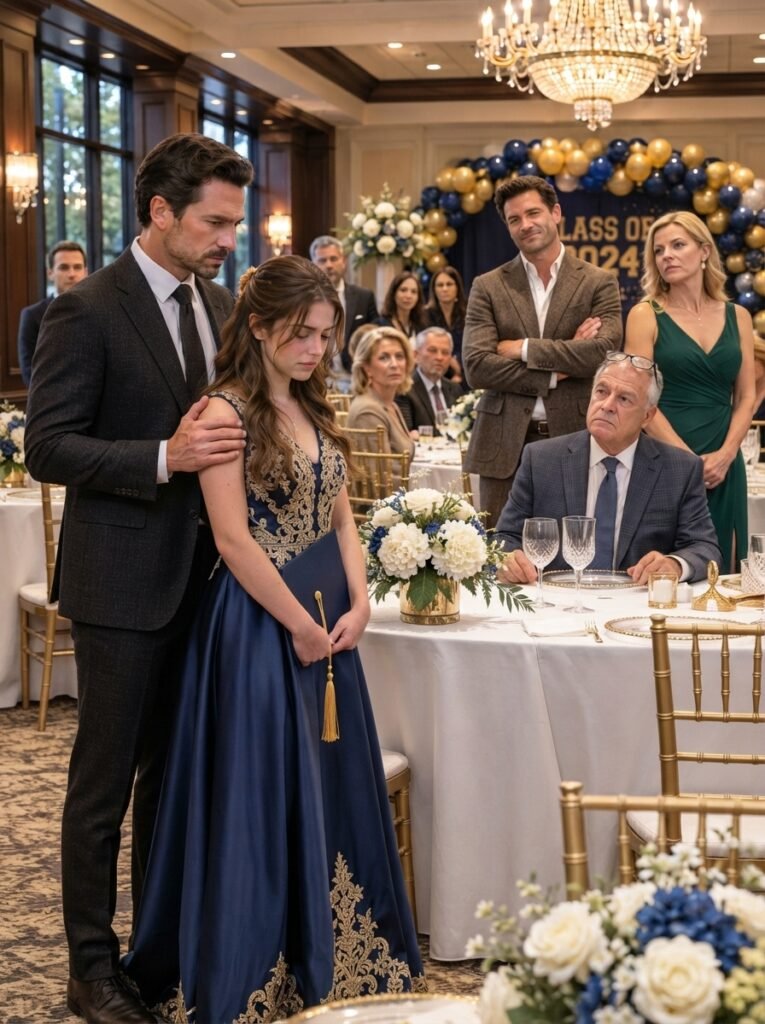
The night my family stole my daughter’s graduation celebration, my father called her a disappointment, my brother called her a waste of money, and forty relatives watched an eighteen-year-old girl apologize for taking up space.
Three hours later, my phone revealed that the dinner wasn’t the only thing they had stolen.
And eleven months after that, the man who had spent my entire life telling me I would never amount to anything stood in a courtroom, staring at a document that proved the granddaughter he’d spent eighteen years treating like an embarrassment was the legal owner of everything he had built his reputation upon.
But that wasn’t the biggest secret.
The biggest secret had been buried for ten years.
And it involved my dead wife.
My name is Fletcher Yates.
I’m forty-six years old, a widower, and the father of a girl named Iris.
For most of my adult life, I thought the worst thing a family could do was stop loving someone.
I was wrong.
Sometimes, the cruelest people are the ones who keep you close enough to use you, while making sure you never realize what you’re worth.
I learned that lesson at the Elmwood Grill on a warm Friday evening in June.
And it began with a banner.
CONGRATS, MASON.
Five feet tall.
Gold letters.
Navy-blue background.
Hanging directly behind the head table at the graduation dinner I had paid $4,200 to organize for my daughter.
I stood in the doorway, staring at those letters, while Iris slowly stopped walking beside me.
“Dad?”
Her voice was so quiet I almost didn’t hear it.
“Is this the right room?”
I checked the reservation confirmation on my phone.
Elmwood Grill.
Private banquet room.
Forty guests.
Friday, June 16.
Six-thirty p.m.
Everything matched.
Except the name.
“Maybe there’s been a mistake,” I said.
I wish I hadn’t said that.
Because Iris believed me.
For approximately seven seconds, she believed the adults in her family couldn’t possibly have done something so deliberately cruel.
Then my father called out from the head table.
“Fletcher!
You’re late.”
He was seated beneath the banner, wearing a charcoal suit and holding a glass of expensive red wine.
His reading glasses rested on top of his head.
My father, Harold Yates, had built his entire personality around being the most important man in every room he entered.
At seventy-one, he still believed respect was something people owed him automatically.
I approached the table.
“Dad, what’s with the banner?”
He glanced behind himself.
“What about it?”
“It says Mason.”
“That’s right.”
“This is Iris’s graduation dinner.”
He took another sip of wine.
Then he said the words I would hear in my nightmares for weeks.
“Your daughter was never the guest of honor.”
I stared at him.
“What did you just say?”
He sighed as though I were an employee who couldn’t understand simple instructions.
“Don’t make this difficult, Fletcher.
Iris is a nice girl, but Mason is graduating from Ridgemont University.
That’s an accomplishment worth recognizing.”
My daughter had just graduated from high school with a 3.6 GPA.
She had earned a partial academic scholarship to Wakefield State.
She had spent ten years growing up without her mother.
And in a few months, she would become the first person in our immediate household to attend college without taking on a mountain of debt.
I was incredibly proud of her.
Apparently, my father wasn’t.
“Dad,” I said slowly, “I paid for this dinner.”
“I know.”
“Four thousand, two hundred dollars.”
“I know how much money you gave Sterling.”
“Then why is Mason’s name on everything?”
My father set down his wineglass.
“Because your brother and I decided the money would be better spent celebrating someone with a real future.”
I heard a small sound behind me.
Iris had lowered her eyes.
That was when my younger brother appeared.
Sterling Yates, forty-three years old, immaculate haircut, expensive watch, and the permanent expression of a man who believed the world existed to admire him.
He had inherited our father’s confidence without inheriting our grandmother’s work ethic.
“What’s the problem?” he asked.
I held up the printed program.
The front featured a photograph of his son, Mason, wearing a navy blazer.
Underneath it read:
Celebrating Mason Yates — Ridgemont University, Class of 2028.
There wasn’t a single photograph of Iris inside.
“Explain this,” I said.
Sterling smiled.
“Oh, come on, Fletcher.
Don’t pretend you don’t understand.”
“Understand what?”
“That you wasted four thousand dollars trying to make your daughter feel like something she’s not.”
The room grew quieter.
Sterling noticed.
And instead of lowering his voice, he raised it.
“Mason is graduating from a prestigious university.
Iris is going to some commuter school twenty minutes from that rental you’ve been living in since Elise died.”
I felt my face turn hot.
He had brought my dead wife into it.
For no reason other than to hurt us.
Elise had been gone for ten years.
Ten years of empty chairs at school concerts.
Ten years of birthdays without her laugh.
Ten years of watching Iris grow into a young woman who increasingly resembled the person I missed most in the world.
Sterling knew all of that.
He also knew I had spent those ten years working extra shifts as a commercial building maintenance supervisor, making sure Iris never had to worry about electricity, groceries, or school supplies.
We lived in a rental because I had chosen stability over appearances.
Sterling considered that a personal failure.
“You’re going to embarrass yourself,” he said.
“Just sit down and eat.
Nobody’s kicking you out.”
He gestured toward the banner.
“But that stays.”
I looked around.
Forty guests.
My aunts, uncles, cousins, neighbors, and Sterling’s business associates.
Fourteen of them were close enough to hear every word.
Not one stood up.
Not one told Sterling to stop.
My sister-in-law, Paige, glanced at Iris and then looked away.
At the far end of the room, Mason stood beside several friends, holding a drink.
He wasn’t laughing, but he wasn’t intervening either.
Then I felt Iris touch my sleeve.
“Dad?”
I turned.
She was still holding her graduation cap.
Her eyes were bright, but she hadn’t cried.
“It’s okay.
I can sit anywhere.”
Those six words hurt more than anything my father or brother had said.
Because I knew exactly where she’d learned them.
When Iris was twelve, my father had taken Mason to a weeklong baseball camp in Florida.
Iris wanted to go too.
Grandpa told her the trip was for boys.
At fourteen, she watched Sterling introduce Mason at a church career event as “the next Yates who will make something of himself.”
Nobody introduced her.
At sixteen, our family Christmas card featured Mason’s varsity photograph.
Iris wasn’t even mentioned.
Every time, I made excuses.
Grandpa was old-fashioned.
Sterling could be thoughtless.
The family didn’t mean anything by it.
I told myself keeping the peace was the responsible thing to do.
But standing in that restaurant, watching my daughter search for the least inconvenient chair, I finally understood something terrible.
I hadn’t been keeping the peace.
I’d been teaching my daughter that other people’s cruelty was something she was supposed to tolerate.
In my jacket pocket was a little velvet pouch.
Inside rested Elise’s cameo pendant, hanging from a thin silver chain.
Her mother had given it to her for her own graduation.
Elise wore it at our wedding.
She wore it the day Iris was born.
I’d brought it because I planned to give it to Iris after dinner, during a speech about the woman who would have been proudest of her.
Instead, I placed my hand on Iris’s shoulder.
“Come on, sweetheart.”
“Where are we going?”
“Home.”
“But Dad—”
“Nobody gets to make you feel unwelcome at a celebration meant for you.”
We walked out.
I didn’t raise my voice.
I didn’t throw anything.
I didn’t threaten anyone.
And that silence apparently frightened my family more than any argument could have.
Because the moment we reached the parking lot, my phone started ringing.
Sterling.
Then my father.
Then Sterling again.
I ignored them.
Iris climbed into the passenger seat and carefully folded her hands over her graduation cap.
“Are you mad at me?” she whispered.
I turned toward her.
“What?”
“For making you leave.”
My throat tightened.
“Oh, sweetheart.”
She stared down at her hands.
“I know Grandpa likes Mason more.
I just thought tonight might be different.”
I reached across the center console and took her hand.
“You didn’t make us leave.
I did.
And I should have done it a long time ago.”
She nodded, but I could tell she wasn’t convinced.
Then I remembered a name.
Tanya Cho.
The event manager at Elmwood Grill.
Before Sterling offered to handle the arrangements, Tanya and I had discussed the reservation directly.
She’d been professional, friendly, and extraordinarily patient while I tried to choose between three different catering packages.
I still had her number.
I called.
She answered on the third ring.
“Mr.
Yates?”
“Hi, Tanya.
This is Fletcher Yates.”
A pause.
Then:
“Mr.
Yates, I was actually going to call you.”
Something in her voice made me sit straighter.
“Why?”
“Because I wasn’t comfortable with what happened to your reservation.”
My fingers tightened around the steering wheel.
“What happened?”
“Your brother came in two weeks ago.
He changed the guest of honor, the printed programs, the seating arrangements, and the decorations.”
“Without asking me?”
“I asked him whether you’d approved everything.”
“And?”
“He told me it was a family decision.”
I shut my eyes.
Then Tanya continued.
“He also sent an email explaining that the original reservation under your daughter’s name was a scheduling error.”
A scheduling error.
That’s what Sterling had called my daughter.
I looked at Iris, who was quietly pulling the tassel from her graduation cap.
“Tanya, how much did my brother actually pay the restaurant?”
Another pause.
I heard a keyboard clicking.
“Two thousand, one hundred dollars.”
I went still.
“That’s impossible.”
“I’m looking at the invoice right now, Mr.
Yates.”
“I gave Sterling forty-two hundred.”
“I understand.”
“Then where’s the other half?”
Tanya lowered her voice.
“That’s not the only problem.”
My pulse began hammering.
“What do you mean?”
“Your brother submitted a reimbursement request through a private family education fund.
The supporting paperwork bears your signature.”
I stared through the windshield.
“I didn’t sign anything.”
“I was afraid you were going to say that.”
“How much was the reimbursement?”
“Four thousand, two hundred dollars.”
I swallowed.
Sterling hadn’t simply stolen half my money.
He had apparently tried to collect the entire amount a second time.
Using my name.
And then Tanya said something even worse.
“The request was approved by someone named Harold Yates.”
My father.
Of course.
I should have known.
But what Tanya said next made my blood turn cold.
“Mr.
Yates, the reimbursement came from an account labeled the Elise Yates Memorial Education Fund.”
I couldn’t speak.
Elise.
My dead wife’s name.
Attached to money I had never known existed.
“Can you send me the paperwork?”
I finally asked.
“Yes.
I saved everything.”
I looked at the digital clock.
11:41 p.m.
Somehow, nearly five hours had passed since we’d left the restaurant.
Iris and I had gone home, eaten takeout in silence, and then I’d called Tanya again to discuss what she’d discovered during her review of the evening’s records.
“One more thing,” I said.
“Can you confirm the booking changes in the family event chat?
The one Sterling added you to when he was arranging the dinner?”
“With your permission?”
“Please.
Just the restaurant’s original confirmation, the amount actually paid, and the email changing the honoree.”
“I can do that.”
At 11:47 p.m., Tanya posted a single screenshot showing the original reservation, Sterling’s change request, and an email approving the alterations under my name.
The attached message was short.
For the record, Elmwood Grill originally booked this event as Iris Yates’s graduation celebration.
The honoree was subsequently changed at the request of Sterling Yates.
The restaurant received $2,100 for the event.
The family chat erupted.
Sterling called seven times.
Paige sent three messages and deleted them.
My aunt Margaret wrote:
Fletcher, what does this mean?
Then my father appeared.
HAROLD YATES: DELETE THAT SCREENSHOT IMMEDIATELY.
I stared at those words.
He wasn’t apologizing.
He wasn’t asking about Iris.
He was trying to erase the evidence.
Then another message arrived.
HAROLD YATES: YOU HAVE NO IDEA WHAT YOU’RE INTERFERING WITH.
I read that sentence three times.
Because for the first time in my life, my father sounded afraid.
Not angry.
Afraid.
And when Tanya called me back a few minutes later, I finally began to understand why.
“Mr.
Yates,” she whispered, “I’ve found another file attached to the reimbursement request.”
“What kind of file?”
“A document authorizing continued management of an education trust.”
I frowned.
“What education trust?”
She hesitated.
“I think you need an attorney.”
Then she said the sentence that changed the direction of my entire life.
“Because according to this document, your daughter inherited an interest in a company eleven years ago.”
I didn’t sleep that night.
I sat at the kitchen table until sunrise, staring at three documents Tanya had forwarded privately.
The first was Sterling’s altered banquet order.
The second was the reimbursement request.
The third was a scanned page titled:
BENEFICIARY ACKNOWLEDGMENT AND CONTINUED MANAGEMENT AUTHORIZATION.
My name appeared at the bottom.
Fletcher Daniel Yates.
The signature looked remarkably convincing.
But it wasn’t mine.
Worse, the document identified Iris as a beneficiary of something called the Evelyn Yates Family Trust.
Evelyn was my grandmother.
She had died eleven years earlier.
She’d been a formidable woman, sharp-minded and stubborn, who spent most of her life building up a modest collection of commercial properties.
I remembered her hands smelling of lavender soap and fresh bread.
I remembered her sitting on her back porch, teaching Iris how to identify birds by their songs.
I remembered her telling my daughter:
“Never confuse being quiet with being weak, little bird.”
What I didn’t remember was any trust.
When Grandma died, my father told everyone that her properties and business interests had passed into the family company.
He said the estate was complicated.
He said there was nothing the younger generation needed to worry about.
I believed him.
I’d been too busy caring for Elise, who died the following year, to question the paperwork.
Now I wondered what else I’d allowed my father to explain away.
At six-thirty that morning, Iris found me sitting beneath the kitchen light.
She wore an old gray sweatshirt that had belonged to Elise.
Her hair was tangled from sleep.
“Dad?”
I looked up.
“Hey, sweetheart.”
“Did you sleep?”
“A little.”
She glanced at the documents spread across the table.
“Is Uncle Sterling in trouble?”
I thought about how to answer.
“I think he may have done something very serious.”
She sat opposite me.
For a while, neither of us spoke.
Then she reached into her sweatshirt pocket and pulled out a folded envelope.
“I think you should see this.”
It was addressed to Iris Yates.
The return address belonged to a trust administration company in Richmond.
The postmark was eleven days old.
“Where did you get this?”
“It came a few days after my birthday.”
Iris had turned eighteen less than two weeks before graduation.
“Why didn’t you tell me?”
She looked embarrassed.
“Grandpa said it was just business paperwork.”
My stomach tightened.
“He knew about it?”
“He was here when the mail came.
He told me not to worry about it because the family handled those things.”
She hesitated.
“He said if I started asking questions about money, everybody would think I was greedy.”
I stared at her.
“Did you open it?”
She shook her head.
“I didn’t want to upset anyone.”
I unfolded the envelope.
Inside was a notice informing Iris that she had reached the age specified for certain beneficiary rights under the Evelyn Yates Family Trust.
There was a telephone number.
A reference number.
And one sentence highlighted near the bottom.
“Upon attainment of age eighteen, the beneficiary is entitled to receive a full accounting of all trust assets, transactions, distributions, and outstanding obligations.”
I read it twice.
Then I looked at my daughter.
“Iris, honey, you haven’t done anything wrong.”
“But Grandpa said—”
“Grandpa doesn’t get to decide whether you have rights.”
She lowered her eyes.
Then, after a long silence, she asked:
“Does this have something to do with Mom?”
I looked at the reimbursement form.
The name of Elise’s memorial fund seemed to stare back at me.
“I don’t know yet.”
But I was going to find out.
For Iris.
For Elise.
And for every single year I had let my family tell us we weren’t worth fighting for.
At eight o’clock, I called Naomi Brooks.
Naomi had been one of Elise’s closest friends.
She was also an attorney who specialized in estates, trusts, and business disputes.
We hadn’t spoken in nearly a year.
When she answered, she sounded surprised.
“Fletcher?
Everything okay?”
“No.”
Something in my voice made her stop asking casual questions.
“Tell me.”
I explained the dinner.
The missing money.
The forged signature.
The trust notice.
And my father’s involvement.
Naomi listened without interrupting.
When I finished, there was a long silence.
Then she said:
“Bring everything to my office.
And Fletcher?”
“Yeah?”
“Don’t sign anything your family sends you.
Not even a birthday card.”
By nine-thirty, Iris and I were sitting across from Naomi in a conference room that smelled faintly of coffee and polished wood.
Naomi wore a cream-colored blouse and had a pair of reading glasses hanging from a chain around her neck.
She looked through the documents carefully.
She examined Sterling’s email.
She compared the restaurant paperwork with the trust notice.
Then she turned to the document bearing my signature.
“Did you authorize this?”
“No.”
“Did Iris authorize anything?”
“No.”
Naomi nodded.
“Good.
Then we start by preserving evidence.
No more emotional phone conversations with Sterling or your father.
Communicate in writing.”
She opened her laptop.
“What do you know about the Yates family business?”
I shrugged.
“Grandma Evelyn owned some commercial buildings.
Dad managed them.
I always assumed he inherited everything when she died.”
Naomi looked at me over her glasses.
“Did you ever see her will?”
“No.”
“Her trust agreement?”
“No.”
“Any estate accounting?”
“No.”
She leaned back.
“Fletcher, I need you to understand something.
People often assume that the relative who manages a family business also owns it.”
“Doesn’t he?”
“Not necessarily.”
She typed for several minutes.
Then she rotated the laptop toward me.
On the screen was a public business record.
YATES PROPERTY GROUP, LLC.
Below it was a list of properties and registered company information.
I recognized the names.
A small shopping center on Franklin Avenue.
Two office buildings near the interstate.
An old brick textile mill on Maple Street.
The properties my father liked to describe as the foundation of his success.
Naomi pointed to an older filing.
“Your grandmother was the majority owner of this company.”
“I know.”
“Do you know what happened to her ownership interest after she died?”
I shook my head.
“Neither do I.
Not yet.
But I can tell you the estate records identify an irrevocable trust, and the trustee records point to your father.”
I frowned.
“What does that mean?”
“It means someone has been managing property for the benefit of people who may not have been told what belonged to them.”
I felt my hands go cold.
Naomi looked at Iris.
“Sweetheart, did your grandmother ever say anything to you about the family business?”
Iris hesitated.
“She used to take me to the mill.”
“The old building on Maple Street?”
Iris nodded.
“She told me it used to be beautiful.
She said people had forgotten what it could become.”
Naomi’s expression changed.
“Did she say anything else?”
Iris stared at the table for a moment.
“She told me someday I’d have to make a decision about it.”
My heart skipped.
“What decision?”
“I don’t know.
I was little.”
She looked embarrassed.
“I thought she meant deciding what color to paint it.”
Naomi went very still.
Then she closed the laptop.
“Fletcher, I’m going to request the complete trust agreement and the annual accountings.
Iris has the right to request them directly now that she’s eighteen.
We’ll also examine the company’s ownership records.”
“How long will that take?”
“Some records may come quickly.
Others won’t.”
She paused.
“But I want you to be prepared for the possibility that this isn’t just about four thousand dollars.”
I looked at Iris.
She was sitting so quietly that I almost forgot she was there.
For years, my father had treated her as if she were a stranger who had wandered into the wrong family.
Now an attorney was suggesting she might have a legal interest in the very business he bragged about owning.
And the thought terrified me.
Not because of the money.
Because I understood my father well enough to know what he’d do if someone threatened his control.
He wouldn’t apologize.
He would attack.
And this time, his target wouldn’t just be me.
It would be Iris.
My father called at eleven-seventeen that morning.
I didn’t answer.
He left a voicemail.
“Fletcher, you’ve created quite a mess.
Your brother is embarrassed, the restaurant is upset, and people are asking questions that don’t concern them.
You will come to my house this afternoon and straighten this out.”
A pause.
“And bring Iris.
She needs to learn that family matters stay inside the family.”
I played it for Naomi.
She listened with an expression I’d never seen before.
“Save that.”
Then she asked whether my father had ever used money or business obligations to pressure me.
I almost laughed.
“Which time?”
I told her about Sterling’s truck.
Two years earlier, Sterling had needed a $34,000 commercial vehicle loan to expand his landscaping company.
His credit wasn’t strong enough.
My father called me.
“Sterling needs help.
You’re family.”
I co-signed.
Sterling promised I would never have to cover a payment.
He mostly kept that promise, although he’d fallen behind twice and I’d paid to bring the loan current.
The balance was still approximately $22,000.
Naomi explained that co-signing meant I couldn’t simply walk away from the debt.
“You remain legally responsible unless the lender releases you or the loan is paid off,” she said.
“We’ll get the account records and make sure you aren’t being kept in the dark.”
I nodded.
Then I told her something else.
For years, I had been contributing money to a small local education charity that my father said honored Elise.
Sometimes fifty dollars.
Sometimes a hundred.
On the anniversary of her death, I’d usually sent five hundred.
My father had always told me the donations helped students who had lost a parent.
Naomi looked up sharply.
“What charity?”
“The Elise Yates Memorial Education Fund.”
She stared at me.
“Do you have receipts?”
“Probably.
Dad used to send letters.”
“Find them.”
“Why?”
“Because a memorial fund established in your wife’s name should have records of what it received and how the money was used.
Especially if someone is submitting reimbursement requests through it.”
My stomach dropped.
For ten years, I’d been donating money in Elise’s memory.
And now it appeared my brother had tried to use that fund to pay for a dinner celebrating his own son.
I suddenly remembered something Elise had once told me.
We were sitting in our kitchen, months before she died.
Sterling had just asked for another loan.
I’d been irritated, but Elise said nothing until Sterling left.
Then she looked at me and asked:
“Fletcher, why do you always have to prove you belong to your own family?”
At the time, I’d laughed.
“They’re my family.
Of course I belong.”
She’d reached across the table and touched my hand.
“Then they should never make you feel like belonging has a price.”
I hadn’t understood.
Or maybe I’d understood and refused to admit it.
Now, ten years later, her words returned with a force that almost knocked the breath from my chest.
By Sunday afternoon, the story had spread through our entire extended family.
Sterling had posted a carefully worded statement online.
He claimed Iris’s graduation dinner had been a “family misunderstanding.”
He said I’d arrived unexpectedly, caused a scene, and walked out because I couldn’t accept Mason’s success.
My father posted underneath:
Some people think money entitles them to control how everyone celebrates.
I read the comments.
Aunt Margaret defended me.
Two cousins asked why the event had been changed without the person paying for it agreeing.
Others blamed me for bringing financial matters into public view.
Then Paige posted:
There are two sides to every story.
I put the phone down.
Iris was sitting on the couch with her laptop open.
She’d been trying to finish her college housing application.
“Are people saying things about us?” she asked.
“Some.”
“Because of the dinner?”
“Yes.”
She stared at the screen.
“Would it be easier if we just stopped talking about it?”
I sat beside her.
“No.”
“But Uncle Sterling says—”
“I know what Sterling says.”
She lowered her voice.
“I don’t want everyone fighting.”
I thought about that for a moment.
“Neither do I.”
“Then why can’t we just leave it alone?”
I looked at her.
“Because people who do something wrong shouldn’t get to decide that everybody else has to pretend it never happened.”
She was quiet.
Then she asked:
“Did Mom ever fight with Grandpa?”
The question surprised me.
“Sometimes.”
“About what?”
I smiled sadly.
“Mostly about how he treated people.”
Iris traced a finger over the edge of her laptop.
“Do you think she would’ve been embarrassed at the restaurant?”
I felt a sharp ache in my chest.
“No.”
“Not even a little?”
“Your mother would have been furious.”
That made Iris smile.
A tiny smile.
The first one I’d seen since Friday.
I reached into my pocket and took out the velvet pouch.
“I was supposed to give you this after dinner.”
She looked at it.
“What’s that?”
“Something your mom wanted you to have someday.”
I opened the pouch.
The cameo pendant caught the afternoon light.
Iris stared.
“Mom’s necklace?”
I nodded.
“Her mother gave it to her at graduation.”
Iris touched the carved ivory-colored cameo with one finger.
“She wore this in the picture by your bed.”
“Yes.”
I lifted the chain.
“May I?”
She turned around.
I fastened it behind her neck.
When she faced me again, tears were running down her cheeks.
She touched the pendant.
“Do you think she’d be proud of me?”
I pulled her into my arms.
“Oh, Iris.”
I held her while she cried.
“Your mother would be proud of the person you are even if you never earned another grade, won another award, or received another scholarship.”
She cried harder.
And for the first time since the restaurant, she stopped trying to be brave.
That was the moment I promised myself something.
No matter what the trust documents revealed, no matter how much money was involved, I would not let this become another story about adults fighting over wealth while Iris disappeared into the background.
She was the reason I was fighting.
Not a prize to be won.
Not a weapon against my father.
My daughter.
And she deserved to decide what her future looked like.
On Monday morning, I received a text from Mason.
Uncle Fletcher, can we talk?
Please don’t tell Dad.
I stared at it.
Mason was twenty-two.
He’d always been polite to me, although increasingly distant as he grew older.
He had enjoyed every advantage my family had denied Iris.
Private tutoring.
Baseball camps.
Expensive clothes.
A college education that, according to Sterling, had been paid for through “family planning.”
I’d never resented Mason for those things.
But I had resented the silence at the restaurant.
I answered:
Where?
Twenty minutes later, he sent an address.
A coffee shop near Ridgemont’s downtown campus.
I went alone.
Mason was waiting at a corner table, wearing jeans and a faded university sweatshirt.
Without his father standing beside him, he looked younger.
Nervous.
Almost frightened.
“Thanks for coming,” he said.
I sat.
“What do you want, Mason?”
He rubbed his palms against his jeans.
“I owe Iris an apology.”
“Yes, you do.”
He swallowed.
“I knew they were changing the dinner.”
I felt something tighten in my chest.
“How long?”
“About two weeks.”
“Why didn’t you tell us?”
He stared at the table.
“Grandpa said you’d understand eventually.”
I waited.
Mason looked up.
“He said the dinner wasn’t really about graduation.”
My heart began beating faster.
“What was it about?”
Mason glanced around the coffee shop.
“Grandpa’s been trying to refinance the family properties.”
I frowned.
“What does that have to do with your graduation?”
“He’s been telling investors I’m going to take over the company.”
“Are you?”
“That’s what he says.”
Mason took a breath.
“There’s a group interested in financing a major redevelopment project.
Grandpa wanted them to see that the company had a younger successor.”
I thought about the banquet.
The expensive decorations.
The photographs.
The printed programs.
And the group of unfamiliar men I’d noticed standing near the bar.
“Those weren’t all family guests, were they?”
Mason shook his head.
“Some were business people.”
A terrible suspicion began forming.
“Your grandfather invited potential investors to a dinner I paid for, changed the guest of honor, and used it to introduce you as his successor?”
Mason nodded.
“That’s what I think.”
I sat back.
The humiliation hadn’t been random.
It had been useful.
My father and brother had turned Iris’s celebration into a business presentation.
But why?
Mason swallowed.
“There’s something else.”
I waited.
“A few days before the dinner, Grandpa asked me to sign some papers.”
“What papers?”
“Something about voting rights.
He said Grandma’s trust was old and needed to be updated.”
My mouth went dry.
“Did you sign them?”
“No.”
“Why not?”
“Because I saw Iris’s name.”
I stopped breathing for a second.
Mason reached into his backpack and pulled out a folder.
Inside was a photocopy of an internal company memorandum.
Across the top were the words:
PROPOSED TRANSITION OF MANAGEMENT AUTHORITY.
Below that were two names.
Mason Yates.
Iris Yates.
Beside Mason’s name was a percentage.
9%.
Beside Iris’s name was another.
51%.
I stared.
“Where did you get this?”
“Grandpa left it on his desk.
I copied it because I wanted to know why he kept saying I’d inherit everything.”
My hands were trembling.
“Did you ask him?”
Mason nodded.
“What did he say?”
Mason looked ashamed.
“He said Grandma had made a mistake before she died.”
I stared at him.
“What kind of mistake?”
He looked directly at me.
“He said she left control of the company to Iris.”
For a moment, the coffee shop seemed to disappear.
I heard the espresso machine.
The clatter of dishes.
Someone laughing near the door.
But those sounds seemed very far away.
“Fifty-one percent?”
I whispered.
Mason nodded.
“Grandpa said it wasn’t fair.
He said Iris was too young and didn’t know anything about business.”
“She was seven when Grandma died.”
“I know.”
He hesitated.
“And he said he needed to fix it before she turned eighteen.”
The words hit me like ice water.
Before she turned eighteen.
Iris had turned eighteen eleven days before graduation.
The forged paperwork had been prepared shortly before her birthday.
The dinner had been changed two weeks earlier.
Everything was connected.
My father wasn’t simply favoring one grandchild over another.
He was trying to preserve control over assets my grandmother had left to my daughter.
Mason pushed another page toward me.
“This is why I wanted to talk.”
It was a photograph of a property redevelopment proposal.
At the bottom was a handwritten note:
Obtain Fletcher witness acknowledgment and Iris beneficiary election before June 16.
Below it was my father’s handwriting.
“No delays.
Once the celebration is documented, proceed.”
I looked up.
“Documented?”
Mason nodded.
“Grandpa wanted photographs of the dinner for the investor presentation.
He wanted everyone to see me as the family successor.”
I felt sick.
“Did he know Iris would be there?”
“Of course.”
“And he still did it?”
Mason’s face crumpled.
“He said she’d get over it.”
For the first time, I saw genuine shame in his eyes.
“I should’ve stopped them, Uncle Fletcher.”
“Yes,” I said.
He nodded miserably.
“I know.”
I studied him.
He looked nothing like Sterling in that moment.
There was no arrogance.
No smug smile.
Just a young man who had finally understood that enjoying the benefits of cruelty didn’t make him innocent.
“Why are you telling me now?”
I asked.
Mason swallowed.
“Because Grandpa told me something Friday night after you left.”
“What?”
“He said Iris would never know what she almost had.”
The hair rose on my arms.
Mason reached into his bag again.
This time he handed me a small flash drive.
“I copied some files from the office computer.
I haven’t opened all of them.
I don’t know what’s important.”
“Why give them to me?”
He looked down.
“Because I don’t want to become the kind of man my father is.”
I stared at him for a long moment.
Then I said:
“Giving me those files doesn’t erase what happened.”
“I know.”
“But it might be the first decent thing you’ve done about it.”
Mason nodded.
His eyes were wet.
Before I left, he grabbed my sleeve.
“Uncle Fletcher?”
“Yeah?”
“There’s one more thing.”
I waited.
“Grandpa said if Iris found out about the trust, she’d probably blame her mother.”
I frowned.
“Why would she blame Elise?”
Mason shook his head.
“I don’t know.
But he sounded absolutely certain.”
Naomi called me that evening.
Her voice was unusually restrained.
“Fletcher, are you sitting down?”
I looked at the folder Mason had given me.
“Should I be?”
“Yes.”
I sat.
“Tell me.”
“I’ve received the certified trust agreement from the original custodian.
Your grandmother left a sixty-percent ownership interest in Yates Property Group to a trust for her grandchildren.”
I held my breath.
“How was it divided?”
“Fifty-one percentage points of the company to Iris.
Nine to Mason.”
My eyes filled.
For eleven years, my father had acted as if Mason were the rightful heir to everything.
For eleven years, he’d treated Iris like an unwanted obligation.
And all that time, Grandma Evelyn had made Iris the majority beneficiary of the family business.
Naomi continued.
“Your father held his own forty-percent interest and served as trustee over the inherited shares.
Under the trust terms, Iris gained the right to request an accounting at eighteen, along with the scheduled release of her ownership interest.”
“Then why hasn’t anything been transferred?”
“That’s the question.
The records we have show your father submitted documents seeking to delay the release of her interest.”
“The forged documents?”
“Possibly connected.
We’re still comparing them.”
I rubbed my forehead.
“How much is the company worth?”
Naomi paused.
“The available records list several commercial properties.
Based on the last financial statements, we’re potentially talking about millions in net value, but I won’t give you an exact figure until a qualified accountant verifies the debt and ownership structure.”
I barely heard the last part.
Millions.
Iris had been humiliated over a dinner costing $4,200 while unknowingly holding an inheritance worth far more than anyone had ever told us.
Then Naomi said:
“There’s something else.”
I closed my eyes.
“Of course there is.”
“Your grandmother originally named two people to oversee Iris’s interests.”
“Two trustees?”
“Your father was trustee.
The other person had independent oversight authority under the trust agreement.”
“Who?”
Naomi hesitated.
“Elise.”
My breath caught.
My wife.
“Your grandmother trusted Elise to review major transactions affecting Iris’s inheritance,” Naomi continued.
“After Elise died, that oversight became ineffective.
Your father appears to have continued managing the assets without appointing the replacement required by the trust.”
I stared at the wall.
“Why didn’t he appoint someone?”
Naomi didn’t answer immediately.
Then she said:
“Fletcher, I think your wife may have been asking questions about the company’s finances before she died.”
The room tilted.
“What questions?”
“I found a reference to a request she made for an independent audit.”
I gripped the phone.
“When?”
Another pause.
“Three days before her accident.”
For a moment, I couldn’t breathe.
Ten years ago, Elise had died in a highway collision on a rainy Tuesday afternoon.
She’d been thirty-six.
I remembered the police officer at my front door.
The hospital corridor.
The sound of my mother’s voice breaking when she told Iris that Mommy wasn’t coming home.
I had spent a decade believing Elise had been driving to an ordinary appointment when another driver lost control on the wet road.
Now I learned that, three days earlier, she had been investigating the very business my father had used to humiliate our daughter.
“Naomi,” I whispered, “what exactly was Elise trying to find?”
Her answer came quietly.
“I think she suspected someone was taking money from Iris’s trust.”
For the next four days, I moved through life as if I were standing outside my own body.
I went to work.
I checked on Iris.
I answered ordinary questions from coworkers about maintenance schedules and replacement air-conditioning units.
But underneath everything was one thought.
Elise had known.
Before she died, she’d suspected my father was stealing from our daughter.
And somehow, I had spent ten years knowing nothing.
On Wednesday morning, Naomi called.
“We need to act quickly.”
“What’s happened?”
“Your father has scheduled a transaction involving the Maple Street property.”
“The mill?”
“Yes.
A redevelopment company has proposed buying it.
The preliminary agreement is worth approximately three million dollars.”
I sat down.
“Can he sell it?”
“That depends on the company’s governing agreement and the voting authority over Iris’s interest.
We’re examining that now.
But the documents your father supplied to the proposed buyer appear to misrepresent who controls the company.”
I thought about the banquet.
Mason’s photograph.
The business associates.
The absurd banner.
My father had been trying to construct the appearance of a smooth family succession.
He wanted potential investors to believe Mason was taking over.
He wanted Iris to remain invisible.
And he needed signatures.
Signatures that apparently didn’t exist.
So he created them.
Naomi continued.
“We’re filing for emergency relief to prevent the transaction from closing while the ownership and alleged forgery are investigated.”
“Can that happen?”
“We can ask the court.
We still have to prove our case.”
“Do whatever you need to do.”
She paused.
“Fletcher, there may be a substantial amount of money missing.”
“How much?”
“We don’t know yet.
But the preliminary bank records don’t reconcile with the distributions reported to the beneficiaries.”
I rubbed my eyes.
“Are we talking thousands?”
“Possibly much more.”
I looked through the kitchen doorway.
Iris was sitting on the floor beside the couch, sorting old photographs of Elise.
She had no idea what was happening.
Or maybe she did.
Maybe she’d understood far more than I’d ever given her credit for.
I lowered my voice.
“Naomi, I don’t care if she gets fifty dollars or five million.
I just want my daughter to know the truth.”
“I know.”
Then Naomi said something I didn’t expect.
“There’s a woman who wants to speak with us.”
“Who?”
“Paige.”
Sterling’s wife.
The same woman who had stood near the bar during the graduation dinner.
The same woman who had looked away while Iris was humiliated.
I almost said no.
Then Naomi continued.
“She says she has evidence.”
Paige arrived at Naomi’s office carrying an oversized purse and looking as though she hadn’t slept in days.
She wore no makeup.
Her hair was tied back.
For once, she wasn’t wearing the polished expression she’d perfected over two decades of family gatherings.
She sat down opposite us.
“I need you to know something,” she said.
I folded my arms.
“Go ahead.”
“I didn’t know about the trust when Sterling and Harold started planning the dinner.”
I stared at her.
“But you knew they were changing it.”
She nodded.
“Yes.”
“And you said nothing.”
Tears filled her eyes.
“Yes.”
I leaned forward.
“Do you have any idea what you did to Iris?”
Paige looked down.
“I saw her face when she walked into that room.”
“Then you know.”
She wiped her cheeks.
“I’m not asking you to forgive me.”
“Good.”
Naomi gently interrupted.
“Paige, you said you brought records.”
Paige opened her purse.
Inside was a thick folder containing photocopies, bank statements, and handwritten notes.
She placed them on the table.
“Sterling keeps copies of everything because Harold taught him never to trust anyone.”
She gave a bitter laugh.
“Turns out he should’ve taken his own advice.”
Naomi began examining the pages.
Paige continued.
“Sterling’s landscaping company has been struggling for years.
The expensive equipment, the new trucks, the commercial contracts—most of it is financed.”
I nodded.
I already knew about the truck loan.
“What I didn’t know,” Paige said, “was that Harold had been moving money into Sterling’s business through accounts connected to the family properties.”
Naomi looked up.
“Did Sterling tell you that?”
“No.
I found the records when our accountant asked about some unexplained transfers.”
She pointed to a statement.
“Sterling said they were advances against his future inheritance.”
“Whose inheritance?”
I asked.
Paige couldn’t meet my eyes.
“Apparently, Iris’s.”
I felt a wave of nausea.
Naomi examined another page.
“These transfers need to be verified.
Some may have legitimate explanations, but the descriptions are concerning.”
Paige nodded.
“There’s more.”
She slid a small envelope across the table.
Inside were copies of several documents bearing my signature.
I recognized one immediately.
The truck loan.
Sterling had photographed the signed paperwork two years earlier.
He’d kept the image.
Then he’d used it as a source for copying my signature onto other forms.
“Sterling said Harold needed the signatures to make the new arrangement look consistent with older approvals,” Paige whispered.
I stared at the pages.
My name.
My signature.
My supposed consent.
Again and again.
My family had turned the fact that I trusted them into a tool for stealing from my daughter.
Naomi carefully collected the documents.
“Paige, did you personally see any signatures being forged?”
Paige hesitated.
“Yes.”
“By whom?”
She looked at me.
“Sterling.”
My hands curled into fists.
“And Harold was there?”
“Sometimes.”
“Did he know?”
Paige’s voice broke.
“He told Sterling that Fletcher would never notice.
He said you signed whatever the family needed because you wanted your father’s approval.”
I looked away.
That one landed harder than I wanted it to.
Because it was true.
For years, I’d wanted my father to look at me the way he looked at Sterling.
I’d wanted him to say he was proud.
Instead, I’d made myself useful enough to be exploited.
Naomi asked Paige to explain the documents’ origins, one by one.
She made careful notes and arranged for the original records to be preserved.
Then Paige reached into her purse again.
This time, she removed a yellowed envelope.
“I found this in Harold’s old desk drawer.”
The handwriting on the front was unmistakable.
Elise’s.
My heart stopped.
REQUEST FOR INDEPENDENT ACCOUNTING — EVELYN YATES TRUST.
My wife’s name appeared beneath the heading.
Dated June 2018.
Three days before she died.
I reached for it.
Paige pulled it back gently.
“There’s something you need to know before you read it.”
I stared at her.
“What?”
Her lips trembled.
“Elise came to Harold’s office the week she died.”
I couldn’t speak.
“She was furious.
I’d never seen her like that.”
“What happened?”
“She accused him of diverting trust money into Sterling’s business.”
I felt the blood drain from my face.
Paige continued.
“Harold told her she was confused.
He said the accounts were complicated and she didn’t understand business.”
I knew that sentence.
I’d heard variations of it my entire life.
“Elise didn’t believe him,” Paige said.
“She told him she was requesting an audit.”
I whispered, “And?”
Paige looked directly into my eyes.
“Harold told her that if she kept digging, he’d make sure you thought she’d been stealing from the family.”
The room went silent.
I stared at her.
“Why would he say that?”
“Because he knew how much you loved her.
He knew that threatening your marriage was the only thing that might frighten her enough to stop.”
My throat burned.
“Did she stop?”
Paige shook her head.
“No.”
A tear slipped down her cheek.
“She told him she’d rather lose every dollar than let Iris grow up believing she mattered less than Mason.”
I covered my mouth.
For ten years, I’d imagined Elise’s final days were ordinary.
Work.
Dinner.
Helping Iris with homework.
Laughing at television shows.
I had never known she was fighting a battle against my own father.
A battle about our daughter.
Paige pushed the envelope toward me.
“There’s a second page.”
I opened it.
The first page was a formal request for trust accountings.
The second contained a handwritten note.
Harold, I know what you’ve been doing.
I know which accounts you’ve been using, and I know Fletcher didn’t authorize those transfers.
You don’t get to use his goodness against him anymore.
If you refuse to account for Iris’s inheritance, I’ll take the records to someone who will.
Elise.
I stared at the words until they blurred.
Then I bent forward.
And cried.
Not quietly.
Not gracefully.
I cried the way a man cries when a decade of grief suddenly becomes heavier than his body can carry.
Naomi sat beside me.
Paige whispered, “I’m sorry.”
I couldn’t answer.
Because the woman I’d lost had been trying to protect the daughter we’d brought into the world.
And I hadn’t even known there was a war.
The next two months were a blur of attorneys, financial records, hearings, and phone calls.
Naomi brought in a forensic accountant named David Mercer.
David was a quiet, methodical man who wore inexpensive suits and had the unsettling habit of asking very simple questions that nobody seemed able to answer.
“Where did this money go?”
“Who authorized this transfer?”
“Why was this expense charged to Iris’s trust?”
“Who benefited?”
He worked through years of bank statements, tax records, business ledgers, and vendor invoices.
The answers were worse than I’d imagined.
Over the years, money belonging to Iris’s trust had been used to support Sterling’s landscaping company.
Some transfers were labeled management expenses.
Others were recorded as loans.
Several had no adequate supporting paperwork.
One series of payments went into an account controlled by the so-called Elise Yates Memorial Education Fund.
But David couldn’t find evidence that it had operated as a legitimate scholarship program.
There were no consistent award records.
No documented selection process.
And no convincing explanation for why money intended for Iris had been routed through the fund.
The memorial account appeared to have served as a convenient place to move money between family entities.
Meanwhile, my own donations had been deposited alongside those questionable transfers.
For ten years, I thought I was helping children who had lost a parent.
Instead, my father’s records showed expenses that had nothing to do with scholarships.
Sterling’s equipment.
Business travel.
Private consulting charges.
Even portions of Mason’s tuition expenses.
When David completed his preliminary analysis, he presented the findings to Naomi and me.
“Based on the records available so far, approximately $1.36 million in trust funds and related distributions require explanation or recovery.”
I stared at him.
One point three six million dollars.
Money that might have helped Iris attend college.
Money that might have given us financial security.
Money that could have allowed me to stop working overtime and spend more evenings with my daughter.
I thought about the birthday when Iris turned thirteen.
She’d asked whether we could take a trip to Washington, D.C., to see the Smithsonian museums.
I’d told her we needed to save up.
We never went.
I remembered buying secondhand textbooks.
Repairing our old car myself.
Skipping vacations.
And all those nights when I worried about whether I was giving Iris enough.
My father had watched.
He had accepted my help.
He had let me co-sign Sterling’s truck loan.
And all that time, he had apparently been using funds intended for my daughter to support the son he’d always favored.
I wanted to scream.
Instead, I asked David one question.
“Can Iris get it back?”
He didn’t make promises.
“Some amounts may be recoverable.
Some may be tied up in property or loans.
The court will have to determine the validity of the transactions and any restitution owed.”
I nodded.
Then I asked the question that mattered even more.
“Can we stop them from taking anything else?”
Naomi answered.
“We’re working on that now.”
The emergency court proceedings had already begun, and the proposed mill sale was put on hold while the ownership dispute was reviewed.
The prospective buyer suspended negotiations after receiving notice of the litigation.
My father was furious.
Sterling was worse.
He sent me an email with the subject line:
YOU ARE DESTROYING THIS FAMILY.
I read the first paragraph.
Then I forwarded it to Naomi.
I didn’t answer.
For the first time in my life, I didn’t feel compelled to defend myself.
My father showed up at my house on a Thursday evening in August.
I was in the kitchen making spaghetti.
Iris was upstairs, preparing for her first semester at Wakefield State.
When the doorbell rang, I opened it expecting a package.
Instead, I found Harold Yates standing on my porch.
His face was red.
His tie was loosened.
He looked ten years older than he had at the graduation dinner.
“Let me in,” he said.
I stayed in the doorway.
“What do you want?”
“We need to talk.”
“Call Naomi.”
“Don’t you dare hide behind an attorney when I’m speaking to you.”
I looked at him.
Then I said something I’d never said before.
“You don’t get to order me around anymore.”
He stared.
“Excuse me?”
“You heard me.”
He stepped closer.
“Everything I did was for this family.”
I almost laughed.
“Whose family?”
His jaw tightened.
“Your brother needed help.”
“So you took from Iris?”
“Sterling was building a business.”
“Iris was a child.”
He waved a hand.
“She didn’t need that money.”
I felt something inside me turn cold.
“She didn’t need her inheritance?”
“She had you.”
I stared at him.
He continued.
“Mason needed an opportunity.
Sterling needed capital.
Iris was fine.
She had a roof over her head and food on the table.”
“Because I worked for it.”
“Exactly.”
He spread his hands as though he’d made a brilliant argument.
“You were always better suited to an ordinary life.
Sterling had ambition.”
I looked at the man who’d raised me.
For the first time, I saw him clearly.
Not as a father whose approval I had failed to earn.
But as a man who believed some people existed to support the ambitions of others.
“Did you know about Elise’s audit request?”
I asked.
He went still.
“What?”
“The one she filed before she died.”
His expression changed.
Only slightly.
But enough.
“Elise didn’t understand the company.”
“She understood it well enough to know money was missing.”
“Your wife was emotional.”
I took a step forward.
“Don’t.”
He stared.
“Don’t what?”
“Don’t talk about her like that.”
He sneered.
“You’re still worshipping a woman who’s been dead for ten years.”
My whole body went rigid.
Then a voice came from behind me.
“Grandpa?”
I turned.
Iris stood at the bottom of the stairs.
She was wearing jeans and one of my old college T-shirts.
Elise’s cameo pendant rested against her chest.
My father immediately rearranged his expression.
“Iris, sweetheart.”
I watched him transform.
The hard lines softened.
His voice became warm.
False.
“Your father and I are having a disagreement.”
Iris looked at him.
“No, Grandpa.
You’re trying to convince him that stealing from me was okay.”
My father blinked.
“Iris, you don’t understand.”
She descended the last step.
“Then explain it.”
He hesitated.
“Business is complicated.”
She nodded slowly.
“That’s what you keep saying.”
“I was protecting the company.”
“From me?”
He said nothing.
Iris looked directly at him.
“When I was little, Grandma Evelyn used to take me to the mill.
Do you remember?”
My father frowned.
“Of course.”
“She told me the building mattered because people used to work there.
She showed me where the old sewing machines had been.”
He shifted impatiently.
“What’s your point?”
“My point is that Grandma talked to me about the company.
You never did.”
“Because you were a child.”
“I’m not anymore.”
He stared at her.
Then Iris said something that made my eyes fill.
“You spent eighteen years teaching me that I didn’t belong in this family.
But Grandma apparently spent her last years making sure you couldn’t erase me from it.”
My father took a step backward.
For a moment, he seemed unable to speak.
Then his face hardened.
“You think owning a piece of paper makes you important?”
Iris shook her head.
“No.”
She touched the pendant around her neck.
“My mom made me important before I ever knew what money was.”
My father looked at me.
“You’re filling her head with nonsense.”
I stepped between them.
“This conversation is over.”
He pointed at Iris.
“She’ll destroy everything Evelyn built.”
I opened the front door wider.
“Leave.”
He looked stunned.
“Fletcher—”
“Get out.”
He stood there for several seconds.
Then he turned and walked down the porch steps.
I watched him climb into his car.
His tires scraped against the curb as he drove away.
When I closed the door, Iris was crying.
I pulled her into my arms.
“I’m sorry,” she whispered.
“For what?”
“For talking to him like that.”
I held her tighter.
“You never have to apologize for telling the truth.”
The biggest revelation came in October.
By then, Iris had started college.
She was taking classes in business administration and historic preservation, a combination that would have made Grandma Evelyn smile.
She still lived at home and commuted to campus.
Not because she lacked ambition.
Not because she was afraid to leave.
But because she liked our little house.
She liked the garden Elise had planted.
She liked coming home to the old photographs on the hallway wall.
And she liked being near me.
One afternoon, Naomi asked us to come to her office.
When we arrived, a small wooden document box sat on the conference table.
It had been delivered from the trust company’s archives.
Naomi explained that the original custodian had discovered a packet of correspondence stored separately from the annual financial records.
It contained materials submitted by Elise shortly before her death.
Some had never been reviewed in connection with the later trust administration.
Inside were copies of financial statements.
Correspondence with an outside accountant.
Several handwritten notes.
And a sealed envelope.
On the front, in Elise’s handwriting, were five words.
FOR IRIS, WHEN SHE’S READY.
I couldn’t move.
Naomi looked at my daughter.
“This was written by your mother.”
Iris reached for the envelope with trembling hands.
“Can I open it?”
Naomi nodded.
“It’s yours.”
Iris carefully broke the seal.
Inside were four folded pages.
She began reading silently.
Then tears filled her eyes.
“Dad?”
I looked at her.
“Will you read it with me?”
I moved beside her.
The letter began:
My beautiful Iris,
If you’re reading this, you’re old enough to understand something I hope you never have to learn the hard way.
People will sometimes tell you that being loved means being obedient.
They’ll say you should be grateful for whatever they give you, even when they take more than they offer.
That’s not love.
Love should never require you to disappear.
Iris pressed a hand against her mouth.
I kept reading.
Your great-grandmother Evelyn sees something extraordinary in you.
She says you remind her of herself before the world taught her to stop asking questions.
She has made arrangements to protect your future.
I hope those arrangements are never necessary.
But if anyone ever tells you that you don’t deserve a voice in the family business, remember that Evelyn wanted you to have one.
My eyes burned.
The next paragraph was addressed to me.
Fletcher, if you’re reading this with our girl, please remember what I always told you.
You are not responsible for earning your father’s love.
You were a good son before you ever gave him a dollar.
You were a good husband before you ever bought me a ring.
And you became the best father I know the moment you held Iris for the first time.
I stopped.
I couldn’t see the page anymore.
Iris took my hand.
Together, we read the final paragraph.
I don’t know what will happen with the audit.
I don’t know whether Harold will admit what he’s done.
But I do know this: If our daughter ever has to choose between pleasing this family and protecting herself, I hope she’ll choose herself.
And I hope you’ll stand beside her.
All my love,
Mom.
There was a date beneath her signature.
June 2018.
Three days before she died.
I lowered the pages.
For a long time, none of us spoke.
Then Iris whispered:
“She knew.”
I nodded.
“She knew what Grandpa was doing.”
“She suspected.”
Iris looked at me.
“And she still trusted you.”
I thought about the years I’d spent wondering whether I’d been enough for Elise.
Whether I’d worked too much.
Whether I’d missed too many ordinary moments.
Whether I should have been home the afternoon of her accident.
And suddenly, I understood something.
Elise hadn’t died believing I’d failed her.
She’d died believing I would be there for Iris when it mattered.
My daughter wrapped her arms around me.
For the first time in ten years, the grief felt different.
It still hurt.
It always would.
But beneath it was something I hadn’t felt in a long time.
Peace.
Naomi quietly placed another page on the table.
“There’s one more thing.”
I looked up.
“What?”
“Elise included a statement explaining why your grandmother structured the company ownership the way she did.”
I frowned.
“What do you mean?”
Naomi pointed to the percentages.
Fifty-one percent for Iris.
Nine percent for Mason.
Forty percent retained by my father.
At first, the division had seemed strange.
Why would Grandma give such an enormous share to one grandchild and so little to the other?
Now I was about to learn the answer.
Naomi handed me the document.
It was a signed memorandum from Evelyn Yates.
And the first sentence made my entire body go cold.
“My son Harold has repeatedly demonstrated that he will favor the male members of this family, regardless of their character or capability.”
I stared at the page.
The next sentence was even more devastating.
I do not intend to let that prejudice determine who controls the work I spent fifty years building.
Grandma had known.
Not guessed.
Known.
She had seen how Harold favored Sterling.
She had seen how Mason was being raised to believe the family business belonged to him automatically.
And she had seen how Iris was already learning to make herself smaller.
Evelyn continued:
Iris has shown curiosity, kindness, patience, and an instinct for preserving things that other people are eager to discard.
I do not expect a seven-year-old child to manage a company.
I expect the adults responsible for her to protect her interests until she can decide for herself.
Then came the line that explained everything.
“I have allocated fifty-one percent to Iris so that no combination of Harold’s existing interest and Mason’s inheritance can outvote her once she is entitled to exercise control.”
I stared at those words.
Grandma hadn’t accidentally made Iris the majority owner.
She had designed the arrangement.
Deliberately.
My father owned forty percent.
Mason stood to receive nine.
Together, they held forty-nine.
No matter how closely they cooperated, they couldn’t legally outvote Iris once she controlled her shares.
My grandmother had built a safeguard around a little girl she feared the family would someday try to silence.
And she’d done it eleven years before that little girl walked into a restaurant and found her own name missing from her graduation celebration.
But the final sentence of the memorandum was the one that broke me.
If the day comes when they tell Iris she doesn’t belong at the table, I want her to remember something.
“I made certain the table could never belong to them without her.”
Eleven months after the graduation dinner, I sat in a courtroom beside my daughter.
My father was seated across the aisle.
Sterling sat next to him.
Neither looked at us.
The intervening months had changed everything.
The trust accounting had revealed years of improper transfers, misleading financial reports, and documents bearing signatures that the affected people denied providing.
A handwriting expert had examined the disputed paperwork.
Digital records showed that several documents had been assembled using images copied from earlier signed agreements.
Bank records connected multiple unauthorized transfers to accounts controlled by Sterling and my father.
Paige had testified.
Mason had testified.
Tanya had supplied the original restaurant records and correspondence.
The proposed mill sale had never closed.
And the court had already issued temporary orders restricting further disputed transactions while the case proceeded.
Now came the final hearing on the trust administration.
My father wore his best navy suit.
He looked diminished.
Not because he’d suddenly become remorseful, but because for the first time in his life, he couldn’t make inconvenient questions disappear by raising his voice.
Naomi presented the financial evidence.
The trust agreement.
The disputed authorizations.
The missing accountings.
The transfers.
And Grandma Evelyn’s memorandum explaining the ownership arrangement.
My father’s attorney argued that Harold had acted to preserve the company during difficult financial years.
He argued that some of the money had been used for legitimate family-business purposes.
He argued that the inheritance structure was impractical.
Then Naomi asked my father a question.
“Mr.
Yates, did you know that your mother intended Iris to receive controlling ownership of the company?”
He hesitated.
“Yes.”
“Did you tell Iris?”
“No.”
“Did you tell her father?”
“No.”
“Why?”
He looked toward me.
“Because Fletcher wouldn’t have understood.”
Naomi let the silence settle.
“Did you know Iris would become entitled to request an accounting when she turned eighteen?”
“Yes.”
“Did you make arrangements to provide one?”
“No.”
“Instead, you sought to continue controlling her interest?”
“I was protecting the business.”
Naomi approached the witness stand.
“Mr.
Yates, you arranged a public celebration recognizing Mason as the company’s future successor.
Was that your intention?”
My father’s jaw tightened.
“It was a family dinner.”
“Wasn’t that dinner originally booked to celebrate Iris’s graduation?”
He didn’t answer.
Naomi waited.
Finally, he said:
“Yes.”
“And it was paid for by Iris’s father?”
“Yes.”
“Yet you changed the honoree to Mason without Fletcher’s consent?”
My father’s eyes moved toward Sterling.
“That was my son’s arrangement.”
Naomi nodded.
Then she displayed the email Tanya had preserved.
The one showing my father’s approval of the altered event.
His name.
His instructions.
His decision.
There it was, projected across the courtroom.
The screenshot that had started everything.
Naomi turned back toward him.
“Mr.
Yates, was Iris’s graduation actually a scheduling error?”
He said nothing.
“Was she truly never intended to be the guest of honor?”
His shoulders sagged.
“That was how we chose to handle it.”
Naomi paused.
“Why?”
My father looked toward Iris.
Then he said:
“Because Mason was supposed to take over.
That’s how it should have been.”
The courtroom went silent.
There it was.
The truth.
Not an accounting mistake.
Not a misunderstanding.
Not a family disagreement.
A man who believed his preferred heir deserved to inherit what someone else legally owned.
And a young woman who had spent her childhood paying the emotional price for that belief.
Naomi returned to her table.
The judge reviewed the documents.
When he finally spoke, his voice was measured.
He didn’t discuss whether Iris was more deserving than Mason.
He didn’t debate which grandchild was more impressive.
He addressed the evidence.
The trust terms.
The fiduciary obligations.
The failure to account.
The unauthorized transfers.
And the attempts to delay Iris’s rights.
The court ruled that Harold had breached his responsibilities as trustee.
He was removed from that position.
The disputed authorizations were found invalid.
The court ordered financial remedies and restitution based on the accounting, with recovery proceedings to address assets and amounts still outstanding.
An independent fiduciary would supervise the remaining trust administration.
And Iris’s majority ownership rights, subject to the company agreement and the court’s implementing orders, were to be recognized.
Separate allegations of forgery and financial misconduct were referred to the appropriate authorities for investigation.
I listened without moving.
Across the aisle, Sterling looked as though someone had drained the life out of him.
My father stared at the table.
Then the judge said something I’ll never forget.
“A trustee is entrusted with another person’s property.
Family relationships do not make that property available for personal use.”
I looked at Iris.
She was crying.
Not because she had won millions.
Not because her grandfather had lost control.
But because somebody had finally said, in a room where everyone had to listen, that what belonged to her couldn’t simply be taken because her family thought she mattered less.
When the hearing ended, my father approached us in the hallway.
“Fletcher.”
I turned.
He looked at Iris.
For one strange second, I thought he might apologize.
Instead, he said:
“Are you happy now?
You’ve destroyed your own grandfather.”
I felt my daughter’s hand slip into mine.
Then Iris answered.
“No, Grandpa.”
Her voice was steady.
“You did that yourself.”
She took a breath.
“And the saddest part is that you could have loved all of us without losing anything.”
My father opened his mouth.
Nothing came out.
Iris turned away.
And I followed her.
For once, we were the ones who decided when the conversation was over.
The months after the hearing weren’t easy.
The money didn’t magically reappear.
Recovering misused trust assets required further legal work, negotiated repayments, and the sale of certain business assets.
Some funds had already been spent.
Some debts remained.
Sterling had to sell equipment and restructure his business to meet financial obligations.
The truck loan I’d co-signed was eventually paid off through a refinancing and asset-sale arrangement, and I obtained written confirmation that the lender had released me.
Mason moved into a small apartment and took an entry-level job outside the family company.
He apologized to Iris without making excuses.
She didn’t forgive him immediately.
But eventually, they began talking.
Not as the golden grandson and the forgotten granddaughter.
Just as cousins.
My father’s conduct remained under separate investigation, and the civil judgment didn’t erase the possibility of further consequences.
But Iris decided she wouldn’t spend her life waiting for him to become someone different.
She had a future to build.
And, as it turned out, Grandma Evelyn had left her a remarkable place to begin.
The Maple Street mill.
The old brick building Grandma had taken her to when she was little.
The building my father had wanted to sell.
After months of planning, Iris proposed something neither I nor Naomi had anticipated.
She wanted to restore part of the property and turn it into a community learning center.
A place where students could study business, design, preservation, and skilled trades.
A place offering workshops and scholarships for young people who couldn’t afford expensive extracurricular programs.
She’d studied the costs, consulted architects, and arranged for an independent management team to oversee the project without compromising the company’s other obligations.
She wasn’t trying to prove she could spend money.
She was trying to build something that mattered.
One evening, she brought me a sketch.
It showed the old mill renovated with bright windows, classrooms, workshops, and a courtyard full of trees.
At the top she’d written:
THE ELISE & EVELYN LEARNING CENTER.
I stared at it.
“Iris…”
She smiled nervously.
“Too much?”
I shook my head.
“No, sweetheart.”
I pulled her close.
“It’s perfect.”
The center took time to develop.
Contractors had to inspect the building.
Permits had to be approved.
Funding had to be structured responsibly.
But slowly, the old mill began coming back to life.
And the girl my father had dismissed as someone with no future was helping create opportunities for other young people to build theirs.
On the afternoon of the center’s first community open house, Iris stood beside me in the restored entrance hall.
Sunlight poured through enormous industrial windows.
The exposed brick walls had been cleaned.
Photographs of the building’s history lined the hallway.
Elise’s cameo pendant rested against Iris’s pale-blue dress.
She looked beautiful.
Not because she wore expensive clothes.
Not because she owned a controlling interest in a company.
But because she stood with the quiet confidence of someone who no longer needed permission to exist.
Tanya Cho arrived carrying a bouquet of flowers.
She hugged Iris.
Then she turned to me.
“Fletcher, there’s something I never told you.”
I smiled.
“After everything that’s happened, I don’t think another surprise can hurt me.”
She laughed softly.
“I hope this one won’t.”
She reached into her bag and removed an old photograph.
It showed a younger Tanya standing beside Elise in front of Elmwood Grill.
I stared.
“You knew my wife?”
Tanya nodded.
“She helped me when I was working my way through hospitality school.
My father knew her through a restoration project, and she encouraged me to finish my education.”
I looked at the photograph.
Elise was smiling.
That familiar, slightly crooked smile.
Tanya continued.
“When your original reservation came through under Iris’s name, I recognized it immediately.”
My chest tightened.
“Why didn’t you say anything?”
“I wasn’t certain it was the same family until I found the older correspondence.”
She looked at Iris.
“Your mother was a remarkable person.”
Iris wiped her eyes.
“Thank you.”
Tanya squeezed her hand.
“When your uncle changed the reservation, I kept the original confirmation because the whole thing felt wrong.”
She paused.
“Your mother used to tell me that records matter because powerful people often depend on everyone else forgetting.”
I closed my eyes.
For ten years, I’d been afraid the world would forget Elise.
Instead, traces of her kindness had been waiting in places I never thought to look.
Then Tanya gave Iris the photograph.
“Your mother helped me find my future.
I’m glad I could help you protect yours.”
Iris hugged her.
And I stood there, remembering the restaurant.
The banner.
The humiliation.
The moment Iris whispered that she could sit anywhere.
I thought of everything that had happened since.
The forged signatures.
The stolen funds.
The courtroom.
Grandma Evelyn’s letter.
Elise’s final words.
And one last truth became clear.
The woman my father dismissed as emotional had preserved the evidence of his betrayal.
The grandmother he considered old-fashioned had protected her granddaughter with extraordinary foresight.
And the girl he called unworthy had become the person entrusted with the family’s future.
Later that evening, after the visitors had gone, Iris and I sat on a bench in the courtyard.
The sun was setting behind the old brick chimney.
She leaned her head against my shoulder.
“Dad?”
“Yeah, sweetheart?”
“Do you ever wish we’d just stayed at the restaurant that night?”
I thought about it.
The forty guests.
The humiliation.
The empty chair Iris had offered to take.
And the eleven months that followed.
“No.”
She smiled.
“Me neither.”
Then she took out her phone.
She showed me a photograph from the open house.
Children laughing around a workshop table.
Students examining architectural sketches.
Volunteers arranging scholarship applications.
People who had no connection to the Yates family, but who now had a place where they were welcome.
“Grandma would have loved this,” Iris said.
“She would.”
“And Mom?”
I looked at Elise’s pendant.
“Your mother would have been the first person through those doors.”
Iris laughed through her tears.
For a while, we sat in silence.
Then she whispered:
“I spent so many years wishing Grandpa would pick me.”
I turned toward her.
She wiped her cheeks.
“But I don’t wish that anymore.”
“Why?”
She looked out at the building.
“Because Mom and Grandma already did.”
I wrapped my arm around her.
“Yes, sweetheart.”
She rested her head against me again.
And as the evening lights came on inside the old mill, I thought about the smallest detail of that terrible graduation dinner.
Forty guests.
A beautiful banquet hall.
An expensive meal.
And one girl who believed she had no right to sit at the main table.
My father had spent years deciding who deserved a place in our family.
My grandmother had spent her final years ensuring that one little girl would never be powerless against those decisions.
And my wife had spent the last days of her life trying to protect the truth.
They had not left Iris an inheritance merely so she could be rich.
They had left her a choice.
A choice about how to live.
A choice about whom to trust.
A choice about what kind of family she wanted to create.
My father had spent his life teaching us that love was something you earned by being useful to him.
Elise taught me that love was something you gave without keeping score.
Grandma Evelyn taught Iris that kindness and strength were not opposites.
And my daughter taught me the lesson I should have learned decades earlier.
Being rejected by people who refuse to see your worth doesn’t make you worthless.
Sometimes, it simply means you’ve been asking the wrong people to recognize it.
Iris stood and offered me her hand.
“Come on, Dad.
Let’s go home.”
I took it.
As we walked toward the parking lot, I looked back one last time at the old mill.
The place Grandma had dreamed of saving.
The place my father had tried to sell without its rightful owner’s consent.
The place my daughter had chosen to give a new life.
And I remembered one sentence from Grandma’s memorandum.
If they ever tell Iris she doesn’t belong at the table, I made certain the table could never belong to them without her.
I smiled.
Because the real surprise wasn’t that Iris had inherited a majority share of the family business.
It wasn’t even that my father had spent eleven years hiding it.
The real surprise was what my daughter chose to do once she finally had the power he’d been so desperate to keep.
She didn’t demand that everyone who had humiliated her come begging for forgiveness.
She didn’t use her inheritance to make other people feel small.
She built a place where no child would ever be told that their dreams mattered less than somebody else’s.
And when the center welcomed its first group of scholarship students, Iris personally greeted every one of them at the door.
Not as a millionaire.
Not as an heiress.
Not as the granddaughter of Harold Yates.
But as Iris.
The girl who had once whispered, “It’s okay.
I can sit anywhere.”
Only now, when a nervous student asked where they were supposed to sit, my daughter smiled and answered with the words I wished somebody had said to her eighteen years earlier.
“Anywhere you like.
There’s a place for everyone here.”
And for the first time in our lives, that was exactly the kind of family we belonged to.
THE END.