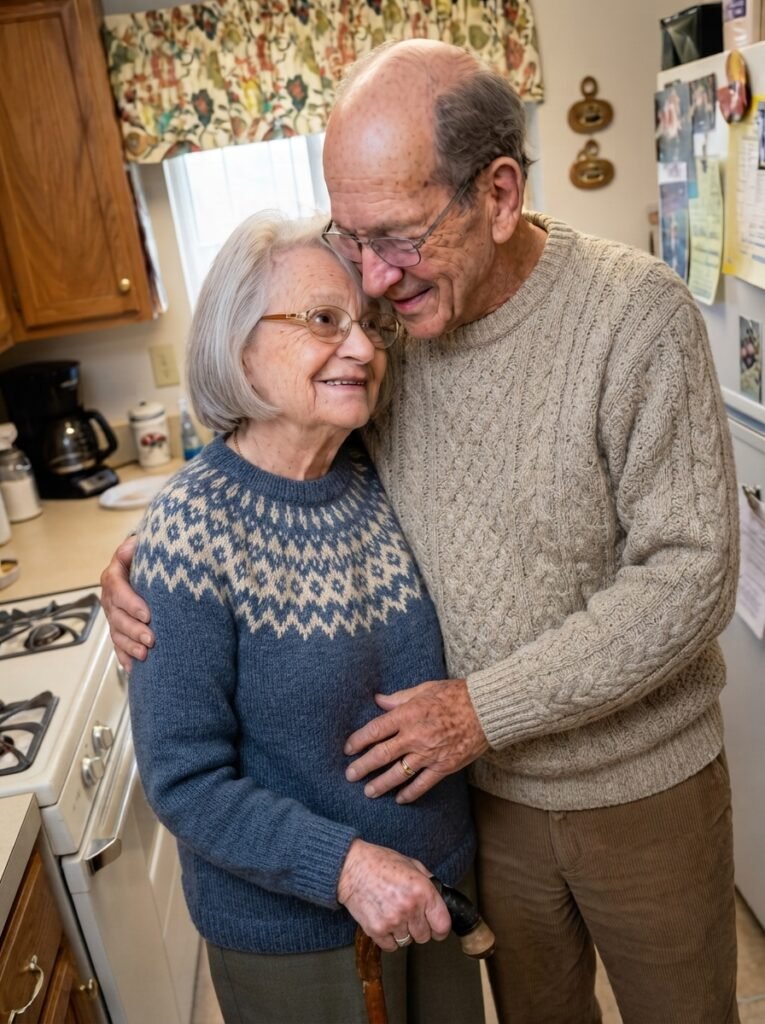
At 74, I never imagined I’d fall for someone again. But after ten years of widowhood, a man I met online made me feel young and hopeful. I went to our first date with butterflies in my stomach, only to find a stranger waiting with something that would change everything I believed about my past.
The man sitting at our reserved table looked nothing like the elderly gentleman I had come to meet.
He wore a navy sweater, as Harold had promised, but he couldn’t have been much older than 50.
“Excuse me, sweetheart. Have you seen a man named Harold?”
He stood, his face pale.
“I’m Harold, ma’am.”
My stomach twisted.
“You’ve been lying to me? Do you have any idea how cruel that is to someone my age?”
His eyes filled with tears.
“Ma’am, please. I know what this looks like, but I needed you to come.”
I turned to leave.
“Your husband Michael asked me to do this years ago. I was just too afraid.”
I gripped the back of a chair.
“My Michael? How on earth do you know my husband?”
The young man reached into his bag and carefully pulled out a large envelope.
“Please, sit down. There’s something you need to know before you jump to any conclusions.”
He placed the envelope in my trembling hands.
I recognized Michael’s handwriting before I opened the letter.
“My darling Amelia,” it began. “There is something I should have told you myself. Before we met, I was involved with a woman who later had my child. I only learned about him recently. Amelia, I have a son. His name is Harold.”
By the time I read those lines, I was sobbing so hard I couldn’t speak.
“How can this be true?” I cried, looking at Harold through my tears.
Michael had been my first love.
We married at 22, certain that children would eventually fill our little house.
But they never came.
I had health problems that made conceiving difficult.
We endured appointment after appointment, treatment after treatment, and one disappointment after another.
Eventually, we stopped trying.
Michael never once blamed me.
“We’re a family already,” he used to say whenever I apologized.
He died of a heart attack ten years ago, at 64.
I never remarried.
Instead, I helped raise my nieces and nephews, celebrated their birthdays, babysat their children, and watched them build the families Michael and I had once dreamed of.
I was happy for them. Truly.
But I missed having someone waiting for me at home.
Last month, my niece Jenny squeezed my hand and said, “Aunty, you’ve spent your whole life loving everyone else. Don’t you think you deserve a little love yourself?”
Before I could protest, she signed me up for a dating site for seniors.
At first, it was awful.
Men half my age asked me for money, while others sent messages that made me blush.
Then Harold wrote.
His profile said he was 74, just like me.
His photograph looked so much like Michael that I stared at it for minutes. But that wasn’t why I answered him.
He loved old jazz, Sunday crosswords, and ridiculous old-man jokes.
He remembered that I grew roses, asked about my family, and never made me feel silly for being lonely.
Soon, I looked forward to his messages more than anything else.
After three weeks, I gathered the courage to suggest coffee.
I even put on lipstick, feeling foolishly nervous.
Now I was sitting opposite a stranger who had used my husband’s face to make me believe another man might love me.
“Tell me how you knew Michael,” I demanded.
Harold placed two photographs on the table.
In one, Michael stood beside him outside a small house.
In another, they sat at a kitchen table, smiling over mugs of coffee.
I recognized Michael’s green cardigan.
I had bought it for his last birthday.
“When were these taken?”
“About three months before he died.”
“How old are you?”
“Fifty-four.”
That meant he was born when Michael was about 20, two years before our wedding.
“Who was your mother?”
“Ruth. She and Michael dated briefly. They separated before she realized she was pregnant. She tried finding him later, but couldn’t. Then she married another man.”
“Michael never knew?”
“Not until I contacted him.”
Harold explained that he grew up believing his mother’s husband was his father.
After that man died, Ruth told him the truth.
She gave Harold Michael’s name, but he was angry, convinced his biological father had abandoned him.
“It took nearly a year to write to him,” Harold said. “I was 44 when I finally did.”
He slid several copied letters toward me.
Michael’s handwriting was unmistakable, with his slanted letters and the little lines he drew beneath important words.
One letter ended with a joke about his inability to keep houseplants alive.
I remembered hearing that joke so often I used to finish it for him.
“We confirmed it with a DNA test,” Harold said, offering another document. “He wanted us both to be certain.”
I looked at the results, then back at the letter.
“He knew he had a son,” I whispered. “And he came home to me every evening without saying a word.”
“For those last few months, yes.”
“That’s supposed to make it better?”
“No.”
I read further.
Michael wrote that meeting Harold had made him both joyful and frightened. He had spent years watching me grieve the children we couldn’t have, and he feared this news would reopen that sorrow.
Then came a sentence I could barely bear to read.
“I told myself I was protecting you, Amelia, but I know I am also protecting myself from a conversation I am afraid to have.”
I lowered the page.
“Why didn’t he tell me?”
Harold stared at his hands.
“Because I asked him to wait.”
“What?”
“I wasn’t ready to meet you. I barely knew him. He told me about your marriage and how much you both wanted children, and I thought you’d look at me and see everything you couldn’t have.”
“You didn’t know me.”
“I know. I was frightened.”
I remembered Michael’s distracted expression during the final months of his life. Once I’d found him sorting through old photographs, staring at a picture from his youth.
“Just thinking about how quickly life moves on,” he’d told me.
I’d kissed his forehead and gone to bed.
Now I wondered whether he’d been choosing pictures to show his son.
“How often did you see him?”
“Most weekends. We talked on the phone, too. He wanted to introduce us. I kept asking for another week.”
I pushed the letters toward him.
“For 42 years, I was his wife. Neither of you had the right to decide what I could handle.”
“You’re right.”
He took another page from the envelope.
“This was the last letter he sent me.”
It was dated four days before Michael died.
Michael wrote that he couldn’t continue keeping Harold separate from our marriage.
He intended to tell me that weekend, even if Harold wasn’t ready to meet me yet.
But the weekend never came.
Michael collapsed on a Thursday afternoon while carrying groceries into our kitchen.
By the time help arrived, he was gone.
I held the letter for a moment.
“Then why do you have this one addressed to me?”
“He wrote it earlier, when he was struggling with how to explain. He gave it to me in case something happened before you two talked. He asked me to make sure you received it.”
“And you waited ten years?”
Harold’s face crumpled.
“I went to his funeral. I stood at the back. You were surrounded by people, and you looked devastated. I couldn’t walk up and tell you.”
“You could have called afterward.”
“I know.”
“Or written.”
“I know.”
“Ten years, Harold.”
“I told myself you needed time. Then I was ashamed of how long I’d waited. Every year, it got harder.”
For ten years I’d visited Michael’s grave and told him about the family, the garden, the ordinary days we no longer shared. All that time, his son had been somewhere, keeping words meant for me.
I stood and put the letters back into the envelope.
“There’s something else,” Harold said.
I almost laughed.
“What else could there possibly be?”
“The dating profile.”
I turned back.
“Yes. We haven’t discussed that, have we?”
“I found your photograph on the senior site. I recognized you from pictures Dad gave me. I’d been thinking about contacting you again, and suddenly there you were.”
“So you created a false profile?”
He nodded.
“I used one of his photographs. I thought if we talked first, if you got comfortable with me, you’d agree to meet.”
“You pretended to be interested in me romantically.”
“I never meant for it to go that far.”
“But you knew why I was there!”
A woman at the table glanced up.
I didn’t lower my voice.
“I told you how lonely I’d been. I told you I missed having someone to share breakfast with. You answered like a man who wanted those things, too.”
“I genuinely liked talking to you.”
“Was any of it even yours?”
He hesitated.
“Dad taught me about jazz and crosswords. Some jokes were his. But I listened when you talked about your roses, and Jenny’s children. I wanted to know you.”
“Then you should have told me who you were.”
“I was afraid you’d turn me away.”
I tightened my grip on the envelope.
“You didn’t earn my trust, Harold. You borrowed it from a dead man.”
He lowered his eyes.
I left before he could speak again.
At home, I put the letters inside Michael’s old desk and sat alone until evening.
Jenny called twice. On her third attempt, I answered.
“Aunty? How was your date?”
I tried to tell her, but my voice broke.
Twenty minutes later, she was beside me on the couch, reading Michael’s confession.
“So he really had a son?” she asked.
“Apparently.”
“And that man pretended to be your date?”
I nodded.
“That’s cruel,” she whispered.
Something about hearing someone else say it made me cry again.
“I don’t know what to think about Michael anymore.”
Jenny took my hand.
“You knew him for 42 years as your husband. This doesn’t erase everything you shared.”
“But he lied.”
“He did. You can love him and still be angry.”
For several days I studied the letters, searching for an explanation that would make them hurt less.
I checked Michael’s photograph albums.
Several pictures were missing from their usual places, perhaps the ones he’d given Harold.
I remembered an unexpected trip across town, a phone call taken outside, and a question about whether families could begin later in life.
I’d said family was whatever people made of it.
If only Michael had told me why he was asking.
But I remembered other things, too.
Michael holding my hand after painful appointments.
Michael teaching Jenny to ride her bicycle. Michael making breakfast after an argument because he hated leaving things unresolved.
He had loved me. He had also hidden something that belonged in our marriage.
Both were true, whether I liked it or not.
One evening, I found myself reading the first letter again. Michael had written that he hoped Harold and I might someday know each other, but that neither of us owed the other an instant relationship.
That, at least, sounded like the man I’d married.
A week after the café meeting, I called Harold.
“Amelia?” he answered.
“I have questions.”
“Ask anything.”
“I want to know about your life. Not just your father. Yours.”
There was a pause.
“All right.”
“And if we meet again, you tell me the truth even when it’s uncomfortable.”
“I promise.”
We met at a different café.
This time, Harold wore a gray shirt. There was no navy sweater and no attempt to impress me with familiar jokes.
I asked about Ruth.
“She was a school secretary. She loved gardening and ridiculous television competitions. She died three years ago.”
He told me about growing up with a kind but distant stepfather and wondering why certain things about himself felt unexplained.
Then he mentioned his wife and two grown daughters.
“You have children?”
“Two girls. Both in their 20s.”
Michael had grandchildren.
He had seen their photographs, Harold told me, but never met them.
I wondered what he’d have thought of them. Whether he’d have spoiled them with silly gifts, or taught them his awful jokes.
“I’m sorry,” Harold said.
“For which part?”
“All of it. Waiting so long. Lying about my age. Using Dad’s picture. Making you think I wanted something I couldn’t give you.”
I looked at him.
“What did you think would happen after our date?”
“I thought I’d hand over the letter, explain, and hope you’d let me stay in your life.”
His cheeks reddened.
“I didn’t think far enough ahead. I should have stopped the moment I realized you were becoming attached.”
“Yes. You should have.”
He didn’t argue.
That mattered more than another excuse.
“I can’t be your mother, Harold.”
“I’m not asking you to.”
“And I won’t pretend this was a wonderful surprise.”
“I understand.”
“But I’d like to know the real person Michael knew.”
His eyes filled.
“Really?”
“Slowly. And only if you stop trying to be him.”
“I will.”
We started with phone calls.
Harold told me about his work restoring old furniture. I told him about Jenny’s children and the rosebush Michael had planted beside our porch.
Sometimes we talked about Michael. Sometimes we talked about ordinary things, like a leaking faucet or what to make for dinner.
Once, Harold repeated one of his father’s terrible jokes.
I groaned so loudly that he burst out laughing.
“That’s exactly how Dad said you’d react.”
Despite myself, I smiled.
Months passed before I accepted his invitation to meet his family.
On the morning of our visit, Jenny arrived to drive me.
“Nervous, Aunty?”
“A little.”
“You don’t have to go.”
“I know. That’s why I want to.”
Before leaving, I stood at my bedroom mirror.
On the dresser lay the lipstick I’d worn to meet Harold the first time.
I’d felt foolish that morning, hoping someone might find me beautiful again.
For a while, I considered deleting my dating profile. But I hadn’t.
I still wanted companionship.
Someone to share breakfast with, walk beside, and come home to.
Harold’s deception hadn’t changed that desire.
I picked up the lipstick.
Jenny appeared in the doorway.
“Ready?”
I glanced at Michael’s photograph.
I wished he’d trusted me enough to tell me about his son. I wished we’d had that difficult conversation while he was alive. I would probably always wish those things.
But I was meeting Harold’s family because I wanted to, not because Michael had asked me to.
Harold wasn’t the son I’d never had. He already had a mother, a history, and a life of his own.
We were two people who had loved the same man, learning how to build an honest relationship after a painful beginning.
I finished applying my lipstick.
“Ready,” I told Jenny.
And when I stepped outside, I felt something I hadn’t expected to feel again.
I was looking forward to meeting someone new.