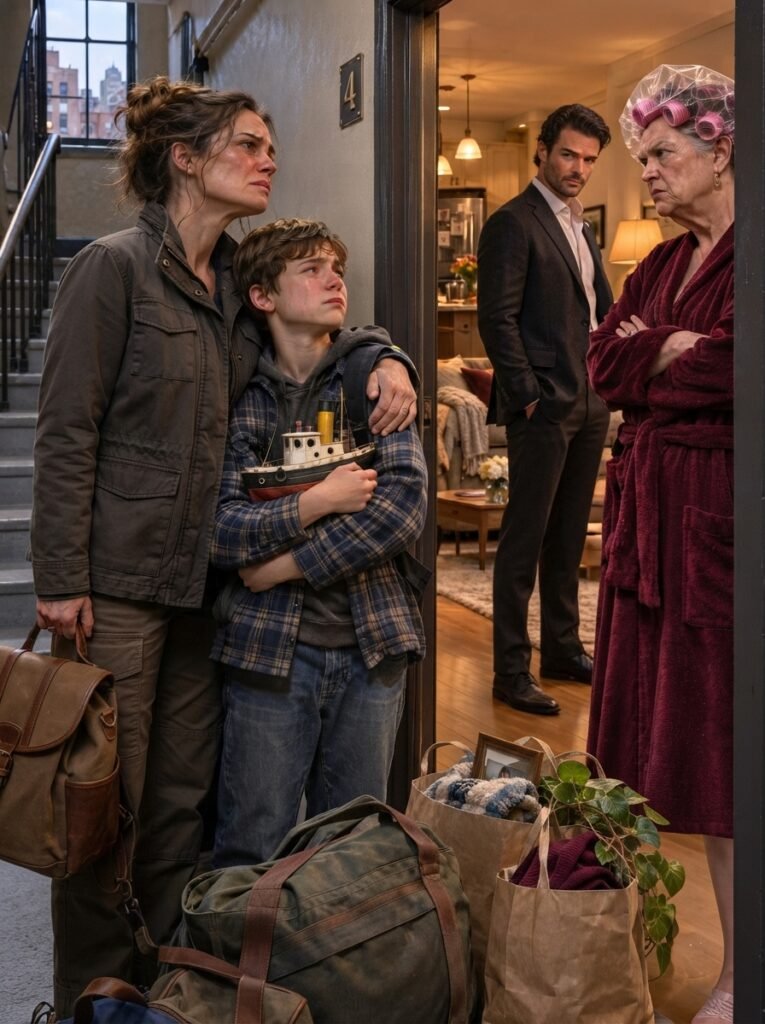
The night my husband threw my twelve-year-old son and me out of our home, he made one terrible mistake.
He let my son take a little wooden tugboat.
At the time, I thought it was an act of mercy.
Three weeks later, I would understand that the battered toy was the reason my father had spent the final months of his life looking over his shoulder.
And by the time the truth came out, my husband would be begging me to destroy the very thing he had once tossed into my son’s arms.
But I’m getting ahead of myself.
My name is Mara Whitlock Price.
I’m forty-one years old, a paramedic in Seattle, and until that rainy Thursday in November, I believed that hard work, loyalty, and love could make a marriage survive almost anything.
I was wrong.
“Get out of my house, Mara.
And take that boy with you!”
My mother-in-law’s voice echoed through the fourth-floor hallway.
Daphne Price stood in our apartment doorway wearing her burgundy bathrobe, pink hair curlers tucked beneath a plastic shower cap.
Her arms were folded tightly across her chest.
Behind her, our home looked exactly as it had that morning.
The cream-colored sofa I’d saved for six months to buy stood beneath the living room window.
The framed photographs I’d arranged on the mantel were still there.
A pot of beef stew simmered in the kitchen.
Everything was familiar.
Except that my belongings were piled on the hallway floor.
Three duffel bags.
Four grocery sacks.
My paramedic jacket.
Evan’s school notebooks.
And a cardboard box containing the photographs of my father.
I stared at the mess.
“What is this?”
Daphne lifted her chin.
“Your things.
I suggest you take them before I call building security.”
I looked past her.
“Nolan?”
My husband appeared from the kitchen holding a glass of water.
He was forty-six, tall and handsome, with dark hair that was just beginning to gray at the temples.
He wore an expensive charcoal sweater I’d bought him for Christmas.
Five hours earlier, he’d been holding my hand outside my father’s attorney’s office.
“Whatever happens with the will,” he’d whispered, “we’re a team.”
Now he couldn’t meet my eyes.
“Nolan,” I said carefully, “tell your mother to stop this.”
He rubbed his forehead.
“Mara, don’t make a scene.”
“A scene?”
My voice cracked.
“Our belongings are in the hallway!”
He sighed as though I were being unreasonable.
“Mom and I discussed everything after the meeting.
We don’t think this arrangement is sustainable anymore.”
I stared at him.
“Arrangement?
You mean our marriage?”
Daphne laughed.
“Oh, please.
Don’t act surprised.”
She stepped forward.
“My son married you because you came from a respectable, established family.
We assumed Graham Whitlock would eventually leave you something substantial.”
My stomach tightened.
“But now we discover your father left you absolutely nothing!”
She emphasized the last word with obvious satisfaction.
“Not a dollar.
Not a house.
Not even a miserable little savings account.”
“Stop,” I whispered.
“Why should I?
Do you expect Nolan to keep supporting you and another man’s child when there’s nothing in it for him?”
Beside me, Evan stiffened.
My son was twelve years old, with dark brown hair, serious gray eyes, and a habit of worrying about everyone except himself.
He had adored his grandfather.
We had buried Graham Whitlock only nine days earlier.
And now the people Evan had called family for five years were treating him like unwanted furniture.
I stepped between him and Daphne.
“Don’t you dare talk about my son that way.”
Nolan finally looked at me.
“Mom could have phrased it better.”
I laughed once, a sound I barely recognized.
“That’s what you have to say?”
He glanced at his watch.
“I’ve supported this household for years, Mara.”
“Supported?”
I felt heat rise into my face.
“I’ve worked twelve-hour ambulance shifts.
I’ve paid half the mortgage expenses, groceries, insurance, repairs, and utilities.
I paid for your mother’s dental work last spring!”
Daphne bristled.
“And we appreciated that.
But circumstances have changed.”
I stared at the woman.
“You know perfectly well my father provided the money that purchased this condominium.”
“The deed is in my name,” she snapped.
The words came so quickly that I noticed them even through my shock.
“My name, Mara.
Your father gave me that money.
This property belongs to me.”
For a moment, I wondered why she sounded as though she were repeating something she’d practiced.
Then Nolan approached.
“Look, Mara, this doesn’t have to be ugly.”
I stared at his outstretched hand.
“You’re throwing us out in the rain.”
“You have a job.
You’ll figure something out.”
“And Evan?”
Nolan glanced at my son.
“I’ve done plenty for him already.”
Something inside me went perfectly still.
In eighteen years as a paramedic, I’d watched strangers risk their lives to rescue people they had never met.
Yet the man who had promised to help raise my child couldn’t offer that child a roof for one more night.
“Five years,” I whispered.
Nolan looked away.
“Love doesn’t pay the bills.”
I opened my mouth, but Evan gently touched my sleeve.
“Mom?”
I turned.
“What, sweetheart?”
“Can I please get Grandpa’s tugboat?”
His voice was so small that it nearly broke me.
Daphne rolled her eyes.
“That ridiculous thing?”
“It’s in my bedroom,” Evan explained.
“On the shelf by my window.”
My father had spent an entire winter building the wooden model with him.
Every Sunday afternoon, they would sit at Graham’s workbench, sanding tiny pieces of wood, painting the black-and-white hull, and debating whether the yellow smokestack needed one more coat.
My father had once laughed and said, “A good captain always knows where the important things are hidden.”
I’d assumed he was joking.
Daphne disappeared into the apartment.
A minute later, she returned carrying the boat.
“Here.”
She tossed it toward Evan.
My son caught it against his chest, but the little brass mast struck the hallway railing.
It bent sideways.
He looked at the damage with an expression so wounded that I wanted to scream.
But he only whispered, “Thank you.”
Daphne stepped back.
Nolan reached for the door.
I looked at him one final time.
“Did you ever love us?”
For the first time that evening, something like shame crossed his face.
Then he said, “I loved the life I thought we were going to have.”
And he closed the door.
The deadbolt turned twice.
Evan stood motionless beside me.
Through the wood, I heard Nolan speaking urgently on his phone.
“Vince, listen.
The old man left everything to the kid.
It’s locked in some trust.
I can’t get access to it.”
A pause.
“No, she doesn’t know anything.”
Another pause.
Then his voice dropped.
“Don’t start panicking.
We still have time to find it.”
I frowned.
Find what?
I leaned closer, but his footsteps faded toward the kitchen.
Then Evan slipped his hand into mine.
“Mom, are we homeless?”
It was the question no mother ever wants to hear.
I knelt in front of him.
Forcing my tears back, I brushed the wet hair from his forehead.
“Not homeless, baby.
Just between homes.”
He studied my face.
“Are you scared?”
I could have lied.
Instead, I nodded.
“A little.”
He squeezed my hand.
“Okay.
Then we can be scared together.”
That was the moment I understood something my husband never would: a family wasn’t defined by the name on a deed.
I gathered our bags and called a cab.
As we drove away through the Seattle rain, Evan sat beside me holding his grandfather’s tugboat.
I didn’t notice that he kept rubbing his thumb over its yellow smokestack.
And I certainly didn’t know he was carrying a secret that could destroy the people who had just thrown us away.
Chapter 2: The Secret Inside the Tugboat
My supervisor, Tessa Boone, opened the emergency medical services station door at 9:47 that night.
She took one look at our luggage and Evan’s pale face.
Then she stepped aside.
“Come in.”
No questions.
No judgment.
Just those two words.
Tessa had supervised my ambulance unit for nearly eleven years.
She was fifty-three, broad-shouldered, sharp-eyed, and capable of making the toughest firefighters in Seattle straighten their backs with one raised eyebrow.
Within twenty minutes, Evan was lying beneath a clean blanket on a cot in the staff rest room.
Tessa brought him a sandwich, a carton of chocolate milk, and one of the spare pillows she kept for exhausted crews.
Then she sat beside me in the kitchen.
I told her everything.
The will.
The apartment.
Daphne’s accusations.
Nolan’s betrayal.
When I finished, Tessa remained silent for a long moment.
Finally, she said, “Your father warned you about Nolan.”
I looked down.
“He did.”
Graham had never been comfortable around my husband.
At first, he’d tried to hide it.
He invited Nolan to Sunday dinners and remembered his birthday.
He asked about Nolan’s business consulting work and occasionally offered advice.
But whenever Nolan left the room, my father’s expression changed.
“Watch what he does when he thinks nobody’s paying attention,” Graham once told me.
I’d been angry.
“You’re judging him because he doesn’t work with his hands like you did.”
My father had given me a sad smile.
“Sweetheart, I don’t care what a man does with his hands.
I care what he does with other people’s trust.”
I’d accused him of being controlling.
He’d never raised the subject again.
Now, sitting in the fluorescent light of the station kitchen, I wished I could apologize.
Tessa touched my arm.
“Your dad was a good man, Mara.”
I swallowed hard.
“I keep thinking about the last time I saw him.”
Two days before his death, I’d visited Graham at his Queen Anne apartment.
He was seventy-three and had recently been diagnosed with a serious heart condition.
That afternoon, he seemed unusually tired.
He’d insisted that I take home an old photograph of him standing beside a fishing boat with my mother.
When I asked why, he said, “Some things shouldn’t disappear just because the people in them are gone.”
Then he’d held my hand.
“Promise me you’ll always listen when Evan tells you something important.”
I laughed gently.
“Of course, Dad.”
“No.”
His fingers tightened around mine.
“I mean it.
Sometimes children notice the truth before adults are ready to see it.”
At the time, I thought he was talking about my relationship with Nolan.
I hadn’t understood that he was giving me instructions.
At two in the morning, I was sitting beside Evan’s cot when he opened his eyes.
“Mom?”
“I’m right here.”
He pushed himself upright.
“Can you close the door?”
Something in his voice frightened me.
I did as he asked.
Then he pulled the little tugboat from beneath his blanket.
“Grandpa told me something before he died.”
I sat beside him.
“What did he tell you?”
Evan looked toward the door.
“He said I wasn’t supposed to tell anyone unless something really bad happened.”
My heart began to beat faster.
“Like what?”
“Like if Nolan and Grandma Daphne made us leave.”
I stared at him.
My father had predicted this?
“He said he hoped he was wrong,” Evan continued.
“He said if they really loved us, nothing would happen.”
Evan’s lower lip trembled.
“I wanted him to be wrong, Mom.”
I pulled him close.
“Oh, sweetheart.”
“But Grandpa said if they threw us out, I should show you the boat.”
He placed it between us.
Then he pointed to the bright yellow smokestack.
“Watch.”
He twisted it.
Once.
Twice.
A tiny click sounded inside the wooden hull.
The smokestack lifted free.
Beneath it was a narrow compartment no wider than my thumb.
Evan carefully tipped the boat.
A tiny brass key and a folded piece of paper fell onto the blanket.
I recognized my father’s handwriting immediately.
My hands shook as I opened the note.
Mara,
If you’re reading this, my worst fears have come true.
I’m sorry I couldn’t make you believe me while I was alive.
Don’t trust Nolan.
And whatever you do, don’t let Daphne know about the key.
The condominium was never meant to belong to her.
Five years ago, I discovered something about the Price family that changed everything.
Nora Keene has the documents.
Tell her the tugboat has finally reached its destination.
I wish I had been brave enough to tell you everything in person.
Love, Dad.
I read it three times.
Then I looked at Evan.
“Did Grandpa tell you what the key opens?”
He shook his head.
“He said Nora would know.”
I took out my phone.
Before I could call the attorney, the screen lit up.
NOLAN CALLING.
I stared at the name.
Evan watched me anxiously.
“Are you going to answer?”
I pressed the green button.
“What do you want, Nolan?”
“Mara.”
His voice was breathless.
“Listen carefully.
Did Evan take that wooden boat?”
My fingers tightened around the phone.
“Why?”
“Just answer the question!”
I glanced at my son.
“He’s got the boat his grandfather made him.”
A sharp breath.
Then Nolan said, “I need you to bring it back.”
I couldn’t believe what I was hearing.
“You threw a child out of his home, and now you want his toy?”
“It’s not about the toy!”
In the background, I heard Daphne shouting.
“Ask her about the smokestack!”
My blood turned cold.
Nolan cursed.
“Mom, shut up!”
Then, more quietly, he said, “Mara, that boat belongs to the family.
Your father may have put something inside it that isn’t yours.”
I looked down at the key.
“Something like what?”
Silence.
Then Nolan asked, “Where are you?”
I ended the call.
Almost immediately, a text appeared from an unknown number.
Your father didn’t die believing they were innocent.
Call Nora before they find you.
A second message followed.
And don’t trust anyone who says Graham was only trying to protect his money.
My hands went numb.
I looked at Evan.
Then at the tugboat.
My father had been dead for nine days.
Yet somehow, he’d just reached into the wreckage of my marriage and handed me a warning from beyond the grave.
I called Nora Keene.
She answered on the third ring.
“Mara?”
“Nora, I found something.”
A pause.
“What kind of something?”
I swallowed.
“My father left a key inside Evan’s tugboat.”
The silence on the other end was absolute.
Then Nora asked, in a voice I’d never heard her use before:
“Did Nolan see you open it?”
“No.”
“Good.”
I heard papers rustling.
“Where are you?”
“At my station.”
“Stay there.
Lock the doors.
And Mara?”
“Yes?”
“Your father left very specific instructions for this moment.”
Her next words made my entire body go cold.
“If anyone asks you to hand over that boat, you must understand they’re not trying to steal your inheritance.
They’re trying to prevent you from finding out how Evan’s father really died.”
I stopped breathing.
Evan’s father.
Daniel.
The man I’d loved before Nolan.
The man who had died in a shipyard fire eleven years earlier.
For eleven years, I’d believed his death was an accident.
Now my father’s attorney was telling me otherwise.
And for the first time since the funeral, my grief was replaced by something much more frightening.
I needed to know the truth.
Chapter 3: The Man Who Died Saving Everyone Else
Daniel Reed was twenty-nine when he died.
He had sandy brown hair, an easy laugh, and a maddening habit of leaving half-finished cups of coffee all over the house.
He worked as a marine safety inspector.
He loved old boats, terrible action movies, and making pancakes shaped like animals.
And he loved our son long before Evan was born.
Daniel and I had been together for six years.
We’d planned to marry when Evan was a little older, after we’d saved enough money for a modest ceremony by the water.
We never got that chance.
The fire happened on a cold February morning at the Whitlock Marine repair yard.
Daniel was inspecting an older service vessel undergoing electrical repairs.
According to the official report, an accidental electrical fire spread through a maintenance building before anyone could stop it.
Daniel helped three workers escape.
Then he went back inside because another man was missing.
The building collapsed.
Daniel never came out.
The report said the fire was a tragic accident, worsened by faulty equipment and confusion during the evacuation.
I accepted that explanation because I couldn’t bear to imagine anything worse.
My father arranged Daniel’s funeral.
He paid for a beautiful memorial and helped establish a scholarship for the children of maritime workers who died on the job.
He carried Evan down the church aisle when I couldn’t stop shaking long enough to walk.
But after Daniel’s death, something changed in him.
He stopped visiting the shipyard.
He sold several of his business interests.
And he became strangely uncomfortable whenever I mentioned the investigation.
Once, about a year after the fire, I found him staring at a photograph of Daniel.
“Dad?”
He quickly put it away.
“Are you okay?”
He nodded.
Then he said something I had never forgotten.
“Sometimes the worst thing a man can do isn’t the mistake he makes.
It’s what he allows to happen afterward.”
I assumed he was blaming himself for the accident.
I hugged him and told him Daniel had known the risks of his job.
My father started crying.
It was the only time I’d ever seen him do that.
Now, sitting in the staff rest room with Nora still on the phone, I wondered whether his tears had meant something entirely different.
“What are you saying?”
I whispered.
Nora’s voice softened.
“I’m saying Daniel found evidence of serious wrongdoing before the fire.
Your father eventually learned that the official investigation had been compromised.”
“By who?”
“We can’t discuss everything over the phone.”
“Nora—”
“Mara, listen to me.
I know what this sounds like.
I also know how much you trusted the findings after Daniel’s death.”
I closed my eyes.
“Did my father know?”
A pause.
“He knew pieces.
He spent years trying to prove the rest.”
“And he never told me?”
“He was afraid of what would happen if the people responsible realized you knew.”
I looked at Evan.
He was sitting cross-legged on the cot, holding the model boat.
“Does this have something to do with Nolan?”
Nora didn’t answer immediately.
Then she said, “Seven years ago, your father hired a private forensic accountant to investigate a series of financial transfers connected to the old shipyard.”
My throat tightened.
“What transfers?”
“Insurance payments.
Contractor invoices.
Settlement funds.”
I knew the words individually.
Together, they meant nothing.
Nora continued.
“At first, Graham believed someone had been stealing from his company.”
“And then?”
“He discovered that the theft may have been connected to the conditions that caused the fire.”
I pressed a hand against my mouth.
Nora lowered her voice.
“Mara, Nolan Price was working as a financial consultant for one of the companies involved.”
The room tilted.
“No.”
“I’m sorry.”
“No.
I met Nolan years after Daniel died.”
“That doesn’t mean he wasn’t connected to what happened.”
I stared at the station wall.
I remembered the first time Nolan and I met.
It had been at a charity fundraiser for injured first responders.
He’d introduced himself as a business consultant.
He’d been charming, attentive, and sympathetic when I told him about Daniel.
He said he’d lost someone close to him once and understood how grief could leave a person afraid to love again.
Had that sympathy been rehearsed?
Had he known who I was before he walked over?
Nora spoke again.
“There’s something else.
Your father believed Daphne knew more than she admitted.”
I thought of the older woman’s expression when she’d mentioned the condominium deed.
Of Nolan’s sudden panic about the tugboat.
Of the stranger’s warning.
“Where does the key fit?”
“At a property on Pier Seventeen.
Your father kept an old records room there after he sold the maritime business.”
“What’s inside?”
“I’ve never been allowed to open the secured cabinet.
Graham kept the key himself.”
My chest tightened.
“Then how do you know about it?”
“Because I witnessed the instructions he signed regarding that room.
He wanted you to decide what happened to its contents.”
“Nora, why didn’t you tell me at the will reading?”
“Your father was very clear.
Until the key reached you, I was to assume he had decided not to involve you.”
I looked down at the brass key.
It was small and old-fashioned, with a tiny anchor engraved near the bow.
Then Nora said, “I can meet you at the station at six.
I’ll bring someone who understands the financial evidence.
For now, don’t go anywhere alone.”
Before hanging up, I asked one final question.
“Nora, how did my father die?”
She went quiet.
“His doctors attributed it to heart failure.”
“Do you believe them?”
“I have no medical evidence to dispute them.”
That was a careful answer.
Too careful.
When I ended the call, Evan was watching me.
“Was that about Dad?”
I nodded.
He looked down at the tugboat.
“Grandpa told me something about him once.”
I sat beside him.
“What?”
“He said my dad was the kind of man who went back for people when everyone else was running away.”
Tears burned behind my eyes.
“That’s true.”
Evan traced the bent brass mast.
“Then why did Grandpa look sad when he said it?”
I couldn’t answer.
He carefully set the boat on the blanket.
“Mom?”
“Yes?”
“Do you think Grandpa was scared before he died?”
I thought of the trembling handwriting, the hidden key, and the instructions he’d entrusted to a little boy.
“Maybe.”
Evan slipped his hand into mine.
“Then we should finish what he started.”
I looked at my son.
Twelve years old.
Freshly betrayed.
Still grieving.
Yet somehow, he was the bravest person in the room.
I kissed his forehead.
“Together,” I whispered.
And in the dim light of the rest room, with the rain still washing against the windows, I made a promise.
I would find out why Daniel died.
I would find out what my father had been hiding.
And if Nolan and Daphne had played any part in destroying our family, I would make certain they could never do it to anyone else.
I had no idea how much that promise was going to cost me.
Chapter 4: The Locked Room at Pier Seventeen
Nora arrived at the station at 5:52 a.m.
She wore a dark wool coat and carried a battered leather briefcase.
Her silver hair was pinned neatly at the back of her head, but the shadows beneath her eyes told me she’d slept no more than I had.
Beside her stood a woman in her thirties with a cropped black haircut and a serious expression.
“This is Leila Moreno,” Nora said.
“She’s a forensic accountant.
She’s been assisting with your father’s investigation.”
Leila shook my hand.
“I’m sorry about Graham.
He was stubborn, occasionally infuriating, and considerably smarter than most people gave him credit for.”
Despite everything, I smiled.
“That sounds like Dad.”
Nora placed her briefcase on the table.
“Before we go anywhere, I need you to understand something.”
She opened a folder.
Inside were photographs of Nolan, Daphne, and a heavyset man with thinning hair.
I recognized him.
“That’s Vince.”
“Vincent Calder,” Leila confirmed.
“A financial consultant who has worked with Nolan for more than fifteen years.”
I studied the photograph.
Vince had attended our wedding.
He’d given a charming speech about finding your soulmate late in life.
He’d even danced with my father.
“What does he have to do with this?”
Leila opened another folder.
“Possibly everything.”
The first document was a transfer record from an insurance settlement account.
The receiving company was called Cascade Renewal Holdings.
The second document listed the company’s managing member.
Daphne Price.
I looked up.
“My mother-in-law owns this company?”
“She did on paper,” Leila said.
“The company was dissolved several years ago.
Its remaining funds passed through two additional businesses before disappearing into investment accounts we haven’t fully traced.”
“How much money?”
Leila hesitated.
“Approximately eight million dollars moved through accounts connected to the shipyard claim and settlement administration.”
I stared at her.
“Eight million?”
“That’s the amount we’ve identified as questionable, not necessarily the final loss.
Some transfers may have been legitimate, and we need original records to prove which weren’t.”
I thought of Daphne complaining about grocery prices.
Of Nolan insisting he couldn’t afford to contribute to Evan’s school trip.
Of the way they’d treated me like a financial burden.
Nora leaned forward.
“There’s something you should know about the condominium.”
I looked at her.
“Please tell me.”
“Your father did provide the purchase money.
But it wasn’t a gift to Daphne.”
She slid another document toward me.
It was a promissory note.
The borrower was Daphne Price.
The lender was Graham Whitlock.
The principal amount was $684,000.
My eyes widened.
“She owes my father six hundred and eighty-four thousand dollars?”
“She owed him.
The note is now an asset of his estate, subject to its terms.”
I turned the page.
There was a recorded deed of trust securing the debt against the condominium.
“And this is valid?”
“The documents appear properly executed and recorded.
Daphne has already begun making claims that Graham intended to forgive the loan, but we’ve found no executed release.”
I remembered Daphne shouting, Your father gave me that money!
“Why would Dad arrange it this way?”
Nora’s expression darkened.
“That’s one of the questions we hope the records room can answer.”
At seven, Tessa agreed to remain with Evan at the station.
My son didn’t like the idea.
“I should go with you.”
I crouched beside him.
“If anything dangerous happens, I need to know you’re safe.”
He considered that.
Then he took my hand and placed the little brass key in it.
“Promise you’ll bring it back.”
“I promise.”
He looked at me seriously.
“Grandpa said a captain never leaves anybody behind.”
I kissed his forehead.
“Your grandfather was right.”
The drive to Pier Seventeen took less than twenty minutes.
Seattle’s waterfront was beginning to wake.
Delivery trucks rolled past warehouses.
Gulls circled over gray water.
A ferry sounded its horn beyond the piers.
The old Whitlock property sat behind a rusting chain-link fence.
It was a two-story brick building with faded blue doors and a weather-beaten anchor mounted above the entrance.
I’d visited it hundreds of times as a child.
Dad used to bring me there on Saturday mornings.
He’d buy me hot chocolate from a vending machine while he checked shipping manifests and argued good-naturedly with the dock crews.
Now the building looked abandoned.
Nora unlocked the front entrance using a separate key from her ring.
Inside, the air smelled of dust, old timber, and salt.
We walked through a narrow corridor.
Leila stopped before a metal door marked RECORDS.
“Here.”
I held up the tiny brass key.
It seemed much too small for the door.
“Not that lock,” Nora said.
She opened the room with her own key.
Inside were filing cabinets, wooden shelves, and a large steel desk.
A faded photograph of Whitlock Marine’s first tugboat hung on the wall.
Leila moved the photograph aside.
Behind it was a small brass keyhole set into a recessed panel.
My pulse quickened.
I inserted the key.
It turned smoothly.
The panel opened.
Behind it sat a compact fire-resistant safe.
The brass key had released the safe’s mechanical access cover, exposing a second locking mechanism.
Nora gave me an envelope.
“Your father left me this combination under seal.”
I opened it.
Inside were four numbers.
12-04-13-07.
December 4, 2013.
The date on which the official inquiry into Daniel’s death had been closed.
My hands began shaking again.
I entered the combination.
The safe opened.
Inside were three things.
A thick red ledger.
A sealed waterproof case.
And a yellow envelope addressed to me.
I reached for the envelope first.
On the front, my father’s handwriting said:
MARA — PLEASE READ THIS BEFORE YOU DECIDE WHETHER YOU CAN FORGIVE ME.
I looked at Nora.
She watched me with an expression that frightened me more than anything she’d said.
“What did he do?”
I whispered.
Nora’s eyes filled with tears.
“I think your father wanted you to hear that from him.”
I broke the seal.
Chapter 5: My Father’s First Confession
Mara,
If you’ve opened this letter, then Evan has done what I asked him to do.
I’m proud of him.
I always knew that boy had more courage than most grown men.
I need you to read everything before deciding what kind of man I was.
There are things I failed to tell you about Daniel.
And there is one terrible thing I did that I can never undo.
I stopped.
My father’s handwriting blurred.
I took a breath and continued.
On the day of the fire, Daniel had been investigating discrepancies in maintenance records and contractor payments.
He believed someone had approved electrical work that had never been completed.
He also believed several inspection reports had been falsified.
Daniel came to me with his concerns.
I told him I would investigate.
I should have stopped operations immediately.
Instead, I allowed my finance people to convince me the paperwork discrepancies were administrative mistakes.
I chose to delay.
Three days later, the fire happened.
A terrible pressure spread through my chest.
I remembered Daniel standing in our kitchen, frustrated and exhausted.
“Something’s wrong at the yard, Mara.”
I’d been making dinner.
“What kind of wrong?”
“People are signing off on repairs nobody’s done.”
“Have you told my dad?”
“Yeah.
He says he’s looking into it.”
I’d kissed him and told him to be patient.
Three days later, he was dead.
My father’s letter continued.
After the fire, an investigator requested the original maintenance approval forms.
One document carried my signature.
I believed I had signed a general authorization.
Later, I learned the final inspection approval attached to it had been altered.
But I didn’t immediately report that discovery.
I was afraid the company would collapse.
I was afraid of criminal charges, lawsuits, and the possibility that everything I’d built would disappear.
And I was ashamed.
I lowered the pages.
My father had been afraid.
Graham Whitlock, who had taught me to stand up for people who couldn’t stand up for themselves, had once allowed fear to silence him.
I hated knowing it.
I hated that he hadn’t trusted me enough to tell me.
Leila stood quietly beside the desk.
Nora didn’t interrupt.
I forced myself to continue.
By the time I tried to correct the record, several original files were missing.
The company lawyer assured me the matter had been thoroughly investigated.
I wanted to believe him.
That is my deepest shame.
I was willing to accept reassurance because the truth frightened me.
Years later, I discovered that money intended for repair contractors and accident-related obligations had been diverted into companies controlled by people I trusted.
One of those people was Nolan Price.
I gripped the page.
When Nolan entered your life, I recognized his name.
At first, I believed it might be a coincidence.
I hired someone to investigate.
It was not a coincidence.
My stomach dropped.
He knew who you were before you met him.
A sound escaped my throat.
Nora stepped closer.
“Mara?”
I shook my head.
I couldn’t speak.
The letter continued.
I should have told you immediately.
Instead, I tried to discover what Nolan wanted and whether there was enough evidence to take to the authorities.
I told myself I was protecting you.
Perhaps I was also protecting myself.
That cowardice cost us years.
I’m sorry.
The red ledger contains the financial transactions I uncovered.
The waterproof case contains copies of Daniel’s records and the evidence gathered afterward.
Don’t destroy them to preserve my reputation.
Don’t excuse my silence because I was your father.
If I have learned anything, it’s that a person who loves you must be willing to tell you the truth, even when that truth makes them look terrible.
I love you, Mara.
I loved Daniel.
And I love Evan more than I can put into words.
I hope you’ll understand why I arranged the inheritance the way I did.
Dad.
I lowered the letter.
For several seconds, I couldn’t hear anything except the faint hum of the building’s ventilation system.
My father had known Nolan’s connection to Daniel’s death.
He’d watched me marry him.
He’d stood beside us at the wedding.
He’d let Nolan hold Evan on his shoulders during the reception.
And he had said nothing.
I wanted to scream.
I wanted to forgive him.
I wanted to ask why he’d left me in the dark.
Most of all, I wanted one more afternoon with him so I could hear his answer.
Nora touched the edge of the desk.
“I argued with him about telling you.”
I looked up.
“You knew?”
“Not everything.
Graham disclosed the extent of his concerns gradually, as the evidence developed.
When he first came to me, he wanted help reconstructing missing corporate records.”
“Why didn’t you tell me?”
“I was his attorney.
I couldn’t simply disclose his confidential communications without authorization.”
“You could have told him he was wrong.”
“I did.”
I looked away.
Nora said quietly, “He believed Nolan would retaliate if he knew Graham was investigating.
He was frightened that Evan could become a target.”
I laughed bitterly.
“So his solution was to let me sleep beside the man?”
Nora didn’t defend him.
“No.
And I won’t pretend that was the right decision.”
That honesty hurt more than reassurance would have.
I looked at the red ledger.
On its cover, my father had written:
THE PEOPLE WHO WERE PAID FOR WORK THAT WAS NEVER DONE.
Leila opened it.
Rows of transactions filled the pages.
Contractor names.
Payment dates.
Invoice numbers.
Bank account references.
Then I saw an entry dated four days before Daniel’s death.
A payment of $219,000.
Authorized by Nolan Price.
Received by Cascade Renewal Holdings.
Daphne’s company.
I stared at it.
“He was being paid before Daniel died.”
Leila nodded.
“We have records connecting Nolan to these accounts before the fire.
We’re still establishing who authorized the payments and what work, if any, they represented.”
“Did he cause the fire?”
“We don’t know yet.”
“But he was there.”
Leila’s face tightened.
“Yes.”
I looked at her.
“Where?”
She opened a second folder.
Inside was an old employee access report.
On the morning of the fire, Nolan’s temporary contractor credential had been used to enter the maintenance wing at 6:41 a.m.
The first emergency call had come twenty-three minutes later.
A cold sensation spread through my body.
Nora spoke carefully.
“That does not prove he set the fire.
But it directly contradicts his later claim that he had no operational involvement at the site.”
I remembered our wedding.
Nolan had raised his glass and said, “The best things in life come when you least expect them.”
Had he known exactly where to find me?
And why?
Suddenly, a loud metallic bang echoed from the corridor.
We all turned.
Footsteps.
Heavy.
Approaching quickly.
Leila closed the ledger.
Nora stepped toward the door.
Then a man’s voice called from the hallway.
“Mara Whitlock?”
My heart jumped.
“Who’s there?”
“Seattle Police Department.
Detective Sofia Alvarez.”
Nora glanced through the door’s narrow window.
Then she released a breath.
“She’s with us.”
The detective entered with another officer.
She was a compact woman in her forties with dark eyes and an expression that suggested she rarely wasted words.
“Nora,” she said.
“I’m glad you called before opening the safe.”
She looked at me.
“Mrs.
Price, your father contacted law enforcement before he died.
Some of this material may become evidence in an ongoing investigation.
We’d like to document exactly what was recovered.”
I stared at her.
“My father went to the police?”
“Through counsel, yes.”
“Then why wasn’t Nolan arrested?”
“Because suspicion, financial inconsistencies, and partial records aren’t enough to prove every offense.
Your father was helping us identify originals and witnesses.”
I looked at the ledger.
At Daniel’s access records.
At my father’s letter.
For the first time, I understood that the tugboat wasn’t merely hiding a family secret.
It was carrying the missing pieces of an investigation that had been waiting eleven years for the truth.
Chapter 6: The Woman Who Owned My Home
By noon, I was back at the station.
Evan ran toward me the moment I entered.
“Mom!”
I dropped to my knees and held him.
He smelled like chocolate milk and the cheap shampoo he used after soccer practice.
For one beautiful moment, he was just my son.
Not the beneficiary of a complicated trust.
Not the grandson of a man carrying terrible secrets.
Not a child whose father had died under suspicious circumstances.
Just Evan.
“Did you find anything?” he asked.
I looked into his eyes.
“Yes.”
“Was Grandpa telling the truth?”
I hesitated.
“He was trying to tell us the truth.
Some of it is very hard.”
Evan thought about that.
“Did he do something wrong?”
My chest tightened.
“Yes, sweetheart.
He made mistakes.
Big ones.”
Evan lowered his eyes.
“Does that mean he was bad?”
I sat beside him.
“I think people can love us very much and still do things that hurt other people.
Loving someone doesn’t mean pretending they were perfect.”
He was quiet.
Then he asked, “Did Grandpa try to fix it?”
I looked at the tugboat resting on the cot.
“I believe he did.”
That afternoon, Nora arranged for us to stay in a furnished apartment owned by a retired nurse named Helen Porter.
Helen had volunteered with local emergency medical teams for years.
When Tessa told her what had happened, she offered the apartment for two weeks at no charge.
“It’s small,” she said apologetically when she showed it to us.
It had one bedroom, a foldout sofa, and a kitchen barely large enough for two people.
But it was clean.
Warm.
Safe.
And when Evan saw a narrow shelf beside the living room window, he immediately placed the tugboat there.
“It’s perfect,” he announced.
I almost cried.
I was still unpacking when Nora called.
“Daphne has contacted the estate’s trustee.”
I sat on the bed.
“What does she want?”
“She claims your father promised to forgive her condominium loan before he died.”
I remembered her confidence.
“Of course she does.”
“She’s also claiming some household expenses you paid were voluntary gifts.”
I closed my eyes.
“She’s trying to make it look like she supported us.”
“Yes.”
“What happens now?”
“The trustee can demand payment under the note according to its terms and challenge any fraudulent claims.
A recorded deed of trust gives the estate security, but it doesn’t mean anyone can instantly take the condominium.”
I nodded.
“Good.”
Nora paused.
“You sound disappointed.”
“No.
I just don’t want to become what they are.
I want this handled legally.”
There was a brief silence.
Then she said, “Your father would have been proud of that.”
I didn’t answer.
I wasn’t ready to hear what my father would have wanted.
Instead, I asked about the note.
“Why did he lend Daphne the money?”
Nora hesitated.
“There’s a document in the case files that may explain it.”
She emailed me a scanned memorandum.
It was dated five years earlier, a few months before my marriage to Nolan.
The memo referred to a negotiated financial arrangement involving Graham Whitlock, Daphne Price, and Vincent Calder.
One sentence made my stomach turn.
The advance shall not constitute consideration for silence regarding historic company liabilities, and no party acknowledges the existence of any such arrangement.
I read it again.
Then again.
My father had been negotiating with people who were threatening to expose him.
Daphne hadn’t merely benefited from his generosity.
She’d apparently used his guilt as leverage.
And he’d protected himself by structuring the transaction as a secured loan.
My phone rang before I could read further.
Daphne.
I answered.
“What?”
Her voice was shrill.
“Mara, you need to tell that attorney to stop harassing me!”
I put the call on speaker and activated the phone’s built-in recording only after saying, “Daphne, I’m on speaker.
Evan isn’t here.
I want our conversations documented, and I won’t record unless you agree.”
“Don’t you dare record me!” she snapped.
“Then I won’t.
What do you want?”
“That woman is claiming your father loaned me the money for my home!”
“He did.”
“It was a gift!”
“Then show her the gift documents.”
Silence.
I continued.
“And since you were so certain the condominium belonged exclusively to you, I’m sure you’ll have no problem providing the paperwork.”
“Listen to me, you ungrateful little—”
I ended the call.
Ten minutes later, Nolan called.
I let it go to voicemail.
He left three messages.
The first was angry.
The second was apologetic.
The third made my skin crawl.
“Mara, sweetheart, this has gotten out of hand.
I was upset yesterday.
Mom was upset.
We all said things we didn’t mean.”
He sighed dramatically.
“Come home.
Bring Evan.
We can work through this.”
I stared at the screen.
Yesterday, love hadn’t paid the bills.
Today, apparently, love had discovered interest rates.
I forwarded the messages to Nora.
Then I blocked Nolan’s number.
That evening, Tessa came over with groceries and a bag containing Evan’s favorite cereal.
While Evan worked on his math homework, she stood beside me at the sink.
“You’re handling this better than I would.”
I shook my head.
“I’m not handling it.
I’m barely holding it together.”
She glanced toward the living room.
“That kid thinks you’re the strongest person alive.”
“I don’t feel strong.”
“Strength isn’t feeling fearless.
It’s making dinner when you want to collapse.”
I looked at the box of pasta in my hand.
Then I laughed.
It was the first real laugh I’d managed since the eviction.
But it disappeared when my phone buzzed.
Another message from the unknown number.
Check the date on Nolan’s first email to you.
Then ask yourself why he’d already been searching for Evan’s trust records.
I stared at the words.
I knew exactly when Nolan had first emailed me.
October 17, seven years earlier.
The morning after the charity fundraiser.
I opened my old email archive.
His message was still there.
It was wonderful meeting you last night.
I hope we can have coffee sometime.
I scrolled down.
Attached beneath his signature was an automatically generated contact-card file.
Its creation date was six weeks before we’d met.
The file named me as a contact.
Mara Whitlock — Graham’s daughter.
My heart sank.
Nolan hadn’t met me by accident.
He’d prepared for me.
And somewhere in the years that followed, I had mistaken his planning for love.
Chapter 7: The Marriage That Was Never an Accident
The next morning, I went through seven years of messages.
Nolan had always seemed attentive.
He remembered anniversaries, sent flowers to the station, and left little notes on the refrigerator.
When Evan was sick, he brought soup.
When I worked late, he sometimes waited up for me.
Those memories had once felt like proof that I’d finally found happiness again.
Now they looked different.
He had asked about my father’s business almost immediately.
He’d wanted to know whether the company was still privately owned.
Whether Graham intended to sell his remaining shares.
Whether my father had named me as executor.
He’d once suggested that Evan needed a “more flexible” savings plan than the one Graham maintained.
At the time, it sounded like practical financial advice.
Now it sounded like an inventory.
I remembered a dinner at our apartment two years earlier.
Graham had brought Evan a beautifully illustrated book about ocean navigation.
Nolan had smiled politely.
Then, when Evan went to bed, he’d asked, “Instead of buying toys, why don’t you put some money into an account Mara and I can manage?”
My father had looked at him for a long moment.
“No.”
Nolan laughed.
“Just a suggestion.”
Graham hadn’t smiled.
“A child’s money should remain a child’s money.”
They’d barely spoken for the rest of the evening.
At ten, Leila arrived with new information.
She spread several documents across my kitchen table.
“We’ve traced some of the transactions from the old shipyard through a company called Meridian Risk Advisory.”
I frowned.
“That’s Nolan’s business.”
“Yes.
He presented himself as an independent consultant, but he received payments from companies that were under review for inflated maintenance costs.”
“How much?”
“Over seven hundred thousand dollars across several years, including money paid through entities associated with Vince Calder.”
I stared at the numbers.
“What was he doing with it?”
“We’re still reconstructing the contracts.
But the records suggest he helped arrange payments, assess financial exposure, and structure transactions.”
I felt sick.
“Daniel told my father about those fake repairs.”
Leila nodded.
“And someone made sure the person responsible for investigating them remained close to the family afterward.”
“Why?”
She looked at me carefully.
“Because you were Graham Whitlock’s daughter.”
I leaned back.
Of course.
My father had spent decades building his maritime business.
Even after selling much of it, he retained investment interests and old records that could expose financial wrongdoing.
As his only child, I was the person most likely to inherit his private papers.
And my husband would have had access to my home.
My mail.
My passwords.
My grief.
I thought of how Nolan had helped me sort through Daniel’s belongings after we became engaged.
He’d insisted I didn’t need to keep boxes of old work papers.
“You’re holding onto pain,” he’d said gently.
I’d let him help me throw things away.
Now I wondered whether he’d been looking for something specific.
Leila reached into her bag.
“There’s another thing.”
She handed me a photograph.
It showed a younger Nolan standing beside Vince Calder at a corporate event.
Behind them was a banner for Cascade Renewal Holdings.
The date printed on the image was April 2014.
Only four months after the official investigation into Daniel’s death had closed.
Nolan had claimed he’d never heard of Cascade Renewal.
I looked at the photograph until my vision blurred.
“How did you get this?”
“An archived business newsletter.”
“Does Nora have it?”
“Yes.”
I nodded slowly.
Then I asked, “Do you think he married me because of the money?”
Leila’s expression softened.
“I can’t tell you what Nolan felt.
I can tell you that he had a financial interest in your family before he introduced himself.”
I looked toward the window.
Outside, schoolchildren were walking beneath bright umbrellas.
“Sometimes he was kind,” I whispered.
“I believe you.”
“He was kind to Evan, too.
Not always, but sometimes.”
Leila waited.
“How do I make sense of that?”
She took a slow breath.
“Maybe he was capable of kindness and betrayal.
Those things can exist in the same person.
But kindness doesn’t erase what he chose to do.”
I closed my eyes.
The hardest part wasn’t discovering that Nolan had lied.
It was realizing how many times I had rearranged my understanding of reality to make his behavior seem reasonable.
When he forgot Evan’s birthday, I’d blamed work.
When he complained about my shifts, I’d blamed stress.
When Daphne insulted my son, I’d told myself she was lonely and old-fashioned.
I had spent five years making excuses for people who never offered my child the same generosity.
That afternoon, I made an appointment with a divorce attorney.
Her name was Rachel Dunn.
She was direct, practical, and unimpressed by Nolan’s threats.
“Your husband’s mother may own the condominium,” she said after reviewing the paperwork, “but she doesn’t get to decide the terms of your marriage.
We can address the financial contributions you’ve made, your personal property, and any relevant marital claims.”
I nodded.
“And Evan?”
“Is Nolan his legal father?”
“No.
Daniel was his father.
Nolan never adopted him.”
Rachel put down her pen.
“Then Nolan has no automatic parental rights merely because he married you.
If he tries to use Evan to reach the trust, we’ll respond accordingly.”
I felt a fraction of the pressure leave my chest.
When I returned home, Evan was sitting at the kitchen table, carefully straightening the tugboat’s bent brass mast.
“What are you doing?”
He looked up.
“Fixing Grandpa’s boat.”
He held a tiny screwdriver between his fingers.
“Grandpa taught me how to take the mast off without breaking the wood.”
I smiled.
“He taught you everything about that thing.”
“Not everything.”
He looked thoughtful.
“There’s one piece he said I wasn’t allowed to open unless the first secret wasn’t enough.”
I stopped.
“What piece?”
Evan touched the base of the mast.
“This.”
A small circular brass plate was fitted beneath the deck.
I leaned closer.
There was a tiny engraved anchor beside one screw.
The same anchor stamped into the brass key.
I felt the room grow cold.
“Did Grandpa tell you what’s inside?”
Evan shook his head.
“He said if you ever had to look, it would mean somebody was still lying.”
I stared at the little boat.
We’d already found the records room.
We’d already discovered the loan.
We’d already learned that Nolan had known my family before we met.
What could possibly be left?
Evan lifted the screwdriver.
“Should we open it?”
I thought of Nora’s warning.
Of the unknown messages.
Of Daniel’s death.
Then I said, “Yes.”
He removed the first screw.
Then the second.
The brass plate came loose.
Beneath it was a narrow hollow space.
Inside lay a small waterproof memory card wrapped in blue tape.
And on the tape, in my father’s handwriting, were six words.
THE DAY DANIEL TRIED TO WARN US.
Chapter 8: The Recording My Husband Never Knew Existed
I called Nora before touching the memory card.
She arrived an hour later with Detective Alvarez and a digital evidence specialist.
After examining the card, the specialist made a forensic copy so the original could be preserved.
“It’s possible the files are corrupted,” he warned.
I stood beside Evan, barely breathing.
The specialist connected the copy to his laptop.
Three folders appeared.
The first contained maintenance photographs.
The second contained scanned documents.
The third was labeled PERSONAL.
Inside it were four video files.
The first opened with Daniel’s face filling the screen.
I made a sound that startled everyone.
Eleven years.
For eleven years, I’d seen Daniel only in photographs and the few family videos I’d managed to preserve.
Now he was moving.
Breathing.
Looking directly into the camera.
His sandy hair was damp, and the fluorescent lights overhead cast shadows beneath his eyes.
“Okay,” he said, adjusting the camera.
“February eighteenth.
Just after seven in the morning.
Inspection notes for the north maintenance wing.”
His voice.
Oh, God.
His voice.
I gripped the back of a chair.
Evan moved closer.
“Mom?”
I couldn’t answer.
Daniel turned the camera toward a row of electrical cabinets.
“These cabinets are marked as inspected and repaired, but the protective equipment listed on the invoice hasn’t been installed.”
He pointed to a metal housing.
“See that?
Original wiring.
Original switches.
No replacement assembly.”
He moved to another cabinet.
“Same problem here.”
Then he held a printed document in front of the camera.
The contractor approval form bore the name Meridian Risk Advisory.
At the bottom was a signature.
Nolan Price.
I stared at it.
The man I’d married had signed paperwork approving repairs that apparently had never happened.
Daniel continued.
“I asked the contractor representative for an explanation.
He said the invoices were processed before the physical work was completed.”
He shook his head.
“That’s not how safety certification works.”
The video ended.
The second recording was shorter.
Daniel stood outside beside a blue industrial dumpster.
Behind him, the maintenance wing was visible.
“I’ve submitted a written recommendation to suspend operations until the discrepancies are resolved,” he said.
Then his expression changed.
He looked over his shoulder.
“They want the report amended.
I’m not doing that.”
I leaned toward the screen.
“Who?”
I whispered.
Daniel couldn’t answer me.
But he continued speaking.
“If anything happens to these records, the originals should still be with Graham.”
The recording stopped.
I pressed my hands against my mouth.
My father had kept the records.
He’d hidden them in a toy.
Eleven years after Daniel died, his warning had finally reached us.
Detective Alvarez opened the third recording.
It was taken inside Daniel’s truck.
He appeared exhausted.
“The maintenance contractor says the missing components were delivered to Dock Nine,” he explained.
“But the delivery logs don’t match the purchase orders.
Vince Calder authorized the payment, Nolan Price certified the work, and someone higher up approved the release.”
He paused.
“I don’t know how far this goes.”
Then he leaned closer to the camera.
“But if a fire starts in that building, those people are going to die.”
My knees weakened.
Nora caught my arm.
The fourth file wasn’t another inspection video.
It was a short clip taken through Daniel’s windshield.
It showed a black sedan parked near the north maintenance gate.
Three people stood beside it.
A man wearing a dark coat.
Another man carrying a briefcase.
And a woman with short, pale hair.
The image was grainy.
But I recognized her.
Daphne.
She looked younger, thinner, and considerably better dressed.
Still, there was no mistaking her face.
She was standing outside the shipyard on the morning of the fire.
The same woman who’d claimed she’d never been involved with my father’s company.
The same woman who’d tossed my son’s tugboat into his arms.
The same woman who’d shouted that we were worthless because my father had left me no money.
Evan stared at the screen.
“That’s Grandma Daphne.”
Nobody answered.
Detective Alvarez leaned forward.
“Can you identify the two men?”
I nodded.
“Nolan and Vince.”
The detective examined the still image.
“We’ll need independent confirmation, but it’s consistent with the photographs we have.”
Then she looked at me.
“This is important, Mara.
The recordings support Daniel’s concerns about the maintenance work.
They also place people connected to the financial transactions at the site.”
“Does it prove they killed him?”
“Not by itself.”
I felt anger flash through my grief.
“Then what more do you need?”
She didn’t flinch.
“Evidence establishing what caused the fire, who knew the hazards existed, and who made decisions that contributed to the deaths.
We also need to separate financial crimes from possible criminal responsibility for the fire.”
I looked at Daniel’s frozen face.
“He warned them.”
“Yes.”
“And they ignored him.”
“That’s what these records suggest.”
I sank into a chair.
Evan placed a hand on my shoulder.
For several minutes, nobody spoke.
Then my son asked something that made every adult in the room turn toward him.
“Detective?”
“Yes, Evan?”
“Did you notice the blue crate?”
She looked at the screen.
“What blue crate?”
Evan pointed to the background of the fourth recording.
Near the maintenance gate sat a large blue shipping crate.
Three white stripes were painted on its side.
“My grandpa drew that same crate in his notebook,” Evan said.
I stared at him.
“What notebook?”
“The one he kept at the cabin.
He said it was his map of all the things he wished he’d fixed.”
Nora went very still.
“Did he show you where he kept it?”
Evan nodded.
“In the boathouse.”
The detective looked at Nora.
Then at me.
And I realized the tugboat had revealed another secret.
My father had left evidence in more than one place.
Chapter 9: The Daughter Nobody Mentioned
Before we could make plans to visit the cabin, my phone vibrated.
Another message from the unknown number.
You’ve found the videos.
Good.
But the crate wasn’t carrying electrical parts.
I stared at the screen.
Someone knew exactly what we’d discovered.
I showed Detective Alvarez.
She read the message twice.
“How long has this person been contacting you?”
“Since the night Nolan threw us out.”
“Have you answered?”
“No.”
“Let’s do that together.”
With her guidance, I typed:
Who are you?
The response came almost immediately.
Someone Nolan abandoned before he abandoned you.
I frowned.
Another message appeared.
Ask him about Sloane.
Sloane?
I’d never heard the name.
Then a photograph arrived.
It showed Nolan standing beside a teenage girl in a blue graduation gown.
The date was six years earlier.
I stared at the girl’s face.
She had Nolan’s dark hair.
His narrow nose.
His unmistakable gray-green eyes.
Beneath the photograph was a message.
I’m his daughter.
He told you I didn’t exist.
I sat down.
Nolan had once told me he’d never had children.
He’d claimed an old relationship had ended badly, but he’d always been grateful for the chance to help raise Evan.
I remembered how confidently he’d said it.
I’ve never had a kid of my own, Mara.
Evan is enough.
Now there was a grown daughter I’d never known about.
I typed:
Why are you helping us?
A long pause.
Then:
Because my father did something to your family that he also did to mine.
He made us believe we were loved until we became inconvenient.
Her next message included an address.
A coffee shop near Pioneer Square.
I’ll be there at four.
Tell the detective I’m willing to speak.
At the meeting, Sloane Price was nothing like her father.
She was twenty-four, with dark hair cut just above her shoulders and a cautious, intelligent expression.
She worked as a records technician and had the nervous habit of twisting a silver ring around her finger.
When she saw me, she stood.
“Mrs.
Price?”
“Mara.”
She nodded.
“I’m Sloane.”
For a moment, we simply looked at each other.
Then she said, “I’m sorry about your husband.”
Despite everything, I almost laughed.
“Apparently, you know him better than I do.”
Her smile disappeared.
“I wish I didn’t.”
Detective Alvarez sat nearby while Sloane explained.
Her mother, Rebecca, had lived with Nolan for several years.
They separated when Sloane was eight.
Nolan maintained contact sporadically, visiting whenever it was convenient.
When Rebecca became seriously ill, Sloane asked Nolan for help with medical expenses.
He promised to send money.
He never did.
Rebecca died when Sloane was eighteen.
At the funeral, Nolan stayed for twenty minutes.
Then he left because he had a business meeting.
I felt physically ill.
“Why didn’t he tell me about you?”
Sloane shrugged.
“He told me you weren’t ready to deal with his past.
Maybe he told you something similar about his old girlfriend.”
I shook my head.
“He said he didn’t have children.”
Something flickered across her face.
Pain.
Not surprise.
Just pain.
“That sounds like him.”
She took a breath.
“After Mom died, I found old paperwork in a box she’d kept.
Nolan had sent her money years earlier through a company called Cascade Renewal.”
Detective Alvarez leaned forward.
“Do you still have the paperwork?”
“Yes.
I’ve given copies to my attorney.
I brought the originals for you to examine.”
She slid a folder across the table.
Inside were bank statements, letters, and a photocopied agreement.
One transfer stood out.
$75,000.
The date was three months after Daniel’s death.
The memo line read:
FINAL CONFIDENTIAL SETTLEMENT — R.
PRICE.
I looked at Sloane.
“Your mother’s last name was Price?”
“She used it while they were together.”
“Did she know what the money was for?”
Sloane hesitated.
“I think she knew something.
She was frightened of my grandmother.”
“Daphne?”
Sloane nodded.
“My grandmother visited us once when I was little.
I remember her and Mom arguing in the kitchen.”
“About what?”
“Mom kept saying, ‘I won’t lie about a man dying.'”
I froze.
Sloane’s voice trembled.
“I didn’t understand it then.
But after I started looking through the paperwork, I realized the money came from the same companies mentioned in the old shipyard investigation.”
She looked at me.
“I contacted your father about eight months before he died.”
My mouth went dry.
“You knew Grandpa?”
“We met twice.
He listened to everything I had.”
Her eyes filled.
“He was kind to me.
He didn’t treat me like I was responsible for my father’s actions.”
I swallowed.
“Why didn’t you contact me sooner?”
“Graham asked me not to.
He was afraid Nolan would discover the investigation before the missing records were secured.”
She looked down.
“After Graham died, I couldn’t stop thinking that he had trusted me to help.
When I heard about the will, I figured Nolan would panic.”
“And the text messages?”
“I sent them.”
I studied her.
“How did you know Evan had found the videos?”
She gave me a small, sad smile.
“Because Graham told me there were two hiding places.
He didn’t tell me exactly what was in them, but he said if the boat opened, you would eventually look at Daniel’s recordings.”
She reached across the table.
“I know you don’t have any reason to trust me.
But I remember what it’s like to stand in a doorway and hear my father say I wasn’t his responsibility anymore.”
I looked at her hand.
Then I took it.
For the first time since the eviction, I felt something unexpected.
Not relief.
Not victory.
Recognition.
Nolan had left wounded people behind him for years.
And one of them had come back, not to demand revenge, but to protect a little boy she’d never met.
Sloane glanced at the detective.
“There’s one more thing.”
She opened her bag and removed a faded envelope.
It was addressed to Rebecca Price.
Inside was a handwritten note from Daphne.
The message was brief.
Rebecca, you’ve been paid enough.
If you continue asking about what happened at Dock Nine, you will create problems for your daughter.
Below it was a date and a signature.
Daphne Price.
Detective Alvarez studied the letter carefully.
Sloane looked at me.
“Grandma wasn’t afraid my mother would tell people about the money.”
“What was she afraid of?”
Sloane’s voice dropped.
“That Mom would tell them who ordered the safety system disabled.”
Chapter 10: What Happened at Dock Nine
The answer came from a man named Mateo Ruiz.
He was sixty-two, retired, and living in a small house outside Tacoma.
Eleven years earlier, he’d worked as a senior maintenance electrician at Whitlock Marine.
His name appeared in Daniel’s inspection notes.
His testimony had been dismissed during the original investigation because the company’s lawyers claimed his recollections were unreliable.
After the fire, he’d lost his job.
Then his marriage.
Then almost everything else.
When Detective Alvarez contacted him with the newly recovered evidence, he agreed to meet.
We sat in his kitchen beneath a clock shaped like a fishing boat.
Mateo had broad hands, a permanently furrowed forehead, and a slight tremor in his left hand.
He studied the photograph of Daniel for a long time.
“That boy saved my life,” he said.
My throat tightened.
“How?”
Mateo looked at me.
“Your Daniel came into the building after the alarms started.
He found me trying to get an older mechanic out through a service corridor.”
He swallowed.
“Smoke was everywhere.
Daniel helped us reach the outside stairs.”
“What happened next?”
Mateo stared at the table.
“We heard someone else shouting.”
I knew the rest.
Daniel had gone back.
Mateo continued.
“There’s something you need to understand.
That building wasn’t supposed to be operating that morning.”
“Because of the electrical problems?”
“Because the safety interlocks had been bypassed.
Daniel had flagged the issue.
The maintenance crew wanted the system shut down.”
“Who refused?”
Mateo took a slow breath.
“A contractor told us the shutdown had been postponed by management.”
“Which contractor?”
“Vincent Calder handled the payments.
Nolan Price was there reviewing the project.
But the instruction came through a signed management authorization.”
I leaned forward.
“Whose authorization?”
Mateo looked away.
“Your father’s.”
The words hit me like a physical blow.
“No.”
“I’m sorry.”
He opened a folder and removed a photocopy.
There was Graham Whitlock’s signature.
Beneath it was a directive authorizing temporary operation of the maintenance wing while replacement equipment was pending.
My chest tightened.
“Was the signature real?”
Mateo shook his head.
“I don’t know.
But the directive existed.
We were told the owner had approved it.”
I thought of my father’s letter.
I believed I had signed a general authorization.
Later, I learned the final inspection approval attached to it had been altered.
“Did my father know the safety system had been bypassed?”
Mateo sighed.
“I can’t tell you what he knew.
I can tell you that I warned management.
Daniel warned management.
And someone decided the work could continue.”
He looked at the photograph again.
“That decision killed people.”
I couldn’t speak.
The man I’d loved had died trying to save others.
The father I’d trusted had failed to stop the danger.
And the husband I’d married afterward had been involved with the companies responsible for the fraudulent repairs.
It was almost too much to comprehend.
Mateo reached across the table.
“Your father came to see me last year.”
I lifted my head.
“What?”
“He apologized.”
I stared at him.
“He said he’d spent too many years hiding behind lawyers and technical explanations.
He told me he was going to give investigators everything he had.”
Tears filled Mateo’s eyes.
“I told him I didn’t need an apology.
I needed somebody to acknowledge that Daniel had been right.”
He swallowed.
“Your father said he was finally ready to do that.”
On the drive home, I cried so hard that I had to ask Nora to pull over.
I sat in the passenger seat with my face in my hands.
I cried for Daniel.
For the years Evan had grown up without his father.
For the little boy who’d asked why he didn’t have a dad at school.
For my father, whose failures had become intertwined with the tragedy.
And for the younger version of myself who had believed the official explanation because believing anything else would have been unbearable.
Nora waited until I could breathe again.
Then she said, “You don’t have to forgive Graham today.”
I looked at her.
“Do you think I should?”
“I think forgiveness is yours to decide.
Your father chose to provide evidence and accept responsibility for what he could.
That doesn’t erase the past.”
I wiped my face.
“Was he going to confess publicly?”
“He had already given counsel a signed statement correcting his earlier account.
He also authorized us to provide it to investigators.”
“And if he’d lived?”
“He intended to testify.”
I stared out at the gray highway.
My father had spent years running from the truth.
Then, at the end of his life, he’d finally turned around.
I didn’t know whether that made him brave.
I didn’t know whether it made him forgivable.
But I knew something else.
The truth mattered more than the reputation of anyone involved, even someone I loved.
And for the first time, I was ready to follow it wherever it led.
Chapter 11: A Mother’s Worst Fear
Three days later, Evan disappeared for twenty-seven minutes.
Those twenty-seven minutes nearly destroyed me.
It happened after school.
I had arranged for him to be picked up by Helen’s granddaughter while I met with Rachel about the divorce.
At 3:18 p.m., my phone rang.
It was the school office.
“Mrs.
Price, Evan isn’t at the designated pickup location.”
I stood so quickly my chair fell backward.
“What do you mean?”
“His teacher says he left class at the usual time.
We’re checking the building.”
I grabbed my coat.
Rachel was already calling the school.
I don’t remember driving there.
I remember traffic lights.
The sound of my own breathing.
My hands gripping the steering wheel so hard my knuckles ached.
When I reached the school, two staff members were searching the playground.
I ran toward the office.
“Evan!”
No answer.
A cold terror spread through me.
Then my phone buzzed.
A message from Nolan.
Tell Nora to drop the investigation and I’ll tell you where your son is.
The world stopped.
I read it again.
Then I called 911.
I was a paramedic.
I’d spent eighteen years teaching frightened parents how to stay calm during emergencies.
But when I told the dispatcher my son was missing and my estranged husband had sent a threatening message, my voice barely worked.
“Ma’am, stay on the line.”
I gave her Nolan’s name.
His phone number.
His mother’s address.
Everything I knew.
Officers arrived within minutes.
Detective Alvarez was notified.
Then, at 3:45 p.m., a school employee spotted Evan walking toward the main office from a neighboring community center.
I ran to him.
He looked frightened but unharmed.
“Mom!”
I dropped to my knees and wrapped my arms around him.
I couldn’t stop shaking.
“Where were you?”
He clung to me.
“Nolan was waiting near the side gate.”
My blood turned cold.
“He said you wanted me to come with him.”
I closed my eyes.
Evan continued.
“But Grandpa told me if anybody ever used your name to get me into a car, I should call you first.”
I held him tighter.
“So what did you do?”
“I said I needed to get something from my locker.
Then I went to the community center because the front desk lady knows me.”
I kissed his hair.
“You did exactly the right thing.”
Evan looked up.
“Mom, Nolan wasn’t alone.”
I froze.
“Who was with him?”
“Grandma Daphne.”
He swallowed.
“She said I had something that belonged to her.”
I stared at him.
“The tugboat?”
He nodded.
“She said Grandpa stole it from the company.”
I thought of the hidden evidence.
The safe.
The recordings.
The red ledger.
Even after throwing us into the rain, they were still trying to reach the secrets inside the boat.
Detective Alvarez arrived shortly afterward.
She spoke gently with Evan, documenting what he’d seen.
Nolan’s message was preserved.
School cameras had recorded a dark sedan near the side gate.
The license plate was registered to a company associated with Vince Calder.
That evening, Nolan called from another number.
I answered only long enough to tell him the call would be documented.
“I just wanted to see Evan,” he insisted.
“You threatened me.”
“Mara, I was frustrated.”
“You tried to take my child.”
“That’s ridiculous!
He’s practically my son.”
The words struck me with such force that I almost laughed.
“Yesterday he was another man’s child.”
Silence.
Then Nolan said quietly, “You don’t understand what you’re involved in.”
“Then explain it.”
“You think your father was some saint?
You have no idea what Graham did.”
I gripped the phone.
“Then tell me.”
Nolan’s breathing changed.
For a moment, I thought he might confess everything.
Instead, he said, “Your father ruined a lot of lives.
Don’t let him ruin yours from the grave.”
He hung up.
That night, Rachel helped me seek additional protective measures, and Detective Alvarez documented the threats and attempted approach to Evan.
The police increased their attention to the case.
Tessa arranged for a trusted colleague to help with transportation until the situation stabilized.
And I made Evan a promise.
“Nobody is taking you away from me.”
He stared at the tugboat on the shelf.
“Mom?”
“Yes?”
“Do you think Nolan ever really liked me?”
I felt something break inside my chest.
I sat beside him.
“I think Nolan liked being part of our lives when it suited him.”
Evan looked down.
“That’s not the same thing, is it?”
“No, baby.”
He considered that.
Then he said, “I’m glad Grandpa liked me even when I was annoying.”
I laughed through my tears.
“Your grandpa thought you were brilliant, even when you covered his workshop in glitter.”
Evan smiled faintly.
Then he asked, “Do you think Dad would have liked me?”
I pulled him into my arms.
“Oh, Evan.”
My voice broke.
“He would have loved you more than anything.”
My son leaned against me.
“Then I guess I had a dad after all.”
I held him until he fell asleep.
And in that small, borrowed apartment, surrounded by people who had offered us kindness without asking for anything in return, I finally understood how thoroughly Nolan had misunderstood love.
He thought love was an investment.
My son had learned that love was what remained when everything else was taken away.
Chapter 12: The Blue Crate
We went to the cabin on a Saturday morning, accompanied by Detective Alvarez, a forensic investigator, and Nora.
The property sat beside a quiet lake about an hour and a half outside Seattle.
My father had purchased it before I was born.
It was a modest cedar house with a stone fireplace, a wide porch, and a narrow dock extending into the water.
When I was young, I’d spent my summers there catching frogs, swimming until my fingers wrinkled, and listening to my father tell stories about the ships he’d repaired.
After Daniel died, Graham began bringing Evan to the cabin.
The two of them would fish, build birdhouses, and make pancakes on a cast-iron griddle.
Evan loved it more than anywhere else.
Now the cabin belonged to him through the trust.
Yet as we drove up the gravel road, I couldn’t stop wondering whether my father had ever been able to enjoy the place without remembering what he’d done.
The boathouse stood near the water.
Its blue paint had faded, and the wooden steps creaked beneath our feet.
Inside were fishing rods, life jackets, old tools, and shelves filled with spare boat parts.
Evan walked straight toward a workbench.
“Grandpa kept his notebook here.”
He opened a drawer.
Empty.
His face fell.
“It was right here.”
Detective Alvarez looked around.
“Can you describe it?”
“Blue cover.
Black elastic band.
Grandpa drew little anchors on the pages.”
The investigator began photographing the room.
I searched the shelves.
Then I noticed something strange.
A rectangle of clean wood showed where a heavy object had recently been moved.
Dust surrounded it.
“Someone’s been here.”
The detective approached.
A broken padlock lay beneath the workbench.
Its shackle had been cut.
We all went still.
Someone had entered the boathouse before us.
Someone who knew what they were looking for.
Evan stared at the empty drawer.
“Nolan knew about this place.”
I looked at him.
“What do you mean?”
“He came here once when Grandpa wasn’t home.”
My stomach dropped.
“When?”
“Last summer.”
Evan frowned.
“You were working.
Nolan said Grandpa asked him to check the roof after a storm.”
I remembered the afternoon.
Nolan had been gone for hours.
When he returned, he’d said the cabin looked fine.
Had he been searching for the notebook even then?
The investigator continued examining the room.
Then he called us over.
Beneath the workbench was a narrow wooden compartment.
A section of the back panel had been loosened.
Inside lay a small metal box.
The detective photographed it before opening it.
Within were several pages torn from a notebook and an old shipping receipt.
The receipt was dated the morning of the fire.
Its destination was Dock Nine.
Its contents were listed as electrical safety equipment.
The signatures belonged to Vince Calder and a warehouse supervisor.
But attached to the receipt was a handwritten correction.
SHIPMENT NOT DELIVERED TO INSTALLATION SITE.
REMOVED BY MANAGEMENT INSTRUCTION.
Leila, who had joined us by phone, asked the investigator to read the serial numbers.
She went silent.
Then she said, “Those match equipment listed as installed and paid for.”
My hands trembled.
“What does that mean?”
“It means the company may have paid for safety equipment that never reached the worksite.”
Detective Alvarez studied the document.
“And if the equipment can be located, it may provide physical corroboration of the fraudulent inspection reports.”
Evan tugged my sleeve.
“Mom, the blue crate wasn’t at the shipyard when Grandpa showed me the drawing.”
I turned.
“What?”
“Grandpa drew it next to the old pump house.”
We followed him outside.
Beyond the boathouse stood a small concrete building with a rusted metal door.
It had once housed equipment for pulling lake water into a maintenance system.
My father had stopped using it years earlier.
The investigator checked the building.
Its door was secured with a newer padlock.
Evan pointed.
“That’s the same blue paint.”
Across the threshold, beneath years of dust, were three faint white stripes.
The detective contacted the property manager and confirmed that the structure was part of the estate.
Then the investigators documented the lock and obtained authorized access.
Inside was a large blue shipping crate.
Its paint was chipped.
Its hinges were rusted.
And on the side, barely visible, were three white stripes.
My heart began pounding.
The crate was opened after photographs were taken.
Inside lay electrical control assemblies wrapped in industrial plastic.
Several bore the same serial numbers listed on the invoices.
Unused.
Uninstalled.
Some still sealed in their original packaging.
For eleven years, the company had claimed those components had been installed before the fire.
But there they were.
Hidden in a shed beside my father’s cabin.
I looked at the equipment.
Then at the lake.
Then at Nora.
“Why did Dad keep this?”
She shook her head slowly.
“I don’t know.”
But the pages from the notebook contained an explanation.
My father had written:
Vince moved the crate after the fire.
I discovered it in storage several months later.
I should have reported it immediately.
Instead, I kept it because I was afraid the originals would disappear if I turned them over to the same people who had handled the first inquiry.
Below that was another entry, written years afterward.
I have now informed counsel and the investigators.
The crate is to remain secured until it can be examined properly.
I stared at the words.
My father had spent years living beside evidence of the disaster that killed Daniel.
Every summer.
Every fishing trip.
Every peaceful evening beside the lake.
The truth had been waiting only a few hundred feet from the place where my son learned to swim.
Evan slipped his hand into mine.
“Mom, are you okay?”
I looked at him.
Then at the detective carefully photographing the crate.
“No,” I whispered.
“But I think we’re finally getting somewhere.”
That evening, the investigators removed the equipment for examination.
Before leaving, I stood alone on the dock.
The lake was silver beneath the fading sky.
I could almost see Daniel standing beside me, laughing as he tried to untangle a fishing line.
For years, I’d believed his death was an unavoidable tragedy.
Now I knew there had been warnings.
Choices.
Money.
People who had looked away.
And a father who had waited far too long to speak.
I looked toward the boathouse.
“Daniel,” I whispered, “I’m going to find out everything.”
Then I heard footsteps.
Evan joined me.
“Grandpa used to say the lake kept secrets.”
I smiled sadly.
“He did?”
Evan nodded.
“But he also said water always finds a way out.”
I pulled him close.
Maybe the truth was like water.
You could block it, bury it, or pretend it wasn’t there.
But sooner or later, it found a way through.
Chapter 13: The Deal Nolan Offered Me
The next week changed everything.
Investigators verified that several electrical assemblies recovered from the blue crate matched equipment billed as installed before the fire.
Leila and the authorities continued tracing payments connected to the fraudulent repair invoices.
Former workers were interviewed.
Additional corporate records were subpoenaed.
And for the first time, the evidence supported a much clearer picture of what had happened.
The repair work had been falsely certified.
The safety system had not been restored as claimed.
Operations had continued despite documented warnings.
And Daniel had died after entering a dangerous building to rescue people trapped inside.
Whether the fire had been deliberately ignited remained under investigation.
But financial wrongdoing and knowing disregard of serious safety risks were no longer merely theories.
Meanwhile, Nolan became increasingly desperate.
He sent flowers.
Then apologies.
Then threats.
He offered to return some of my possessions if I persuaded Nora to stop the estate’s financial claims.
When I refused, he had his attorney send a letter claiming I was deliberately damaging his reputation.
Rachel responded.
I kept working.
I kept taking Evan to school.
I kept showing up for my life.
Then Nolan made an offer that revealed how little he understood me.
Through our attorneys, he proposed a settlement.
He would agree to an uncontested divorce and pay me $150,000.
In exchange, he wanted me to withdraw my personal allegations, stop assisting any private investigation, and encourage Nora to negotiate the estate’s claims against Daphne.
Rachel explained that no private settlement could lawfully prevent me from complying with subpoenas or participating in a criminal investigation.
The proposal was nevertheless revealing.
Nolan was still trying to buy control of the situation.
I told Rachel to reject it.
Two days later, another message arrived.
You’d really throw away one hundred and fifty thousand dollars just to punish me?
I stared at the screen.
Then I typed:
Daniel’s life wasn’t for sale.
I sent it.
And blocked the number.
That night, my phone rang again.
This time, it was Sloane.
“Can you talk?”
“Of course.”
Her voice sounded strained.
“My father came to my apartment.”
I stood.
“Are you okay?”
“Yes.
I didn’t let him in.”
“What did he want?”
“He wanted Mom’s old papers.”
My stomach tightened.
“Did he threaten you?”
“He said I was destroying the family.”
There was a bitter laugh on the other end.
“Imagine that.
The man who told his own daughter she wasn’t his problem suddenly cares about family.”
I sat down.
“Sloane, listen to me.
You don’t owe him anything.”
She was quiet.
Then she whispered, “I know.”
I hesitated.
“Are you safe tonight?”
“Yes.
I’m staying with a friend.”
“Good.”
A pause.
Then she said, “Mara?”
“Yes?”
“Your dad once told me something.”
I looked toward Evan, who was reading on the sofa.
“What?”
“He said families aren’t always the people who make promises.
Sometimes they’re the people who show up after the promises have been broken.”
My eyes filled.
“He said that?”
“Yeah.”
She laughed softly.
“He also said you’d probably be angry with him for half the things he’d done.”
I swallowed.
“He wasn’t wrong.”
“But he said you’d tell the truth anyway.”
I looked down.
Sloane continued.
“He believed that about you more than anything.”
After the call, I sat in silence for a long time.
For weeks, I’d been trying to decide whether my father deserved forgiveness.
But perhaps forgiveness wasn’t the question I needed to answer first.
Perhaps the question was whether I could love the man he’d been while still acknowledging the damage he’d caused.
I thought about the workers’ families.
About Mateo.
About Sloane’s mother.
About Daniel.
And I made another decision.
I called Nora.
“I want the estate’s liability reviewed.”
She was quiet.
“What do you mean?”
“If my father’s company withheld money or caused losses that were never properly compensated, I want the estate to address those claims.”
“Mara, those issues are legally complicated.
Some may involve entities your father no longer controlled, different insurers, limitation periods, and disputed liabilities.”
“I understand.”
“Evan is the beneficiary.
You can’t simply give away his assets.”
“I know.
I’m not asking you to break the trust.
I’m asking you to make sure the trustee gets a complete accounting and that legitimate claims aren’t ignored.”
Nora was silent for a moment.
Then she said, “Your father left instructions concerning exactly that.”
I froze.
“What instructions?”
“He established a separate reserve from his business-sale proceeds to address potential restitution and unresolved claims, subject to legal review.”
My breath caught.
“How much?”
“Twelve million dollars.”
I sat completely still.
“Why didn’t you tell me?”
“Because we’ve been working through the estate inventory and the independent trustee’s obligations.
The reserve is separate from Evan’s protected distribution.”
I covered my mouth.
My father had known.
He’d understood that money couldn’t bring the dead back.
But he’d also understood that apologies without accountability meant very little.
I wiped my eyes.
“Is it enough?”
“I don’t know,” Nora admitted.
“But it’s a start.”
I stared at my son’s little wooden tugboat.
For weeks, I’d thought the boat contained a key to revenge.
Now I understood that it was carrying something far more complicated.
It was carrying the truth about a terrible failure—and the possibility of repairing at least some of the harm.
Chapter 14: The Last Lie
The arrests came four months later.
By then, winter had turned Seattle gray and bitterly cold.
I’d returned to regular shifts.
Evan was playing soccer again.
We had moved from Helen’s temporary apartment into a small rented townhouse near his school.
It wasn’t glamorous.
The kitchen cabinets were old.
The backyard was barely large enough for a picnic table.
But nobody could threaten to throw us out because they didn’t like the result of a will reading.
The first arrest was Vince Calder.
Investigators had obtained records showing that payments from the fraudulent maintenance contracts moved through accounts he controlled.
Confronted with the financial evidence and the newly recovered original inspection materials, he began cooperating with prosecutors through his attorney.
His cooperation led to additional documents.
More account records.
Internal emails.
Messages that had been deleted from company systems but preserved in backups.
And one particular memorandum that changed the direction of the case.
It was titled:
NORTH WING OPERATIONAL CONTINUITY — FINAL AUTHORIZATION.
The memo showed that Nolan had been informed of the missing safety equipment before the fire.
He’d nevertheless certified to financial administrators that the work was complete.
Daphne’s company had received money connected to the unperformed repairs.
Vince had processed the payments.
And after Daniel raised concerns, internal communications discussed how to “contain the inspection problem.”
That phrase appeared repeatedly.
Contain the inspection problem.
Not fix the equipment.
Not protect the workers.
Not stop the operation.
Contain the problem.
Then prosecutors uncovered an email sent by Daphne two days before the fire.
It read:
The inspector is causing unnecessary complications.
If this delays the project, the financial exposure will be unacceptable.
Nolan needs to resolve it before the next review.
The inspector was Daniel.
The man who had died trying to save his coworkers.
My hands trembled when I read the email in the materials provided through our attorneys.
Nora sat beside me.
“There’s more.”
I looked at her.
She gave me a second page.
An email from Nolan to Vince, sent the morning before Daniel’s final inspection.
Get the replacement equipment off the installation schedule.
We can’t afford another delay.
Graham has already signed the continuation authorization.
I stared at it.
Nolan had known the equipment was missing.
He’d known operations were supposed to stop.
He’d known Daniel was raising objections.
And he’d continued anyway.
My father had signed a continuation authorization without adequately verifying that the hazards were resolved.
That failure had given the contractors the opening they needed.
The consequences had been catastrophic.
I looked at Nora.
“Did Nolan deliberately start the fire?”
“The investigation has not established that.
Prosecutors are examining the conduct that created and concealed the danger, along with the financial crimes.”
I nodded slowly.
I wanted the truth.
Not a more dramatic version of it.
The truth was already terrible enough.
Nolan was arrested at his office.
Daphne was arrested two days later.
The charges included serious fraud-related offenses, conspiracy allegations, and offenses connected to falsified business records.
Prosecutors also pursued charges arising from the conduct surrounding the fatal fire, with the precise responsibility of each person left for the courts to determine.
The proceedings would take time.
There would be hearings.
Motions.
Witnesses.
Arguments.
And no guarantee that every wrong could be punished exactly as it deserved.
But for the first time, Nolan and Daphne were no longer controlling the story.
They had to answer questions.
They had to produce records.
They had to face people who had been harmed.
When Nolan’s arrest appeared on the local news, Evan sat beside me.
He watched his former stepfather being escorted toward a police vehicle.
Then he asked, “Are you happy?”
I thought about it.
“No.”
He looked surprised.
“Why not?”
“Because none of this brings your dad back.
And none of it makes what happened to us okay.”
Evan watched the television.
“But it means they can’t keep lying?”
I put my arm around him.
“It means people are finally listening.”
He leaned against me.
“That’s good.”
I kissed his forehead.
“Yes.
That’s good.”
The condominium situation progressed separately.
The estate’s trustee formally demanded payment under the secured loan.
Daphne’s lawyers continued arguing that my father had intended the transaction as a gift.
But the signed note, recorded security documents, and payment history strongly supported the estate’s position.
Eventually, faced with the financial claims and her own growing legal expenses, Daphne agreed to a court-supervised resolution.
The condominium was sold.
The secured debt was paid according to the settlement.
And money recovered for the estate was handled under the applicable trust and estate arrangements.
I didn’t stand outside the building to watch the moving trucks.
I didn’t send Daphne a message.
I didn’t celebrate.
I was working an ambulance shift that morning.
We responded to a call involving an elderly man who had fallen in his kitchen.
His frightened wife kept apologizing because the house was messy.
I knelt beside her.
“Ma’am, you don’t have to apologize.”
She looked at me with tears in her eyes.
“He’s all I have.”
I took her hand.
“Then let’s take good care of him.”
As we loaded her husband into the ambulance, I understood something.
For months, my life had revolved around people who measured human worth in money.
But there were still people who understood that love meant caring for someone when they had nothing left to offer.
And I was finally becoming one of those people again.
Chapter 15: The Man Daniel Went Back to Save
Eleven months after the night Nolan threw us out, I learned the truth that changed everything.
It happened during a meeting at Nora’s office.
By then, Nolan’s criminal case had advanced considerably.
Vince had entered a cooperation agreement.
Daphne’s financial records had exposed years of fraudulent transactions.
The evidence recovered from the boathouse had strengthened the case involving the false repair certifications.
And Nolan’s attorneys were discussing possible resolutions with prosecutors while continuing to dispute his responsibility for the fatal fire.
I thought I understood the worst of it.
I thought there were no more secrets that could hurt me.
Then Nora called.
“Mara, Detective Alvarez has found something in the old emergency response records.”
I stared at my phone.
“What kind of something?”
“Something about the man Daniel went back to rescue.”
My heart began beating faster.
For eleven years, I’d believed Daniel had returned to the burning building for a missing maintenance worker.
Mateo had remembered hearing someone shouting.
But the original reports had never clearly established that person’s identity.
Some witnesses believed the missing man had escaped through a side door.
Others claimed he had never been inside.
The confusion had been blamed on smoke, panic, and the collapse.
“What did you find?”
I asked.
Nora’s voice trembled.
“I need you to come in.”
An hour later, I sat across from Detective Alvarez.
She placed a photograph on the desk.
It showed a younger man sitting on a hospital bed.
His shoulder and upper arm were wrapped in white bandages.
His face was turned partly away.
The photograph was eleven years old.
But I recognized him instantly.
Nolan.
I stared at the image.
“No.”
Detective Alvarez waited.
“No,” I repeated.
“That can’t be right.”
She opened a folder.
“During the original investigation, a contractor was treated for burns and smoke inhalation after escaping the north maintenance wing.”
I looked at the photograph.
“Who?”
“The medical records initially identified him through an employer-provided name that didn’t match his legal identity.
Investigators later recovered the associated company records, but the discrepancy wasn’t resolved during the original inquiry.”
She slid another document toward me.
A billing record.
A company authorization.
An employee photograph.
And an identification entry confirming the patient as Nolan Price.
I looked at the image again.
The bandaged shoulder.
The shape of his face.
The scar.
Suddenly, I remembered something.
The first summer Nolan and I were married, we’d gone swimming at the lake.
He’d taken off his shirt, and I’d noticed a wide, pale scar running across his left shoulder.
“What happened?”
I’d asked.
“Motorcycle accident,” he’d said casually.
“College.”
I’d kissed the scar.
He’d smiled.
And I’d never asked about it again.
Now I pressed a hand against my mouth.
“That scar…”
Detective Alvarez nodded.
“The medical records document an injury consistent with the scar.”
I looked from the photograph to the detective.
“Are you telling me Nolan was in the building?”
“Yes.”
“During the fire?”
“Yes.”
I shook my head.
“Then how did he get out?”
She took a breath.
“We have new testimony from two surviving workers, along with a previously unidentified sequence of emergency photographs.”
My hands began trembling.
Nora moved closer.
The detective continued.
“Daniel helped several workers reach the exterior stairs.
Witnesses heard another man calling for help from inside.
Daniel went back.”
I knew that.
I’d known it for eleven years.
But something in her face frightened me.
“One worker recalls Daniel helping that man through a service passage shortly before the collapse.”
The room seemed to tilt.
“No.”
“The descriptions and newly recovered records are consistent with Nolan being the man who escaped.”
I couldn’t breathe.
Detective Alvarez placed another photograph on the desk.
It was grainy.
Taken from across the yard.
Smoke poured from the maintenance building.
A man in work clothes was staggering toward the emergency staging area.
Beside him was another man supporting his injured arm.
The second man’s face wasn’t visible.
But I recognized his jacket.
It was Daniel’s.
I’d bought it for his birthday.
I reached for the photograph.
My fingers touched the paper.
And suddenly, eleven years collapsed into one impossible moment.
Daniel had gone back into the fire to save Nolan Price.
The man who later married me.
The man who raised my son for five years.
The man who threw us into the rain because my father had left me no inheritance.
My first love had apparently died saving the life of my second husband.
I made a sound that didn’t feel human.
Nora reached for me.
But I couldn’t bear to be touched.
I stood.
Walked toward the window.
And stared blindly at the street below.
I remembered Nolan standing beside Daniel’s framed photograph at our wedding.
He’d said, “I hope I can be half the man he was.”
I’d cried.
I’d thought it was the most beautiful thing anyone had ever said.
Now I understood why my father had looked so stricken.
Nolan hadn’t been paying tribute to a stranger.
He’d been speaking about the man who had helped him escape a fire.
And he’d never told me.
Not once.
Not when we met.
Not when we married.
Not when Evan asked questions about his father.
Not when he stood beside me at Daniel’s grave.
I turned toward the detective.
“Did my father know?”
Nora hesitated.
“Graham suspected it after reviewing the old treatment records.
He was trying to confirm the identity before he died.”
I gripped the windowsill.
“Did Nolan know Daniel was the man who saved him?”
Detective Alvarez answered carefully.
“We have evidence placing them together during the evacuation.
Nolan’s exact knowledge and account of those final moments have been disputed.”
I nodded.
I didn’t need her to claim more than the evidence proved.
The possibility was devastating enough.
Then Nora handed me a final document.
It was a statement Vince had provided through his attorney.
One paragraph stood out.
Nolan never wanted the hospital records reviewed because he was afraid Mara would learn he had been present during Daniel Reed’s attempted rescue.
He told me that if the identity of the rescued contractor became public, the Whitlock family would never forgive him.
I read it twice.
Then I sat down.
For a long time, I cried without making a sound.
Daniel had walked back into danger because someone needed help.
He hadn’t known whether that person was rich.
Poor.
Kind.
Cruel.
Deserving.
He’d simply heard a human being calling for help.
And he’d gone back.
That was who Daniel Reed had been.
The man who later benefited from his sacrifice had chosen to hide the connection, exploit Daniel’s family, and abandon Daniel’s son.
I finally looked up.
“Does Evan have to know?”
Nora’s expression softened.
“Not immediately.
You can decide how to tell him in a way he can understand.”
I stared at the photograph.
“He’s already lost so much.”
Detective Alvarez closed the folder.
“Whatever you decide, Mara, please understand that Daniel’s courage stands apart from everything Nolan did afterward.”
I nodded.
But something inside me had changed.
For months, I’d wanted Nolan to understand the pain he’d caused.
Now I realized that he might never be capable of understanding.
And perhaps I didn’t need him to.
The truth was not valuable because it made the guilty feel ashamed.
It was valuable because it finally gave the innocent their voices back.
Chapter 16: The Day We Faced Them
The legal proceedings continued for more than another year.
There were difficult days.
Days when defense attorneys challenged the financial evidence.
Days when witnesses struggled to remember events from more than a decade earlier.
Days when I returned home exhausted and wondered whether justice was simply another word for endless waiting.
But the case moved forward.
Vince’s cooperation helped prosecutors establish the movement of fraudulent payments.
Former workers described the missing equipment and the pressure to continue operations.
The original maintenance records contradicted the certification documents.
And the surviving evidence from the fire revealed how deeply the financial misconduct had become entangled with dangerous decisions at the shipyard.
Eventually, Nolan and Daphne entered guilty pleas to substantial fraud and conspiracy offenses.
Nolan also admitted responsibility for his role in approving false records and concealing known safety deficiencies.
Other allegations relating to the fire were addressed through the proceedings according to what the evidence could support.
Not every question received a perfect answer.
Not every person received a punishment equal to the suffering they’d caused.
But the findings established what Daniel had tried to tell us.
The repairs had not been completed.
The warnings had been ignored.
And the official story had concealed serious wrongdoing.
At sentencing, I attended with Nora and Rachel.
Evan stayed with Tessa.
I didn’t want him to carry the burden of watching the man who’d betrayed him stand before a judge.
When Nolan entered the courtroom, he looked older.
His hair was grayer.
His face was thinner.
The expensive watches were gone.
For the first time since I’d met him, he looked like a man who couldn’t buy his way into appearing successful.
Daphne sat several rows away, wearing a conservative suit.
There were no curlers.
No bathrobe.
No smug smile.
She looked smaller than I remembered.
But when her eyes met mine, I saw the same resentment that had filled the apartment doorway.
She still believed the world had treated her unfairly.
I felt no desire to argue.
Several victims and family members had been given opportunities to speak about the harm caused by the offenses.
Mateo described the years he’d spent being dismissed as unreliable.
A widow spoke about raising two children after losing her husband in the fire.
A former employee explained how the fraudulent contracts had helped destroy his livelihood.
Then I stood.
My hands shook as I approached the lectern.
I had prepared a statement.
Three pages.
I’d rewritten it at least twenty times.
But when I looked at Nolan, I folded the paper.
“I want to tell you about a man named Daniel Reed.”
The room became quiet.
“Daniel wasn’t wealthy.
He didn’t wear expensive suits or drive a luxury car.
He was a safety inspector who loved his family and believed that people deserved to come home from work alive.”
I swallowed.
“Eleven years ago, he identified serious problems at a shipyard.
He tried to get them corrected.”
Nolan lowered his eyes.
“When the fire began, Daniel helped people escape.”
My voice trembled.
“Then he heard someone else calling for help.”
I paused.
“Daniel went back.”
I looked directly at Nolan.
“The evidence now indicates that the man he helped escape was the man who later married me.”
Nolan’s face tightened.
I continued.
“For five years, I lived beside a man who knew far more about my first husband’s death than he ever admitted.”
I could hear my heart pounding.
“He watched my son grieve for the father he never knew.
He listened to us tell stories about Daniel.
He accepted our love and our trust.”
My eyes filled.
“And when he learned he couldn’t control my father’s inheritance, he threw that little boy out of our home.”
I took a shaky breath.
“I used to think the cruelest thing Nolan did was abandon us.”
I looked down at my folded statement.
“But now I know the cruelest thing was allowing us to believe his love was genuine while hiding what he knew.”
I raised my head.
“I am not asking anyone to punish Nolan because he stopped loving me.
I am asking the court to consider the harm caused by the conduct he admitted, the people who lost money, the workers exposed to danger, and the families who spent years without answers.”
My voice grew steadier.
“My son will grow up knowing two things.”
I paused.
“First, that his father was a brave man who risked his life for strangers.”
“Second, that the value of a person is not measured by what they own, what they inherit, or what someone else can take from them.”
I returned to my seat.
Nora took my hand.
I didn’t look at Nolan again.
The court imposed prison sentences and financial penalties based on the offenses and the applicable law.
Restitution and related financial recovery issues continued through separate proceedings.
Daphne’s sentence was less severe than Nolan’s, but her life as she’d known it was over.
The condominium was gone.
Her business interests had been exposed.
The family reputation she’d guarded so fiercely had been destroyed by the records she once believed would never surface.
I didn’t feel triumph.
I felt tired.
But beneath that exhaustion was something I’d almost forgotten.
Peace.
Outside the courthouse, Sloane was waiting.
She had attended the proceedings quietly, sitting in the back.
When she saw me, she opened her arms.
I hugged her.
For a long moment, neither of us spoke.
Then she whispered, “I’m glad you didn’t give up.”
I pulled back.
“Neither did you.”
She wiped her eyes.
“I spent so many years wanting him to love me.”
I understood.
“I know.”
“Now I don’t even know what I want.”
I looked at her.
“You don’t have to decide today.”
She smiled faintly.
Then she said, “Evan asked if I wanted to come over for dinner this weekend.”
I laughed through my tears.
“Did he?”
“He said you make terrible spaghetti but excellent grilled cheese.”
I shook my head.
“That child.”
Sloane smiled.
“I think I’d like to come.”
I squeezed her hand.
“Then come.”
And there, on the courthouse steps, something extraordinary happened.
Two people Nolan Price had treated as disposable made a family decision without asking his permission.
We chose to remain in one another’s lives.
Chapter 17: The Letter My Father Saved for Last
Six months after the sentencing, Nora called to say the estate administration had reached an important milestone.
The independent trustee had completed a substantial accounting of the assets, liabilities, reserves, and pending claims.
The estate’s financial arrangements were complicated.
The remaining business-sale proceeds, investments, properties, and recovered loan payments still represented considerable wealth.
But my father had also left instructions for handling unresolved obligations connected to the old maritime business.
The restitution reserve was being administered under legal supervision, with claims reviewed rather than simply distributed according to emotion.
Some former workers and families had already received additional compensation through settlements and related recovery processes.
Others were still pursuing claims.
Evan’s inheritance remained protected.
The Queen Anne apartment and the lakeside cabin were being maintained for his future under the trust’s terms.
There were educational provisions, living-expense protections, and independent oversight.
Nolan could never simply walk in and claim the money.
Daphne could never force Evan to surrender it.
And I had no intention of treating my son’s inheritance as my personal bank account.
That afternoon, Nora invited Evan and me to her office.
There was one final envelope.
Graham had instructed her to give it to us only after the central litigation had been resolved and we had access to the full record.
It was addressed to both of us.
TO MARA AND EVAN — WHEN YOU FINALLY KNOW THE WHOLE STORY.
I stared at my father’s handwriting.
Evan sat beside me.
“Can I open it?”
I smiled.
“Of course.”
He carefully broke the seal.
Inside were two letters.
One was addressed to me.
The other to Evan.
I opened mine.
Mara,
If you’ve reached this point, you know more about my mistakes than I ever wanted you to know.
You also know why you deserved the truth.
I can’t ask you to forgive me.
I can’t erase the years I spent delaying decisions that should have been made immediately.
And I can’t bring Daniel back.
But I need you to understand one thing about the inheritance.
I didn’t leave everything to Evan because I believed you were unworthy.
I did it because Nolan had spent years trying to make me transfer control of my assets into arrangements he could influence through you.
I feared he would manipulate you through our marriage, and eventually through Evan.
The independent trust was the strongest protection I could establish for my grandson without placing those decisions in the hands of someone Nolan might pressure.
I should have told you this while I was alive.
I should have trusted you to face the danger with me.
I am sorry I didn’t.
I paused.
There was more.
But there’s something else.
For years, I believed money could fix the damage I’d helped cause.
I paid settlements.
Established scholarships.
Supported families.
Those things mattered, but they never changed the essential truth: I had failed people who trusted me.
Then Evan asked me a question one afternoon at the cabin.
“Grandpa, why do people always say money makes someone important?”
I told him it didn’t.
He thought for a moment and said, “Then why do grown-ups get so mean when they think they might lose it?”
Tears blurred my vision.
I could hear Evan saying those words.
Curious.
Serious.
Completely incapable of understanding why adults would choose money over kindness.
My father’s letter continued.
I didn’t have a good answer.
But his question made me understand what kind of future I wanted to leave behind.
Not simply a wealthy grandson.
Not a powerful family.
A better understanding of what wealth is for.
I hope Evan uses the opportunities I left him to build a life of his choosing.
And I hope you never mistake my failure to leave you money in the will for a failure to recognize your worth.
You were always the best part of my life.
I just wasn’t always the father you deserved.
Love, Dad.
I pressed the letter against my chest.
For a moment, I couldn’t speak.
Then Evan tugged my sleeve.
“Mom?”
I wiped my face.
“Yes?”
“Grandpa wrote me something.”
“Would you like to read it?”
He nodded.
Then he began.
Dear Captain Evan,
If you’re reading this, I hope you’ve learned to forgive your old grandpa for giving you such a heavy responsibility.
I know everybody will talk about the houses, the cabin, the investments, and the money.
But I want you to remember something.
A boat isn’t valuable because of its paint or the price someone paid for it.
It’s valuable because of what it can carry safely through a storm.
People are the same.
Evan smiled through his tears.
Your father was the bravest man I ever knew.
He went back for people who needed him.
Your mother has spent her life doing the same thing.
And I hope you never forget that courage doesn’t always look like running into a burning building.
Sometimes it looks like telling the truth.
Sometimes it looks like saying you’re sorry.
And sometimes it looks like walking away from people who refuse to treat you with love.
Evan’s voice shook.
He paused.
I put my arm around him.
“Take your time.”
He swallowed and continued.
I made you a little tugboat because I wanted us to build something together.
But I also made it because I knew you were good at keeping promises.
I never wanted you to be frightened by my secrets.
I’m sorry if I asked too much of you.
You did exactly what I hoped you would.
You protected your mother.
Now I want you to do something even more important.
Be a boy.
Play soccer.
Laugh with your friends.
Build things.
Make mistakes.
And let your mother take care of you.
You don’t have to carry the world just because I left you part of mine.
Love you to the moon and back,
Grandpa.
Evan lowered the letter.
Then he began to cry.
Not the quiet tears he’d hidden the night of the eviction.
Not the frightened tears he’d shed when Nolan approached him at school.
Real, helpless sobs.
I pulled him into my arms.
He buried his face against my shoulder.
“I miss him, Mom.”
I kissed his hair.
“I know, sweetheart.”
“I miss Dad, too.”
My own tears fell.
“I know.”
He held me tighter.
“Why did they both have to die?”
There was no good answer.
No explanation that would make a twelve-year-old’s grief fair.
So I simply held him.
And for once, I didn’t try to be strong enough for both of us.
We cried together.
When Evan finally looked up, he whispered, “Do you think Grandpa knew we’d be okay?”
I looked at the two letters.
At the little boy who’d carried a secret through the worst night of our lives.
At Nora, sitting quietly across the desk.
“I think he hoped,” I said.
Evan nodded.
Then he said something that I would remember for the rest of my life.
“I think he gave us the boat because he couldn’t stay and help us himself.”
I smiled through my tears.
“Maybe he did.”
And in that moment, I understood my father’s final gift.
It wasn’t the key.
It wasn’t the money.
It wasn’t even the evidence.
It was the chance to stop living inside someone else’s lies.
Chapter 18: A Home Nobody Could Take Away
A year later, the little wooden tugboat sat on a shelf beside the kitchen window of our new home.
Not the old condominium.
Not the temporary apartment where Evan and I had slept after being thrown out.
A home that belonged to our future.
I purchased a modest house near Evan’s school using my own savings, the proceeds from resolving my marital financial claims, and a manageable mortgage.
It had three bedrooms, a narrow front porch, and a backyard with an old maple tree.
Evan chose the smaller upstairs bedroom because it had a window facing the street.
“Better for watching the mail truck,” he explained.
He had become obsessed with receiving letters.
Real ones.
Handwritten letters.
Like the kind Graham used to send him from the cabin.
He’d also begun building model boats again.
At first, he refused to touch Grandpa’s tugboat.
He said it was too important.
Then one afternoon, he took it down from the shelf and carefully straightened the bent brass mast.
I watched him work.
“Are you sure you want to fix it?”
He nodded.
“Grandpa always said broken things weren’t useless.”
He adjusted the brass fitting.
Then he polished the yellow smokestack.
When he finished, the tugboat looked almost exactly as it had before Daphne threw it.
Almost.
A faint mark remained in the brass.
Evan studied it.
“Should I replace this piece?”
I looked at the scar.
Then at my son.
“What do you think?”
He considered it.
“No.”
“Why?”
“Because that’s part of its story.”
I smiled.
“Then leave it.”
That summer, we returned to the lakeside cabin.
For the first time, the place felt peaceful again.
The legal battles were no longer consuming every hour of my life.
Evan could fish without wondering what someone was hiding.
He could swim without feeling guilty for being happy.
He could laugh.
Sloane came with us.
So did Tessa.
Helen visited one weekend, bringing enough baked goods to feed a small army.
Mateo joined us for a barbecue and told Evan stories about Daniel that I’d never heard.
He described how Daniel had once stayed late to help an apprentice repair a broken toolbox.
How he brought coffee for the night crew.
How he argued fiercely when he thought someone was being treated unfairly.
Evan listened to every word.
That evening, after everyone had gone inside, he sat beside Mateo on the dock.
“Do you think my dad knew he wasn’t going to come out of the fire?”
Mateo looked toward the water.
“I don’t know, son.”
Evan nodded slowly.
“Was he scared?”
Mateo’s eyes filled.
“Probably.”
My son considered that.
“Then he was really brave.”
Mateo put a hand on his shoulder.
“Yes.
He was.”
I watched them from the porch.
And I realized that my son was finally learning about his father through the people who had known him.
Not through Nolan’s carefully manufactured sympathy.
Not through a sanitized official report.
Through stories.
Memories.
Truth.
The inheritance remained under independent management.
The restitution work continued.
Some families had accepted settlements.
Others had chosen to pursue additional legal remedies.
Nothing could undo what had happened at the shipyard.
But the financial records were no longer buried, and the surviving workers no longer had to fight alone to be believed.
In time, I helped establish a charitable program supporting the children of emergency responders and maritime workers killed or seriously injured in the line of duty.
We named it the Daniel Reed Foundation.
It began modestly, with independent directors, community donations, and support from people who remembered what Daniel had done.
It offered educational grants, counseling assistance, and practical help to families navigating the aftermath of sudden loss.
At the opening event, Evan wore a navy-blue suit.
He stood beside me while I spoke.
When it was his turn, he approached the microphone.
He looked nervous.
Then he reached into his pocket.
And took out a tiny wooden boat.
Not Grandpa’s tugboat.
A smaller one he’d made himself.
“My grandpa taught me how to build boats,” he began.
The room fell quiet.
“He said the most important part wasn’t how nice they looked.”
Evan turned the model over in his hands.
“It was whether they could help people get home.”
He looked toward me.
“My dad helped people get home.
He didn’t get to come home himself.”
My heart tightened.
Evan swallowed.
“But I think he’d be happy if we helped other families.”
There was a long silence.
Then applause filled the room.
I stood beside my son, crying openly.
Not because I’d lost everything.
But because, after so much grief, I was finally watching something good grow from the truth.
That night, when we returned home, Evan placed his little boat beside Graham’s tugboat.
Two boats.
Two generations.
Two reminders of the people we’d lost.
I stood in the doorway watching him.
“Mom?”
“Yes?”
“Do you think we’re rich?”
I laughed softly.
“Your grandfather left you a great deal, Evan.
But I think you know that money isn’t everything.”
He nodded.
“I mean, are we rich in the other way?”
I tilted my head.
“What other way?”
He gestured toward the kitchen.
The table where Tessa had left a container of homemade cookies.
The refrigerator covered in photographs.
The couch where Sloane had fallen asleep during a movie the night before.
The shelves filled with books and model boats.
And the little house where nobody was afraid of being ordered to leave.
“This way,” he said.
I looked around.
Then I pulled him into my arms.
“Yes, sweetheart.”
My voice trembled.
“In this way, we’re the richest people I know.”
He hugged me back.
For a long time, we stood there in the warm light of our kitchen.
Then Evan stepped away.
“Mom, can I ask you something?”
“Anything.”
“Do you ever think about Nolan and Grandma Daphne?”
I paused.
“Sometimes.”
“Do you hate them?”
I considered my answer.
There had been a time when I thought I always would.
A time when anger was the only thing strong enough to carry me through the day.
But anger had gradually lost its hold on me.
Not because Nolan and Daphne deserved forgiveness.
Not because the past had stopped mattering.
But because I had begun building a life that was bigger than what they’d done.
“No,” I said finally.
“I don’t hate them.”
Evan looked surprised.
“Really?”
“Really.”
“Why?”
I smiled sadly.
“Because I don’t want to spend the rest of my life giving them space in my heart.”
He thought about that.
Then nodded.
“Grandpa would like that.”
I looked at the tugboat.
“Maybe.”
Evan grinned.
“And Dad?”
I smiled.
“Your dad would probably tell us to stop talking and go eat the cookies before Tessa comes back for them.”
Evan laughed.
It was a beautiful sound.
A sound that filled every corner of our little home.
He ran toward the kitchen.
I followed.
And as I turned off the hallway light, I glanced back at the wooden tugboat.
Its black-and-white hull shone beneath the lamp.
The yellow smokestack stood straight.
And the tiny brass mast still carried the faint scar from the night our lives fell apart.
I thought about that fourth-floor landing.
The rain.
The bags.
Daphne’s cruel smile.
Nolan closing the door.
And my frightened little boy asking whether we were homeless.
For so long, I’d believed that was the night everything ended.
But I understood it differently now.
That was the night the lies stopped protecting the people who had betrayed us.
That was the night my son showed me what courage looked like.
And that was the night a dead grandfather’s final promise began leading us home.
My father hadn’t been perfect.
He’d made mistakes that could never be undone.
He had failed people, including people he loved.
But in the end, he had chosen to preserve the truth rather than take it to his grave.
Daniel had chosen to return for people who needed him.
Evan had chosen to trust me with a secret that frightened him.
And I had finally chosen to stop measuring my worth through the eyes of people who saw love as a financial transaction.
There was no magical ending that brought everyone back.
No fortune large enough to erase grief.
No courtroom verdict that could restore eleven lost years.
But there was something I’d once thought impossible.
A future that belonged to us.
And the freedom to fill it with people who genuinely loved us.
That night, before bed, Evan came downstairs one final time.
He was carrying Grandpa’s tugboat.
“Mom?”
I looked up from the sofa.
“What is it, sweetheart?”
He placed the boat on the coffee table.
“There’s something I forgot to tell you.”
I smiled.
“What?”
He opened a tiny compartment beneath the cabin roof.
I’d never seen it before.
Inside was a small, folded square of paper.
My heart skipped.
“Another secret?”
Evan nodded.
“Grandpa gave me this the day we finished building the boat.
He said it wasn’t about the will or anything bad.”
He unfolded the paper.
There were only twelve words.
No matter where life takes you, you will always have a home.
Beneath them was my father’s familiar signature.
And below that, in Evan’s crooked handwriting, he’d added something of his own.
Because home is Mom.
I stared at the paper.
Then at my son.
And I began to cry.
Evan wrapped his arms around me.
“Don’t cry, Mom.”
I laughed through my tears.
“These are happy tears.”
He smiled.
“Good.”
Then he whispered, “Grandpa was right, wasn’t he?”
“About what?”
Evan looked around our little house.
“That a boat doesn’t have to be big to carry someone through a storm.”
I kissed his forehead.
“No, sweetheart.”
I pulled him closer.
“He wasn’t wrong about that.”
And as the rain began tapping gently against our windows, I realized something I wished I could have told the woman I’d been on that terrible November night.
They could take the apartment.
They could take the furniture.
They could take the marriage, the promises, and every illusion I’d ever had about them.
But they couldn’t take my son.
They couldn’t take the truth.
And they could never take away the kind of love that had carried us through the storm.
The world outside grew quiet.
Evan fell asleep against my shoulder.
I held him for a little longer before carrying him upstairs.
And for the first time in years, I went to bed without wondering whether the people I loved would still be there when morning came.
Because the greatest inheritance my father left us wasn’t money.
It was the courage to build a life that nobody else could own.
THE END.