My grandma, Margaret, was the sweetest woman you could ever meet. She was the kind who left food out for stray cats, spent her evenings crocheting blankets for the children’s hospital, and never forgot a handwritten birthday card. She had a smile for the mailman, cookies for the garbage collectors, and kind words for absolutely everyone.
Except for Mr. Harold.
Harold was her next-door neighbor for over 40 years, and apparently, her mortal enemy. Those two were like fire meeting gasoline. If Grandma was out watering her prize-winning roses, Harold would lean over the fence and shout that she was drowning them. If he was mowing his lawn on a Saturday morning, she’d march out in her bathrobe to inform him that he was cutting the grass too short and ruining the neighborhood’s property values.
I grew up spending summers at Grandma’s house, witnessing their daily battles. As a kid, I found it entertaining. As I got older, I just assumed they simply hated each other with a passion that defied explanation.
“Grandma, why don’t you just ignore him?” I asked her once, after they argued for twenty minutes about where the property line actually was. She’d pursed her lips and muttered, “Some people are just born grumpy, sweetheart. Nothing you can do about it.” She never actually answered my question.
The strange thing was, despite all the fighting, they never moved. Other neighbors came and went over the decades, but Margaret and Harold stayed put, right next to each other, locked in their endless battle.
Then everything changed last winter.
Harold had been sick for months. We all knew it. You could see it in the way he moved more slowly and the way his lawn began to look neglected. There was talk of hospice care, and his son visited frequently.
Here’s what shocked everyone: Harold was refusing help from nearly everyone. Doctors frustrated him. Nurses annoyed him. Even his own son seemed to irritate him. The only person he allowed near him, the only person whose presence he actually seemed to tolerate, was my grandmother.
I couldn’t wrap my head around it. “Grandma, he actually lets you help him? The man who spent 40 years telling you that your rosebushes were ugly?”
She was putting on her coat, getting ready to go next door with a container of soup. “Sometimes the ones who growl the loudest are just the loneliest, honey,” she said quietly. “Sometimes people push away the world because they’re afraid of letting it in.” I didn’t understand what she meant then. I wish I had.
That January was brutal. I was staying with Grandma, helping her around the house because the driveway was treacherous with ice. Early one morning, around six, Harold’s son called.
“Please,” his voice was thick with emotion. “Can Margaret come? Dad’s asking for her. The hospice nurse says it won’t be long now.”
I woke Grandma gently. She didn’t ask questions. She just grabbed her warmest coat, pulled on her boots, and hurried out the door into the freezing morning.
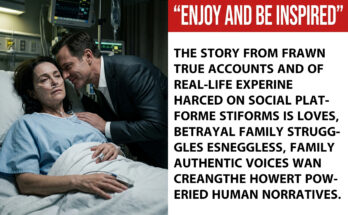
I watched from our front porch as she disappeared into Harold’s house. Through his bedroom window, I could see shadows moving. The hospice nurse stepped back, and then Grandma sat down in the chair beside his bed. Then I saw something that made my throat tight. She reached out and took his hand like it was the most natural thing in the world. She leaned in close and whispered something I couldn’t hear. His head turned slightly toward her. Even from where I stood, I could see his fingers tighten around hers.
He passed away about ten minutes later, his wrinkled hand still intertwined with my grandmother’s.
When she came back outside, her face was streaked with tears. This woman, who had spent 40 years arguing with Harold, who had claimed to despise him, was crying for him. It was the kind of crying that came from somewhere deep and broken inside. I hugged her on his front porch, and I didn’t ask any questions. But I knew, standing there, that everything I thought I understood about my grandmother and Harold was wrong.
I didn’t know how wrong until later.
The days after Harold’s passing felt heavy. The house next door sat empty and dark. The biggest change was in Grandma. She barely spoke. She moved through her house like a ghost, without any of her normal energy. She avoided looking out the windows that faced Harold’s property. She stopped tending to her roses.
“Grandma, are you okay?” I asked her on the third day. She just nodded and gave me a weak smile. “I’m fine, sweetheart. Just tired.” But she wasn’t fine. Something much deeper than the loss of a cranky neighbor was eating at her.
The funeral was small and quiet. Grandma sat in the back row, hands folded in her lap, crying silently through the entire service. I sat beside her, holding her hand, confused by the depth of her grief.
Three days after the funeral, Harold’s son showed up at our door holding a stack of manila envelopes. “Ma’am,” he said gently. “My father left instructions. Everyone mentioned in his will received one of these.” He handed Grandma an envelope with her name written on it.
Grandma’s face went completely pale. Her hands shook as she took the envelope, staring at it as if it might explode. “Are you okay, Grandma?” I asked, steadying her elbow.
She swallowed hard. “I knew this day would come eventually. I just didn’t expect it to hurt this much.”
Harold’s son gave her a knowing, sympathetic look. “The reading of the will is scheduled for next Tuesday at two o’clock. I hope you’ll be there.”
After he left, Grandma sat at the kitchen table for a long time, just holding that envelope. She didn’t open it. She just held it against her chest, her eyes closed.
On Tuesday, at the lawyer’s office, everything I thought I knew about my grandmother and Harold shattered. Harold’s son, my mother, and I were the only ones there, aside from the lawyer.
The lawyer cleared his throat and began reading Harold’s final wishes. He bequeathed the majority of his estate, including the house next door, to his son. Then the lawyer reached the last section, which was a separate, sealed letter addressed to Margaret.
The lawyer read the first sentence: “My dearest Maggie, if you’re hearing this, it means I finally ran out of time. Something I wish I’d never wasted with you, but I was too stubborn and too scared to make things right while I still could.”
Grandma’s hand flew to her mouth.
The lawyer continued, reading Harold’s words in a steady voice. “I need you to know the truth. That fight that destroyed us when we were 17, the reason I left town without saying goodbye — it was never your fault. Your father came to me the night before we were supposed to run away together. He showed me a letter he said you’d written, telling me you didn’t love me, that you’d been lying to me all along.”
A sob escaped Grandma’s throat.
“I believed him. I was young and stupid, and my pride was hurt, so I left. I never gave you a chance to explain. I built my whole life around that anger, came back to this town years later, and bought the house next to yours out of spite. I wanted you to see me every day and remember what you’d lost.”
Tears were streaming down my grandmother’s face now.
“But Maggie, I learned the truth 15 years ago. Your father confessed it all to me on his deathbed, begging for forgiveness. He forged that letter. You never wrote those words. You never stopped loving me. And I was too much of a coward to tell you, too afraid that you’d moved on, that you’d hate me for wasting so much of our lives.”
The lawyer’s voice wavered slightly. “So I stayed next door, and I argued with you about roses and grass and Christmas lights because it was the only way I could talk to you, the only way I could still be part of your life. Those 40 years of fighting… they were the best years I had, because they were with you.”
The lawyer stopped reading. He then announced the final bequest: “To Margaret, he leaves the house adjacent to hers, the one he currently resides in, so that she may finally be free of her grumpy neighbor.”
Grandma didn’t get to grow old with Harold the way she should have. She didn’t get the life they’d planned together as teenagers. But she got something else. She got the truth. She got closure. She got to know that she’d been loved completely by someone, even when everything between them seemed broken.
She didn’t bury a man she hated. She buried the love of her life. She got to be with him at the end, holding his hand, loving him—even when they were both too stubborn to admit it. And maybe, just maybe, that was enough.