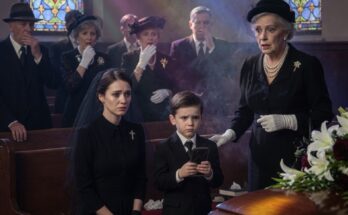
I never forgot the taste of fear. It was bitter, like the medicine my mother, Mara, couldn’t swallow without water that terrible afternoon.
I grew up with very little, but what we lacked in possessions, we made up for in love. Our home was a small, weathered house, but it was filled with warmth. That all changed the day my father died. The car accident happened so suddenly. One moment, he was there, ruffling my hair and promising a fishing trip; the next, police officers were at our door. I was only seven.
The loss broke something in my mother. She tried to hide it, tried to stay strong for me, but I saw how her shoulders slumped a little more each day. The bills piled up faster than she could count. My father’s modest income had been our lifeline, and without it, we were struggling just to survive.
“Mom, why are you crying?” I asked one evening, finding her at the kitchen table.
She quickly wiped her eyes and forced a smile. “I’m not crying, sweetheart. Just tired from work.”
“You’re always tired now,” I said softly, climbing into the chair beside her.
“I know, baby. But we’re going to be okay. We have each other, and that’s what matters most.”
Three years later, that promise began to crumble. Mom grew sick. It started with persistent coughs that echoed through the house at night, followed by fevers and weakness. Soon, there were days she couldn’t get out of bed at all.
I became her caretaker at ten. I learned to cook simple meals, though they often burned. I fetched groceries with the few dollars she gave me, counting every cent twice. I helped her to the bathroom when she was too weak to walk alone.
“Viktor, you’re such a good boy,” she whispered one afternoon. “You shouldn’t have to do all this.”
“I want to help you, Mom. You always took care of me. Now it’s my turn.”
“You’re ten years old. You should be playing with friends, not playing nurse.”
I shook my head stubbornly. “I don’t need friends. I have you.” She smiled, though tears glistened in her eyes.
The day everything fell apart started like any other terrible day. Mom’s medication sat on the nightstand, but our water pipe had burst during the night. Water pooled across the kitchen floor, and no matter how many times I tried the tap, nothing came out.
She needs to take her pills. Panic rose in my chest. She needs water.
I looked out the window at the massive mansion that loomed just down the street. I had passed it countless times. Rich people lived there. Rich people who probably had an endless supply of water.
My hands trembled as I walked up the long driveway. I pressed the doorbell and waited, my heart hammering.
When the man answered, I forced myself to speak. “I need water, please. My mom… she’s sick. Our pipe broke, and she needs to take her medication.”
He looked down at me with cold, assessing eyes. His expensive suit was perfect. I felt small and dirty in my worn-out clothes.
“Not my problem,” he said flatly.
“Please, sir. Just a bottle of water. Anything. She’s really sick.”
His lip curled. “I’m not responsible for your family’s poverty. Maybe if your father had worked instead of teaching you to beg, you wouldn’t be in this situation.”
My voice broke. “My father died. He died in a car accident. My mom is really, really sick. I just need a little water.”
“At your age, I was already earning my own money,” the man sneered. “Get off my property before I call the police.”
The door slammed so hard I flinched. I stood there for a moment, stunned and humiliated, before turning and running home with empty hands and burning eyes.
That night, everything got worse. I gave my mother water from the emergency jug, but it wasn’t enough to stop what came next. Someone knocked on our door after dark. It was a woman from child services, with a police officer.
“We received a report about unsafe living conditions,” the woman said gently, surveying our house.
I watched in horror as they questioned my mother, examined the burst pipe, and noted the lack of food. No matter how much Mom pleaded, no matter how many times I cried that I could take care of her, the decision had been made.
They took me away that very night. I pressed my face against the car window, watching my mother collapse on the front porch, sobbing and reaching for me. That image burned itself into my memory forever.
She died three months later. I learned about it from a social worker. I was eleven, and suddenly, I was completely alone. For years, the last image I carried was of my mother reaching for me, and beside that memory lived the cruel face of the man who had denied us water.
The next ten years were difficult. I moved through foster homes, never belonging anywhere. But I found refuge in school. Books became my escape, and science my sanctuary. I studied with fierce determination, dreaming of saving lives, of being someone who helped.
By eighteen, I earned a full scholarship to medical college. It was there, during my second year, that I met Sofia. She sat beside me in anatomy class. When she smiled at me, something in my chest loosened for the first time in years.
“You always look so serious,” she said one afternoon. “Do you ever relax?”
“I relax.”
“When? I’ve never seen it.” Her eyes sparkled.
Sofia laughed and closed my textbook. “Come on. Let’s take a real break. Tell me something about yourself that has nothing to do with medicine.”
I hesitated. “I like old movies. Black and white ones. They remind me of watching them with my mom.”
Her expression softened. “That’s sweet. I’d love to watch one with you sometime.”
Our relationship grew slowly. Sofia was patient with my silences and gentle with my guarded heart. She made me laugh. For the first time since childhood, I felt like I had a future that included happiness.
Two years passed. I was twenty, in my final year of medical school. Sofia was my anchor.
One spring evening, she brought it up over dinner. “I want you to meet my parents.”
My fork paused. “Your parents?”
“Yes. They’ve been asking about you forever.” She squeezed my hand. “I know it’s scary, but they’re really nice. My dad keeps saying he wants to meet the brilliant young man who’s stolen his daughter’s heart.”
I wanted to believe good people existed who judged others by their hearts.
“Okay,” I said finally. “When?”
“This Saturday?”
That Saturday, my hands were sweating. We drove through increasingly affluent neighborhoods. When Sofia pulled up to a massive mansion with iron gates, my breath caught.
“I know it’s a lot,” she said, almost apologetic. “Don’t let the house intimidate you.”
I followed her up the stone pathway, my heart pounding. Sofia rang the doorbell. I heard footsteps.
When the door swung open, my entire world stopped.
It was him. Adrian. The same man. Older now, with gray in his hair, but unmistakably the one who had slammed the door in my face ten years ago. The man who had destroyed my life.
“Sofia, sweetheart!” He pulled his daughter into a hug, then turned to me with an extended hand and a warm smile. “And you must be Viktor. I’ve heard so much about you. Welcome, son. Come in, come in.”
I shook his hand automatically, my mind screaming. I couldn’t speak. I couldn’t breathe. He didn’t recognize me at all.
I walked through the mansion in a daze. I sat down mechanically, reeling with memories of that terrible day.
“Viktor, are you okay?” Sofia whispered, touching my arm. “You look pale.”
“I’m fine,” I managed, though my voice sounded hollow.
Dinner was served. Sofia’s mother, Elena, kept the conversation flowing, asking about my studies.
“We’re so impressed,” Elena said warmly. “A full scholarship. That takes real dedication.”
“Thank you, ma’am,” I said quietly.
Adrian, Sofia’s father, leaned back. “I respect a young man who works hard. That’s how I built my business. Started from nothing and worked my way up.”
Started from nothing, I thought. He has no idea what nothing really means.
“Viktor’s amazing, Dad. He’s going to be an incredible doctor,” Sofia said, squeezing my hand.
“I’m sure he will be.” Adrian raised his wine glass. “To Viktor. Welcome to our family.”
My throat was tight. I reached for my water glass with a trembling hand, then set it down. The moment had come.
“May I have some water, please?” I asked quietly.
Adrian immediately stood up. “Of course, son! I like you already.” He filled my glass himself, setting it down with a smile.
I stared at the water, and something inside me snapped.
“That’s exactly what I asked you ten years ago,” I said. “Remember?”
The table went silent. Adrian’s smile faded. “I’m sorry, what?”
“Ten years ago. I knocked on your door. I was ten years old, and I asked you for water.” My hands were shaking. “My mother was dying. Our pipe had burst. She needed water to take her pills.” I fixed my gaze on him. “You looked at me, a desperate child, and told me to get off your property before you called the police. You sneered that my father should have worked instead of teaching me to beg. You denied my dying mother the one thing that might have helped her that night.”
Adrian was white. “I… I don’t know…”
“You don’t remember the little poor kid with the worn-out clothes? I was your neighbor. My mother was taken by child services that night because of the conditions in our home. She died three months later.” I stood up. The fine china, the wealth, the smiles—it all dissolved. “I’m sorry, Sofia. I cannot be part of this family.”
I turned and walked out of the mansion.
I found myself at the cemetery as the sun set, kneeling at my mother’s grave, shaking with sobs. “Mom, I don’t know if I did the right thing. He destroyed us. He took you away from me. And I saved him.” My voice broke. “Was I wrong?”
I wiped my eyes and looked up. Someone had spray-painted graffiti on the old iron fence nearby. One message caught my eye: “U’R RIGHT.”
Those two simple words in messy blue paint loosened something in my chest.
“Viktor,” I heard.
I turned and saw Adrian standing a few feet away, his face wet with tears. The man fell to his knees on the grass.
“I’m so sorry,” he choked out. “God, I’m so sorry. I don’t expect you to forgive me. What I did was unforgivable.”
I stood slowly. “You have no idea what you took from me.”
“I know.” His whole body shook. “I was cruel. I was heartless. I never thought about the lives I destroyed. Your mother, you, all those years you suffered.” He looked up at me. “I can’t change what I did. But I will spend the rest of my life trying to make up for it, if you’ll let me.”
I looked down at this broken man who had once seemed so powerful. Now he just looked small, filled with regret.
“I hated you for so long,” I whispered.
“I deserve your hate.”
“Maybe,” I cracked. “But my mother didn’t raise me to carry hate. She raised me to be kind, even when the world wasn’t kind to me.”
I took a shaky breath and extended my hand. “I can’t promise I’ll ever fully forgive you. But I won’t let what you did turn me into someone like you used to be.”
Adrian grasped my hand and pulled himself up. He pulled me into an embrace, and surprised by my own reaction, I hugged him back. Ten years of anger and pain poured out of both of us.
When we separated, Sofia was standing at the cemetery entrance, her mother beside her. Sofia ran to me, and I held her tight. “I’m sorry,” I whispered.
“No,” she said firmly. “You have nothing to apologize for.”
I looked over her shoulder at the graffiti on the fence. “U’R RIGHT.” Two words that changed everything.