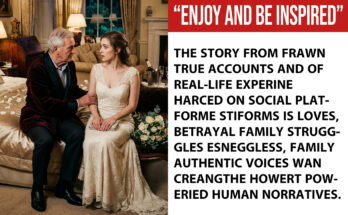
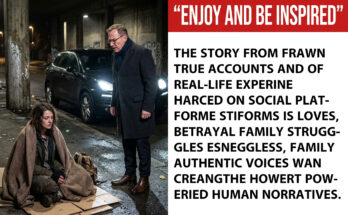
I spent eighteen years being told I was a ghost in my own home. In the Carmichael Estate, a sprawling twelve-acre fortress of Georgian brick and white columns in Wellesley, Massachusetts, silence wasn’t just a lack of sound; it was a weapon. My stepmother, Diane Shaw Carmichael, was a master of the silent cut. She would sit across from me at the dinner table, her movements as calculated as a chess grandmaster’s. The sterling silver forks would clink against bone china, a rhythmic, metallic punctuation to her cruelty.
“It’s strange, William,” she would say, her voice just loud enough to carry to my father at the head of the table. “Elena looks nothing like the Carmichael line. Not the eyes, not the jaw. It’s almost as if she’s an intruder.”
My brother, Preston, would follow with that sharp, barking laugh that made my shoulders lock in a permanent state of tension. “Maybe Mom had a fling with the help while you were away, Dad. A little charity work for the neighborhood.”
My real mother had died when I was three. I have no memories of her face, only a ghost of a scent—something floral and soft, like lilies in the rain. That scent vanished the day Diane moved in. For nearly hai decades, I lived as a biological anomaly, a guest in my own lineage. At seventeen, I realized that some houses are built to be escaped. I packed a duffel bag at 2:00 a.m., walked past the hissing fountain in the circular driveway, and didn’t look back for seventeen years.
I became Elena Carmichael, a senior financial analyst at Morrison and Clark in Boston. I lived in a modest one-bedroom in Beacon Hill, drove a battered Subaru with rust spots on the bumper, and built a life out of numbers—because numbers didn’t lie. People did.
The email came on a Tuesday. Not a call, not a telegram. A cold, digital notification from Lawrence Rothstein, my father’s attorney. William Carmichael had passed away from a stroke. Your presence is required for the reading of the will.
Driving my seven-year-old Subaru back to Wellesley felt like piloting a tugboat into a harbor of yachts. As I pulled up the long driveway, I saw Diane standing at the massive front window. She didn’t look like a grieving widow; she looked like a general bracing for an invasion.
Inside, the house was a hive of vultures. Distant cousins and business associates whispered as I passed. “Seventeen years without a visit,” I heard one murmur. “She’s only here for the inheritance.”
Preston stood in the foyer, draped in a Tom Ford suit that cost more than my car. He wore a Rolex and a smirk that was even more expensive.
“Elena,” he said, his voice projecting for the benefit of the room. “I’m surprised you found the place. The GPS doesn’t usually track ‘the disowned’.”
“I’m just here for the fine print, Preston,” I replied, refusing to take his outstretched hand.
Lawrence Rothstein appeared, a man carved from old parchment and legal precedents. “Everyone, please. To the library.”
As we filed into the room where my father used to read to me—before the light left this house—I felt a familiar dread. Preston and Diane took the front row, sitting like royalty awaiting a coronation.
“Before we begin,” Lawrence said, adjusting his wire-rimmed glasses, “there is a matter of procedural clarity that must be addressed.”
Preston stood up, turning to face the thirty-two people in the room. “Actually, Lawrence, let’s be blunt. My father’s will states that his estate is to be divided among his biological children. But for years, there has been a cloud over Elena’s legitimacy.”
The room erupted. Outrage and agreement clashed in a cacophony of elite bickering. I sat in the back, my heart a dull thud in my chest.
“In the interest of justice,” Preston continued, “I demand a DNA test before a single cent is touched.”
“Fine,” I said, my voice cutting through the noise. I stood up, meeting Preston’s victorious gaze. “I’ll take the test. But if we’re honoring the ‘biological’ clause, we should be thorough. Everyone claiming a share of the inheritance gets swabbed. No exceptions.”
Preston laughed, the sound echoing off the mahogany shelves. “Fine by me, little sister. I’ve got nothing to hide.”
But as he spoke, I caught a glimpse of Diane. For the briefest of seconds, her composure shattered, and a look of pure, unadulterated terror flickered across her face.
The following week was a blur of sterile white walls and the humming of refrigeration units at GeneTech Labs in Cambridge. Dr. Rachel Morrison, a forensic DNA specialist who looked like she hadn’t smiled since the late nineties, oversaw the collection.
Preston went first, swaggering into the office like he was there to accept an award. He winked at me on his way out. “Clarity is coming, Elena. Hope you like your tiny apartment, because you’re going to be in it for a long time.”
When it was my turn, my hands were slick with sweat. Dr. Morrison swabbed the inside of my cheek with clinical precision.
“Nervous?” she asked, her voice neutral.
“I’ve spent half my life being told I don’t belong here,” I said. “Wouldn’t you be?”
“The DNA doesn’t care about what people say,” she replied. “The markers are either there, or they aren’t. Results in five to seven days.”
I spent those days in a Courtyard Marriott. I couldn’t go back to my apartment, and I couldn’t stomach staying in the house of shadows. The funeral took place that Thursday at St. Paul’s Church. It was a grand, hollow affair. Four hundred people in black, mourning a man they only knew through balance sheets.
I was ushered to Section C, back row, seated behind distant cousins and business partners who didn’t even know my father’s middle name. The program was a masterpiece of exclusion: Wife: Diane Carmichael. Son: Preston Carmichael. Other Relatives: Elena Carmichael.
Diane gave a eulogy that was more of a performance than a farewell. She spoke of “William’s greatest pride, his son Preston.” She never uttered my name. Not once.
After the service, as the elite moved toward the reception for champagne and shrimp cocktails, I stood alone by the stone archway of the church. A hand touched my arm.
It was Rosa Martinez, the housekeeper who had been with my father since before I was born. She looked aged, her eyes clouded with tears and something else—fear.
“Miss Elena,” she whispered, her voice barely audible over the wind. She pressed a heavy, iron key into my palm. “Third floor study. The locked one. Your father… he wanted you to see it before the lawyers finish. He told me to wait until the end.”
“What is it, Rosa?”
“The key to the truth,” she said, before disappearing into the crowd.
I waited cho đến 1:00 a.m. that night. The estate was dark, the security lights casting long, jagged shadows across the lawn. I let myself in through the side entrance and climbed the stairs to the third floor. The study had been off-limits for as long as I could remember—a private sanctuary Dad had locked after his stroke.
The key turned with a heavy, satisfying clack. I stepped inside and flipped the switch.
My breath hitched. The walls weren’t lined with books. They were covered in photographs. Professional surveillance photos.
Thousands of them. Me, at twenty-one, walking to a lecture in Boston. Me, at twenty-five, sitting in a coffee shop. Me, last year, carrying groceries into my Beacon Hill apartment. My father hadn’t ignored me. He had watched my entire adult life from the shadows.
On the desk sat a red folder labeled CONFIDENTIAL. I opened it, and the world began to tilt. Inside was a DNA test dated twelve years ago.
Subject: Preston Carmichael. Result: 0% biological relationship to William Carmichael.
My knees hit the floor. I grabbed a second document—medical records from 2013. Preston had needed a kidney transplant for a minor genetic disorder. Dad had volunteered to be the donor. That was when the doctors told him the truth. They weren’t just incompatible; they were genetically unrelated.
I heard a floorboard creak in the hallway. A shadow fell across the doorway, and I realized I wasn’t alone.
I spun around, the DNA report crumpled in my hand. Preston stood in the doorway, his tie loosened, a glass of scotch in his hand. He looked at the photos on the wall—his sister’s life documented like a high-stakes investigation—and then his eyes landed on the red folder.
“What are you doing in here?” he hissed, stepping into the room. “This room is off-limits. I’m calling security.”
“Read this, Preston,” I said, my voice trembling with a mixture of rage and pity. I held out the report from 2013.
He snatched it, his eyes scanning the lines. I watched as the color drained from his face, replaced by a sickly, grey pallor. The glass of scotch slipped from his fingers, shattering on the hardwood.
“This is fake,” he whispered. “You planted this. You’re trying to mess with my head before Friday.”
“It’s from Mass General, Preston. Look at the date. It’s from khi you needed the transplant. Dad volunteered to give you a kidney, and the universe told him the truth instead. He knew. He knew for twelve years that you weren’t his.”
Preston’s legs buckled. He fell into my father’s leather chair, the very seat of power he had been so eager to claim. “Then tại sao? Why did he keep me? Why did he let me believe…”
“Because he loved you anyway,” I said, the words tasting like ash. “Because he was a better man than Diane. He raised you, he protected you from the truth, and he watched me from a distance because he was too ashamed to admit he’d been fooled by your mother.”
I pulled out a letter from the bottom of the folder. Shaky, uneven handwriting. A stroke victim’s final effort.
Elena, I failed you, it began. When your mother died, I was a hollow shell. Diane appeared like a miracle, but she was a parasite. I married her too fast. When Preston was born, I didn’t question it. But the transplant revealed the lie. Diane had an affair with a colleague, Marcus Bennett. I tried to divorce her—I did divorce her, legally, five years ago—but she stayed. She used my stroke to isolate me. She blocked your calls. She told me you hated me. I hired the investigators just to see your face. This will is my last chance to make things right. I’m sorry, my daughter. I love you. I always—
The letter ended there. The pen had trailed off the page.
Preston looked up at me, his eyes wet. “The divorce… they were already divorced?”
“Check the papers, Preston. She’s been a squatter in this house for five years, playing the role of the grieving wife trong khi she controlled Dad’s medical decisions.”
“She made me hate you,” Preston whispered. “She told me you were the one who didn’t belong.”
“And tomorrow, at 10:00 a.m., the whole world is going to find out the truth,” I said.
Preston stood up, his face hardening into a mask of pure horror. “Elena, if this comes out… I have nothing. I don’t know who I am.”
“You’re the child of a woman who built a kingdom on a lie,” I said. “Whatever happens next is on her.”
I walked out of the room, leaving him sitting in the dark among the photos of the sister he had spent a lifetime despising.
Friday morning arrived with the oppressive weight of a New England winter storm. The meeting was held at Lawrence Rothstein’s office in downtown Boston—a corner suite on the 14th floor overlooking the Boston Common.
Diane sat in the center of the room, draped in a black St. John suit and pearls. She looked like the image of dignity, nhưng her fingers were shredding a lace handkerchief in her lap. Preston sat beside her, but he was leaned away, his eyes fixed on the floor. He hadn’t spoken to her in twenty-four hours.
I sat across from them, the red folder heavy in my lap. The second cousins and minor beneficiaries filled the back of the room, sensing the blood in the water.
Lawrence Rothstein opened his leather briefcase with a deliberate, agonizing slowness. “Ladies and gentlemen, we are here to finalize the distribution of the William Carmichael Estate, valued at approximately $47.3 million.”
He pulled a sealed envelope from the GeneTech Labs. “As per the biological clause added to the will two years ago, we have the results of the mandatory DNA testing.”
The silence was so thick it felt physical.
“Elena Carmichael,” Lawrence read, his voice steady. “Confirmed 99.999% biological match to William Carmichael. She is the legal and biological heir.“
I let out a breath I felt like I’d been holding since I was seventeen. Diane’s posture shifted; she looked at me with a cold, desperate hope. She still thought Preston was safe.
“Preston Carmichael,” Lawrence continued. He paused, his eyes flicking over the paper. He didn’t look at me. He looked at Preston.
“Zero biological relationship detected. There is no genetic match between Preston Carmichael and the deceased.”
The room didn’t erupt this time. It went cold.
“That’s a lie!” Diane screamed, lunging to her feet. “Lawrence, you’ve been bought! Elena tampered with the samples! This is fraud!”
“It’s not fraud, Diane,” I said, sliding the red folder across the mahogany desk. “It’s history. Dad knew. He’s known since 2013.”
Lawrence opened the folder, his eyes widening as he saw the medical records and the secret DNA test. He looked at Diane, then at the divorce decree.
“Mrs. Carmichael—or should I say, Ms. Shaw,” Lawrence said, his voice dropping to a dangerous register. “This document indicates your marriage to William was dissolved in September of 2019. You have been residing in the Wellesley house under false pretenses and have no legal standing as a spouse.”
Diane turned to Preston, her voice a frantic, high-pitched warble. “Preston, honey, it was for us! I did it to protect your future! William was a cold man, he didn’t understand—”
“Who is he?” Preston asked. His voice was hollow, dead. “Who is my father, Mom?”
Diane’s mouth worked soundlessly. “Marcus Bennett,” she finally whispered. “It was… it was a mistake.”
“A thirty-one-year mistake,” Preston said. He stood up, looking at his mother as if she were a stranger. “You made me a weapon. You made me torture Elena for a crime you committed. You’ve turned my entire life into a punchline.”
Lawrence cleared his throat. “There is one final codicil to the will. Mr. Carmichael left a letter to be read in the event that the biological clause was triggered.”
He began to read. My father’s words, now amplified by the law. He detailed the isolation, the blocked calls, the way Diane had used Preston’s status to keep William compliant after his stroke. He finished with a direct order: The estate passes in its entirety to my daughter, Elena. Preston Shaw and Diane Shaw are to be removed from all properties immediately. They are to receive nothing.
Diane sank into her chair, the pearls around her neck looking like a noose. Preston didn’t cry. He just walked to the window and stared out at the city he no longer owned.
The aftermath was a clinical demolition.
Diane moved to a condo in Boca Raton, Florida. She tried to sue for a portion of the estate, nhưng the divorce decree and the evidence of medical coercion were ironclad. She lives on a small pension from her own family, a far cry from the Wellesley millions. We haven’t spoken since the day in Lawrence’s office.
Preston disappeared for a while. He moved to Portland, legally changed his name to Preston Shaw, and started over. He didn’t contest the will. He didn’t ask for a dime.
I stayed in Boston for a month, closing out the estate. I walked through the Georgian brick house, my footsteps echoing in the empty halls. I fired the security team Diane had hired. I kept Rosa, giving her a pension that would allow her to retire in luxury, though she refused to leave until the house was “settled.”
I stood in the third-floor study one last time. I had the surveillance photos taken down, but I kept the one of me at twenty-five, sitting in that coffee shop. In the background of the shot, through the window, you could see a black town car parked across the street. My father had been in that car. He had been right there.
I realized then that DNA is just a blueprint. It’s the materials you choose to build with that matter. My father had chosen a lie for twelve years because he loved the son he raised. I had chosen the truth because it was the only way to be free.
I turned the Carmichael Estate into a non-profit: The Carmichael Foundation for Children Without Parents. It provides scholarships, housing, and—most importantly—therapy for kids who have been told they don’t belong. The fountain in the driveway no longer hisses; it sings.
Last week, a letter arrived at the foundation. No return address, just a Portland postmark. Inside was a single, handwritten sentence:
Thank you for not destroying me worse than I destroyed myself. — P.
I put the letter in the desk drawer, next to my father’s unfinished note. I looked at the line where his pen had trailed off: I love you, my daughter. I always—
I took a pen and finished it for him.
I always knew.
Justice doesn’t belong to the blood. It belongs to the people who are brave enough to stand in the light. I walked out of the study, locked the door, and for the first time in thirty-four years, I felt like I was finally home.