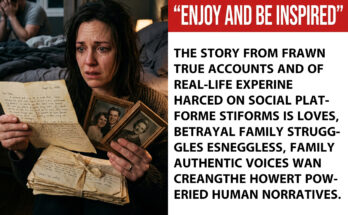
This is the chronicle of my own private coup d’état—the moment I stopped being a tenant in my own life and became the architect of a dynasty’s destruction. They say that when you’re drowning, the world goes quiet. But for me, the silence began on a Tuesday in March, on the front porch of a pale-blue house in Indianapolis.
The Indiana wind was a cruel, biting thing that day, smelling of wet earth and impending sleet. I stood there, clutching the handle of a plastic infant carrier, my body still vibrating with the phantom echoes of the maternity ward. I had been discharged from St. Vincent Medical Center only two hours prior. My hospital bag, stuffed with mesh undergarments and half-empty bottles of peri-wash, sat at my feet like a slumped confession of my vulnerability.
I reached for the brass handle of our front door, expecting the warmth of the foyer and the smell of the lemon-scented candles I’d lit before my water broke. Instead, the door remained stubbornly, impossibly locked.
Through the frosted glass, I saw a silhouette. Daniel Carter, the man I had married three years ago under a canopy of oak trees and promises, stood in the entryway. He didn’t reach for the lock. He stood with one hand braced against the frame, his face flushed a dark, reckless red.
“You can’t come in,” he shouted, his voice muffled but unmistakable through the wood. “You gave birth to a girl, Emily. I told you. I wanted a son.”
I blinked, the wind whipping my hair across my face. I was sure the post-birth exhaustion was causing auditory hallucinations. Our daughter, Charlotte, made a tiny, bird-like sound in her car seat.
“Daniel, move,” I said, my voice cracking with a mixture of confusion and rising panic. “I just had a major surgery. My stitches hurt. It’s freezing out here. Open the door.”
He didn’t move. He kicked the door open just wide enough to scream at me, but his body blocked the threshold like a barricade. “I told you what I needed! Someone to carry the Carter name! Someone to inherit the business! Instead, you gave me… this.” He gestured toward the car seat as if it were a defective piece of luggage.
“This?” I repeated, the word tasting like copper in my mouth. “She is your child, Daniel. She has your eyes.”
When I tried to push past him, desperate for the heat of the house, Daniel’s hand flew out. It wasn’t a shove. It was a sharp, stinging slap that cracked through the March air. My head snapped to the side, and for a second, the world turned into a kaleidoscope of grey sky and white pain. Before I could steady myself, he snatched my diaper bag from the porch and threw it into the wet grass of the driveway.
“Get out,” he barked, his voice devoid of any humanity. “You and that girl are not staying in my house.”
The door slammed. The deadbolt clicked—a final, metallic sentence. I stood there, one hand pressed to my burning cheek, the other still white-knuckled on the car seat handle. I looked at the window. The curtain shifted—the hand of a coward retreating into the shadows.
As I turned to stumble toward the car, my vision blurring with tears of rage, I noticed a small, black device perched under the eaves of the porch—a doorbell camera I had forgotten we installed. It was blinking red, recording every second of the man I loved dismantling our lives.
The drive to Carmel was a blur of highway lights and the rhythmic, frantic screaming of a newborn who knew, instinctively, that her world had just collapsed. My hands were shaking so violently that I could barely keep the steering wheel straight. Every bump in the road sent a jolt of agony through my midsection, a visceral reminder of the life I had just brought into a world that apparently didn’t want her
I pulled into the driveway of a brick colonial house, the home of my older sister, Rachel Morgan. Rachel was the antithesis of the Carter family—she was loud, fiercely loyal, and possessed a mind like a forensic accountant.
The front door flew open before I could even unbuckle my seatbelt. Rachel ran to the car, her face a mask of horror as she saw me—disheveled, bleeding slightly from a cut on my lip, clutching a screaming baby.
“Em? What on earth happened? Why aren’t you home?”
I couldn’t force the words out. I just pointed to my face, where the imprint of Daniel’s hand was beginning to bloom into a dark purple bruise. Rachel’s silence lasted half a second, then turned into a low, dangerous growl.
Inside, under the warm kitchen lights, the smell of brewed coffee and lavender tried to settle my nerves. Rachel hovered, wraping me in a thick blanket while she expertly soothed Charlotte. But her eyes remained fixed on my cheek.
“He threw us out,” I finally whispered, my voice sounding like it belonged to a ghost. “He said… because she’s a girl, she’s not a real Carter. He said we don’t belong there.”
Rachel set the baby down in a borrowed bassinet and sat across from me. She didn’t offer platitudes. She didn’t say it would be okay. Instead, she pulled out her laptop.
“Daniel’s been acting strange for months, Emily. The way he talked about the business, the way he hovered over the ‘succession’ plans. I didn’t want to worry you while you were pregnant, but my gut was screaming.”
She began typing with a ferocious intensity. “Open the Marion County property app,” she commanded.
“Why? It’s our house, Rachel. We bought it two years ago.”
“Just do it.”
I pulled up the site on my phone, my pulse quickening as the page loaded. I entered our address: 1242 Willow Brook Lane. I waited for the owner’s name to appear. I expected ‘Daniel and Emily Carter.’
The screen blinked. I froze. The owner of the house was not Daniel. It wasn’t me.
The owner was Margaret Holloway.
“His mother?” I whispered. The air in the room felt suddenly thin. “He moved the house to his mother?”
Rachel turned her screen around, showing a zoomed-in view of the transfer history. “Look at the date, Emily. January 19th. You were eight months pregnant. That was the day he took you to the 4-D ultrasound and cried when he saw the baby’s face. He wasn’t crying because he was happy; he was crying because he’d just finished stealing your home.”
The realization hit me with the force of a physical blow. January 19th. I remembered that day with agonizing clarity. We had gone to Trattoria Rossi afterward to celebrate. Daniel had toasted to “our future” and “the legacy we’re building.” He had held my hand across the table, his thumb stroking my wedding ring.
He hadn’t been building a legacy. He had been conducting a liquidation.
“He moved the deed from his C&C Holdings LLC directly to Margaret,” Rachel explained, her voice a sharp, calibrated instrument of logic. “It’s a classic fraudulent conveyance. He thought that by putting it in her name, he could protect the asset from a divorce settlement. He planned this, Em. He didn’t just lose his temper today. He’s been drafting the exit strategy for months.”
I looked at Charlotte. She was sleeping now, her tiny chest rising and falling in a rhythm of innocence that broke my heart. “So he waited,” I said, the pieces of the puzzle clicking into place with sickening precision. “He waited to see if the ‘asset’ was a boy. He waited to see if I provided the ‘heir’ he wanted. And the second I didn’t…”
“The second you didn’t, you became an overhead cost he wanted to cut,” Rachel finished. “But he made a mistake. He forgot that you aren’t just a wife. You’re a mother. And mothers are the best auditors in the world when their children are threatened.”
That night, I didn’t sleep. I sat in Rachel’s guest room, the blue light of my phone illuminating the dark. I began my own investigation. I scrolled through months of text messages. I found one from December, a seemingly “joking” comment Daniel had made: If this baby is a girl, don’t expect me to celebrate. I’ve got enough estrogen in my life with my mother.
At the time, I had laughed it off. Now, it looked like a premeditated statement of intent.
I photographed my face. I photographed the bruise on my hip where I’d hit the doorframe. I recorded a voice memo of everything I remembered—the coldness in his eyes, the sound of the deadbolt.
The next morning, Rachel drove me to a high-rise in downtown Indianapolis. We weren’t going to a doctor. We were going to see Laura Bennett, a family law attorney known as “The Velvet Hammer.”
Laura’s office smelled of old leather and expensive stationery. She listened to my story without interrupting, her expression a mask of professional neutrality that only slipped when I mentioned the property transfer date.
“January 19th,” Laura repeated, writing the date in a heavy black ledger. “While you were in the third trimester. That is exceptionally bold. And exceptionally stupid.”
Laura leaned across her desk, her eyes locking onto mine. “Emily, your husband thinks he’s playing a game of checkers. He thinks because the house is in his mother’s name, you’re homeless. He’s about to find out that I play chess. But first, I need to know—did he mention the ‘Family Restructuring Agreement’ he tried to get you to sign last year?”
I blinked, racketing my brain through the fog of the last few months. “The tax paperwork? He told me it was a standard update for the LLC. He said it would help with the baby’s college fund.”
Laura nodded, a grim smile playing on her lips. “He didn’t just move the house. He tried to move your entire identity into a corner where you had no legal standing. But he forgot one crucial detail: Indianapolis law regarding the ‘marital residence’ is very specific. You cannot be unilaterally excluded from a home you’ve contributed to, regardless of whose name is on the deed.”
“But his mother owns it now,” I argued.
“On paper, perhaps,” Laura said, standing up and smoothing her suit. “But in the eyes of a judge, a transfer made during a high-risk pregnancy to a direct family member for zero consideration? That’s not a ‘restructuring.’ That’s a fraud. And we’re going to audit every cent that went into that house.”
That afternoon, Laura filed for an Emergency Protective Order and temporary custody. She also filed a motion for Exclusive Use of the Marital Residence.
Then, the phone rang. It was Daniel.
I put it on speaker, my heart hammering against my ribs. Rachel stood by the window, her jaw set.
“Emily,” Daniel’s voice was eerily calm, the rage of the porch replaced by a condescending irritation. “Mom says you’ve been digging into the county records. I hope you realize how pathetic that looks.”
“I realize that you stole our home while I was carrying your child, Daniel,” I said, my voice steadier than I expected. “I realize you assaulted me on the day I came home from the hospital.”
“I was upset!” he snapped. “I had expectations! You knew how much a son meant to the Carter legacy. And as for the house—it’s family property. Margaret has always been the silent partner. You wouldn’t understand how high-level assets work.”
“I understand enough to know that a man who hits his wife and rejects his daughter doesn’t deserve a legacy,” I replied. “I’m done, Daniel.”
“You’re done when I say you’re done,” he hissed. “You have nothing. No house, no savings—I’ve frozen the joint accounts. You’re going to come crawling back and sign the settlement my mother’s lawyers are drafting, or you’ll be raising that girl in a shelter.”
Rachel gestured frantically for me to keep him talking. “A settlement?” I asked. “What settlement?” Daniel laughed, a cold, hollow sound. “The one where you admit you left voluntarily because you couldn’t handle motherhood. If you do that, I might let you see the girl on weekends. If not… well, Margaret has a lot of friends in the court system.”
The next few days were a flurry of tactical maneuvers. Laura Bennett moved like a shadow, serving papers to Daniel at his corporate office in front of his board of directors. The “Carter Legacy” was beginning to leak, and the board didn’t like the smell of a domestic violence investigation.
But the real turning point came from an unexpected source.
Our neighbor on Willow Brook Lane, a retired teacher named Linda Perez, called Rachel. She had seen me on the porch. She had seen the diaper bag fly through the air. And she had something Daniel hadn’t accounted for.
“I have a Nest camera facing the street,” Linda told us over tea in Rachel’s kitchen. “I’ve never liked Daniel. The way he spoke to the landscapers, the way he looked at you like you were an ornament. I saved the footage from that morning. All of it.”
We watched the video on Rachel’s laptop. There I was, pale and frail, holding Charlotte. There was Daniel, looming over me like a titan of spite. We watched the slap—the sharp, visceral motion that made the paramedics who saw the later photos winced. We watched the door slam.
“It’s perfect,” Laura said when she saw the clip. “He claimed in his initial response that you ‘left in a fit of post-partum hysterics.’ This video proves he expelled a medical patient and a newborn into the cold. That’s not a ‘misunderstanding.’ That’s a crime.”
By the time the hearing for the temporary orders arrived, the “Saint Margaret” mask was also starting to crack. Margaret Holloway had left a series of indignant voicemails on my phone, accusing me of “weaponizing a family restructuring” and “ruining her son’s reputation over a slap.”
I saved every single one. Every word was a nail in the coffin of their defense.
The morning of the hearing was grey and heavy with Indianapolis humidity. I wore a navy dress that Rachel had bought me—it was professional, modest, and hid the fact that I was still wearing a maternity support belt. Charlotte was with Rachel in the hallway. I walked into the courtroom alone, my head held high.
Daniel was there, sitting with a high-priced lawyer who looked like he’d rather be anywhere else. Margaret was in the front row, her pearls gleaming like shark teeth.
The judge, a woman in her late fifties named Judge Sarah Miller, looked through the file with a terrifyingly neutral expression. Then, she looked at the video.
The silence in the courtroom as the slap echoed through the speakers was deafening.
Judge Miller paused the video on the frame where Daniel was pointing to the driveway. She looked at Daniel, then at Margaret, then back at me. “Mr. Carter,” she said, her voice like cracking ice. “Before we discuss the property transfer of January 19th, I have a question about your definition of ‘de-escalation.’ Because what I see here is a man committing a felony.”
The hearing was a massacre.
Daniel’s lawyer tried to argue that the property transfer was a “legitimate internal business transaction” meant to protect the family from a pending lawsuit. He tried to frame Daniel’s actions as “situational stress” caused by the pressure of the Carter business.
Judge Miller wasn’t buying it.
“A ‘legitimate transaction’ that excludes the mother of his child during a high-risk pregnancy?” she asked, peering over her glasses. “And you, Mrs. Holloway—you accepted this deed knowing your daughter-in-law was eight months pregnant?”
Margaret stood up, her face flushing. “My son handles the finances! I am a woman of standing in this community—”
“You are a woman who is currently being investigated for fraudulent conveyance,” the judge snapped. “Sit down.”
The ruling was delivered with the speed of a guillotine. I was granted Temporary Sole Physical Custody of Charlotte. Daniel was granted only supervised visitation, contingent on a full psychological evaluation.
But the real blow came next.
“The court finds that the petitioner was unlawfully excluded from the marital residence,” Judge Miller announced. “Despite the transfer to Margaret Holloway, the court grants Emily Carter Temporary Exclusive Occupancy of the home at 1242 Willow Brook Lane. Mr. Carter has two hours to remove his personal belongings under police supervision.”
Daniel looked like he’d been struck. Margaret looked like she was about to have a stroke.
“But it’s my house!” Margaret shrieked.
“It’s a crime scene, Mrs. Holloway,” the judge replied. “And until the final audit of the Carter assets is complete, nobody is moving a single piece of furniture without the court’s permission.”
Outside the courtroom, Daniel finally approached me. He didn’t look like the titan of industry anymore. He looked small. He looked like the coward I had seen through the frosted glass.
“You really did this,” he said, his voice trembling with a mixture of disbelief and hate. “You turned everyone against me over one mistake.”
“One mistake?” I asked, looking him dead in the eye. “The transfer was a mistake? The lies were a mistake? Rejecting your daughter because of her gender was a mistake? No, Daniel. Those were choices. And today, you’re just seeing the bill.”
As Daniel turned to walk away, his mother grabbed his arm, whispering something into his ear. She looked at me, a chilling smile spreading across her face. “Enjoy the house while you can, Emily,” she called out. “You forgot about the second mortgage I took out in your name using the power of attorney you signed three years ago.”
The air in the pale-blue house smelled of Daniel’s cologne and the lingering scent of Margaret’s expensive floor wax. It felt like a haunted house, a museum of a life that had never actually existed. But as I walked into the nursery, I saw the green walls and the crib waiting beneath the mobile of stars.
I sat on the rocking chair, holding Charlotte. She was two weeks old now, and the world was finally starting to settle.
Margaret’s threat about the second mortgage had been her final gambit, but she had underestimated Laura Bennett. We had discovered that the “power of attorney” Margaret used had been forged—Daniel had signed my name while I was in the hospital for a previous scare. It wasn’t a debt; it was identity theft.
By summer, the Carter empire had effectively dissolved. The fraudulent conveyance was overturned, and the house was returned to the marital estate. Daniel was forced to sell his shares in the business to pay for the mounting legal fees and the settlement Laura had negotiated.
He didn’t just lose his house. He lost his reputation. The board of directors ousted him, and the “Carter Legacy” became a punchline in the Indianapolis business journals.
I kept the screenshot of the property record—the one Rachel had shown me that first night. I framed it and put it in my home office. Not as a reminder of betrayal, but as a reminder of the moment I found my voice.
One afternoon, a few months later, I was sitting on the porch. The Indiana sun was warm now, the March wind a distant memory. I was watching Charlotte play on a blanket in the grass.
A car pulled up—a modest sedan, not the luxury SUVs the Caldwells favored. A woman stepped out. It was Linda Perez, the neighbor with the camera.
“I brought some lemon cake,” she said, smiling. “And I wanted to see how the world-record holder for the fastest audit is doing.”
I laughed, a genuine, deep-seated sound that felt like it was healing the cracks in my soul.
“We’re doing well, Linda. We’re doing very well.”
I realized then that Daniel had tried to lock me out of a house, thinking it was my only source of power. He hadn’t realized that the house was just wood and stone. The real power was the truth I carried, the sister who stood by me, and the daughter who would grow up knowing that her value was never, ever up for negotiation.
The audit was finally over. The balance sheet was clear. And for the first time in my life, I wasn’t just a tenant. I was the owner of my own destiny.