You sit frozen in that little café in Narvarte long after Roberto disappears through the glass door.
His unfinished coffee cools on the table. The sugar packet he never opened lies beside the saucer, damp from the ring of his cup. Outside, people keep walking, cars keep honking, vendors keep shouting, but inside your body, the whole world has gone silent.
“Ask your family.”
Those three words keep moving through your mind like a knife being turned slowly.
At first, you tell yourself he was confused. Hungry people say strange things. Broken people blame the past because the present is too cruel to hold. But Roberto had not sounded confused.
He had sounded terrified.
You pay the bill with hands that will not stop shaking. The young waitress looks at you with careful concern, but you cannot explain why a man collecting cans under the sun has just made your perfect life feel like a crime scene. You leave a tip too large for the coffee and walk back to your SUV.
For several minutes, you just sit behind the wheel.
You stare at your reflection in the rearview mirror: perfect lipstick, diamond earrings, silk blouse, the face of a woman who rebuilt herself after divorce. Your mother always says you landed on your feet. Your brother says you upgraded. Your new husband, Alejandro, says Roberto was a weak man who chose failure.
But Roberto had once stayed awake three nights grading exams because one student’s scholarship depended on it.
A weak man would not have done that.
You drive straight to your mother’s house in Coyoacán.
The house looks exactly the way it always does: blue gate, white walls, bougainvillea spilling over the balcony like a painting too pretty to trust. Your mother’s gardener is trimming the hedges with surgical precision. Through the front window, you see movement inside, the soft gold glow of afternoon lamps, the kind of warmth that used to mean home.
Now it looks staged.
Your mother, Elena, opens the door before you knock twice.
She is wearing pearls at four in the afternoon. Her hair is pinned into its usual elegant twist, and she smells faintly of expensive powder and orange blossom perfume. When she sees your face, her smile falters for half a second.
That half second tells you more than words.
“Mariana,” she says. “What happened?”
You step inside without greeting her.
“I saw Roberto today.”
The silence changes immediately.
It is not dramatic. No vase breaks, no thunder rolls, no music swells. But your mother’s fingers tighten around the edge of the door, and the pearls at her throat shift as she swallows.
“Where?” she asks.
“In the street,” you say. “Collecting cans.”
Your mother closes the door carefully behind you.
For one wild second, you expect her to cry. You expect horror, pity, maybe even guilt. Instead, she walks past you into the sitting room and straightens one of the silver-framed photographs on the mantel.
“That is unfortunate,” she says.
Unfortunate.
The word lands in your chest like a slap.
“He is homeless, Mamá.”
“He made choices.”
“He told me to ask my family why.”
Your mother’s hand freezes on the photograph.
It is a picture from your second wedding. You in ivory silk, Alejandro smiling beside you, your mother proud in lavender, your brother Daniel raising a champagne glass behind you. Everyone looks happy. Everyone looks innocent.
“What exactly did he say?” she asks.
You look at her carefully.
“He said he did what he had to do.”
Your mother turns slowly, and now the softness is gone from her face.
“Do not bring that man’s poison into this house.”
There it is. Not surprise. Not confusion. Defense.
You feel your heart begin to pound.
“What poison?”
“Roberto was always good at making himself look noble,” she says. “That was his talent. He could destroy a life and still make people feel sorry for him.”
“He lost his job. His home. His clothes. His dignity.”
“And whose fault is that?”
You stare at her.
For years, the story had been simple. Roberto had stolen money from the private school where you both taught. Roberto had emptied your joint savings. Roberto had been seen with another woman near a hotel in Roma. Roberto had signed the divorce papers without fighting because guilty men do not fight.
That was what your family told you.
That was what your lawyer confirmed.
That was what Alejandro, your lawyer back then and your husband now, helped you survive.
But standing in your mother’s sitting room, watching her eyes harden instead of soften, you suddenly understand something terrible.
You never actually heard Roberto confess.
Not once.
Your brother Daniel appears at the hallway entrance holding a glass of mineral water.
He is still in his tailored shirt from work, sleeves rolled to the elbow, watch shining on his wrist. Daniel has always had that effortless confidence of men who never pay for their own mistakes. He looks from you to your mother, and his expression tightens.
“What’s going on?” he asks.
You do not look away from him.
“I found Roberto.”
Daniel’s glass pauses halfway to his mouth.
“Alive?” he says.
The room goes cold.
Your mother turns sharply. “Daniel.”
But it is too late.
The word is already standing between you.
Alive.
You take one step toward him.
“Why would you say it like that?”
Daniel laughs too quickly.
“I mean… after all these years. We didn’t know where he ended up.”
“No,” you say. “That’s not what you meant.”
He sets the glass down.
“Mariana, don’t start building conspiracies because you saw your ex looking pathetic on a sidewalk.”
“Pathetic?” you repeat.
Daniel lifts both hands.
“I’m sorry, but what do you want me to say? The man ruined you. He embarrassed this family. He got what happens when people live without discipline.”
Something inside you burns hot and clean.
“You were the one who told me he had another woman.”
“He did.”
“You were the one who showed me the bank withdrawal.”
“Because there was one.”
“You were the one who brought Alejandro into my life.”
Daniel’s eyes flick toward your mother.
Again, only half a second.
Again, enough.
Your phone buzzes in your purse. You ignore it. Then it buzzes again. When you pull it out, Alejandro’s name glows on the screen.
Your mother sees it.
“Answer your husband,” she says.
The command in her voice is so familiar that your thumb almost obeys automatically. But for the first time in years, you let the call ring until it dies. Your mother’s jaw tightens.
“Mariana,” she says softly. “Some doors should stay closed.”
You turn toward her.
“Did Roberto steal from the school?”
“Yes.”
“Did he steal from me?”
“Yes.”
“Did he cheat?”
Your mother does not answer fast enough.
Daniel does it for her.
“Yes,” he says. “And you know that.”
“No,” you whisper. “I know what you told me.”
Your mother steps closer, lowering her voice like she is trying to pull you back into childhood.
“You were destroyed, mi niña. You were not eating. You were not sleeping. We protected you from details that would have broken you.”
“You mean you controlled what I knew.”
“We saved you.”
The same word Roberto used.
Saved.
Your breath catches.
“From what?”
Your mother’s face changes again. For one second, something ancient and frightened moves behind her eyes. Then it disappears beneath polished cruelty.
“From him,” she says.
You leave before they can say anything else.
Alejandro calls six more times while you drive home.
You do not answer. The city blurs around you, all sunlight and exhaust and people living ordinary lives while yours quietly splits down the middle. By the time you pull into your building’s underground parking garage, you know exactly what you need to find.
The divorce file.
You kept it in a storage box because you thought keeping it meant strength. Proof that you survived. Proof that the worst chapter of your life had been closed and catalogued.
Now you drag the box from the closet like it contains a body.
Your apartment is silent except for the paper scrape of old documents. Alejandro is still at work, or pretending to be. You spread the file across the dining table: bank statements, legal notices, school termination letters, divorce papers, the settlement agreement.
You had signed all of it through tears.
Back then, your mother sat beside you. Daniel handled the calls. Alejandro spoke in that calm, protective voice that made you feel like someone was finally steering the ship.
You read the settlement again.
Then again.
Your stomach twists.
There is a clause you do not remember.
Roberto Velasco agrees to assume full financial liability for the irregular withdrawals connected to the San Gabriel Scholarship Fund and releases Mariana Ibarra from any and all claims, investigations, or institutional review.
You read the sentence until the words blur.
Mariana Ibarra.
Your name.
Your name had been in the scholarship fund documents?
You stand so fast your chair falls backward.
You had never managed the scholarship fund. You taught literature. Roberto taught history. The scholarship committee had been run by the board, and your mother had been a donor liaison because rich parents trusted her face.
Your brother handled fundraising events.
You call the one person from that old life who never liked your family.
Patricia Mendez answers on the fourth ring.
She had been the school accountant, sharp-eyed, blunt, always too honest to be invited to the right tables. You have not spoken to her in seven years. When she hears your voice, she does not sound surprised.
“I wondered when you would call,” she says.
Your throat tightens.
“Patricia, what happened with Roberto?”
There is a long silence.
Then she says, “Are you alone?”
You look around your expensive apartment.
“I am.”
“Do not ask me this if you are not ready to hate people you love.”
You close your eyes.
“I’m ready.”
Patricia exhales.
“Roberto did not steal that money.”
Your hand flies to the table.
For a moment, you cannot breathe.
“Then who did?”
“You really don’t know?”
“No.”
Another silence.
Then Patricia says the names.
“Your mother and Daniel.”
The room tilts.
You grip the edge of the table, but there is nothing steady left in the world. Patricia keeps talking, and every word opens a door you wish had stayed locked. She tells you the scholarship fund had been used as a private pipeline for donor money, fake student grants, inflated event invoices, and transfers routed through accounts opened with your signature.
Your signature.
Not because you signed them.
Because someone copied it.
“The board found irregularities,” Patricia says. “Roberto found them first. He came to me with copies. He was going to report it.”
“Why didn’t he?”
“Because they made him choose.”
Your mouth goes dry.
“Choose what?”
“You or himself.”
You sink into the chair.
Patricia’s voice softens for the first time.
“They had documents with your name on them, Mariana. Bank authorizations. Approval forms. Emails from an address that looked like yours. If Roberto reported them, your mother and brother were going to claim you helped them. They had already prepared everything.”
“No,” you whisper.
“Yes.”
You press your fist to your mouth.
“Roberto knew I didn’t do it.”
“That’s why he signed.”
You stare at the divorce papers on the table.
“He signed what?”
“A confession,” Patricia says. “A private one first. Then a legal settlement. He agreed to take responsibility for the missing money, resign from the school, surrender his recommendation letters, give up his pension contributions, and leave you. In exchange, your family promised your name would never be touched.”
Your eyes fill, but the tears feel too small for what is happening.
“Why would he leave me?”
“Because your mother told him you would go to prison if he stayed and fought.”
The sound that comes out of you is not quite a sob.
It is more like something breaking.
Patricia continues carefully.
“They also told him that if he loved you, he would let you hate him. Hate would help you move on. Truth would destroy you.”
You look toward the wedding photo on the console table.
Alejandro’s hand on your waist.
His smile.
His calm, helpful voice during the divorce.
“What did Alejandro know?” you ask.
Patricia goes quiet.
That silence answers before she does.
“He drafted the agreement,” she says.
Your whole body goes numb.
“He was your family’s attorney before he became yours.”
You cannot speak.
You remember Alejandro bringing you tea after the divorce hearing. You remember him telling you Roberto had signed without hesitation. You remember him saying, “Some men reveal themselves only when pressure arrives.”
Now you wonder how many rehearsed lines became your reality.
Patricia gives you one more piece.
“There was a copy of Roberto’s evidence. I kept one folder because I knew someday this would rot open. I mailed it to myself, sealed, dated, notarized. I can bring it to you.”
You wipe your face with the back of your hand.
“No. Meet me somewhere public.”
“Good,” she says. “You’re learning.”
You meet Patricia two hours later in a hotel lobby in Reforma.
She looks older but exactly the same in the eyes. She carries a brown envelope under one arm and does not hug you. Instead, she sits across from you and slides the envelope over the marble table.
“Once you open this,” she says, “you cannot become the woman who did not know again.”
You open it.
Inside are copies of transfer records. Emails. Signature comparisons. Invoices from companies you recognize because Daniel once bragged about “consulting” for them. There is also a scanned letter written by Roberto, dated three days before your divorce was finalized.
You unfold it with trembling fingers.
Mariana, if you ever read this, it means the truth survived me.
You stop there.
You cannot breathe.
Patricia looks away, giving you the privacy of your collapse.
You force yourself to continue.
I did not betray you. I did not steal from you. I did not touch another woman. I signed because they showed me what they built around your name, and I believed that prison would kill the light in you faster than hatred for me would. If losing you is the price of keeping you free, then I will pay it, even if you never know.
The paper shakes in your hands.
There is more.
Do not trust Alejandro. He is not protecting you. He is protecting the people who paid him first.
You fold forward, pressing the letter to your mouth.
For seven years, you slept beside the wrong truth.
For seven years, Roberto carried your family’s crime on his back. He lost his profession, his reputation, his marriage, and finally his home. And when you found him under the sun, he still refused your money because dignity was the only thing your family had failed to steal.
Patricia touches the envelope.
“There’s enough here to reopen everything.”
You look up.
“Will it clear Roberto?”
“It can,” she says. “But it will also destroy your mother, Daniel, and probably Alejandro.”
You laugh once, quietly, without humor.
“They already destroyed themselves.”
When you return home, Alejandro is waiting.
He stands in the living room with his jacket off, sleeves rolled, phone in hand. The apartment lights are too bright. The divorce papers are still spread across the dining table because you left in a hurry.
He looks at the documents.
Then at your face.
“Where were you?” he asks.
You place your purse on the table.
“With Patricia Mendez.”
His expression does not change.
That is what terrifies you.
A truly innocent man would ask why. A guilty man calculates how much you know. Alejandro calculates.
“You should not have done that,” he says.
There is no warmth in his voice now.
No husband.
Only lawyer.
You lean against the table, exhausted but suddenly clear.
“Roberto didn’t steal.”
Alejandro sighs.
“Mariana.”
“Don’t say my name like I’m a client you can manage.”
His jaw tightens.
“You are emotional.”
“You helped my family frame him.”
“I helped prevent a scandal that would have swallowed you.”
There it is.
Not denial.
Just justification.
You stare at him as if seeing a stranger wearing your husband’s skin.
“You knew they forged my signature.”
“I knew there were documents that made you vulnerable.”
“You knew I was innocent.”
“I knew innocence does not always matter in court.”
The coldness of that sentence enters your bones.
Alejandro steps closer.
“Your mother and Daniel created a disaster. Roberto chose to contain it. That was his decision.”
“You mean he chose to save me.”
“He chose to martyr himself,” Alejandro says. “There’s a difference.”
You almost laugh.
“How convenient for everyone who benefited.”
His eyes sharpen.
“You have a good life because people made difficult choices.”
“No,” you say. “I have a stolen life.”
Alejandro’s voice lowers.
“Be careful.”
Something in you goes still.
Not calm.
Dangerously still.
“Are you threatening me?”
“I am advising you not to burn down your own family because a ruined man told you a sad story.”
You pull Roberto’s letter from the envelope and place it on the table.
Alejandro sees the handwriting.
For the first time, his confidence cracks.
“Where did you get that?”
You smile through tears.
“From the truth.”
He reaches for the letter.
You snatch it back.
“No.”
His face hardens.
“You do not understand what you are handling.”
“I understand perfectly.”
“No,” he says. “You don’t. If this comes out, your mother could go to prison. Daniel could lose everything. The school will be humiliated. Donors will sue. Your name will still be dragged through court.”
“And Roberto?”
Alejandro does not answer.
You step closer.
“What happens to Roberto?”
His silence is uglier than any confession.
You nod slowly.
“That’s what I thought.”
Alejandro tries one final mask.
“I love you.”
You look at the man who built a marriage on your grief.
“No. You loved how useful my ignorance was.”
He flinches as if you struck him.
For one second, you see anger flash hot behind his eyes. Then the lawyer returns. He smooths his face, picks up his jacket, and walks toward the door.
“You’ll regret this,” he says.
You answer before he leaves.
“No, Alejandro. I already do.”
That night, you do not sleep.
You sit on the floor surrounded by documents, reading every page until dawn pushes pale light through the windows. You find patterns. Dates. Transfers. Names hidden behind shell companies. Every lie has a receipt.
By six in the morning, you know your family did not just frame Roberto.
They built their current life from his ruin.
Daniel’s “business expansion” began three months after Roberto resigned. Your mother’s house renovation was paid for through a consulting firm linked to scholarship events. Alejandro’s law firm received a “crisis management retainer” from your brother two days before he first introduced himself to you as your personal attorney.
You make three copies of everything.
One goes to Patricia.
One goes to a criminal attorney she recommends.
One goes into a safe deposit box under a name only you know.
Then you go looking for Roberto.
You begin at La Merced.
The shelter is tucked between noise and heat, behind a faded green door that sticks when the volunteer opens it. The smell inside is bleach, beans, sweat, and tired hope. Men sit along the walls with plastic bags at their feet, guarding what remains of their lives.
When you ask for Roberto Velasco, the volunteer studies you.
“Are you family?”
You almost say yes.
Then you realize the law would say no.
“No,” you whisper. “But I should have been.”
She softens.
“He left early. He usually walks toward Eje Central. Sometimes he sells cans near the recycling yard.”
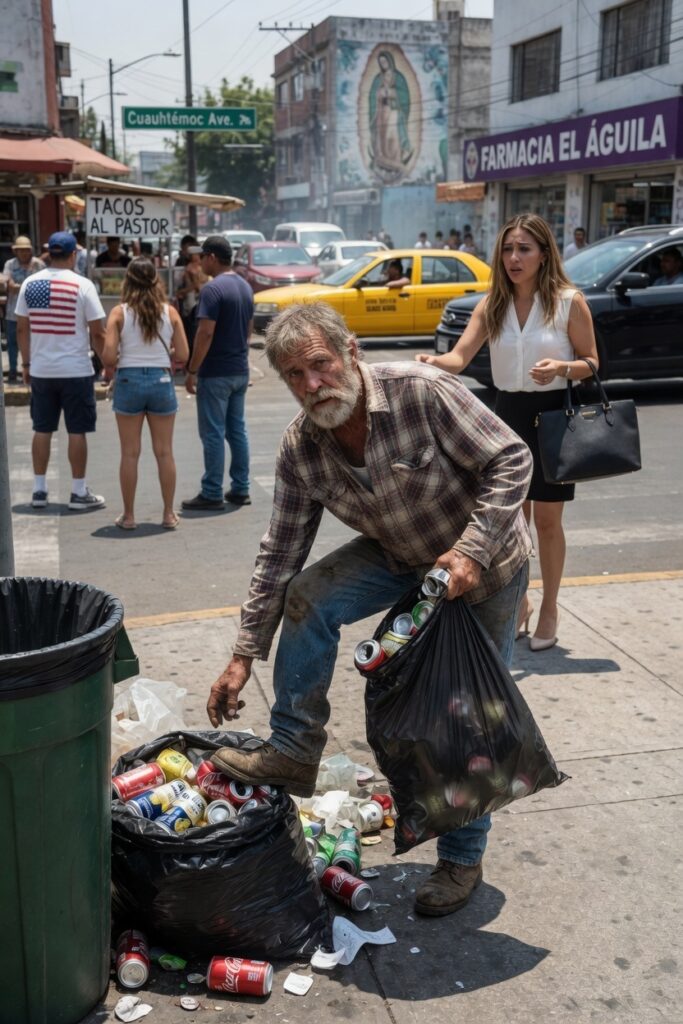
You find him three hours later behind a market, sorting aluminum from plastic with a concentration that breaks your heart.
His hands are dirty. His face is sunburned. He has a cut near his thumb wrapped in cloth. But when he sees you, the first emotion in his eyes is not shame this time.
It is fear.
“You shouldn’t be here,” he says.
You stop a few feet away.
“I know.”
“I told you to ask your family, not to come back to me.”
“I did ask.”
He looks down.
“And?”
You hold up his letter.
The world between you changes.
Roberto stares at the paper as if it is a ghost standing in daylight. His mouth opens slightly, but no words come. The bag of cans slips from his hand and spills across the pavement with a bright metallic crash.
You step closer.
“I know.”
His face crumples.
Not fully. Roberto has learned too much control from pain. But something in him gives way, and he turns his head as if he can hide tears from the woman he once loved more than his own future.
“You were never supposed to read that,” he says.
“Why?”
“Because then it meant I failed.”
You shake your head.
“No. It means you survived long enough for the truth to find me.”
He laughs once, brokenly.
“Truth is late.”
“Yes,” you say. “But it came.”
For a long moment, neither of you speaks.
People move around you. A vendor argues with a customer. A truck reverses with a sharp beep. Somewhere nearby, oil crackles in a pan.
Yet all you can hear is your old life breathing between you.
“I hated you,” you whisper.
“I know.”
“I said terrible things.”
“I know.”
“I married him.”
Roberto closes his eyes.
“I know.”
The words hurt more because he says them gently.
You want him to accuse you. You want him to scream. You want him to give you something easier than grace. But Roberto only bends down and begins gathering the cans because even heartbreak must make room for survival.
You kneel beside him in your expensive slacks.
He freezes.
“Mariana, don’t.”
You pick up a crushed soda can and place it in the bag.
For seven years, he carried humiliation for you.
You can carry one can.
“I’m going to clear your name,” you say.
His hands stop moving.
“No.”
“Yes.”
“No,” he says, sharper now. “You don’t know what they’ll do.”
“I know what they did.”
“You know paper. You don’t know them cornered.”
You look at him.
“Then tell me.”
His face hardens with memories.
“They didn’t just threaten court. Daniel had men follow me. Your mother sent someone to my aunt’s house. Alejandro told me if I spoke, they would release documents showing you approved the transfers. They made me watch them put your name on a criminal complaint draft.”
Your stomach turns.
Roberto continues.
“I thought if I disappeared, they would leave you alone.”
“They didn’t leave me alone. They placed me in a prettier cage.”
He looks at you then.
Really looks.
Something old and tender moves in his eyes, but he buries it.
“You look well,” he says.
You almost break.
“I look expensive. That isn’t the same thing.”
He glances away.
“I’m glad you’re not in prison.”
“I’m not glad you were buried alive.”
His jaw tightens.
“I made my choice.”
“And now I’m making mine.”
You stand.
“Come with me.”
“No.”
“Roberto.”
“No,” he says again. “I won’t be your rescue project.”
“You’re not.”
“Then what am I?”
The question cuts through everything.
You have no easy answer. Ex-husband. Victim. Hero. Stranger. The man you misjudged so completely that apology feels almost insulting.
So you tell the truth.
“You’re the person I owe the rest of my life to, whether you accept anything from me or not.”
His eyes fill again, and this time he does not hide fast enough.
“I don’t want your life, Mariana.”
“I know.”
“I wanted the one we had.”
The words land between you like something still warm from the fire.
You cannot answer.
Because part of you did too.
But there are years between you now. Damage. New marriages. Old grief. The truth may resurrect names, but it does not rewind time.
So you say only what you can promise.
“Then let me give you back yours.”
The attorney’s office smells like leather, coffee, and war.
Her name is Cecilia Warren, an American-Mexican criminal attorney Patricia found through a former school donor. She is calm in the way surgeons are calm. She reads the documents for almost an hour without interrupting.
Roberto sits beside you in clothes you bought only after he agreed they were “temporary evidence-preservation garments,” not charity.
He looks uncomfortable in the clean shirt.
You look uncomfortable in your own skin.
Finally, Cecilia removes her glasses.
“This is not just defamation,” she says. “This is fraud, forgery, coercion, obstruction, and possibly extortion.”
Roberto looks at the floor.
You look straight at her.
“Can his name be cleared?”
“Yes,” she says. “But it will be ugly.”
“Good.”
Cecilia studies you.
“Ugly means your family may retaliate. It means your marriage will become evidence. It means every person who benefited from the cover-up will try to paint Roberto as unstable and you as emotional.”
Alejandro’s words echo.
You are emotional.
You sit straighter.
“Then we do it carefully.”
Cecilia nods.
“We start with a notarized statement from Patricia. Then we file a petition to reopen the school’s internal investigation. We also send preservation notices to the school, the bank, and Alejandro’s firm. Nobody deletes anything after that without creating a bigger problem.”
Roberto’s hand tightens around the cup of water.
“And if they already deleted things?”
Cecilia smiles slightly.
“People like this always think deletion is the same as disappearance. It usually isn’t.”
For the first time, something like hope moves across Roberto’s face.
It is small.
But you see it.
Two days later, your mother invites you to dinner.
Not asks.
Invites, in that polished way that means attendance is expected.
The message says: We need to talk like a family before outsiders poison you further.
You show Cecilia the text.
She says, “Go.”
Roberto says, “Don’t.”
You look at both of them.
“I’m going.”
But you do not go alone.
You wear a small recording device Cecilia legally clears for your own protection, and Patricia waits in a car two blocks away with copies of the evidence. Roberto refuses to wait nearby, so he stays at the attorney’s office, pacing like a man standing outside a burning building.
Your mother’s dining room is set for four.
That detail almost makes you laugh.
You, your mother, Daniel, and Alejandro.
The same four people who built your second life from the ashes of your first.
Alejandro looks composed, but there are shadows beneath his eyes. Daniel keeps checking his phone. Your mother sits at the head of the table with a roast chicken in front of her, because in her world, even a conspiracy deserves proper serving dishes.
“Sit,” she says.
You remain standing.
“I’m not hungry.”
Daniel scoffs.
“Of course. This is a performance.”
You look at him.
“No, Daniel. The performance was seven years long.”
Alejandro leans back.
“Mariana, whatever you think you found—”
“I found enough.”
Your mother’s fork touches the plate with a soft click.
“You found a bitter accountant and a homeless man.”
“I found bank records.”
Daniel’s face changes.
You turn to him.
“Yes. Those bank records.”
He recovers quickly.
“You don’t understand financial structures.”
“No,” you say. “But prosecutors do.”
The room stills.
Your mother’s eyes narrow.
“You would send your own mother to prison?”
The old Mariana would have collapsed under that sentence.
The new one feels something harden into place.
“You were willing to send me.”
Her face goes pale.
Daniel stands.
“That is not what happened.”
“Sit down,” you say.
He laughs.
“You don’t give orders here.”
You step closer.
“No, I give evidence.”
That shuts him up.
Alejandro speaks softly.
“You need to think about consequences.”
“I have. Roberto lived inside them for seven years.”
Your mother’s expression flickers at his name.
“Roberto was never strong enough for you.”
You stare at her.
“He was strong enough to lose everything so I wouldn’t be framed for your crime.”
Her hand trembles once on the table.
Only once.
But you see it.
Daniel points at you.
“You have no idea what that school was doing to us. They treated us like decorative donors while they let old money families control everything. We took back what should have been ours.”
You almost cannot believe he is confessing through arrogance.
“Scholarship money, Daniel. Money for children.”
He shrugs.
“Most of those kids would never belong there anyway.”
Your disgust is so sharp it steadies you.
“And my signature?”
He looks away.
Your mother answers.
“You were family. We used what we had.”
The words are so monstrous that for a second, even Alejandro closes his eyes.
You look at your mother, the woman who held you when you were sick, who braided your hair before school plays, who later sat beside you while you cried over Roberto’s supposed betrayal.
“You used me.”
“I saved you,” she snaps.
“No. Roberto saved me from you.”
Her face twists.
“Roberto was nothing before this family.”
“He was my husband.”
“He was a teacher with cheap shoes and sentimental ideas.”
“He was innocent.”
Your mother rises.
“Innocence is a luxury poor men use when they have nothing else to offer.”
That sentence hangs in the room.
Cold.
Complete.
And recorded.
You feel no triumph.
Only grief.
Alejandro sees it on your face. He understands too late that this dinner was never about convincing them. It was about letting them speak.
His chair scrapes back.
“Mariana,” he says carefully. “Turn off whatever you brought.”
Daniel’s eyes widen.
Your mother looks at your blouse.
You step away from the table.
“No.”
Alejandro’s voice sharpens.
“You’re making a mistake.”
“No,” you say. “I’m correcting one.”
Your mother comes around the table faster than you expect.
For a second, you think she might slap you. Instead, she grabs your wrist. Her nails dig into your skin with desperate strength.
“Think,” she hisses. “Think of your name. Think of the shame.”
You look down at her hand.
Then back at her.
“For seven years, Roberto ate shame that belonged to you.”
You pull free.
“Now it’s your turn.”
You leave while Daniel is still shouting.
Your heart pounds so hard you barely feel your feet on the stairs. Outside, Patricia starts the car before you reach it. You get in, close the door, and only then do you begin to shake.
Patricia says nothing.
She just drives.
By morning, Cecilia has the recording.
By noon, formal notices go out.
By five, Alejandro’s law firm places him on leave.
By the next day, the school announces it is reopening the San Gabriel Scholarship Fund investigation due to “newly surfaced evidence.” The phrase is bland enough for public relations. But inside your phone, the world is exploding.
Your mother calls twenty-three times.
Daniel sends threats disguised as family grief.
Alejandro sends one message.
You are being manipulated by a man who has nothing to lose.
You stare at the screen.
Then you type back:
He already lost everything because of us.
You do not send anything else.
The public unraveling begins slowly, then all at once.
A journalist contacts Cecilia. Former teachers reach out to Patricia. Parents who once whispered about Roberto now admit that the story never made sense. One former student writes online that Professor Velasco was the only adult who ever made him feel worthy of a classroom full of rich kids.
That post goes viral.
Then another appears.
Then another.
Within a week, Roberto’s name is no longer attached only to scandal. It is attached to memory. To gratitude. To the kind of decency people recognize too late and then rush to praise as if praise can replace protection.
Roberto hates all of it.
He sits in Cecilia’s conference room while messages pour in and looks like he would rather be back sorting cans.
“They think I’m a saint,” he mutters.
You sit across from him.
“No. They think they owe you an apology.”
“Apologies don’t pay rent.”
You pause.
“No. But restitution might.”
He looks at you carefully.
“What did you do?”
“I didn’t do anything. Cecilia did attorney things.”
Cecilia looks up from her laptop.
“I filed for damages.”
Roberto closes his eyes.
“Of course you did.”
You smile for the first time in days.
“She’s terrifying. I like her.”
“I noticed,” he says.
For one brief second, it almost feels like the old rhythm.
The banter.
The warmth.
Then the past returns, and both of you go quiet.
Three weeks later, the school board holds a closed hearing.
You testify first.
You tell them you never authorized the transfers. You tell them your signature was forged. You tell them Roberto was coerced into accepting blame because your family threatened to implicate you.
Your voice shakes only once.
When you say, “I believed the lies because they came from people I trusted.”
Roberto testifies after you.
He wears a navy suit Cecilia found through a donor who insisted it was not charity but “a long-overdue professional courtesy.” His hair is trimmed. His beard is gone. His face still carries the weather of the streets, but beneath it, the teacher has returned.
He does not dramatize anything.
That is what destroys the room.
He states dates. Names. Threats. Documents. He explains how he found the discrepancies, how he confronted Daniel, how Alejandro drafted the settlement, how your mother cried while asking him to “save Mariana from prison.”
He pauses there.
Then he says, “I believed her tears.”
No one in the room moves.
Not even you.
The board chair, a gray-haired woman with expensive glasses, finally asks the question everyone has been avoiding.
“Mr. Velasco, why did you not come forward later?”
Roberto looks at his hands.
“Because after enough people call you guilty, you begin to understand that truth needs money to be heard.”
That sentence breaks something open.
By the end of the hearing, the board votes unanimously to rescind Roberto’s termination and issue a public statement clearing his name. They also refer your mother, Daniel, Alejandro, and associated entities for criminal investigation.
Roberto does not smile when he hears it.
He just lowers his head.
You know he is not celebrating.
He is mourning the seven years the statement cannot return.
Outside the building, reporters wait.
Cecilia guides you through them, but one question cuts through the crowd.
“Mr. Velasco, what do you want now?”
Roberto stops.
For a moment, you think he will keep walking.
Instead, he turns.
“I want my students to know I never stole from them,” he says. “That is all.”
The clip spreads everywhere.
That night, you watch it alone in your apartment.
Alejandro’s clothes are gone now. His side of the closet is empty. His cologne no longer sits beside your perfume. Yet the apartment still feels contaminated by all the years you spent mistaking quiet control for safety.
Your divorce from Alejandro is faster than your emotional recovery.
He fights at first. Then Cecilia’s evidence makes fighting expensive. His firm cuts ties, the bar opens an ethics review, and suddenly the man who once warned you about consequences becomes very interested in private settlement.
You do not settle quietly.
Not this time.
Your mother tries a different path.
She comes to your building one rainy afternoon, smaller than you have ever seen her. No pearls. No lipstick. A gray shawl pulled tight around her shoulders. The security guard calls up, and against Cecilia’s advice, you let her come.
She stands in your living room and looks around like she is searching for the daughter she could still control.
“I am your mother,” she says.
You nod.
“Yes.”
“I made mistakes.”
“You committed crimes.”
Her mouth tightens.
“You sound like them.”
“No. I sound like myself.”
She lowers herself onto the sofa without being invited.
“Daniel pushed things too far. Alejandro complicated everything. I only wanted to protect the family.”
You sit across from her.
“Which family?”
She looks confused.
“The family.”
“Because I was family when my signature was useful. Roberto was family until he became inconvenient. The scholarship children were family when their photos looked good at fundraisers. So tell me, Mamá. Which family did you protect?”
Her eyes fill with tears.
Once, that would have ended the conversation. You would have rushed to her. You would have apologized for making her cry.
Now you watch carefully.
“I was afraid,” she whispers.
“Of being poor?”
“Of being powerless.”
You think of Roberto sleeping in a shelter.
“You chose to make someone else powerless instead.”
She covers her face.
“I did not know he would end up like that.”
“Yes, you did,” you say softly. “You just thought he would do it far enough away that we wouldn’t have to look.”
Her sob is quiet.
But you no longer confuse tears with truth.
She asks if you can forgive her.
You tell her the honest thing.
“Not yet.”
Then the harder thing.
“Maybe not ever.”
When she leaves, you feel no victory.
Only space.
A painful, necessary space where obedience used to live.
Months pass.
The investigations widen. Daniel’s assets freeze. Your mother’s accounts are audited. Alejandro negotiates with people who no longer return his calls as quickly. The school creates a restitution fund in Roberto’s name, though he argues fiercely against it until former students insist.
He is offered his teaching position back.
At first, he says no.
Then one morning, he calls you.
You are in your kitchen making coffee when his name appears on your phone. For a second, you just stare at it. Even now, after everything, seeing Roberto’s name feels like touching a scar and finding it warm.
You answer.
“Hello?”
“I’m standing outside the school,” he says.
You go still.
“And?”
“And I think I’m going to walk in.”
You smile through sudden tears.
“Do you want me there?”
There is a pause.
“Yes,” he says. “But not to rescue me.”
“No,” you say. “Just to witness.”
You arrive twenty minutes later.
Roberto is standing across the street from the old gates. He looks nervous in a clean shirt and worn blazer. The morning sun catches the silver in his hair, and for a moment you see both men at once: the young teacher you married and the battered survivor who returned.
Students move through the entrance, laughing, complaining, carrying backpacks.
Life continues with insulting ease.
You stand beside him.
“Ready?”
“No.”
“Going anyway?”
He exhales.
“Yes.”
Together, you cross the street.
The principal meets him in the courtyard, along with several teachers, board members, and former students who heard he might come. Nobody planned a ceremony, but people gather anyway. Applause begins awkwardly, then grows.
Roberto freezes.
You see the panic in his face.
Not pride.
Panic.
Because applause can feel like accusation when you have spent years being watched for the wrong reasons.
You touch his sleeve lightly.
“You can breathe,” you whisper.
He does.
An older student steps forward, now a grown man in a suit.
“Professor Velasco,” he says, voice breaking. “You helped me get my scholarship. I never believed what they said.”
Roberto’s face changes.
The words reach a place no legal document could touch.
One by one, former students come forward. They do not heal seven years. They do not erase hunger, shame, or the nights he slept with one eye open. But they give back fragments of a name that should never have been taken.
And Roberto, for the first time since you found him, lets himself cry in public.
Not broken tears.
Released ones.
A year later, the final court hearing ends.
Your mother avoids prison through cooperation and restitution, but she loses the house. Daniel is sentenced for fraud and forgery. Alejandro loses his license to practice law for a long time, maybe forever. None of it feels like enough, and all of it feels exhausting.
Roberto receives a settlement large enough to buy a modest apartment, rebuild his pension, and fund a scholarship for students whose parents cannot buy their way out of consequences.
He names it after no one.
That is very Roberto.
You sell the SUV.
Not because you have to.
Because every time you sat in it, you remembered the day you almost drove past him. You buy a smaller car and move to a quieter apartment with windows that face morning light instead of other people’s balconies.
You also resign from every charity board your mother placed you on.
For the first time in your adult life, your calendar belongs to you.
One evening, Roberto invites you to the school auditorium.
He is giving a lecture on historical memory, which sounds exactly like him. You sit in the back row, not wanting to distract him. He speaks about nations that bury uncomfortable truths, families that rewrite shame, and the cost paid by those forced to carry official lies.
He never mentions your family.
He does not have to.
Afterward, you find him outside beneath a jacaranda tree.
Purple petals scatter across the pavement like bruised confetti. He looks tired but peaceful. That peace is new, and you protect it by not standing too close.
“You were good,” you say.
“I was nervous.”
“You always were before lectures.”
He smiles faintly.
“You remember.”
“I remember too much now.”
The smile fades, but gently.
You both stand in the evening light, surrounded by students leaving campus, car doors closing, parents calling names. The world has become ordinary again, but not in the way it was before. This ordinary is earned.
Roberto looks at you.
“Are you happy?”
The question surprises you.
You think about it seriously.
“I’m honest,” you say. “That feels like the beginning of happy.”
He nods.
“That’s a good answer.”
You look down at the petals near your shoes.
“And you?”
He takes a breath.
“I’m not who I was.”
“No.”
“But I’m not who they made me either.”
Your eyes sting.
“That’s a better answer.”
He laughs softly.
For a moment, you both let the past stand beside you without demanding anything.
Then you say what you have wanted to say for a year, but waited until it would not be a burden.
“I’m sorry I believed them.”
He closes his eyes.
You continue before courage fails.
“I’m sorry I let hatred make sense because truth hurt too much. I’m sorry I rebuilt my life on top of your grave while you were still alive. And I’m sorry that my love was not strong enough to doubt the lie.”
Roberto is quiet for a long time.
When he finally speaks, his voice is steady.
“I forgave you before you knew there was something to forgive.”
That breaks you more than anger would have.
You wipe your face quickly, embarrassed.
He does not touch you. He knows better than to turn forgiveness into comfort too quickly. Instead, he stands beside you and lets you cry without making your tears his responsibility.
When you can breathe again, he says, “I don’t know what we are now.”
You nod.
“Neither do I.”
“I can’t go backward.”
“I know.”
“And I won’t be saved by you.”
“I know that too.”
He looks at you then, and this time there is no fear in his eyes.
“But maybe,” he says slowly, “we can have coffee sometimes.”
You smile.
“Coffee sounds fair.”
“Small coffee.”
“Tiny coffee,” you say.
He laughs, and the sound is so familiar that it hurts.
But it also heals.
Not completely.
Nothing real heals completely.
The next Sunday, you meet him at a café that is not the one where he left you with the truth like a live wire. This one has yellow walls, wooden chairs, and a woman at the counter who calls everyone corazón. Roberto arrives early, because he always did.
You arrive exactly on time, because you are learning not to chase what must come freely.
He has already ordered coffee.
Two cups.
No grand gesture. No dramatic promise. No return to a marriage that died in a room full of forged papers and weaponized love.
Just two people sitting across from each other with the truth finally on the table.
Outside, the city moves under the sun.
A man pushes a cart of fruit down the street. A child drops a coin and chases it laughing. Somewhere, a can rolls along the curb, flashing silver in the light before coming to rest.
Roberto sees it.
So do you.
For a second, neither of you speaks.
Then he reaches for his coffee, looks at you over the rim, and says, “Tell me something true.”
You take a breath.
You look at the man you lost, the man you found, and the future neither of you is foolish enough to name too soon.
Then you answer.
“I almost drove past you that day.”
He holds your gaze.
“But you didn’t.”
“No,” you say. “I didn’t.”
And for the first time in years, that is enough.