THEY SERVED YOU DOG FOOD AT YOUR OWN 70TH BIRTHDAY—SO YOU CANCELED THE CARDS AND EXPOSED THE SECRET YOUR SON AND HIS GIRLFRIEND WERE HIDING
You sit alone in your bedroom while laughter shakes the ceiling below.
The house smells like mole, rice, warm tortillas, and betrayal. The food you paid for is being eaten by people who watched your own son put dog kibble in front of you and call it a joke. Your seventy-year-old hands rest on the keyboard, still steady, still trained by forty years of accounting books, tax records, payroll sheets, and numbers that never lied unless people forced them to.
So you start adding.
Rent not paid for four years.
Electricity.
Water.
Gas.
Groceries.
Cell phone bills.
Car insurance.
Credit card charges Luis promised were “temporary.”
Cash withdrawals he said were for job interviews.
Medical bills you postponed because Karla wanted “one nice weekend” in Valle de Bravo.
You open folder after folder, receipt after receipt, statement after statement. Your son’s laughter keeps rising through the floorboards, but little by little, it stops sounding like pain. It becomes evidence.
By midnight, the total sits on the screen.
One million, one hundred and eighty-six thousand pesos.
That number does not include the food you cooked, the laundry you did, the dignity you swallowed, or the empty chair where Lupita should have been sitting tonight.
You lean back and stare at the total until your eyes burn.
Then you open your banking app.
Luis has two additional cards linked to your account. You gave them to him three years ago “for emergencies.” At first, emergencies meant gas, groceries, medicine when he had the flu. Later, emergencies became sneakers, restaurants, liquor, Karla’s beauty appointments, streaming subscriptions, and deliveries arriving at your door while you ate leftovers standing by the sink.
You click the first card.
Cancel.
The app asks if you are sure.
You look toward the stairs.
Below, Luis shouts, “Another round!”
You click yes.
Then the second card.
Cancel.
Then Karla’s authorized card, the one Luis begged you to approve because “she feels uncomfortable asking me for everything, Pa.”
Cancel.
A strange peace enters the room.
Not happiness.
Not revenge.
Something cleaner.
You are not throwing them out yet. You are not screaming. You are not begging your guests to admit what they saw.
You are simply closing the valve.
At 12:23 a.m., Luis calls.
You let it ring.
At 12:24, Karla calls.
You let that ring too.
At 12:25, your phone explodes with messages.
Pa, why isn’t the card working?
Did the bank block it?
We’re at the store. Answer.
This is embarrassing.
You almost laugh.
Embarrassing.
Apparently, a declined card is embarrassing.
Dog food in front of your father is comedy.
At 12:31, Luis bangs on your bedroom door.
“Pa! Open up!”
You sit perfectly still.
“Pa, don’t be childish. The card declined. We need to pay.”
You say nothing.
He knocks harder.
“Did you block them?”
You finally stand, walk to the door, and speak through the wood.
“Yes.”
Silence.
Then his voice lowers.
“What?”
“I canceled the cards.”
“Why would you do that?”
You look at the framed photo on your dresser. Lupita in her blue dress, smiling at your retirement party, one hand on your shoulder. If she were alive, she would have slapped Luis with a sandal and prayed for him afterward.
“Because maintained children don’t need credit cards,” you say.
The hallway goes silent.
Then Luis laughs, but it is thin now.
“Very funny, Pa. Open the door.”
“No.”
“Don’t start. Karla’s waiting downstairs.”
“Then she can keep waiting.”
His tone changes.
“You’re doing this because of the joke?”
You close your eyes.
There it is.
The joke.
Cruel people love that word. It is the cheap blanket they throw over violence when the room gets cold.
“No, Luis,” you say. “I’m doing this because it took a bowl of dog food for me to admit what you’ve been eating from me for years.”
He hits the door once.
Not hard enough to break it.
Hard enough to remind you he is younger.
Your hand moves toward your phone.
“Hit that door again,” you say, “and I call the police.”
For the first time that night, your son has no answer.
He walks away.
You hear footsteps, whispers, Karla’s voice sharp and angry. Then the front door opens and closes. Cars start outside. Guests leave in embarrassed clusters, the way cowards flee after enjoying a show they do not want to be questioned about.
By 1:10 a.m., the house is quiet.
Too quiet.
You sit back at the laptop and open the bank app again. Three declined transactions appear.
A liquor store.
A rideshare.
Then one that makes you sit forward.
Clínica Santa Elena — Maternity Deposit — Declined.
You stare at the words.
Maternity deposit.
Your breath catches.
Karla is pregnant?
No one told you.
Your son, who just fed you dog food in your own house, has been hiding a baby from you while using your card to pay for the clinic?
Then another declined charge appears.
Residencias Doradas San Gabriel — Admission Fee — Declined.
You do not understand at first.
Residencias Doradas.
You open a browser and type the name.
The website loads slowly.
A private senior residence.
Luxury elder care.
Memory support.
Long-term placement.
Your body goes cold.
Not because the card was declined.
Because the charge was attempted minutes after you canceled their cards.
Maternity deposit.
Senior residence admission fee.
A baby coming.
An old man to remove.
Suddenly, the dog food does not feel like humiliation.
It feels like rehearsal.
You open a new folder on your desktop.
You name it Luis.
Then you begin saving everything.
The next morning, you wake before dawn even though you barely slept.
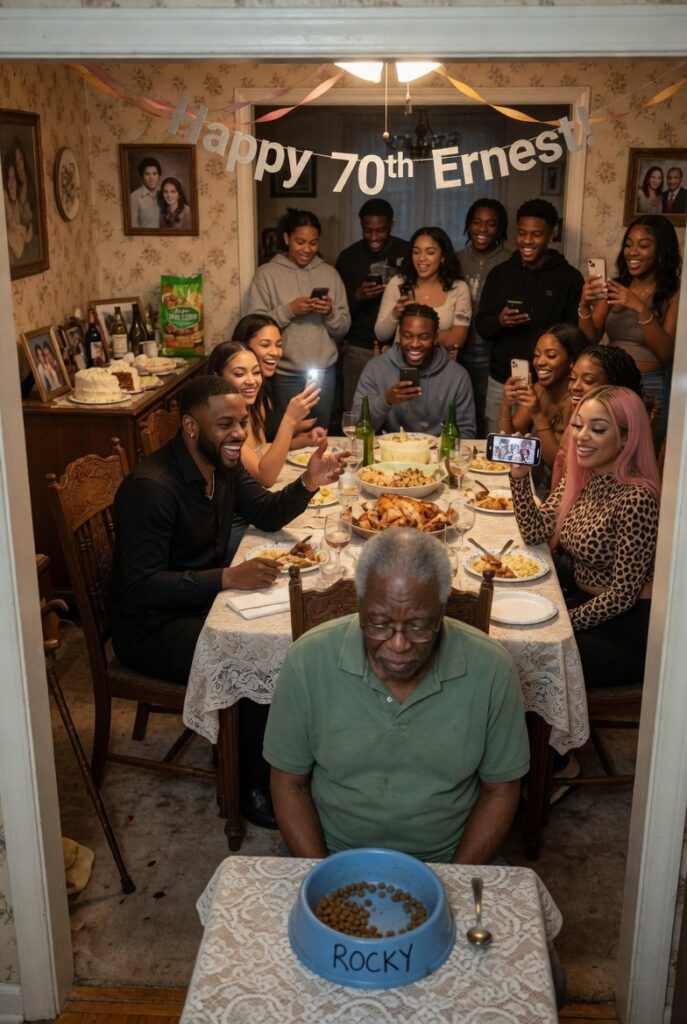
The house is filthy. Plates stacked in the sink. Empty bottles in the living room. Rice dried onto the table. Cake frosting smeared on the counter. And there, by the door, Rocky’s old dish still sits on the floor with the dog food Luis poured for you.
You pick it up carefully.
You wash it.
You dry it.
Then you place it on the shelf beside Rocky’s old collar.
You will not let that dish become their symbol.
It belonged to a dog who loved you better than your own son did last night.
At 8:00 a.m., Luis and Karla come downstairs.
Luis looks angry.
Karla looks worse: pale, swollen-eyed, and furious in a way she tries to disguise as hurt. She wraps a robe around herself and glances at the kitchen, probably expecting breakfast.
You are sitting at the table with coffee, your laptop, and printed bank statements.
There is no food.
Luis stops in the doorway.
“What is this?”
“A conversation.”
Karla crosses her arms.
“Can we do it later? I have a headache.”
You look at her.
“From the party or from the declined maternity deposit?”
Her face empties.
Luis turns toward her too fast.
You notice that.
He did not expect you to say it.
But he knew.
“What are you talking about?” Karla asks.
You slide the printed transaction across the table.
“Clínica Santa Elena. Maternity deposit. Declined at 1:14 a.m.”
Karla’s mouth opens.
Nothing comes out.
Luis steps forward.
“You had no right to look at our charges.”
You look up slowly.
“My card.”
He stops.
You slide the second page across.
“Residencias Doradas San Gabriel. Senior residence admission fee. Declined at 1:19 a.m.”
Now Luis goes pale.
Karla looks at him.
That is when you understand something else.
The secret has layers.
Karla knew about the clinic.
Luis knew about the residence.
But maybe neither knew how much the other had hidden.
You fold your hands.
“Which one of you wants to explain first?”
Luis recovers before Karla.
“That residence was for options, Pa. You’re seventy. We worry about you.”
You almost smile.
“You put dog food in front of me yesterday.”
His jaw tightens.
“That was a stupid joke.”
“And five minutes after your free card stopped working, you tried to pay admission to a senior home.”
Karla snaps, “It wasn’t like that.”
You turn to her.
“Then what was it like?”
She presses her lips together.
Luis glares at her, warning her with his eyes.
That tells you everything.
You lean back.
“Fine. I’ll talk. For four years, you have lived in my house without rent. For four years, I have paid your utilities, food, repairs, phones, insurance, and debts. Last night, at my seventieth birthday dinner, you served me dog food in front of guests and called me a freeloader in my own home.”
Luis rolls his eyes.
“Pa—”
You raise one hand.
“No. You spoke last night. Today you listen.”
He stops, more from shock than respect.
You continue.
“This morning, I discovered you attempted to use my card to pay for a maternity clinic and a senior residence. That tells me you are planning a life that requires my money, my house, and my absence.”
Karla sits down suddenly.
Luis stays standing.
Your son’s face changes again. His anger gets smaller, sharper. He is calculating.
“You’re being dramatic,” he says. “Karla is pregnant. We were going to tell you today.”
You look at her.
“Is that true?”
She places one hand on her stomach, but not tenderly. Protectively. Like she is holding a bargaining chip.
“Yes,” she says.
You feel something twist in your chest.
A grandchild.
For one second, love tries to rise before reason can stop it. You imagine a baby in the house, a crib near the window, small socks drying in the sun. Then you look at Luis and remember the dog food.
A baby does not erase cruelty.
Sometimes it becomes the excuse for more.
“How far along?” you ask.
Karla looks away.
“Three months.”
Luis’s face flickers.
There it is again.
He did not know.
“Three?” he says.
Karla freezes.
You look from one to the other.
Luis’s voice drops.
“You told me six weeks.”
Karla’s eyes sharpen.
“I said around six weeks.”
“No, you said six.”
The room goes very still.
You do not speak.
Accounting teaches patience. If numbers don’t match, you let people explain until they make the hole bigger.
Luis turns fully toward Karla.
“Karla.”
She stands.
“This is not the time.”
“When did you find out?”
She grabs her phone.
“I’m not doing this with him watching.”
“With him?” you repeat quietly.
Neither of them answers.
Luis reaches for the paper on the table, but you pull it back.
“I want both of you out of my house within thirty days.”
Karla laughs once.
“You can’t do that.”
You look at her.
“Yes, I can.”
Luis slams his hand on the table.
“This is my home too.”
“No,” you say. “It is the house your mother and I bought. You are a guest who forgot he was one.”
His face twists.
“I’m your son.”
“Yes. And somehow, that made me tolerate behavior I would have called theft from anyone else.”
Karla points at you.
“You’re really throwing a pregnant woman into the street?”
You look at her stomach.
Then at her face.
“No. I am giving two adults thirty days to become responsible for the child they made.”
Luis looks like he wants to say something cruel.
Then your phone rings.
It is your neighbor, Silvia from next door.
You almost ignore it, but something makes you answer.
“Don Ernesto,” she whispers, “there are two men outside asking if you’re home. They said they’re from a moving company.”
Your eyes stay on Luis.
“What moving company?”
“They have boxes. One says Residencias Doradas.”
The kitchen disappears around you.
So it was not just an online charge.
They had scheduled your removal.
Today.
You stand slowly.
“Thank you, Silvia. Please call my lawyer if they try to enter.”
Luis says, “Who was that?”
You do not answer him.
You walk to the front door.
Two men in navy shirts are standing outside with clipboards and folded boxes. A white van idles by the curb. One smiles politely when you open the door.
“Señor Ernesto Hernández?”
“Yes.”
“We’re here for the relocation assessment.”
“Ordered by whom?”
He checks the clipboard.
“Luis Hernández. Family authorized. The admission is pending payment, but we were told to begin packing personal belongings.”
Behind you, Luis says, “Pa, wait.”
You turn.
Your son is standing in the hall, suddenly not arrogant.
Caught.
That is different.
You look back at the movers.
“There will be no relocation.”
The man’s smile fades.
“I’m sorry?”
“I did not authorize this. This is my property. Please leave.”
The second man looks uncomfortable.
Luis steps forward quickly.
“It’s a misunderstanding. My father gets confused sometimes.”
The words hit harder than the dog food.
Confused.
There it is.
The foundation of the next lie.
If you object, you are confused.
If you resist, you are old.
If you defend yourself, you are unwell.
Your voice becomes very calm.
“Silvia,” you call without turning, because you know your neighbor is watching from her window, “please record this.”
Across the fence, her curtains move.
Good woman.
You face the movers.
“I am Ernesto Hernández. I am the sole owner of this house. I am not relocating. My son has no legal authority over me, my property, or my belongings.”
Luis grabs your arm.
“Stop making a scene.”
You look down at his hand.
“Let go.”
For once, he does not.
So you do what you should have done years ago.
You call the police.
Luis releases you the moment he hears the operator’s voice.
Karla starts crying dramatically from the hallway.
The movers back away toward their van.
By the time the patrol car arrives, three neighbors are outside, Silvia is still recording, and Luis is sweating through his T-shirt.
You give your statement calmly.
The officers ask Luis for documentation authorizing the move.
He has none.
He claims concern.
He claims stress.
He claims you have become forgetful.
You hand the officer your INE, house deed copy, recent medical evaluation from your annual checkup, and the card of your lawyer, Licenciado Arriaga.
The officer reads everything.
Then looks at Luis.
“This is a civil family issue unless there is coercion or fraud,” he says. “But you cannot remove him or his belongings from his property.”
Luis mutters, “I wasn’t trying to remove him.”
Silvia says from her gate, “The boxes said senior residence.”
The officer turns.
Karla whispers, “This is humiliating.”
You look at her.
“Yes.”
At noon, Licenciado Arriaga arrives.
He is not flashy. He is your age, bald, compact, and has the temperament of a locked safe. He handled Lupita’s estate after she passed and has been telling you for years to formalize boundaries with Luis.
You did not listen.
Today, you will.
He sits at your kitchen table while Luis and Karla stand like teenagers called into the principal’s office.
Arriaga places two documents on the table.
“First, notice of termination of permissive occupancy. You have thirty days to leave the property. Second, demand for reimbursement review regarding unauthorized use of Don Ernesto’s credit accounts.”
Luis scoffs.
“He’s my father. You can’t charge family.”
Arriaga looks at him over his glasses.
“Family can commit fraud. Happens every day.”
Karla sits down hard.
Luis glares at you.
“You planned this?”
You look at him.
“No. You did. I’m just reading the papers you forgot I know how to prepare.”
Arriaga continues.
“Additionally, Don Ernesto has revoked all authorized-user cards, changed account permissions, and initiated credit monitoring. Any attempt to open credit, move services, access documents, or represent authority over him will be treated as potential elder financial abuse.”
Luis laughs, but his voice cracks.
“Elder abuse? This is insane.”
You look at him.
“You put dog food in front of me.”
“It was a joke!”
“You scheduled movers to take me to a senior home.”
“I was worried!”
“You told people I was confused.”
“Because you’re acting confused!”
Arriaga’s pen stops moving.
Your son realizes too late.
Again.
The lawyer writes that down.
Karla’s phone vibrates on the table.
She glances at it, then quickly turns it over.
Luis sees the movement.
“Who is that?”
“No one.”
He grabs the phone.
She tries to stop him.
The room shifts.
You do not move.
Luis unlocks it because of course he knows her password. He reads something. His face changes in a way you have never seen before.
Not anger.
Ruin.
“Karla,” he whispers.
She stands.
“Give me my phone.”
He steps back.
“Who is Daniel?”
Her face goes white.
You hear the name and remember nothing at first.
Then Arriaga says quietly, “Daniel Robles?”
Karla snaps toward him.
“How do you know that name?”
Arriaga looks at you.
“Don Ernesto, Daniel Robles is listed as an emergency contact in some documents from Residencias Doradas. He called my office two weeks ago asking whether an adult son could admit a parent if the parent resisted.”
The kitchen goes silent.
Luis looks at Karla as if the floor has opened.
“You called with him?”
She starts crying.
But this time, the tears are desperate, not staged.
“You weren’t doing anything,” she says to Luis. “We needed a plan.”
“We?”
Her phone buzzes again in his hand.
He reads the message aloud before anyone can stop him.
Did he sign the house paper yet? Once the old man is gone and the baby comes, we can push Luis out too. Don’t lose nerve.
The silence after that is so complete you hear the refrigerator hum.
Luis stares at the screen.
Then at Karla’s stomach.
“Is it mine?”
She does not answer fast enough.
That is the answer.
Your knees weaken.
Not because of Karla.
Because of your son.
For all his cruelty, laziness, and entitlement, he is still your child, and you have just watched his life split open in front of you. You want to protect him from the pain. That old instinct rises like a ghost.
Then you remember the kibble.
The movers.
Confused.
No.
Pain does not erase responsibility.
Luis sits down slowly.
“Karla,” he says again, voice hollow. “Is the baby mine?”
She wipes her face.
“I don’t know.”
There it is.
The secret.
Not only the pregnancy.
Not only the senior home.
Karla and Daniel had been using Luis’s entitlement as a ladder. Luis thought he was moving you out so he could inherit the house for his new family. Karla was helping him because she planned to replace him the moment the house was secured.
Your son, the man who tried to feed you dog food, has been fed his own illusion.
Arriaga reaches for the phone.
“May I?”
Luis hands it over without looking at him.
The lawyer scrolls, not far, not long, just enough to find the shape of the conspiracy. Messages about getting you declared incompetent. Messages about pressuring Luis to ask for “his inheritance early.” Messages about the maternity clinic. Messages about Daniel’s name on the baby’s possible paperwork.
Then one message from Karla to Daniel:
Luis is easy. He hates feeling poor more than he loves his dad.
Your son makes a sound like something wounded.
You look away.
That sentence is not only cruel.
It is accurate.
And he knows it.
Karla starts packing that afternoon.
Not because she suddenly respects boundaries.
Because Luis tells her to get out.
The hypocrisy almost makes you laugh. Thirty minutes earlier, he was furious at you for giving him thirty days. Now he wants her gone before dinner.
She screams. He screams. The neighbors hear everything because of course they do. Daniel arrives in a gray car and tries to enter the house like he has rights there.
You stop him at the gate.
He is younger than Luis, handsome in a cheap way, with sunglasses and a gym body that does not know work. He looks at you like you are furniture in his path.
“Where’s Karla?”
“Leaving.”
“I’m helping her.”
“You can wait outside.”
He laughs.
“Old man, don’t make this ugly.”
From behind you, Silvia says, “I’m recording again.”
Daniel looks toward her window.
Good woman.
He waits outside.
Karla leaves with four suitcases, three bags, and a face full of hatred. Before stepping into Daniel’s car, she turns to Luis.
“You’re nothing without this house.”
Luis flinches.
Then she looks at you.
“And you’ll die alone.”
You nod slowly.
“Maybe. But not robbed.”
She gets in the car.
Daniel drives away.
Luis stands on the sidewalk long after they disappear.
You do not comfort him.
That night, the house is quiet again.
Not peaceful.
Wrecked.
Luis sits at the dining table with his head in his hands. The leftover mole is still in the fridge. The cake is half-eaten, frosting scraped where someone took the sugar flowers. A birthday banner hangs crooked over the window.
You stand in the kitchen doorway.
For a moment, you see him at seven, asleep at this same table over homework while Lupita warmed milk. You see him at fifteen, angry after failing math. You see him at twenty-one, promising he would finish school next semester.
You see every chance you gave him.
Every excuse.
Every rescue.
Every time love became a pillow under his fall.
He looks up.
His eyes are red.
“Pa.”
You wait.
“I didn’t know about Daniel.”
“I know.”
He starts crying.
For a second, he looks young enough to forgive.
Then he whispers, “But I knew about the residence.”
You close your eyes.
That honesty hurts worse than denial.
“Why?” you ask.
He wipes his face with both hands.
“Because I thought if you were there, the house would finally feel like mine.”
You sit across from him slowly.
The chair where Lupita used to sit remains empty.
“And the dog food?”
His face crumples.
“I was angry. Karla kept saying everyone thought I was useless. She said if I acted like the man of the house, people would believe it.”
You look at your son.
“You thought manhood meant humiliating a seventy-year-old widower at his own birthday table?”
He covers his mouth.
“I don’t know what I thought.”
“No,” you say. “You thought I would take it.”
He nods, crying.
“I did.”
There it is.
The truth without decoration.
For years, Luis had counted on your love as a floor he could stomp on without falling through. Last night, you finally moved.
You stand.
“You still have thirty days.”
He looks up.
“Pa, please.”
“No.”
“I have nowhere.”
“You had four years to build somewhere.”
“I’m your son.”
“Yes,” you say. “And that is why I am giving you thirty days instead of changing the locks tonight.”
His face twists with pain.
You feel it in your own body.
But you do not sit back down.
“You will clean the house tomorrow. You will pay the next electric bill from your own money. You will return every item bought with my cards that can still be returned. You will speak to Arriaga about repayment. And you will start finding work.”
He looks defeated.
“Doing what?”
“Anything legal.”
He almost smiles.
Almost.
Then it dies.
“Will you ever forgive me?”
You look at the birthday banner.
Then at Rocky’s clean dish on the shelf.
“I don’t know.”
That answer hurts him.
Good.
Some hurt teaches the shape of what was broken.
The next thirty days become the longest month of your life.
Luis sleeps on the couch because he cannot stand the bedroom he shared with Karla. He moves through the house like a ghost at first, quiet and ashamed. Then anger returns in bursts. He complains that you are treating him like a criminal. He snaps when you ask for receipts. He sulks when Arriaga schedules repayment discussions.
But he also starts cleaning.
Badly.
He burns rice trying to cook.
He finds a temporary warehouse job through a neighbor’s nephew and comes home with sore shoulders and a face full of disbelief that money can require pain. He sells his game console, two watches, and the expensive sneakers he bought with your card.
Every time he tries to complain, you show him the spreadsheet.
That ends most conversations.
Karla’s story unravels fast.
She is five months pregnant, not three.
The baby may be Daniel’s.
Daniel is married.
That one arrives like a bad joke. His wife shows up at your gate one Tuesday afternoon, holding screenshots and fury. She is seven months postpartum with their second child. She had no idea about Karla, Luis, or your house.
For a moment, you almost invite her in for coffee.
Then you do.
Her name is Marcela.
She sits at your kitchen table and cries into one of Lupita’s old napkins. Luis, to his credit, does not make the moment about himself. He stands near the sink looking like a man realizing he was not even the villain in the story he thought he controlled.
He was also a fool.
Marcela gives Arriaga more messages.
Daniel and Karla had discussed the house openly. Their plan was ugly but simple: push Luis to pressure you into a residence, get access to the house, use the pregnancy to force him into naming Karla as partner in future claims, then later separate from him and fight for support.
You almost admire the cruelty for its ambition.
Almost.
Luis reads the messages and vomits in the bathroom.
You hear him.
You do not go to him.
By the end of thirty days, Luis has two suitcases.
He finds a rented room in Portales, small and ugly, near the warehouse. The rent is more than he thought rent should be, which tells you everything about how long he has lived inside fantasy.
On moving day, he stands in the doorway.
No Karla.
No guests.
No laughter.
Just your son, thinner than before, holding the bags he should have packed years ago.
He looks at you.
“Can I come visit?”
You think carefully.
“For dinner once a month. If you ask first. If you come sober, respectful, and without asking for money.”
He nods.
“Okay.”
“And Luis?”
“Yes?”
“If you ever try to move me out of my own home again, I will not give you thirty days.”
He lowers his head.
“I know.”
You almost hug him.
Almost.
Instead, you place one hand on his shoulder.
That is enough for now.
After he leaves, the house sounds enormous.
You walk from room to room with a trash bag.
Karla’s forgotten perfume.
Luis’s empty beer cans.
Old delivery menus.
Broken chargers.
Cheap decorations from parties you never wanted.
You throw away more than objects.
You throw away the version of yourself that believed a father must be endlessly useful to remain loved.
In Luis’s old room, you find one thing that stops you.
A photo of him with Lupita at age eight.
He is missing a tooth. She is kissing his forehead. On the back, in her handwriting, it says:
Our boy has a stubborn heart. May life teach him gently.
You sit on the bed and cry.
Life did not teach him gently.
Maybe you were wrong to try to make it do so.
Three months later, the house is yours again in a way it has not been since Lupita died.
You paint the dining room.
You donate half the furniture Karla treated like hers.
You turn Luis’s old bedroom into a small office with Lupita’s sewing machine in the corner and your accounting books on the shelves. You take a cooking class because feeding people no longer has to mean being consumed.
Silvia comes over on Sundays.
She brings gossip.
You make coffee.
Sometimes you laugh until your chest hurts.
Luis visits once a month.
The first visit is awkward.
He brings pan dulce from the bakery and places the receipt beside the box like an offering. You do not ask for it. He shows you anyway. You both pretend not to understand how much it means.
He does not sit in the cabecera.
Neither do you at first.
Then one Sunday, Silvia says, “Don Ernesto, for God’s sake, sit in your own chair.”
So you do.
The world does not end.
Luis pays back small amounts.
Very small.
Painfully small.
But regular.
That matters more than size.
He keeps the warehouse job longer than anyone expected, then finds office work doing inventory because numbers, apparently, were hiding in his blood after all. He starts seeing a therapist after Marcela’s lawyer contacts him as a witness in Daniel and Karla’s mess.
He tells you this one evening with great discomfort.
“I’m going to therapy.”
You sip your coffee.
“Good.”
“That’s it?”
“What did you want? A parade?”
He smiles faintly.
“No.”
“Then good.”
Karla has the baby.
A boy.
A DNA test proves Daniel is the father.
Luis does not tell you this immediately. Silvia does, because Silvia knows everything within six blocks. When Luis finally brings it up, he looks ashamed all over again, but different now. Less theatrical. More honest.
“I think I deserved that,” he says.
You shake your head.
“No one deserves betrayal.”
He looks at you.
You hold his gaze.
“But sometimes betrayal makes us recognize what we were willing to do to others.”
He nods.
“I know.”
A year after the birthday, Luis asks if he can come over on a Saturday.
Not for dinner.
To apologize.
You almost say he already did.
Then you remember: he cried, explained, admitted, and suffered.
But maybe he never apologized properly.
So you say yes.
He arrives wearing a clean shirt and carrying no food, no gifts, no performance. He sits across from you at the dining table, the same table where he placed the dog food.
His hands shake.
“I need to say it clearly,” he begins.
You say nothing.
“I humiliated you in your own house. I called you maintained while I was living from your money. I let Karla record you. I tried to move you into a senior home without your consent. I told people you were confused. I used your love like it was something I owned.”
His voice breaks.
“I am sorry, Pa. Not because Karla betrayed me. Not because I lost the cards. Not because I had to leave. I am sorry because I became someone Mamá would not recognize.”
Your chest tightens.
Lupita’s name sits between you.
Alive again.
You breathe slowly.
“She would recognize you,” you say.
He looks up, devastated.
You continue.
“But she would be very angry.”
He laughs through tears.
“She’d throw a sandal.”
“She would throw two.”
For the first time in a year, you both laugh together without bitterness.
Then Luis lowers his head.
“Can I do anything?”
You look at the table.
At the place where the bowl sat.
At the chair where Lupita used to sit.
At your son, still broken but finally looking at the damage without trying to decorate it.
“Yes,” you say. “You can bring dinner next Saturday. You can cook it. You can invite no one. And you can serve me first.”
He nods.
“I will.”
He does.
The meal is terrible.
Chicken overcooked.
Rice undercooked.
Beans too salty.
You eat every bite.
Not because it is good.
Because he serves it with both hands, eyes lowered, and says, “For you, Pa.”
Sometimes repair tastes like burnt chicken.
Two years later, you turn seventy-two.
This time, there is no surprise party.
No crowd.
No dog dish.
No performance.
Luis asks what you want.
You tell him, “Dinner with people who remember whose birthday it is.”
He invites Silvia, Arriaga, two old friends from your accounting days, and a few neighbors. He cooks with Silvia supervising because nobody trusts him alone with rice. He buys a cake with his own money, and the receipt sits proudly under the box.
Before dinner, he stands.
Everyone quiets.
His face reddens, but he keeps going.
“Two years ago, on my father’s seventieth birthday, I behaved like a cruel, useless man. Some of you know that. Some of you heard versions. I won’t repeat the details because my father lived them once already.”
The room goes very still.
Luis looks at you.
“I thought this house made me important. Then I lost the right to live here and learned I had built nothing. My father gave me thirty days when I deserved a locked door. I am here because he gave me consequences before I became worse.”
Your eyes burn.
He lifts his glass.
“To my father. The owner of this house. The man who documented everything. And the man I am still trying to deserve as a son.”
No one speaks.
Then Silvia claps.
Of course.
Everyone follows.
You look down because if you look at Luis, you may cry in front of your guests, and there are limits.
After dinner, Luis brings out the cake.
He sets it in front of you.
No one eats first.
No one forgets you upstairs.
Everyone sings.
You close your eyes and hear Lupita’s voice in the middle of it, not as a ghost, but as memory.
Warm.
Laughing.
Proud.
When you open your eyes, Luis is watching you.
Not like a man waiting for praise.
Like a son hoping the chair beside you is no longer empty because of him.
You cut the first slice.
Then you hand it to him.
“Serve Silvia next,” you say.
He laughs.
“Yes, Pa.”
Years from now, people will still tell the story of the dog food.
They will say your son humiliated you at your own birthday and you canceled the cards. They will say his girlfriend was pregnant by another man. They will say they tried to put you in a senior home and steal the house. They will say the old accountant had receipts for everything.
Those things are true.
But they are not the whole truth.
The whole truth is that you loved your son so much you forgot love needs doors, locks, rules, and sometimes eviction notices. The whole truth is that grief made you afraid of being alone, so you let your house fill with noise that slowly became disrespect. The whole truth is that one bowl of dog food finally showed you what silence had cost.
You did not become cruel that night.
You became awake.
You canceled cards, not love.
You ended access, not fatherhood.
You stopped financing a man who was willing to call you useless while using your money to plan your removal.
And in doing so, you exposed everyone.
Karla.
Daniel.
Luis.
Yourself.
That is the part nobody likes to include.
Because the hardest person to audit is not the thief.
It is the one who kept approving the withdrawals.
Now, on quiet mornings, you sit in your dining room with coffee, Lupita’s photo, and your old ledger books. The house is peaceful again. Sometimes too peaceful. But it is yours, and peace that belongs to you is better than noise that eats you alive.
Rocky’s dish remains on the shelf.
Clean.
Empty.
Honored.
A reminder that love should never be served as humiliation.
A reminder that even old men can stand up.
A reminder that the moment your son tried to feed you like a dog, you finally stopped letting him live like a king.