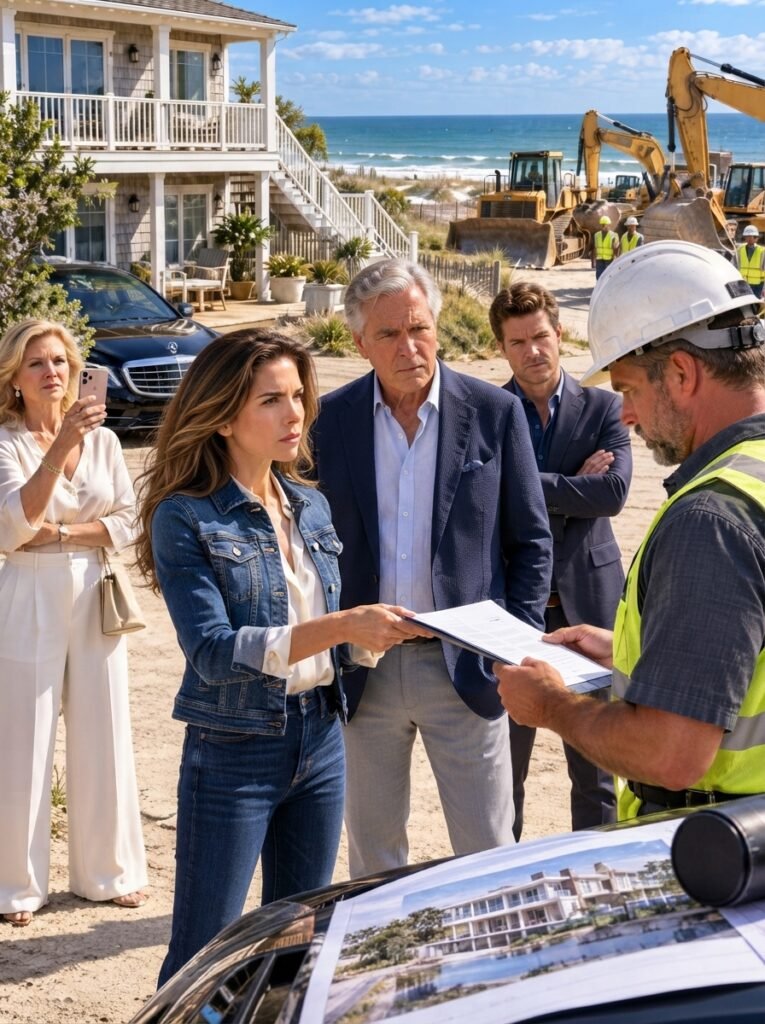
The first bulldozer arrived at 6:43 on a Saturday morning, growling over the dunes like some enormous yellow animal that had come to devour my childhood.
I stood barefoot on the weathered gray deck with Grandpa Arthur’s blue-and-white seashell mug warming my hands.
Beyond the dunes, the Atlantic shimmered silver beneath the sunrise.
Behind me was the house where I had learned to ride out hurricanes, where Grandpa had taught me how to read a tide clock, where pencil marks inside the hallway closet still measured my height from age seven to seventeen.
In front of me, three demolition machines lined up beside the driveway.
And then my father’s black Mercedes appeared.
Gregory Bennett stepped out carrying a leather blueprint tube.
He looked almost cheerful.
“Demolition starts at eight A.M. sharp,” he told the crew.
My mother, Elaine, climbed from the passenger side already holding her phone.
My younger brother Travis followed, sunglasses on, expensive loafers sinking slightly into the sand.
He smiled when he saw the bulldozers.
That smile told me everything.
Dad believed that by lunchtime, Grandpa’s beach house would be rubble.
Mom believed she was about to record the beginning of the Bennett family’s newest luxury development.
Travis believed he had finally won.
None of them knew I had the deed inside the folder on my kitchen counter.
And none of them knew what else was buried in the paperwork they had filed.
“Claire,” Mom called from beside the mailbox. “You really shouldn’t stay for this.”
I took a slow sip of coffee.
“I’m fine.”
She exchanged a look with Dad.
“I know you’re attached to the place,” she continued carefully. “But watching them knock it down isn’t going to make this easier.”
“I said I’m fine.”
Travis laughed.
“Classic Claire. Reality comes knocking and she sits there drinking coffee.”
At thirty-five, my brother had perfected sounding like a self-made businessman despite having never built anything without our father clearing the path first.
Dad had made him vice president of Bennett Shore Development before Travis had managed a single independent project.
I was forty-one and ran a consulting firm advising medical technology companies on regulatory compliance.
Dad still described my work as “that paperwork thing Claire does.”
Years ago, he had offered me an administrative job at Bennett Shore because I was, according to him, “organized and good with people.”
I had declined.
He had interpreted that as arrogance.
Travis had interpreted it as failure.
Dad walked toward the site supervisor.
The man introduced himself as Mark Ellison. He was sunburned, broad through the shoulders, wearing a white hard hat and holding a tablet.
“Morning,” Dad said. “We appreciate the early start. I’d like the structure cleared before noon if possible.”
“We’ll move as quickly as we safely can,” Mark replied. “I just need final property authorization before equipment touches the structure.”
“Everything went through my office.”
Dad unrolled the architectural drawings across his Mercedes.
Even from the deck, I could see the glossy rendering.
Three stories of glass.
Stone terraces.
An infinity pool.
Seven bedrooms.
Outdoor kitchen.
Elevator.
Dad had named it Bennett Ocean House.
Mom preferred Bennett Retreat because she thought it sounded “exclusive without trying too hard.”
“This old place isn’t worth saving,” Travis told Mark. “Rot, foundation problems, bad wiring. My sister’s basically been camping in it because she’s sentimental.”
I looked down at the deck beneath my bare feet.
Eighteen months earlier, I had spent $362,814 replacing electrical systems, reinforcing the foundation, installing hurricane-rated windows, upgrading plumbing, treating moisture damage, and strengthening the deck.
Dad had never noticed.
Why would he?
Whenever I mentioned repairs, he told me I was wasting money “patching an old shack.”
Mom pointed her phone at Dad.
“Gregory, stand next to the house for a second. We can use the demolition video later. Something like ‘honoring the past while building the future.’”
Mark looked up.
“Maybe hold off until we confirm authorization.”
Dad’s expression tightened.
“There isn’t a problem.”
Mark glanced back at his tablet.
“I didn’t say there was.”
Inside the house, morning sunlight fell across Grandpa’s old oak table.
His tide clock still hung above the pantry.
His battered fishing hat remained on a hook near the back door because I had never been able to throw it away.
Two weeks earlier, Dad, Mom, and Travis had walked through the rooms sticking orange disposal labels on furniture.
They had labeled Grandpa’s desk.
His rocking chair.
The cabinet he built by hand.
Not once had they asked my permission.
They had never imagined they needed it.
Travis climbed the deck stairs.
“You should pack anything you care about.”
“I already know what I care about.”
“Dad’s guys are throwing everything out. Don’t call me afterward crying because somebody tossed Grandpa’s old junk.”
I looked at him.
“The junk you said was worthless?”
“It is.”
“Then you won’t miss it.”
His jaw tightened.
“You know, this is why nobody can talk to you.”
“Interesting. You seem to be managing.”
“I’m serious, Claire. You act like you’re better than everyone.”
“I never said that.”
“You don’t have to. Forty-one, unmarried, living in Grandpa’s old house, running some consulting operation nobody understands—”
“Sounds tragic.”
His face reddened.
Before he could answer, Mark called from the driveway.
“Mr. Bennett?”
Something in his voice had changed.
Dad turned.
“I’m getting a mismatch.”
“What mismatch?”
“The parcel records attached to your permit package don’t match the ownership record I’m pulling directly from the county.”
Dad gave an impatient laugh.
“County records lag after estate transfers.”
“This isn’t a recent transfer.”
Dad stopped smiling.
“My father owned this house. His estate transferred everything after he died.”
Mark studied the tablet.
“The owner listed here is Harbor Crest Holdings LLC.”
Travis barked out a laugh.
“Never heard of it.”
Dad frowned.
“Neither have I.”
Mom slowly lowered her phone.
I set Grandpa’s mug on the railing.
Then I went inside, picked up the folder from the counter, and walked down the stairs.
“That’s because none of you ever asked,” I said.
Dad looked irritated.
“Claire, stay out of this. We’re resolving a paperwork problem.”
“No.”
I stopped beside Mark.
“You’re finally discovering one.”
I removed the recorded deed from the folder and handed it to him.
Mark studied the first page.
Then the second.
He compared it with his tablet.
His expression changed.
Dad stepped closer.
“What is that?”
Mark didn’t answer immediately.
He checked the parcel number again.
Then he lifted one hand toward the machine operators.
“Shut everything down.”
Engines died one after another.
The sudden silence was startling.
Dad stared at him.
“What are you doing?”
Mark held up the deed.
“Mr. Bennett, I’m stopping this job.”
“On whose authority?”
“The legal owner’s.”
He looked at me.
Then back at Dad.
“Sir, you’re about to demolish this woman’s house.”
For several seconds, nobody spoke.
Even Travis stopped smiling.
Dad finally laughed once, but there was no humor in it.
“She’s my daughter.”
“That doesn’t affect title.”
“That house belongs to my family.”
“It may belong to a member of your family,” Mark said. “But according to this deed, it doesn’t belong to you.”
Travis stepped forward.
“That’s impossible.”
I met his eyes.
“No. It’s inconvenient.”
Dad snatched the copy from Mark.
His gaze traveled over the page until he found the buyer.
Harbor Crest Holdings LLC.
Then my name beneath it as managing member.
His face changed.
“When?”
“Almost seven years ago.”
“You bought this house?”
“Yes.”
“From whom?”
“Grandpa’s estate.”
Dad stared at me.
“He left it to the family trust.”
“No. He gave you right of first refusal.”
Those five words hung between us.
I could see the exact moment Dad remembered.
Grandpa had offered him the house after the appraisal.
Dad had thirty days to purchase it for the appraised value.
He declined.
I still remembered what he had said at Thanksgiving that year.
That old place is a money pit. Whoever buys it is buying a headache.
When the thirty days expired, the estate became free to sell.
So I bought it.
Not as Claire Bennett.
Through Harbor Crest Holdings.
I used nearly all my savings and took out a commercial loan.
For the first four years, I worked obscene hours to make the payments.
Dad never knew.
Because Dad never asked.
His hands trembled slightly.
“You let me spend months designing a project for property you knew I didn’t own?”
“You spent months designing a project for property you never confirmed you owned.”
“That is not the same thing.”
“It’s exactly the same thing.”
Mom whispered my name.
“Claire…”
But Mark was still looking at his tablet.
His brow furrowed.
“Wait.”
The tone in his voice made everyone turn.
“There’s something else.”
Dad exhaled sharply.
“What now?”
Mark opened another document.
“The permit application includes a chain-of-title attachment showing Bennett Shore Development acquired the parcel six months ago.”
“That’s right,” Travis said quickly.
My stomach tightened.
Mark zoomed in.
“This is a quitclaim deed.”
I stepped closer.
The document showed the property transferring to Bennett Shore Development.
Grantor:
Arthur James Bennett.
My grandfather.
I stopped breathing for a second.
Dad stared at it.
Then his face went white.
“That can’t be right.”
Travis said nothing.
Mark looked between us.
“Why?”
Dad swallowed.
“Because Arthur Bennett was my father.”
“Yes?”
“He died almost seven years ago.”
Silence.
Mark lowered the tablet very slowly.
Mom stopped filming.
I felt something cold settle in my chest.
A dead man had supposedly signed a deed six months earlier.
And somebody had used it to obtain a demolition permit.
Dad turned toward Travis.
“Where did that document come from?”
Travis frowned.
“How would I know?”
“You handled permitting.”
“Our legal department handled permitting.”
“You supervised legal on this project.”
Travis shrugged.
“Somebody obviously uploaded the wrong file.”
“The wrong file with Dad’s signature?” my father snapped.
My phone vibrated.
A black SUV was turning into the driveway.
I knew who it was before the door opened.
Rachel Kim, my attorney, stepped out carrying two document cases.
Dad looked at me.
“You brought a lawyer?”
“I told Rachel to come if demolition equipment appeared.”
Travis laughed nervously.
“Oh, this is good. She planned the whole performance.”
Rachel reached us.
“Good morning.”
“Not particularly,” Dad said.
Rachel ignored him.
She introduced herself to Mark and reviewed the documents.
Within three minutes, she confirmed what I already knew.
The deed to Bennett Shore Development was fraudulent.
The real question was who had filed it.
Rachel opened one case.
“Harbor Crest sent Bennett Shore two formal notices over the past six weeks informing the company it had no ownership interest in this parcel.”
Dad stared at her.
“I never received anything.”
“One was delivered by certified mail.”
“To whom?”
Rachel removed a receipt.
She turned it around.
The signature was unmistakable.
Travis Bennett.
Everyone looked at my brother.
He went very still.
Dad’s voice dropped.
“You signed for this?”
“I sign for dozens of things.”
“It says property dispute.”
“I don’t read every envelope that comes through reception.”
Rachel pulled out another document.
“The second notice was emailed directly to Bennett Shore’s internal project address.”
Dad turned toward Travis again.
“Who manages that mailbox?”
Nobody needed the answer.
Travis shoved his hands into his pockets.
“This is getting ridiculous.”
Mark stepped away and made a phone call.
Within twenty minutes, a county compliance officer arrived.
Then a sheriff’s deputy.
That was when Travis stopped acting amused.
Dad looked ten years older.
Mom had gone strangely quiet.
We all moved inside while officials reviewed the paperwork.
For the first time that morning, my father looked around Grandpa’s living room instead of through it.
His eyes landed on the tide clock.
The fishing photographs.
The bookshelf.
The old chair near the window.
“You changed the wiring,” he said quietly.
“Yes.”
“And the windows.”
“Yes.”
He touched the window frame.
“These are hurricane-rated.”
“I told you that last Christmas.”
He nodded once.
Apparently he remembered.
Outside, yellow bulldozers sat uselessly in the sand.
Dad lowered himself into Grandpa’s chair.
“Why didn’t you tell me you owned it?”
I almost laughed.
“Would you have listened?”
“Yes.”
“Dad, you once spent twenty minutes explaining to me how expensive coastal insurance was while I was the person paying the insurance on this house.”
He looked away.
I felt anger rise in my throat.
“For seven years, you called me irresponsible for living here. You told people I was staying temporarily. You treated me like some pathetic daughter who refused to move on.”
His jaw tightened.
“I didn’t know.”
“That’s the point.”
The words came out quieter than I expected.
“You didn’t know because you never thought my life was important enough to ask about.”
That hurt him.
I could see it.
But I had spent years swallowing my own hurt to protect his pride.
I was finished doing that.
Travis entered from the kitchen.
“This whole thing is being blown out of proportion.”
Dad turned.
“A deed signed by a dead man was filed through my company.”
“Obviously there was an administrative error.”
Rachel looked at him.
“Forgery isn’t an administrative error.”
His eyes flicked toward her.
“You’re accusing me?”
“I haven’t accused anyone.”
“Sounds like you have.”
Before Rachel could answer, Mom spoke.
“Stop.”
Everyone looked at her.
She stood near the dining room doorway gripping her phone.
Her face had lost all color.
“Elaine?” Dad said.
She looked at Travis.
“You need to tell him.”
Travis stared at her.
“Tell him what?”
Mom’s voice shook.
“Tell your father why you needed this house.”
The room went silent.
Dad stood.
“What does that mean?”
Travis laughed again, but it sounded wrong.
“Mom doesn’t know what she’s talking about.”
“Yes, I do.”
She unlocked her phone.
“I found the contract.”
Travis’s face changed.
“What contract?”
“The purchase agreement with Marwick Capital.”
Dad took a step toward her.
“Elaine.”
She looked at him.
“Gregory, Bennett Ocean House was already under contract.”
I frowned.
Dad looked genuinely confused.
“What are you talking about?”
Mom continued.
“Travis agreed to sell the completed property to Marwick Capital for eleven-point-eight million dollars.”
Dad looked at his son.
“I never approved a sale.”
“You didn’t need to yet,” Travis said quickly. “It was preliminary.”
Mom shook her head.
“It wasn’t preliminary.”
She opened a PDF.
“There was a deposit.”
Rachel took the phone.
Her eyes moved rapidly across the screen.
“How much?”
“Eight hundred thousand.”
“Where did it go?”
Mom looked at Travis.
He said nothing.
Dad’s face hardened.
“Where did it go?”
Travis finally exploded.
“Into the company!”
Dad stared at him.
“What?”
“We needed liquidity!”
“For what?”
“For everything!”
His composure broke all at once.
“Three developments are behind schedule. Banks tightened terms. Insurance costs doubled. The Charleston project is bleeding money. If we missed another covenant, lenders could freeze the credit line.”
Dad looked stunned.
“You told me Charleston was stable.”
“It was going to be.”
“You lied to me?”
“I kept the company alive!”
Dad stepped closer.
“By forging a deed?”

“I didn’t forge anything!”
“Then who did?”
Travis said nothing.
That silence answered more than words could.
Dad backed away as though his son had struck him.
I expected satisfaction.
Instead, I felt sick.
Bennett Shore Development had been Dad’s life for thirty years.
He had missed birthdays for it.
Anniversaries.
School plays.
Thanksgivings.
He had built his identity around being the man who could solve every problem.
And now the son he had chosen as his successor had apparently been hiding a financial disaster.
A knock came at the door.
The county officer entered with the deputy.
“Mr. Bennett?”
Dad turned.
“We’ve confirmed the quitclaim deed was submitted electronically from an authorized Bennett Shore Development account.”
Travis swallowed.
The officer continued.
“The notarization is also problematic.”
“How problematic?”
“The notary listed on the document says she never witnessed Arthur Bennett sign anything.”
Rachel frowned.
“She already confirmed that?”
The officer nodded.
“She works for Bennett Shore.”
Dad closed his eyes.
“Who?”
“Rebecca Sloan.”
Dad opened them again.
“She’s Travis’s executive assistant.”
No one moved.
Travis looked toward the door.
The deputy noticed.
“Mr. Bennett, I’d prefer you remain here while we clarify a few things.”
“This is insane.”
Dad spoke without looking at him.
“Did you do it?”
Travis’s face twisted.
“Dad—”
“Did you forge Grandpa’s name?”
“I was trying to save what you built!”
“That isn’t an answer.”
Travis suddenly pointed at me.
“She could have prevented all of this!”
I stared at him.
“How?”
“By giving us the property!”
The absurdity of it stunned everyone.
“You weren’t using it!” he shouted.
“I live here.”
“You know what I mean!”
“No, Travis. I don’t.”
“This land is worth millions. You’re sitting in an old cottage like it’s some shrine while the company employs two hundred people.”
“So you forged a dead man’s signature?”
“I was going to fix everything once the Marwick deal closed!”
Dad whispered, “My God.”
Travis turned toward him.
“You taught me to solve problems.”
Dad flinched.
That sentence landed harder than anything else.
My father stared at the son he had spent decades praising.
Then he looked at me.
For the first time in my life, Gregory Bennett seemed unsure of what to say.
The deputy asked Travis to step outside.
Travis resisted verbally, but not physically.
Mom began crying when they walked him toward the patrol vehicle.
Dad didn’t.
He simply stood at the front window and watched.
I thought that was the end.
I was wrong.
Rachel touched my arm.
“Claire.”
Something in her expression made my stomach tighten again.
“There’s one more thing.”
Dad gave a hollow laugh.
“Of course there is.”
Rachel opened her second document case.
“This isn’t related directly to the deed fraud.”
“What is it related to?”
“Arthur Bennett’s estate.”
Dad turned.
I frowned.
“I thought everything was closed years ago.”
“Most of it was.”
Rachel removed an old envelope.
It had been sealed with my grandfather’s initials.
A.B.
“I received this yesterday from the attorney who administered Arthur’s trust.”
Dad stared at it.
“Why?”
“Because today is seven years from the date the trust became effective.”
I had forgotten.
Grandpa died seven years ago that Monday.
His estate documents had become effective several days later.
Rachel handed the envelope to me.
“This was supposed to be delivered to you today.”
My name was written across the front in Grandpa’s handwriting.
CLAIRE.
My fingers trembled.
Dad stared at the envelope like he had seen a ghost.
I opened it.
Inside was a letter.
Claire,
If you are reading this, seven years have passed.
I hope the house still smells like salt in the mornings.
I stopped.
My vision blurred.
Dad lowered his head.
I continued.
There are things about our family that Gregory never understood because I never taught him properly.
I taught him how to build.
I did not teach him when not to build.
I taught him how to make money.
I did not teach him what money was for.
That failure belongs partly to me.
Dad sat down.
The letter continued.
The beach house was never valuable because of the land.
It was valuable because it was the one place where nobody in our family needed to impress anyone.
Gregory forgot that.
I believe you will not.
I wiped my eyes.
Then I reached the final paragraph.
And everything changed.
You should also know that the first capital used to establish Bennett Shore Development did not come from Gregory.
It came from me.
Dad suddenly looked up.
Rachel was watching him.
I read on.
In 1994, I invested $400,000 under a founder agreement that Gregory and I kept private. In exchange, I retained a security interest and an option over fifty-one percent of the company’s voting shares should certain conditions occur.
My pulse quickened.
Dad stood.
“No.”
Rachel spoke quietly.
“Yes.”
He stared at her.
“That agreement expired.”
“It didn’t.”
“It had a twenty-year term.”
“Unless the company incurred debt secured through falsified family assets.”
Silence.
Dad’s face drained of color.
Rachel continued.
“The clause was extremely specific.”
I looked down at Grandpa’s letter.
My hands were shaking now.
Should such an event ever occur, the option passes to the trustee named in my estate documents.
My eyes reached the final sentence.
I stopped breathing.
Dad whispered, “Who is the trustee?”
Rachel looked at me.
I read the last line aloud.
“Claire, that trustee is you.”
Nobody moved.
Outside, waves crashed against the shore.
Dad stared at me.
“I don’t understand.”
Rachel explained.
Grandpa had never expected the clause to be triggered.
It was essentially a protective mechanism.
If Bennett Shore ever attempted to use falsified family property as collateral, security, or development inventory, Grandpa’s estate could activate his founder option.
Travis’s forged deed had done exactly that.
Dad sank back into the chair.
“So what does that mean?”
Rachel answered carefully.
“It means Harbor Crest Holdings can exercise Arthur Bennett’s founder option.”
Dad stared at her.
“And?”
She glanced at me.
“And acquire fifty-one percent of Bennett Shore Development’s voting shares.”
My mother gasped.
I couldn’t speak.
At 6:43 that morning, my family had arrived believing I was a sentimental failure clinging to an old beach house.
By noon, my brother was sitting inside a sheriff’s vehicle.
By one o’clock, my father had discovered that his company was in financial distress.
And now I was being told that because Travis had tried to steal my house to save Bennett Shore…
I had the legal right to take control of the company they had spent years telling me I wasn’t qualified to work for.
Dad looked shattered.
“You knew?”
I shook my head.
“No.”
He looked at Rachel.
“She didn’t know?”
“No.”
For once, nobody had orchestrated anything.
Nobody had planned some brilliant revenge.
Grandpa had simply understood his family better than we understood ourselves.
Dad walked onto the deck.
I followed several minutes later.
He stood at the railing, looking toward the ocean.
The bulldozers were still parked below.
“I used to hate this house,” he said.
I leaned against the railing.
“I know.”
“Not when I was young.”
He paused.
“After Dad died.”
I waited.
“He always loved being here with you.”
His voice cracked slightly.
“I thought that meant he loved you more.”
That surprised me.
“You were his son.”
“That doesn’t mean you never feel jealous.”
Dad stared at the water.
“He talked to you differently.”
“Because I listened.”
He flinched.
I regretted the sharpness immediately, but it was true.
He nodded.
“You did.”
For several minutes, neither of us spoke.
Then he said something I had never heard Gregory Bennett say.
“I was wrong.”
Three words.
Nothing more.
But from my father, they sounded enormous.
“What are you going to do?” he asked.
“About the company?”
He nodded.
I looked back through the window at Mom.
Then at the officers outside.
Then at Grandpa’s house.
“I don’t know.”
“You could take it.”
“I know.”
“You could fire me.”
“I know.”
He almost smiled.
“Travis definitely would.”
“That’s why Travis isn’t going to be making those decisions anymore.”
The smile disappeared.
A few hours later, investigators escorted Travis away for formal questioning.
The criminal process took months.
Eventually, he pleaded guilty to several charges connected to the fraudulent deed, unauthorized financial representations, and misuse of company funds.
The scandal nearly destroyed Bennett Shore.
Nearly.
I exercised Grandpa’s option.
But I didn’t fire Dad.
Instead, I required something he hated almost as much.
Accountability.
Independent directors joined the board.
Outside auditors reviewed every development.
Dad surrendered unilateral financial authority.
We sold two failing projects and renegotiated the company’s debt.
I brought in an experienced chief financial officer.
Dad remained CEO for eighteen months while the company stabilized.
Then, voluntarily, he stepped down.
The first time he introduced me at a board meeting, he hesitated before saying:
“My daughter Claire, our executive chair.”
I expected it to feel like victory.
It didn’t.
It felt like something quieter.
Something better.
Respect.
Mom never posted the demolition video.
At least, not the version she originally intended.
Months later, she sent me a clip she had recorded that morning.
It showed me walking down the deck stairs with the deed in my hand.
Behind me, three bulldozers waited.
Dad stood beside his Mercedes.
Travis was smiling.
Mom had accidentally captured the exact moment before everything changed.
“You should keep this,” she told me.
“Why?”
“Because someday you’ll forget how calm you looked.”
I laughed.
“I wasn’t calm.”
“No?”
“I was terrified.”
She smiled.
“Funny. Nobody could tell.”
There was one thing I still didn’t understand.
Two years after that morning, I was clearing Grandpa’s desk when I found an old photograph wedged behind a drawer.
Dad was twenty-six in the picture.
Grandpa stood beside him in front of a tiny converted garage.
A crooked cardboard sign read:
BENNETT SHORE DEVELOPMENT.
On the back, Grandpa had written:
Gregory’s first office. 1994.
Underneath was another sentence.
He thinks I’m investing in a company. I’m investing in my son.
I sat there for a long time.
Then I called Dad.
He answered on the third ring.
“Everything okay?”
“I found something of Grandpa’s.”
Silence.
“What?”
I read him the sentence.
Dad didn’t speak.
For nearly thirty seconds, all I heard was his breathing.
Then he said, quietly:
“I never knew he wrote that.”
Neither had I.
That was when the final piece fell into place.
Grandpa’s founder agreement had never been a weapon against Dad.
The fifty-one percent option wasn’t created so somebody could steal the company.
It was created so somebody could save it if Gregory ever became too proud to save it himself.
And Grandpa had chosen me not because he loved Dad less.
He chose me because he believed that when the moment came, I would understand the difference between control and responsibility.
I closed my eyes.
“Dad?”
“Yeah?”
“You know I’m not keeping the shares forever.”
He went silent again.
“What?”
“When the company is completely stable, I’m restructuring Grandpa’s stake.”
“Into what?”
“A trust.”
“For who?”
I smiled.
“For the family.”
Dad inhaled sharply.
“Claire—”
“But there will be rules.”
He laughed through what sounded suspiciously like tears.
“Of course there will.”
“No unilateral borrowing. Independent oversight. No family member gets a management job without qualifications.”
“That one’s aimed at me?”
“That one is aimed at everyone.”
He laughed again.
Then I told him the last part.
“And the beach house stays separate.”
“How separate?”
“Forever.”
He didn’t argue.
A few weeks later, Dad came to the house carrying two coffees.
No architects.
No blueprints.
No demolition crews.
Just coffee.
We sat on the deck while the tide rolled in.
After a while, he looked at Grandpa’s old house and said, “The siding could use paint.”
I stared at him.
He immediately raised both hands.
“Not a development proposal.”
“Good.”
“I’m learning.”
“Slowly.”
He smiled.
Below us, waves broke across the sand where bulldozers had once waited to destroy everything.
For years, my family had thought Grandpa’s greatest legacy was Bennett Shore Development.
They were wrong.
His greatest legacy wasn’t the company.
It wasn’t the money.
It wasn’t even the house.
It was the lesson hidden inside all three.
A house could be rebuilt.
A company could be rescued.
Money could be earned again.
But once people began treating love like ownership, family like hierarchy, and success like permission to take whatever they wanted…
they could lose something no lawyer could recover.
That Saturday morning, my father came to demolish my home.
Instead, he watched the illusion he had lived inside for seven years collapse around him.
My brother tried to steal the property to save an empire.
Instead, his forgery handed control of that empire to me.
And I walked into the confrontation believing the most important document in my possession was a property deed.
It wasn’t.
The most important document had been waiting seven years in a sealed envelope from a dead man who somehow understood exactly what all of us would become.
Dad once told me I was wasting my life preserving an old beach house.
He was wrong about that too.
Because in the end, I didn’t save Grandpa’s house from my family.
Grandpa’s house saved my family from itself.