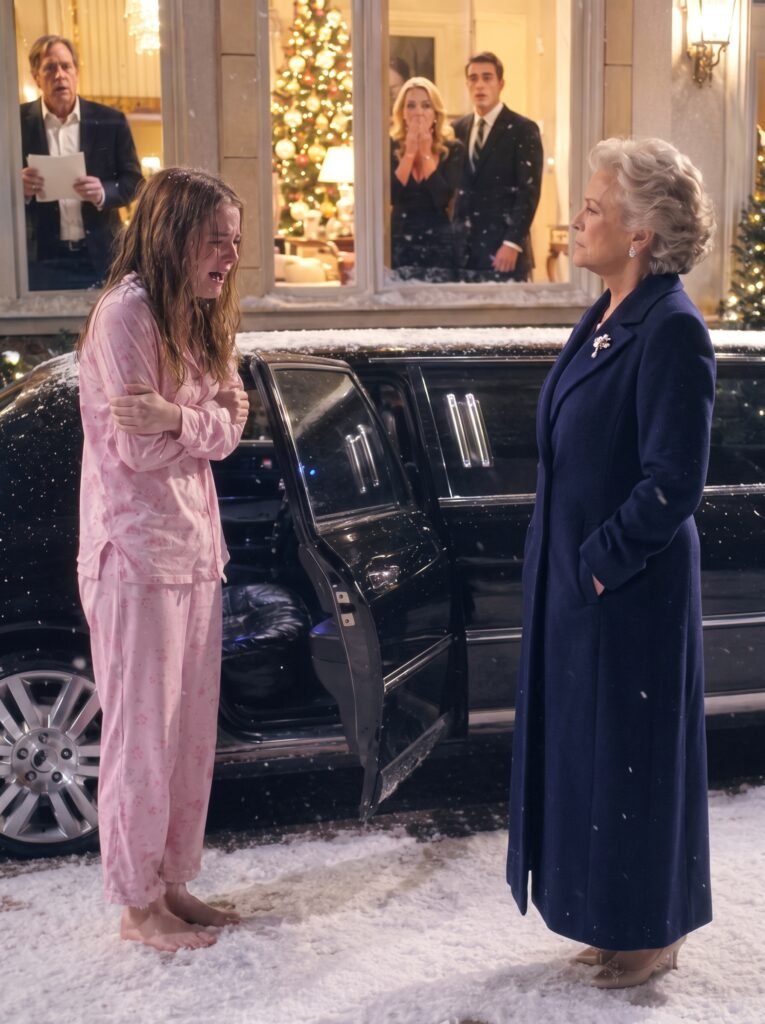
My father stepped onto the porch, his face drained of all color as he locked eyes with her.
For the first time in my life, Robert Carter looked small.
Not physically. He was still broad-shouldered, still wearing his expensive holiday sweater, still standing beneath the porch lights like he owned every inch of the world around him.
But something inside him had folded.
The confidence vanished from his face so quickly that it frightened me more than his anger ever had.
“Mother,” he said.
The word came out rough, almost breathless.
My grandmother did not answer him at first.
She walked toward me.
The snow seemed to soften around her footsteps. Behind her, the driver opened an umbrella, but she waved it away without looking. Her white coat gathered flakes along the shoulders, yet she moved as if the weather had no right to touch her.
When she reached me, her sharp eyes studied my face.
Not with pity.
With recognition.
“You have your mother’s eyes,” she said quietly.
Something broke in my chest.
No one in that house ever said things like that. My mother’s name had been treated like a stain, something to scrub out of conversations before anyone could notice.
I tried to speak, but my jaw trembled too hard.
Grandmother turned slightly. “Blanket.”
The driver was already moving. Within seconds, a thick wool blanket wrapped around my shoulders. Another man I hadn’t noticed stepped from a second vehicle parked behind the limousine, carrying boots and a coat.
My father finally came down the porch steps.
“What are you doing here?” he demanded, but his voice lacked its usual force. “You can’t just appear at my home and—”
“Your home?” my grandmother asked.
Two words.
That was all.
Yet my father stopped walking.
Karen appeared in the doorway behind him, holding a glass of wine that suddenly looked ridiculous in her hand. Ethan hovered over her shoulder, his expression shifting from curiosity to unease.
Inside, the twins were still laughing at something near the Christmas tree, unaware that the air outside had changed.
My grandmother looked past my father toward the house.
“Emily,” she said, turning back to me, “can you walk?”
I nodded, though I wasn’t sure it was true.
The moment I tried to step forward, my knees buckled.
My grandmother caught my arm with surprising strength.
Not tenderly, exactly.
Securely.
As if she had decided I would not fall, and the world had no choice but to obey.
“Get her inside the car,” she told the driver.
My father moved at once. “No. Absolutely not. Emily, get inside the house.”
I stared at him.
A few minutes ago, he had locked me out.
Now he wanted me back in.
The thought would have been funny if I had not been so cold.
My grandmother’s gaze slid to him. “You lost the right to give her instructions when you left her outside in a storm.”
“You don’t know what happened,” he snapped.
“I know what I saw.”
“It was a family matter.”
“No,” she said. “It was a choice.”
The driver helped me into the limousine. Warm air rushed over my frozen hands and face, making my skin sting. I sank into the leather seat, shaking so badly the blanket slipped from one shoulder.
Through the open door, I watched my grandmother remain in the snow with my father.
The word she had spoken still echoed in my head.
Demolish.
Surely she hadn’t meant it literally.
Surely.
My father seemed to wonder the same thing.
“You can’t threaten me,” he said. “Not anymore.”
“I’m not threatening you, Robert.”
Karen came down one step. “Mrs. Whitmore, this is a misunderstanding.”
My grandmother smiled faintly.
It was not a warm smile.
“Karen, I know exactly who you are.”
Karen’s face tightened.
That single sentence made me sit up straighter.
My grandmother turned to the man from the second car. “Mr. Bell, begin with the county records. Confirm the easement, the tax filings, and the ownership transfer dates.”
The man nodded and took out his phone.
My father went rigid.
“What is this?” he asked.
“A correction,” Grandmother said. “Long overdue.”
My father looked toward me, and for one strange second, I saw fear in his eyes. Not fear for me. Fear of what I might hear.
“Emily,” he said, forcing his voice into a softer shape. “Come inside. We can talk.”
I almost laughed.
Talk.
He had never wanted to talk when I asked about my mother. He had never wanted to talk when school forms disappeared or when I found my art supplies thrown away because Karen said they cluttered the house. He had never wanted to talk when I worked late into the night on portfolio sketches while babysitting toddlers who were not my responsibility.
Now, with my grandmother standing in his driveway, he wanted to talk.
Grandmother looked over her shoulder at me.
“You are eighteen in thirteen minutes,” she said. “Until then, I will ask you one question, and you may answer however you wish.”
My fingers tightened around the blanket.
“What question?”
“Do you want to leave this house tonight?”
The silence after that felt enormous.
Snow tapped against the limousine roof. Christmas music floated from the open front door, cheerful and thin. Behind Karen, the tree glowed gold and red.
For years, I had imagined leaving.
I had pictured it quietly, with one suitcase and no goodbye. I had pictured it dramatically, after winning a scholarship or selling a painting or finding some distant relative who actually wanted me.
But now the moment was real.
And all I could think about was the small silver key hanging around my neck.
My mother had told me to call my grandmother when I turned eighteen.
Not run.
Call.
There had to be a reason.
I swallowed. “I want to know the truth first.”
My grandmother’s expression changed.
For the first time, she looked less like a queen and more like a woman who had been waiting a long time to hear those words.
“Then we will start there,” she said.
At exactly midnight, my grandmother stepped into the limousine beside me.
My birthday arrived without cake, candles, or song.
Only snow.
Only silence.
Only the beginning of everything.
The driver took us not away from the house, as I expected, but around to the side driveway where the old carriage garage stood behind a line of bare trees.
No one used that building anymore. My father said it was unsafe. Karen said it was full of mold and old junk. Ethan said it was probably haunted.
As a child, I had tried the door once.
Locked.
Always locked.
My grandmother looked at the key around my neck.
“May I?”
With numb fingers, I lifted the chain over my head and placed the silver key in her palm.
She stared at it for so long that I wondered if she had forgotten I was there.
“This was your mother’s,” she said.
“I know.”
“She wore it the day she married your father.”
I blinked. “She did?”
“Yes. Not because it was pretty. Because it mattered.”
The car stopped in front of the carriage garage.
Outside, my father had followed us, trudging through the snow without a coat. Karen stayed near the porch, arms wrapped around herself. Ethan had retreated inside, though I could see his pale face pressed near the window.
Grandmother stepped out first.
I followed with the driver’s help, my new boots sinking into fresh snow.
The silver key fit perfectly into the carriage house lock.
For a moment, nothing happened.
Then the door gave a soft click.
My father shouted from behind us.
“Don’t open that.”
His voice cracked.
My grandmother did not turn around.
She pushed the door open.
The air inside smelled of cedar, dust, and winter. The driver flipped a switch, and rows of overhead lights flickered on one after another, revealing a room nothing like the abandoned storage space I had imagined.
It was clean.
Organized.
Preserved.
There were shelves of labeled boxes, covered furniture, framed paintings wrapped in cloth, and a large oak desk beneath the far window.
On the wall hung a portrait of my mother.
I stopped breathing.
She was younger in the painting than in the few photographs I owned. Her dark hair fell over one shoulder, and her eyes—my eyes, apparently—looked straight at the viewer with quiet certainty.
She wore the silver key around her neck.
I took one step toward it.
Then another.
My grandmother came to stand beside me.
“Her name was Clara Whitmore before she married your father,” she said. “She was my only child.”
I kept staring at the portrait. “Dad said she didn’t have family.”
“He lied.”
The words landed softly, but they changed the room.
My father stood in the doorway now, breathing hard. “Clara wanted distance from you.”
Grandmother’s face remained still. “Clara wanted peace. There is a difference.”
He laughed once, bitterly. “You controlled her entire life.”
“I protected what was hers.”
“You never approved of me.”
“No,” she said. “I did not.”
The honesty stunned even him.
I turned from the portrait. “Why didn’t you ever come for me?”
That question had lived inside me for years before I even knew whom to ask.
My grandmother looked at me fully.
“Because your father showed me documents that said Clara wanted no contact between us after her death. He told me you were fragile, that seeing me would confuse you, that you were being cared for and loved.” Her jaw tightened. “And because I made the worst mistake of my life. I believed paper more than instinct.”
My father looked away.
Grandmother continued. “I hired investigators over the years. Robert made sure everything looked acceptable from the outside. Good school. Clean house. Holiday cards. Carefully managed appearances.”
Karen stepped into the doorway behind him. “Emily was never mistreated.”
I turned toward her.
The room seemed to wait.
Karen’s cheeks flushed. “She had chores. Rules. That isn’t mistreatment.”
My grandmother’s gaze shifted to my wet shoes, my trembling hands, the blanket still around my shoulders.
Karen looked down.
No one spoke for a moment.
Then Grandmother walked to the oak desk and opened the top drawer. Inside was a small metal box.
She placed it on the desk and used my key again.
The lid lifted.
Inside were envelopes, a stack of photographs, a flash drive, and a sealed letter with my name written across it.
Emily, on your eighteenth birthday.
My mother’s handwriting.
I knew it instantly, though I had only seen it on the backs of old birthday cards.
My hand shook as I picked it up.
Grandmother said, “You do not have to read it tonight.”
But I was already opening it.
The paper smelled faintly of lavender.
My dearest Emily,
If you are reading this, then you are eighteen, and I am not there to tell you the truth myself. I have imagined this moment a thousand times, and in every version, I wish I could hold your hand.
There are things your father may never tell you.
There are things I was afraid to tell you too soon.
But fear has already taken too much from this family.
You are a Whitmore as much as you are a Carter. Before you were born, I created a trust in your name with your grandmother’s help. Not because money matters most, but because freedom does. I wanted you to have choices no one could take from you.
The house where you grew up was never meant to belong to your father.
It was placed in trust for you.
My eyes blurred.
I read that line again.
The house where you grew up was never meant to belong to your father.
It was placed in trust for you.
I looked up slowly.
My father’s face had turned gray.
Grandmother stood beside the desk, watching me with quiet sorrow.
I forced myself to keep reading.
Robert may tell you he provided everything. The truth is more complicated. After my illness worsened, I discovered debts, signatures, and decisions I had not approved. I tried to fix what I could before I died. Some things I could not fix in time.
Listen to your grandmother.
Ask about the east wall.
Trust your art.
And remember this most of all: you were loved before you were born, and you have never been the burden someone made you believe you were.
With all my heart,
Mom
By the end, I could no longer see the words.
My grandmother handed me a handkerchief.
Not a tissue.
An actual handkerchief.
It should have felt strange, but it didn’t.
I pressed it under my eyes and looked at my father.
“The house is mine?”
His mouth opened.
Closed.
Then he said, “It’s complicated.”
Grandmother’s voice cut through the room. “No. It is documented.”
“I maintained it,” he said sharply. “I raised her in it.”
“You lived in it,” Grandmother replied. “There is a difference.”
Karen looked at my father. “Robert?”
He ignored her.
I stepped closer to the desk. My feet had stopped shaking, or maybe I had simply gone numb in another way.
“What does ‘ask about the east wall’ mean?”
No one answered.
My grandmother’s eyes moved to the far side of the carriage house.
Against the east wall stood a tall cabinet covered with a white sheet.
My father moved before anyone else.
“No.”
Mr. Bell, the man from the second car, stepped between him and the cabinet. He didn’t touch my father. He didn’t need to.
Grandmother nodded to me.
I crossed the room slowly.
Each step felt like moving through a dream.
I pulled the sheet away.
Behind it was not a cabinet.
It was a door.
A narrow wooden door built into the wall, painted the same shade as the paneling. Hidden unless someone knew where to look.
My key fit this lock too.
Inside was a small studio.
My mother’s studio.
A skylight above was covered in snow, softening the light to silver. Canvases stood along the walls. Jars of brushes lined a table. A faded scarf hung from the back of a chair.
It felt as if she had stepped out only minutes ago.
I entered carefully, afraid to disturb the air.
On an easel near the center of the room sat an unfinished painting.
A little girl in a red coat standing beneath a winter tree.
Me.
Or at least, the version of me my mother had imagined I might become.
Beside the easel was another envelope.
This one was addressed to my grandmother.
Grandmother’s hand trembled when she saw it.
That was the first time I realized she was not made of stone.
She opened it with great care.
As she read, her expression changed from sadness to confusion.
Then to something like alarm.
“What is it?” I whispered.
She did not answer immediately.
Instead, she turned the letter over, as if searching for a page that wasn’t there.
“Margaret,” my father said.
It was the first time he had called her by name.
Grandmother looked at him.
“What did you do with the blue ledger?”
My father went still.
The question meant nothing to me, but it clearly meant everything to him.
Karen stepped forward. “Robert, what ledger?”
He snapped, “Stay out of this.”
The words struck the room harder than a shout.
Karen recoiled.
For the first time all night, I saw something in her face I had never expected.
Fear.
Not of my grandmother.
Of my father.
Grandmother folded the letter. “Clara wrote that the truth was in the blue ledger. She wrote that if anything happened before she could bring it to me, Emily’s key would lead me here.” Her voice lowered. “The ledger is missing.”
My father looked at the floor.
I waited for him to deny it.
He didn’t.
Outside, sirens sounded faintly in the distance.
Karen turned toward the driveway. “Robert?”
Grandmother looked calm, but I saw her fingers tighten around my mother’s letter.
“I made calls before I arrived,” she said. “A welfare check. A property attorney. A physician. And someone from the trust office.”
My father let out a cold laugh. “Of course you did. You always arrive with an army.”
“No,” Grandmother said. “Tonight I arrived with witnesses.”
A heavy silence followed.
The sirens grew closer, then stopped near the main house.
My father looked toward the open carriage house door. Snow moved beyond it like static across a dark screen.
He seemed to calculate something.
Then his shoulders dropped.
“You don’t understand,” he said.
I almost didn’t recognize his voice. It had lost the anger. Beneath it was exhaustion.
“I was young,” he continued. “Clara’s family hated me. Your mother made everything difficult. The trust, the lawyers, the conditions. It was never just a marriage. It was a negotiation.”
Grandmother stared at him. “She loved you.”
He flinched.
For a second, I thought he might cry.
Then he hardened again.
“She loved the idea of me.”
I stood in my mother’s studio, surrounded by proof that she had existed beyond the version he allowed me to know.
“She loved me,” I said.
My father looked at me then.
Something unreadable passed across his face.
“Yes,” he said quietly. “She did.”
The answer hurt more than I expected.
Because it was the first true thing he had said all night.
A police officer appeared at the door with another woman in a dark coat. They spoke quietly with Mr. Bell. No one rushed. No one shouted. It was not the dramatic scene my imagination might have invented.
It was worse in its calmness.
Real consequences did not always arrive like thunder.
Sometimes they came holding clipboards.
The woman in the dark coat introduced herself as a county social services supervisor, though she made clear that because I was now eighteen, her role was limited. A physician checked my temperature and examined my fingers while I sat in the limousine with the door open.
“Mild hypothermia risk,” he said. “She needs warmth, fluids, and rest.”
My grandmother’s mouth tightened.
My father stood several feet away, speaking to one of the officers. Karen stood alone on the porch, arms crossed tightly, no longer pretending to be composed.
Ethan watched from the doorway.
When he saw me looking, he disappeared inside.
Grandmother handed me a thermos of tea.
“I have rooms prepared at my residence,” she said. “You can stay there tonight.”
I wrapped both hands around the warm cup. “What happens to them?”
“That depends on what the documents show. And what you decide.”
“What I decide?”
“The trust became fully active at midnight. The property is yours, Emily. So are decisions attached to it.”
The word yours felt too large to hold.
The house where I had been made to feel like a guest.
The room where I had cried silently into pillows.
The kitchen where my acceptance letter had been opened and hidden.
Mine.
But ownership did not make me feel powerful.
It made me feel responsible for a life I had not known belonged to me.
“I don’t want revenge,” I said.
Grandmother looked at me carefully.
“I want answers.”
A faint softness touched her face. “Then we will seek answers.”
Across the driveway, Karen suddenly walked toward us.
My father called after her, but she ignored him.
She stopped near the limousine, snow gathering in her hair.
For a moment, she looked older. Not cruel. Not kind. Just tired in a way I had never noticed before.
“Emily,” she said.
I stiffened.
Grandmother did not move, but the driver stepped slightly closer.
Karen noticed. Her lips pressed together.
“I didn’t know about the house,” she said.
I said nothing.
“I knew your father had… arrangements. Money from Clara’s side. But I thought it was old family drama. I didn’t know it was yours.”
“Did you know about Hawthorne?” I asked.
Her eyes dropped.
That was answer enough.
“You let him decline it.”
“I told myself it was practical,” she said. “The twins need help. Money has been tighter than Robert admits. I thought there would be other schools.”
I stared at her. “You thought my future was practical to give away?”
She swallowed.
“I was wrong.”
The words came quietly.
Not enough.
But real.
My grandmother said, “Where is the blue ledger, Karen?”
Karen looked genuinely confused. “I’ve never heard of it.”
My father approached fast. “That’s enough.”
Karen turned on him. “No, Robert. It isn’t.”
He stopped.
She looked back at me. “There is a locked file cabinet in his study. Bottom drawer. He never lets anyone touch it.”
My father’s face changed.
Grandmother saw it too.
“Mr. Bell,” she said.
The attorney was already moving toward the house with one of the officers.
My father followed, protesting in a low, tense voice.
Karen stayed by the car.
“I am not asking you to forgive me,” she said to me. “I just thought you should know.”
Then she walked back through the snow.
I watched her go, unsure what I felt.
Hate would have been simpler.
But the truth had opened too many doors at once.
Inside the house, voices rose and fell. Drawers opened. Footsteps moved overhead. The twins began crying, and Karen hurried in.
My grandmother sat beside me in the limousine.
For a while, neither of us spoke.
Then I asked, “Did my mother paint a lot?”
Grandmother’s eyes drifted toward the carriage house. “Constantly. She painted when she was happy, angry, afraid, hopeful. Sometimes all at once.”
“Dad said it was a hobby.”
“She had a gallery show scheduled in New York the spring after you were born.”
I turned to her. “What happened?”
“You happened,” she said, and when she saw my expression, she added gently, “Not as a burden. As a choice. Clara decided to pause everything for one year. She said art would wait. You would not.”
A strange warmth spread through me.
I had spent years believing my dreams were selfish because everyone around me treated them that way.
But my mother had dreamed too.
And she had made room for love without erasing herself.
Grandmother reached into her coat pocket and took out a small velvet pouch.
“I brought this for your birthday.”
Inside was a bracelet made of delicate silver links. At the clasp hung a tiny charm shaped like a paintbrush.
“It was Clara’s at eighteen,” she said. “She wore it until the day she replaced it with the key.”
I touched the charm carefully.
“Thank you.”
Her eyes softened. “Happy birthday, Emily.”
It was the first time anyone had said it that night.
I put the bracelet on.
It fit perfectly.
The front door opened again.
Mr. Bell emerged carrying a black file box. The officer walked beside him. My father followed behind, pale and furious, but silent.
“No blue ledger,” Mr. Bell said when he reached us. “But we found copies of trust correspondence, school documents, and several sealed financial statements.”
Grandmother frowned. “Copies?”
Mr. Bell nodded. “The originals are missing.”
My father looked at me then.
Not at my grandmother.
At me.
“You don’t know what you’re starting,” he said.
I expected anger to flare inside me.
Instead, I felt very still.
“No,” I said. “I don’t. But I know what I’m ending.”
His face tightened.
Grandmother gave a small nod, as if I had answered a question she had not asked aloud.
By two in the morning, the house was quiet.
The officers left after taking statements. The social services supervisor arranged a follow-up because of the twins. Mr. Bell secured the documents he had found. My grandmother insisted the physician check me once more before letting me leave.
My father and Karen remained inside with the younger children.
No one demolished anything that night.
Not the house.
Not the walls.
Not even my father’s carefully built image.
But something had been demolished all the same.
The lie.
Before we left, I asked to go back into the carriage house alone.
Grandmother hesitated only briefly before nodding.
The studio waited in soft silence.
I stood before my mother’s unfinished painting and imagined her hand moving across the canvas. Had she painted it while I slept nearby? Had she known she might never finish it?
On the table beside the brushes lay a sketchbook.
I opened it.
The first pages were studies of hands, trees, windows, baby blankets. Then came portraits of me as an infant, round-cheeked and solemn.
Near the back, the drawings changed.
There were sketches of the house from odd angles. The staircase. The fireplace. The east wall of the carriage house. A section of Robert’s study.
On the final page was a drawing of a blue book.
Beneath it, my mother had written three words:
Not with Robert.
I stared at the sentence.
Not with Robert.
So the ledger had not been in my father’s study after all.
I turned the page, but there was nothing else.
A loose photograph slipped from the back cover and fluttered to the floor.
I bent to pick it up.
It showed my mother standing in front of the carriage house, smiling faintly. Beside her stood a younger version of my father, one arm around her waist.
But there was someone else in the background.
A woman near the trees, half turned away from the camera.
I brought the photograph closer.
My heart began to pound.
The woman was Karen.
Younger.
Before she was my stepmother.
Before my mother died.
Before any story my father had ever told me said she should have been there.
On the back of the photo, in my mother’s handwriting, was a date.
Two weeks before her death.
And beneath the date, one sentence:
If anything happens, ask Karen why she lied.
PART 3 — FINAL PART
The photograph trembled in my hand.
For several seconds, I could hear nothing but the quiet groan of the carriage house settling beneath the snow. The world outside had gone still, as if even winter had leaned closer to read the words on the back of that photo.
If anything happens, ask Karen why she lied.
Karen.
The woman who had smiled when the curtain closed.
The woman who had watched my father chip away at my future one quiet decision at a time.
The woman who had just admitted she knew about Hawthorne.
I turned the photograph over again.
There she was, younger but unmistakable. Same sharp cheekbones. Same pale-blond hair, though then it fell loose around her shoulders instead of being pinned into perfect holiday curls. She stood half-hidden near the trees behind my mother and father, not smiling, not looking at the camera.
Watching.
My skin prickled.
Why had Karen been there two weeks before my mother died?
Why had my father spent eighteen years pretending they had met later?
And what lie had my mother known about?
The carriage house door creaked open behind me.
I spun around.
My grandmother stood in the doorway, snowlight framing her like a ghost from another century. Her eyes moved from my face to the photograph.
“What did you find?”
I couldn’t answer. I simply handed it to her.
She studied the front first.
For the first time since she arrived, her composure faltered so completely that she reached for the doorframe.
“Margaret?” I whispered.
She turned the photo over.
Her lips parted.
“Oh, Clara,” she said softly.
I hugged my arms around myself. “You knew Karen?”
Grandmother lifted her eyes.
“No,” she said. “But Clara did.”
The answer chilled me more than the storm had.
Behind Grandmother, headlights washed across the snow as one of the cars adjusted position in the driveway. Somewhere in the main house, a door closed. The sound seemed too ordinary for a night that had torn my life open.
Grandmother slipped the photograph into the envelope with my mother’s letter.
“We need to speak with Karen.”
My stomach tightened. “Now?”
“Now.”
We crossed the yard together, the blanket still wrapped around me, the bracelet cold against my wrist. Every step toward the house felt like walking backward through my childhood—past the windows I had scrubbed, the porch I had shoveled, the kitchen where I had learned to stay quiet.
But this time, I did not enter as someone asking permission.
I entered as someone carrying a question.
The Christmas tree still glowed in the living room.
Its ornaments shimmered in gold and scarlet, reflecting against the windows. Wrapped gifts sat beneath it in neat piles. Ethan’s gaming console box lay open near the couch, bright and careless. The fireplace crackled as if nothing had happened.
Karen stood near the staircase holding one of the twins, Lily, against her shoulder. Her younger son, Noah, sat on the bottom step in striped pajamas, rubbing his eyes. When Karen saw us, the color left her face.
My father stood in the hall, speaking sharply into his phone.
He stopped when he saw the photograph in Grandmother’s hand.
“No,” he said.
Just one word.
Karen looked from him to us.
“What is that?”
Grandmother held out the photo.
Karen did not take it at first.
Then her fingers closed around the edges, careful, almost afraid. She looked down.
The change in her face was immediate.
Recognition.
Then grief.
Then something heavier than either.
My father stepped toward her. “Karen.”
She flinched.
That tiny movement told me more than a shout ever could have.
“Why were you there?” I asked.
Karen closed her eyes.
The little girl on her shoulder stirred. Karen kissed her hair automatically, a mother’s movement, practiced and gentle. Then she handed Lily to my grandmother’s driver, who had followed us inside with quiet tact.
“Take them to the den,” Karen said. “Please.”
My father snapped, “You don’t give orders in my house.”
Karen turned to him slowly.
“No, Robert,” she said. “Apparently none of us ever did.”
He stared at her.
For a moment, the entire house held its breath.
Then Karen looked at me.
“I was your mother’s nurse.”
The words did not fit anywhere in my mind.
“What?”
“Not officially by the end,” Karen said. “But in the beginning, yes. Clara hired me during her illness. Part-time at first. Then more often when things became difficult.”
Grandmother’s eyes sharpened. “Clara never told me.”
“She wanted to,” Karen said. “Robert asked her not to.”
My father laughed under his breath. “This is absurd.”
Karen’s voice shook, but she did not look away from me.
“I met your father because of your mother. Not after she died. Before.”
A strange pressure filled my ears.
All these years, Karen had lived in my mother’s house, used my mother’s rooms, replaced my mother’s name with silence—and she had known her.
“Did you lie to her?” I asked.
Karen pressed the photograph against her chest.
“Yes.”
My father moved closer. “Karen, think very carefully.”
“I have,” she said, and her eyes filled. “For eighteen years.”
The living room clock ticked toward three in the morning. Snow slid softly down the window glass. The Christmas tree hummed with golden light, absurdly beautiful.
Karen turned to Grandmother.
“Clara was frightened before she died. Not always. Some days she was peaceful. She painted. She talked about Emily. She talked about Hawthorne, even then. She said her daughter would study somewhere surrounded by music and canvases and mountain light.”
My throat closed.
Karen continued, “But other days, she kept checking papers. She believed money was missing. She believed Robert had forged signatures after she became too weak to attend meetings.”
My father’s jaw clenched. “She was ill.”
“She was clear,” Karen said.
Grandmother stepped forward. “The blue ledger?”
Karen nodded once.
“Clara kept notes in it. Dates. Copies. Account numbers. Names of people she had spoken to. She knew the formal documents could disappear, so she wrote everything by hand too. She asked me to bring it to you.”
Grandmother went still.
“You?”
Karen’s face crumpled.
“I was supposed to drive to your house the night before Clara died.”
No one spoke.
Even my father’s anger seemed to falter.
“What happened?” I whispered.
Karen looked at me, and for the first time, I saw the young woman in the photograph—the one standing in the snow, tangled in someone else’s secrets, not yet hardened into the person I knew.
“Robert found out,” she said. “He told me Clara was confused. He said if I delivered those accusations, it would destroy your family and upset Clara in her final days. He said Margaret would take Emily away from him. He said I would lose my job. He said no one would believe a private nurse over a grieving husband.”
Grandmother’s eyes glistened, though her posture stayed straight.
“And you believed him.”
Karen swallowed.
“I wanted to.”
The honesty landed quietly.
“I was twenty-six,” she said. “My mother was sick. I needed work. Robert was charming when he wanted to be. He made me feel important, as if I was the only one who understood him. I told myself Clara was afraid because illness makes people afraid. I told myself papers were just papers.”
She looked at the photograph.
“Then Clara died.”
The room seemed to tilt.
My father said, “Enough.”
But Karen was no longer speaking to him.
“After the funeral, I found the blue ledger in the trunk of my car. Clara must have placed it there herself before she became too weak.”
Grandmother inhaled sharply.
“What did you do with it?”
Karen shut her eyes again.
“I hid it.”
My father’s face changed. “What?”
That single word told everyone he had not known.
For the first time all night, Karen looked almost relieved.
“You searched my apartment,” she said to him. “Remember? You called it concern. You said I was grieving too. But I had already hidden it somewhere else.”
My grandmother’s voice was barely above a whisper.
“Where?”
Karen opened her eyes and looked directly at me.
“At Hawthorne.”
The name rang through me like a bell.
“Hawthorne Preparatory?” I asked.
Karen nodded.
“My younger sister worked there then, in the administrative office. I mailed the ledger to her and asked her to lock it away with instructions not to release it unless Clara’s daughter came asking. I told myself that was enough.”
My breath caught.
“My acceptance letter.”
Karen pressed her lips together.
“When your counselor sent the letter, it came with a note saying Hawthorne was honored to continue Clara Whitmore’s legacy scholarship. Robert opened it first.”
Grandmother stared at her. “Legacy scholarship?”
Karen nodded. “Clara had arranged it before she died. Not just for tuition. Room, supplies, mentorship, gallery access. Everything. Hawthorne was supposed to contact Emily at eighteen.”
My father’s hands curled at his sides.
“You had no right,” Karen said to him, her voice gaining strength. “You had no right to take that from her.”
He turned on her. “And you had every chance to speak up.”
“Yes,” she said.
The word was steady.
“I did.”
That stopped him.
Karen wiped her cheek with the back of her hand.
“Three years ago, when Emily’s art teacher called about the regional exhibition, I told Robert she should go. He said Clara’s family would find out. Last year, when Hawthorne sent preliminary forms, I told him hiding them was wrong. He said Emily would leave and never come back. Tonight, when she asked about the acceptance letter, I told him to give it to her.”
I stared at her.
“You did?”
She looked down.
“Not loudly enough.”
That hurt, but it did not feel like an excuse.
It felt like a confession.
My father’s voice came low and bitter. “How moving. Now you want to be noble.”
Karen turned toward him fully.
“No. I want to stop being afraid of what happens when I tell the truth.”
The words seemed to loosen something in the walls.
For years, my father had filled every room with certainty. His anger had been weather. His rules had been gravity. But now, standing between my grandmother and Karen, he looked like a man surrounded by doors he had locked from the wrong side.
Grandmother took out her phone.
“I am calling Hawthorne.”
“At three in the morning?” my father demanded.
Grandmother did not look at him. “Some institutions know how to answer when history knocks.”
Ten minutes later, she was speaking to a woman named Dr. Elowen Price, the headmistress of Hawthorne Preparatory Academy.
My grandmother put the call on speaker.
When Dr. Price heard my name, there was a silence.
Then she said, “We have been waiting for Emily Carter for a very long time.”
My knees weakened.
Grandmother’s hand touched my elbow.
Dr. Price continued, “Her mother’s instructions were unusually specific. A sealed package was placed in archival custody eighteen years ago by a woman named Sarah Vale.”
Karen whispered, “My sister.”
“The package could only be released in person,” Dr. Price said. “To Emily Carter, on or after her eighteenth birthday, accompanied by Margaret Whitmore or proof of direct identity.”
My grandmother closed her eyes.
“Dr. Price,” she said, and her voice nearly broke, “is it still there?”
“Yes,” said the headmistress. “It is still here.”
I covered my mouth.
The blue ledger existed.
My mother had not vanished into memory.
She had left a trail.
A real one.
Dr. Price’s tone softened. “Mrs. Whitmore, I should also tell you something else. Clara left a letter for Emily with the package, but there is another item in our gallery vault. A painting.”
My heart thudded.
“What painting?” I asked before I could stop myself.
The headmistress paused.
“Emily,” she said gently, “your mother titled it The Girl Who Opens the Door.”
No one in the room moved.
Then Dr. Price added, “It has never been displayed. Clara requested that it wait for you.”
For the first time that night, I cried without trying to hide it.
Not because I was cold.
Not because I was afraid.
Because somewhere, eighteen years ago, my mother had believed I would reach a door.
And open it.
We left for Hawthorne before dawn.
My grandmother insisted I sleep first at her estate, but when Dr. Price said she could meet us by late morning, I knew sleep would only trap me inside the questions. So Grandmother wrapped me in a warmer coat, called ahead for food, and instructed her driver to take us north through the snowy Vermont roads as the sky turned pale behind the mountains.
Karen came with us.
That surprised everyone.
Especially my father.
He stood in the driveway as we prepared to leave, his face drawn and unreadable. He had stopped shouting. Maybe he had finally understood that loudness could not change paper, memory, or midnight.
Karen carried one small bag.
The twins stayed with a neighbor until social services could follow up. Ethan refused to come downstairs.
As Karen climbed into the second car, my father caught her wrist—not hard, but urgently.
“You’re really doing this?”
Karen looked at his hand until he released her.
“I should have done it years ago.”
He looked past her to me.
For one moment, I saw not the towering man at the dinner table, not the father who locked doors, but someone smaller. Someone who had spent years holding too tightly to things that were never his.
“Emily,” he said.
I waited.
His mouth worked as if apologies were in a language he had never learned.
“You don’t understand what it was like after Clara died.”
The old me might have filled the silence for him.
The old me might have softened, explained, apologized for hurting him by existing.
But the snow was falling, and my mother’s key lay warm beneath my sweater.
“You can tell the truth through proper channels,” I said. “That’s where I’ll listen.”
His eyes lowered.
I got into the car.
The drive to Hawthorne felt like traveling into a future that had been waiting in the mountains.
The school appeared just before noon, rising from a ridge above a frozen lake. Stone buildings stood among snow-laden pines, their windows glowing amber against the white landscape. Iron gates opened slowly as our cars approached. Above them, carved into an arch, were the words:
ART IS MEMORY MADE BRAVE.
I read them three times.
Dr. Price met us at the entrance to the main hall. She was tall, silver-haired, and wore a deep green coat that made her look like she belonged to the forest as much as to the school.
When she took my hand, she did not shake it like a stranger.
She held it like an apology.
“Welcome home, Emily.”
I looked around at the vaulted ceiling, the student paintings, the polished floors smelling faintly of wax and pine.
Home.
The word had never felt less like a place.
And more like an invitation.
We were led to the archives beneath the old gallery. The room was temperature-controlled and quiet, lined with flat files, cabinets, and shelves of labeled boxes. Dr. Price unlocked a gray metal cabinet and withdrew a sealed archival case.
My grandmother stood beside me.
Karen stood a little behind us, pale and silent.
Dr. Price placed the case on the table.
“Only you may open it,” she said.
The clasp was simple.
My fingers still shook.
Inside lay the blue ledger.
It was smaller than I had imagined, bound in faded navy cloth. My mother’s handwriting filled the first page.
For Emily, when truth becomes safer than silence.
Beneath it were dates, notes, clipped copies, names, accounts. Grandmother and Mr. Bell read quickly, their faces growing more serious with every page. It was not dramatic in the way stories make discoveries dramatic. There were no gasps over every line. Just the steady, undeniable accumulation of proof.
Trust transfers delayed.
School correspondence intercepted.
Funds redirected through accounts my father had controlled.
Letters from Grandmother marked refused, though my grandmother swore she had never received them back.
A life rearranged one document at a time.
Then, near the end of the ledger, we found something unexpected.
Not an accusation.
A letter from my father to my mother.
Grandmother hesitated before handing it to me.
“You should decide whether to read this.”
I knew I should have felt anger.
Instead, I felt the pull of an unfinished question.
I unfolded the page.
Clara,
I know Margaret thinks I married you for security. Maybe part of me did want to be safe. I grew up watching money decide who mattered. Then I met you, and for once I wanted to be more than what I came from.
But every time I stand beside you, I feel measured and found lacking.
Your mother looks at me like I am temporary.
Your lawyers speak around me.
Even this house has your name in its bones.
I love you. I love Emily. But I am terrified that one day she will look at me with your family’s eyes and see nothing worth keeping.
The letter ended there.
No signature.
No apology.
Just fear, written before it hardened into control.
I placed the paper down gently.
Karen whispered, “He was different then.”
Grandmother’s expression was grave. “Fear can explain a door. It does not excuse locking someone behind it.”
I nodded.
But something inside me shifted.
My father’s choices were still his.
The harm was still real.
But for the first time, he became more than a monster in my memory. He became a man who had mistaken possession for love, secrecy for protection, and control for worth.
That did not free him from consequence.
It freed me from needing hatred to survive him.
Dr. Price led us next to the gallery vault.
The painting was covered in linen.
When she pulled the cloth away, I forgot to breathe.
It showed a girl in a red coat standing before a door in a wall of winter branches. The girl’s hand rested on a silver key. Beyond the door was not a room, but a sunrise over mountains, wild and golden and impossibly bright.
The girl’s face was unfinished in a way that made it feel alive.
Not blank.
Waiting.
At the bottom, in my mother’s delicate signature, were the words:
The Girl Who Opens the Door.
I stepped closer until I could see the brushstrokes.
“Did she know?” I whispered.
Grandmother stood beside me, tears shining openly now.
“She hoped.”
A small card had been tucked behind the frame. Dr. Price handed it to me.
Emily,
This painting is not finished because you are not finished. No one gets to decide the shape of your life before you live it. Not grief. Not fear. Not even love, when love forgets to let go.
Paint the face yourself when you are ready.
Mom
I pressed the card to my heart.
For eighteen years, I had believed my mother left me only a key.
But she had left me a question.
Who will you become when the door finally opens?
The answer did not come all at once.
It came in the weeks that followed.
The legal process began quietly but firmly. Mr. Bell filed petitions with the trust court. Financial records were reviewed. My father was removed from all authority connected to my trust and property. Funds taken from accounts meant for my education were traced, and arrangements were made for restitution through proper legal channels.
There were interviews.
Statements.
Documents.
Difficult phone calls.
Not one of them felt like revenge.
They felt like cleaning a window that had been painted black.
Karen gave testimony. So did her sister, Sarah, who arrived at Hawthorne carrying her own guilt like a heavy coat. She had kept the package safe for eighteen years but had never known whether she should have done more. When she met me, she cried before saying hello.
“I’m sorry,” she said.
I had heard those words more in a month than in the rest of my life.
Some apologies were too small for the damage behind them.
But they were still doors.
Karen moved out of the house before New Year’s. She took the twins with her to a modest rental apartment near town. Social services monitored the transition, and Grandmother helped ensure the children had stability without making Karen feel purchased.
Ethan stayed with my father.
For a while, I thought he would never speak to me again.
Then, one afternoon in January, a message arrived.
I’m sorry about the letter.
That was all.
I stared at it for a long time.
Then I typed back:
Thank you for saying that.
Three dots appeared.
Disappeared.
Appeared again.
He finally wrote:
Dad said you were leaving because you thought you were better than us. I believed him.
I looked out the window of my room at Hawthorne, where students crossed the snowy courtyard carrying instrument cases and portfolios. Someone laughed below. Somewhere, a piano played.
I typed:
I’m leaving because I’m allowed to grow.
This time, his reply came faster.
I think I want that too.
I did not know what would become of Ethan.
But for the first time, I wondered whether he might become more than the boy who laughed at the table.
My father’s apology came in March.
Not in person.
Not at first.
It arrived through his attorney, attached to a formal statement admitting he had hidden correspondence, mismanaged trust-related funds, and interfered with my education. The language was stiff, legal, controlled.
But behind it was a handwritten note.
Emily,
I do not know how to write this without making excuses. I am ashamed of what I did. I told myself I was keeping the family together. The truth is, I was afraid of losing everything, and I made you pay for that fear.
Your mother loved you. I should have protected that love instead of trying to own what remained of it.
I am entering counseling because people I hurt deserve more than words. You do not owe me forgiveness. You do not owe me anything.
Dad
I read it once.
Then again.
I did not cry.
But I did fold it carefully and place it in a drawer.
Not as forgiveness.
Not yet.
As proof that even locked rooms could someday open from the inside.
Spring arrived at Hawthorne like a secret revealed in color.
Snow melted from the ridges. The frozen lake turned silver-blue. Students painted outside in scarves and rolled-up sleeves. I spent hours in the studio, learning how to mix light instead of only shadow.
For years, my art had been small because I had learned to take up little space.
At Hawthorne, my canvases grew.
Mountains.
Doors.
Hands.
A kitchen window half-covered by a curtain.
A carriage house with a hidden studio inside.
A girl in a red coat facing sunrise.
Dr. Price never rushed me. My instructors did not praise everything, which I came to appreciate. They challenged me. They asked what I meant. They made me defend color choices and composition and silence.
One evening, Grandmother visited as I was working alone in the studio.
She entered without her usual sharp footsteps, carrying two paper cups of cocoa.
“I bribed the dining hall,” she said.
I smiled. “That sounds illegal.”
“I prefer ‘strategic.’”
She stood behind me, looking at the canvas on my easel.
It was my mother’s painting.
Not the original. That remained in the gallery vault until I felt ready. This was my study of it—a red-coated girl before a door, but now I had begun shaping the face.
Not my mother’s face.
Not entirely mine.
Something between the two.
Grandmother was quiet for a long time.
Then she said, “Clara would have loved this.”
My brush paused.
“Do you think she’d be angry? About all the years we lost?”
Grandmother’s hand tightened around her cup.
“I think she would grieve them,” she said. “Then she would ask what we planned to do with the years we still have.”
I looked at her.
She did not hide her tears anymore.
Neither did I.
By May, the trust court confirmed what my mother had intended. The house, the carriage studio, and remaining family assets assigned to my education were legally secured. My father was required to repay what he had taken through structured restitution. He also agreed, as part of the legal resolution, not to interfere with my schooling or contact me except through approved channels until I chose otherwise.
I expected the final ruling to feel triumphant.
Instead, it felt quiet.
Like setting down a heavy suitcase after carrying it so long that my hands had forgotten how to open.
The question remained: what should happen to the house?
Grandmother assumed I would sell it.
Karen thought I might rent it.
My father, through his lawyer, asked for time to remove personal belongings.
I visited alone in early June.
The snow was gone. The driveway where I had stood freezing was lined with wet green grass. The porch looked smaller in daylight. The kitchen window reflected clouds instead of Christmas lights.
I unlocked the front door with my own key.
The house smelled of dust, lemon cleaner, and old smoke from the fireplace.
I walked from room to room.
Here was the dining room where Ethan had waved my letter.
Here was the hallway where I had learned to listen for footsteps.
Here was my bedroom, stripped nearly bare, sunlight falling across the floorboards.
I waited for anger.
It came, but softer than before.
Not gone.
Changed.
In the carriage house, my mother’s studio glowed with summer light. The unfinished painting still stood on the easel, waiting.
On the table, I found something I had missed before.
A small inscription carved into the underside of the wooden chair.
C.W. + E.C.
First studio day, someday.
My fingers traced the letters.
Clara Whitmore and Emily Carter.
My mother had not planned only for my escape.
She had planned for my return.
That was when I knew.
The house would not be sold.
It would not remain a monument to pain, either.
By autumn, the Carter-Whitmore Arts House opened its doors.
Not as a mansion.
Not as a symbol of wealth.
As a scholarship residence and community studio for young artists from complicated homes—students with talent, courage, and nowhere quiet to make sense of themselves.
Grandmother funded the renovations. Hawthorne partnered with the program. Dr. Price helped select the first group of students. Karen volunteered to organize supplies twice a week, never asking for praise, never pretending the past had vanished.
Ethan came one Saturday to assemble easels.
He had grown taller, quieter.
When he saw me watching him struggle with a screw, he lifted the instruction booklet.
“I swear this thing is written in another language.”
I took the screwdriver. “You’re holding the back leg upside down.”
He groaned. “I knew that.”
“No, you didn’t.”
For a second, we looked at each other.
Then we laughed.
It was awkward.
Small.
Real.
Later, he stood before the kitchen window where the curtain had once been pulled closed.
“I remember that night,” he said.
I looked at him.
His voice lowered. “I thought if I laughed, Dad would be proud of me.”
The old hurt stirred.
But so did something else.
“You were a kid too,” I said.
“That doesn’t make it okay.”
“No,” I said. “It makes it something you can choose not to become.”
He nodded, eyes bright.
In December, one year after the night everything changed, we held the first winter exhibition at the Arts House.
Snow fell again.
This time, I watched it from inside a room full of warmth.
The carriage house had been transformed into a gallery. My mother’s paintings hung beside student work. The hidden studio remained preserved, but its door was no longer concealed. A small brass plaque beside it read:
CLARA WHITMORE STUDIO
For every artist waiting to be found.
Grandmother arrived in her white coat, as elegant as ever, though she leaned on my arm when the walkway grew slick. Karen came with Lily and Noah, both dressed in red sweaters. Ethan arrived late with a crookedly wrapped gift and snow in his hair.
My father came too.
I had not expected him to.
He stood near the entrance, thinner than before, holding his hat in both hands. He looked at the walls, the students, the open studio door. His eyes stopped on the portrait of my mother.
For a long time, he did not move.
Then he approached me.
Grandmother stiffened beside me.
I touched her hand lightly.
“It’s all right.”
My father stopped a few feet away.
“Emily,” he said.
“Robert.”
The name felt strange, but not cruel.
He accepted it with a small nod.
“I won’t stay long. I only wanted to see what you made of it.”
I looked around at the glowing room, the paintings, the young artists laughing over cider, the open doors.
“I didn’t make it alone.”
His eyes moved to Clara’s portrait.
“No,” he said. “You didn’t.”
He reached into his coat and took out a small wrapped package.
“I found this in storage. It should have been yours.”
Inside was a wooden paintbrush case, worn smooth from use. My mother’s initials were burned into the lid.
C.W.
I opened it carefully.
Inside were seven brushes and a folded note in my mother’s handwriting.
For Emily’s first real canvas.
My breath caught.
My father’s voice was quiet.
“I almost threw it away years ago. I don’t know why I didn’t.”
I looked at him.
Maybe because some part of him had remembered love.
Maybe because guilt had hands.
Maybe because not every lost thing wants to stay lost.
“Thank you for bringing it,” I said.
His eyes filled, but he blinked the tears back.
“I’m sorry,” he whispered.
This time, the apology was not hidden behind attorneys or formal statements.
It stood between us, fragile and bare.
“I know,” I said.
It was not forgiveness.
Not fully.
But it was no longer a wall.
Before he left, he stopped in front of my newest painting.
It was the final version of The Girl Who Opens the Door.
I had worked on it for months, not altering my mother’s original, but completing my own response beside it. In mine, the girl had opened the door and turned back—not to return to the cold, but to let light spill behind her so others could find the way.
My father studied it.
“What is it called?” he asked.
I stood beside him.
“The House That Opened.”
He nodded slowly.
“That’s a good name.”
After he left, Grandmother found me near the studio.
“You handled that with more grace than many people twice your age.”
I smiled faintly. “I had good women leaving clues for me.”
Her eyes softened.
“Clara would have adored knowing you.”
I looked through the open studio door at my mother’s brushes, her chair, her unfinished dreams becoming something larger than grief.
“I think she does,” I said.
Near the end of the evening, Dr. Price tapped a spoon against a mug and asked everyone to gather.
Students, teachers, neighbors, trustees, children with frosting on their sleeves—all crowded into the carriage gallery beneath strings of warm lights.
Grandmother stood beside me as Dr. Price announced the first Clara Whitmore Doorway Scholarship.
“For a student whose talent is matched by courage,” she said, “and whose future deserves room to unfold.”
The recipient was a fourteen-year-old girl named Maya, who painted birds as if they were made of music. When her name was called, she froze in disbelief.
Then she covered her face and cried.
I walked over and handed her the scholarship envelope.
Her hands shook the way mine had once shaken.
“Does this mean I can come here after school?” she whispered.
I smiled.
“It means the door is open.”
Across the room, Karen wiped her eyes. Ethan clapped louder than anyone. Grandmother stood perfectly still, but her face shone.
And in that moment, the final truth settled over me—not as a revelation from a hidden letter or a forgotten ledger, but as something living.
My grandmother had come that night and said, “Demolish.”
I had thought she meant the house.
My father had feared she meant his power.
But the thing that truly needed demolishing was older than all of us.
The silence.
The shame.
The belief that love could be buried so deeply it would never rise again.
A year earlier, I had stood outside in the snow, watching a family celebrate without me.
Now I stood inside the same place, surrounded by people who had chosen truth over comfort, repair over pretending, and hope over fear.
The Christmas tree glowed in the corner, decorated not with perfect ornaments but with small painted doors made by every student in the program. Some were bright. Some were crooked. Some were unfinished.
Mine hung near the top.
A red door.
A silver key.
A sunrise behind it.
Grandmother slipped her arm through mine.
“Happy birthday, Emily.”
This time, there was cake.
There were candles.
There was music.
And when I closed my eyes to make a wish, I realized I did not need to wish for escape anymore.
So I wished for open doors.
For Maya.
For Ethan.
For Karen’s children.
For my father, somewhere on his own difficult road.
For my grandmother, who had returned too late and still in time.
For my mother, whose love had crossed eighteen winters, hidden in keys and canvases and handwritten clues, until it found me exactly when I needed it most.
Then I blew out the candles.
The room erupted in applause.
Outside, snow fell gently over the driveway where I had once stood alone.
Inside, the house was warm.
And every door was open.
THE END