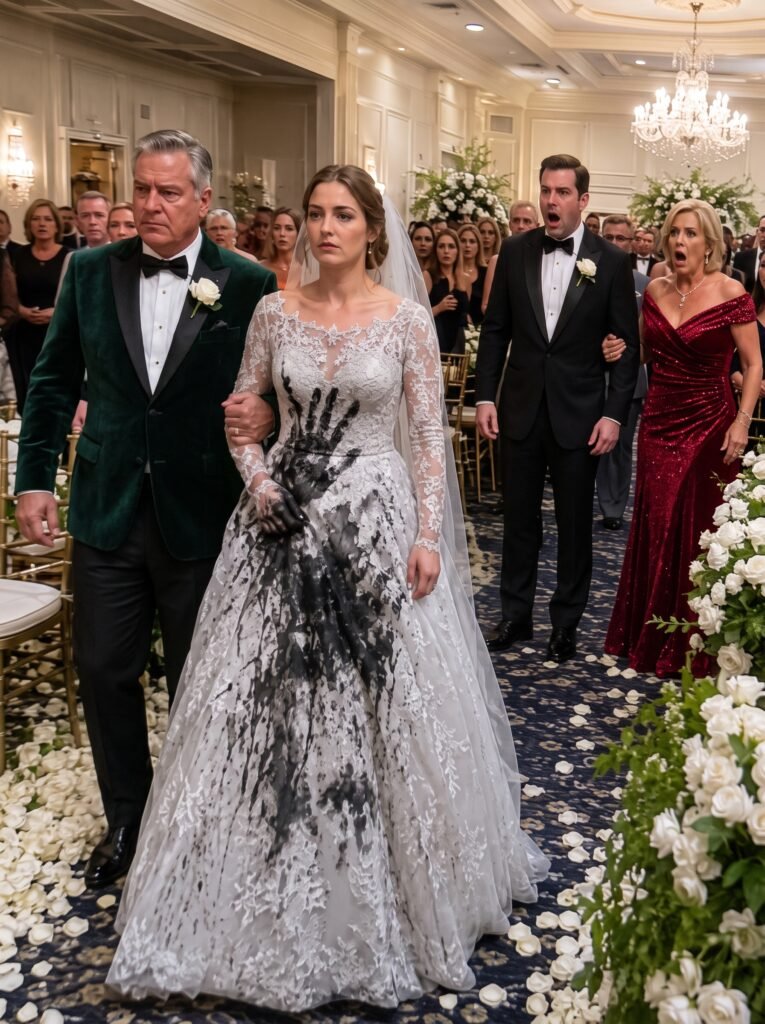
Chairs scraped back. Someone’s phone clattered to the floor. A woman in the third row—Daniel’s aunt, I think—stood up with her hand pressed to her mouth, staring at the screen like she couldn’t reconcile what she was seeing with the family she thought she’d married into thirty years ago.
Eleanor’s composure cracked for the first time since I’d known her. “That footage is doctored,” she said, but her voice had lost its practiced steadiness. “This is a setup. She’s trying to destroy this family out of spite.”
“The timestamp matches the venue’s own security system,” I said. “Which I didn’t touch. I simply requested a copy this morning, once I found the dress.” I turned the remote toward the screen and let the footage keep playing—Eleanor glancing over her shoulder before she poured the stain, checking her watch, tucking the note into the lace with the same careful precision she’d used to plan a wedding meant to bind me to a family built on stolen money.
Daniel’s father, seated in the front row, hadn’t moved since the first image appeared. I’d always liked Robert Whitmore, in the distant, cautious way you like someone you suspect doesn’t fully know what happens in his own house. Now I watched something break behind his eyes as he looked at his wife, and I understood, in that moment, that whatever came next for this family, it wouldn’t be united.
“Robert,” Eleanor said, turning to him, her voice suddenly softer, pleading in a register I’d never once heard her use. “You know I would never—”
“I’ve seen the foundation’s numbers look strange for two years,” Robert said quietly, not looking at her, staring instead at the frozen frame of his wife’s face caught mid-crime on a fifteen-foot screen. “I told myself I was imagining it. I told myself you’d never risk what we built.” His voice cracked. “I should have looked closer.”
Daniel, beside me, had gone very still. “Maya,” he said, low, urgent, no longer performing for the room. “Whatever you think you know—”
“I don’t think I know it, Daniel. I have eleven months of forensic documentation.” I held up the flash drive again, letting it catch the chandelier light. “You want to know the part that actually hurt? It wasn’t finding the shell companies. It wasn’t the zoning bribe, or even the liability documents your lawyer drafted for me to sign next Tuesday, conveniently timed for right after the honeymoon, when I’d be too happy and too naive to read the fine print.” I paused, and for the first time since walking down that aisle, I let my voice shake, just slightly, just enough to be human instead of a weapon. “It was realizing you introduced me to two hundred people today as your bride, knowing the whole time that the woman standing next to you does forensic accounting for a living, and thinking I still wouldn’t notice you stealing from disabled veterans’ scholarship funds.”
A guest near the front—one of Daniel’s college friends, I recognized him vaguely—stood up. “Wait, the scholarship fund? The one for veterans?”
“Slide fourteen,” I said, and Tessa advanced the projection.
The gasps that followed weren’t confused anymore. They were furious.
Two officers I hadn’t noticed—colleagues from my division, positioned discreetly near the side exits since that morning, once I’d realized exactly what I was walking into—stepped forward from the back of the chapel. My supervisor, Detective Reyes, hadn’t wanted me doing this alone, hadn’t wanted me walking into a wedding to a man under active investigation without backup. I’d insisted. I needed my own hands on this, needed the moment to belong to me and not just the case file.
“Eleanor Whitmore,” Reyes said, moving up the aisle with the calm, procedural authority I’d always found strangely comforting in the field, “Daniel Whitmore. We need you to come with us.”
Eleanor’s mask, the one she’d worn through two hundred guests, through a wedding she’d engineered down to the humiliating stain on my dress, finally shattered completely. “This is not how this ends,” she hissed, not at Reyes, not at the guests, but directly at me. “You think you’ve won something? You’ve destroyed your own future. Do you understand what you’ve thrown away?”
I looked at her—really looked, the way I’d learned to look at fraud for eight years, past the polish and the performance to the fear underneath—and felt something settle in my chest that was quieter and stronger than anger.
“I haven’t thrown anything away,” I said. “I’ve finally put it down.”
The chapel emptied slowly, guests filing out in stunned clusters, whispering into phones, some already composing the texts that would turn this wedding into local legend by morning. Robert Whitmore sat alone in the front pew long after the officers led Daniel and Eleanor out through the side door, staring at the blank projection screen like it might somehow rewind itself back into the wedding he thought he’d been attending.
I found him there twenty minutes later, still in my ruined dress, the stain gone cold and stiff against the silk.
“I’m sorry,” I said, and meant it, because whatever Robert had or hadn’t known, I didn’t believe he’d built a life of quiet cruelty the way his wife and son had. “I know this wasn’t the day you expected either.”
He looked up at me, older suddenly than he’d seemed an hour earlier. “Don’t apologize to me, Maya. I’ve spent two years choosing not to see what was right in front of me. That’s not something you owe me comfort for.” He paused. “The veterans’ scholarship. How long has that money been missing?”
“Fourteen months,” I said. “Give or take.”
He nodded slowly, some private calculation working behind his eyes, and I recognized in him, for the first time, the same instinct I’d built my entire career around—the refusal to let numbers lie quietly once you’d finally looked at them honestly.
“I want to help make it right,” he said. “The foundation. The scholarship fund. Whatever’s left to salvage. I don’t expect that to earn me anything from you. I just—” his voice caught. “I need it to matter that at least one of us tries to fix this.”
I believed him. Robert Whitmore testified against his own wife three months later, handing over years of foundation records he’d apparently been quietly archiving out of a suspicion he’d never let himself fully name until that afternoon in the chapel. It became, eventually, one of the more useful pieces of the case—not because we needed it, my documentation had already been airtight, but because it meant the story that followed wasn’t just about a woman who’d humiliated a bride at her own wedding. It became a story about a family finally, painfully, choosing truth over loyalty to a lie.
The trial took the better part of a year. Eleanor fought every step, hiring the best defense money—increasingly, obviously stolen money—could buy, but eleven months of forensic documentation doesn’t bend easily under cross-examination, and the security footage of her pouring that stain down my dress, replayed in court exactly as it had been replayed in that chapel, did more to sink her credibility than any financial spreadsheet ever could have. Jurors, it turns out, understand cruelty in a way that sometimes cuts through complexity faster than fraud ever does.
Daniel took a plea deal, testifying against his mother in exchange for a reduced sentence, which told me everything I needed to know about the character I’d nearly married—not loyalty, not even to the woman who’d raised him, only self-preservation dressed up, as always, in whatever costume the room required.
I didn’t attend sentencing. I’d given the case everything I had, testified when required, handed over documentation that would echo through headlines for months, and by the time the gavel finally fell, I’d already decided that some chapters deserve to close quietly, on your own terms, rather than dramatically in a courtroom you no longer need anything from.
I left the state attorney’s office eight months after the wedding, not because of any scandal attached to me—if anything, my reputation had only sharpened, colleagues half-joking that I’d become something of a legend in the financial crimes division—but because I’d realized, sitting in that chapel with a flash drive in my bouquet, that I wanted my expertise to build things now instead of only excavating what others had destroyed.
I opened my own firm eighteen months later, small at first, specializing in exactly the kind of nonprofit and foundation auditing that might have caught Eleanor years before a wedding dress ever needed to become evidence. My father, who’d walked me down that aisle with a trembling arm and never once asked me to explain myself afterward, became my first office manager, insisting at seventy-one that retirement had never suited him anyway.
Tessa, who’d stood in that sound booth ready to send incriminating files to two hundred phones without a moment’s hesitation, became my business partner. We named the firm Whitmore Forensics—not out of any lingering attachment to the family, but because I liked the reminder built into the name, the quiet, permanent proof that I’d walked into their world and walked back out having taken far more than I lost.
Some nights, closing up the office alone, I still think about that moment at the altar—Daniel’s hand on my wrist, Eleanor’s small, sharp, victorious smile, the two hundred faces waiting for my humiliation to prove some point about a woman’s place they thought they understood.
I think about the stain, cold and drying against silk, and how certain I’d felt walking through it instead of running.
They thought a ruined dress would break me.
Instead, it turned out to be the only wedding gift either of them ever gave me worth keeping—the moment, irreversible and public, that finally freed me from spending one more day pretending their world was one I wanted any part of.
THE END