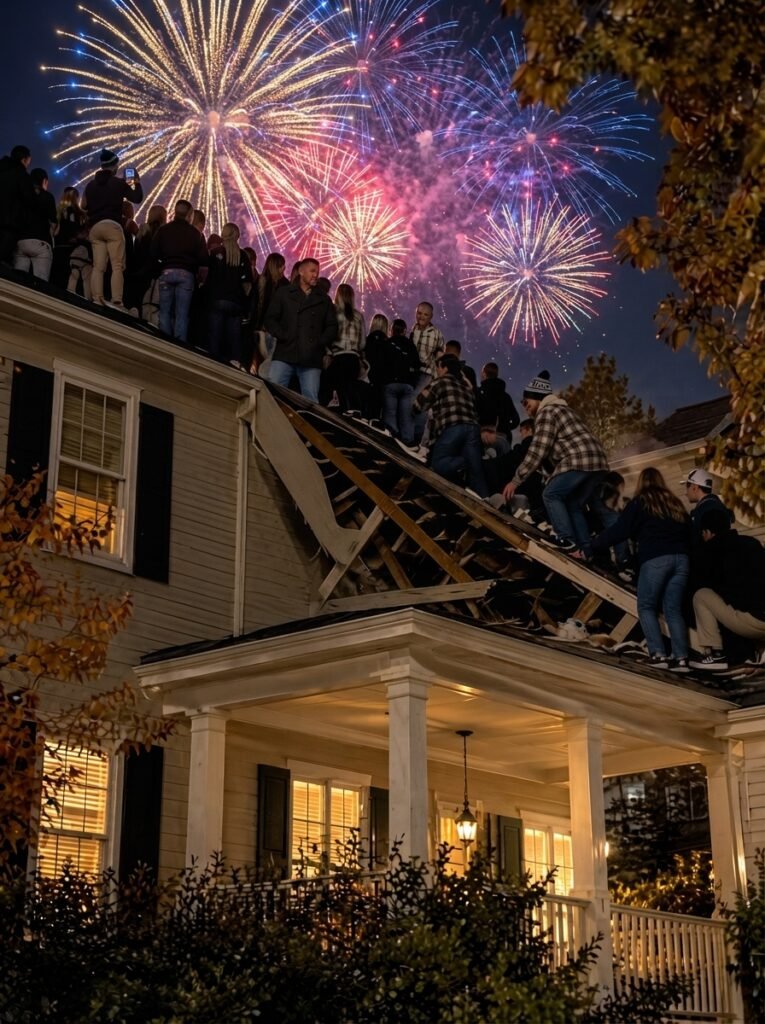
My neighbor invited 25 people to watch Halloween fireworks from my rooftop, even after I told her no. She had no idea the terrace was dangerously damaged. When I saw her guests heading upstairs, I called 911. But before I could warn them, a terrifying crack came from above. What had happened?
The first stranger walked past my kitchen window carrying a folding chair.
The second had a cooler.
By the time I saw a woman carrying two champagne bottles through my side gate, I knew something was terribly wrong.
Then I heard footsteps on the staircase leading to my rooftop.
I rushed outside and found my neighbor Karen directing people upstairs.
“Karen! What are you doing?”
She turned, smiling as though I’d come to welcome her guests.
“Everyone’s arriving a little early. Isn’t this exciting?”
“Get them down. Right now.”
Her smile disappeared.
“Oh, Evelyn. Don’t start.”
I was 52, and I’d lived in that three-story house for almost 20 years.
My late husband, Michael, had built the rooftop terrace himself.
And Karen knew perfectly well she wasn’t allowed up there.
Three days earlier, she’d knocked on my door.
“I’m having a fireworks party,” she’d announced. “Your rooftop has the best view, so I told everyone we could watch from there.”
I’d stared at her.
“Karen, absolutely not. You can’t invite strangers onto my property.”
She’d laughed.
“Oh, don’t be so dramatic. It’s just one night.”
I’d shut the door, assuming she’d understood. Apparently, she’d understood perfectly and decided my answer didn’t matter.
Now it was 8:30 p.m. on Halloween, and strangers were carrying chairs, drinks, and bags of food toward a terrace I’d closed months earlier.
“Karen, I told you no!”
She glanced toward the staircase.
“Everyone’s already here. Don’t make a scene.”
A man squeezed past us with another cooler.
“Great place you’ve got,” he told Karen.
She thanked him.
I couldn’t believe what I was hearing.
“Karen, this isn’t your house.”
She lowered her voice.
“You’re embarrassing me.”
Then she hurried after her guests. I stood frozen for a moment, listening to laughter overhead.
Three months earlier, a contractor had inspected the terrace after I’d noticed a section of decking shifting beneath my feet.
He’d found serious deterioration around several supports.
“Don’t have groups up here until we repair this,” he’d warned. “I wouldn’t take chances with the weight.”
I’d stopped using the terrace and posted a large warning on its door.
I hadn’t expected anyone to ignore it.
Another guest climbed the stairs.
Then another.
When I counted the 25th person, I pulled out my phone and called 911.
I explained that people had entered my property without permission and were gathering on a structurally unsafe rooftop.
The dispatcher asked whether anyone was injured.
“Not yet,” I said. “But there are 25 people up there.”
She instructed me to warn them immediately, keep people away from the damaged area, and avoid creating a rush toward the staircase.
I hurried toward the first step.
Before I reached it, a terrible cracking sound came from above.
The music stopped.
Someone screamed.
Then Karen appeared at the top of the stairs, gripping the railing.
“Oh my God!” she shrieked, staring behind her.
For one awful second, I thought someone had fallen through.
“What happened?” I shouted.
“The floor moved!”
A man yelled for everyone to get downstairs.
Several people surged toward Karen.
“Stop!” I called. “Don’t run!”
I could hear the dispatcher speaking through my phone.
I repeated her instructions as loudly as I could.
“The terrace is damaged! Move away from the railing and listen carefully. We need everyone down without pushing!”
A woman near the staircase raised both hands.
“Everybody, stop moving!”
The crowd quieted enough for me to hear her.
“I’m Sophie,” she called. “What do you need us to do?”
“Keep people away from the broken boards. Don’t let everyone crowd the stairs.”
Sophie turned toward the guests.
“One at a time! Give each other room!”
Karen was still staring at the decking.
“That wasn’t supposed to happen,” she whispered.
I wanted to ask what she’d expected.
Instead, I stayed on the phone.
I was following the dispatcher’s directions while Sophie helped people move carefully toward the exit.
A woman came down crying.
Two men followed, one supporting the other by the elbow.
“Is he hurt?” I asked.
“He twisted his ankle when the boards shifted,” the woman answered.
The man shook his head.
“I can walk.”
I directed them toward the front yard, where they could wait for help.
More guests descended.
Some were angry. Others looked frightened.
One woman demanded to know why nobody had warned them the rooftop was dangerous.
I almost answered, but another guest was coming down.
The evacuation seemed to take forever.
Finally, Sophie appeared beside Karen.
“That’s everyone,” she said.
Karen descended without looking at me.
Emergency responders arrived moments later. They checked on the guests, including the man with the sore ankle, and kept everyone away from the staircase.
Nobody had fallen through the deck.
But a section near the railing had cracked and sagged enough to make the danger unmistakable.
I sat on my front steps, shaking.
For nearly 20 years, that rooftop had been the safest place I knew.
Now I couldn’t stop imagining what might have happened if I’d waited another five minutes.
Sophie approached me while the others gathered near the sidewalk.
“Are you Evelyn?”
I nodded.
“I’m sorry about all this. Karen told us you invited everyone.”
I looked up.
“She said what?”
“She said you’d agreed to let us use the terrace. That you might come upstairs once we were settled.”
Another woman overheard us.
“She told me you and her had been doing this for years.”
I stared toward Karen.
She was standing beside Paul, a guest who’d helped carry chairs downstairs.
When she noticed me watching, she looked away.
“Excuse me,” I told Sophie.
I walked straight toward my neighbor.
“Karen, did you tell these people I invited them?”
She shifted her weight.
“I said we used to watch fireworks together.”
“That’s not what I asked.”
“Well, I didn’t want everyone feeling awkward.”
“So you lied.”
Her cheeks reddened.
“I thought once they arrived, you’d realize it wasn’t a big deal.”
I glanced at the people standing in my yard.
“Someone could have been seriously hurt.”
“I didn’t know the deck was that bad.”
“There was a warning on the door.”
Karen hesitated.
“I saw it.”
My anger sharpened.
“You saw it?”
“I thought it was an old notice. You leave things up for ages.”
“Karen, it said the terrace was closed because the supports were unsafe.”
She looked toward the house.
“I didn’t think you’d actually let us go up there if it was dangerous.”
I couldn’t believe her reasoning.
“I told you not to come.”
Sophie had followed me.
“Karen, you told us Evelyn was expecting us.”
Karen pressed her lips together.
“Can we discuss this privately?”
“No,” Sophie said. “You brought us here. We deserve to know what happened.”
Several guests turned toward us.
Karen finally admitted she’d never received permission.
The silence that followed was worse than shouting.
One man shook his head.
“I wouldn’t have brought my wife here if I’d known.”
Another woman said, “You should’ve told us the truth.”
Karen looked suddenly smaller.
“I’m sorry,” she murmured.
But she was looking at her guests, not me.
After the responders finished checking the situation, they told me to keep the terrace closed and have the structure professionally assessed before anyone used it again.
I assured them I would.
The guests gradually left.
Sophie was among the last.
She paused at my gate.
“I’m really sorry. We had no idea.”
“I know,” I said.
She glanced upstairs.
“I’m glad everyone got down safely.”
“So am I.”
When she left, Karen remained beside my front steps.
For the first time that evening, she seemed uncertain what to say.
“Evelyn, I never wanted anyone hurt.”
“Then why didn’t you listen when I said no?”
She looked at the house.
“Michael always let us come up.”
The mention of my husband stopped me.
“Michael invited you,” I said. “That’s different.”
Karen sighed.
“You know what I mean.”
“No. I don’t think I do.”
Michael had built the terrace over three summers. He’d worked on it during weekends, measuring every board twice and saving for materials whenever our budget allowed.
When he finally finished, he’d carried two old chairs upstairs and insisted we eat dinner beneath the stars.
He’d burned the chicken.
We’d laughed about it for years.
Later, he built a wooden bench against the far wall because he said I deserved somewhere comfortable to sit while watching the sunset.
On summer evenings, we’d bring coffee upstairs and talk about our days.
Sometimes we didn’t talk at all.
The terrace had never been about impressing anyone.
It was our place.
Occasionally, Michael invited neighbors over for fireworks.
Karen had come several times, along with a few others.
She always arrived early and stayed late.
Michael didn’t mind.
He enjoyed company.
But he also knew when to tell people the evening was over.
After he died, I stopped hosting gatherings.
I still went upstairs alone, especially on the evenings when I missed him most.
The bench remained in its usual corner.
His old wind chime hung beside the door.
Sometimes, sitting there made the house feel less empty.
Karen knew all of this.
Or I’d thought she did.
“Michael loved having people up there,” she said.
“He loved inviting people up there.”
“That’s what I’m saying.”
“No, Karen. You’re talking as though his kindness gave you permanent permission.”
She crossed her arms.
“I thought you needed something to bring you out of yourself.”
I stared at her.
“What?”
“You’ve been alone so much since he passed. You hardly entertain anymore. I thought seeing everyone enjoying the terrace again might remind you of happier times.”
I felt a painful mixture of anger and disbelief.
“You thought bringing 25 strangers onto my roof against my wishes would help me?”
“When you put it like that, it sounds awful.”
“Because it was awful.”
Karen looked down and muttered, “I didn’t mean it that way.”
I thought about the warning she’d ignored and the guests she’d misled.
“You don’t get to decide what I need just because you don’t like the answer I gave you.”
She said nothing.
“And you certainly don’t get to use Michael to justify it.”
Her eyes filled with tears.
For a moment, I almost softened.
Then I remembered the cracking sound.
“Karen, you are not to enter my property again without an invitation. Not the yard. Not the stairs. Nowhere.”
She nodded.
“I understand.”
“I hope you do.”
I went inside and locked the door.
That night, I barely slept.
Every time I closed my eyes, I imagined the deck collapsing beneath those chairs.
But another thought troubled me.
I’d known the terrace needed repairs for three months.
I’d closed it, posted a warning, and avoided using it.
What I hadn’t done was make a decision about rebuilding.
The contractor had explained that much of Michael’s original work would need replacing.
I’d thanked him, taken the estimate, and put it in a drawer.
Replacing those boards felt like erasing something Michael had touched.
So I’d waited.
The following morning, I called the contractor.
He remembered the terrace immediately.
“Has something changed?” he asked.
“Yes,” I said. “And I need you to come back.”
I also arranged to have the side gate secured and the staircase access locked.
I wasn’t leaving another opportunity for anyone to wander upstairs.
The contractor arrived two days later.
His expression changed when he saw the damaged decking.
“You’re fortunate nobody was standing directly over the weakest section when it shifted.”
I nodded.
He inspected the terrace carefully, then showed me where the supports had deteriorated.
Some boards would need replacing.
Others could be saved.
The bench Michael had built was still sound, although its fastenings needed attention.
“Can we keep it?” I asked.
“Yes. We’ll make sure it’s secure.”
I touched the weathered wood.
Michael had sanded that bench by hand because he hated rough edges.
He’d spent an entire afternoon making the seat comfortable, then asked me to test it repeatedly.
I remembered teasing him that he’d built furniture fit for a queen.
He’d bowed and called me Your Majesty.
The memory made me smile.
The contractor waited while I looked around.
“Let’s do the repairs,” I said.
He nodded.
“I’ll put together an updated plan.”
After he left, I sat in the kitchen with the old estimate and a photograph of Michael standing beside the finished terrace.
For months, I’d told myself I was protecting what he’d left behind. But the terrace was becoming unsafe while I tried to preserve it exactly as it had been.
Michael had built it for us to enjoy.
He wouldn’t have wanted me frightened to step outside my own rooftop door.
A week later, Karen knocked.
I considered ignoring her.
Then I opened the door, leaving the screen between us.
She held an envelope.
“I wanted to offer something toward the damage.”
I didn’t take it.
“The contractor is handling the repairs.”
“I know. I just feel responsible.”
“You are responsible for bringing people up there after I refused.”
She nodded.
“I’ve apologized to the guests. I told them everything.”
I waited.
“And I told them you never gave me permission.”
That mattered.
“Thank you for telling them the truth.”
Karen looked relieved.
“Maybe once the terrace is fixed, we could have coffee up there. Just the two of us.”
I shook my head.
“Karen, I’m not ready for that.”
Her expression fell.
“I thought we were moving past this.”
“I’m moving forward. That doesn’t mean everything goes back to how it was.”
She looked at the envelope again.
“I understand.”
This time, I believed she was beginning to.
I accepted her offer to contribute toward the repairs, but made it clear that money wouldn’t buy access to my home.
After she left, I returned to the kitchen.
I didn’t feel triumphant.
I felt tired.
Still, for the first time since Michael died, I’d made a decision about the terrace without worrying whether anyone else would approve.
The repairs took several weeks.
I watched the workers remove damaged boards and reinforce the structure.
Some afternoons, I had to turn away.
Other days, I stood nearby, asking questions.
One morning, a worker called me over.
“We found something you might want.”
He held a piece of wood from beneath the bench.
On its underside, Michael had carved two initials.
E and M.
I covered my mouth.
I’d never known they were there.
The worker smiled.
“We can preserve this piece.”
“Please do.”
When the work was finished, the terrace looked different. The boards were lighter. The railing had been strengthened. The bench sat securely against the wall.
But the view was exactly as I remembered.
On my first evening upstairs, I carried two mugs of coffee out of habit.
I stood looking at them for a moment.
Then I poured one into a smaller cup and sat on Michael’s bench.
The wind chime moved gently beside the door.
I missed him.
That hadn’t changed.
But for once, the sadness didn’t make me wish the whole world would stay still.
Several months later, I invited Sophie and two neighbors I trusted to enjoy the evening view.
We brought snacks, sat talking, and watched the sky turn orange above the rooftops.
Nobody arrived without asking.
Nobody assumed the terrace belonged to them.
As the evening ended, Sophie looked around.
“Have you thought about having a bigger gathering someday?”
I smiled.
“Maybe.”
She laughed.
“Well, after what happened, I wouldn’t blame you if you never hosted again.”
I glanced at Michael’s bench.
He’d loved welcoming people.
I did too, when it was my choice.
“Maybe someday,” I repeated. “But I’ll be the one sending the invitations.”
After everyone left, I stayed upstairs a little longer.
I ran my fingers over the preserved piece of wood beneath the bench, where Michael had carved our initials.
For years, I’d worried that changing the terrace would mean losing another part of him.
Now I understood that what mattered most hadn’t been the boards or the railing.
It was the life we’d shared there.
Karen had mistaken our kindness for something she could claim.
But Michael had taught me that generosity meant opening your door because you wanted to, not because someone forced it.
I looked out over the quiet neighborhood.
The terrace was still mine.
And finally, I could enjoy it again.
So here’s the real question: If your neighbor ignored your refusal, endangered 25 people, and then apologized, would you ever trust her enough to welcome her into your home again, or would that permanently cross the line?
If you enjoyed reading this story, here’s another one you might like: For two years, my neighbor complained about everything my dog did. Then he vanished, and a friend spotted her taking him into a building across town. I rushed there expecting a confrontation, but what I witnessed left me speechless. What was she doing with my dog?