“Explained what?”
“That you’re hardly using this place anymore.”
I said nothing.
“And eventually,” she continued, “this house will basically belong to Sarah and Jason anyway.”
She smiled.
“So she said there was no reason for it to sit empty.”
That sentence did something to me.
Not because she was wrong about one thing.
Jason was my only child.
For years, my will had left most of what I owned to him.
The cabin included.
But inheritance is a strange thing.
Some people see it as a gift from the dead.
Others begin spending it while you’re still alive.
Brenda apparently belonged to the second group.
I looked around my home again.
At the dirty dishes.
The missing wine.
The wet towels.
The relatives.
Then I asked quietly, “Did Sarah tell you I was preparing this house for a tenant?”
Brenda shrugged.
“She mentioned you had some idea about renting it.”
Some idea.
“It isn’t an idea.”
Her expression tightened.
“Well, surely one month isn’t going to ruin anything.”
“One month?”
Larry looked away.
Brenda crossed her arms.
“We planned to stay until the end of the month.”
I almost laughed.
Instead, I picked up my keys.
“You need to leave.”
The room went silent.
Brenda stared at me.
“Excuse me?”
“You heard me.”
Her voice sharpened.
“Diane, we’ve brought food. People took time off work. We’ve made plans.”
“Those plans were made inside my house without asking me.”
“Sarah asked.”
“No. Sarah gave permission she didn’t have.”
Brenda shook her head.
“This is ridiculous. You’re acting like we’re strangers.”
“You entered my home without my permission.”
“We’re family.”
“Family usually calls first.”
Her face reddened.
Larry finally stood.
“Maybe everybody should calm down.”
I looked at him.
“I am calm.”
That seemed to bother them more than shouting would have.
Brenda walked back toward the couch.
“We’ll discuss this with Sarah.”
“No.”
She turned.
“I’ll discuss it with Sarah.”
Then I picked up my purse.
“I’m meeting a realtor this afternoon.”
Brenda laughed.
Actually laughed.
“You’re not seriously renting this place to strangers when your own family could use it.”
I opened the door.
“What I do with my property is my decision.”
Then I walked outside.
My hands did not start shaking until I reached my car.
Jason called before I reached the main road.
I watched his name appear on the dashboard screen.
I let it ring.
He called again ten minutes later.
Then again.
I didn’t answer.
Because I knew my son.
Jason was forty-one years old.
He was kind.
He was hardworking.
And when conflict involved Sarah, he had developed a habit that I had unfortunately helped him perfect.
He tried to make everyone else comfortable.
Especially her.
I had watched it happen gradually during their six-year marriage.
At first, the requests seemed harmless.
Could I cover their hotel when we traveled together?
Of course.
Could I help with the new refrigerator?
Sure.
Could I pay Jason’s car insurance for a few months while they saved?
Fine.
Then came property taxes.
A medical bill.
A vacation they “really needed.”
The monthly family phone plan somehow remained in my name long after Jason had stopped living with me.
Their streaming subscriptions were tied to one of my cards.
I had paid part of Sarah’s student loan during a difficult year.
I never kept score because I believed that was what parents did when they were able to help.
The largest amount was sitting in a savings account.
Sixty thousand dollars.
Money I had quietly set aside to help them make a down payment on their first house.
They knew about it.
Jason knew.
Sarah definitely knew.
I reached my home shortly after six that evening.
Jason had called eleven times.
Sarah had called twice.
Brenda had sent one message.
You embarrassed us today.
I stared at it for a long time.
Then I opened my laptop.
The sixty thousand dollars sat in a joint-purpose savings account I had created years earlier.
My money.
My name.
My contribution.
I transferred every dollar back into my private account.
Next, I called the cleaning service scheduled to prepare the cabin.
Canceled.
Then I went through my credit card statements.
Jason and Sarah’s phone line?
Removed.
Their roadside assistance?
Canceled.
The annual membership I paid for them?
Stopped.
The little automatic transfers I had been sending Jason on the first of each month because “groceries are expensive these days”?
Ended.
It took less than forty minutes.
Forty minutes to undo years of helping.
When I finished, I closed the laptop.
The house was silent.
For the first time all day, I cried.
Not because of the money.
Not even because of the cabin.
I cried because I suddenly understood that generosity had become expectation.
And somewhere along the way, expectation had become ownership.
At nine the next morning, someone pounded on my front door.
I knew who it was before I opened it.
Sarah.
She stood on the porch in leggings and an expensive coat I had bought her for Christmas two years earlier.
Her face was already red.
“What did you do?”
No hello.
No apology.
I stepped aside.
“Good morning, Sarah.”
She stormed into the hallway.
“Jason got notifications. The savings account is empty.”
“My money isn’t missing.”
“You know what I mean.”
“I do.”
She turned toward me.
“You promised us that money.”
“I told Jason I was saving money to help you purchase a home.”
“That’s the same thing.”
“No, it isn’t.”
Her jaw tightened.
“You’re punishing us because my parents used the cabin.”
“I’m responding to what happened.”
“They didn’t damage anything.”
“You don’t know that.”
“They’re careful.”
“They opened Robert’s anniversary wine.”
Sarah blinked.
For half a second, she looked uncomfortable.
Then she recovered.
“It’s wine, Diane.”
There it was.
Three words.
It’s wine, Diane.
As if the meaning of something belonged to whoever consumed it.
I walked into the kitchen.
She followed.
I picked up my watering can from beside the back door.
I had several potted herbs on the patio.
Sarah stepped into my path.
“This is childish.”
I looked at her.
“What exactly is childish?”
“Canceling things. Taking back the house money. Acting like we’re stealing from you.”
“Did you give your parents permission to stay at my cabin?”
She hesitated.
“Yes.”
“Did you ask me?”
“I didn’t think I needed to.”
That answer hurt more than I expected.
“Why?”
She threw her hands up.
“Because that house will be ours eventually.”
I set the watering can down.
Slowly.
“Eventually is not today.”
She rolled her eyes.
“You know what I mean.”
“No. I think I’m finally understanding exactly what you mean.”
She folded her arms.
“Jason is your only son.”
“Correct.”
“So unless you’re secretly planning to give everything to charity, the cabin goes to him.”
“Maybe.”
Her expression changed.
Only slightly.
But I saw it.
“Maybe?”
I stepped closer.
“And whether you ever receive that house is still my decision.”
Sarah stared at me.
“You would change your will over this?”
“I would change my will because I’m alive.”
She opened her mouth.
I continued.
“You appear to have confused my future death with your current property rights.”
Her face went white.
Then red.
“You are unbelievable.”
“No. I have simply been too easy.”
“Jason is going to be furious.”
“Jason is welcome to talk to me.”
She grabbed her purse.
“My parents are staying until the end of the month.”
“No, they’re not.”
“They made plans.”
“Then they can make different ones.”
“You cannot throw them onto the street.”
“They have a home.”
“Three hours away.”
“So do I.”
She headed for the door.
At the threshold, she turned.
“You’ll regret treating family this way.”
I looked at her.
“Sarah, I spent years helping your family.”
“You helped Jason.”
“I helped both of you.”
“Because we’re your family.”
“Exactly.”
She stared at me.
“And family is not supposed to take advantage of that.”
She left without responding.
Jason called twenty minutes later.
This time, I answered.
“Mom.”
He sounded exhausted.
“Hello, Jason.”
“Can I come over?”
“Yes.”
When he arrived, he looked worse than I expected.
He hadn’t shaved.
His eyes were red.
He sat at my kitchen table without removing his jacket.
For a while, neither of us spoke.
Finally, he said, “I didn’t know.”
“About the cabin?”
He nodded.
“I swear.”
I studied him.
“Sarah said you did.”
“She lied.”
The word came out quietly.
That surprised me.
Jason had defended his wife through arguments I thought no sane person could defend.
He had always softened his language.
Sarah was stressed.
Sarah misunderstood.
Sarah meant well.
Sarah didn’t realize.
But he had said lied.
I sat across from him.
“Tell me.”
He rubbed both hands over his face.
“She told her parents they could use the cabin about two months ago.”
“Two months?”
“I found the messages last night.”
My stomach tightened.
“Why were you looking at her messages?”
“Because after you left yesterday, Brenda called Sarah screaming. Sarah kept telling her not to worry because you would ‘get over it.'”
His mouth twisted.
“Then she said something that didn’t make sense.”
“What?”
“She said, ‘Jason won’t let his mother change anything important.'”
I felt cold.
He continued.
“I asked what she meant.”
“And?”
“She wouldn’t answer.”
Jason pulled out his phone.
“So after she went to bed, I checked our shared tablet. Her messages sync to it.”
He looked ashamed.
“I know I shouldn’t have.”
“What did you find?”
His eyes met mine.
“A lot.”
I waited.
“Mom, Sarah has been talking about your money for years.”
I felt something drop inside my chest.
“How?”
“Not just the cabin.”
He swallowed.
“The house. Your investments. The sixty thousand dollars. Your retirement account. She told Brenda that we didn’t need to worry about saving as aggressively because I’d inherit enough someday.”
I said nothing.
“She told her that when you got older, we could probably sell your main house and move you somewhere smaller.”
My fingers tightened beneath the table.
Jason’s voice cracked.
“She said the cabin was practically already ours.”
I stared at my son.
He looked sick.
“I never said any of that.”
“I believe you.”
He closed his eyes.
“There was more.”
Of course there was.
“When did her parents arrive?”
“Tuesday.”
“How did they get inside?”
Jason looked at me.
“Sarah had a key copied.”
I remembered giving Jason an emergency key years earlier.
One key.
For my son.
Not his wife.
Not her parents.
Not cousins.
“Without asking me.”
“Yes.”
I stood and walked to the window.
Outside, sunlight hit the small garden Robert had planted.
For several seconds, I couldn’t speak.
Jason finally said, “I’m sorry.”
I turned.
“Did you know about the sixty thousand?”
“Yes.”
“Did you consider it yours?”
“No.”
His answer came immediately.
“I hoped you’d still help us. Of course I did. But I knew it was your money.”
He looked at the table.
“I think I stopped noticing how much you were doing.”
That was probably true.
Sometimes people didn’t become entitled all at once.
They became comfortable.
Then dependent.
Then blind.
“What are you going to do about Sarah?”
His face changed.
“I don’t know.”
“That’s between you and your wife.”
He nodded.
“But the cabin isn’t.”
“No.”
“I’m going back there tomorrow.”
His head snapped up.
“Alone?”
“Yes.”
“Mom—”
“I’ll bring a locksmith.”
That stopped him.
Then, unexpectedly, he said, “Good.”
Sunday afternoon, I drove back into the mountains.
This time I did not bring sheets.
I did not bring cleaning supplies.
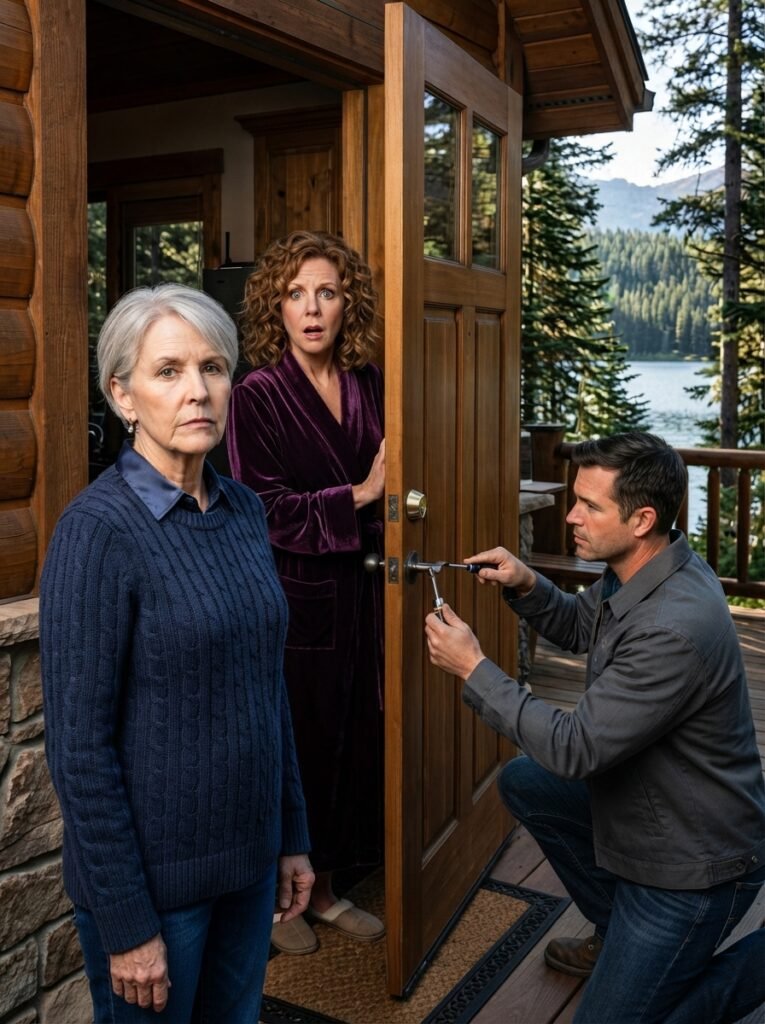
I brought a locksmith.
His name was Carlos.
He followed me in a white van.
When we reached the cabin, I saw the same cars.
Music again.
Smoke rose from my outdoor grill.
Apparently, they had decided my demand to leave was optional.
I knocked.
Brenda opened the door wearing one of my bathrobes.
My bathrobe.
For half a second, neither of us spoke.
Then her mouth curved into a smile.
“We already told you we’re staying until the end of the month.”
She leaned against the doorframe.
“I don’t know why you’re making such a production out of this.”
Then she noticed Carlos standing behind me.
A new deadbolt was tucked beneath his arm.
Her smile vanished.
“You can’t be serious.”
“I’m completely serious.”
Larry appeared behind her.
One cousin lowered his glass.
Brenda stepped outside and pulled the door partly closed behind her.
“You’re throwing family out over a misunderstanding?”
“No.”
I kept my voice calm.
“I’m removing people who entered my property without my permission.”
“Sarah gave permission.”
“Sarah does not own this house.”
Carlos cleared his throat politely.
“Ma’am, do you want me to begin?”
Brenda looked at him.
Then at me.
I said, “Yes.”
That single word changed the entire atmosphere.
Larry stepped forward.
“Diane, maybe you should call Jason before doing something you’re going to regret.”
I almost smiled.
Because Jason had already called.
Because for the first time in years, my son had finally stopped defending what couldn’t be defended.
Before I could answer, tires crunched across the gravel.
A car turned into the driveway.
Brenda looked through the railing.
Her entire posture changed.
“Why is Sarah here?”
The car stopped.
Sarah climbed out from the passenger side.
Her face was tight.
Then the driver’s door opened.
Jason stepped out.
Under one arm, he carried a thick folder.
Brenda stared at him.
Then at Sarah.
Then back at the folder.
Her voice dropped.
“What did she do?”
Sarah spun toward her.
“Mom, stop.”
Jason walked toward us.
I had seen my son angry before.
As a child.
As a teenager.
Once when someone hit his parked car.
But this wasn’t ordinary anger.
He looked disappointed.
Deeply.
The kind of disappointment that strips away illusions.
Sarah hurried after him.
“Jason, you said we were coming here to talk.”
“We are.”
He stopped beside me.
Then handed me the folder.
“Mom, these are for you.”
I opened it.
Printed screenshots.
Dozens of them.
Messages between Sarah and Brenda.
My name appeared again and again.
Diane won’t rent forever.
Jason will inherit it.
The sixty grand is basically locked in.
Once Diane gets older, Jason can handle the properties.
Use the cabin whenever you want.
She won’t actually throw family out.
One message was dated nearly six months earlier.
Brenda had written:
What if she finds out?
Sarah had answered:
She’ll complain, then calm down. Jason always gets her to come around.
I read that sentence twice.
Jason always gets her to come around.
I looked at my son.
He looked devastated.
Sarah stepped forward.
“Those messages are private.”
I closed the folder.
“Interesting choice of concern.”
“You had no right to read them.”
Jason finally spoke.
“You were making plans around my mother’s death.”
Sarah’s mouth opened.
“I was not.”
He pulled another page from the folder.
“You told your mother we’d probably have access to Mom’s house within ten years.”
“I was talking generally.”
“My mother is sixty-eight.”
“Jason—”
“You told Brenda we wouldn’t need a large mortgage because of Mom’s assets.”
“I was trying to reassure her.”
“Why does your mother need reassurance about our mortgage?”
Sarah’s eyes flicked toward Brenda.
Brenda immediately stepped in.
“This is being blown completely out of proportion.”
Jason turned toward her.
“You’ve been staying in my mother’s house after she told you to leave.”
“Sarah invited us.”
“My wife invited you into property she doesn’t own.”
Larry raised both hands.
“Everyone needs to calm down.”
“No,” Jason said.
Larry blinked.
My son almost never interrupted his father-in-law.
Jason continued.
“You’ve all been very calm while using my mother.”
The words landed hard.
Sarah grabbed his arm.
“Stop talking to my parents like that.”
He pulled away.
“Stop making this about tone.”
She stared at him.
He pointed toward the house.
“You gave them a copied key.”
“You knew I had one.”
“I knew you had access to my emergency key. I did not know you copied it.”
“It was just practical.”
“For what?”
No answer.
“For what, Sarah?”
Her jaw tightened.
“So I wouldn’t have to bother Diane every time.”
Every time.
I stared at her.
“How many times have you been here without telling me?”
Silence.
Jason looked at her too.
“Sarah?”
She crossed her arms.
“That’s not important.”
My stomach turned.
“It is to me.”
Brenda stepped closer.
“Sometimes Sarah let us come up for weekends.”
I looked at her.
“Sometimes?”
Larry muttered, “Brenda.”
But she was angry now.
And angry people often reveal more than careful people.
“Three or four times. Maybe five. I don’t know.”
I turned toward Sarah.
“You have been giving people access to my home for years?”
“It hasn’t been years.”
Jason opened the folder again.
“March of last year.”
Sarah went pale.
He held up another screenshot.
“July.”
Another.
“Thanksgiving weekend.”
My mind flashed through those dates.
Thanksgiving.
I had been visiting my sister in Arizona.
Sarah had known.
Of course she had.
“You knew when I was away.”
Sarah’s voice softened.
“Diane, nobody hurt anything.”
I looked toward the house.
“My wine is gone.”
She rolled her eyes.
That tiny gesture ended any chance she had of convincing me this was merely poor judgment.
I faced Carlos.
“Change every exterior lock.”
He nodded.
Sarah stepped forward.
“You can’t do that while my parents’ things are inside.”
“They can remove their things.”
“Right now?”
“Right now.”
Brenda laughed sharply.
“Absolutely not.”
I looked at her.
“Then I will call the sheriff and ask what happens when people refuse to leave property they entered without the owner’s permission.”
Her face changed.
“You would call the police on us?”
“I hope I don’t have to.”
Larry put his hand on Brenda’s shoulder.
“Let’s pack.”
She jerked away.
“No.”
“Brenda.”
“This is humiliating.”
I couldn’t help myself.
“So was being asked why I was inside my own house.”
For the first time, nobody had an answer.
The next forty minutes were ugly.
Doors slammed.
Suitcases appeared.
Bags were thrown into cars.
One cousin carried out three bottles of wine until Jason stopped him.
“Those stay.”
The man looked embarrassed and returned them.
Brenda came out carrying a suitcase and my bathrobe.
I held out my hand.
She stared at it.
“The robe.”
“You can’t be serious.”
I kept my hand out.
She yanked it off over her clothes and shoved it toward me.
“Enjoy your precious cabin.”
“I intend to.”
She marched toward the car.
Then Sarah turned on me.
“Are you happy now?”
I looked at her.
“No.”
That surprised her.
“None of this makes me happy.”
“Could’ve fooled me.”
“You think boundaries are punishment because you’ve benefited from there being none.”
Jason looked down.
Sarah stared at me.
Then she pointed toward the house.
“You’ve always said family matters more than money.”
“It does.”
“Then why are you doing this over a house?”
“Because this isn’t about a house.”
My voice rose for the first time.
“This is about you standing in front of me and telling me what belongs to you after I die. It is about giving away access to property I worked decades to afford. It is about your mother drinking something that belonged to my dead husband and laughing when I objected. It is about sixty thousand dollars you apparently considered yours before I handed you one cent.”
Sarah’s face hardened.
“So that’s it? You’re cutting us off?”
“Financially?”
“Yes.”
“Yes.”
Jason looked at me, but he didn’t object.
Sarah spun toward him.
“Say something.”
He did.
“I agree with her.”
She froze.
“What?”
“I said I agree.”
Her voice dropped.
“You agree that your mother should take away the money she promised us?”
“She didn’t promise it to you.”
“Jason—”
“She offered to help us.”
“Same thing!”
“No.”
He shook his head.
“That’s the problem. You think help means ownership.”
Brenda had been loading her car.
Now she marched back.
“This family has treated Sarah like an outsider from the beginning.”
I stared at her.
“I paid part of your daughter’s student loan.”
Brenda stopped.
“I paid for your hotel at Jason’s wedding because you said money was tight.”
Her mouth closed.
“I paid for the rehearsal dinner.”
Silence.
“I covered the emergency dental work Sarah needed three years ago because her insurance wouldn’t pay enough.”
Sarah looked away.
“I helped both of them when Jason was laid off.”
Brenda’s confidence faltered.
“I never asked to be thanked. But I am not going to stand here and be accused of excluding someone because I finally said no.”
Larry touched Brenda’s elbow.
This time, she let him.
They got into their car.
The relatives followed.
Gravel sprayed beneath the tires as they drove away.
Then only three vehicles remained.
Mine.
Carlos’s van.
Jason and Sarah’s car.
Carlos began removing the old deadbolt.
The drill screamed against metal.
Sarah flinched at the sound.
Maybe because she finally understood what it represented.
Not just a lock.
A boundary.
A physical one.
Jason looked at her.
“We need to go home.”
She laughed bitterly.
“Home?”
“Yes.”
“Do we even have one anymore? Or did your mother cancel that too?”
He stared at her.
“Don’t.”
She folded her arms.
“She’s been controlling us with money for years.”
That accusation shocked me.
But Jason answered before I could.
“No.”
Sarah turned toward him.
“Yes, she has.”
“When?”
“Every time she paid for something.”
“She never asked for anything in return.”
“That’s worse.”
I almost laughed from disbelief.
Jason didn’t.
He looked at his wife as if he were seeing her for the first time.
“You really believe that.”
Sarah’s anger weakened.
“Jason…”
He opened the folder again.
“There are messages in here where you tell your mom that once we have the sixty thousand, we should use some of it to renovate instead of putting it all toward a house.”
Sarah said nothing.
“You already spent money Mom hadn’t given us.”
“I was planning.”
“You planned her money.”
“It was supposed to be ours!”
Her voice echoed through the trees.
Nobody spoke.
Even Carlos stopped drilling for a moment.
Sarah realized what she had said.
Too late.
I nodded slowly.
“There it is.”
“Diane—”
“No.”
She started crying.
Not loudly.
A few tears slid down her face.
Part of me wanted to comfort her.
That instinct had cost me more than money.
I let the silence remain.
Jason finally said, “Get in the car.”
Sarah wiped her face.
“What are you going to do?”
“We’re going home.”
“No. About us.”
Jason looked exhausted.
“I don’t know.”
Her face crumpled.
“You’d leave me over your mother’s cabin?”
He shook his head.
“If anything ends our marriage, it won’t be because of a cabin.”
He pointed at the folder.
“It’ll be because I don’t know when you stopped seeing my mother as a person and started seeing her as an estate.”
That sentence silenced everyone.
Sarah got into the car.
Jason turned to me.
“I’m sorry.”
I touched his arm.
“This isn’t all your fault.”
“Some of it is.”
I didn’t argue.
Because he was right.
And so was I.
I had created part of this problem too.
Not intentionally.
But every time I paid a bill without requiring them to solve it themselves, I had made dependence easier.
Every time I ignored a small act of entitlement to keep peace, I had taught people that my discomfort was cheaper than their inconvenience.
“I love you,” I told him.
He nodded.
“I love you too.”
“But things are changing.”
“I know.”
“No more automatic payments.”
“I know.”
“The sixty thousand stays with me.”
He swallowed.
“I know.”
“And I am changing my estate plan.”
That one hurt him.
I saw it.
But he nodded.
“Okay.”
“I haven’t decided what that means.”
“Okay.”
“I’m not trying to punish you.”
“I know.”
He looked toward the cabin.
“Maybe you should’ve done it sooner.”
Two weeks later, I met with my attorney.
I changed several things.
Not because I wanted revenge.
Because I wanted clarity.
My will still provided for Jason.
He was my son.
I loved him.
But the cabin was placed into a trust designed to support my retirement and, if necessary, my future care.
No one could sell it while I was alive.
No one could borrow against it.
No one could treat it as future family property.
I also added charitable beneficiaries.
Not because I wanted to frighten Sarah.
Because I had finally understood something important.
No inheritance is owed to people simply because they expect it.
The sixty thousand remained in my retirement portfolio.
Three weeks after the lock change, Melissa Grant found me a long-term tenant.
A retired school principal named Evelyn moved into the cabin with an elderly golden retriever.
She signed a two-year lease.
Paid a security deposit.
Set up automatic rent payments.
And asked before hanging a single picture.
The first month’s rent arrived on a Tuesday morning.
I looked at the deposit in my bank account and felt something I hadn’t felt in weeks.
Relief.
The cabin was doing exactly what Robert and I had intended.
Protecting me.
Jason called later that night.
He and Sarah had separated temporarily.
I did not celebrate.
I didn’t tell him what to do.
I didn’t insult his wife.
Their marriage belonged to them.
But for the first time, Jason was paying all his own bills.
Every one.
A month later, he stopped by for coffee.
He handed me an envelope.
Inside was a check.
I frowned.
“What’s this?”
“Part of what you’ve paid for me over the last year.”
I pushed it toward him.
“I don’t want it.”
“I know.”
“Then keep it.”
“No.”
His voice was firm.
“I need to do this.”
So I accepted it.
Not because I needed the money.
Because he needed to give it.
Sarah called me once during that period.
I nearly didn’t answer.
Then I did.
Her voice was quieter than usual.
“I wanted to apologize.”
I waited.
“For the cabin.”
I said nothing.
“For giving my parents the key.”
Still I waited.
“For assuming…”
She stopped.
“Assuming what?”
She took a breath.
“That because Jason would probably inherit things someday, that meant we could treat them like they were partly ours now.”
That was closer.
“I was wrong.”
“Yes.”
She clearly hadn’t expected me to say it so directly.
After a pause, she continued.
“My mom kept asking about the cabin. She loved it when we visited. I wanted to be able to give her something.”
“So you gave her something that belonged to me.”
“I know.”
“That isn’t generosity, Sarah.”
Her voice broke.
“I know.”
We were silent for several seconds.
Then she said something I did not expect.
“I think I got used to you fixing things.”
I leaned against the kitchen counter.
“Jason did too.”
“He said that.”
“Did he?”
“Several times.”
Despite everything, I almost smiled.
Sarah continued.
“I don’t expect the sixty thousand.”
“Good.”
“And I told my parents they’re not to contact you unless you want them to.”
“Thank you.”
“My mother is still angry.”
“She is allowed to be.”
Sarah gave a weak laugh.
“You really don’t care?”
“I care very much.”
I looked out at my garden.
“But caring about someone’s feelings doesn’t mean giving them what they want.”
She was quiet.
“I wish I’d understood that earlier.”
“So do I.”
We did not suddenly become close after that call.
Life is rarely that neat.
Trust doesn’t return because someone says the correct words.
It returns through behavior.
Slowly.
Sometimes not at all.
Jason and Sarah eventually began counseling.
They stayed separated for several months.
Whether their marriage survives permanently is still their decision.
But one thing changed almost immediately.
Sarah stopped talking about my property.
Completely.
Brenda never apologized.
Not really.
She sent one text several months later.
Hope you’re satisfied with the renter.
I stared at it.
Then deleted it.
Because I was satisfied.
Not because Brenda had lost access.
Not because Sarah had been embarrassed.
Not because Jason had finally taken my side.
I was satisfied because I had stopped confusing kindness with obligation.
The following spring, I drove to the cabin to inspect the property.
Evelyn had planted flowers beside the porch.
She invited me inside.
The house was spotless.
The cherrywood table had been polished.
The glasses were where they belonged.
There was a new dog bed beside the fireplace.
For a moment, I stood in the living room remembering that terrible Saturday.
Brenda holding Robert’s wine.
Larry telling me to call my son.
Sarah saying the house would eventually be hers.
Then I looked around the room.
Nothing felt stolen anymore.
Evelyn noticed me staring at the wine rack.
“I hope you don’t mind,” she said. “I never touch anything you leave down there. I assumed some of those bottles might be sentimental.”
I had to look away for a second.
“Thank you.”
She smiled.
“Of course. They’re yours.”
Three simple words.
They’re yours.
Something my own family had somehow forgotten.
Before leaving, I walked down to the lake.
Robert and I used to sit there in folding chairs while the sun disappeared behind the mountains.
For years after he died, I couldn’t go near that spot without crying.
That afternoon, I sat on the old wooden bench and watched the water.
I thought about the sixty thousand dollars.
The canceled payments.
The locks.
The attorney.
The folder filled with messages about what would happen after I died.
And I realized the cruelest part had never been that Sarah wanted the cabin.
It was that people had started building plans around a future in which I was no longer there.
They were counting rooms.
Counting accounts.
Counting inheritance.
While I was still alive.
I had spent years believing that being a good mother meant making Jason’s life easier.
Maybe that had been true when he was ten.
Or sixteen.
Or even twenty-five.
But eventually, helping your adult children cannot mean protecting them from every uncomfortable consequence.
Sometimes love means helping.
Sometimes love means giving.
And sometimes love sounds like a locksmith’s drill biting through an old deadbolt.
Jason came to visit me the following Sunday.
We sat on my patio drinking coffee.
He looked healthier than he had in months.
After a while, he said, “Sarah told me about the call.”
“What call?”
“Her apology.”
I nodded.
“She has a lot of work to do.”
“So do I.”
I looked at him.
He smiled sadly.
“For years, every time she pushed too far, I asked you to overlook it because it was easier than confronting her.”
I didn’t deny it.
“I made you responsible for keeping peace in my marriage.”
“Sometimes.”
“I’m sorry.”
I touched his hand.
“I accepted that role too.”
He looked toward the yard.
“Do you know what scared me most about those messages?”
“What?”
“How normal they sounded.”
I understood immediately.
There hadn’t been some elaborate evil plan.
No secret conspiracy.
Just gradual entitlement repeated so often that nobody stopped to question it.
Someday this will be ours.
Diane won’t mind.
Jason will talk her into it.
She doesn’t need the money.
The cabin is sitting empty.
We’re family.
Each sentence small.
Together, they had built an entire fantasy where my ownership existed only until someone else wanted something badly enough.
Jason took a sip of coffee.
“Are you really leaving part of your estate to charity now?”
I looked at him.
He laughed.
“I’m not asking how much.”
“Good.”
“I was just curious.”
“Yes.”
He nodded.
“I think Dad would’ve liked that.”
That surprised me.
“Why?”
“He always said money should do something useful.”
I smiled.
Robert had said that.
Many times.
A few months later, Sarah came with Jason to my birthday dinner.
She brought flowers.
Not expensive ones.
Just daisies from a local market.
There was no dramatic speech.
No forced hug.
She helped clear the plates.
Before leaving, she stopped beside me.
“Can I ask you something?”
“Yes.”
“Do you hate me?”
I considered the question.
“No.”
She looked relieved.
“But I don’t trust you the way I used to.”
Her relief disappeared.
“I understand.”
“I hope someday that changes.”
“So do I.”
That was the truth.
Forgiveness and access are not the same thing.
You can forgive someone and still change the locks.
You can love someone and still remove them from your bank account.
You can hope someone becomes better without giving them another opportunity to take advantage of you while they learn.
Almost a year after the afternoon at the cabin, I received a photograph from Evelyn.
Snow covered the roof.
Her golden retriever stood on the porch wearing a ridiculous red scarf.
Below the picture she had written:
Your cabin is beautiful in winter. Thank you for trusting me with it.
I looked at that word.
Trusting.
Then I thought about how strange life can be.
A tenant understood something my own family had failed to understand.
Being trusted with something doesn’t make it yours.
Being invited somewhere doesn’t make you the owner.
Being named in someone’s will doesn’t mean their life has already become your inheritance.
And being loved does not entitle you to everything the person you love possesses.
That evening, I poured myself a glass of wine.
Not Robert’s anniversary bottle.
That was gone.
I would never get it back.
Some things cannot be replaced.
But I had bought another bottle from the same vineyard.
I carried it onto the patio and raised the glass toward the empty chair beside me.
“Well, Robert,” I whispered, “I finally learned how to say no.”
The wind moved softly through the trees.
For some reason, I could almost hear him laughing.
I had spent most of my life believing generosity meant leaving the door open.
I know better now.
Generosity requires a door.
And sometimes it requires a lock.
Because the people who truly love you will knock.
They will wait.
They will ask permission.
And the ones who become angry when the door is locked were often the reason you needed a lock in the first place.