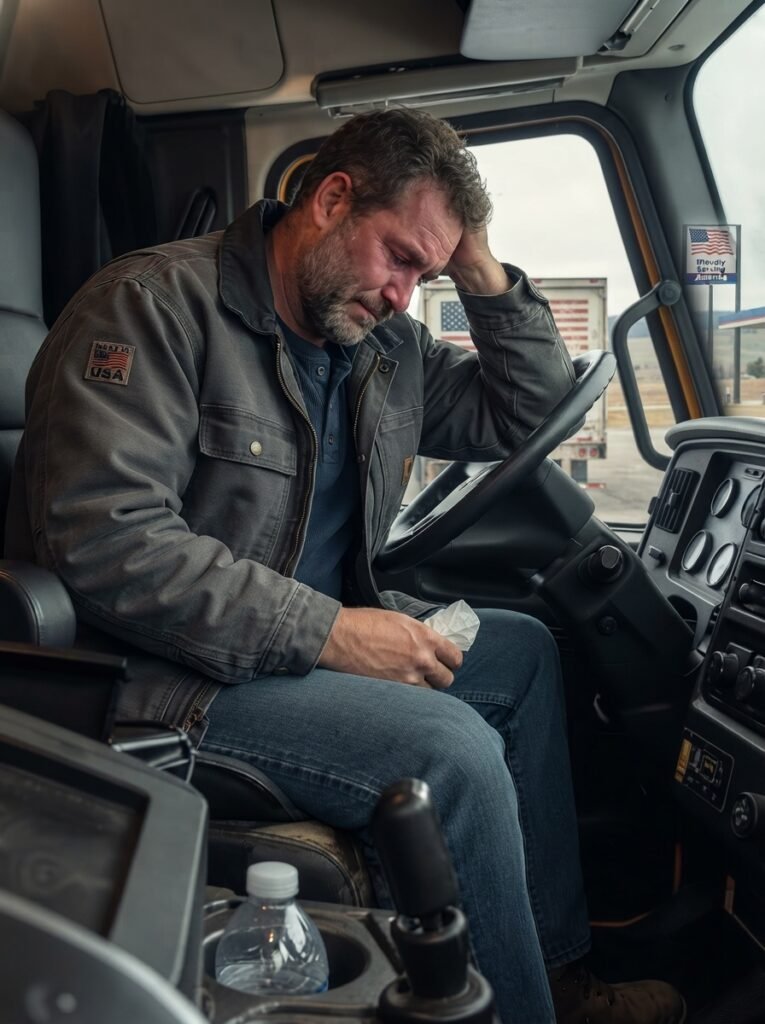
Robert risked his job to help an elderly stranger reach his dying wife during a brutal snowstorm. But when his truck broke down, their desperate journey took an unexpected turn. What Robert discovered about his passenger left him struggling to believe his own ears.
My name is Robert. I’m 46, and I’ve been a truck driver for almost 20 years. Last December, I was hauling a shipment across Colorado when a brutal snowstorm hit.
Visibility was terrible, and I was barely moving when I spotted an older man standing on the shoulder, waving his arms desperately.
I pulled over, rolled down my window, and shouted, “What the hell are you doing out here in this weather?”
“Please, sir, I need to get to Denver,” he said, shivering.
“All flights are canceled, and the buses aren’t running. My wife is dying in a hospital 500 miles from here. I have two days to reach her.”
The problem was that Denver was in the opposite direction from my delivery destination.
Turning around meant missing my deadline, and my boss would almost certainly fire me.
I looked at his frozen hands and said, “Get in. We’ll figure something out.”
His name was Walter.
During our first hour together, he told me everything.
His wife, Cathy, had been receiving treatment in Denver for months while he worked two jobs back home to pay her medical bills.
That morning, her doctors had called to say she probably had only a few days left.
Walter was 72.
He had been trying to reach Denver through a combination of canceled flights, unavailable buses, and rides that hadn’t gotten him nearly far enough.
The last driver had left him at a roadside stop, where he’d tried unsuccessfully to arrange another ride.
“I promised her I’d be there,” Walter whispered, wiping his eyes.
“I can’t let her die alone.”
He tried so hard to hold back his tears that I could barely look at him.
I told him we’d make it, although I had no idea how.
Then, just over an hour into our journey, I heard a horrible knocking sound coming from under my hood.
My stomach dropped because I knew exactly how bad that could be in the middle of a blizzard.
I pulled over, stepped into the freezing wind, and lifted the hood.
Nothing looked obviously broken, but the sound I’d heard was unmistakable. After nearly 20 years of driving, I knew better than to keep running an engine making that kind of noise.
I shut the hood and climbed back inside as the wind rattled the cab.
“What’s wrong?” Walter asked.
“Something serious. We’re not going anywhere in this truck.”
He stared through the windshield.
“I’m sorry, Robert.”
“You didn’t break my engine.”
“But you wouldn’t be here if it wasn’t for me.”
I couldn’t argue with that.
I called dispatch and reported the breakdown. Then I explained why I’d been heading toward Denver instead of continuing west toward Utah.
My dispatcher transferred me to my boss, Grant.
“You turned around for a hitchhiker?” he demanded.
“His wife’s dying.”
“That’s unfortunate, but you’ve got a delivery to make.”
I told him the engine was finished and requested roadside assistance.
Grant said he’d arrange for the truck and trailer to be recovered. Then he instructed me to remain available for reassignment.
When I said I intended to help Walter reach Denver, his voice hardened.
“Walk away from that assignment, Robert, and you’re finished here.”
After the call ended, Walter sat silently beside me.
Finally, he said, “I can’t ask you to lose your job.”
“You didn’t ask. I stopped.”
We waited nearly four hours before a tow truck could safely reach us.
By then, Walter had received another call from the hospital.
Cathy was getting weaker.
The nurse told him she had been awake that morning, asking whether her husband was coming. But nobody could promise how much longer she’d remain conscious.
Walter thanked the nurse and hung up.
Then he covered his face.
“I’ve worked every day I could,” he said. “All these months, I thought if I could just keep paying those bills, I’d be helping her.”
He stared at his phone.
“And now all she wants is me.”
The tow truck eventually brought us to a small service facility.
A mechanic examined my engine and confirmed what I’d feared.
Repairs required parts they couldn’t obtain until after the storm.
I called Grant again.
He told me another driver would collect the freight once conditions permitted.
I was to remain with the disabled truck until the company arranged what happened next.
I refused.
I’d already made Walter a promise.
Grant fired me before I could finish explaining.
I stood in the service office afterward, staring at the phone I’d just lowered.
Nineteen years behind the wheel, and I was suddenly unemployed.
Walter had heard everything.
He offered me the little money he had left. I refused it.
Instead, I started calling drivers I’d known over the years.
Most were stranded themselves. One had already turned back because of road closures. Another was hundreds of miles away.
Finally, a former coworker named Pierce answered.
He was heading toward central Colorado the following morning, provided the highways reopened.
“I can get you partway,” he said. “After that, we’ll have to figure something out.”
It wasn’t much, but it was something.
That night, Walter and I shared a cheap motel room near the service station.
He barely slept.
Around midnight, I found him sitting by the window, holding a photograph of Cathy.
She had silver hair and a wide smile.
“Forty-five years,” Walter said. “That’s how long we’ve been married.”
He told me she’d stayed beside him through unemployment, illness, and every foolish decision he’d ever made.
“She’s always been better at forgiving people than I am.”
I asked him what she’d say if she knew how much trouble he’d caused me.
Walter smiled faintly.
“She’d probably tell me to stop feeling sorry for myself and thank you properly.”
For the first time all day, we laughed.
The next morning, the weather improved enough for some roads to reopen.
Pierce met us outside the motel shortly after sunrise. Before leaving, I collected my overnight bag and an old family photograph from my truck.
I’d kept that photograph tucked behind the visor for years.
It showed my father, my younger sister, and me standing outside our house.
My father died several years ago, and the photograph was one of the few things I had left from when our family was whole.
Pierce drove us east, taking the roads that had reopened.
Walter spent most of the morning watching his phone.
Whenever it rang, he answered immediately.
The hospital called around lunchtime.
Cathy had taken another turn for the worse.
The nurse said she was sleeping more and responding less.
Walter asked whether she could tell Cathy he was coming.
“Of course,” the nurse replied.
Afterward, he sat with his hands folded.
“I don’t think she believes I’ll make it.”
“Then we’ll prove her wrong,” I said.
Pierce eventually dropped us at a highway service stop, where another driver he’d contacted agreed to take us farther.
We still had several hours of travel ahead.
During the transfer, I took the family photograph from my bag while searching for my wallet.
Walter noticed it.
“Your family?” he asked.
I showed him.
“That’s my dad. And my little sister, Emily.”
“Where is she now?”
I hesitated.
“She died when we were kids.”
Walter apologized, but I told him it was all right.
For some reason, I kept talking.
I explained that we’d been involved in a terrible accident during a winter storm. I was 11. Emily was six.
Our car slid off an icy road and struck a tree.
My father was trapped behind the steering wheel, and I was too frightened to understand what was happening.
A stranger stopped and helped us until emergency responders arrived.
My father and I survived.
Emily died later at the hospital.
Walter studied the photograph.
“Where did that happen?”
I told him the stretch of highway near the small town where we’d lived.
His expression changed.
“What year?”
I answered.
He looked away toward the parking lot.
“Robert,” he said quietly, “did your sister have a little red mitten?”
I looked at him.
“What?”
“A red mitten. With a white stripe around the wrist.”
I felt suddenly cold.
“How do you know that?”
Walter’s eyes filled.
“She dropped it when I carried her away from the car.”
For several seconds, I couldn’t speak.
I remembered that mitten.
Emily had refused to leave home without wearing it. Our mother had knitted the pair before she died, and Emily treated them like treasure.
I’d never mentioned the mitten to Walter.
“Who are you?” I asked.
Walter lowered his head.
“I think I’m the man who stopped that night.”
I shook my head.
“No way. That was 35 years ago.”
“I know.”
He described our car, the broken rear window, and my father calling for help.
Then he recalled something else.
“You kept telling me not to leave your sister. I promised I wouldn’t.”
I remembered those words.
I’d forgotten the man’s face, but I’d never forgotten his voice.
I sat down on a bench outside the service stop.
All those years, I’d wondered who had stopped for us. My father had tried to find him afterward, but nobody had gotten his name.
And now he was sitting beside me.
The old man I’d picked up in a blizzard.
Walter began crying.
“I’m sorry about your sister.”
I didn’t understand why he was apologizing.
“You saved us.”
He shook his head.
“Not all of you.”
He told me he’d been 37 when he encountered our wrecked car.
He’d helped me out first, then carried Emily to a safer spot while other motorists assisted my father.
Walter had stayed with us until the ambulance arrived.
A few days later, he contacted the hospital hoping for news. He learned Emily had died from her injuries.
He never discovered what happened to the rest of us.
“I’ve wondered about you for years,” he said. “Whether you grew up all right. Whether your father recovered.”
I told him my father had lived another 28 years.
Then I told him something I’d wanted to say since childhood.
“My dad never stopped talking about you. He said we’d have been in much worse trouble if you hadn’t stopped.”
Walter wiped his face.
“I wish I could’ve done more.”
I looked directly at him.
“You did everything you could.”
He couldn’t answer.
After a while, he told me how badly the accident had affected him.
He’d returned home convinced he’d failed Emily.
Cathy had spent months reassuring him that one person couldn’t control the outcome of a terrible accident.
“She told me that if I wanted to honor that little girl, I should never pass somebody who needed help.”
Over the years, Walter and Cathy had volunteered occasionally with a group that assisted stranded travelers and families facing emergencies.
They never made much money, but they gave what time they could.
“That’s the kind of woman she is,” Walter said.
I stared at the photograph in my hands.
My father had always said that the stranger who stopped for us changed our lives.
Now I understood something else.
Cathy had helped that stranger keep going afterward.
When our next driver arrived, I climbed into the vehicle beside Walter.
Neither of us mentioned turning back.
The roads remained slow, and afternoon turned into evening before Denver finally appeared ahead.
Walter called the hospital when we were less than an hour away.
The nurse told him Cathy was still alive.
“Is she awake?” he asked.
“Not right now. But she’s been waking for short periods.”
Walter closed his eyes.
We arrived at the hospital that evening, nearly two full days after I’d picked him up.
Walter hurried inside as quickly as his tired legs allowed.
I followed him to the ward, where a nurse directed us to Cathy’s room.
She looked much smaller than she had in Walter’s photograph.
Her breathing was shallow, and her eyes were closed.
Walter approached the bed.
“Cathy, sweetheart. I’m here.”
He took her hand and kissed it.
“I’m sorry it took so long.”
For a while, nothing happened.
Then Cathy opened her eyes.
Walter leaned closer.
“It’s me, honey.”
Her lips moved.
He smiled through his tears.
“I know. I know.”
I turned toward the door to give them privacy, but Walter called me back.
“Robert, please. There’s something I want her to know.”
He looked at Cathy.
“Remember that accident I told you about? The little boy and his sister?”
Her eyes moved toward him.
“The boy grew up,” Walter whispered. “He’s standing right here.”
I stepped closer.
Walter told her how he’d been stranded in the storm and how I’d stopped, without knowing who he was.
Cathy looked at me for several seconds.
Then she managed a faint smile.
“You’re Robert?”
I nodded.
“Yes, ma’am.”
Her voice was barely audible.
“He always wondered about you.”
I reached for her free hand.
“Your husband saved my life when I was a kid. I never got to thank him until today.”
She looked at Walter.
“See?” she whispered.
It was such a small word, but I understood what she meant.
For 35 years, she’d been trying to convince him that what he’d done mattered.
Now she finally had proof sitting beside her bed.
Walter lowered his forehead against her hand.
“I know, sweetheart,” he said. “I finally know.”
I stepped into the hallway and let them have their time together.
Cathy died early the following morning with Walter beside her.
He called me from the hospital room afterward.
When I returned, he was sitting beside her bed, holding her hand.
“She waited for me,” he said.
I sat next to him.
Neither of us spoke for a long time.
Over the following weeks, my life became difficult.
I returned home without a job, and finding another one wasn’t as simple as I’d hoped.
Bills kept arriving.
There were mornings when I wondered whether I’d made a terrible mistake.
But every time I thought about Walter sitting beside Cathy, I knew I would make the same decision again.
Eventually, Pierce introduced me to the owner of a smaller transportation company.
I interviewed, explained my employment history, and was offered a position based on my experience.
The job didn’t pay quite as much, but I was grateful for it.
Walter and I kept in touch.
He was grieving, and some days were harder than others. We talked whenever he felt like calling.
About three months after Cathy died, I visited him.
His house was filled with photographs of their life together.
He showed me pictures from their wedding, vacations, and ordinary afternoons I’d never experienced but somehow felt connected to.
Then he brought out a photograph of Cathy when she was younger.
He handed it to me.
“She would’ve wanted you to have this.”
On the back, he’d written five words.
“Thank you for bringing me home.”
I couldn’t speak.
Walter looked at the picture of Emily I’d brought with me.
“I’ve thought about your sister every year,” he said.
“I know.”
“Do you think she’d have been proud of you?”
I looked down at her little smiling face.
“I hope so.”
Walter placed his hand on my shoulder.
“I’m certain of it.”
When I left that afternoon, I put Cathy’s photograph beside my family’s picture in the visor of my new truck.
I still carry both.
Sometimes, when I’m driving through Colorado and the snow starts falling, I think about that December morning.
I think about Walter standing beside the highway, waving his frozen hands.
I think about the broken engine, the job I lost, and the desperate journey to Denver.
But mostly, I think about my father telling me when I was young that a stranger had saved our lives because he chose not to drive past us.
For 35 years, I’d wanted to thank that man.
I never imagined I’d find him on the side of a snowy road.
This time, he was the one who needed someone to stop for him.
I never imagined that helping him reach his dying wife would change my life.
After all those years, I finally had the chance to return his kindness.
The kindness that had allowed me to grow up.
Sometimes people ask whether I regret losing my job over a stranger.
I tell them the same thing every time.
“He wasn’t a stranger. I just didn’t know it yet.”
If someone had carried guilt for years over a tragedy they couldn’t prevent, what would you say to help them find peace?
Loved this story? Here’s another one you might like even more: When Lenora politely asked her seatmate for more room, he told her she should have booked first class. She decided not to argue. But after finding something disturbing under his seat, she realized the rude stranger might know far more about her family than she could have imagined.