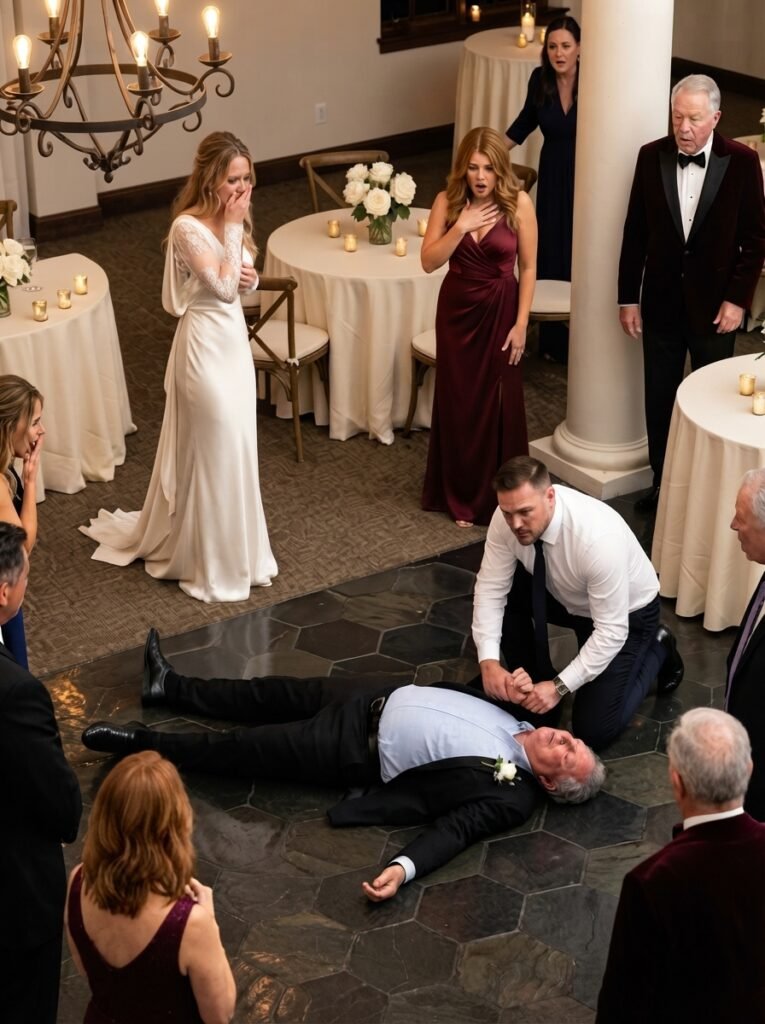
I thought the worst moment of my wedding was watching my father collapse. Then he woke up, whispered, “I remember,” and told us something none of us were prepared to hear.
“My name is Thomas.”
Those were the first words my father said after opening his eyes on the ballroom floor.
Not Dad.
Not John.
Thomas.
My mother stopped breathing beside me.
I was still kneeling in my wedding dress, one hand wrapped around his wrist.
“Dad?”
He looked at me.
His face was pale.
Confused.
Terrified.
“My name is Thomas.”
My husband, Alex, crouched beside me.
Someone had already called an ambulance.
Around us, 200 wedding guests had gone silent.
Dad touched the back of his head and winced.
Then he whispered, “I had a wife.”
My mother made a sound I will never forget.
Not quite a gasp. Not quite a sob.
Dad looked toward her immediately.
“Sarah.”
He still knew her. That mattered.
But then he covered his face.
“Oh, God.”
I grabbed his arm.
“Dad, look at me.”
He did.
“What do you remember?”
His eyes filled.
“A house with yellow shutters.”
“What else?”
“A woman named Laura.”
Mom sat down hard in the chair behind her.
Dad continued as if the words were coming faster than he could stop them.
“A little boy.”
My stomach dropped. “What boy?”
He looked at me. “My son.”
Five minutes earlier, my biggest concern had been whether the caterer had remembered to bring out the second tray of champagne.
Now my father was telling me that somewhere, possibly, I had a brother.
My name is Emily. I’m 26.
For my entire life, my father had been John.
Not because that was his real name.
Because nobody knew his real name.
Twenty-nine years ago, he was found unconscious beside a highway in Pennsylvania after what police believed was a hit-and-run accident.
He had no wallet.
No identification.
No phone, because this was the 1990s.
He had a severe head injury and fractures to his ribs and left leg.
When he woke up, he knew what a hospital was.
He knew how to speak.
He knew what cars were.
He could read.
But he had no idea who he was.
No name.
No hometown.
No family.
Nothing.
Police circulated his description.
Hospitals checked missing-person reports.
His face appeared briefly in local newspapers.
Nothing came back.
The staff needed something to call him.
A nurse started using John.
Eventually, it stuck.
Three years later, he met my mother.
She worked at a bookstore near the rehabilitation clinic he still visited.
Dad used to joke that she gave him directions to the history section and somehow he never found his way out of her life.
Mom knew everything.
Or everything he knew.
He told her before their third date, “I might have a wife somewhere.”
Mom answered, “You might also have been a terrible accordion player. We can’t build a life around possibilities.”
They waited another two years before marrying.
By then, Dad had been missing from his old life for five years.
No one had identified him.
He had a legally established identity under the name John, created through court and administrative processes after the accident.
They built a life.
Then they had me.
Growing up, I knew Dad’s story was unusual.
I also knew not to romanticize it.
He hated when people called it mysterious.
“It isn’t a mystery when you’re the one missing the answers,” he once told me.
Sometimes I’d find him staring at old newspapers online.
Missing-person databases.
Old photographs posted by strangers looking for relatives.
When I was about 11, I asked, “Do you think you had kids?”
He went quiet.
Then he said, “I don’t know.”
“Would you leave us if you found them?”
His face changed immediately.
He knelt in front of me.
“No.”
“What if you had another family first?”
“I would want to know them.”
He took my hands.
“But you and your mother are my family too. One truth wouldn’t erase another.”
At 11, I didn’t really understand that.
At 26, kneeling beside him at my wedding, I suddenly had to.
Paramedics arrived.
They checked Dad while Mom stood a few feet away, white-faced.
One paramedic asked him his name.
He hesitated.
“John.”
Then, “Thomas.”
The paramedic looked confused.
Dad gave a weak laugh. “It’s complicated.”
They wanted him transported because he’d hit his head.
He agreed.
Before they moved him, he grabbed Mom’s hand.
“Sarah.”
She looked down at him.
“I remember you.”
Her face crumpled.
“I know.”
“I remember all of you.”
That was when I understood something important.
His old memories had come back.
His new ones had not disappeared.
He remembered Mom.
Me.
My childhood.
Walking me down the aisle an hour earlier.
He remembered both lives.
At the hospital, doctors did scans.
No bleeding.
No skull fracture.
A mild concussion.
When we explained the amnesia and the sudden memories, the neurologist was careful.
He did not say hitting his head had “cured” him.
He said autobiographical memory can behave unpredictably after severe brain injury, and that sensory cues, stress, emotion, and another neurological event could potentially bring previously inaccessible memories back.
“Potentially” did a lot of work in that sentence.
Nobody could promise the memories were complete.
Or perfectly accurate.
But Dad knew things he had never known before.
His birthday. March 2, 1967.
His hometown. Harrisburg.
His father’s name. His mother’s maiden name.
The street where he grew up.
And his first family.
Laura.
Their son, Matthew.
Matthew had been four years old when Dad disappeared.
Mom sat beside the hospital bed listening to all of it.
She barely spoke.
Finally, she asked, “Did you love her?”
Dad looked at her. “Yes.”
That was hard to hear.
But Mom nodded. “Okay.”
Dad started crying.
“Sarah, I didn’t know.”
“I know.”
“I swear to you—”
“I know.”
She looked exhausted.
“You don’t have to defend yourself for forgetting something you nearly died forgetting.”
That was my mother.
Even with her own heart splitting open, she refused to turn an accident into a betrayal.
I asked Dad, “What happened that night?”
He closed his eyes.
Pieces came slowly.
He had worked as a regional sales manager for an industrial supply company.
The night of the accident, he had been driving home after visiting a client.
Rain. A dark road. Headlights coming too fast behind him.
Then nothing.
He remembered no fight. No conspiracy. No secret escape.
Just driving.
Then waking in the hospital with no memory of who he was.
The strangest part came when Dad asked for my phone.
“What are you doing?”
“Searching.”
“For Laura?”
He nodded.
His hands were shaking too badly, so I did it.
Laura was not exactly an unusual name.
We found hundreds.
Then Dad remembered her middle initial.
M.
Laura M.
Harrisburg.
Nothing obvious.
Then I searched Matthew.
Matthew.
Approximate age 33.
Harrisburg.
There were several.
One had a public profile photo.
Dad saw it before I did. “That’s him.”
I looked at the screen.
A man in his 30s standing beside a little girl.
Dark hair. Brown eyes. And my father’s nose.
Dad started crying. “That’s my son.”
Mom turned away.
I didn’t know whether to comfort Dad or her.
Alex quietly put an arm around Mom.
I will always love him for that.
Dad didn’t message Matthew immediately.
The neurologist recommended rest.
My mother recommended breathing.
I recommended we verify things before detonating a stranger’s life.
The next morning, I searched public records.
Thomas had indeed existed.
Born March 2, 1967. Married Laura in 1989.
One child listed in old records.
Matthew.
Then I found something that made me cry.
A newspaper archive.
“LOCAL MAN STILL MISSING SIX MONTHS AFTER HIGHWAY DISAPPEARANCE”
There was Dad’s face.
Younger. Dark hair.
The same scar near his chin.
The article included a quote from Laura.
“Our son asks every morning when his daddy is coming home. We just want Thomas back.”
Dad read it once.
Then pushed the laptop away.
“I was right there.”
Mom sat beside him.
“No. You weren’t.”
He looked at her.
“You were alive,” she said. “That’s different from being able to come home.”
Later that day, Dad wrote Matthew a message.
He deleted it six times.
Eventually he sent:
“My name is John, but I believe I was born Thomas. I was in an accident 29 years ago and lost my memory. I think I may be your father. I understand how unbelievable this sounds. I can provide documentation. You do not owe me a response.”
Matthew responded 11 minutes later.
“Is this some kind of joke?”
Fair.
Dad replied, “No. I’m sorry.”
Then nothing for three hours.
Finally, “Send me a photo.”
Dad sent one.
Matthew called.
I was in the room. So was Mom.
Dad answered on speaker.
Neither man spoke at first.
Then Matthew said, “Say something.”
Dad whispered, “Matt?”
There was a sharp breath from the phone.
Dad covered his mouth. “I used to call you Matty.”
Silence.
Then Matthew said, “My mother is alive.”
Dad closed his eyes.
“Is she?”
“Yes.”
“Is she okay?”
Another pause.
“She remarried.”
Dad nodded even though Matthew couldn’t see him.
“Good.”
That surprised all of us.
Matthew sounded angry.
“You mean that?”
“Yes.”
“She waited eight years.”
Dad started crying again.
“I’m sorry.”
“She had you declared legally dead.”
“I understand.”
“No, you don’t.”
Matthew’s voice cracked.
“I spent half my childhood thinking you chose to leave.”
Dad said, “I didn’t.”
“I know that now.”
That sentence changed the room.
Matthew had apparently spent the previous hours searching too.
He found old articles about the unidentified accident victim who became John.
He found Dad’s current business license.
Photos.
My parents’ wedding announcement.
Me.
He knew about us before calling.
Then he asked, “Do I have a sister?”
I had been trying very hard not to cry.
I failed.
Dad looked at me. “Yes.”
Matthew said, “Is she there?”
Dad held out the phone.
I didn’t take it at first.
What do you say to a brother you learn exists the day after your wedding?
Apparently, “Hi.”
He laughed.
Not because anything was funny.
Because sometimes people laugh when the alternative is collapsing.
“Hi.”
“I’m Emily.”
“I know.”
“That’s creepy.”
“Sorry. I’ve had a weird afternoon.”
“So have I.”
He laughed again.
Then he said, “Congratulations on getting married.”
That nearly finished me. “Thank you.”
Our first conversation lasted four minutes.
We did not become siblings instantly.
He did not call me his sister again.
Not that day.
He said he needed time.
Of course he did.
Then he asked Dad, “Do you want to talk to Mom?”
Dad went completely still.
My mother stood. “I’ll give you privacy.”
Dad caught her hand. “Don’t go.”
She looked at him. “John.”
Not Thomas.
John.
He said, “Please.”
She stayed.
Laura came onto the phone.
Her voice was older than the woman Dad remembered.
Of course it was.
“Thomas?”
Dad broke. “Laura.”
She started crying.
So did he.
For several minutes, neither managed a complete sentence.
Then Laura asked, “Where were you?”
Dad said, “I didn’t know.”
“I looked for you.”
“I know.”
“Your mother died waiting.”
That destroyed him.
Dad’s mother had died nine years after the accident.
Never knowing.
His father had died before that.
Dad whispere, “I’m sorry.”
Laura said, “You don’t apologize for a brain injury.”
Then, after a long pause, “But I am angry.”
“I understand.”
“No. You probably don’t yet.”
“You’re right.”
I glanced at Mom.
She was crying silently.
Not because Dad had done something wrong.
Because she was listening to her husband grieve a wife who had lost him first.
There was no handbook for any of us.
The legal side was strange but less dramatic than I expected.
Laura had eventually had Thomas legally declared dead.
She had remarried years later.
Dad’s marriage to Mom had been entered into in good faith under his legally established identity.
Attorneys later helped clarify records and identity issues.
Nobody was dragged away for bigamy.
Nobody’s marriage vanished in a puff of paperwork.
Emotionally, though?
Everything changed.
Dad had a son. I had a brother.
Matthew had a father who had not abandoned him.
Laura learned the husband she had buried without a body had been alive the entire time.
And Mom had to make room in her marriage for almost 30 years of history that had appeared in one night.
The first few months were messy.
Then Thomas.
Then John again.
Eventually he settled on:
“Thomas John.”
He joked, “I’ve earned extra names.”
Mom didn’t laugh the first time.
Later she did.
Matthew visited six months after my wedding.
He came alone.
He looked so much like Dad that seeing them together made me uneasy.
Same hands.
Same way of tilting their heads when listening.
They hugged awkwardly.
Dad cried. Matthew did not.
Not until later.
We were sitting on the porch when he said, “I spent years hating him.”
I said, “You didn’t know.”
“I know.”
“You’re allowed to have hated the version of the story you had.”
He stared at the yard.
“That’s what my therapist says.”
“Your therapist sounds expensive.”
He laughed.
That was probably the moment we actually started becoming siblings.
Laura met Dad later.
Mom did not attend that first meeting.
Her choice. Dad understood.
They talked for four hours.
Laura showed him photographs of Matthew growing up.
Birthdays. Graduation. Baseball games.
Matthew’s wedding, which Dad had missed.
Grandchildren he had never known existed.
Dad came home afterward and cried in Mom’s arms.
She held him.
Then she told him, “I can love you and still hate this.”
Dad nodded. “I know.”
Mom looked at him. “I need you to stop saying you know when you don’t.”
That sounded exactly like her.
They went to counseling.
Not because Dad had cheated.
He hadn’t.
Not because Mom wanted him to forget his first family again.
She didn’t.
They went because sometimes nobody is at fault and people still get hurt.
Two years have passed since my wedding.
Dad and Matthew talk every week.
Laura and Dad are not romantic.
That life ended long ago, even if neither chose the ending.
They care about each other.
Mom is still learning how to be comfortable with that.
Matthew calls me Em now.
His daughter calls my father Grandpa Thomas.
My kids, if I have them, will probably call him Grandpa John.
We have accepted that names are complicated in this family.
People ask whether Dad really “got his memory back” by hitting his head.
That’s not how his neurologist describes it.
Dad’s old memories returned suddenly around the time of the fall, but no doctor can say the fall alone caused it.
Emotion. Stress. Music.
The wedding. A head injury.
Some combination. Brains are strange.
Families are stranger.
What I remember most from that night isn’t Dad saying his old name.
It’s what he said after we got home from the hospital.
Mom was standing in the kitchen.
Dad walked toward her.
He said, “I don’t know who I’m supposed to be now.”
Mom looked at him for a long time.
Then she said, “All of you.”
He started crying.
She took his hand.
“The man you were. The man you became. Matthew’s father. Emily’s father. My husband.”
Then she added, “But we’re going to need a very good therapist.”
Dad laughed through his tears.
So did I.
My wedding did not end the way I expected.
By midnight, my father had another name, my mother had discovered her husband once had another wife, and I had a brother seven years older than me.
Within five minutes, our family history had been rewritten.
But nobody was replaced.
That was the part it took us longest to understand.
Dad’s first life didn’t make his second one fake.
His second family didn’t make his first one less real.
Memory gave him back people he had lost.
It didn’t take us away.
It just made the word “family” much bigger than any of us had expected when I walked down the aisle.
If you were Sarah, how would you handle learning that your husband had a wife and son before the accident, even though he genuinely had no memory of them?
If this story made you think about how one unexpected moment can uncover a much bigger truth, you may want to read what happened when a woman noticed a stranger secretly aiming his phone at her during a flight. Click here to read the full story.