The last thing my husband said before he locked us inside the house sounded so casual that, for a few seconds, my mind treated it like a joke.
“You guys won’t starve for three days,” Michael said, adjusting the cuffs of the navy suit I had ironed for him less than an hour earlier. “Be good at home, and I’ll bring you a present when I get back.”
He smiled when he said it.
Not the warm smile people imagine when they hear the word husband. Not the private, tired, familiar smile of a man leaving his wife and child for a difficult business trip. It was brighter than that. Clean around the edges. Almost cheerful. The kind of smile salesmen use when the contract has already been signed and the other person has not yet understood the hidden cost.
I stood in the hallway holding our three-year-old son, Leo, on my hip. Leo still smelled of sleep, milk, and the strawberry shampoo he insisted was “for race cars” because the bottle had a red stripe on it. His little face was pressed against my shoulder, one hand clutching the collar of my T-shirt, his curls flattened on one side from the pillow. He watched his father with the drowsy seriousness of a child trying to decide whether goodbye deserved a tantrum.
“Daddy bring dinosaur?” Leo mumbled.
Michael bent down and tapped Leo’s nose. “If you’re good.”
“He’s always good,” I said automatically.
Michael’s eyes moved to mine.
For one brief second, something passed through his expression that I did not know how to name then. Irritation, maybe. Contempt. Or maybe the faint amusement of someone who has already committed an unforgivable act and is watching the victim continue to speak in ordinary language.
Then it was gone.
“Of course he is,” Michael said.
He picked up his leather overnight bag from beside the door. It was the expensive one I had bought him two Christmases earlier after saving for three months, because he had said a vice president of sales could not walk into client meetings with “a college-boy duffel.” I remember the exact way the leather creaked when he lifted it. I remember the glint of his wedding ring as his hand closed around the handle. I remember the faint smell of his cologne—cedar, citrus, money, lies—drifting through the hallway.
“I’ll text when I land,” he said.
I nodded.
I had packed him a small container of sliced apples because he never ate properly while traveling. I had tucked it into the side pocket of his bag while he showered. Even after everything that had been changing between us, even after the perfume on his collar and the deleted messages and the sudden coldness that entered rooms before he did, I still packed fruit for him. A wife can be suspicious, tired, humiliated, and still perform the rituals of love because sometimes rituals are the last thing keeping her from admitting the love itself is gone.
“Have a safe flight,” I said.
Michael kissed the top of Leo’s head. He did not kiss me.
That had become normal enough that I barely registered it as an injury.
He stepped outside into the pale Raleigh morning. The porch light was still on though the sun had begun to loosen the edges of the dark. Our neighborhood, a carefully landscaped development called Briar Glen, was just waking. Sprinklers hissed across lawns. Garage doors groaned open. Somewhere down the block, a dog barked once and gave up. Everything looked safe in the way suburbs are designed to look safe: white trim, trimmed hedges, security signs in flower beds, expensive strollers on porches, children’s bikes leaning against fences, every house pretending walls and windows mean nothing bad happens inside.
Michael pulled the door closed behind him.
Then I heard the deadbolt slide.
Once.
Then a second lock.
A dry, final sound.
At first, I did not move. My arms tightened around Leo, but only slightly. Something in my body had heard danger, while my mind remained behind, sorting possibilities into the wrong boxes.
Maybe he had locked it out of habit.
Maybe he had accidentally turned the outer lock.
Maybe the sound was not what I thought.
Then his footsteps moved down the porch steps, brisk and purposeful, the steps of a man with somewhere to be and no reason to look back. The car door opened. Shut. The engine turned over. It idled for a few seconds, then pulled away from the curb.
I stood behind the oak door with my ear close to the wood until the sound of his car disappeared completely.
Only then did I reach for the knob.
It did not turn.
I tried again.
Nothing.
I shifted Leo to my other hip and twisted harder.
The knob rattled in my hand, but the door held.
For one ridiculous second, I said his name.
“Michael?”
As if he might be standing just outside, grinning, waiting to tell me I had no sense of humor.
The house answered with its ordinary morning silence.
Leo lifted his head. “Door stuck?”
“I think Daddy locked it by mistake,” I said.
Even then, I lied to protect him from a truth I had not yet accepted.
I set Leo down on the hallway rug and tried the lock from the inside. That was when confusion became fear. The deadbolt was not the only problem. Michael had installed an additional lock months earlier, saying the neighborhood had seen suspicious activity and he wanted us to feel secure. I remembered standing beside him while he demonstrated it, showing how it could be engaged from inside or outside, explaining the heavy metal plate and reinforced latch. I had admired his concern. I had thanked him for making us safer.
Now my fingers found the inside mechanism covered by a small metal shield that had not been there before.
I stared at it.
The hallway seemed to tilt.
“Mommy?” Leo said.
I forced my voice to stay level. “It’s okay, baby. Go sit with your trucks for a minute.”
He padded into the living room in his dinosaur pajamas, obedient because at three he still trusted the tone of my voice more than the facts of the room.
I went to the back door.
The kitchen tiles were cold under my bare feet. Through the window above the sink, I could see the little strip of yard where Leo’s red plastic slide sat wet with dew. Beyond that, the wooden fence and the tops of the neighbors’ crepe myrtles.
The back door had a heavy padlock secured from the outside.
Not a regular lock. Not something that could be turned. A padlock through a hasp Michael had installed on the exterior after a storm bent the frame, saying he would replace it properly later.
Later had apparently arrived as a cage.
I pulled on the door until my shoulder hurt.
The padlock clanked once against the wood.
I went to the side door off the laundry room.
Locked.
Blocked.
The small window above the washer had been painted shut for years and covered with iron security bars from the outside. Those bars had always seemed like an odd old feature of the house, something left by previous owners in a neighborhood that had once been rougher before the development expanded and property values rose. Michael had laughed when I first complained about them after we bought the house.
“Extra security,” he had said. “You worry too much.”
Every window had them.
Every window.
I moved through the house quickly at first, then faster, checking each one as if reality might be different in another room. Living room. Dining room. Guest bedroom. Leo’s room. Our bedroom. Bathroom. The little office where Michael kept financial records in a locked file cabinet I had never been invited to open.
All the same.
Iron bars outside.
Windows that opened only a few inches before hitting metal.
A house I had cleaned, decorated, filled with baby toys, holiday photographs, and the quiet hope that effort could repair distance had turned itself around me and revealed the bones of a prison.
My hands began to shake.
I called Michael.
The call did not go through.
At first I thought service was bad. Then I saw the message: the number you are trying to reach is unavailable.
I tried again.
Unavailable.
I opened WhatsApp.
The sight of the gray line beneath his name made something inside me drop so suddenly I had to grab the counter.
You have been blocked by this contact.
I stared at the words until they blurred.
Blocked.
My husband had blocked me.
The man who had kissed our son and promised a dinosaur had blocked me from contacting him before his car reached the main road.
I opened my contacts and tried my mother.
The call failed.
I looked at the top of the screen.
No Service.
That made no sense. My phone bill was on autopay. Michael handled the family account, but he had never missed payments. I opened the carrier app. It asked me to verify my identity through a code sent by text.
No service meant no code.
I tried the landline in the living room, an old phone we kept because Michael’s mother said every house should have one emergency line. The phone sat on a small table near the window, gathering dust behind a framed photo of Leo on his second birthday. I lifted the receiver.
Nothing.
No dial tone.
Only dead plastic.
I tapped the cradle. Once, twice, ten times.
Nothing.
I pressed the receiver against my ear as if silence might be persuaded.
“Mommy?” Leo called from the living room. “I want cereal.”
The ordinary request cut through everything.
I stood there holding the useless phone while my son asked for breakfast, and the terror inside me had to move aside because hunger, at least, was something I understood.
“Coming,” I said.
My voice cracked.
I went to the kitchen.
That was when I understood the full architecture of what Michael had done.
The refrigerator held two bottles of water, a half-empty carton of milk, a single stick of butter, and a plastic container of mustard. The crisper drawers were empty. Not low. Not neglected. Empty. The apples I had bought Sunday were gone. The yogurt cups Leo ate every morning were gone. The eggs, cheese, leftover pasta, sandwich meat, baby carrots, grapes, juice boxes—gone.
I opened the freezer.
Empty except for one tray of ice cubes.
I opened the pantry.
The shelves looked as if someone had staged them for a photograph about minimalism. No pasta. No rice. No cereal. No flour. No cans. No crackers where the crackers usually were.
I stood before the open pantry, my breath getting thinner.
Then I saw the rice dispenser.
It sat on the lower shelf, clear plastic, round, with a little white lever and a lid printed with tiny blue flowers. Michael had bought it for our anniversary the previous year, the kind of gift that had seemed strange to my friends when I told them and touching to me because he had said, “You always worry we’re running out of basics. Now you’ll never have to.”
I pulled it toward me.
Spotless.
Scrubbed clean.
No grains caught in the corners. No powder at the bottom. Not emptied in haste, but cleaned with intention.
I set it down carefully because if I threw it, Leo would hear.
That was the moment a part of me stopped asking whether this was a misunderstanding.
Michael had not locked the door and forgotten.
He had not rushed to the airport and accidentally taken my phone access with him.
He had not failed to shop.
He had removed food.
He had removed water.
He had cut the landline, blocked my number, deactivated the SIM, locked every exit, and left me and our son inside a house with nothing but enough liquid to keep panic alive.
“You guys won’t starve for three days.”
He had meant it.
Leo came into the kitchen dragging his stuffed blue dog by one ear. “Cereal?”
I dropped to my knees in front of him and put both hands on his small shoulders.
“Sweetheart,” I said, “we don’t have cereal right now.”
His face folded immediately. “But I want cereal.”
“I know. I’m going to find something else.”
The first search found half a package of stale crackers wedged behind the mixing bowls in the cabinet above the stove. Maybe Michael missed them because he never looked there. Maybe he left them on purpose because cruelty enjoys leaving scraps. I found one wrinkled apple in the fruit bowl under a pile of mail. I found three peppermint candies in my purse and a granola bar in the diaper bag with a corner crushed open but still edible.
Inventory.
That was the word that came to me.
I had to make an inventory.
One half package of crackers.
One apple.
One granola bar.
Three candies.
Half carton of milk.
Two bottles of water.
Ice tray.
A toddler.
A mother who had not eaten since dinner the night before.
I gave Leo one cracker and a slice of peeled apple, thin enough to make it last. I poured him a small cup of milk and told him to sip slowly. He sat at the kitchen table swinging his feet, trusting me completely, chewing with solemn concentration.
“Mommy not eat?” he asked.
“I’m not hungry.”
The lie tasted worse than the hunger.
He pushed his cracker toward me. “Share?”
I nearly broke then.
Not because I wanted the cracker. Because even in his confusion, Leo understood generosity better than his father did.
“No, baby,” I whispered. “That’s yours.”
He smiled, satisfied with his role in the morning, and took another bite.
I turned away so he would not see my face.
My name is Emily Parker, though I was Emily Whitaker before I married Michael. I was twenty-nine years old the morning my husband sealed me and our son inside our own home, and for a long time afterward people asked versions of the same question.
How could you not know?
They did not always say it cruelly. Sometimes they asked with concern. Sometimes with morbid curiosity. Sometimes with the careful judgment people disguise as confusion because open blame looks impolite. How could you not know he was capable of that? How could you live with a man who could remove food from the pantry and lock his child inside? How could you not see it coming?
The answer is simple and impossible.
You never see the final act first.
You see small disappearances.
A hand that no longer reaches for yours.
A door closed too firmly.
A joke that lands like a warning.
A credit card statement he says he already handled.
A business trip added to a calendar you did not know existed.
A perfume smell you explain away because the alternative would require action you are not ready to take.
You see the way he begins using your concern as evidence against you.
You are paranoid.
You’re dramatic.
You’re trying to control me.
You’re always imagining problems.
You’re tired.
You need therapy.
You keep the peace because peace still seems possible. You tell yourself your child needs both parents. You remember the man who cried when the baby was born, the man who held your hair when morning sickness made you vomit into a trash can, the man who once drove forty minutes to bring you soup because you had the flu before you lived together. You tell yourself the man who did those things cannot be the same man who now looks at you like you are furniture in the wrong place.
You do not understand yet that people can be both.
Michael Parker was not always a monster.
That is one of the most inconvenient truths of my life.
He was twenty-eight when I met him at a rooftop birthday party in downtown Raleigh, leaning against a railing with a beer in one hand and a laugh that made strangers look over without resenting him for it. He had dark hair, quick eyes, and a gift for making attention feel like sunlight. When he turned that attention on me, I understood immediately why people trusted him. He listened with his whole face. He remembered details. He asked questions that made me feel both seen and lightly challenged. By the end of the night, he knew I worked in retail operations, wanted to go back to school for early childhood education, loved old bookstores, hated cilantro, and had not been on a real vacation in three years.
“Then I’ll take you somewhere,” he said.
“People who say that usually don’t.”
He smiled. “Good. I like low expectations. Easier to exceed.”
He did exceed them.
At first.
He brought coffee to my apartment when I worked late. He fixed the sticky drawer in my kitchen without making me ask. He charmed my friends, remembered my mother’s birthday, held doors open with just enough old-fashioned confidence that it felt sweet instead of performative. He took me to Charleston for a weekend because I had once mentioned wanting to walk the Battery at sunset. He bought me a first edition of a children’s book I loved as a girl. When he proposed after eighteen months, he did it beside a lake at sunset with shaking hands and a speech that made me cry before he opened the ring box.
“Build a life with me,” he said.
I said yes because I believed that was what we were doing.
Building.
We bought the Briar Glen house two years into the marriage, shortly before Leo was born. A brick-front colonial with black shutters, three bedrooms, a fenced yard, and too many iron bars over the windows that the realtor dismissed as “a previous owner’s security preference.” Michael loved the house because it made him look like the kind of man he wanted to be: established, successful, rooted. I loved the nursery, the morning light in the kitchen, and the way the magnolia tree out front bloomed white in late spring.
Carol Parker, Michael’s mother, came with us to the final walkthrough.
She stood in the living room wearing a beige coat, pearl earrings, and her usual expression of restrained evaluation. Carol was not warm in the way mothers-in-law are expected to become warm when grandchildren arrive. She was precise, practical, and almost aggressively composed. She noticed cracks in baseboards, water stains, loose handles, and the way Michael exaggerated square footage when explaining things to her.
“The kitchen plumbing needs inspection,” she said.
Michael rolled his eyes. “Mom.”
“It does.”
“We already had an inspection.”
“Then have another one.”
I had thought she disliked me then. Not openly. She was never rude. That might have been easier. She was simply careful around me, as if affection were a currency she did not spend casually. She brought casseroles after Leo was born but did not stay long. She held him properly, firmly, with a kind of silent competence, but when I thanked her, she usually nodded instead of saying something tender. She remembered practical things—diapers, rash cream, extra wipes—but rarely complimented me. When Michael joked that I worried too much, Carol would look at him sharply, then say nothing.
For years, I thought her silence meant agreement.
I did not know then that Carol’s silence was often the place where she kept things she was not yet ready to say.
Michael’s father had left when Michael was seventeen. He had taken a job in Texas, met a woman, and treated the divorce like a relocation expense. Carol never remarried. She worked as an accountant for a regional construction company, raised Michael alone through his last year of high school, paid for what scholarships did not cover, and learned, I think, to distrust every form of charm that did not come with receipts.
She loved her son.
But she was never fooled by him.
That, I would later learn, was the difference between us.
By the time Valerie reappeared, Michael and I had already developed hairline cracks in the marriage, though I did not call them cracks then. I called them stress. Work. Parenthood. Normal adult exhaustion. Leo’s colic had nearly destroyed my nervous system during his first year. Michael helped sometimes, but only when help came with praise. He wanted to be seen holding the baby more than he wanted to sit through the dark hours when Leo screamed and nothing soothed him. If friends visited, Michael became the tender father instantly, kissing Leo’s cheeks, telling stories, carrying him in one arm while flipping pancakes with the other. Alone, at 2:00 a.m., he sometimes stood in the nursery doorway and said, “You’re better at this,” before going back to bed.
I told myself that was true.
I was better at it.
So I did it.
Valerie was his college girlfriend.
He had described her to me once as “intense,” then laughed when I asked what that meant.
“She was drama,” he said. “Beautiful, but drama. We were kids.”
Her last name was Harlow, though by the time she came back she was calling herself Valerie Hart because, as Michael explained at the reunion, “branding matters.” She appeared at a North Carolina State alumni event we attended because one of Michael’s clients had sponsored it. I wore a green dress I had owned for four years and worried for twenty minutes in the car that I looked like a woman who had spent too much time at home with a toddler. Michael told me I looked “fine” without looking up from his phone.
Valerie looked like a woman who had never accidentally looked anything.
She wore a white silk blouse, black cigarette pants, and red lipstick applied with the kind of precision that makes a face seem more dangerous. Her hair was dark and glossy, her body slim in an expensive way, and she had a laugh that began softly, then ended with her head tilted back just enough to show her throat. When Michael saw her, his whole body changed.
Not dramatically.
No one else might have noticed.
But wives become experts in the physics of attention.
His shoulders loosened. His smile warmed. His eyes sharpened. He looked suddenly younger, as if the version of himself standing beside me—husband, father, mortgage payer—had been a costume he could remove by crossing the room.
“Val?” he said.
She turned.
The pause before she smiled was just long enough to make him want it.
“Michael Parker,” she said. “Look at you.”
That was all.
Look at you.
Three words, and he practically stepped out of our marriage.
I stood beside him while they hugged. Her hand remained on his arm half a second too long. She looked at me after she looked at his watch, his ring, his suit, the room behind him.
“And you must be Emily,” she said.
Must be.
Not are.
I smiled politely because women are trained to smile at the person who makes them feel suddenly replaceable.
Michael drank too much that night.
When we got home, he fell asleep quickly, still smelling faintly of whiskey and her perfume. At 3:14 a.m., I woke to him mumbling.
“Val,” he said.
One syllable.
Soft.
I stared at the ceiling until dawn.
After that, things began changing with a speed that looked gradual only because I kept explaining each piece separately.
He started leaving earlier. Coming home later. Business dinners multiplied. He took calls in the garage. He stopped charging his phone by the bed. He began showering immediately when he got home, even on days when he claimed he had spent all afternoon in conference rooms. He stopped asking about my day. He forgot small things he used to remember. When Leo ran to him, Michael sometimes bent down and opened his arms with visible effort, as if even fatherhood had become something scheduled between more urgent appetites.
Once, I found a receipt in his jacket pocket from a boutique hotel in Durham.
One room.
One night.
He said a client had flown in unexpectedly and needed a place near a meeting site.
“The room was under your card?”
“Company reimbursement.”
“Why didn’t you mention it?”
He looked at me with tired contempt. “Because I didn’t realize I had to report hotel logistics to my wife.”
Another time, he came home with lipstick on his collar. Not bright, not obvious. A faint red shadow near the edge. I held the shirt in my hands while he brushed his teeth.
“What is this?”
He looked at it in the mirror, then at me.
“I don’t know. Maybe from the restaurant napkin.”
“Napkins don’t—”
“Emily.” His voice sharpened. “I had a fourteen-hour day. I am not doing this.”
Doing this meant asking.
Doing this meant noticing.
Doing this meant refusing to treat my humiliation as a scheduling inconvenience.
I stopped doing it.
Not completely. I tried again in little ways. I asked if he was happy. He said, “What kind of question is that?” I asked whether we should go to counseling. He said therapy was for people who wanted strangers to validate their complaints. I asked whether Valerie had been in touch. He laughed.
“You cannot still be on that.”
Then he kissed Leo goodnight, made a joke about Mommy being moody, and went to the office.
That was how the year frayed.
Quietly.
Then all at once.
On the first day locked inside, after inventorying the food, I tried to create order because order kept panic from eating all available air.
I dragged the dining room chairs to the living room window and stood on one to examine the bars from inside. They were mounted into the exterior brick, but around one corner of the living room frame, the plaster had begun to crack. I remembered complaining about it after a heavy rain months earlier. Michael had said he would call someone.
He had not.
In the corner behind the television stand, dusty and ridiculous, I found the old golf club. It had been a gift from a vendor Michael barely knew, part of a branded corporate set he accepted at a sales conference and never used. The club was too heavy for me to swing well, but long enough to wedge against the bar and the inner frame.
I moved Leo’s toys away from the window and put a cartoon on the television through the smart app. The Wi-Fi still worked, but the television streaming account did not allow messaging, and every attempt to access email on the tablet triggered verification to my dead phone number. Michael had understood just enough about our digital life to isolate me where it mattered.
For nearly two hours, I worked at the bars.
I jammed the club head into the narrow gap and leaned my whole weight against it. The first few tries did nothing. Then plaster cracked. The sound was small but thrilling. I tried again. The metal groaned. My palms burned. Sweat ran down my back. I kept stopping to check Leo, to give him a sip of milk, to smile like this was some strange household chore instead of a mother trying to pry open a prison.
“Mommy fix window?” he asked.
“Yes.”
“Daddy be mad?”
I froze.
The question came from somewhere deeper than that day. Children hear the temperature of a house long before they understand weather.
“No,” I said.
Another lie.
The club slipped once and smashed into my knuckles. Skin split. Blood appeared bright across my fingers. I wrapped my hand in a dish towel and kept going.
By noon, one bar had bent outward, and a chunk of plaster the size of my palm fell to the floor. The gap widened enough for air to move through properly, enough for me to see the lawn in a way that felt almost obscene, but not enough for me to climb out. I measured it with my eyes, then looked at Leo.
He might fit.
The thought horrified me the moment it came.
The drop outside was more than six feet to the ground. The window was too high. I could not lower him safely. Even if I somehow managed, what then? A three-year-old alone in the yard, barefoot, frightened, with no way back in. The neighbors on one side were retired and away visiting grandchildren in Virginia. The family on the other side had left for a lake weekend two days earlier; I had watched them load the SUV Thursday evening. The house across the street belonged to a man who traveled for work and a teenager who wore headphones even while taking out trash.
I imagined Leo crying outside under the window while I remained trapped inside.
I put the golf club down.
That option was not an option.
The second day became harder because the house changed from prison to habitat. That sounds strange, but after the first waves of panic, the body adapts even to terror. You begin making rules. Half cup of milk in the morning. Water capfuls for Leo between sips. One cracker at a time. No unnecessary movement. Curtains drawn against heat. Bathroom door left open because closed rooms felt unsafe. Broken glass swept into a corner with a magazine because I could not risk Leo stepping on it.
By evening, the water stopped.
I had gone to wet a cloth because Leo said his head hurt. The kitchen faucet sputtered, coughed, ran thin, then died. I tried again. Nothing. The bathroom sink. Nothing. Shower. Nothing. Laundry room. Nothing.
I stood over the bathtub holding the handle fully open while nothing came out.
That was the closest I came to collapsing.
Not when the door would not open. Not when I saw the empty rice dispenser. Not when the landline failed. Water felt like the last agreement between the world and my child. You can survive fear if there is water. You can survive hunger for a while if there is water. Without it, time turns predatory.
I took the ice tray from the freezer and let two cubes melt in a cup. I gave the water to Leo with a medicine syringe because it helped me control how fast he drank. He made a face.
“More.”
“Tiny sips.”
“I thirsty.”
“I know, baby.”
His cheeks had begun to pinken. At first I thought it was crying, heat, fear. By late afternoon, when I pressed my lips to his forehead, I knew.
Fever.
A low one at first.
Then higher.
I stripped him down to his diaper and T-shirt, laid him on the sofa, and pressed a damp cloth made from melted ice water to his forehead. His eyes looked too shiny. He asked for Daddy once. Then again, softer.
“Daddy coming?”
I could not answer.
I sang instead.
The same songs I had sung when he was a newborn with colic. The wheels on the bus. You are my sunshine. A lullaby my mother used to hum without words because she forgot them but loved the melody. My throat was raw from shouting earlier, so the songs came out cracked and thin.
Leo did not mind.
He pressed his hot cheek against my arm and drifted in and out of uneasy sleep.
That night, hunger became physical in a new way. A hollow twisting under the ribs. A faint trembling in my fingers. My head hurt. My mouth tasted metallic. I had not eaten except two bites of granola bar I took only when I felt dizzy enough to worry I would faint. I kept thinking about all the food Michael must have removed. Did he throw it away? Did he pack it into trash bags? Did he stand in our kitchen after I fell asleep the night before, opening cabinets, emptying shelves, scrubbing the rice dispenser clean?
How long did it take?
Did he feel anything when he took Leo’s yogurt cups?
Did he hesitate over the apple he missed?
Or did he enjoy the efficiency of it?
I thought of him in Miami, though I did not yet know where he truly was. I imagined him in a hotel room with Valerie. Room service. White sheets. A cold glass of water sweating on a nightstand. His phone face down because I was blocked and therefore no longer a sound he had to hear.
Something inside me hardened.
Not enough to stop being afraid.
Enough to stop grieving him.
Near midnight, I picked up the golf club again.
The living room window had already been damaged by my work on the bars. The glass remained mostly intact, though cracked at one corner. I moved Leo to the far side of the room and covered him with a blanket to protect him from shards. He barely stirred. His fever made him heavy, limp in that terrifying way sick children become limp even before danger becomes visible to others.
I stood before the window.
“Help!” I shouted first.
My voice came out hoarse and useless.
No response.
I swung the club.
Glass exploded inward and outward with a violence that thrilled me for one second before I realized how little it changed. The bars remained. But now there was an opening through which sound could travel. I swung again, smashing more glass from the frame. Again. Again. The club struck metal, wood, glass. Shards sprayed across the floor. My arms burned. Blood reopened on my hands. I kept swinging until the frame was jagged and the curtains torn and the night air came in full against my face.
Then I screamed.
“Help! Please! Is anyone there? Help us! My son is sick! Please!”
The neighborhood did not answer.
I screamed until my throat turned to fire.
I banged the golf club against the bars in a rhythm I hoped sounded unnatural enough to wake someone. Metal rang through the house. Leo cried weakly behind me. I shouted apologies to him between cries for help. At some point I started screaming Michael’s name, not because I expected him to hear, but because rage needed somewhere to go.
“Michael! Michael, open the door! Leo is sick!”
Nothing.
The night absorbed me.
Or so I thought.
Then, faint and distant, a siren.
At first I believed I had imagined it because need can invent sounds. I stopped shouting and stood completely still, chest heaving, listening through the bars.
There it was again.
A siren, growing closer.
Then tires against pavement.
Not the smooth glide of a passing car. A vehicle stopping hard near our curb.
A door slammed.
I pressed my face close to the broken window frame.
In the glow of the streetlamp, I saw a silver sedan angled at the curb with the driver’s door open.
The person running toward the front gate was not a police officer.
It was Carol.
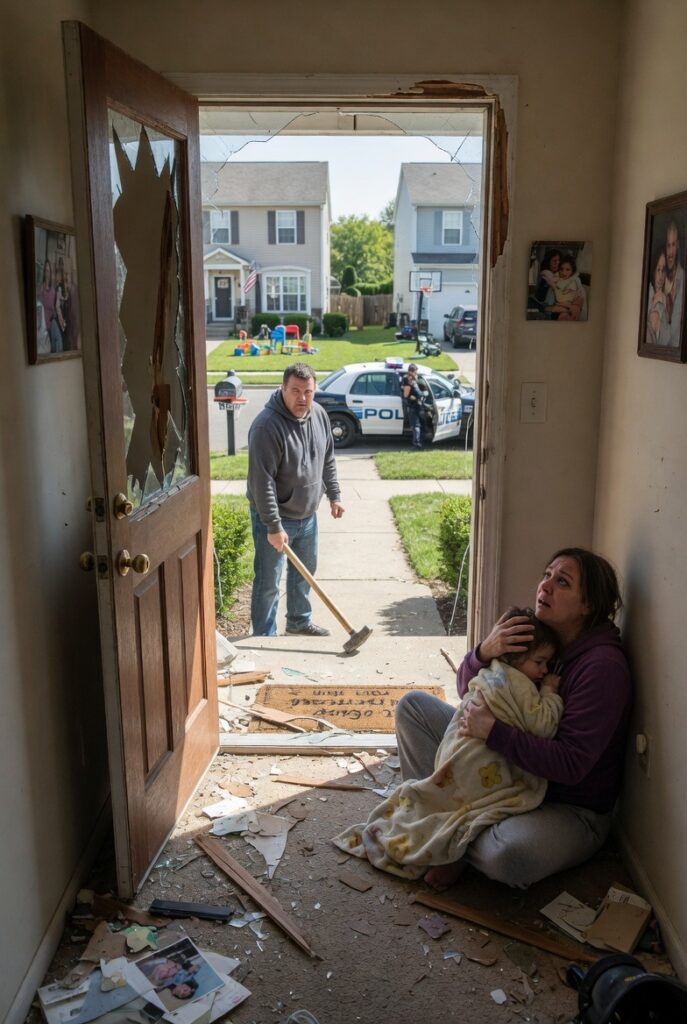
She wore black slacks, a pale sweater, and house shoes. Her silver hair had come loose from its usual neat twist. Her face was white with terror. In both hands she carried a sledgehammer.
For one insane second, I thought she had come to finish what Michael started.
That is what fear does. It makes saviors look like threats until they speak.
“Emily!” she shouted. “Leo!”
“Carol!” My voice broke on her name.
She saw me through the broken window and stopped so abruptly she nearly stumbled. Her eyes moved over my face, my bleeding hands, the bars, the glass, then past me into the room where Leo lay burning on the sofa.
I watched her change.
Whatever careful, contained, unsentimental woman I had known as my mother-in-law vanished. In her place stood a mother and grandmother confronted with the evidence of what her son had done.
Her face fell apart.
Not delicately. Not in a way she could hide. Her mouth opened and no sound came. Then she turned toward the front gate, raised the sledgehammer, and brought it down on the padlock with a force I would not have believed she possessed.
Once.
Twice.
Three times.
Metal shrieked.
“Move back!” she shouted.
I moved Leo as far from the front door as I could, though my arms shook. Carol smashed the gate lock until it split. She ran across the yard, up the porch steps, and attacked the front door.
“Michael!” she screamed as the first blow landed near the hinge. “Open this door right now!”
Another blow.
“Open this door or I swear to God I will tear this whole house down!”
She knew he was not there.
Maybe she screamed his name because rage needed somewhere to go too.
The door shuddered. Wood splintered near the hinge. The sledgehammer rose and fell, rose and fell, the sound so loud it seemed to shake the walls. Neighbors’ lights flickered on at last. Somewhere someone shouted. Carol did not stop.
After what might have been a dozen blows, maybe more, the top hinge tore loose. Then the middle. She struck the lock plate hard enough to crack the frame, then kicked the door with a sharp, furious motion that did not match her age or shoes or the polite silence she had worn for years.
The door gave.
It swung inward crookedly, slammed against the hall wall, and hung there like a broken jaw.
Carol stepped over the threshold.
For a moment, neither of us moved.
Then Leo whimpered.
She dropped the sledgehammer.
The sound of it hitting the hardwood was enormous.
Carol went to him first. I do not blame her. I would have gone to him too. She pressed her hand to his forehead, then his neck. Her face changed again.
“Oh, my God,” she whispered.
Her voice sounded stripped.
She looked at me then. At my hands. My mouth. My face.
“How long?” she asked.
I tried to answer, but only air came out.
She crossed the room and gripped my shoulders. Her hands were firm, practical, shaking.
“Emily. How long?”
“Since yesterday morning,” I whispered. “He left yesterday morning. Maybe… I don’t know. I don’t know what time it is.”
Carol closed her eyes for one second.
When she opened them, they were full of something I had never seen directed toward me before.
Not pity.
Not warmth exactly.
Fury on my behalf.
“We’re going to the hospital,” she said. “Right now.”
She wrapped Leo in a blanket, lifted him with practiced strength, and turned toward the broken door. I tried to follow and nearly fell. She caught my elbow.
“You too,” she said.
“I’m okay.”
“No, you are not.”
“I can walk.”
“You will walk to my car and then you will sit down.”
That was Carol. Even in catastrophe, she issued instructions like invoices.
Neighbors had gathered on porches now, faces pale in porch lights. Mr. Geller from across the street stood in pajama pants holding a phone. Mrs. Haines next door had one hand over her mouth. Someone said, “What happened?” Another voice said, “Should we call the police?” Carol looked at them with such naked contempt that no one asked again.
“They’re on their way,” she snapped.
Then to me, softer but not soft: “Come.”
The cold night air hit my face as we crossed the yard. It smelled of grass, broken wood, and exhaust. I looked back once at the house. The front door hung open. The living room window glittered with broken glass. The iron bars remained fixed in place behind the destruction, indifferent.
That image stayed with me longer than the hunger.
The house still looked like a cage even after rescue began.
At WakeMed Children’s Emergency Department, Leo was taken from my arms before I had time to be afraid of letting him go. Nurses moved around him in swift coordinated bursts. Temperature. Heart rate. Hydration. IV access. Acetaminophen. Questions I could barely answer. How long without water? How much food? Any vomiting? Any seizure activity? Did he lose consciousness? Was he locked in intentionally?
That last question made the room go quiet for one beat.
Carol answered before I could.
“Yes,” she said. “By his father.”
No hesitation.
No protecting him.
No family privacy.
By his father.
I sat in a chair with a blanket around my shoulders while a nurse cleaned my hands. The cuts were not deep enough for stitches but deep enough to sting. Glass had nicked one palm. Blisters had split along my fingers. When the nurse asked how it happened, I said, “Trying to break the bars.”
She looked at me for a second longer than necessary.
Then she said, “You did good.”
Those three words undid me.
Not Michael’s absence. Not the empty pantry. Not the dead phone. Not even Leo’s fever.
You did good.
I had not known how badly I needed someone to say it.
Carol appeared beside me with a paper cup of hot tea and a vending machine sandwich. Turkey and cheese, wrapped in plastic, probably terrible. She set both in front of me.
“Eat,” she said.
“I’m not—”
“Emily.”
I looked up.
Her eyes were red-rimmed. Her hands still shook slightly. There was dried paint dust on her sweater from the doorframe. She looked older than she had two days earlier.
“Eat first,” she said. “Then I’ll tell you everything.”
Everything.
The word landed with weight.
I took the sandwich because my body had begun trembling in a way I could no longer control. The first bite was dry and flavorless. Then hunger recognized food and nearly overtook manners. I ate half before speaking.
“What is happening?”
Carol sat beside me.
For a while, she watched the curtained area where Leo was being treated. Through the gap, I could see his small foot under the blanket. His sock had dinosaurs on it. I focused on that sock because the alternative was imagining all the ways his fever could have gone worse.
“Michael is not in Miami for business,” Carol said.
I stared at her.
“Where is he?”
“Miami, technically. But not for business.”
“Valerie?”
“Yes.” Her mouth tightened around the name. “And others.”
“Others?”
Carol folded her hands in her lap. It was the same gesture she used at holiday dinners when she was about to say something no one wanted to hear.
“I need you to understand something before I go on,” she said. “I am not asking you to feel sorry for him.”
I almost laughed.
“I don’t.”
“Good.”
That was the first time Carol ever said good to me as if we were on the same side.
She continued.
“Two months ago, I saw Michael with Valerie Harlow at a restaurant near Cary. He told me he was meeting clients that night. He was not.”
My fingers tightened around the sandwich wrapper.
“You knew?”
“I suspected before that. That night, I knew enough to ask him.”
“What did he say?”
“That I was old, paranoid, and interfering in his marriage.”
I looked at her.
She did not look away.
“He said that?”
“Yes.”
“I’m sorry.”
“Don’t be. It clarified things.”
Carol’s ability to treat emotional wounds as data would have irritated me once. In that hospital waiting room, it steadied me.
“I tried to speak with him again,” she said. “He denied everything. Then he became angry. He told me if I caused trouble, I would lose access to Leo.”
My throat tightened.
Carol looked toward the ER curtain again.
“I believed him capable of that.”
That admission cost her something. I could hear it.
“So I called my cousin Tony.”
Tony Alvarez, I learned, was Carol’s first cousin on her mother’s side. A retired Raleigh police detective who now ran a small private investigation firm with the kind of discretion people pay extra for when shame is involved. Carol had hired him not to build a case for divorce, not at first, but because she wanted to know whether Valerie was simply an affair or something more dangerous.
“She had a pattern,” Carol said. “Tony found it within two weeks.”
Valerie Harlow was not a heartbroken old girlfriend who had drifted back into Michael’s life because love never dies. She was part of a predatory network that targeted men with disposable income, fragile egos, and enough family assets to leverage. The operation changed names, cities, and methods, but the structure remained familiar: seduction, secrecy, small financial requests, private parties, exclusive games, gambling framed as sophistication, then debt. Shame did the rest. Men trapped by humiliation rarely called police. They lied to wives, emptied accounts, borrowed against homes, and paid until the debt became impossible. Then the operation escalated.
Tony had tracked Valerie through two prior cities: Atlanta and Tampa. In Atlanta, a married orthopedic surgeon had lost nearly seven hundred thousand dollars before attempting suicide. In Tampa, a commercial developer had signed over vehicles and business shares to cover illegal gambling debts. Valerie was never the official collector. She was the lure, the comfort, the whisper. She stood just far enough away from the violence to pretend her hands were clean.
Michael had walked directly into her net.
At first, Carol said, he withdrew small amounts from personal accounts. Then larger ones. He moved money from savings. Sold stock. Took cash advances. Tried to secure a loan against the house, though that paperwork had stalled because the title records required my signature in ways he had not anticipated.
“He was desperate by this week,” Carol said. “Tony believed he was planning something, but we did not know what.”
I looked at her sharply.
“You knew he was dangerous?”
Her face changed.
“I knew he was behaving recklessly. I did not know he would do this.”
The this sat between us: the locked door, the empty pantry, Leo’s fever.
“I tried calling you yesterday morning,” Carol said. “Your number was disconnected.”
“Deactivated.”
“Yes. I went to the house at noon. No answer. I thought perhaps you had gone out with Leo. I went again around dinner. Still no answer. I called Michael. Nothing. Tony checked the GPS tracker he had placed in Michael’s car.”
“You put a tracker on his car?”
“Yes.”
A week earlier, I might have been shocked by that.
In the hospital, it sounded like responsible parenting.
“The car was not at the airport,” she said. “It was already in Miami, near a resort Tony recognized from another investigation. Not a legitimate resort, Emily. A private club with hotel rooms and back-room gambling. By then Tony was trying to reach contacts in Miami-Dade. It took time.”
“Two days,” I said.
Carol flinched.
“Yes.”
My anger rose so fast I nearly stood. “We were inside for two days.”
“I know.”
“Leo had no water.”
“I know.”
“You should have—”
“I should have broken the door sooner,” she said.
The words stopped me because there was no defense in them.
Carol sat very still.
“I will live with that,” she continued. “I thought if I called police without certainty, Michael would claim a domestic misunderstanding, move you somewhere else, take Leo from me, and escalate. I thought careful was safer. I was wrong.”
That was the first clean apology I had heard from anyone connected to Michael in years.
Not I’m sorry you felt.
Not I did my best.
I was wrong.
It did not erase what happened.
But truth entered the room.
“What made you come?” I asked.
“Tony called me at 11:40 tonight. He had confirmation that Michael was being held by the people running the game. They were preparing to demand a ransom. He also had audio from the recording device near your front door.”
I stared.
“Recording device?”
Carol nodded once.
“Tony installed it when you and Leo were at my house three weeks ago. Outside. Under the porch trim. He was monitoring whether Valerie or anyone else came to the house.”
“You put a recording device at my door.”
“Yes.”
I should have been angry.
I was too tired to decide.
“What did it record?”
Carol’s face tightened.
“Michael locking the door yesterday morning. And what he said.”
You guys won’t starve for three days.
Be good at home.
I closed my eyes.
Carol continued, voice lower. “Then silence most of the day. Then you screaming. The audio alert reached Tony late because the device had intermittent connection. He called me while he was coordinating with Miami police. I came immediately.”
“With a sledgehammer.”
“It was in my garage.”
“Why?”
“My father believed every house should have one.”
For reasons I still cannot fully explain, that almost made me laugh.
Then the ER doctor came out and told us Leo was dehydrated but stable, fever responding, no signs of severe complications. They wanted to keep him under observation. He would recover.
He would recover.
The sentence moved through me like oxygen.
I bent forward with my hands over my face and sobbed.
Carol did not touch me immediately. She sat beside me, close enough that I knew she was there, far enough that I did not have to manage her feelings. After a few minutes, she placed one hand between my shoulder blades. Stiffly. Awkwardly. As if comfort were a language she had learned from a phrasebook.
I leaned into it anyway.
Later, near dawn, while Leo slept behind the curtain with fluids running into his small arm, Carol told me the rest.
Michael had driven to Miami with Valerie two days earlier, not flown. He had told me he was flying because flights leave clean records and airports support lies. The GPS showed stops in Savannah and Jacksonville, then a private resort outside Miami that Tony knew as a front for illegal high-stakes poker. Valerie’s associates had already extended Michael credit in previous sessions. He thought the weekend would be his chance to win back losses before anyone discovered them. That is how gamblers think when pride and panic have fused.
Instead, he lost everything.
The remaining savings.
The car.
A watch.
Access codes.
Then he signed IOUs.
Three hundred thousand dollars.
At interest rates designed not to be paid.
The man behind the operation was known as the Shark, though his legal name was Hector Salazar. He specialized in wealthy men who believed they were too smart to become prey. By the time Michael realized Valerie was not his lover but his handler, he was in a back room without his phone, surrounded by men who did not care about his sales awards, his mortgage, or his little boy locked in Raleigh.
“Why would he lock us in?” I asked, though I already knew.
Carol looked toward Leo.
“To stop you from interfering. To stop you from discovering the missing money before he had time to win it back. To stop you from calling me.”
The logic was vile.
It was also exact.
Michael had not intended, perhaps, to kill us. That distinction mattered legally but not morally. He had intended to remove us from the world temporarily, like a man putting inconvenient documents into a drawer. He calculated that three days without real food and limited water would frighten me but not destroy us. He had counted on my weakness, my silence, my habit of explaining him to myself.
He had not counted on a fever.