Nobody in Red Hollow had ever believed the woman with the wooden cart belonged to a story worth telling.
That was the first cruel mistake the town made.
Every morning before sunrise, while porch lights still glowed behind lace curtains and the bakery on Winslow Avenue was only beginning to breathe warm yeast into the cold air, Lucy Harper moved through the brick streets with her shoulders hunched against the wind, pulling a crooked little cart behind her. It had once been painted blue, maybe for a child, maybe for someone’s garden tools, but the color had worn away in strips. One wheel leaned outward like a bad ankle. When it rolled over loose stones, it clattered loud enough to make dogs bark from behind fences.
People heard that sound and knew she was coming.
Some closed their blinds.
Some turned their backs.
Some whispered before she even reached the curb.
Lucy kept walking.
Her boots were split at the sides and stuffed with folded grocery bags to keep the cold out. Her coat, a brown wool thing with missing buttons, hung from her thin frame like it had been made for a larger woman in another life. The cuffs were shiny with age. The hem was patched with thread that did not match. Her hands were red and white from winter, cracked at the knuckles, rough from glass, metal, cardboard, and the sharp hidden teeth of other people’s trash.
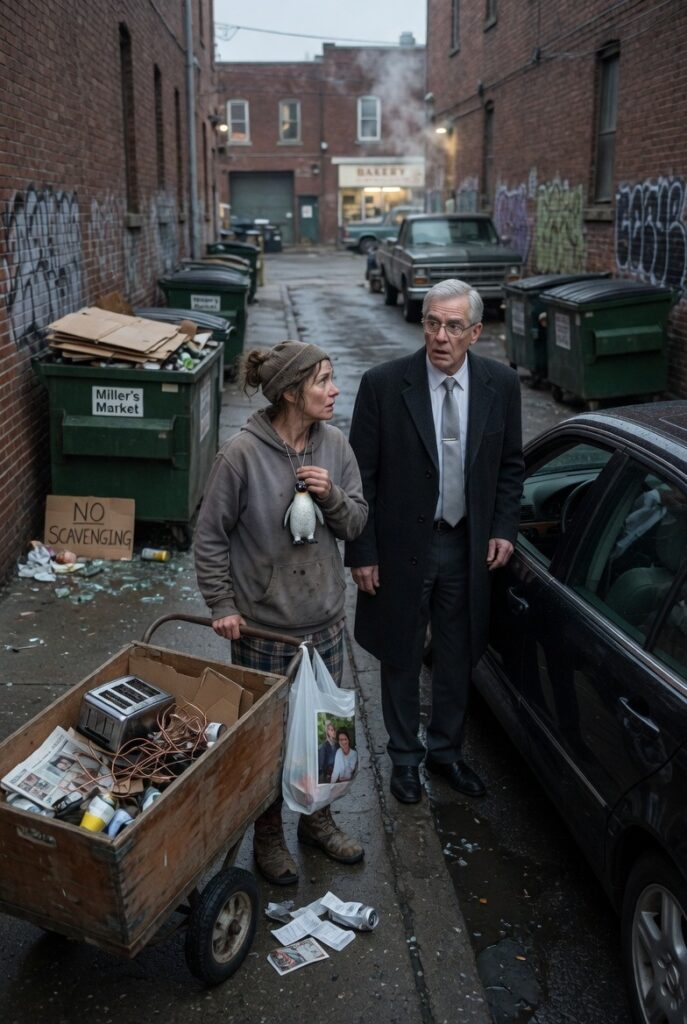
She knew which dumpsters were worth checking and which were not. Behind Miller’s Market, bruised fruit appeared on Mondays and Thursdays. Behind the diner, if she came before the manager caught her, she could sometimes find bread ends wrapped in paper. Behind the hardware store, broken tools and copper wire sometimes waited under splintered wood. Behind the school, after events, there were bottles and cans enough to trade for a few dollars at the recycling yard.
The town saw garbage.
Lucy saw inventory.
That distinction had kept her alive for ten years.
She moved carefully, with the patient concentration of someone doing work that mattered because, for her, it did. She separated plastic from aluminum, clear bottles from cloudy ones, cardboard from damp paper, wire from appliances, screws from broken hinges. She carried a flattened screwdriver in her pocket and an old pair of pliers tied with twine to the cart handle. Her hands knew how to take apart a toaster, strip a lamp, pry a brass knob from a ruined cabinet, rescue what value remained in things people had already condemned.
But Red Hollow did not respect the usefulness of that work. Red Hollow was a town that liked easy categories. Good families lived near the square. Struggling families lived near the railroad tracks. Important men had names painted on office windows. Invisible women pushed carts before dawn.
Lucy had become one of the invisible.
Except, of course, when people wanted someone to laugh at.
The children were the worst because they had learned cruelty without yet learning shame. They called after her from school bus stops and front porches.
“Trash lady!”
“Hey, Penguin Lady!”
“Do you sleep in the dumpster too?”
Sometimes they threw bottle caps or pebbles. Sometimes they imitated the way she walked, shoulders forward, head low, one hand curled protectively at her throat. Their mothers rarely corrected them. Some even smiled in that tight, satisfied way people smile when another person’s humiliation confirms their own position in the world.
The nickname came from the pendant.
It was small, silver, and shaped like a penguin, hanging from a thin chain at Lucy’s neck. Everything else she owned looked tired enough to be thrown away. The pendant did not. She polished it with the corner of her sleeve every morning before the sun came up. Even on the coldest days, when her fingers shook too hard to tie her laces properly, she rubbed that little penguin until it caught the first light and shone.
People noticed because it made no sense.
A woman who slept under laundromat awnings should not own anything delicate. A woman who pulled bottles from trash bins should not wear silver. A woman whose life had fallen so far should not have one bright thing against her chest.
So they mocked it.
They called her Penguin Lady.
Lucy never corrected them.
Not because the name did not hurt. It did. It hurt in the dull, familiar way old bruises hurt when the weather changes. But she had learned long ago that answering cruelty gave it a place to land. Silence, at least, stayed hers. In a life where everything else could be taken, silence had become the last locked room inside her.
So when boys from the high school leaned out of pickup trucks and shouted, she kept her eyes on the sidewalk.
When women at the grocery store stopped talking as she passed, she kept pulling the cart.
When the owner of the laundromat swept the pavement around her without saying good morning, she gathered her blanket and left.
When people acted as though poverty were a smell that could cling to them if they stood too close, Lucy did not defend herself.
She had spent ten years being reduced to what others could bear to see.
She had almost forgotten she had once been seen differently.
Almost.
There were mornings when memory came for her without warning.
It could happen while she was sorting cans behind Miller’s Market, or while she was drinking cold coffee from a discarded paper cup, or while she was warming her hands over a vent behind the bank. A sound would pull her backward. Rain on metal. A screen door swinging shut. A man laughing from the belly instead of the mouth. Then, without permission, the years would open, and Lucy Harper would no longer be the woman in the brown coat with the bent cart.
She would be seventeen again, standing behind the counter at Mae’s Diner on Highway 14, with her hair still chestnut and thick down her back, her apron tied twice around her waist, and her pockets smelling faintly of nickels, ketchup packets, and sugar.
She had been working at Mae’s since the week after she turned sixteen. The diner sat on the edge of San Marco County, where the highway bent toward cattle country and summer storms gathered fast over the mountains. It was a place of vinyl booths, chrome stools, coffee poured before anyone asked, and regular customers who believed a waitress should remember exactly how they liked their eggs. Mae Donnelly owned it, ran it, and ruled it with a pencil behind her ear and a voice that could stop a trucker mid-complaint.
Mae had hired Lucy because Lucy needed work and because Mae had a weakness for girls who looked like they were trying very hard not to ask for help.
Lucy’s childhood had not offered much worth keeping. Her father disappeared when she was nine. Her mother drifted through waitressing jobs, boyfriends, unpaid bills, and long silences, until one winter she left for Albuquerque with a man named Ray and did not come back. By then Lucy had already learned the most useful lessons of abandonment: keep your bag light, keep your expectations lower, and do not mistake attention for love.
Mae gave her hours. That mattered.
She gave her leftover soup at closing. That mattered more.
And on a wet Thursday in July, Mae’s Diner gave her Tom Harper.
The storm arrived at four in the afternoon with the theatrical violence of weather in that part of New Mexico. One moment the sky beyond the diner windows was a flat white glare. The next, clouds rolled over the ridge like smoke, turning the highway silver under sudden rain. Trucks hissed past in sheets of water. Customers ran in laughing, shaking out jackets, asking for coffee as thunder cracked overhead.
Lucy was carrying two plates of meatloaf when the bell over the door rang and Tom stepped inside.
She noticed the rain first, streaming off the bill of his cap and down the shoulders of his denim jacket. Then the coil of fence wire looped over one arm. Then his smile, embarrassed and open, as if he knew he was dripping all over Mae’s clean floor and hoped nobody would be too mad about it.
“Any chance I could wait this out with a cup of coffee?” he asked.
Mae looked him over from behind the register. “Long as you don’t rust on my floor.”
Tom laughed. Lucy remembered that laugh years later with painful clarity. It was not loud, not showy. It came easy, like a door opening.
He took a stool near the counter. Lucy poured him coffee. His hands were broad and scratched from work, his nails clean but permanently shadowed by dirt. He thanked her like he meant it. That alone made him unusual.
“You work over at Calloway’s?” Mae asked, nodding at the fence wire.
“Yes, ma’am. Lower pasture fencing took a hit last night.”
“Arthur keeping you boys busy?”
Tom smiled. “Always.”
Lucy knew Arthur Calloway’s name because everyone in three counties did. The Calloway ranch stretched beyond San Marco, beyond Red Creek, beyond places Lucy had ever been invited to imagine. Arthur owned cattle, land, water rights, mineral leases, and half the buildings on Main Street, though people respected him not because he was rich but because he paid fairly, remembered debts, and had once personally driven an injured ranch hand eighty miles to a hospital in Santa Fe when the ambulance was delayed. Men liked working for him. That said something.
Tom came in again two days later.
Then the following Tuesday.
Then Friday after lunch, when the diner was nearly empty and Lucy was wiping down the pie case.
He ordered cherry pie he clearly did not want just so he could sit long enough to talk to her.
“You always eat dessert like it offended you?” she asked.
He looked down at the untouched slice and grinned. “I’m working up to it.”
“You ordered it.”
“I panicked.”
She almost smiled then. She did not give smiles away easily.
“What did you panic about?”
He looked at her, and his face changed just enough for her to understand before he said it.
“You.”
Lucy turned away, pretending to check the coffee pot.
That should have scared him off. It would have scared off most boys his age. But Tom Harper did not chase the way impatient men chased. He simply returned. He learned her rhythm. He came during slow hours and spoke when she seemed willing. He kept quiet when she did not. He never made a show of generosity, never left tips so large they felt like pressure, never crowded her with questions she did not want to answer.
He was twenty-two, five years older than she was, though hardship made both of them seem older in different ways. He had grown up on the rough side of a proud family. His mother, Carol Harper, was known in San Marco for her sharp mouth, sharp suits, and sharper memory for slights. His brothers, Dean and Russell, were bigger than Tom, louder than Tom, and seemed to believe life owed them something for being angry at it. Tom had escaped that house by working. He started at Calloway’s as a teenager, learned horses and fence lines and irrigation pumps, and by twenty-two had become the kind of man Arthur trusted with keys, equipment, and instructions that mattered.
Lucy did not know all of that at first.
At first, she knew only that he walked her home after late shifts because the road by the creek got dark and boys sometimes drank there.
She knew he fixed the loose hinge on her apartment door without making her feel poor for needing it fixed.
She knew he remembered that she hated orange soda, liked black coffee with sugar, and preferred the corner booth because she could see the door.
She knew when he looked at her, he did not look through her, around her, or down at her.
He looked as if she were a fact worth paying attention to.
For a girl who had survived by making herself easy to overlook, that was terrifying.
One evening in September, after the diner closed, they sat on the back steps while the world smelled of rain and fryer grease. Lightning flickered beyond the fields, too far away to threaten. Lucy had just turned eighteen. Tom had brought her a cupcake from the bakery, slightly crushed in a paper bag, with a single candle he had clearly stolen from someone’s junk drawer.
She laughed despite herself. “You are terrible at birthdays.”
“I’m new at being invited to them.”
“I didn’t invite you.”
“Mae did.”
“Mae talks too much.”
“She told me not to make you cry.”
Lucy looked down at the candle. The flame leaned in the night breeze.
“That sounds like Mae,” she said.
Tom was quiet for a while. Then he said, “Can I tell you something without you running off?”
“That depends on what it is.”
“When I’m with you, things make sense. I don’t know how else to explain it.”
She stared at him.
Nobody had ever spoken to her like that. Not in a way that sounded sober, plain, and true. Men had called her pretty. Men had called her sweetheart with intentions hiding underneath. Men had made promises with the loose confidence of people who expected not to be held accountable. But Tom said it differently. He said it as if love, for him, was not a performance but a conclusion he had reached after paying attention.
Lucy did not answer.
She blew out the candle and tried very hard not to cry.
Six months later, they were married in a small white church outside San Marco, the kind with a bell that no longer rang and windows that rattled when trucks passed. Lucy wore a cream dress Mae found at a secondhand shop and altered herself, muttering the whole time that men were useless about lace. Tom wore his best suit, which was too tight in the shoulders and too short in the sleeves. Arthur Calloway attended in a dark coat and stood near the back, quiet and dignified. Carol Harper sat in the second row with her lips pressed so thin they nearly disappeared.
Lucy remembered Tom’s hand trembling when he slid the ring on her finger.
She remembered the taste of grocery-store cake.
She remembered Mae crying openly into a napkin while pretending she had allergies.
She remembered Tom whispering, as they stepped into the moonlit churchyard, “Mrs. Harper,” as if her new name were a treasure he could not believe they were allowed to keep.
They rented a little adobe bungalow at the edge of the valley, where the land began to lift toward brown hills and mesquite trees scratched against the bedroom window when the wind rose. It was not much. The kitchen floor sloped. The water heater complained like an old man. In summer, dust collected on every sill no matter how often Lucy wiped it away. But there were two rooms, a porch swing, a shed out back, and enough sky to make the place feel larger than it was.
Lucy loved it with the devotion of someone who had never owned safety before.
She painted the kitchen yellow.
Tom built shelves from salvaged boards.
They bought mismatched dishes from yard sales and a blue quilt from an estate sale outside Clovis. Lucy planted rosemary in coffee cans on the porch. Tom brought home broken crates, bent horseshoes, old jars, rusted hinges, chipped windows, saying, “Think you can do something with this?”
And Lucy always could.
That became their private ritual. Tom rescued discarded things from ranch sheds and barns. Lucy turned them into something useful or beautiful. A broken shutter became a mail organizer. Horseshoes became hooks. Weathered boards became a narrow table. Mason jars became porch lights. Tin cans became planters painted robin’s-egg blue. Tom watched her work with an expression of such sincere admiration that sometimes Lucy had to look away.
“You can make something out of anything,” he told her.
“No, I can’t.”
“Yes, you can.”
“You just like junk.”
“I like what you see in it.”
On their first anniversary, Tom came home with dust on his jeans, sunburn across his nose, and a tiny black box hidden badly in his jacket pocket. Lucy noticed it before he made it through the door but pretended not to because his excitement was too sweet to spoil.
They ate chili on the porch as the sunset spread copper over the valley. Afterward, he cleared his throat like he was about to testify in court and handed her the box.
Inside was the penguin.
A silver pendant no bigger than her thumb, carefully shaped, polished bright, with tiny dark eyes and a rounded belly. Lucy blinked at it, then laughed.
“A penguin?”
Tom rubbed the back of his neck. “I know it’s not fancy.”
“It’s very fancy. It’s also a penguin.”
“I read something,” he said.
“That sounds dangerous.”
“They pick one mate, right? One love. They stick together.”
Lucy’s laughter softened.
Tom lifted the chain and fastened it around her neck. His fingers brushed the nape of her neck and lingered there. When she turned, he touched the pendant where it rested against her chest.
“I loved you once,” he said quietly, “and that was enough to know I’d love you forever.”
Lucy had no answer for that. She kissed him instead.
For a while, life honored them.
Not perfectly. There were bills. There were long days. There were evenings when Tom came home too tired to eat and mornings when Lucy woke before dawn to open the diner. There were repairs they could not afford, arguments about money, a winter when the heater failed twice, and one month when the truck needed work so badly they both pretended not to hear the engine knocking.
But there was laughter.
There was coffee on the porch.
There was Tom’s hand reaching for hers in sleep.
There were Sundays when Lucy made chili and cornbread, and Tom sat at the kitchen table sorting screws while she sanded old wood smooth enough to stain. There were dreams spoken carefully, as if saying them too loudly might scare them away.
A little land of their own someday.
A workshop for Lucy.
Maybe children.
“Not yet,” she said whenever Tom brought it up.
“Not yet is not never,” he replied.
“No.”
“Then I can wait.”
He meant it.
That was the thing about Tom. He had been raised among people who treated wanting as a kind of hunger that justified grabbing. But Tom had become gentle through effort. He did not confuse love with ownership. He did not demand what Lucy was not ready to give. He seemed to understand, without needing every scar explained to him, that trust was not a door she could fling open just because someone knocked kindly.
Then came the storm.
It was a Tuesday in late August, ten years before anyone in Red Hollow would call her Penguin Lady.
The day began with heat so intense the road shimmered like water. By noon, even the cicadas had gone quiet. Mae closed the diner early because the air-conditioning failed, and customers were becoming unreasonable. Lucy drove home in the truck with the windows down, sweat sticking her dress to her back, one hand on the wheel, the other touching the silver pendant out of habit.
Tom was at Calloway Ranch.
The clouds started building around four.
At first they looked like mountains behind mountains, white towers rising beyond the western ridge. By five they had turned bruised purple. By six, wind was moving dust sideways across the yard. Lucy stepped onto the porch and saw lightning flicker far away, thin and white.
She called the ranch office.
No answer.
She told herself there was nothing strange in that. Storms always made everyone busy. Calloway’s lower pasture flooded fast when the dry creek came alive. Tom had worked that stretch a hundred times. He knew where the ground dropped, where the fence sagged, where the culverts clogged.
At seven, rain began.
Not gently. It arrived all at once, hammering the roof so hard Lucy could not hear the kitchen clock. Water streamed from the gutters. The yard turned black and glossy. The mesquite branches thrashed against the window like hands.
At eight, she called again.
At nine, she put on her jacket.
At ten, she stood in the open doorway, rain blowing across her face, and watched the road disappear beyond silver sheets of water.
At eleven, Arthur Calloway called.
His voice was tight but controlled. Tom and two other men had gone to secure fencing near the lower pasture before the creek rose. The other men had returned. Tom had stayed behind to cut loose a section snagged by debris. They were looking for him.
Lucy did not remember hanging up.
She remembered driving.
She remembered water over the road and headlights shaking in rain.
She remembered Arthur’s foreman stopping her at the ranch gate because beyond that point the road was nearly gone. She remembered screaming at him, though later she could not recall the words. She remembered Arthur himself appearing in a yellow slicker, soaked through, face set like stone, telling her they had men along both banks, trucks, ropes, lights.
“Lucy,” he said, gripping her shoulders, “I need you to wait at the house.”
“No.”
“I know.”
“No.”
“I know.”
But the storm was bigger than grief. Bigger than protest. Bigger than any human command.
By three in the morning, she was back home because Arthur had promised to come as soon as there was news, and because Mae, who had somehow heard, sat in the kitchen with her and held her hand while rain attacked the roof.
At 3:42 a.m., someone knocked.
Lucy knew before she opened the door.
Arthur Calloway stood on the porch with his hat in both hands. Behind him, rain fell in gray ropes. His face had changed. That was how Lucy knew. Powerful men always believed they could arrange the world until the world refused, and the refusal left them looking suddenly older.
“No,” Lucy said.
Arthur’s mouth moved, but she did not hear the first words.
They had found Tom downstream near a fallen cottonwood where the current bent around a cutbank. He had been caught by debris. The water had been too strong. By the time they reached him, he was gone.
Lucy made a sound then that Mae would remember for the rest of her life.
At the funeral, people said Lucy was composed.
People always say foolish things when they mistake shock for strength.
She stood beside Tom’s coffin in the little church where they had married, wearing a black dress Mae had pressed for her, the penguin pendant hidden under the collar because she could not bear to feel it move when she breathed. The room smelled of lilies and damp wool. Rainwater streaked the windows. Men from the ranch stood with their hats in their hands. Arthur sat in the front row, eyes lowered. Mae cried without apology.
Carol Harper did not cry.
She entered late, wearing black lipstick and a severe suit, Dean and Russell behind her like guards. She looked at the coffin first, then at Lucy. Her expression contained something worse than grief. It contained accusation.
Lucy was too hollow to care.
During the service, the pastor spoke of Tom’s goodness, his loyalty, his work ethic, his love for his wife. At the word wife, Carol’s jaw tightened. Lucy saw it because she saw everything and understood nothing. Grief had turned the world into a room underwater. People moved. Mouths opened. Hands touched her shoulder. She felt none of it as present reality. She stood in the strange, impossible fact that Tom’s body was six feet away and Tom was nowhere.
After the burial, Arthur approached her near the cemetery gate.
“Lucy,” he said softly. “I want you to come by the ranch office when you can. There are papers. Benefits. Insurance. Tom—”
She flinched at the name.
Arthur stopped.
“I’m sorry,” he said. “Not today. But soon. Please.”
She nodded because nodding was easier than speaking.
She did not go.
That failure would become one of the hinges on which her life swung into darkness.
Three days after the funeral, while the house still smelled of casseroles left by women who did not know what else to do, Carol Harper arrived with Dean, Russell, and an attorney named Martin Keene.
Lucy remembered the sound of their tires on gravel.
She remembered opening the door and seeing Carol on the porch with a black handbag tucked under her arm, chin lifted, eyes dry.
Martin Keene stood beside her in a gray suit that looked too smooth for a man in a dusty yard. He had a narrow face, gold-rimmed glasses, and a smile that seemed to have been practiced before a mirror until all humanity had been polished out of it.
“Mrs. Harper,” he said. “May we come in?”
Lucy should have said no.
She knew that later. She knew it with a clarity that punished her for years. She should have closed the door. She should have called Mae. She should have called Arthur. She should have demanded time, demanded papers, demanded proof.
But grief makes obedience feel like relief.
She stepped aside.
They entered her home as if inspecting a property already acquired. Carol looked around the little living room with visible distaste: the reclaimed shelves, the mismatched cushions, the curtains Lucy had sewn from old tablecloths. Dean leaned against the doorframe, chewing gum. Russell opened a cabinet without asking.
Keene placed a folder on the kitchen table.
“It is my unpleasant duty,” he began, “to discuss certain legal realities.”
Lucy sat because her knees felt unreliable.
Keene explained that Tom had died without a valid will. He explained that certain assets had been premarital property. He explained that the truck, tools, personal accounts, and household items were subject to family claims. He explained that Carol, as Tom’s mother, had rights. He used words that sounded official and final. Intestate. Disputed. Probate. Inventory. Freeze.
Lucy stared at his moving mouth and understood only fragments.
“This house was Tom’s before he married you,” Carol said.
“It was our house,” Lucy whispered.
Carol’s face hardened. “This was my son’s home before it was yours. Do not confuse a wedding with ownership.”
Dean laughed under his breath.
Keene slid a document toward her. “We are recommending that you vacate voluntarily while matters are sorted. It will prevent further legal complications.”
“Vacate?” Lucy repeated.
Carol had already risen. She moved through the living room, taking colored stickers from her handbag and placing them on things. Tom’s toolbox. The lamp Lucy had made from an oil can. The kitchen table. A cedar chest. Even the porch swing visible through the window.
“What are you doing?” Lucy asked.
“Inventory,” Carol said.
That word entered Lucy like a blade.
Inventory.
As if the life she had built with Tom were an estate sale.
As if love could be tagged, sorted, claimed by blood.
“Stop,” Lucy said, but her voice was so weak even she barely heard it.
Carol did not stop.
Russell found Tom’s work jacket on a hook by the door and took it down.
“No,” Lucy said louder.
He looked at her with bored contempt. “What?”
“That stays.”
Carol turned. “That belonged to my son.”
“He was my husband.”
Carol crossed the room so fast Lucy stood without thinking. The older woman’s face was inches from hers.
“Do not say that to me like it makes you equal,” Carol hissed. “You had him for a minute. I had him his whole life.”
Something inside Lucy broke then, not loudly, not with the clean snap of courage, but inwardly. She was twenty years old. Her husband was dead. She had not slept more than an hour at a time since the storm. Her mind was full of rain, coffin wood, and the image of Tom’s cap hanging on the peg by the door. These people had walked into her grief with folders and stickers and law-shaped lies. She did not have enough self left to fight them.
By dusk, she had packed one bag.
Mae was not there. Arthur did not know. The neighbors watched from behind curtains as Lucy walked down the dirt road wearing the penguin pendant under her dress and carrying the wedding photo wrapped in a towel.
She took two dresses, a pair of boots, Tom’s last letter from a week he had worked in Colorado, the photograph from their wedding, and the silver penguin.
Everything else stayed behind.
At the bend in the road, she turned once.
The bungalow stood against the darkening hills, yellow kitchen curtains glowing in the window. Carol was inside. Lucy could see her shadow moving room to room.
For one insane second, Lucy thought Tom might step onto the porch and call her back.
He did not.
She kept walking.
Later, she would try to explain to herself why she did not go to Arthur. There were practical reasons. She had no car. She had no phone once the bill went unpaid. She had no strength for another conversation with another powerful person in another office full of papers she did not understand.
But underneath all that was shame.
Shame is a strange and dangerous thing because it often attaches itself to the victim first. Lucy had been robbed, intimidated, lied to, and thrown out, but as she walked away from the only home she had ever loved, a damaged part of her believed she had failed. Failed Tom. Failed to protect their life. Failed to become the kind of woman people did not dare treat that way.
She left San Marco County before sunrise.
The first weeks blurred into bus stations, shelters, cheap motels when she could afford them, and the kindness of strangers that felt almost as frightening as their cruelty. She worked where she could. A laundry in Roswell. A motel outside Las Cruces. A packing shed near Hatch during chile season. She washed dishes, sorted linens, cleaned bathrooms, hauled crates, scrubbed floors. She never stayed long because staying meant being known, and being known meant being asked questions.
The money ran out anyway.
It always did.
At first she thought of homelessness as something temporary, a crisis with an end hidden somewhere ahead. She told herself she only needed one steady job, one room, one chance to breathe. But life at the edge of survival drains choice slowly. One missed bus becomes a lost job. One lost job becomes unpaid rent. One unpaid rent becomes a night outside. One night outside becomes two. Then people begin looking at you differently, and after enough time, their version of you replaces your own unless you fight like hell to remember.
Lucy fought at first.
She kept herself clean in gas station bathrooms. She braided her hair. She applied for work. She used shelters when beds were open. She wrote down addresses in a little notebook. She believed, stubbornly, that she could climb back.
Then winter came.
Then sickness.
Then a man at a shelter stole her bag, including the wedding photo.
She searched dumpsters behind the shelter for hours in freezing rain, tearing open bags with her bare hands, sobbing so hard she could barely breathe. She never found the photograph.
She still had the pendant because she wore it always, even sleeping, even bathing in truck stop sinks, even when men looked at it too long.
After that, something in her loosened.
She drifted north through towns whose names blurred. She learned where churches served meals and which police officers kicked people awake before dawn. She learned not to sleep too close to anyone and not too far away either. She learned to hide money in three places. She learned to read a dumpster from ten feet away: restaurant waste by smell, glass by shine, cardboard by weight, metal by sound.
Years passed without ceremony.
Hunger aged her.
Weather hardened her.
Fear trained her body to flinch before her mind understood why.
By twenty-seven, she looked older than women ten years ahead of her. Her face had grown narrow, cheekbones sharp, eyes too large. Her hair, once chestnut, had faded under dust and sun into a color people mistook for gray. She spoke little because conversations required energy, and energy had become currency.
Red Hollow found her in the eighth year after Tom’s death.
Or rather, she found Red Hollow and stayed because it did not immediately drive her out.
The town sat in a shallow valley in northern New Mexico, red rock ridges to the west, cottonwoods along a narrow creek, train tracks cutting the poor side from the side with shade trees and restored porches. It had a grocery store, a diner, two churches, a bank, a hardware store, a laundromat, a library with limited hours, and enough self-regard to believe itself kinder than it was.
Lucy slept first behind the abandoned feed store, in a shed with a roof that leaked only in one corner. The owner lived in Phoenix and rarely checked the property. She found a broken wooden cart behind the building and repaired the handle with wire. That cart became her business, her pantry, her closet, her proof that she was still working at staying alive.
Soon people noticed.
Then they named her.
Penguin Lady.
The first time she heard it, she was crossing Bledsoe Street with a sack of cans over her shoulder. Two boys on bikes circled her.
“Why you got a penguin?” one asked.
Lucy did not answer.
“You live at the zoo?” the other said.
Then the name spread the way ugly things spread in small towns: quickly, with laughter, without ownership.
At the diner, waitresses used it.
At the market, stock boys used it.
At school, children used it as if it had always been true.
Lucy Harper disappeared beneath it.
The Penguin Lady remained.
There were nights when she whispered her own name just to make sure she still knew it.
Lucy.
Lucy Harper.
Tom’s Lucy.
But the town had its own story, and people trusted stories that spared them responsibility. In Red Hollow’s version, she had always been what she appeared to be: a ragged scavenger, a nuisance, an unfortunate figure at best and a dirty joke at worst. Nobody asked where she came from. Nobody asked what had happened. Nobody asked whether a woman wearing a silver penguin might have once been loved beyond measure.
The easiest story was this: she was trash, and trash belonged with trash.
So when the black Mercedes rolled into the alley behind Miller’s Market on an October morning sharp with frost, nobody in Red Hollow understood that history had finally come to find her.
Lucy was bent over a crate of broken appliances, carefully pulling copper wiring from a toaster with her pliers. Her breath showed in pale clouds. The sun had barely cleared the rooftops. A delivery truck idled at the far end of the alley. Somewhere inside the market, men were unloading produce.
The Mercedes stopped behind her cart.
Lucy froze.
Cars did not stop for her unless someone inside meant trouble. Teenagers sometimes filmed her. Store owners sometimes threatened her. Men sometimes asked if she wanted to earn twenty dollars in ways that made her skin crawl.
She closed her fingers around the toaster wire and turned slowly.
The driver’s door opened.
The man who stepped out wore a charcoal overcoat, leather gloves, and the unmistakable bearing of someone accustomed to being obeyed. His hair was silver now, not dark as she remembered. His shoulders were still broad but bent slightly under age. Deep lines bracketed his mouth. He stood beside the car, staring.
Lucy’s heart began to pound before her mind named him.
Arthur Calloway.
Ten years vanished and arrived at the same time.
She saw him on her porch in the rain. She saw him in the church. She saw him beside Tom’s coffin, eyes lowered, hands folded over his hat. She saw the world before Red Hollow and felt terror rise in her throat like floodwater.
Arthur took one step forward.
His eyes fell to the pendant.
The change in his face was not small. Recognition struck him visibly, as if someone had driven a fist into his chest.
“Lucy?” he said.
Her name in his voice nearly undid her.
Nobody in Red Hollow called her Lucy.
She backed away too quickly. Her heel hit the cart wheel. Bottles rattled.
“It’s mine,” she said.
The words came out harsh and frightened, shaped by years of accusation. She closed her hand around the penguin. “I didn’t steal it.”
Arthur stopped moving.
His face broke.
“Oh, God,” he whispered. “No. No, Lucy, I know you didn’t.”
She did not believe him. Not immediately. Belief had become a luxury she could not afford.
He removed his gloves slowly, as if trying not to startle her. “Tom gave that to you.”
Lucy swallowed.
A delivery man at the end of the alley paused to look. Lucy noticed because she noticed everything that could become danger.
Arthur noticed too.
His jaw tightened. “Would you allow me to take you somewhere warm? Somewhere private? I need to speak with you.”
She almost laughed. The idea was absurd. Men in expensive coats did not step into alleys to rescue women like her. Not without cost. Not without a trap. Not in a world that had been consistent in its lessons.
“No,” she said.
Arthur nodded once, accepting the refusal as if she had every right to make it.
“Then I’ll speak here.”
He looked older in the cold. Tired. But his eyes, gray and sharp, were the same eyes she remembered from Calloway Ranch, eyes that missed little and tolerated less.
“I have been looking for you for ten years,” he said.
Lucy stared.
The alley seemed to tilt.
“What?”
“Since after Tom’s funeral. Since I learned what they did. I hired investigators. More than one. I followed every trace I could find. Lucy, I thought you might be dead.”
Her hand tightened around the pendant until its edges bit her palm.
Arthur’s voice roughened. “But when I saw that necklace from the car, I knew. I knew it had to be you.”
The delivery man was still watching. A stock boy had come to the back door of the market. Two faces peered from an upstairs window across the alley.
Lucy felt the old shame rush in hot and poisonous. Arthur Calloway, who had known her as Tom’s wife, was seeing her now with dirty hands, cracked lips, a ruined coat, and a cart full of trash. She wanted to vanish. She wanted to run. She wanted to turn her back and become Penguin Lady again because Penguin Lady had no past that could be pitied.
Arthur seemed to understand.
He stepped aside and opened the rear passenger door of the Mercedes.
“I will not force you,” he said. “I will not touch you. But you are freezing, and what I have to tell you should not be said in an alley while strangers stare.”
Lucy looked at the car.
Then at the market door.
Then at Arthur.
“Why?” she asked.
“Because Tom asked me to protect you if he ever could not,” Arthur said. “And I failed him once. I do not intend to keep failing him now.”
That name, that promise, that shame in his voice—together they opened a narrow path through fear.
Lucy climbed into the car.
The leather seat was warm.
That nearly made her cry.
Arthur did not drive her to a hotel or office. He drove out of Red Hollow and up a winding road toward a property Lucy had seen only from a distance: a stone-and-adobe house set among cottonwoods, iron gates, long fields brown with late autumn grass. Calloway Manor, people called it, though Arthur himself had always disliked grand names.
The house was large but not gaudy. It sat low against the land, built around courtyards and shaded portals, with old beams and tall windows. A housekeeper opened the door, took one look at Lucy, and to her credit showed no shock. Arthur asked for tea and privacy.
Lucy stood in the foyer afraid to move.
Her boots left damp marks on the polished floor.
Arthur saw her looking and said, “Floors can be cleaned.”
It was the first ordinary kindness of the day.
He led her to a study lined with books, framed maps, ranch photographs, and shelves holding small bronze sculptures of horses. A fire burned low in a stone fireplace. Lucy had not been that warm in years. The heat made her fingers ache as feeling returned.
Arthur closed the door gently.
For a long moment, neither of them spoke.
Then he crossed to a desk, unlocked a drawer, and removed a thick leather folder.
Lucy’s body recognized danger in papers before her mind did. Her shoulders tightened. She remembered Martin Keene’s folder on the kitchen table. She remembered legal words used like weapons.
Arthur placed the folder down but did not open it yet.
“I want you to understand something before I show you anything,” he said. “Nothing in this folder obligates you to trust me. Nothing requires you to make a decision today. You can have your own attorney review every page. In fact, I insist on it. But you need to know what was hidden from you.”
Lucy remained standing.
Arthur opened the folder.
The first document he turned toward her carried Tom Harper’s signature.
Lucy forgot how to breathe.
She had known that signature better than her own once. Tom wrote his T with a heavy downward stroke and crossed it long, as if the line needed room to run. He had signed grocery receipts, work orders, birthday cards, notes left on the kitchen counter. The sight of it after ten years struck Lucy with such force that she had to grip the back of a chair.
“This is Tom’s will,” Arthur said.
“No,” Lucy whispered.
“Yes.”
“He didn’t have one.”
“He did.”
Arthur’s voice remained calm, but something hard moved beneath it. He turned the document so she could read the first page.
Last Will and Testament of Thomas Daniel Harper.
Lucy’s vision blurred.
The will had been signed and notarized seven months before Tom’s death. It named Lucy Harper, his lawful wife, as sole beneficiary and heir to his estate. The house. The truck. The tools. The savings account. Personal belongings. Any pending compensation, wages, or benefits.
All of it.
Hers.
Arthur placed another document beside it.
“This was the ranch death benefit and insurance settlement. Tom was covered because he died during work related to flood damage. There were also wages, accrued leave, and a private fund I maintain for families of employees who die on duty.”
Another document.
“This was the trust account I opened when you disappeared.”
Another.
“These are records of attempted claims made by Carol Harper, Dean Harper, and Russell Harper.”
Another.
“This is the false death certificate they provided for you.”
Lucy stared at it.
Her own name appeared in black ink.
Lucy Anne Harper.
Date of death: September 3.
Cause: suicide.
She read it once.
Then again.
Then again.
The room receded until there was only that paper and the horrifying neatness of the lie.
They had killed her on paper while she was still walking.
Carol had not merely taken the house.
She had erased Lucy from the world that could have helped her.
Arthur spoke, but his voice sounded far away. “When you did not come to the office, I sent a man to the house. Carol told him you were gone. Later, when my attorney contacted them about beneficiary paperwork, they produced that document. I knew something was wrong. I knew Tom would never have left his affairs in such disorder, because he had come to me months before and asked how to make certain you were protected. I sent him to our attorney. I witnessed him sign the will.”
Lucy looked up slowly.
“You knew?”
“I knew he had made provisions,” Arthur said. Pain moved across his face. “I did not know they had thrown you out. I did not know until too late. By the time I began asking hard questions, you had vanished. Carol claimed you had taken your life. The certificate was filed through a clerk later found to have accepted money. Martin Keene, the attorney she used, had a reputation I should have looked into sooner. He has since been disbarred.”
Lucy’s fingers went numb.
Arthur continued because the truth, once opened, demanded air.
“I challenged the certificate. Quietly at first, then through investigators. The county resisted admitting fault. Keene delayed. Carol threatened litigation. I kept the funds locked rather than release a cent to them. Eventually, we proved the death certificate fraudulent, but that still left the problem of finding you. Without you, the estate could not properly transfer. I hired people to search shelters, employment records, hospitals, police reports. Your trail went cold more than once.”
Lucy sank into the chair without meaning to.
Arthur pushed a statement toward her.
“The account has been maintained for ten years. It includes the original settlement, Tom’s estate proceeds recovered where possible, interest, and money I added because I considered the delay my responsibility.”
The total at the bottom of the page was two hundred forty-three thousand, six hundred eighteen dollars and seventy-two cents.
Lucy stared at the number.
It meant nothing at first.
Numbers that large belonged to other people’s lives. Houses. Businesses. College funds. Retirements. Not to a woman who counted coins behind a laundromat to decide whether she could buy soup.
Then meaning arrived all at once.
Ten years.
Ten years of cold.
Ten years of hunger.
Ten years of sleeping with one eye open.
Ten years of being spat on, ignored, stepped around, laughed at.
Ten years of Red Hollow’s children shouting Penguin Lady while money intended to protect her sat behind legal walls because greed had declared her dead.
It had not been fate.
It had not been weakness.
It had not been some punishment life had chosen for her because she was disposable.
It had been done.
By people.
By names.
By hands.
By signatures.
Anger came into Lucy like a storm that had spent a decade crossing distance.
It shook her so violently she pressed both hands to her mouth.
Arthur looked away, not because he was indifferent but because he understood that dignity sometimes requires privacy even in the presence of someone else.
“I am sorry,” he said.
Lucy laughed once, a broken, airless sound. “People keep saying that after the damage is done.”
Arthur accepted the blow.
“Yes,” he said. “We do.”
She looked at the false death certificate again.
“Carol did this?”
“Yes.”
“Dean and Russell?”
“Yes.”
“Keene?”
“Yes.”
“The clerk?”
“Yes.”
“Why?”
Arthur’s face turned cold. “Money. Control. Spite. I cannot pretend to know the exact proportions.”
Lucy touched the penguin pendant.
Tom had given it to her on a porch full of sunset and trust. Carol had looked at that love and seen theft. That was what Lucy understood now. Carol had not wanted Tom’s belongings because she needed them. She had wanted to prove that Tom had never truly chosen Lucy. She had wanted to reach into the marriage after death and rewrite it.
Arthur opened another folder within the folder.
“There is more,” he said.
Lucy almost told him to stop. She did not know how much truth a person could survive in one afternoon. But she nodded.
He showed her letters Tom had written to the ranch attorney when preparing the will. Notes in Tom’s hand about the bungalow, the truck, a small life insurance policy through the ranch, and instructions that if anything happened to him, Lucy should speak to Arthur before anyone else.
One note, written on lined paper, nearly destroyed her.
Mr. Calloway,
I know this is probably foolish because I am young and not planning on dying, but storms and horses and equipment do not ask whether a man has plans. If anything happens, please make sure Lucy is not bullied by my family. They never accepted her. She is my wife. Everything I have is for her. She is the best thing I ever chose.
Lucy bent over the page and wept.
Not pretty tears. Not dignified tears. The kind that come from the deepest room of the body, where grief has been stored so long it has hardened around the lungs. She wept for Tom. She wept for the girl on the dirt road with one bag. She wept for the photograph stolen from the shelter. She wept for every morning she had believed survival was all she deserved.
Arthur did not touch her.
He waited.
When the worst passed, he placed a clean handkerchief near her hand.
Lucy took it.
Before she could speak, tires sounded on gravel outside.
Arthur’s head lifted.
His expression changed so completely that Lucy felt fear before she knew why. He rose and crossed to the window, moving aside the curtain only enough to see.
His mouth became a line.
“They’re here,” he said.
Lucy’s body went cold despite the fire.
“Who?”
But she knew.
Arthur turned from the window. “Carol. Dean. Russell.”
The room shrank.
For a second, Lucy was twenty again. The kitchen. The stickers. The folder. Carol’s voice saying blood as if marriage were dust. She looked at the study door, then at the windows, measuring exits.
Arthur saw the calculation.
“No,” he said gently.
Lucy flinched at the firmness in his voice.
He softened, but did not withdraw the command. “You do not have to face them if you choose not to. That is your right. But do not run because they taught you to. Not from my house. Not today.”
Her pulse thundered.
Arthur stepped closer, stopping several feet away.
“You did nothing wrong,” he said. “You were lied to. You were robbed. You were erased. But you are alive, Lucy. Tom’s wife is alive. Walk out of this room as that woman, not as the woman they tried to bury.”
Something in the words found a place to stand.
Lucy looked down at herself: ruined coat, dirty hem, cracked hands. She wanted clean clothes, a bath, time, armor. But truth does not always wait until a person feels ready to hold it.
Voices carried from the front of the house.
Carol’s voice, older but unmistakable.