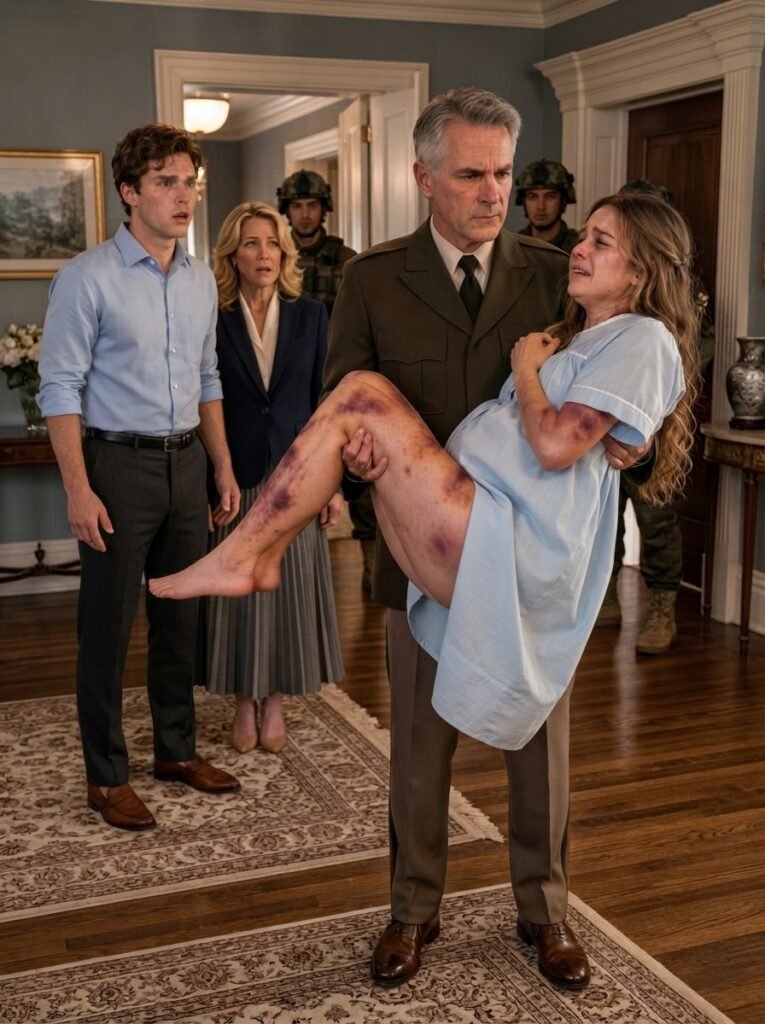
He took it.
I demanded it back.
Ryan grabbed my arm.
I pulled away.
Linda came running from the hallway.
“What is wrong with you two?”
“I need my doctor.”
“You need sleep,” she said.
“I want my phone.”
Ryan stepped between me and the bedroom door.
“Stop.”
“Move.”
“Emily.”
“Move.”
I tried to get around him.
His hand hit my side.
Whether he meant to shove me or simply stop me didn’t matter.
I lost my balance and struck the corner of a chair.
Pain exploded across my ribs.
I screamed.
For one horrifying second, nobody spoke.
My hands flew to my stomach.
The baby moved.
I almost collapsed with relief.
Ryan stared at me.
Linda stared at him.
Then she said something I will never forget.
“Put her in bed before the neighbors hear.”
That was the moment I understood that neither of them was going to help me.
Ryan carried me into the bedroom.
Not gently.
Not lovingly.
He put me on the mattress and told me to stay there.
Linda brought ice.
Not for my pain.
For the bruising.
“Use this,” she whispered. “Your father asks too many questions.”
I lay awake until sunrise.
The next morning Dad called.
Ryan answered.
“She’s sleeping.”
I heard Dad’s voice through the speaker.
“Wake her.”
“She needs rest.”
“Wake my daughter.”
Ryan looked at me.
I shook my head.
Not because I didn’t want Dad.
Because I was terrified of what Ryan would do after the call.
Ryan stepped into the hallway.
The apartment became quiet.
Five minutes later, he returned.
“What did you tell him?”
“Nothing.”
“He thinks something’s wrong.”
“I didn’t tell him anything.”
“He knows you.”
I lowered my eyes.
Ryan leaned close enough for me to smell coffee on his breath.
“Then make him stop worrying.”
That afternoon, Dad called again.
This time Ryan wasn’t nearby.
I answered.
“Dad?”
There was silence.
Then his voice changed.
Not Colonel Bennett.
My father.
“Emily, are you safe?”
My throat closed.
I wanted to say no.
One word.
That was all it would have taken.
But footsteps moved outside the bedroom.
So I whispered,
“I’m okay.”
Another pause.
“Are you alone?”
“No.”
Then Linda appeared.
I ended the call.
I thought I had protected myself.
What I didn’t know was that my father had already heard enough.
The next afternoon, someone knocked on our apartment door.
Ryan opened it.
Dad stood in the hallway.
He was still wearing his Army dress uniform from a ceremony at the installation.
The silver eagle insignia on his shoulders caught the hallway light.
Ryan’s smile disappeared.
“Colonel Bennett.”
Dad looked past him.
“You should’ve called,” Ryan added.
“I wanted to surprise my daughter.”
Linda appeared immediately.
Too quickly.
She had probably heard Dad’s voice from the kitchen.
“James.”
Dad never liked when she called him that.
“Emily’s resting,” she said. “She doesn’t need excitement.”
“My daughter can tell me that herself.”
“Pregnancy has been difficult.”
Dad stepped inside.
Ryan hesitated, then moved aside.
The apartment looked normal.
Almost aggressively normal.
The living room had been cleaned.
The pillows were straight.
A candle burned on the coffee table.
Family photographs sat neatly on a shelf.
But my father noticed the silence.
No television.
No music.
No sound from the bedroom.
Then he noticed the untouched bowl of soup on a tray.
The full glass of water.
The prenatal vitamins still sitting beside it.
Dad stopped.
“When did she eat?”
Linda answered immediately.
“She isn’t hungry.”
Dad looked at her.
“That wasn’t my question.”
Ryan forced a laugh.
“She ate earlier.”
Dad said nothing.
He walked down the hallway.
I heard his footsteps.
For the first time in weeks, I felt both hope and terror at the same time.
The bedroom door opened.
Dad saw me lying beneath a thick blue blanket.
My face must have told him more than I realized.
He stopped in the doorway.
“Emily.”
My heart broke.
“Dad.”
He crossed the room and sat beside me.
His hand closed around mine.
My fingers were trembling.
He noticed.
“Tell me what’s wrong.”
“Nothing.”
“Don’t do that.”
I stared at the wall.
“You’ve been afraid for weeks.”
“I’m tired.”
“No.”
His voice was gentle.
But certain.
“You’re afraid.”
My eyes burned.
“Please don’t ask.”
Dad went completely still.
Those four words changed everything.
Linda appeared in the doorway.
“See? She’s dramatic. She worries everyone.”
Ryan walked in behind her.
“She’s uncomfortable. The baby’s getting heavy.”
Dad slowly stood.
His eyes moved from my face to my hands.
Then to Ryan.
“Leave the room.”
Ryan frowned.
“Excuse me?”
“You heard me.”
Linda crossed her arms.
“This is our home.”
Dad’s expression didn’t change.
“And she’s my daughter.”
My breathing quickened.
I could feel everything collapsing.
The excuses.
The lies.
The careful positioning of blankets and clothing.
“Daddy…”
Dad turned immediately.
“Please.”
“Please what?”
My grip tightened around the blanket.
“If you see…”
I couldn’t finish.
Dad lowered his voice.
“If I see what?”
“Everything will fall apart.”
The room went silent.
Ryan moved suddenly.
“Sir, don’t touch the blanket.”
Dad looked at him.
Linda spoke over Ryan.
“She fell. Pregnant women fall all the time.”
Nobody had asked how I got hurt.
That was their mistake.
Dad’s face changed.
Slowly.
His hand reached for the edge of the blanket.
I shut my eyes.
Ryan stopped breathing.
Linda’s confidence disappeared.
Dad pulled the blanket down.
The silence that followed felt endless.
Purple bruises covered my ribs.
Yellowing marks ran along my thighs.
Finger-shaped discoloration wrapped around my upper arm.
And beside my swollen belly was a dark handprint.
Dad stared at it.
Then at the older bruises.
Then at me.
His face lost every trace of color.
I had seen my father angry before.
I had seen him furious.
But this was different.
This was restraint so complete that it terrified everyone in the room.
Ryan swallowed.
“Sir… I can explain.”
Dad turned toward him.
“No.”
One word.
Barely louder than a whisper.
Then heavy footsteps approached through the hallway outside the apartment.
They stopped at our door.
For one strange second, nobody moved.
Ryan stood beside the bed, pale.
Linda’s mouth opened, but nothing came out.
Dad folded the blanket back over me with shaking hands.
Then someone knocked.
Firm.
Official.
Dad walked to the door.
He opened it.
Two Chicago-area police officers stood outside with a woman in a navy coat carrying a medical bag.
“Colonel Bennett?” one officer asked.
Dad nodded.
Ryan stared at him.
“You called the police?”
Dad looked over his shoulder.
“Before I came upstairs.”
My eyes widened.
Dad continued.
“My daughter stopped answering video calls. Her husband repeatedly prevented me from speaking to her privately. Yesterday she told me she wasn’t alone after I asked whether she was safe.”
Ryan took a step forward.
“This is insane.”
The officer raised one hand.
“Stay where you are, sir.”
Ryan stopped.
Dad looked at me.
“I hoped I was wrong.”
His voice cracked.
“I prayed I was wrong.”
The woman with the medical bag entered.
She introduced herself as a paramedic.
One officer asked Ryan and Linda to move into the living room.
Linda exploded.
“This is ridiculous! She fell!”
The second officer glanced toward the bedroom.
“Ma’am, you can explain everything outside this room.”
“This is my son’s home.”
“And right now we need space to assess her condition.”
Ryan looked at my father.
“This isn’t what you think.”
Dad’s jaw tightened.
“What I think no longer matters.”
He pointed toward me.
“What she says matters.”
That sentence gave me something I had not felt in months.
Permission.
Not pressure.
Not orders.
Permission to speak.
The officers separated Ryan and Linda.
The bedroom door closed.
For the first time in months, I was alone with people who weren’t telling me what to say.
The paramedic crouched beside the bed.
“Emily, I’m going to ask you some questions.”
I nodded.
“Did someone hurt you?”
My lips trembled.
Dad stood near the window.
He didn’t answer for me.
The paramedic waited.
That mattered.
Finally, I whispered,
“Yes.”
The word barely existed.
But once it was spoken, I couldn’t take it back.
“Who hurt you?”
I began crying.
“My husband.”
Dad closed his eyes.
“And anyone else?”
I looked toward the door.
“Linda didn’t hit me.”
The paramedic waited.
I swallowed.
“But she helped him hide it.”
Dad turned away.
The paramedic checked my blood pressure.
My pulse.
My ribs.
When her fingers moved near the darkest bruise, I flinched.
“How long has this been happening?”
“Months.”
“During the pregnancy?”
“Yes.”
“Has your stomach been struck?”
I froze.
“Not directly.”
“Emily.”
I looked at Dad.
Then back at her.
“He grabbed me there once. Last night he shoved me and I hit a chair.”
The paramedic’s expression sharpened.
“When was your last prenatal appointment?”
I hesitated.
“Almost six weeks ago.”
Dad looked at me in disbelief.
“What?”
“Ryan kept canceling.”
The paramedic stood.
“We’re going to the hospital.”
Ryan heard through the closed door.
“No.”
The officer outside immediately ordered him back.
Ryan’s voice rose.
“She doesn’t need a hospital! She needs rest!”
I suddenly screamed.
“I NEED A DOCTOR!”
Everyone went silent.
Even me.
I hadn’t raised my voice in weeks.
The words seemed to shock something awake inside my chest.
Ryan stared toward the bedroom.
Linda shouted from the living room.
“Look at how unstable she is!”
My father stepped into the hallway.
I couldn’t see his face, but I heard every word.
“You will never use my daughter’s fear as evidence against her again.”
Linda laughed bitterly.
“You don’t know what she’s like here.”
Dad replied quietly.
“No. I know exactly what you wanted me to believe she was like here.”
The paramedics brought in a stretcher.
I resisted.
“I can walk.”
“Let them help you,” Dad said.
“I don’t want people looking.”
My father knelt beside me.
“Emily.”
I looked at him.
“You have nothing to hide.”
That sentence nearly destroyed me.
Because for months, shame had been Ryan’s strongest weapon.
He made me ashamed of being hurt.
Ashamed of being afraid.
Ashamed of not leaving.
Ashamed of every bruise I concealed.
But as Dad said those words, something became painfully clear.
The shame had never belonged to me.
They carried me through the apartment.
Ryan stood against the wall with an officer beside him.
For the first time, he looked frightened.
Not angry.
Frightened.
“Emily,” he said.
I turned my head.
“Tell them it was an accident.”
I stared at the man I had loved.
The father of my unborn child.
The man whose apologies had once convinced me bruises could somehow disappear from memory.
He softened his voice.
“Please.”
Linda started crying.
Real tears this time.
“You’re destroying this family.”
The stretcher stopped.
Not because anyone told it to.
Because I lifted my hand.
I looked directly at Linda.
“No.”
My voice shook.
“You helped destroy it every time you watched him hurt me.”
Linda’s face hardened.
“You ungrateful—”
The officer stepped between us.
“Enough.”
I looked at Ryan.
Then I said the sentence I had been too frightened to say for months.
“Don’t come near me again.”
The elevator doors closed.
Dad rode with me to the hospital.
He sat beside the stretcher with both hands locked together.
For ten minutes, he barely spoke.
Then he whispered,
“I should’ve come sooner.”
I looked at him.
“You didn’t know.”
“I knew something was wrong.”
“You didn’t know what.”
“I should have.”
“Dad.”
His eyes were red.
For the first time since childhood, I saw my father cry.
Not loudly.
Not dramatically.
One tear slipped down his cheek.
He wiped it away immediately.
“I teach people to recognize danger,” he said. “And my own daughter was…”
“Stop.”
He looked at me.
“They made sure you couldn’t see.”
That was the truth.
Abuse had not arrived wearing a sign.
It had arrived disguised as concern.
Privacy.
Marriage problems.
Pregnancy stress.
Family support.
One excuse layered over another until even I struggled to recognize my own life.
At the hospital, everything moved quickly.
Blood tests.
An ultrasound.
Questions.
More questions.
A doctor examined my ribs.
A nurse photographed injuries for my medical records after receiving my permission.
Dad remained outside during the private examination.
He never demanded details.
Never pushed.
He simply stayed.
The longest moment of my life came when the ultrasound technician spread warm gel across my stomach.
I stared at the ceiling.
“What if something’s wrong?”
Dad was beside me again.
He held my hand.
The screen flickered.
Then the room filled with sound.
A heartbeat.
Fast.
Steady.
Alive.
I broke.
Not gracefully.
Not quietly.
I sobbed so hard the technician had to pause.
Dad lowered his forehead to my hand.
The baby was alive.
The doctor found no immediate sign of catastrophic injury to the pregnancy, but I was dehydrated, anemic, badly bruised, and had a cracked rib that appeared to be several weeks old.
Several weeks.
I hadn’t even known.
Pain had become so normal that I stopped understanding what normal was.
Then the police arrived at the hospital.
One officer carried an evidence bag.
Inside was my phone.
Ryan had hidden it beneath clothing in a drawer.
Another bag contained several handwritten pages.
My notes.
I had forgotten they existed.
Months earlier, after the second time Ryan hurt me, I began writing down dates.
Not because I planned to go to the police.
Because I was afraid I was losing my mind.
Ryan would hurt me.
Then apologize.
Then tell me it hadn’t been that bad.
Linda would say I was exaggerating.
Days later, I would question my own memory.
So I started writing.
March 8 — grabbed left arm near kitchen.
March 23 — pushed into bathroom wall.
April 11 — Linda saw bruise. Said wear long sleeves.
May 2 — Ryan took phone after argument.
May 19 — told me Dad was getting tired of my drama.
Page after page.
The officer placed them carefully on the table.
“Do you recognize these?”
“Yes.”
“Did you write them?”
“Yes.”
Dad stared at the pages.
His expression broke again.
But there was more.
The police had obtained permission to secure items from the apartment while documenting the scene.
Inside my nightstand, beneath prenatal pamphlets, they found an old phone.
I had hidden it months earlier.
I had completely forgotten about it.
The screen was cracked.
The service had been disconnected.
But it still contained audio recordings.
My hands went cold.
I remembered.
One night, after Ryan accused me of lying about him, I had pressed record before he entered the room.
The first recording was mostly arguing.
Then Ryan’s voice became clear.
“If you call your father, I’ll tell him you’re unstable.”
My voice answered.
“He’ll know.”
“No, he won’t. Because everyone already thinks pregnancy is making you crazy.”
Then Linda.
Calm.
Almost bored.
“James believes uniforms, doctors, and official stories. Give him a reasonable explanation and he’ll accept it.”
Dad went motionless.
The recording continued.
I was crying.
Ryan said,
“Stop acting like I beat you every day.”
Then came the sound of something hitting the wall.
My voice screamed.
The recording ended.
No one in the hospital room spoke.
The officer shut off the phone.
Dad stared at the floor.
Linda had been wrong about one thing.
James Bennett did believe evidence.
And now they had given him plenty.
Ryan and Linda were both detained that night while investigators determined the full extent of what had happened.
Ryan was later charged in connection with assaults against me.
Investigators also examined allegations involving intimidation, interference with my access to communication, and attempts to prevent me from seeking medical care.
Linda was not treated as an innocent observer.
My statements, the recordings, messages, and other evidence forced investigators to examine her role separately.
For the first time, they weren’t controlling the story.
They were answering questions.
I stayed in the hospital overnight.
Dad slept in a chair beside the window.
At 3:17 in the morning, I woke and found him staring at the ultrasound photograph.
“You’re supposed to be sleeping,” I whispered.
He looked up.
“So are you.”
I smiled faintly.
There it was.
A tiny piece of us.
The father and daughter we had been before everything became frightening.
“I’m sorry I lied to you.”
Dad’s expression changed.
“Don’t apologize.”
“I kept saying I was okay.”
“You were surviving.”
“I should’ve left.”
“Emily.”
“I should’ve—”
He leaned forward.
“No.”
His voice was firm now.
“You do not carry responsibility for someone else’s decision to hurt you.”
I started crying again.
He reached for my hand.
“I don’t care how many times you stayed. I care that you’re safe tonight.”
Two days later, I left the hospital.
I did not return to Ryan’s apartment.
Dad had already arranged for me to stay somewhere secure while the case moved forward.
He never told me what to do about my marriage.
That surprised me.
He didn’t say divorce Ryan.
Didn’t say forgive him.
Didn’t tell me what kind of mother I needed to become.
He simply gave me choices.
For months, everyone around me had taken choices away.
Dad gave them back.
I eventually chose to end the marriage.
I also obtained legal protection preventing Ryan from contacting me except through approved legal channels where necessary.
There were hearings.
Statements.
Evidence.
Lawyers.
Days when I felt strong.
Days when the sound of footsteps in a hallway made my hands shake.
Healing was nothing like the movies.
There was no single moment when everything stopped hurting.
Some mornings I woke convinced Ryan was standing outside my door.
Some nights I dreamed Linda was telling everyone I was unstable.
But something else happened too.
I started answering my phone again.
I went outside.
I ate when I was hungry.
I chose my own clothes.
I attended every prenatal appointment.
And slowly, the woman I had been before Ryan taught me to fear my own voice began returning.
Three weeks before my due date, Dad arrived carrying another package.
I looked at it suspiciously.
“What now?”
“Open it.”
Inside was a tiny green sleeper.
Printed across the front were the words:
Grandpa’s New Recruit.
I burst out laughing.
“Absolutely not.”
“It’s tasteful.”
“It’s propaganda.”
“Family tradition.”
“You bought this months ago, didn’t you?”
Dad hesitated.
Then smiled.
“Maybe.”
At the bottom of the box was another note.
I opened it.
Your mom would be proud of you.
I stopped breathing.
Dad looked away.
“She would,” he said.
I held the note against my chest.
For the first time, I believed him.
My daughter was born healthy.
Six pounds, eleven ounces.
Ten fingers.
Ten toes.
A furious little cry that filled the entire delivery room.
Dad stood beside the window while the nurse placed her against my chest.
Colonel James Bennett had faced deployments, combat zones, and ceremonies honoring soldiers who never came home.
Nothing prepared him for becoming a grandfather.
“Do you want to hold her?” I asked.
He looked terrified.
“I don’t know.”
I laughed.
“You’ve commanded thousands of soldiers.”
“They could support their own heads.”
The nurse helped him.
Dad held my daughter like she was made of glass.
She opened her eyes.
He stopped breathing.
“Hello,” he whispered.
I watched my father’s entire face change.
Then my daughter wrapped four tiny fingers around one of his.
Dad cried again.
This time he didn’t hide it.
Months later, the legal process was still moving forward.
There was no magical erasing of the past.
The bruises disappeared long before the memories did.
But the apartment, the blue blanket, and the fear no longer controlled my life.
One afternoon, Dad and I sat together while my daughter slept beside us.
He looked at me.
“Can I ask you something?”
“Sure.”
“Why didn’t you tell me?”
I thought about it for a long time.
“Because Ryan convinced me that asking for help meant I was weak.”
Dad nodded slowly.
“And Linda convinced me that if people knew, they’d judge me for staying.”
He said nothing.
“And then the longer I stayed, the harder it became to explain.”
Dad looked toward the sleeping baby.
“That’s how control works.”
I glanced at him.
He continued.
“People imagine danger always looks like danger. Sometimes it looks like someone telling you they’re protecting you.”
I remembered Ryan taking my phone.
Linda canceling appointments.
The closed bedroom door.
The soup beside my bed.
The blanket.
Then I remembered what happened when Dad lifted it.
The truth didn’t arrive with sirens.
The sirens came later.
The truth began in silence.
In one father looking at bruises his daughter had been trained to hide.
In one moment when Ryan realized there was no explanation left.
For months, my husband and mother-in-law had tried to make everyone believe I was weak.
They told people I was emotional.
Fragile.
Unstable.
They treated my fear like proof that something was wrong with me.
But the person they underestimated most wasn’t my father.
It was me.
Because the day Dad uncovered those bruises, he didn’t rescue a helpless daughter.
He gave a terrified woman enough safety to speak.
And once I finally said the word…
Yes.
Yes, he hurt me.
Yes, I was afraid.
Yes, I need help.
Everything changed.
Ryan spent months trying to teach me silence.
Linda spent months helping him build lies around that silence.
My father destroyed neither of them.
He didn’t need to.
He simply opened the door.
The police asked questions.
Doctors documented injuries.
Evidence told the story.
And I finally told the truth.
One evening, almost a year after Dad first walked into that apartment, I found the blue blanket packed inside a storage box.
I stared at it for a long time.
That blanket had once felt like protection.
Then it became a hiding place.
I nearly threw it away.
Instead, I carried it downstairs.
Dad was sitting at the kitchen table with my daughter asleep against his chest.
He looked up.
“You okay?”
I held the blanket.
For a moment, my hands shook.
Then I smiled.
“Yeah.”
And this time…
I wasn’t lying.
I cut the damaged sections away.
Months later, the remaining fabric became part of a small quilt in my daughter’s nursery.
Not because I wanted to remember the pain.
Because I wanted to remember what happened after it was uncovered.
The hospital.
The heartbeat.
My father’s hand holding mine.
My daughter’s first cry.
My first morning waking up without fear.
Ryan and Linda had believed that exposing the truth would destroy my life.
They were wrong.
The truth destroyed the prison they had built around it.
And whenever Dad looks at my daughter now, I sometimes catch him staring at her with the same expression he wore in that hospital room when he first heard her heartbeat.
Grateful.
Protective.
Almost amazed.
He still calls me too often.
Still asks whether I’ve eaten.
Still reminds me to lock the door.
And yes…
He still buys ridiculous Army-themed baby clothes.
Some things never change.
But one thing did.
I no longer whisper when someone asks whether I’m okay.
Because I learned something in that bedroom beneath that blue blanket.
Silence can protect a lie.
But the moment the truth finally has somewhere safe to stand…
It becomes stronger than everyone who tried to bury it.