He watched once.
Then twice.
By the third replay, his hands were shaking so badly he nearly dropped his phone.
The video lasted only forty-seven seconds.
Forty-seven seconds was enough to destroy thirty-seven years of trust.
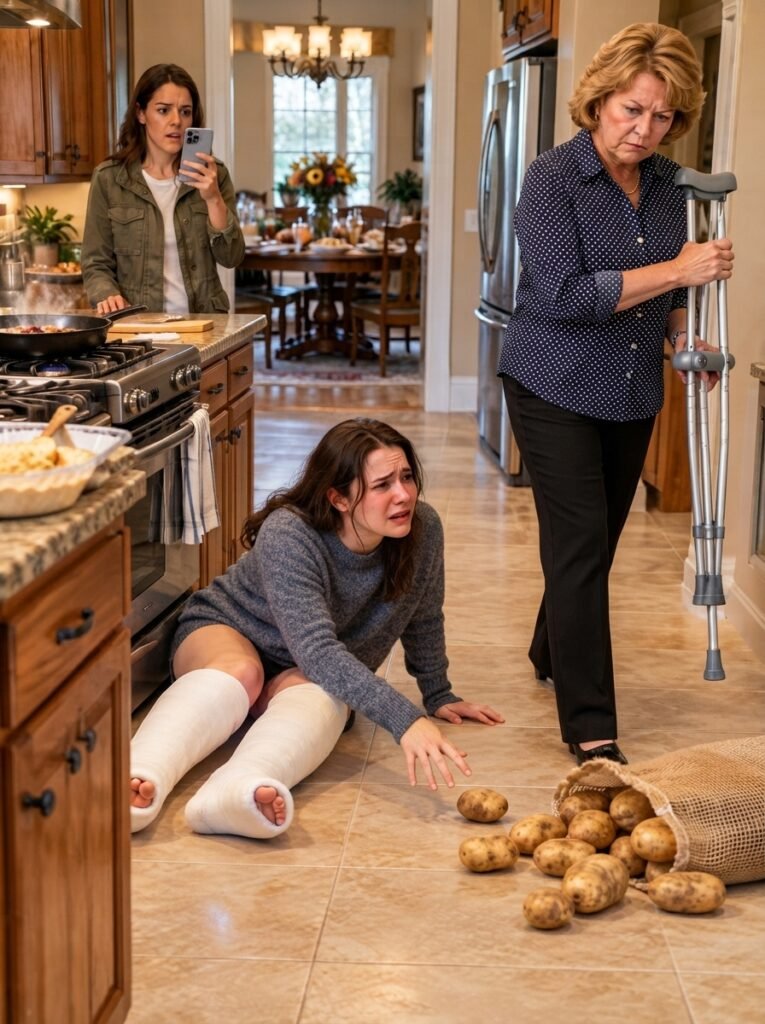
Clara sat on the beige kitchen tile, her face pale from pain.
Thick fiberglass casts covered both legs from her toes to just below her knees.
A skillet hissed on the stove three feet away.
Marcus’s mother, Phyllis, stood over her.
Clara lifted one trembling hand.
“Please, Phyllis.
Just give me my crutches.”
Phyllis picked them up.
For a second, Clara looked relieved.
Then Phyllis carried them into the hallway.
“When you finish the pie prep.”
She returned, nudged a sack of potatoes toward Clara with her shoe, and said, “And hurry it up.”
The video ended.
Marcus stared at his reflection in the dark phone screen.
Around him, passengers slept, read magazines, drank coffee, and watched movies while the plane carried him toward Chicago.
That morning, Marcus had personally arranged Clara’s medication beside the couch.
He had filled her water bottle.
He had placed her phone within reach.
Five days earlier, a distracted driver had slammed into the rideshare carrying Clara home from work.
Both legs fractured.
The orthopedic surgeon had been explicit.
No weight-bearing.
No unnecessary movement.
Assistance required at all times.
Marcus had nearly canceled the corporate summit.
Phyllis had insisted he go.
“I’m her mother-in-law,” she’d said warmly.
“Practically her mother.”
Marcus closed his eyes.
Practically her mother.
He looked at the screen again.
His cousin Sarah had sent the video with one sentence:
WATCH THIS THE SECOND YOU LAND.
DO NOT CALL YOUR MOTHER UNTIL YOU’VE SEEN IT.
Marcus flagged down a flight attendant.
“What’s the earliest way back to Austin?”
She blinked.
“You’re headed to Chicago.”
“I know.”
“Is there an emergency?”
Marcus looked at Clara frozen on his screen.
“Yes.”
He texted Sarah.
Stay with her.
Do not leave her side.
I’m coming home today.
Then he sent another message.
To his lawyer.
He should have stopped there.
Instead, Marcus played the video a fourth time.
He watched Clara.
The skillet.
His mother.
The potatoes.
And then his attention drifted to something behind Phyllis.
A corner of black leather beneath a stack of mail.
Marcus paused the video.
Zoomed in.
His lungs seemed to forget how to work.
It was his father’s notebook.
The notebook Phyllis said had disappeared seventeen years ago.
The notebook Marcus had spent years searching for.
Marcus’s father, Daniel Hale, had died when Marcus was twenty.
Officially, Daniel suffered a fatal heart attack alone in his study.
It had been sudden.
Terrible.
And, according to Phyllis, uncomplicated.
Daniel had been fifty-one.
A successful contractor.
Healthy enough to run five miles most mornings.
Marcus remembered standing beside the coffin while relatives whispered that life could be cruel.
He remembered Phyllis gripping his hand so tightly her nails dug crescents into his skin.
He also remembered asking about Daniel’s black notebook.
His father carried it everywhere.
Construction estimates.
Phone numbers.
Ideas.
Personal thoughts.
Daniel called it “the place where truth goes before people are ready for it.”
Marcus had laughed at the phrase when he was young.
After Daniel died, the notebook vanished.
Phyllis claimed she had thrown it out accidentally while clearing Daniel’s office.
Marcus had believed her.
Until now.
He called Sarah immediately.
She answered in a whisper.
“Marcus?”
“Don’t react.”
“What?”
“In the kitchen.
Behind Mom.
Under the mail.
Is there a black notebook?”
Silence.
Then faint footsteps.
“Yes.”
Marcus gripped the armrest.
“Take it.”
“Why?”
“Just take it, Sarah.
And get Clara out of that house.”
Another pause.
Then Sarah said, “Okay.”
Back in Austin, Sarah returned to the kitchen.
Clara was still on the floor.
Phyllis was stirring sauce.
Sarah crossed toward the mail, casually rested one hand on the counter, and slid the notebook beneath her jacket.
“Clara needs to go to the hospital,” Sarah said.
Phyllis didn’t look up.
“For what?”
Sarah stared at her.
“For having two broken legs.”
“She was already treated.”
“She’s in pain.”
“She’s dramatic.”
Clara’s eyes met Sarah’s.
Something unspoken passed between them.
Sarah found the wheelchair Marcus had rented and left near the downstairs guest room.
She helped Clara into it.
The instant they reached the foyer, Phyllis stepped in front of the door.
“Where exactly do you think you’re going?”
“To the hospital.”
“No.”
Sarah’s eyebrows rose.
“That wasn’t a request.”
Phyllis’s gaze dropped.
The notebook’s corner had slipped from beneath Sarah’s jacket.
Every trace of irritation disappeared from Phyllis’s face.
In its place came fear.
Real fear.
“Give me that.”
Sarah instinctively stepped backward.
“What?”
Phyllis moved toward her.
“That notebook.
Give it to me.”
Clara suddenly grabbed Sarah’s wrist.
“Don’t.”
Phyllis stopped.
Slowly, she looked at Clara.
And something strange happened.
Clara’s expression changed.
Not confused.
Not frightened.
Recognizing.
Phyllis whispered, “You’ve seen it.”
Clara said nothing.
Phyllis’s face drained of color.
“You opened it.”
Sarah looked between them.
“Clara?”
Clara swallowed.
“I saw it three months ago.”
The room became silent.
Phyllis’s voice was barely audible.
“You had no right.”
Clara looked at her.
“Neither did you.”
Three months earlier, Clara had come to Phyllis’s house to help prepare for a neighborhood charity luncheon.
She had been searching the pantry for serving platters when an old cardboard box fell from the top shelf.
Inside were Daniel’s things.
A wristwatch.
Two faded photographs.
A pair of reading glasses.
And a black leather notebook.
Clara recognized Daniel’s initials immediately.
D.H.
She knew the story.
Marcus had spoken about the missing notebook many times.
She should have closed the box.
Instead, curiosity won.
She opened it.
Most pages contained ordinary notes.
Invoices.
Measurements.
Material costs.
But toward the back, Daniel’s handwriting changed.
The entries became longer.
Personal.
Urgent.
One line made Clara sit down.
If something happens to me, Marcus must know the truth about Phyllis.
Clara had heard Phyllis enter the house before she could read further.
Panicked, Clara returned the notebook to the box.
For three months, she wrestled with what she had seen.
She wanted to tell Marcus.
Twice she tried.
Both times she stopped.
Because what if she misunderstood?
What if she reopened his deepest grief based on half a sentence?
So she remained silent.
And now Phyllis knew.
Sarah rolled Clara outside.
Phyllis followed them onto the porch.
“Clara.”
Clara looked back.
“You don’t understand what you read.”
“I barely read anything.”
“Then give it back.”
“No.”
Phyllis’s voice cracked.
“For once in your life, listen to me.”
Clara stared at the woman who had taken her phone, hidden her crutches, and left her crawling across a kitchen floor.
“No.”
Sarah pushed the wheelchair down the ramp.
Behind them, Phyllis shouted, “You will destroy this family!”
Clara turned.
Her voice was quiet.
“You already did.”
Marcus landed in Dallas and caught the first connection to Austin.
By the time he reached the hospital, it was after seven.
He found Clara in a private examination room.
Sarah stood beside her.
Marcus stopped in the doorway.
For an instant, nobody spoke.
Then Clara’s face crumpled.
Marcus crossed the room.
He knelt carefully beside her chair and wrapped his arms around her.
“I’m sorry.”
Clara shook her head.
“You didn’t know.”
“I left you there.”
“You trusted your mother.”
“That was my mistake.”
Clara pulled back.
“Marcus, there’s more.”
Sarah held out the notebook.
The sight of it hit Marcus harder in person.
The leather was worn at the corners.
His father’s initials were barely visible.
Marcus touched the cover.
For seventeen years, he had imagined this object in a landfill.
Now it was in his hands.
“Where was it?”
“Your mother’s kitchen,” Sarah said.
Marcus opened the first page.
Daniel’s handwriting.
Immediately recognizable.
His throat tightened.
He remembered watching those hands build a treehouse.
Teaching him to throw a baseball.
Writing grocery lists.
Signing birthday cards.
He turned pages slowly.
Then faster.
Until Clara whispered, “Near the back.”
Marcus found the entry.
April 6.
Seventeen years earlier.
Phyllis lied again tonight.
His eyes moved lower.
I confronted her about the withdrawals.
She denied everything until I showed her the statements.
Nearly $180,000 gone over four years.
Marcus frowned.
“What withdrawals?”
Sarah leaned closer.
He continued.
She says the money went to help someone.
She refuses to tell me who.
I told her tomorrow I’m meeting Howard.
I won’t protect her anymore.
Howard.
Marcus knew the name.
Howard Bell had been his father’s attorney.
Marcus turned the page.
Another entry.
She begged me not to tell Marcus.
Said the truth would ruin him.
I told her Marcus deserves honesty.
She said some truths destroy people.
Then the final written page.
Daniel’s handwriting looked rushed.
If something happens to me, Marcus must know the truth about Phyllis.
The money was not stolen for herself.
I finally know where it went.
I wish I didn’t.
Below it, Daniel wrote one name.
Eleanor Voss.
Marcus read it twice.
“I don’t know that name.”
Neither Clara nor Sarah did.
The hospital admitted Clara overnight.
Her fractures had not shifted significantly, but swelling had increased because of the unnecessary movement.
Marcus barely slept.
At six the next morning, he called Howard Bell.
Howard was eighty-two and retired outside San Antonio.
There was a long silence after Marcus explained the notebook.
Then Howard said, “You found it.”
Marcus sat straighter.
“You knew?”
“I knew Daniel kept one.”
“Who is Eleanor Voss?”
Another silence.
“Marcus, some things are better discussed in person.”
Marcus’s jaw tightened.
“My wife was crawling on my mother’s kitchen floor yesterday because my mother took away her crutches.
I found my dead father’s notebook hidden in the background of a video.
I’m done accepting silence.”
Howard exhaled.
“Come at noon.”
Howard Bell lived in a modest limestone house surrounded by cedar trees.
Marcus arrived alone.
Howard opened the door before Marcus knocked.
Age had bent his shoulders, but his eyes remained sharp.
He looked at the notebook in Marcus’s hand.
“Daniel trusted that thing more than he trusted most people.”
“So tell me.”
Howard led Marcus into a study.
No coffee.
No pleasantries.
Marcus sat.
Howard remained standing.
“Your father discovered that Phyllis had been sending money to Eleanor Voss.”
“Who was she?”
“A woman in Waco.”
“Why?”
Howard looked directly at him.
“Because Eleanor had a child.”
Marcus frowned.
“And?”
“A son.”
The room seemed suddenly smaller.
Howard continued carefully.
“A son born eighteen months before you.”
Marcus’s stomach tightened.
“What does that have to do with my mother?”
Howard opened a drawer.
He removed a sealed envelope.
Across the front, Daniel had written:
FOR MARCUS, IF PHYLLIS NEVER TELLS HIM.
Marcus stopped breathing.
Howard placed it on the desk.
“Daniel gave me this the morning he died.”
Marcus stared at him.
“The morning?”
“Yes.”
“You saw him that day?”
Howard nodded.
“He came here at nine.
He died that evening.”
Marcus picked up the envelope.
His hands were cold.
Inside was a letter.
Marcus unfolded it.
Son,
There is no painless way to tell you this.
Phyllis is not the woman who gave birth to you.
Marcus stopped reading.
A strange rushing filled his ears.
“No.”
Howard said nothing.
Marcus looked again.
Your biological mother was Eleanor Voss.
The paper shook.
Eleanor was nineteen when you were born.
Your biological father was not me.
Phyllis and I adopted you privately after circumstances I did not fully understand at the time.
Phyllis told me Eleanor wanted no contact.
I recently discovered that was a lie.
Marcus stood so quickly the chair scraped backward.
“No.”
Howard remained still.
“My father adopted me?”
“Daniel loved you as his son from the day he met you.”
“Who was my biological father?”
Howard’s expression changed.
“I don’t know.”
Marcus laughed once, without humor.
“This is insane.”
“There’s more.”
Marcus looked at him.
Howard pointed to the letter.
Marcus continued.
Eleanor tried to contact you repeatedly.
Phyllis intercepted every letter.
Years later, Eleanor threatened legal action.
Phyllis began paying her—not to stay away, but because Eleanor was ill and Phyllis felt guilty.
Marcus closed his eyes.
The missing money.
Not theft.
Payments.
Guilt.
Howard said quietly, “Daniel discovered Eleanor had been asking to meet you for years.”
“Where is she?”
Howard looked down.
“She died sixteen years ago.”
Marcus felt as though something inside him cracked.
One year after Daniel.
“Did she ever see me?”
“I don’t know.”
Marcus sank into the chair.
All those years.
Birthdays.
Graduation.
Wedding.
A mother he never knew.
A father who learned the truth too late.
And Phyllis standing in the middle of it.
Marcus whispered, “Why did Dad die the day he planned to tell me?”
Howard’s face became unreadable.
“That question has bothered me for seventeen years.”
Marcus confronted Phyllis that evening.
Not at her home.
At Howard’s office, with Clara joining by video call from the hospital and Sarah beside her.
Phyllis entered angry.
Then she saw Howard.
Her anger vanished.
Marcus placed Daniel’s notebook on the table.
“Sit down.”
“You don’t speak to me that way.”
“Sit down.”
For the first time in Marcus’s life, Phyllis obeyed.
He placed Daniel’s letter beside the notebook.
“Eleanor Voss.”
Phyllis shut her eyes.
Marcus felt rage rise.
“She was my mother.”
Phyllis whispered, “I was your mother.”
“You raised me.
You were not the woman who gave birth to me.”
“I changed your diapers.
I held you when you were sick.
I took you to school.
I—”
“And you lied to me.”
Phyllis’s eyes filled.
“You don’t understand.”
“Then make me.”
She looked toward Clara on the screen.
“This is because of her.”
Marcus stared at her.
“No.
This is because of you.”
Phyllis’s shoulders collapsed.
For several seconds, she looked older than Marcus had ever seen her.
Then she spoke.
“Eleanor was my younger sister.”
Marcus froze.
Howard turned sharply.
“What?”
Phyllis looked at Marcus.
“My half sister.”
The room fell silent.
“She was seventeen years younger than me.
Our father had another family.
Eleanor grew up struggling.
When she became pregnant, she had no money, no husband, nowhere stable to live.”
Marcus struggled to process the words.
“So you were my aunt.”
“Yes.”
“Why didn’t you tell me?”
“Because Eleanor changed her mind.”
Marcus frowned.
“What?”
“She agreed to the adoption.
Then after you were born, she wanted you back.”
Phyllis wiped her face.
“I had already held you.
Daniel had held you.
You were ours.”
“That wasn’t your decision.”
“I know.”
“Did you intercept her letters?”
“Yes.”
“Did Dad know?”
“Not until the end.”
Marcus leaned forward.
“And the money?”
“I sent it because she was sick.
Cancer.
She had no insurance worth anything.
I thought if I helped her, maybe I could make up for what I did.”
Marcus’s voice turned cold.
“By keeping me from her?”
Phyllis sobbed.
“I was afraid.”
“Of what?”
“That you’d choose her.”
The honesty of the answer silenced everyone.
Phyllis looked toward Clara.
“I have spent my entire life being terrified someone would take my family away from me.”
Clara’s voice came softly through the speaker.
“So you control them until they can’t leave.”
Phyllis looked at her.
Clara continued.
“You took my phone.
My crutches.
You made me depend on you and then punished me for needing help.”
Phyllis’s face hardened.
“That has nothing to do with this.”
“It has everything to do with it.”
Marcus looked at his mother.
For the first time, he saw the pattern.
The childhood rules.
The guilt whenever he traveled.
The silent treatment when he disagreed.
The insistence that family loyalty meant obedience.
Fear had become control.
Control had become cruelty.
But one question remained.
Marcus opened Daniel’s notebook.
“Dad died the night he discovered everything.”
Phyllis went still.
Howard watched her closely.
Marcus said, “What happened that night?”
Phyllis didn’t answer.
“Mom.”
Her hands began trembling.
“What happened?”
She whispered, “We argued.”
“About Eleanor?”
“Yes.”
“What happened after that?”
“He went into his study.”
“And?”
“He had chest pain.”
Marcus stared.
“Did you call 911?”
Phyllis started crying.
Eventually, she whispered, “Not immediately.”
Howard’s face changed.
“How long?”
“I don’t know.”
“How long, Phyllis?”
“Maybe… fifteen minutes.”
Marcus recoiled.
“Why?”
“He said he was going to tell you everything.
He said our marriage was over.
I was furious.
I thought he was being dramatic.
Then he collapsed.”
“You waited fifteen minutes?”
“I panicked!”
“You left him on the floor?”
“He was breathing!”
Marcus stood.
Clara covered her mouth on the screen.
Phyllis shouted, “I didn’t kill him!”
Marcus looked at her.
“No.
But you chose your secret before you chose his life.”
She broke down.
Howard turned away.
For Marcus, something ended in that room.
Not love exactly.
Love was more complicated than a switch.
But trust vanished completely.
Over the next month, Marcus focused on Clara.
He moved them temporarily into a furnished apartment.
Phyllis was not allowed inside.
Marcus filed paperwork giving Sarah emergency access to Clara’s care and strengthened their medical directives.
Clara began physical therapy once her casts were replaced with walking boots.
Marcus never missed an appointment.
Phyllis sent messages.
Marcus didn’t answer.
Then, six weeks after the kitchen incident, Howard called.
“There’s something you need to see.”
Marcus almost ignored him.
Then Howard added, “It concerns Eleanor.”
Marcus and Clara drove together.
Howard had discovered a storage envelope inside Daniel’s old legal archive.
Inside were photographs.
Marcus picked up the first.
A young woman stood outside a diner.
Dark hair.
Brown eyes.
Marcus’s eyes.
Eleanor.
Another showed Eleanor holding a newborn.
On the back:
Marcus, three days old.
Marcus sat down.
Clara squeezed his hand.
Then Marcus noticed the final photograph.
Eleanor stood beside another young woman.
Phyllis.
They were smiling.
Between them stood a tall young man.
Marcus turned it over.
Three names were written.
Eleanor.
Phyllis.
David Mercer.
Marcus stared at the third name.
“David Mercer?”
Howard went pale.
Clara noticed.
“Howard?”
The old attorney sat slowly.
“I know that name.”
Marcus looked up.
“How?”
Howard opened an old case file.
“David Mercer worked for your father.”
Marcus felt a chill.
“Daniel?”
“Yes.”
“Doing what?”
“He was Daniel’s foreman.
And his closest friend.”
Marcus stared again at the photograph.
Then Howard said the sentence that changed everything.
“David Mercer died in a construction accident six months before you were born.”
Marcus’s mind raced.
“So he could be my biological father.”
“Possibly.”
Clara was studying the photograph.
“Why would Daniel adopt the child of his dead best friend?”
Howard looked at her.
“That is exactly what I’m wondering.”
They ordered DNA testing through surviving relatives.
Two weeks later, the answer arrived.
David Mercer was Marcus’s biological father.
Marcus read the result sitting beside Clara at their dining table.
Daniel had not randomly adopted him.
Daniel had adopted his best friend’s child.
But why hide it?
Marcus returned to Phyllis.
This time, Clara came too.
Phyllis looked exhausted.
Marcus placed the photograph on the table.
“You knew David Mercer.”
Her face changed.
“Yes.”
“He was my father.”
Tears appeared immediately.
“Yes.”
Marcus clenched his jaw.
“Tell me everything.”
Phyllis whispered, “David loved Eleanor.”
“Then why did she give me away?”
“She didn’t want to.”
Marcus stared.
Phyllis continued.
“David died before you were born.
Eleanor fell apart.
She had nowhere to live.
Daniel felt responsible.”
“Responsible for what?”
Phyllis looked away.
Marcus’s voice sharpened.
“Responsible for what?”
Phyllis whispered, “The accident.”
The room became silent.
“Daniel owned the site,” she said.
“David told him equipment was unsafe.
Daniel delayed replacement because they were behind schedule.”
Marcus felt sick.
“The equipment failed?”
“Yes.”
“Dad caused David’s death?”
“Not intentionally.
But he blamed himself.”
Clara said softly, “So adopting Marcus…”
“Was Daniel’s way of taking responsibility.”
Marcus closed his eyes.
The father he had worshipped was suddenly human.
Flawed.
Guilty.
Maybe even responsible for another man’s death.
But Phyllis wasn’t finished.
“Daniel loved you,” she said.
“Not from guilt.
Not after the first day.
You became his entire world.”
Marcus believed that.
That was what made the next discovery worse.
Clara had begun turning the old photograph over and over.
Then she frowned.
“There’s something written under the frame.”
She peeled back a strip of old mounting paper.
A second line appeared.
Not Daniel’s handwriting.
Eleanor’s.
David never knew the baby wasn’t his.
Everyone froze.
Marcus felt the air leave the room.
“What?”
Clara read it again.
David never knew the baby wasn’t his.
Marcus looked at Phyllis.
Her face had become almost gray.
“You know.”
Phyllis started shaking.
“Mom.”
No answer.
“Who was my biological father?”
Phyllis stood.
Marcus stood too.
“Who?”
She whispered, “Daniel.”
Silence.
Complete.
Impossible.
Marcus stared at her.
Clara covered her mouth.
Phyllis began to cry.
“Daniel had an affair with Eleanor.”
Marcus backed away.
“No.”
“It happened once.”
“No.”
“David was away for several weeks.
Daniel and Eleanor—”
“Stop.”
Marcus pressed both hands against his head.
Daniel.
His adoptive father.
His biological father.
The man who had spent seventeen years believing he was raising his dead friend’s son.
Or had he?
Marcus looked at Phyllis.
“Did Daniel know?”
“Not until shortly before he died.”
The final puzzle piece clicked into place.
The money.
The notebook.
The panic.
The letter.
The final confrontation.
Daniel had discovered not only that Eleanor wanted contact.
He had discovered
Marcus was biologically his own son.
Marcus whispered, “That’s the truth Dad was going to tell me.”
Phyllis nodded.
“But there’s something else,” she said.
Marcus almost laughed from exhaustion.
“What else could there possibly be?”
Phyllis looked directly at Clara.
Then at Marcus.
“The night Daniel died, we weren’t arguing because he planned to leave me.”
Marcus waited.
“He was leaving because he found out I had lied about something even worse.”
Phyllis crossed the room and opened an old wooden cabinet.
From inside, she removed a sealed hospital envelope.
“I kept this because I knew someday the truth would catch me.”
Marcus opened it.
Inside was a genetic paternity report dated seventeen years earlier.
He read the first page.
Then the second.
His knees weakened.
Daniel Hale was excluded as Marcus’s biological father.
Marcus looked up.
“But you just said—”
“I believed Eleanor,” Phyllis whispered.
“She told me Daniel was your father.
Daniel believed her too.”
Marcus stared at the report.
“Then who was?”
Phyllis shook her head.
“Turn the page.”
Marcus did.
A second comparison had been conducted.
The name printed beneath the probability calculation made no sense.
Marcus read it once.
Then again.
Howard James Bell.
Marcus slowly turned toward the elderly attorney standing near the doorway.
Howard’s face collapsed.
Clara gasped.
Marcus couldn’t speak.
Howard lowered himself into a chair.
Phyllis whispered, “That’s why Daniel went to Howard the morning he died.”
Marcus stared at the man who had safeguarded Daniel’s letter for seventeen years.
The man who had told him where to search.
The man who had guided him toward every truth except one.
“You knew?”
Howard’s eyes filled.
“I suspected.”
“You’re my father?”
Howard whispered, “Yes.”
Marcus laughed once, shattered.
“This whole time?”
Howard nodded.
“I was married.
Eleanor worked briefly in my office.
It was an affair I have regretted every day since.”
Marcus stepped backward.
“So David thought I was his.”
“Yes.”
“Daniel thought I was his.”
“Yes.”
“And you knew I might actually be yours.”
Howard covered his face.
Marcus finally understood Daniel’s final line.
I finally know where the money went.
I wish I didn’t.
It wasn’t the money that horrified Daniel.
It was the chain of lies surrounding Marcus’s birth.
A dead man who believed Marcus was his son.
A grieving friend who adopted him out of guilt.
A wife terrified of losing him.
A biological mother kept away.
And an attorney who quietly watched the boy grow into a man.
Marcus looked at Phyllis.
“Why keep the notebook?”
She wiped her tears.
“Because it was the last thing Daniel touched.”
“Why hide it?”
“Because every page reminded me that one day you might learn the truth.”
Marcus looked toward Clara.
She was standing now with the help of her walker.
Weakly.
Carefully.
But standing.
And suddenly Marcus understood the cruel irony.
His whole life had been built around adults terrified that truth would make him leave.
So they hid things.
Controlled things.
Silenced people.
And in doing so, they created the exact loss they feared.
Marcus took Clara’s hand.
Phyllis whispered, “Marcus, please.”
He looked at the woman who had raised him.
He remembered bedtime stories.
Packed lunches.
Baseball games.
Birthday cakes.
And Clara helpless on the kitchen floor.
Love did not erase cruelty.
Cruelty did not erase every good memory.
Both could be true.
But consequences had to be true too.
“I’m not going to spend the rest of my life hating you,” Marcus said.
Phyllis began to cry harder.
“But you will never control my family again.”
He turned toward Howard.
“And you don’t get to become my father because a DNA test says you are.”
Howard nodded through tears.
“I understand.”
“My father was Daniel Hale.”
Howard’s voice broke.
“Yes.”
Marcus looked at the notebook in his hand.
Daniel had made terrible mistakes.
He had carried guilt.
He had believed lies.
But he had loved Marcus.
Sometimes family was blood.
Sometimes family was choice.
Sometimes family was the person who came home.
Eight months later, Clara walked without crutches for the first time.
Marcus stood ten feet away in the physical therapy room.
“Don’t you dare catch me unless I fall,” she warned.
He smiled.
“Yes, ma’am.”
She took one step.
Then another.
Her legs trembled.
Marcus’s eyes filled.
“Three more.”
Clara laughed.
“You’re worse than my therapist.”
“Two more.”
She reached him.
Marcus wrapped his arms around her.
She whispered, “I made it.”
“Yes.”
Behind them, Sarah clapped.
Life had not returned to normal.
It had become something different.
More honest.
Marcus visited Phyllis occasionally, always on his terms.
She began therapy.
She apologized to Clara without excuses.
Clara accepted the apology but did not offer instant forgiveness.
Howard wrote Marcus letters.
Marcus read some.
Others remained unopened.
And Daniel’s notebook stayed in a locked drawer in Marcus’s home.
Not because Marcus feared the truth.
But because he no longer needed to reread it every day.
One Sunday morning, nearly a year after the video, Marcus and Clara invited Sarah for lunch.
Clara made pecan pie.
When she placed it on the table, Marcus laughed.
“You’re sure you want that recipe in this house?”
Clara grinned.
“I changed it.”
“How?”
“Less bitterness.”
Sarah nearly spit out her coffee.
They were still laughing when Marcus noticed something inside the notebook he had brought out to show Sarah.
The back cover looked thicker than the front.
He pressed his thumb along the leather.
A hidden flap opened.
Inside was one final folded note.
Daniel’s handwriting.
Marcus unfolded it.
Only three lines.
Marcus, if you ever find this, know one thing.
The worst thing a family can inherit is not a secret.
It is the belief that love gives you permission to control someone.
Marcus stared at the words.
Across the table, Clara waited.
He handed her the note.
She read it.
Then looked at him.
For a long moment, neither spoke.
Finally, Clara smiled.
“Your dad understood eventually.”
Marcus looked toward the window.
“Yes.”
Outside, sunlight filled the yard.
No locked doors.
No hidden crutches.
No secrets keeping anyone trapped.
Marcus reached across the table and took Clara’s hand.
For most of his life, people had told him family meant loyalty.
They were wrong.
Family meant love without captivity.
And the truth that had nearly destroyed them had finally done something none of the lies ever could.
It set them free.
ADMIN
Content published under this byline is prepared by our editorial team, drawing on a mix of original reporting, research, and AI-assisted drafting, with each piece reviewed before publication. Our focus is on delivering clear, accurate, and engaging coverage across the topics our readers care about most.
More From This Author
She Cut My Gown the Night Before the Biggest Award of My Life. By the Time the Cameras Turned On, My Family Learned Why She Should Have Left It Hanging.
The night before the most important ceremony of my career, I came home and found…
My Mother-in-Law Tried to Teach Her Son How to Put Me in My Place. She Didn’t Know I Had Already Put Their Entire Plan in a Lawyer’s Hands.
“Watch closely, son,” my mother-in-law said, raising her hand toward my face. “Maybe you’ll finally…
She Stole My Mother’s Day Gift. Then the Recording Revealed Who Had Really Been Stealing From My Son.
The moment my daughter-in-law ripped €25,000 out of my hands and shoved it into her…
She Thought the Empty Apartment Was Hers for the Taking. The Camera in the Hallway Exposed a Secret None of Us Were Ready For.
The moment my mother-in-law saw the video on my phone, the apartment keys slipped from…
My Father Cut Me Out of His Will in Front of Everyone. Then I Gave Him the One Document That Destroyed the Lie He’d Told for Thirty Years.
The cruelest gift my father ever gave me was a microphone. Not because he handed…
They Saved Me a Seat When They Needed My Money. By Dessert, Everyone Learned Why I Had Stopped Paying for Their Love.
The first thing I noticed at my parents’ thirtieth anniversary dinner wasn’t the flowers, the…