The old farmer had spent twenty-five years believing he had rescued a stranger’s abandoned child.
He was about to discover that the baby had never been a stranger at all.
And the woman who had spent a quarter of a century telling him he had wasted his life was the only person who knew why.
It happened on an ordinary Thursday afternoon in Pine Ridge, Missouri.
The sun was beginning to sink behind the cornfields.
A soft October wind rattled the loose boards on the porch of a weather-beaten farmhouse, and seventy-three-year-old George Mercer sat in his favorite wooden chair, holding a paper cup of coffee between trembling hands.
His sister, Brenda, stood near the porch steps, talking to two neighbors.
Or, more accurately, talking about him.
“He could’ve had a comfortable retirement,” Brenda announced, loud enough for George to hear.
“Instead, he threw everything away raising somebody else’s unwanted baby.”
One neighbor shifted uncomfortably.
George stared into his coffee.
After twenty-five years, he had learned that answering Brenda rarely accomplished anything.
“That boy hasn’t been home in years,” she continued.
“And George still acts like he’s some kind of saint for taking him in.”
George finally raised his eyes.
“Sam calls me every Sunday.”
Brenda gave a sharp laugh.
“Phone calls don’t put food on your table.”
George opened his mouth to respond.
Then he heard tires crunching against gravel.
A dark SUV was slowly approaching the farmhouse.
The vehicle stopped beneath the old maple tree.
The driver’s door opened.
A tall young man stepped out wearing work boots, dark jeans, and a brown jacket.
For a moment, he simply stood beside the SUV, staring at the little white house.
George leaned forward.
His breath caught.
“Sam?”
The young man smiled, although his eyes were already shining.
“Hey, Dad.”
George’s paper coffee cup slipped from his fingers.
It struck the porch step and burst open.
He tried to stand, but his aching knees nearly gave way.
Sam was already moving toward him.
Yet before he reached the porch, he stopped.
He returned to the SUV, opened the passenger door, and carefully lifted something from the seat.
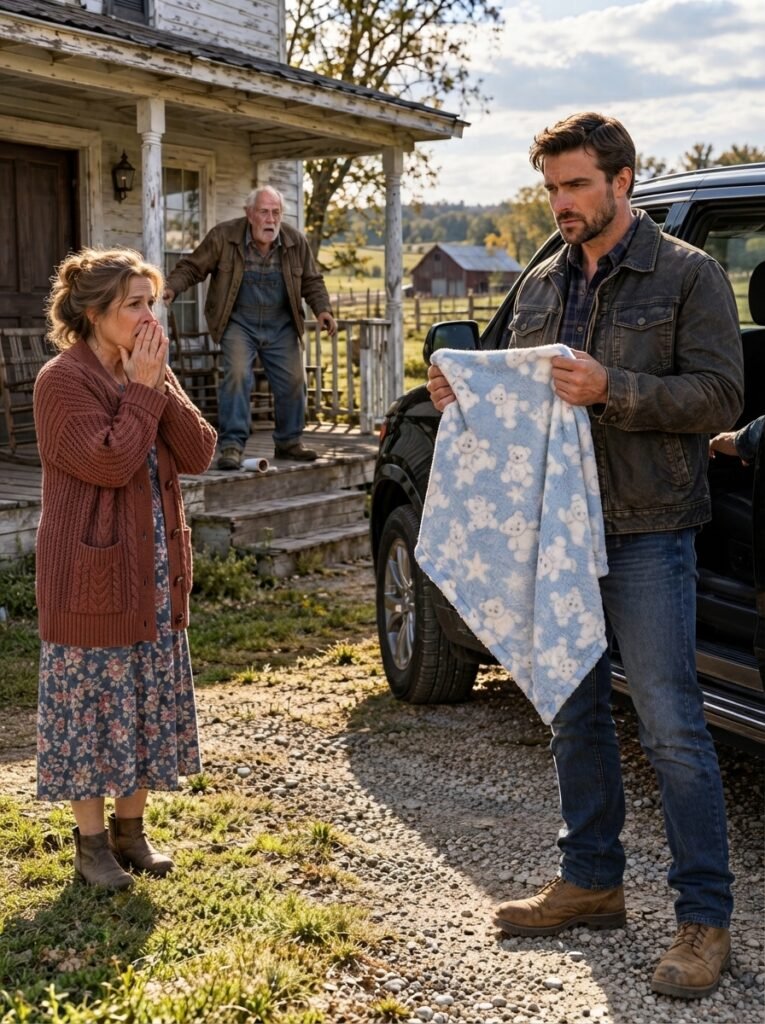
A faded blue baby blanket.
The fabric was worn thin in places, and one corner had been repaired with uneven white stitching.
Brenda saw it.
Every trace of color disappeared from her face.
“Where did you get that?” she whispered.
Sam looked at her.
“You recognize it?”
Brenda gripped the porch railing.
“That’s impossible.”
Sam slowly unfolded the blanket.
From a carefully opened seam, he removed a yellowed envelope wrapped in protective plastic.
“Twenty-five years ago,” he said, “somebody left me in a ditch beside Dad’s cornfield.”
George stared at the envelope.
“Son, what’s going on?”
Sam swallowed.
“Dad, you spent my entire childhood telling me that finding me was the luckiest accident of your life.”
He looked toward Brenda.
“But it wasn’t an accident.”
Brenda began shaking her head.
“No.
No, you don’t understand.”
Sam pulled a folded document from the envelope.
It was an original birth certificate.
The mother’s name was Evelyn Price.
And beneath the word Father, someone had written:
George Thomas Mercer.
George stopped breathing.
His fingers tightened around the porch railing.
“Evelyn?” he whispered.
Sam nodded slowly.
“Dad, I think you need to sit down.”
But George remained standing.
Because twenty-five years earlier, Evelyn Price had been the woman he loved.
And according to Brenda, she had abandoned him without a word.
Twenty-five years earlier, George Mercer was forty-eight years old and already tired in ways sleep couldn’t fix.
He rented forty acres from Price Agricultural Holdings and worked another sixty for neighboring farmers whenever someone needed an extra pair of hands.
His truck had 287,000 miles on it.
The farmhouse roof leaked in three places.
His bank account rarely held more than a few hundred dollars.
He had no wife, no children, and very little reason to believe his circumstances would ever improve.
But George had one thing that poverty had never managed to take from him.
He was a decent man.
He returned money when store clerks accidentally gave him too much change.
He stopped to help strangers with flat tires.
He delivered vegetables to elderly neighbors who could no longer tend their gardens.
And when somebody asked why he bothered helping people when he barely had enough for himself, George always answered the same way.
“Being poor doesn’t mean you have to be selfish.”
Most people in Pine Ridge respected him.
They just didn’t want his life.
That autumn evening, George was repairing a broken fence beside a rented cornfield when he heard something strange.
A faint cry.
He stopped hammering.
The wind moved through the corn stalks.
For a moment, he heard nothing.
Then the cry came again.
High-pitched.
Desperate.
Human.
George followed the sound toward a muddy drainage ditch.
And there, beneath a patch of bent grass, he found a newborn baby.
The child was wrapped in a faded blue blanket soaked with rainwater.
His face was bright red.
His tiny fingers were curled against his chest.
Mud stained the blanket and one of his cheeks.
George stood frozen.
He looked toward the road.
No car.
No footprints he could clearly distinguish from the tractor tracks.
No adult calling for a missing child.
“Lord have mercy,” he whispered.
The baby cried again.
George dropped his tools.
He scrambled into the ditch, scooped the infant into his arms, and tucked the trembling little body inside his jacket.
“Hey, hey.
Easy now.”
The child continued crying.
George held him closer.
“I’m here.”
He had never held a newborn before.
He was terrified of hurting him.
But the moment the baby felt George’s warmth, his crying softened.
One tiny hand reached from the blanket and closed around George’s finger.
George stared at it.
Something inside him shifted.
He would later struggle to explain that moment.
There had been no heavenly voice.
No sudden burst of light.
No miraculous sign.
Just a cold, exhausted farmer holding a frightened child beside a muddy cornfield.
But somehow, George knew.
He was not leaving that baby behind.
At 7:18 p.m., he rushed through the emergency entrance of Valley View Community Hospital.
A nurse named Patricia Dawson hurried toward him.
“Sir, what happened?”
“I found him,” George gasped.
“Out by the cornfield.
He’s cold.
Please help him.”
The nurse immediately took the infant.
George watched helplessly as medical staff carried him through a pair of swinging doors.
He remained in the hallway for nearly forty minutes.
His muddy boots left dark marks on the polished floor.
A deputy arrived.
Then a social worker.
Then another nurse.
They asked questions George couldn’t answer.
Where were the child’s parents?
How long had the infant been outside?
Had he seen anyone near the field?
Was there a note?
George shook his head again and again.
“I don’t know.
I just heard him crying.”
Eventually, Patricia returned.
“The baby’s going to be all right.”
George covered his face.
For the first time that evening, he allowed himself to cry.
The nurse studied him.
“Are you related to the child?”
George lowered his hands.
“No, ma’am.”
“Then why are you crying?”
He looked through the window toward the room where the baby slept.
“Because he’s all alone.”
Patricia said nothing.
But she never forgot his answer.
The police recorded the infant as an unidentified male.
County child services opened an investigation.
The blue blanket was photographed and examined.
Finding no obvious identifying marks, the authorities eventually returned it with the baby’s belongings.
And George went home to a farmhouse that had never felt emptier.
He lasted exactly one night.
The next morning, he appeared at the child services office before it opened.
A woman named Margaret Collins found him sitting outside, holding a paper bag containing two clean baby outfits.
“Mr.
Mercer?”
“Yes, ma’am.”
“Can I help you?”
George stood.
“I came about the little boy.”
Margaret recognized him immediately.
“I’m afraid we still haven’t located his family.”
George nodded.
He looked down at the bag.
Then he said something that changed his life.
“What would I have to do to become his family?”
Margaret stared at him.
“Mr.
Mercer, are you asking about fostering?”
“If that’s what it’s called.”
“Raising a newborn is expensive.”
“I know.”
“You’d need inspections, references, training, and a home study.”
George nodded again.
“I can do those things.”
Margaret hesitated.
“Do you understand that this child could have medical needs?
That someone might come forward claiming him?
That you may be caring for him temporarily?”
George took a slow breath.
“I understand.”
“Why would you take on that responsibility?”
He looked toward the window.
Outside, families were arriving with children in car seats.
“Because somebody should.”
The following months nearly broke him.
George attended every required appointment.
He repaired the broken stair railing.
He installed smoke detectors.
He cleaned and painted the room that had once belonged to his father.
He sold an old hunting rifle to buy a crib.
And when child services told him he needed a reliable emergency contact, he approached his sister.
Brenda was four years younger than George.
She lived across town with her husband, Ray, and their ten-year-old son, Mason.
Unlike George, Brenda had always believed survival required looking after yourself first.
When he explained what he wanted, she stared at him as if he’d announced he intended to fly to the moon.
“You’re almost fifty.”
“Forty-eight.”
“Same difference.”
George waited.
“You don’t have money.
You don’t have a wife.
You don’t even own the land you work.”
“I own my house.”
“Barely.”
“Brenda.”
She folded her arms.
“Why would you do this?”
George looked exhausted.
“Because when I held that child, I couldn’t imagine giving him back to the world that left him out there.”
Brenda’s expression changed.
Only for a second.
Something frightened moved behind her eyes.
Then she shook her head.
“You’re making a terrible mistake.”
George asked anyway.
“Will you be my emergency contact?”
“No.”
He nodded.
“All right.”
He turned toward the door.
Behind him, Brenda said quietly, “He isn’t yours, George.”
George stopped.
He looked back.
“Maybe not.”
Then he added:
“But he will never have to wonder whether somebody wanted him.”
Three months later, George became the baby’s approved foster parent.
By the time the adoption proceedings were completed, the child had learned to laugh when George made ridiculous faces.
George named him Samuel.
Sam for short.
He never knew why the name came to him so naturally.
It simply felt right.
Strong.
Dependable.
A name that belonged to someone who would survive.
On the afternoon the adoption became final, George carried Sam outside the courthouse.
Margaret Collins watched as the farmer adjusted the baby’s little knitted hat.
“Congratulations, Mr.
Mercer.”
George looked at the infant.
“Thank you.”
“It’s quite a responsibility.”
He smiled.
“Most good things are.”
That evening, he returned to the farmhouse with his son.
There were no balloons.
No celebration dinner.
No expensive gifts.
Just a secondhand rocking chair, a warm bottle, and a tired man who sat beside the window until midnight watching a baby sleep.
Before turning off the lamp, George whispered:
“Welcome home, Samuel Mercer.”
And for the first time in his life, the little farmhouse felt complete.
Raising Sam required sacrifices George hadn’t imagined.
When Sam was two, a winter storm damaged the barn roof.
George spent three freezing nights repairing it because he couldn’t afford to hire anyone.
When Sam was four, he developed pneumonia.
George drove him to the hospital in the middle of the night, praying every time the boy coughed.
When Sam was six, he broke his arm falling from a tree.
George spent the entire afternoon sitting beside him in the emergency room, holding his uninjured hand.
And when Sam was eight, he asked the question George had dreaded for years.
“Dad, where’s my mom?”
They were sitting at the kitchen table.
Rain tapped against the windows.
George slowly set down his fork.
“What made you ask?”
“Mrs.
Henderson told us to make Mother’s Day cards.”
George swallowed.
“Oh.”
“I told her I didn’t have one.”
He waited.
“She said everybody has a mother.”
George looked at his son’s face.
The boy wasn’t angry.
He was confused.
George pulled his chair closer.
“Sam, everybody comes into this world because of a mother and a father.”
“Then where are mine?”
George placed a hand over the boy’s small fingers.
“I don’t know, son.”
Sam looked down.
“Did they not want me?”
George felt those words like a knife.
He wanted to say something simple.
Something comforting.
Something that would make everything better.
But he had promised himself he would never lie to Sam about the circumstances of his birth.
“I don’t know why you were left there,” he said.
“Maybe somebody was frightened.
Maybe something terrible happened.
I wish I knew.”
Sam’s lip trembled.
“Was I bad?”
George pulled him into his arms so quickly the chair scraped across the floor.
“No.”
He held the boy tightly.
“Listen to me.
You were a baby.
You hadn’t done anything wrong.”
“Then why did they leave?”
George closed his eyes.
“I don’t know.”
For a long moment, they sat in silence.
Then George whispered:
“But I know why I stayed.”
Sam looked up.
“Why?”
“Because you’re my son.”
The boy wrapped both arms around his father’s neck.
“Forever?”
George kissed the top of his head.
“Forever.”
Sam cried against his shoulder.
George cried too.
And when they finally separated, Sam picked up a crayon.
Instead of making a Mother’s Day card, he drew a picture of a little farmhouse with two stick figures standing outside.
One was tall.
One was small.
Across the top, he wrote:
MY DAD IS MY WHOLE FAMILY.
George kept that drawing in his dresser for the rest of his life.
As the years passed, Sam became painfully aware of how little they had.
His classmates wore new sneakers.
Sam wore shoes repaired with glue.
Other children brought packed lunches full of snacks.
Sam often carried peanut butter sandwiches and apples from the tree behind the farmhouse.
When the school organized an expensive field trip, George worked three Saturdays repairing fences so his son could go.
Sam discovered this by accident.
One evening, he came downstairs for water and found George sitting at the kitchen table, counting money.
There were three small piles.
One for electricity.
One for groceries.
One for Sam’s school trip.
George counted the bills twice.
Then he moved ten dollars from the grocery pile into the school pile.
Sam stood silently in the doorway.
The next morning, he told his father he didn’t want to go.
George looked surprised.
“Why not?”
“It’s boring.”
“You were excited last week.”
“I changed my mind.”
George studied him for a moment.
Then he crouched down.
“Sam, look at me.”
The boy reluctantly raised his eyes.
“Did you hear me counting money last night?”
Sam nodded.
George sighed.
He sat beside him.
“Son, there’s something you need to understand.”
Sam waited.
“We may not have as much money as other families.”
“I know.”
“But that doesn’t mean you have to stop wanting things.”
Sam’s eyes filled.
“I don’t want you to be hungry.”
George looked away.
He had thought he’d hidden it better.
Finally, he placed an arm around his son.
“I’m going to tell you something my father told me.”
“What?”
“A hard life isn’t the same as a bad life.”
Sam leaned against him.
George continued.
“I’m tired sometimes.
I worry about money.
My knees hurt.
And there are days when I wish I could give you more.”
He smiled sadly.
“But you know what I have that I never had before?”
Sam shook his head.
“A reason to come home.”
That weekend, Sam went on the field trip.
George ate canned beans for three days.
And neither of them ever spoke about it again.
Brenda never changed.
At family dinners, she referred to Sam as “George’s project.”
When Sam was twelve, she asked him whether he ever wondered about his “real family.”
Sam looked up from his plate.
“My real family is sitting right here.”
Brenda laughed.
“You know what I mean.”
George put down his fork.
“That’s enough, Brenda.”
She rolled her eyes.
“I’m only asking a question.”
But Sam had already learned something important.
His aunt’s cruelty hurt his father more than it hurt him.
So he stopped responding.
He worked harder at school instead.
He read books borrowed from the public library.
He joined the mathematics club.
He learned how to fix engines beside George.
By sixteen, he could calculate the cost of planting a field, repair a tractor, and prepare a simple family budget.
His teachers noticed.
One afternoon, Mrs.
Henderson—the same teacher who had once helped him make his Mother’s Day drawing—asked him to stay after class.
“Sam, have you thought seriously about college?”
He shrugged.
“Dad can’t afford it.”
“That’s not what I asked.”
Sam looked uncomfortable.
She placed several application forms on her desk.
“There are scholarships.
Grants.
Programs for students with your grades.”
He stared at them.
“I don’t want Dad to be alone.”
Mrs.
Henderson smiled gently.
“Then give him something wonderful to come home to.”
Sam took the forms.
That night, he found George repairing an old lawn mower in the shed.
“Dad?”
“Yeah?”
“Can I ask you something?”
“Sure.”
“What would you say if I wanted to go to college?”
George stopped working.
He set down his wrench.
For a long moment, he simply stared at Sam.
Then his face broke into the widest smile the boy had ever seen.
“I’d say you’d better start filling out applications.”
Sam hesitated.
“But the money—”
“We’ll figure that out.”
“You always say that.”
“And somehow we always do.”
Sam looked at his father.
He saw the gray beginning to spread through George’s hair.
The deep lines around his eyes.
The hands that had worked every day of his life.
“I don’t want to leave you behind.”
George walked over and rested both hands on his son’s shoulders.
“Sam, I didn’t raise you to stay small enough to fit inside my world.”
The boy swallowed.
“I raised you so you could build your own.”
Six months later, Sam received a scholarship to study accounting and financial investigation at a university in St.
Louis.
George was so excited he drove to the corner store and bought a cake.
It was the first store-bought birthday cake they had purchased in years.
He made Sam pose beside it while he took photographs with an old digital camera.
Brenda arrived halfway through the celebration.
When she heard the news, she smiled thinly.
“St.
Louis, huh?”
Sam nodded.
“That’s right.”
“Big city.
Lots of opportunities.”
George beamed.
“Isn’t it wonderful?”
Brenda looked directly at Sam.
“Well, just remember where you came from.”
Sam met her eyes.
“I always will.”
Her smile disappeared.
On the morning he left, George drove him to the bus station.
Sam had one duffel bag, a folder of school records, and a lunch George had packed.
Inside the lunch bag were two sandwiches, an apple, and a handwritten note.
Sam discovered the note later.
It read:
Don’t forget to eat.
Don’t forget to sleep.
And don’t forget that somebody back home thinks you’re the finest young man in Missouri.
Love, Dad.
Before boarding the bus, Sam hugged George.
“I’m going to make you proud.”
George held him tightly.
“You already have.”
Then he pressed forty dollars into Sam’s hand.
“Take it.”
“Dad, that’s too much.”
“It’s all right.”
Sam recognized the money.
It was what remained after George had paid the electric bill.
He tried to hand it back.
George closed his fingers around it.
“Buy yourself something good.”
The bus driver called for boarding.
Sam stepped away.
He looked at the little man in worn boots standing beneath the station clock.
“I love you, Dad.”
George’s voice cracked.
“I love you too, son.”
When the bus disappeared around the corner, George remained on the sidewalk until there was nothing left to see.
Brenda, who had driven separately, approached him.
“He’ll forget you by Christmas.”
George wiped his eyes.
“No, he won’t.”
“Kids grow up.
They find better things.”
George turned toward her.
For once, his voice carried an edge of anger.
“My son isn’t a thing I bought so he’d owe me something.”
Then he walked to his truck and drove home.
That night, for the first time in eighteen years, the farmhouse was silent.
George warmed a can of soup.
He set one bowl on the table.
Then, without thinking, he reached for a second.
When he realized what he was doing, he slowly put it away.
He ate alone.
But before going to bed, he checked his phone.
There was a message from Sam.
Made it safely.
Dorm is small but nice.
Love you, Dad.
George read it three times.
Then he smiled.
And slept peacefully.
Sam worked hard at college.
He earned excellent grades.
He took internships.
He worked part-time jobs in the evenings and sent George money whenever he could.
George usually returned it.
Buy yourself groceries, he would write.
They spoke every Sunday.
Sometimes their conversations lasted only ten minutes.
Other times they talked for hours.
George told Sam about the crops, the weather, and the old tractor that refused to start.
Sam told George about examinations, professors, and the unfamiliar excitement of city life.
They never ran out of things to say.
But there was one subject Sam rarely mentioned.
The blue blanket.
George had given it to him when he left home.
He had found it in an old wooden chest, carefully folded beneath Sam’s childhood drawings.
“Thought you might want this someday,” George said.
Sam recognized it immediately.
It was the blanket from the photographs taken shortly after he was found.
The same blanket that had wrapped around him in the ditch.
Sam ran his fingers over the worn fabric.
“Why did you keep it?”
George shrugged.
“Seemed important.”
Sam smiled.
“Thanks, Dad.”
He packed it at the bottom of his duffel bag.
For four years, it remained there.
Then, one stormy evening during Sam’s final year at college, everything changed.
A pipe burst in the apartment he shared with two classmates.
Water soaked the floor.
Books floated in the hallway.
Sam rushed to save his belongings.
As he pulled his duffel bag from beneath the bed, the old blanket caught on a broken zipper.
A seam tore open.
Something stiff slid from inside the lining.
Sam stopped.
He picked it up.
It was a small packet wrapped in yellowed plastic.
The plastic had been carefully folded and sealed with old tape.
Inside were three things.
A letter.
A birth certificate.
And a photograph.
At first, Sam assumed they were documents George had hidden for him.
But when he unfolded the letter, his hands began shaking.
The handwriting was delicate.
The ink had faded.
At the top, someone had written:
For George Mercer, if my son survives.
Sam read the first line.
George, if you’re reading this, it means somebody loved our baby enough to bring him home.
He stopped breathing.
Then he read the next line.
Please forgive me for what happened.
I never stopped loving you.
Sam sat down on the wet floor.
He read the letter again.
And again.
His entire life had been built around one story.
He had been abandoned by unknown parents.
George had found him by accident.
Nobody knew where he came from.
But the letter suggested something completely different.
It suggested George knew his mother.
It suggested George was his biological father.
And it suggested someone had deliberately prevented them from finding each other.
Sam turned to the birth certificate.
Under Mother was the name Evelyn Marie Price.
Under Father was George Thomas Mercer.
The document had been issued by a private maternity clinic that had closed nearly twenty years earlier.
Attached to it was a handwritten note from a midwife named Grace Kessler.
Live male infant.
Healthy.
Born at 3:42 a.m.
Sam stared at the date.
It matched his birthday.
Then he looked at the photograph.
It showed a young woman standing beside a red barn.
She had long dark hair, thoughtful eyes, and a beautiful, slightly nervous smile.
Beside her stood George.
Twenty-five years younger.
His hair was darker.
His shoulders were straighter.
And he was looking at the woman as though she were the only person in the world.
Sam turned the photograph over.
There were four words written on the back.
George and Evelyn.
Forever.
For several minutes, Sam couldn’t move.
Then he reached for his phone.
His thumb hovered above his father’s number.
He wanted to call immediately.
He wanted to demand answers.
He wanted to ask why George had never told him.
But a terrible possibility stopped him.
What if George didn’t know?
What if someone had lied to him?
Sam looked again at the letter.
If my son survives.
Those words frightened him more than anything else.
Why would a mother write that?
And why had the letter been hidden inside a baby’s blanket?
He placed the documents back inside the packet.
Then he made a decision.
He would find the truth before he broke his father’s heart.
Over the next three years, Sam followed a trail of records that seemed designed to disappear.
His accounting degree opened doors.
He found work with a financial investigations firm that specialized in recovering assets concealed through fraudulent transactions.
He learned to read contracts the way mechanics read engines.
He understood what people could hide inside ordinary numbers.
And he soon discovered that money often told stories people were desperate to keep secret.
His first stop was the county records office in Pine Ridge.
The clerk found no modern record of Evelyn Price living in town.
But an old property tax file led Sam to Price Agricultural Holdings.
The company had once been controlled by Warren Price, one of the wealthiest landowners in the region.
Warren had died several years earlier.
Sam searched archived newspapers.
There were photographs of Warren attending charity galas, donating equipment to schools, and shaking hands with politicians.
He was frequently described as a generous community leader.
Then Sam found an article from twenty-six years earlier.
The headline announced that Warren’s daughter, Evelyn, had returned to Pine Ridge after working as a nurse in Kansas City.
A small photograph accompanied the article.
It was the woman from the picture hidden in the blanket.
Sam stared at the screen.
He had found her.
Or at least, he had found proof that she existed.
He searched further.
Six months after the article, Evelyn disappeared from local news.
There was no wedding announcement.
No obituary.
No public explanation.
Sam contacted the private maternity clinic.
It had closed.
He contacted former employees.
Most had moved away.
Several had died.
Finally, he located a retired nurse living in Arizona.
Her name was Grace Kessler.
She was eighty-six years old.
When Sam introduced himself over the phone, she sounded pleasantly confused.
“Samuel Mercer?”
“Yes, ma’am.”
“I’m sorry.
Do I know you?”
“I believe you helped deliver me twenty-five years ago.”
There was silence.
Then Grace asked:
“Who was your mother?”
Sam looked at the birth certificate.
“Evelyn Price.”
The silence became much longer.
When Grace finally spoke, her voice was trembling.
“Oh, dear God.
They told me that baby had died.”
Sam felt the room tilt.
“What?”
Grace began crying.
“I knew it.
I knew something wasn’t right.”
He gripped the phone.
“Mrs.
Kessler, please.
What happened?”
She took several breaths before answering.
“Your mother gave birth at a private clinic outside Pine Ridge.
She was frightened, but she was healthy.
And when you were born, she held you and cried because you looked so much like your father.”
Sam couldn’t speak.
Grace continued.
“She asked me to make certain George Mercer knew about you.”
“Did you?”
“I tried.”
“What happened?”
“Warren Price arrived before sunrise.
He brought a doctor and two men.
He told everyone Evelyn had suffered a psychiatric crisis and needed to be transferred to a private facility.”
Sam’s stomach tightened.
“And me?”
Grace’s voice broke.
“They took you.”
He closed his eyes.
“What do you mean, took me?”
“Your mother was sedated.
Warren said arrangements had been made.
He told me you were going to a family in another state.”
Sam whispered, “But I was found in a ditch.”
Grace gasped.
“No.”
“Yes.”
“My God.”
Sam heard her sobbing.
Then she said something that changed the direction of his investigation.
“Son, you need to understand something about Warren Price.”
“What?”
“He was terrified of your existence.”
“Why?”
Grace hesitated.
“Because of your grandmother’s will.”
Evelyn Price’s mother, Nora, had been a formidable woman.
She inherited farmland from her parents and spent decades expanding it into one of the county’s most valuable agricultural properties.
Her husband, Warren, managed the business.
But Nora owned the land.
And she never entirely trusted him.
Shortly before her death, Nora created a family trust.
Under its terms, more than three hundred acres of farmland, along with substantial investments, would eventually pass to any living child born to her daughter Evelyn.
If Evelyn had no surviving children by a specified date, the remaining property would transfer into a different branch of the family arrangement administered by Warren.
Sam read the documents three times.
Then he called a lawyer.
Her name was Rachel Hart.
She specialized in estate fraud and disputed inheritances.
When Sam showed her the trust, she leaned back in her chair.
“Do you know what this means?”
Sam nodded slowly.
“I think so.”
Rachel tapped the document.
“If your mother had a living child, Warren’s claim to that land was invalid.”
“And if everyone believed the baby died?”
“Then Warren could exploit that belief to take control.”
Sam stared at the papers.
He thought about the farmhouse.
The rented cornfield.
The endless bills.
The winters George had spent wearing boots with holes in them.
Then he asked a question that made Rachel stop smiling.
“What land did the trust own?”
She opened the property schedule.
She read the first parcel description.
Then the second.
Sam recognized the county road.
The creek.
The southern boundary.
He leaned forward.
“Read that again.”
Rachel repeated the description.
Sam slowly sat back.
He knew that land.
He knew every fence post, every drainage ditch, and every uneven patch of ground.
It was the same cornfield where George had found him.
The land George had spent decades renting belonged to the trust created for Evelyn’s child.
A child Warren had claimed was dead.
Sam stared at the page.
His father had spent twenty-five years paying rent to a company that should never have controlled that property.
And the rightful beneficiary had been sleeping under George’s roof all along.
The discovery left Sam physically sick.
He walked outside Rachel’s office and stood beneath a streetlight.
Cars moved past him.
People laughed.
A bus stopped across the road.
Life continued as though nothing extraordinary had happened.
But Sam couldn’t stop thinking about George.
The man who had gone hungry.
The man who had sold his possessions.
The man who had apologized for not being able to give his son more.
His father had been robbed twice.
First of the truth.
Then of the means to give his child a better life.
Sam returned to Rachel’s office.
“I want everything.”
Rachel looked up.
“Everything?”
“The records.
The financial transfers.
The trust accounts.
Every dollar that company collected.”
“Sam, this could take years.”
He looked at the photograph of George and Evelyn.
“I’ve already waited twenty-five.”
The investigation uncovered a trail of fraud.
Warren Price had used false medical statements and a fabricated report of an infant death to persuade the trustees that Evelyn’s child had not survived.
Land was transferred.
Income was redirected.
A management company collected rents from farmers who had no idea the property was connected to a disputed family trust.
Some money went into agricultural equipment.
Some funded property acquisitions.
And some disappeared into accounts controlled by Warren’s longtime associate, Harold Pike.
Pike had been the town’s most respected banker.
He had attended church with George.
He had approved and rejected George’s loan applications.
He had shaken his hand at the grocery store.
He had even donated twenty dollars to Sam’s high school graduation fundraiser.
Sam remembered him smiling and saying:
“Your father’s raised a fine young man.”
Now Sam stared at financial statements showing how much money Pike had helped move.
He felt something colder than anger.
He felt clarity.
Warren had taken his child away.
Pike had helped conceal the financial consequences.
And someone else had physically delivered the baby to the field.
That final person remained unidentified.
Until Sam discovered a payment.
A transfer made twenty-five years earlier.
Eighteen thousand dollars.
Recipient:
Brenda Mercer.
Sam sat completely still.
He checked the date.
It was two days after his birth.
He checked the account.
It originated from a private fund controlled by Warren Price.
He checked the description.
Family relocation assistance.
Sam knew his aunt had never relocated.
He printed the record.
Then he found another payment.
Two thousand dollars.
Three months later.
Then another.
The payments continued for nearly a year.
Sam stared at Brenda’s name.
For the first time, he understood why she had spent his entire life looking at him with an expression that seemed to contain both hatred and fear.
She knew.
She had always known.
He picked up his phone.
Then put it down.
He would not confront Brenda without knowing the whole story.
Because he had learned something during his years investigating fraud.
People lied most effectively when they believed their lies were the only things keeping them alive.
And Brenda had been lying for twenty-five years.
Finding Evelyn took another eight months.
Grace remembered that Warren had transferred her to a private medical facility under a different surname.
Old records revealed that Evelyn had eventually been discharged.
For a while, she lived in Colorado.
Later, she moved to New Mexico.
Sam traced employment records and public directories until he found a woman named Evelyn Shaw working at a rehabilitation clinic outside Santa Fe.
He stared at her photograph on the clinic’s website.
Her dark hair had turned silver.
There were gentle lines around her eyes.
But the resemblance was unmistakable.
He called the clinic.
A receptionist answered.
“Good afternoon, Desert Springs Rehabilitation.”
Sam struggled to speak.
“Could I leave a message for Evelyn Shaw?”
“Certainly.”
He swallowed.
“Tell her Samuel Mercer called.”
The receptionist paused.
“Does she know you?”
Sam looked at the old photograph beside his computer.
“I think she might.”
Evelyn returned his call that evening.
Her voice was soft.
“Hello?”
Sam gripped the phone.
“Is this Evelyn?”
“Yes.”
“My name is Samuel Mercer.”
There was a brief silence.
“How can I help you?”
He closed his eyes.
“I think you knew my father.”
“Who’s your father?”
“George Mercer.”
The line went completely silent.
Sam heard a small sound.
Something falling.
Then Evelyn whispered:
“George?”
“Yes.”
For several seconds, she seemed unable to breathe.
Finally, she asked:
“How old are you?”
“Twenty-five.”
Sam heard her begin crying.
“What’s your birthday?”
He told her.
A sound escaped her throat.
It was not quite a sob.
Not quite a scream.
It was the sound of a person hearing a door open in a room she had believed sealed forever.
“Are you my baby?” she whispered.
Sam’s own eyes filled.
“I think I am.”
Evelyn broke down.
For twenty-five years, she had believed her son died shortly after birth.
Warren had told her the baby suffered complications.
He claimed the child had been cremated before she recovered from the medication.
When she demanded records, he told her she was unstable.
When she tried to contact George, her letters came back unopened.
Warren insisted George had left Pine Ridge and wanted nothing more to do with her.
Eventually, Evelyn fled her father’s control.
She changed her surname.
She rebuilt her life.
But she never married.
She never had another child.
And every year, on the birthday of the son she believed she had lost, she bought a small blue candle and let it burn beside a photograph of a newborn’s empty cradle.
“I named you Samuel,” she cried.
Sam froze.
“What?”
“Samuel.
After my grandfather.”
He sat down heavily.
George had chosen the same name.
Without knowing.
Evelyn sobbed.
“I held you for less than an hour.
They took you away while I was asleep.”
Sam pressed a hand over his mouth.
“Mom…”
The word escaped before he could stop it.
Evelyn began crying harder.
No one had called her that in twenty-five years.
Their first meeting took place in a small café in Santa Fe.
Sam arrived thirty minutes early.
He ordered coffee he couldn’t drink.
Every time the door opened, he looked up.
Then a silver-haired woman entered carrying a worn leather purse.
She stopped when she saw him.
Her eyes widened.
She placed one hand over her heart.
“Samuel?”
He stood.
For a moment, neither moved.
Then Evelyn crossed the room.
She threw her arms around him.
And Sam held her as she cried against his chest.
He had spent his childhood wondering whether his mother had wanted him.
Now she was holding him so tightly he could barely breathe.
“I looked for you,” she whispered.
“I swear I would have come if I’d known.”
Sam closed his eyes.
“I believe you.”
They sat together for hours.
Evelyn told him about George.
How she had met him at a county fair.
How he had quietly repaired her broken car without accepting payment.
How she had fallen in love with his kindness.
“He was so different from the men my father approved of,” she said.
Sam smiled faintly.
“He still is.”
Evelyn laughed through her tears.
She told Sam how George used to bring her wildflowers.
How they sat on the tailgate of his truck watching the stars.
How he once said he couldn’t offer her much.
And how she’d answered:
“I don’t need much.
I just need you.”
When she became pregnant, she had been frightened but happy.
George didn’t know yet.
She planned to tell him after her next appointment.
But Warren discovered the pregnancy first.
He was furious.
“A farmhand?” he shouted.
Evelyn refused to end the relationship.
Warren threatened to disinherit her.
She said she didn’t care.
Then he began controlling her movements.
He took her car keys.
He dismissed employees who helped her contact George.
He intercepted her letters.
Evelyn eventually escaped to a friend’s house.
But complications during her pregnancy forced her to seek medical care.
Warren promised to help.
She believed him.
That was the mistake that cost her twenty-five years.
Sam listened without interrupting.
When Evelyn finished, he asked:
“Did you ever tell Aunt Brenda?”
Evelyn’s face changed.
“Brenda?”
“She received money from your father.”
Evelyn stared at him.
“No.”
Sam showed her the records.
She read them.
Her hands began trembling.
Then she whispered:
“I trusted her.”
Sam leaned forward.
“What do you mean?”
Evelyn began crying again.
“Brenda was the only person in George’s family who knew I was pregnant.”
Sam felt the room grow cold.
“She promised she’d help me tell him.”
Evelyn covered her mouth.
“Oh, Samuel.”
Then she said the words that explained everything.
“I gave Brenda that blue blanket.”
Evelyn had sewn the blanket herself.
She made it during the final weeks of her pregnancy.
On the night before the birth, she had hidden a letter and a copy of the birth paperwork inside a small pocket in the lining.
She was frightened Warren might separate her from the baby.
She knew the documents could prove the child’s identity.
So she had carefully stitched the pocket closed.
Then she entrusted the blanket to Brenda.
“If anything happens,” Evelyn told her, “please make sure George gets this.”
Brenda promised.
And Evelyn believed her.
Sam looked at the photograph of the blanket on his phone.
The uneven white stitching suddenly made sense.
His mother had sewn the pocket herself.
Then someone had used the blanket to conceal him.
For twenty-five years, the truth had traveled beside him.
Through childhood illnesses.
Through school.
Through the night he left home.
Through every apartment and every move.
Waiting inside a few inches of faded blue fabric.
Sam stared at Evelyn.
“Why would Brenda do this?”
Evelyn shook her head.
“I don’t know.”
But Sam intended to find out.
He and Rachel continued gathering evidence.
Grace Kessler signed a sworn statement.
Evelyn provided old letters, medical records, and photographs.
A DNA test confirmed that she was Sam’s biological mother.
George, still unaware of the investigation, agreed to a DNA test after Sam explained that he was helping with a confidential family-records project.
Sam hated misleading him.
But he needed certainty before bringing twenty-five years of buried pain to the farmhouse door.
When the results arrived, Sam sat alone in his apartment.
He opened the report.
Then he began crying.
The probability that George Mercer was his biological father exceeded 99.99 percent.
The man who had rescued him.
The man who had raised him.
The man who had sacrificed everything.
He was Sam’s father in every possible meaning of the word.
Sam called Evelyn.
“I got the results.”
She knew before he said anything.
“George?”
“Yes.”
Evelyn cried softly.
“I knew it.”
Sam looked at the photograph of the young couple.
Then he asked:
“Do you still love him?”
Evelyn was quiet for a long moment.
Finally, she whispered:
“I never stopped.”
Rachel filed a legal action seeking to restore the trust assets and recover property transferred through fraudulent concealment.
The evidence was overwhelming.
The original birth record.
The false infant-death report.
The financial transactions.
The hidden payments.
The midwife’s testimony.
The DNA results.
And an old internal memorandum signed by Harold Pike.
The memorandum contained one devastating sentence:
No surviving descendant of Evelyn Price is to be acknowledged for purposes of trust distribution.
Rachel stared at it.
“This wasn’t a misunderstanding.”
Sam nodded.
“It was planned.”
The case moved quickly once the defendants realized the documents had survived.
Pike initially denied everything.
Then his attorneys learned that investigators had recovered bank records from accounts he believed had been destroyed.
A settlement conference was scheduled.
Several properties were placed under court supervision.
Assets were frozen.
Negotiations began over restoring the trust and compensating the rightful beneficiary.
During the proceedings, Sam learned another terrible detail.
George’s rent had been increased repeatedly during the years when Sam was growing up.
Each increase had been approved by Harold Pike.
The same man who knew the land had been wrongly diverted from Sam’s inheritance.
Sam reviewed the records.
One increase occurred the year he started elementary school.
Another came when George bought him his first bicycle.
A third arrived shortly before Sam entered high school.
Every time George struggled to pay, Pike had offered him a small extension with a sympathetic smile.
Sam stared at those documents until his vision blurred.
He remembered his father sitting beneath the kitchen light, counting bills.
He remembered the empty plates.
The patched boots.
The old truck that George could never afford to replace.
And he finally understood something that made him angrier than he’d ever been.
George hadn’t failed to provide for his son.
He had been systematically deprived of the resources that should have belonged to that son.
Sam closed the folder.
Then he told Rachel:
“I don’t want a quiet settlement that lets everyone pretend this was a clerical error.”
Rachel watched him carefully.
“What do you want?”
“The truth.”
“And after that?”
Sam thought of George standing in the bus station with forty dollars.
“I want my father to have the life he deserved.”
By the time Sam returned to Pine Ridge, the court had approved a settlement restoring the disputed farmland to a trust benefiting him and requiring substantial financial restitution.
The agreement also preserved evidence for any criminal investigation.
Harold Pike had resigned from the bank.
Several former executives were facing investigations.
Warren Price was long dead.
But one person remained.
Brenda Mercer.
And she still had no idea how much Sam knew.
Sam drove toward Pine Ridge with the blue blanket resting on the passenger seat.
Evelyn sat quietly in the back.
She had insisted on coming.
But she was terrified.
“What if George hates me?” she whispered.
Sam glanced at her through the mirror.
“He won’t.”
“You don’t understand.
He’s spent twenty-five years believing I walked away.”
“Then we’ll tell him the truth.”
Evelyn looked out at the passing cornfields.
“I was supposed to spend my life with him.”
Sam swallowed.
“You still might.”
She smiled sadly.
“People don’t get twenty-five years back, Samuel.”
He was quiet for a moment.
Then he said:
“No.”
He looked toward the road.
“But they can choose what to do with the years they have left.”
Evelyn reached forward and gently squeezed his shoulder.
Neither knew what waited at the farmhouse.
Neither expected Brenda to be standing on the porch.
And neither imagined that the woman who had helped destroy their family was carrying one final secret.
The moment Sam held up the blue blanket, Brenda knew.
The secret was over.
She looked at the envelope.
At the birth certificate.
At George’s stunned face.
Then at the young man she had spent twenty-five years pretending not to love.
“Where did you get that?” she whispered.
Sam stepped closer.
“From the blanket you gave me.”
Brenda shook her head.
“That’s not possible.”
“You knew my mother.”
She began backing away.
“You don’t understand.”
“You knew George was my father.”
Her eyes filled.
“Samuel—”
“And you took money from Warren Price.”
The two neighbors stared.
George looked from Sam to his sister.
“What is he talking about?”
Sam held up the bank records.
“Eighteen thousand dollars.
Two days after I was born.”
Brenda closed her eyes.
George’s voice trembled.
“Brenda?”
She began crying.
George took a step toward her.
“Tell me he has it wrong.”
Brenda covered her mouth.
“George…”
“Tell me!”
The force of his voice startled everyone.
He had never shouted at his sister like that.
Brenda looked at the ground.
Then she whispered:
“I knew Evelyn was pregnant.”
George staggered.
Sam caught his arm.
“Dad, sit down.”
But George pushed gently away.
He stared at Brenda.
“You told me she left town.”
Brenda cried harder.
“You have to understand what was happening.”
“You told me she didn’t want me!”
“I know.”
“You watched me grieve her!”
Brenda began sobbing.
George’s voice broke.
“And then you stood in my house for twenty-five years telling me that boy wasn’t mine?”
Brenda couldn’t answer.
George pressed a hand against his chest.
The pain on his face was almost unbearable.
He turned toward Sam.
“Is it true?”
Sam nodded.
“Dad, I’ve had the DNA tests.”
George’s eyes widened.
Sam stepped closer.
“I’m your son.
Your biological son.”
George stared at him.
His lips trembled.
Then he whispered:
“Oh, Samuel.”
Sam hugged him.
George clung to his son as though someone might still try to take him away.
For a long time, neither spoke.
Finally, George pulled back.
He placed both hands against Sam’s face.
“You were mine?”
Sam smiled through tears.
“Always.”
George shook his head.
“All those years…”
His voice broke again.
“All those years, you were mine.”
Sam held his father’s hands.
“Dad, I would’ve been yours even if the test said otherwise.”
George began crying.
And then, from behind them, Brenda spoke.
“There was a reason.”
Sam turned.
Brenda was gripping the railing so tightly her knuckles had turned white.
“I didn’t do it because I hated you.”
Sam’s expression hardened.
“Then tell us why.”
She swallowed.
“Because Warren Price was going to have you killed.”
The yard went silent.
George stared at her.
“What?”
Brenda lowered her head.
And finally, after twenty-five years, she began telling the truth.
Her son Mason had been ten years old when the trouble started.
He had a serious heart condition.
The doctors recommended surgery.
Insurance covered part of the treatment, but the family faced crushing bills, travel expenses, and debts they couldn’t manage.
Ray had lost his job.
Their savings were gone.
Brenda was desperate.
Then Warren Price contacted her.
He knew about Mason’s illness.
He knew about the unpaid bills.
And he knew Brenda was connected to George.
“He offered me money,” she whispered.
George stared at her.
“What for?”
Brenda wiped her eyes.
“He wanted me to keep you away from Evelyn.”
George closed his eyes.
Brenda continued.
“I thought she was just some rich girl who’d eventually break your heart anyway.”
She looked at her brother.
“I told myself I was protecting you.”
George said nothing.
“Then she told me about the baby.”
Brenda’s voice shook.
“She was so happy, George.
She wanted to tell you herself.”
Sam stood motionless.
Brenda continued.
“Warren found out she’d spoken to me.
He threatened to make certain Mason never received the help he needed.”
George’s face tightened.
“So you took the money.”
Brenda nodded.
“I did.”
The words hung in the air.
“I told myself it was for my son.”
Sam asked quietly:
“What happened when I was born?”
Brenda looked at him.
“Warren called me before sunrise.
He told me Evelyn was sick and that the baby needed to be taken to an adoption agency.”
She began shaking.
“He said everything had been arranged.”
Sam’s stomach twisted.
“Did you believe him?”
“At first.”
Brenda wiped her cheeks.
“I went to the clinic.
A nurse handed you to me, wrapped in the blue blanket.
I knew Evelyn had hidden something in the lining, but I didn’t open it.”
She paused.
“I was supposed to meet a man at an old equipment shed near the county line.”
George stared at her.
Brenda’s voice became barely audible.
“When I arrived, there were two men waiting.”
She looked at Sam.
“One was holding a medical bag.
The other had a shovel.”
Nobody moved.
Brenda began sobbing.
“I heard one of them say there couldn’t be any paperwork.
That Warren wanted the problem gone.”
Sam felt sick.
Brenda looked directly at him.
“I realized they weren’t taking you to a family.”
She covered her mouth.
“They were going to kill you.”
George grabbed the porch railing.
“My God.”
Brenda shook her head.
“I drove away before they saw me.”
Her voice broke.
“I didn’t know where to go.
I couldn’t take you home.
Warren knew my address.
He knew where Mason went to school.”
Sam was breathing heavily.
“So you left me in a ditch?”
Brenda nodded miserably.
“I drove toward George’s field because I knew he always worked there until sunset.”
She looked at her brother.
“I saw his truck.
I knew he was nearby.”
George whispered:
“You could’ve brought the baby to me.”
“I know.”
“Why didn’t you?”
Brenda’s face crumpled.
“Because I was afraid.”
She wiped her nose with a trembling hand.
“I was afraid Warren’s men were following me.
I thought if anyone saw me hand you over, they’d know George was involved.”
She took a breath.
“So I put you near the ditch.
I parked behind the trees.
I watched.”
Sam stared at her.
The rain.
The cold.
The darkness.
The tiny blanket.
All the images he had carried from George’s stories suddenly changed.
Brenda continued.
“You cried.
I almost ran back.”
Her voice became a whisper.
“Then George heard you.”
She looked at her brother.
“I watched him drop his tools.
I watched him pick you up.”
George began trembling.
Brenda closed her eyes.
“And when he held you against his chest, I knew you were safe.”
Sam asked the question that had haunted him.
“Then why did you spend twenty-five years treating me like I didn’t belong?”
Brenda looked at him with unbearable shame.
“Because I was a coward.”
She swallowed.
“Warren kept sending money.
He threatened Mason.
He said if I ever told anyone who you were, he’d make sure the boy disappeared for good.”
Tears rolled down her cheeks.
“After Warren died, I could’ve told you.
I should’ve.”
Sam waited.
“But by then, I’d spent so many years pretending I didn’t care that I didn’t know how to stop.”
She looked at George.
“I was ashamed.
Every time I looked at Sam, I saw what I’d done.”
George stared at his sister.
“You could’ve ended this years ago.”
“I know.”
“You stole twenty-five years from us.”
Brenda began sobbing.
“I know.”
Sam looked toward the cornfield.
He imagined his aunt watching from behind the trees.
He imagined George rushing toward the sound of his cries.
Two frightened adults.
One helpless baby.
One terrible decision.
And a lifetime of consequences.
Finally, Sam spoke.
“Aunt Brenda, you saved me from those men.”
Brenda looked up hopefully.
Then Sam continued.
“But you also helped create the danger I needed saving from.”
Her face collapsed.
He stepped closer.
“I won’t pretend the years of cruelty didn’t happen.
And I won’t pretend that keeping quiet after Warren died was okay.”
Brenda nodded through her tears.
“I understand.”
“But you can tell the truth now.”
She looked at him.
Sam’s voice softened.
“All of it.”
A car door opened behind them.
Everyone turned.
Evelyn stepped out of the SUV.
She stood still for a moment, one hand resting against the door.
Her silver hair moved gently in the wind.
She wore a simple blue sweater.
Her eyes were filled with tears.
George stared.
For a moment, he seemed unable to recognize what he was seeing.
Then his face changed.
“Evelyn?”
She nodded.
“Hello, George.”
He took one uncertain step.
Then another.
“Is it really you?”
Evelyn covered her mouth.
“Yes.”
George began shaking.
“I thought…”
His voice failed.
Evelyn walked toward him.
“I know.”
He looked at her face.
The same eyes.
The same gentle smile.
Twenty-five years older.
But unmistakably hers.
“I thought you didn’t want me,” he whispered.
Evelyn’s face crumpled.
“Oh, George.”
She reached for his hands.
“I wanted you every day.”
He began crying.
“I waited for you.”
“I know.”
“I wrote letters.”
“I never got them.”
He stared at her.
She squeezed his hands.
“I wrote too.”
They stood looking at each other.
Two people separated by cruelty, lies, and time.
Then George pulled her into his arms.
Evelyn held him tightly.
And the two of them wept.
Sam stepped away.
He gave them the moment they had been denied for a quarter of a century.
George pressed his cheek against Evelyn’s hair.
“You’re here.”
She nodded against his chest.
“I’m here.”
He drew back slightly.
His hands trembled as he touched her face.
“I got old.”
Evelyn laughed through her tears.
“So did I.”
He smiled.
“You’re still beautiful.”
She closed her eyes.
“And you’re still George.”
He kissed her forehead.
The wind moved softly through the trees.
For a few precious moments, the years seemed to fall away.
Brenda watched silently.
Then she turned and walked toward the gravel road.
“Brenda,” Sam called.
She stopped.
He approached her.
“You need to speak with Rachel Hart.”
Brenda nodded.
“I will.”
“There may be legal consequences.”
“I know.”
Sam looked at her.
She seemed smaller than he remembered.
“I don’t know if I can forgive you.”
Brenda’s eyes filled.
“I don’t expect you to.”
He took a breath.
“But I don’t want you to spend the rest of your life lying.”
She nodded.
Then, for the first time in twenty-five years, she looked at him without pretending he was a burden.
“You have your father’s eyes,” she whispered.
Sam smiled sadly.
“So I’m told.”
Brenda began crying again.
And Sam let her.
That evening, the three of them sat around George’s kitchen table.
George.
Evelyn.
Sam.
It was a simple table with scratches along the edges.
The same table where George had counted pennies.
The same table where Sam had done homework.
The same table where they had shared meals because there wasn’t enough food for two.
Now Evelyn sat in the chair Sam used as a boy.
George kept looking at her as though afraid she might disappear.
Sam watched them quietly.
Finally, George turned toward him.
“Son, there’s something I don’t understand.”
“What’s that?”
“How did you find all this?”
Sam smiled.
“Accounting.”
George raised an eyebrow.
“Accounting?”
“A lot of people think money disappears when somebody moves it into another account.”
“And?”
Sam leaned forward.
“It doesn’t.
It leaves a trail.”
He explained the investigation.
The trust.
The false death report.
The payments.
The lawsuit.
George listened in stunned silence.
When Sam told him about the farmland, his father frowned.
“Which field?”
“The south property.”
George stared.
“The one by Miller Creek?”
Sam nodded.
“The one where you found me.”
George looked confused.
“That’s Price land.”
“It was.”
“What do you mean, was?”
Sam opened his leather folder.
He removed a certified court document.
Then he placed it on the table.
“Dad, Grandma Nora created a trust for Mom’s children.”
George glanced at Evelyn.
She nodded.
“Sam is the rightful beneficiary.”
Sam slid the document toward him.
“The court approved a settlement restoring the land to that trust.”
George read the first page.
His eyes widened.
He looked at Sam.
Then back at the document.
“Three hundred and twelve acres?”
Sam nodded.
George shook his head.
“Son, there must be some mistake.”
“There isn’t.”
“But that land’s worth…”
“A lot,” Sam said quietly.
George stared at the paper.
Then Sam placed another document on the table.
“This is the financial restitution agreement.”
George looked at the figures.
His mouth opened.
He read them again.
Then he leaned back.
“Good Lord.”
Sam smiled faintly.
“Yeah.”
George stared at him.
“Samuel, this is millions of dollars.”
Sam nodded.
Evelyn watched her son’s face.
He seemed calm.
But she knew how much this moment meant to him.
George shook his head again.
“I don’t understand.”
Sam took his father’s hands.
“Dad, do you remember when I was nine and you couldn’t afford new winter boots?”
George frowned.
“Maybe.”
“Yours had holes in them.
You wrapped plastic grocery bags around your socks so your feet wouldn’t get wet.”
George looked embarrassed.
“Son…”
“You bought me a new coat instead.”
“Every kid needs a coat.”
Sam smiled through tears.
“Do you remember when I wanted to join the baseball team?”
“Sure.”
“You sold your grandfather’s watch to pay for my uniform.”
George looked down.
“It was just a watch.”
“Do you remember when you told me you’d already eaten at work?”
George’s eyes filled.
Sam squeezed his hands.
“Dad, I remember every single time you went without so I wouldn’t have to.”
George shook his head.
“You don’t owe me anything.”
“I know.”
Sam smiled.
“That’s why I want to give you something.”
He placed a final envelope on the table.
George stared at it.
“What is that?”
Sam took a deep breath.
“It’s the deed to this house and the land around it, free of every remaining lien.”
George looked confused.
“I already own the house.”
“You did,” Sam said.
“But the mortgage and repair loans were still hanging over it.”
He opened the envelope.
“I paid them off.
The paperwork is complete.”
George stared at him.
“Samuel…”
“And there’s something else.”
Sam reached into his pocket and pulled out a small brass key.
He placed it beside the deed.
George looked at it.
“What does that open?”
Sam smiled.
“Your new truck.”
George blinked.
“My what?”
“A truck.
Parked behind the barn.”
George stared.
Then he began laughing.
A shaky, disbelieving laugh.
“Son, I don’t need a new truck.”
Sam laughed too.
“Dad, yours has been threatening to die since I was twelve.”
George wiped his eyes.
“That old thing still runs.”
“Barely.”
Evelyn laughed softly.
George looked from the key to his son.
Then his expression changed.
He reached across the table and covered Sam’s hand.
“Listen to me.”
Sam looked up.
“I don’t need any of this.”
Sam swallowed.
“I know.”
George’s voice broke.
“You coming home was enough.”
Sam lowered his head.
For a moment, he was eighteen again, standing at the bus station with forty dollars in his pocket.
Then he whispered:
“I didn’t come home to repay you, Dad.
I came home so you wouldn’t have to keep paying for loving me.”
George began crying.
He stood with difficulty.
Sam rose to meet him.
And they embraced beside the kitchen table.
Evelyn wiped her eyes.
Outside, the last light disappeared behind the cornfields.
For the first time in twenty-five years, George Mercer knew the whole truth about his son.
But Sam had one final surprise.
And it would change Pine Ridge forever.
Three months later, Brenda testified under oath.
Her statement confirmed how Warren Price had separated Evelyn from her newborn and how the child had ended up beside George’s field.
She provided old letters, a photograph of Warren’s associate, and a notebook in which she had recorded the dates of his threats.
Some of the evidence had been hidden in a box beneath her bed for decades.
Investigators reopened the historical case.
Harold Pike faced serious charges connected to the fraudulent financial transactions.
The county newspaper published the story across its front page.
For weeks, Pine Ridge talked about little else.
The man everyone had dismissed as a foolish farmer had unknowingly raised the rightful heir to one of the county’s largest agricultural trusts.
The child people called unwanted had never been unwanted by either parent.
And the wealthy men who had presented themselves as guardians of the community had profited from separating a family.
Brenda’s cooperation mattered.
It did not erase what she had done.
But it helped establish the truth.
She resigned from several community committees and began volunteering at a children’s charity, though she understood that good deeds could never purchase forgiveness.
For a long time, Sam kept his distance.
George struggled even more.
He loved his sister.
But love did not make betrayal painless.
One Sunday afternoon, Brenda appeared at the farmhouse holding a small cardboard box.
George answered the door.
“What is it?”
She looked nervous.
“I found some things.”
He hesitated.
Then stepped aside.
Brenda placed the box on the kitchen table.
Inside were photographs of Sam’s childhood.
His first birthday.
His kindergarten graduation.
A picture of him riding a bicycle without training wheels.
Another showed George sleeping in a chair with a toddler curled against his chest.
George stared at them.
“Where did you get these?”
Brenda swallowed.
“I took them.”
He looked at her.
“Why?”
Her eyes filled.
“Because even when I was pretending he didn’t matter, I couldn’t stop caring.”
George said nothing.
Brenda picked up a photograph.
It showed Sam at twelve, holding a blue ribbon from the county science fair.
“I was proud of him,” she whispered.
Tears rolled down her cheeks.
“I was proud of both of you.
I just hated myself too much to say it.”
George sat down.
For a long time, neither spoke.
Then he asked:
“Why didn’t you tell me after Warren died?”
Brenda looked at her hands.
“Because by then, Mason was gone too.
I’d lost my boy.
And every time I saw you with Sam, I remembered what I’d almost cost you.”
George closed his eyes.
Mason had died several years after his surgery, following complications from his lifelong illness.
Brenda had never recovered.
She had buried her grief beneath anger.
But George knew something she was only beginning to understand.
Pain could explain cruelty.
It could not excuse it.
He looked at his sister.
“I don’t know how to trust you again.”
She nodded.
“I know.”
“But you can stop lying.”
“I have.”
“Then keep doing that.”
Brenda began crying.
George looked at the photographs.
Finally, he said:
“Leave the box.”
She nodded.
Then quietly walked out.
It wasn’t forgiveness.
Not yet.
But it was the first honest conversation they’d had in twenty-five years.
Spring arrived early that year.
The fields turned green.
The creek overflowed after a week of heavy rain.
George began spending more time outside.
His knees still hurt.
His hands still trembled.
But something inside him had changed.
For years, he had moved through life as though expecting another disappointment.
Now he woke every morning with Evelyn beside him.
She had moved into the farmhouse after months of careful conversations and the kind of awkward courtship that made Sam smile.
They began again slowly.
Coffee in the mornings.
Walks beneath the maple trees.
Evenings sitting together on the porch.
Sometimes they talked about the years they’d lost.
Sometimes they said nothing at all.
They discovered that silence could be comfortable when it no longer concealed secrets.
One afternoon, Evelyn found George standing beside the old cornfield.
He was looking toward the ditch.
She approached quietly.
“George?”
He turned.
“Hey.”
She stood beside him.
For a while, they watched the wind move through the grass.
Then George whispered:
“Right there.”
Evelyn followed his gaze.
“Where?”
He pointed toward a patch of ground beside the fence.
“That’s where I found him.”
Evelyn’s eyes filled.
She walked slowly toward the ditch.
George followed.
The ground was dry now.
Wildflowers grew along the bank.
A red-winged blackbird called from a nearby fence post.
Evelyn knelt.
She touched the earth.
“This is where he was?”
George nodded.
She began crying.
He lowered himself carefully beside her.
Evelyn looked at him.
“You saved our son.”
George shook his head.
“He saved me too.”
She took his hand.
“George…”
He looked at her.
“Before Sam, I was just getting through one day at a time.
Work.
Bills.
Sleep.
Do it again.”
His voice softened.
“Then that little boy came along, and suddenly everything mattered.”
Evelyn cried harder.
George looked toward the field.
“I would’ve taken him in even if he wasn’t mine.”
She squeezed his hand.
“I know.”
He smiled sadly.
“That’s what made him mine.”
They remained there until the afternoon sun began to fade.
Then George helped Evelyn stand.
Together, they walked back toward the farmhouse.
Neither noticed Sam watching from the porch.
He was smiling through tears.
A month later, Sam invited the entire town to a gathering on the restored farmland.
He refused to explain why.
Flyers appeared at the grocery store, the library, the school, and the county offices.
The announcement simply read:
Community Celebration — Mercer Farm — Saturday, 11:00 a.m.
People assumed Sam planned to announce a business venture.
Some thought he was selling the property.
Others believed he would reveal plans for luxury homes.
By eleven o’clock, more than two hundred people had gathered beside the field.
There were folding chairs.
A small wooden platform.
Tables filled with homemade food.
Children ran between the trees.
George arrived with Evelyn.
He wore a clean blue shirt Sam had bought him.
His boots were polished.
But he looked deeply uncomfortable.
“Son, what’s all this?”
Sam smiled.
“You’ll see.”
George frowned.
“I don’t like surprises.”
Evelyn laughed.
“That’s not true.”
George looked at her.
“You were a surprise.”
She squeezed his arm.
“And you survived.”
Sam stepped onto the platform.
The crowd quieted.
He looked across the faces.
People who had watched him grow up.
People who had helped.
People who had laughed.
People who had said he would never amount to anything.
Then he looked at his father.
George stood beside Evelyn beneath the maple tree.
His hands were folded in front of him.
His expression was proud and slightly confused.
Sam took a breath.
“Twenty-five years ago, a man working in this field heard a baby crying.”
The crowd grew silent.
“He didn’t have much money.
He didn’t own the land.
He didn’t know where the child came from.”
Sam paused.
“But he picked that baby up anyway.”
George lowered his eyes.
Sam continued.
“When he decided to raise me, people told him he was making a mistake.”
A few faces shifted uncomfortably.
“They said I wasn’t his responsibility.”
Sam looked toward the old farmhouse.
“They said he couldn’t afford me.”
His voice trembled.
“They were right about one thing.”
He paused.
“Dad couldn’t afford everything other kids had.”
George looked down.
“But he gave me something many people spend their whole lives trying to find.”
Sam swallowed.
“He gave me a place where I never had to earn the right to be loved.”
The crowd was silent.
“I grew up watching him work until his hands bled.
I watched him wear out his boots so I could have shoes.
I watched him pretend he wasn’t hungry so I could finish dinner.”
George covered his face.
Sam continued.
“For years, I thought being rich meant having enough money that you never had to worry again.”
He smiled through tears.
“But my father taught me something different.”
He looked directly at George.
“A rich man isn’t someone who has everything.
He’s someone who can give love even when he has almost nothing.”
Applause began.
Then faded as Sam raised his hand.
“Today, I want to announce what we’re doing with this land.”
He gestured toward a large white covering beside the platform.
Two workers pulled it away.
Beneath it stood a beautiful wooden sign.
Carved into the wood were the words:
THE GEORGE MERCER FAMILY CENTER
Below the name was a simple illustration of a blue blanket wrapped around a sleeping baby.
George stared.
Sam turned toward the crowd.
“This property will become a nonprofit center for children and families facing emergencies, abandonment, housing instability, and financial hardship.”
People began whispering.
Sam continued.
“There will be temporary family accommodations, counseling services, educational programs, and support for foster parents.”
He looked at his father.
“We’ll work with licensed agencies and local organizations so families can receive safe, practical help when they need it most.”
George’s hands began shaking.
Sam smiled.
“And we’ve established a fund to help children from struggling families attend college or vocational school.”
He paused.
“Because nobody should have to choose between buying groceries and giving their child a future.”
The crowd erupted in applause.
But Sam wasn’t finished.
“I’ve also created a second fund.”
He looked toward Brenda.
She stood near the back of the gathering.
Her face was pale.
Sam took a breath.
“This fund will provide emergency medical assistance for children whose families are struggling with uncovered treatment expenses.”
Brenda covered her mouth.
Sam continued.
“It will be called the Mason Mercer Children’s Fund.”
Brenda began crying.
She stared at Sam in disbelief.
He met her eyes.
“I can’t change what happened to Mason.”
His voice softened.
“And I can’t change what happened twenty-five years ago.”
He paused.
“But maybe we can make sure another frightened family doesn’t have to choose between doing what’s right and saving someone they love.”
Brenda sank into a chair.
She cried openly.
George looked toward his sister.
Then back at Sam.
His eyes filled.
The applause became thunderous.
And for the first time in his life, Brenda understood that forgiveness wasn’t something she could demand.
It was something she might someday be fortunate enough to receive.
After the ceremony, George approached his son.
He looked at the sign.
Then at the people gathering around the new foundation plans.
“Samuel, you didn’t have to do all this.”
Sam smiled.
“I know.”
“It’s too much.”
“Maybe.”
George shook his head.
“You could’ve kept the money.”
Sam looked across the field.
Children were playing near the fence.
Parents stood together talking.
Evelyn was laughing with Mrs.
Henderson.
Brenda sat beneath a tree, holding a photograph of Mason.
Then Sam turned back to his father.
“Dad, all my life, you taught me that the best thing you can do with what you have is help somebody who needs it.”
George’s eyes filled.
Sam continued.
“You didn’t wait until you were wealthy.”
He smiled.
“You started with me.”
George swallowed.
Sam placed a hand on his shoulder.
“I’m just continuing what you began.”
George pulled him into an embrace.
The crowd applauded again.
But neither man seemed to notice.
For a long moment, they were simply father and son.
The same two people who had once shared canned soup beneath a leaking roof.
Only now, the whole town knew what their love had accomplished.
That evening, George sat alone on the porch.
The celebration had ended.
The tables were cleared.
The last cars had disappeared down the gravel road.
Evelyn was inside making tea.
Sam had gone to help the volunteers collect supplies.
George watched the sun sink behind the cornfields.
Then he heard footsteps.
Brenda approached slowly.
“Mind if I sit?”
George looked at her.
Then nodded.
She lowered herself into the chair beside him.
For a while, neither spoke.
Crickets began singing in the ditch.
The air smelled of damp earth and freshly cut grass.
Finally, Brenda whispered:
“I used to think you ruined your life.”
George looked toward the field.
“I know.”
She swallowed.
“I thought taking that baby would destroy you.”
George remained silent.
Brenda wiped her eyes.
“But you became a better man because of him.”
George shook his head.
“No.”
She looked at him.
He smiled faintly.
“I became a father.”
Brenda began crying.
“I’m sorry, George.”
He closed his eyes.
She had said those words many times in recent months.
But tonight, they sounded different.
They sounded like someone finally understood what she had done.
George turned toward her.
“I loved Evelyn.”
“I know.”
“I would’ve married her.”
“I know.”
“We could’ve raised Samuel together.”
Brenda covered her face.
“I know.”
George looked at the sky.
For a long time, he said nothing.
Then he spoke quietly.
“I’m not going to pretend those years didn’t hurt.”
Brenda nodded.
“And I’m not going to tell you everything’s fine.”
“I understand.”
George took a slow breath.
“But I don’t want to spend whatever time I have left carrying hatred.”
Brenda turned toward him.
He looked at her.
“So we’re going to start with the truth.”
She nodded through tears.
“And we’ll see what comes after.”
Brenda reached for his hand.
George hesitated.
Then allowed her to hold it.
It wasn’t a perfect reconciliation.
It wasn’t the kind of forgiveness that erased consequences.
But it was real.
And for George Mercer, real had always mattered more than perfect.
Six months later, the George Mercer Family Center opened its first emergency family apartment.
The building stood near the same field where George had discovered Sam.
Inside were warm bedrooms, a kitchen, donated clothing, books, and a playroom filled with toys.
On opening day, George arrived wearing his old brown jacket.
Sam met him at the entrance.
“Ready to see it?”
George smiled.
“Lead the way.”
They walked through the rooms.
George touched the freshly painted walls.
He admired the little beds.
He paused beside a bookshelf filled with children’s stories.
Then he stopped in front of a glass display case.
Inside was the faded blue blanket.
Carefully cleaned.
Gently repaired.
Folded beneath a photograph.
The photograph showed a young George standing outside the farmhouse, holding baby Sam.
Beside it was a small engraved plaque.
George leaned closer.
The words read:
This blanket once held a child the world had forgotten.
One man refused to forget him.
May every child who enters this place know that love can begin with a single act of courage.
George stood completely still.
His eyes filled.
Sam moved beside him.
“Dad?”
George looked at the blanket.
“You kept it.”
“Of course.”
George smiled through tears.
“It wasn’t much of a blanket.”
Sam laughed softly.
“No.”
He looked at his father.
“But it held everything I needed.”
George placed his hand against the glass.
Then he whispered:
“Not everything.”
Sam frowned.
“What do you mean?”
George turned toward him.
“You needed somebody to pick you up.”
Sam’s eyes filled.
He smiled.
“And you did.”
They stood together for a long time.
Then Sam reached into his pocket.
He removed one final envelope.
George laughed.
“Another one?”
Sam smiled.
“Just one.”
George opened it.
Inside was a photograph taken recently.
It showed George and Evelyn standing beside the old cornfield.
George’s arm was around her shoulders.
They were smiling.
On the back, Sam had written:
Twenty-five years ago, you found me.
Twenty-five years later, I helped you find each other.
Thank you for never giving up on me.
Love, your son.
George read the words.
Then he embraced Sam.
And as they stood together, Evelyn entered the room.
She saw them crying.
“Oh, you two,” she said softly.
George opened one arm.
“Come here.”
Evelyn joined them.
For the first time in twenty-five years, the three of them stood together beneath the same roof.
Not as strangers.
Not as people connected by a mystery.
But as a family.
Years later, people in Pine Ridge would still tell the story.
They would speak about the abandoned baby.
The poor farmer.
The wealthy family that tried to hide the truth.
The blue blanket.
The recovered inheritance.
And the extraordinary generosity of a son who turned his good fortune into a refuge for others.
But the people who knew George best understood that the greatest part of the story had nothing to do with money.
It wasn’t the farmland.
It wasn’t the settlement.
It wasn’t even the shocking discovery that Sam was George’s biological son.
The miracle had happened much earlier.
On a rainy evening.
Beside a muddy ditch.
When a tired farmer who had almost nothing heard a baby crying.
George could have continued walking.
He could have decided the child was somebody else’s responsibility.
He could have called for help and walked away.
Instead, he climbed into the mud.
He lifted the baby into his arms.
And he made a promise.
“You’re not alone anymore, little man.”
Twenty-five years later, the world finally learned how much that promise was worth.
And George learned that the child he had rescued had been his own son all along.
But perhaps the most beautiful part was this:
George hadn’t needed a birth certificate, a DNA test, or an inheritance to love Sam.
He had loved him from the moment those tiny fingers wrapped around his thumb.
One quiet evening, long after the family center had opened, Sam asked his father a question.
They were sitting on the farmhouse porch.
The same porch where Brenda had once mocked him.
The same porch where the truth had finally emerged.
“Dad?”
George looked up.
“Yeah, son?”
“If you’d known back then that I wasn’t related to you, would you still have taken me home?”
George stared at him.
Then he smiled.
“Sam, I didn’t know you were related to me.”
“I know.
I mean, if you’d known for certain.”
George leaned back in his chair.
He looked toward the cornfield.
Then he reached for his son’s hand.
“Let me tell you something.”
Sam waited.
“That night, when I found you, I didn’t hear a voice telling me you were my boy.”
George smiled softly.
“I didn’t see some sign from heaven.”
He squeezed Sam’s hand.
“I just saw a baby who needed somebody.”
Sam’s eyes filled.
George continued.
“And I figured if I had two good arms, a warm jacket, and enough strength to carry you to the hospital, then I had everything I needed to do the right thing.”
Sam wiped his eyes.
George looked directly at him.
“You didn’t become my son because we shared blood.”
His voice grew thick with emotion.
“You became my son because the moment I picked you up, I decided I would never put you down.”
Sam leaned forward and embraced him.
George held him tightly.
And in the distance, beyond the old farmhouse, the wind moved gently through the cornfield where their story had begun.
The place where a frightened baby had once cried for help had become a place where struggling families could find shelter.
The man who once believed he had nothing had discovered he had given the world something priceless.
And the boy who had once been described as having “no father or mother” had grown into a man surrounded by love.
Because sometimes the greatest inheritance isn’t the land beneath your feet, the money in your bank account, or the name written on your birth certificate.
Sometimes the greatest inheritance is the love of someone who chooses you when choosing you means sacrificing everything.
And twenty-five years after George Mercer lifted a newborn from the mud, that single act of love had become something neither of them could ever have imagined.
A home for hundreds of children.
A family reunited.
And proof that one ordinary act of kindness can change generations.
The End.