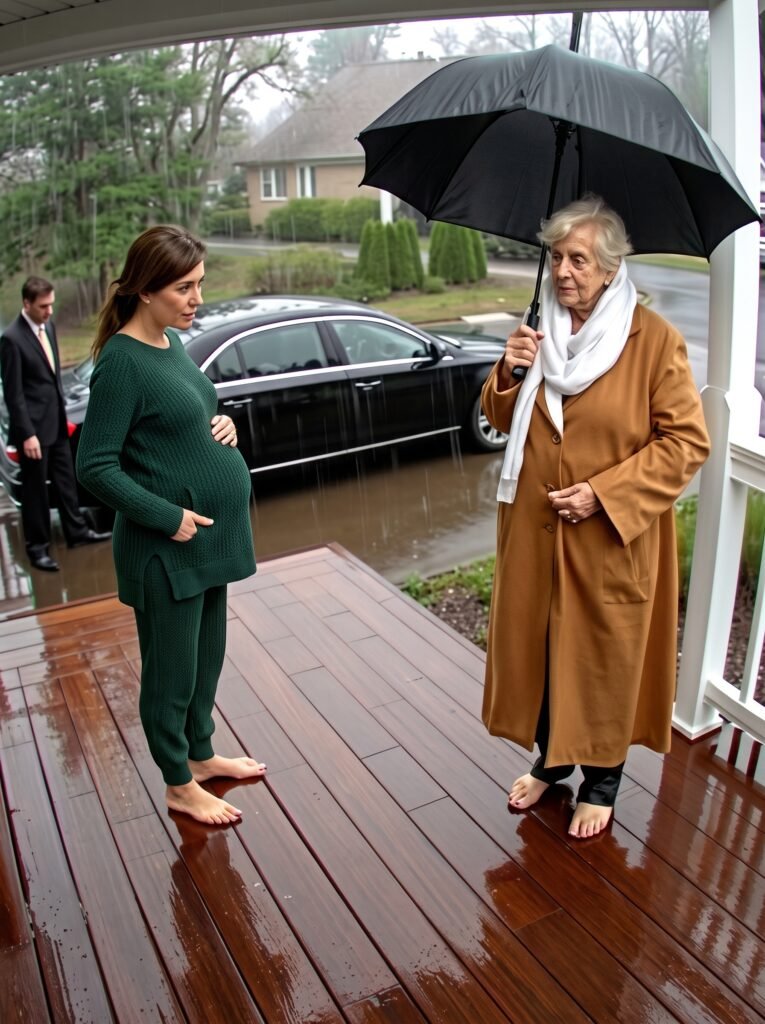
Grandmother wrapped her wool coat around my shoulders before I’d even fully stood up, its warmth so sudden and unfamiliar against my frozen skin that I nearly collapsed into her instead of standing on my own.
“Easy now,” she murmured, an arm firm around my waist. “I’ve got you.”
The porch light flicked on above us. Michael’s silhouette appeared behind the frosted glass of the front door, and a moment later the bolt turned. He opened it wearing an expression of practiced concern so convincing I almost forgot, for half a second, that I’d been sitting outside in a thunderstorm for twenty minutes because of him.
“Mrs. Preston!” he said, all warmth, all charm, the same voice he used at his father’s country club dinners. “I didn’t realize you were coming by. Emma, sweetheart, why didn’t you tell me you stepped out—I would have grabbed you an umbrella.”
Grandmother turned to look at him with an expression I’d never seen on her face before. Not anger, exactly. Something colder than anger. Something final.
“Stepped out,” she repeated slowly. “Is that what we’re calling it.”
Michael’s smile flickered, just slightly, the practiced ease cracking at the edges. “I’m not sure what you mean.”
“I mean,” Grandmother said, her voice never rising above a conversational register, which somehow made it more frightening than shouting ever could have, “that I sat in my car for four minutes before I got out, watching you through that window, and I heard every word you said to my granddaughter before you locked that door on a pregnant woman in the middle of a storm.”
The color drained from Michael’s face.
“Eleanor, that’s — that’s not — she was being unreasonable, we had a disagreement, I would never have actually left her out there long, I was just trying to make a point—”
“You made your point,” Grandmother said. “Now I’m going to make mine.”
She turned back to me, her expression softening instantly, decades of hardness folding away like it had never existed. “Emma. Go get in the car. James is bringing dry clothes and a blanket. We’re leaving.”
“Grandma, I can’t just—this is my house too, I have things inside, my—”
“You’ll have everything you need within the hour,” she said firmly. “Go. Now.”
I looked back at Michael one final time — really looked at him, in a way I don’t think I’d allowed myself to in the two years since I’d married him, past the charm and the excuses and the slow, patient way he’d worn down every boundary I’d ever tried to set. He looked smaller somehow, standing in that doorway. Smaller than he’d ever seemed when he was the one making me feel small.
I walked to the car without another word.
Through the rain-streaked window, I watched my grandmother stay behind on that porch a moment longer, standing eye to eye with a man twice her size and half her age, utterly unafraid.
I couldn’t hear what she said to him. But I saw his face change — saw the moment the color truly left it, saw him take an unconscious step backward into his own doorway as if retreating from something he suddenly understood was far more dangerous than he’d ever imagined a seventy-something grandmother could be.
Whatever she told him, it was the last time I ever saw Michael Bennett look confident about anything again.
She climbed into the car a minute later, settling beside me with the composed elegance of someone who’d just discussed nothing more consequential than weekend brunch plans, and reached over to squeeze my hand.
“What did you say to him?” I asked, teeth still chattering slightly despite the blanket James had draped over my shoulders.
“I told him,” Grandmother said, staring straight ahead as the car pulled away from the curb, “that he had exactly one night to remove his personal belongings from that house, because by tomorrow evening, it wasn’t going to be his problem anymore. Or anyone’s problem. It was going to be a pile of rubble.”
“Grandma, you can’t just—that’s his house. He inherited it from his father.”
“That house,” she said, turning to look at me with an intensity that silenced whatever protest I’d been about to make, “sits on a plot of land I sold to his father twenty-three years ago, with a covenant clause his father’s lawyer was too arrogant to read closely enough. If the property is ever used in the commission of documented abuse or endangerment, Preston Development retains the right to reclaim the land at fair market assessment. I wrote that clause myself, Emma, thirty years ago, after watching too many young women in this town discover what their charming husbands were capable of once the wedding rings were on.”
I stared at her, rain still dripping from my hair onto the leather seat, utterly speechless.
“You’ve been planning for this,” I whispered. “For decades. Before I was even born.”
“I’ve been protecting for decades,” she corrected gently. “I never wanted to use that clause. I hoped I never would. But I built it because I’ve learned, over eighty-one years, that hope is not a strategy, and cruel men rarely announce themselves before the wedding.”
I began to cry again, but this time it wasn’t humiliation driving the tears. It was something closer to relief, and something even closer to being seen — truly seen, for the first time in longer than I wanted to admit — by someone who had been quietly watching over me long before I ever knew I needed watching.
“What happens now?” I asked.
Grandmother reached over and rested a steady hand against my still-flat belly, her eyes soft in a way that belied the ice in her voice only minutes earlier.
“Now,” she said, “you and this baby come stay with me. And tomorrow, we begin making sure Michael Bennett understands, in no uncertain terms, exactly whose family he was foolish enough to marry into.”
Grandmother’s estate sat on twelve acres at the edge of town, a sprawling stone house I’d visited perhaps a dozen times in my life, always for holidays, always brief, always slightly formal in the way visits to wealthy relatives tend to be. I’d never stayed the night there. By morning, I had a room of my own, a stack of dry clothes that fit remarkably well for having been assembled in under an hour, and a breakfast tray brought to me by a housekeeper named Priya who informed me, kindly but firmly, that Mrs. Preston did not permit guests to skip meals.
I found Grandmother in her study before nine, already dressed, already on the phone, a legal pad covered in her sharp, slanted handwriting spread across the desk in front of her.
“—no, James, I want the demolition permit expedited, not delayed. I don’t care what the standard processing time is, I know the mayor’s office better than the mayor does.” She glanced up, saw me hovering in the doorway, and waved me in without missing a beat of the conversation. “Yes. Have Marcus draft the reclamation notice too. I want it delivered by courier this afternoon, not mailed. I want him to have to sign for it.”
She hung up and looked at me with the brisk energy of a woman half her age. “Sleep well?”
“I don’t think I slept at all,” I admitted, sitting in the leather chair across from her desk. “Grandma, I need to understand what’s actually happening. Is this — is this really legal? Taking his house?”
“Completely legal,” she said, sliding a folder across the desk toward me. “That’s the covenant I mentioned. Preston Development retained reclamation rights on twenty-three parcels sold in that development in the nineties, this being one of them, specifically for situations involving domestic endangerment. It’s iron-clad. My lawyers have already confirmed it holds.”
I opened the folder and found copies of documents I didn’t fully understand — deed restrictions, zoning language, a clause highlighted in yellow that specifically referenced “credible evidence of abuse or endangerment occurring on the property.” Beneath it, a photograph I hadn’t known existed: a still image, grainy but unmistakable, of me on that porch, curled against the wall in the rain.
“The car has a dash camera,” Grandmother said quietly, watching my face as I stared at the image. “It’s been recording since before I got out. I wanted you to know that in case this ever needs to go further than a demolition notice. In case he tries to fight it, or in case you ever decide you want more than just walking away.”
My hands trembled slightly, not from the cold this time, but from something rawer — the strange, disorienting comfort of seeing my own worst moment documented not as evidence of my failure, but as evidence of his.
“What do you mean, more?” I asked.
Grandmother folded her hands on the desk, studying me with the same steady patience she’d shown my entire life, the patience of a woman who’d built an empire from nothing and never once mistaken kindness for weakness.
“I mean, Emma, that you have choices now you didn’t have yesterday. You can simply leave — take the baby, take a settlement, disappear from that man’s life entirely and never look back. Nobody would fault you for that. It might even be the wisest choice.” She paused. “Or, if some part of you wants him to actually answer for what he did — not just to you, but to whoever came before you, because men like that rarely start with their wives — I have the resources to make sure he answers for it properly. In court, in the press, in whatever forum does the most good.”
“Whoever came before me?” I repeated slowly, a cold feeling settling into my stomach that had nothing to do with last night’s rain.
Grandmother’s expression tightened, just slightly. “I had my people look into him more thoroughly last night, while you slept. There was a woman before you, Emma. Danielle Ortiz. Engaged to Michael for eight months, four years ago. The engagement ended abruptly. She moved out of state shortly after. I don’t know the details yet. But I intend to find out.”
I sat back in the chair, the folder heavy in my lap, feeling the ground shift beneath a marriage I’d already known was rotten but hadn’t yet understood might have roots reaching further back than I’d ever imagined.
“I want to know,” I said finally, my voice steadier than I expected. “Whatever happened to her. I want to know all of it.”
Grandmother almost smiled — the first real warmth I’d seen from her since the car pulled away from that house the night before.
“That’s my girl,” she said. “Now. Eat your breakfast. Priya made eggs, and I won’t have you skipping meals while you’re carrying my great-grandchild. We have a great deal of work to do, and you’ll need your strength for what’s coming.”
Danielle Ortiz answered the phone on the fourth ring, her voice guarded, careful in the particular way of someone who’d learned to be careful the hard way.
“I don’t really talk about Michael Bennett,” she said, once Grandmother’s private investigator had explained who was calling and why. “Is he doing this to someone else?”
“His current wife,” I said, taking the phone myself, my hands steadier than they’d been in days. “I’m Emma. He locked me outside in a thunderstorm two nights ago. I’m pregnant.”
There was a long silence on the line, long enough that I thought she might hang up. Then, quietly: “He used to lock me in the pantry. Not outside — inside, in the dark, when I ‘talked back.’ He told me it was for my own good. That I needed to learn to control my temper.” A bitter laugh. “I didn’t have a temper. I had opinions. He couldn’t tell the difference, or didn’t want to.”
Over the next hour, sitting in Grandmother’s study with Priya bringing in tea neither of us touched, Danielle told me everything — eight months of escalating control disguised as devotion, isolation disguised as protection, and finally, the night she’d tried to leave and found herself locked in that same house, in a different room, until his mother had talked him down at 3 a.m. and driven Danielle to her sister’s apartment herself, sworn to secrecy under threat of the Bennett family’s considerable legal resources.
“His mother knew?” I asked, feeling something in my chest go hard and cold.
“His mother’s the one who taught him,” Danielle said quietly. “That’s what I eventually figured out. It’s not something he invented on his own, Emma. It’s inherited.”
I hung up the phone and sat in silence for a long time, Grandmother watching me from across the room with an expression that held no satisfaction, only grim confirmation of what she’d already suspected.
“There will be others,” she said finally. “There always are, with men like this. But you and Danielle together — that’s no longer a disagreement between spouses that a good lawyer can spin into ‘personal differences.’ That’s a pattern. And patterns are very difficult to argue away in a courtroom, or in the press.”
The demolition crew arrived at the house on schedule, three days later, exactly as promised. I wasn’t there to watch it — Grandmother insisted I didn’t need to be, that some victories were better witnessed from a distance, in photographs rather than in person, so the memory of the place could stop having power over me sooner rather than later. But I saw the pictures afterward: Michael standing on the sidewalk in a rumpled suit, watching a house he’d assumed would always be his collapse into a pile of stone and splintered wood, while a small crowd of neighbors gathered to watch, phones raised, the story already spreading through the community faster than any lawyer could contain it.
He tried to fight the reclamation in court. His attorney argued the covenant was outdated, unenforceable, a relic that shouldn’t hold up against modern property law. Grandmother’s legal team dismantled the argument in forty minutes, presenting the dash-cam footage, Danielle’s sworn statement, and three more women who came forward once the story broke publicly — each with their own version of the same pattern, the same house, the same careful cruelty passed down like inheritance from a mother who’d never once been held accountable for teaching her son exactly how to make it look like love.
Eleanor Bennett — Michael’s mother — was named in a separate civil suit within the month.
The judge ruled in Grandmother’s favor on every count. The land reverted to Preston Development. Michael Bennett, for all his charm and his family’s money, found himself facing not just a demolished house but a name that could no longer open doors the way it once had, a professional reputation collapsing nearly as fast as the walls of that house had.
My daughter was born on a bright March morning, six months after that night in the rain, in a hospital room filled with sunlight instead of storm clouds. I named her Eleanor, after the woman who’d stepped out of a black car into a thunderstorm and refused to let cruelty go unanswered, who’d taught me — far too late in some ways, and exactly in time in every way that mattered — that survival wasn’t the same as safety, and that sometimes the people who love us most fiercely have been quietly building the tools to protect us long before we ever knew we’d need them.
Grandmother held baby Eleanor for the first time in that hospital room, her sharp, capable hands surprisingly gentle as they cradled her tiny great-granddaughter, and looked up at me with an expression I’d never seen on her face before — not the cold fury from that rainy porch, not the brisk determination of the weeks that followed, but something softer, older, and entirely unguarded.
“You know,” she said quietly, “I built that covenant thirty years ago because I lost a friend to a man exactly like Michael Bennett, back when nobody believed women, back when there was no such thing as leaving quietly, let alone leaving with dignity. I told myself if I ever had the chance to stop it happening to someone I loved, I would burn the whole thing down without hesitation.”
“You did,” I said, sitting up carefully to take my daughter back into my arms. “You did exactly that.”
“I only got the chance because you called,” she said. “Because somewhere in that storm, soaked and freezing and humiliated, some part of you still believed help might come if you just held on a little longer.”
I looked down at my daughter, sleeping peacefully in my arms, safe in a world her great-grandmother had rebuilt from the rubble of a house that never deserved to stand.
“I’ll teach her that too,” I said. “That help is worth waiting for. That some people build empires just so they’ll have the power to tear down the things that hurt the people they love.”
Grandmother smiled — a real smile, rare and warm — and reached out to smooth a strand of hair from baby Eleanor’s forehead.
“Then I’d say,” she said softly, “that this family is finally building something worth inheriting.”
THE END