“To what?”
“Dad’s glasses.”
“Oh.”
She shrugged.
“He sat on them.”
“Then why did he leave on a trip without them?”
“I bought him another pair.”
“Where?”
Brenda’s eyes hardened.
“Why are you doing this?”
I placed the glasses gently on the table.
“Doing what?”
“Walking around inspecting everything like a detective.”
I smiled.
“I haven’t been home in twelve years. Maybe I’m curious.”
She stared at me for another second.
Then her smile returned.
But it no longer reached her eyes.
Later, I walked down the hallway.
My parents’ bedroom door was locked.
I tried the handle twice.
“Why is this locked?”
Brenda came quickly behind me.
“Mom started keeping it locked.”
“Why?”
“Privacy.”
“They’re not here.”
“I know.”
“So why is it locked now?”
She exhaled sharply.
“Because I don’t have the key with me.”
That answer made no sense.
Before I could push further, she added, “Ever since I moved back, I handle everything for them anyway. Bills. The house. The store paperwork. Even that money you send every month.”
I turned slowly.
“You handle my money?”
“The money you send Mom and Dad.”
“Yes.”
“Why?”
“They’re old, Shawn.”
Her voice changed.
Not worried.
Dismissive.
“They don’t understand things the way they used to.”
I felt something cold move through me.
“Our father ran a grocery store for thirty-eight years.”
“And now he’s seventy-eight.”
“And Mom?”
“Same problem.”
I looked at her.
Mom was seventy-four.
Maybe slower than she had once been.
But the last time I spoke to her on the phone, she had remembered the exact name of one of my employees whose wife had been sick.
That call had been nearly five months ago.
I suddenly realized something else.
Since then, every time I called, Brenda answered.
Mom was resting.
Dad was at an appointment.
They were tired.
They were out.
There had always been an explanation.
I walked outside before Brenda could read my face.
Mr. George was waiting near the fence.
He looked toward the house.
Then toward me.
“Your sister inside?”
“Yes.”
He lowered his voice.
“Shawn, nobody’s seen your parents in months.”
Everything inside me stopped.
“What?”
“Not at church.”
He swallowed.
“Not at the store. Not at the clinic. Your father missed our fishing trip in September. Don never misses it. Never.”
I looked back at the house.
“Brenda says they’re traveling.”
George gave me a grim look.
“She says something different every time somebody asks.”
“How long?”
“At least four months.”
My hands went numb.
George continued.
“Nancy was helping them. Cleaning. Driving your mother to appointments. Brenda fired her around August.”
“Why?”
“She wouldn’t say.”
He hesitated.
“Except Nancy left crying.”
I stared at him.
“What did she tell you?”
“Only that your parents were in trouble.”
“Why didn’t somebody call me?”
“We tried.”
My stomach dropped.
“What do you mean?”
“Your sister said you wanted nothing to do with the family anymore. Said you told her not to give out your number.”
“That’s a lie.”
“I figured.”
George looked ashamed.
“But by then, she had convinced people Don was confused and Maria was getting worse. She said doctors told her they needed peace.”
I suddenly remembered Brenda’s words.
They don’t understand things the way they used to.
Not concern.
Preparation.
She had been preparing a story.
I returned inside.
I acted normal.
At dinner, Brenda poured wine.
I didn’t touch mine.
“When can I call them?” I asked.
She kept cutting her food.
“No signal where they are.”
“What hotel?”
“They’re staying with family.”
“Thomas Jr.?”
“Yes.”
“Give me his number.”
Her fork stopped.
“I don’t have it.”
“You traveled with him last year.”
“That doesn’t mean I saved his number.”
I leaned back.
“When are they coming home?”
“After New Year’s.”
“Maybe?”
She looked up.
“Maybe.”
I smiled.
“Okay.”
That seemed to relax her.
For the rest of dinner, I talked about harmless things.
Columbus.
Weather.
Work.
I even told her I might leave the next morning.
Her shoulders visibly loosened.
That told me everything.
That night, I lay awake in my old bedroom.
The room had become storage.
Boxes lined one wall.
Around two in the morning, the house went silent.
Then I heard it.
Knock.
I sat up.
Waited.
Knock.
Slow.
Faint.
I got out of bed.
The hallway was dark.
Brenda’s bedroom door remained closed.
I walked toward the kitchen.
Then came the third sound.
Knock.
Not from a wall.
From underneath me.
I froze.
I pressed my bare hand against the cold kitchen floor.
Nothing.
Then—
Knock.
Knock.
Knock.
Three deliberate hits.
I stood up so fast my shoulder struck the counter.
The old farmhouse had a basement.
I remembered it suddenly.
Not the main cellar where Dad stored tools.
An older basement.
A storm storage room built beneath the original kitchen decades before I was born.
When we were children, the entrance had been hidden beneath a movable pantry cabinet.
Dad eventually stopped using it because the stairs were steep and the room was damp.
I hadn’t thought about it in thirty years.
I grabbed my phone.
Before doing anything else, I texted George.
COME TO THE HOUSE. DO NOT KNOCK. CALL THE POLICE IF I DON’T TEXT YOU AGAIN IN TEN MINUTES.
Then I searched the kitchen.
The new cabinets covered nearly everything.
But the floor told the truth.
One section of tile near the pantry was newer.
I pulled at the cabinet.
It didn’t move.
I looked underneath.
Bolts.
Someone had secured it in place.
My heart began pounding.
I grabbed Dad’s old toolbox from the mudroom and found a wrench.
It took three minutes to loosen the bolts.
Every second felt too loud.
Finally, the cabinet shifted.
Beneath it was a rectangular wooden hatch.
A heavy chain had been wrapped through two metal brackets.
And locked.
I stared at it.
Then three knocks came from directly underneath.
My hands began shaking.
“Dad?”
Silence.
I crouched down.
“Dad? Mom?”
For several seconds, nothing happened.
Then I heard a voice.
Barely a whisper.
“Shawn?”
My knees almost gave out.
It was my father.
I stood and grabbed the heaviest hammer I could find.
The lock broke on the fourth strike.
I pulled the chain away.
Opened the hatch.
A cold smell rose from below.
Damp concrete.
Dust.
Stale air.
And something else.
Fear.
I switched on my phone flashlight.
“Dad?”
“Down here.”
His voice cracked.
I descended the narrow stairs.
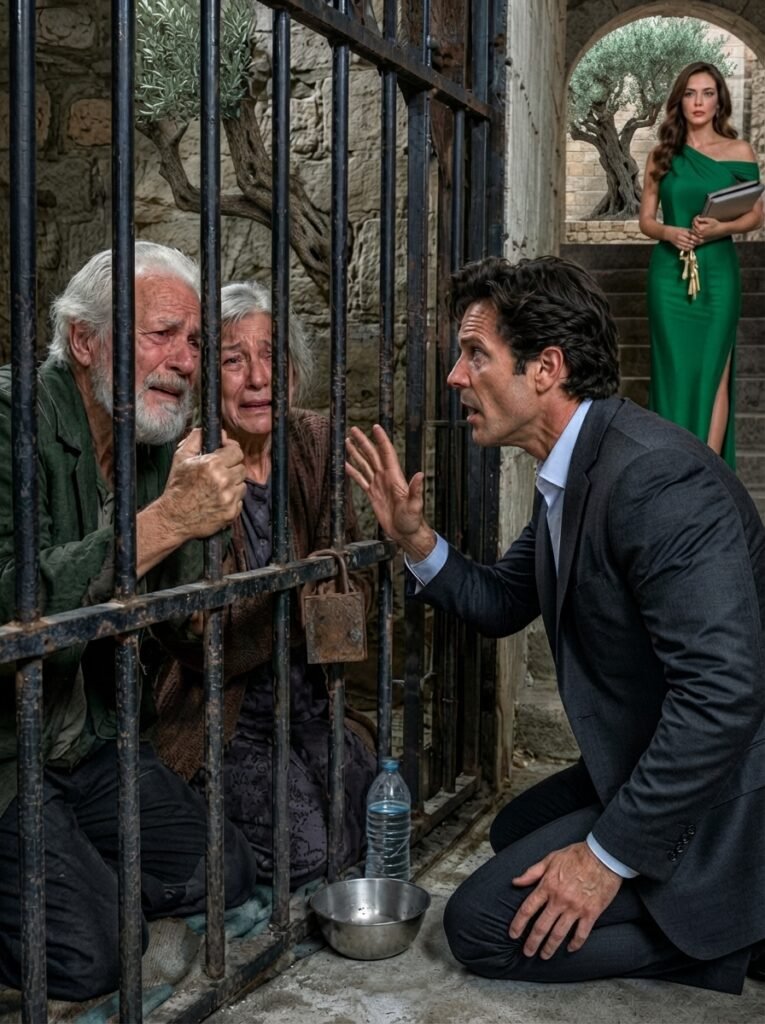
At the bottom was a storage room barely larger than a bedroom.
A small electric heater glowed beside one wall.
There were two folding cots.
A plastic bucket.
Bottles of water.
Canned food.
And my parents.
My mother was curled beneath a blanket.
My father sat beside her.
He had lost so much weight I almost did not recognize him.
For twelve years, I had imagined coming home.
I imagined Dad calling me an idiot for staying away so long.
I imagined Mom crying into my shirt.
I never imagined finding them locked beneath their own kitchen.
“Dad.”
The word came out broken.
He tried to stand.
He couldn’t.
I crossed the room and fell to my knees.
He grabbed my face with both hands.
“My boy.”
That destroyed me.
I had built warehouses.
Managed hundreds of people.
Negotiated contracts worth millions.
But in that basement, I became twenty-three again.
A son who had left.
A son who should have come home sooner.
Mom opened her eyes.
“Shawn?”
I turned.
She reached toward me.
I held her hand.
It was freezing.
“I’m here, Mom.”
She started crying.
“So long.”
“I know.”
“I prayed you would come.”
My chest felt like it had been split open.
“What happened?”
Dad looked toward the stairs.
“Brenda.”
One word.
That was all he needed to say.
Then we heard a sound overhead.
A floorboard.
Dad’s eyes widened.
His fingers closed around my wrist.
“Don’t let her close the door again.”
Footsteps entered the kitchen.
Slowly.
I stood.
Brenda appeared at the top of the basement stairs.
She was wearing a robe.
Her face was completely different now.
No smile.
No surprise.
Only rage.
“What did you do?”
I stared up at her.
“What did I do?”
“You had no right opening that.”
I almost laughed because the sentence was so insane.
“No right?”
“They’re sick!”
Dad shouted from behind me.
“Liar!”
Brenda flinched.
I climbed two steps.
She backed away.
“You locked our parents in a basement.”
“I was protecting them.”
“From who?”
“Themselves!”
She pointed downward.
“Dad started giving money away. Mom kept forgetting things. They were making terrible decisions.”
Dad’s voice shook with fury.
“I tried to stop you from selling the store!”
Brenda went silent.
I looked at him.
“What?”
“That’s what this started over,” Dad said.
“She wanted the grocery store and the back acreage. She said we didn’t need them anymore.”
Brenda snapped, “You didn’t!”
Dad ignored her.
“She brought papers. Said they were power-of-attorney forms.”
My stomach turned.
“I refused.”
He pointed toward his broken glasses upstairs.
“She pushed me.”
Brenda’s expression changed.
“Dad slipped.”
“You pushed him?”
“It was an accident!”
Mom spoke weakly.
“You told us Shawn had stopped sending money.”
Brenda froze.
I looked at her.
“What?”
Mom was crying now.
“She said you were tired of supporting us.”
I felt sick.
“She said you had your own life.”
“Mom, I never stopped sending it.”
Her face crumpled.
“I knew it.”
I turned toward Brenda.
“Where is the money?”
She crossed her arms.
“This isn’t what you think.”
“Where is the money?”
“It paid expenses.”
“Four months in a basement is an expense?”
“Lower your voice.”
Something inside me nearly broke.
Then I heard movement outside.
A car door.
Brenda heard it too.
“Yes.”
She spun toward the front hall.
I moved after her.
But Dad grabbed the railing behind me.
“Bedroom.”
I stopped.
“What?”
“The locked bedroom.”
Dad struggled for breath.
“She keeps the papers there.”
Brenda ran.
Not toward the front door.
Toward my parents’ room.
She was trying to destroy evidence.
I went after her.
She reached the hallway just as pounding erupted at the front entrance.
“Pinewood Ridge Police!”
Brenda froze.
I stood ten feet behind her.
She turned toward me.
For one second, I saw the sister I remembered.
The girl who used to follow me through cornfields.
The teenager who cried when I left for Columbus.
Then her expression hardened again.
“You ruined everything.”
“No.”
I shook my head.
“You did.”
The police entered seconds later.
George was behind them.
So were paramedics.
When they found my parents downstairs, even the officers looked stunned.
Mom and Dad were taken to the hospital.
Dehydration.
Malnutrition.
Dad had an untreated fracture in two fingers from what Brenda had called a “fall.”
Mom had missed multiple medical appointments.
But they were alive.
That mattered more than anything.
Brenda was detained while officers searched the house.
What they found inside my parents’ locked bedroom turned a terrible situation into something even worse.
Bank statements.
Loan documents.
Property deeds.
Letters addressed to my parents that had never been opened.
And a folder containing copies of my monthly transfers.
Every single payment had arrived.
Two thousand dollars.
Month after month.
Brenda had moved most of it into another account.
But there was more.
Dad had been right.
She had prepared documents transferring control of the grocery store and part of the family land into a company connected to her.
One signature had been forged.
Another had apparently been obtained after she told Mom it was a medical insurance form.
Then investigators found messages.
Brenda had been negotiating with a developer.
The land along the highway had become valuable.
Very valuable.
A commercial project was planned nearby.
My parents’ property, which they had bought decades earlier for almost nothing, was suddenly worth hundreds of thousands of dollars.
Brenda wanted them declared incompetent.
If she gained full authority over their finances, she could sell everything.
But Dad refused to cooperate.
So she isolated them.
First she took their phones.
Then she dismissed Nancy.
Then she told the neighbors they were confused.
After that, she moved them downstairs “temporarily.”
Temporary became days.
Then weeks.
Then months.
She brought them food.
Water.
Medicine when she remembered.
And whenever anyone asked where they were, she invented another story.
A relative.
A medical retreat.
A holiday.
A long visit.
She never expected me to come home.
That was the one thing she had not planned for.
At the hospital, I sat beside Dad while he slept.
Mom was in the next bed.
Morning light began filling the room.
Christmas Eve.
For a long time, neither of us spoke.
Then Mom said quietly, “Don’t blame yourself forever.”
I stared at the floor.
“I should have come home.”
“Yes.”
The answer surprised me.
She squeezed my hand.
“You should have.”
Tears burned behind my eyes.
“But we also should have told you more.”
“How?”
“Before Brenda took the phones.”
Mom looked toward Dad.
“We were proud.”
That word hurt more than blame would have.
“Your father kept saying you were busy building your life.”
Dad opened one eye.
“I said no such thing.”
Mom almost smiled.
“Yes, you did.”
Dad grunted.
Then looked at me.
“We didn’t want to become another problem you had to solve.”
“You’re my parents.”
“I know.”
His voice softened.
“And you are our son.”
I lowered my head.
For years, I had told myself sending money was enough.
Two thousand dollars each month had become a substitute for presence.
I paid bills.
I paid insurance.
I paid repairs.
But I had stopped asking the simplest question.
Are you okay?
A few hours later, Nancy came to the hospital.
The moment she saw my mother, she burst into tears.
“I tried,” she said.
“I swear I tried.”
She explained that in August, she had arrived unexpectedly and heard Mom shouting from behind the kitchen.
Brenda intercepted her before she could investigate.
Nancy demanded to see my parents.
Brenda threatened to call police and accuse her of trespassing.
Nancy contacted adult protective services afterward, but Brenda claimed my parents were staying with relatives and produced documents showing she had authority to manage their affairs.
The complaint stalled.
Nancy had never forgiven herself.
Dad reached out and held her hand.
“You tried more than most.”
George came later.
Mrs. Mabel sent food.
Then people from church arrived.
By evening, half the town seemed to know.
And for the first time, I understood those strange looks when I arrived.
People had suspected something.
But Brenda had spent months building a wall of explanations around my parents.
Age.
Privacy.
Dementia.
Travel.
Family conflict.
Every lie was small enough to sound possible.
Together, they became a cage.
Brenda remained in custody through Christmas.
The investigation continued for months.
The forged documents were voided.
The sale never happened.
Most of the money she had taken was eventually traced.
Not all of it.
But Dad surprised me when I brought that up.
“Forget the missing money.”
“I can recover it.”
“Maybe.”
He looked at me.
“But money isn’t what almost killed us.”
I knew what he meant.
Isolation had.
Silence had.
Assumptions had.
The belief that because somebody said, “They’re fine,” nobody needed to check.
My parents did not return immediately to the old house.
I rented a place near the hospital where they stayed while recovering.
Then I did something I should have done years earlier.
I reorganized my company.
I delegated more.
I cut travel.
And I stopped pretending work would collapse if I stepped away for a week.
That spring, I spent more time in Pinewood Ridge than I had during the previous decade combined.
Dad recovered enough to sit outside the grocery store again.
Mom started baking.
And one afternoon, while we were sitting on the back porch, Dad reached into his pocket.
He pulled out the broken glasses.
The same pair I had found beneath the magazine.
“You kept those?”
He nodded.
“Why?”
Dad turned them over in his hands.
“Because these brought you downstairs.”
I swallowed.
“They were just glasses.”
“No.”
He looked toward the kitchen.
“They were proof.”
Then he smiled.
“And your mother said I looked distinguished in them.”
Mom shouted from inside, “I said no such thing!”
Dad laughed.
It was the first time I had heard that laugh in years.
The criminal case against Brenda eventually moved forward.
I attended only when necessary.
People asked whether I hated her.
I never knew how to answer.
Hate would have been easier.
Brenda was my sister.
I remembered teaching her to ride a bicycle.
I remembered carrying her home after she fell into the creek.
I remembered her crying the day I left for Columbus.
But I also remembered that basement.
The folding cots.
The cold concrete.
My mother’s shaking hand.
My father whispering, Don’t let her close the door again.
Some things cannot be undone simply because the person who did them shares your blood.
Months later, one of Brenda’s attorneys asked whether I would write a letter describing the good things I remembered about my sister.
I did.
I wrote the truth.
I wrote that she had once been funny.
Loyal.
Stubborn.
Protective.
Then I wrote another truth.
None of those memories changed what she had done.
I did not ask for revenge.
I did not ask for mercy.
I asked only that my parents never again be placed under her control.
That Christmas became the dividing line in our family.
Everything was either before the basement or after it.
The following December, I came home again.
Not unexpectedly this time.
Dad had called me six times to make sure I knew exactly what day dinner was.
Mom had already baked enough food for twenty people.
George brought a ridiculous sweater.
Nancy helped decorate.
And the Christmas tree looked nothing like Brenda’s perfect department-store display.
It was messy.
Crooked.
Covered in decades of memories.
The wooden angel I made when I was eight.
Brenda’s old paper star from second grade.
Dad’s cracked glass ornament.
Photographs.
Candy canes.
Too much tinsel.
It was perfect.
After dinner, Mom brought out cinnamon bread.
Dad sat at the kitchen table wearing new glasses.
I was pouring coffee when he tapped his knuckles against the wood.
Knock.
Knock.
Knock.
I froze.
For a moment, I was back in the darkness.
Bare feet on the kitchen floor.
My heart pounding.
Three tiny knocks beneath me.
Dad looked up.
Then he smiled.
Mom understood immediately.
Her eyes filled with tears.
I sat down beside them.
Dad covered my hand with his.
“Last year,” he said quietly, “three knocks meant we needed someone to find us.”
He tapped the table again.
Three times.
“This year, it means everybody’s here.”
I couldn’t speak.
So I just held his hand.
Outside, snow began falling over Pinewood Ridge.
Inside, Mom complained that Dad was eating too much bread.
George argued about football.
Nancy laughed.
The old furnace rattled exactly the way I remembered.
Nothing about the house was elegant anymore.
Nothing matched.
Nothing was perfect.
But my parents were upstairs.
The basement door was gone.
Dad had insisted on removing it completely.
He filled the old room with tools, paint cans, and boxes of Christmas decorations.
“No locked doors in this house anymore,” he told me.
And he meant it.
For twelve years, I had thought coming home could wait.
Another month.
Another Christmas.
Another year.
I had believed sending money meant I was taking care of my family.
But families can disappear while the checks keep clearing.
People can be in danger behind freshly painted walls.
And sometimes the truth is not hidden hundreds of miles away.
Sometimes it is beneath the same floor everyone has been walking across.
All it takes is one person willing to stop.
Listen.
And hear the knocking.