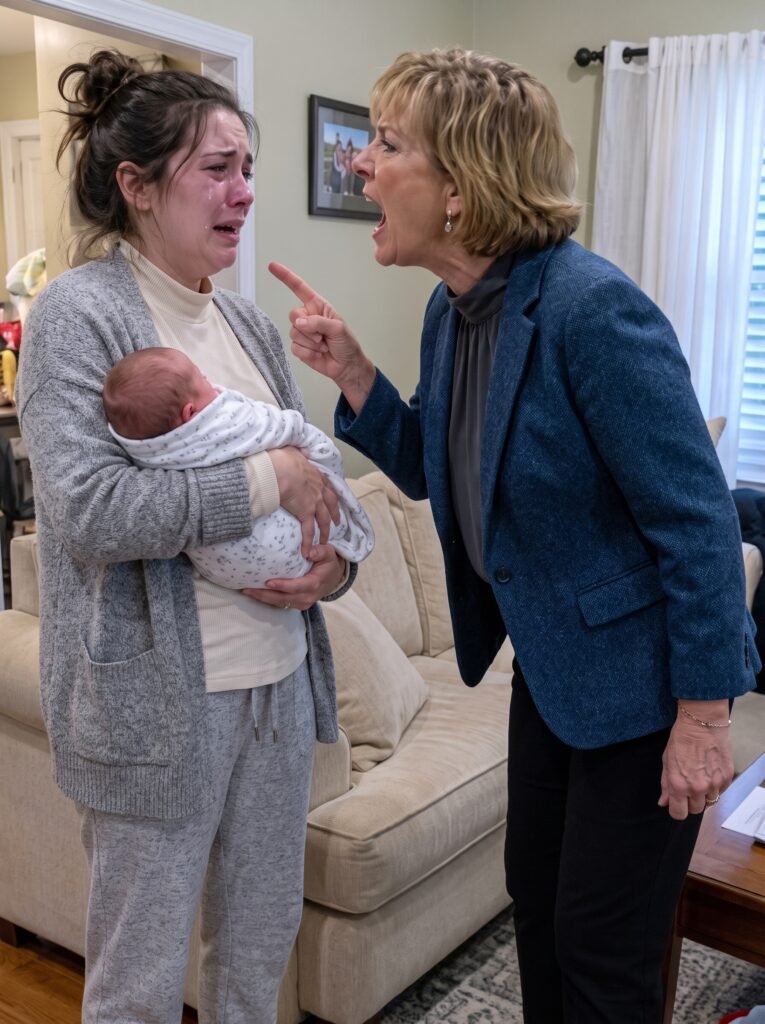
The words hung in the air between us, sharper than anything she’d said before, and for a moment I actually laughed — a short, disbelieving sound that startled Ava further in my arms.
“Protect me from you?” I repeated. “Mom, I didn’t know I needed protecting from my own mother until about thirty seconds ago. But thank you for clarifying.”
Janet’s face flickered — surprise, maybe, that I wasn’t crumbling the way I always had before. For twenty-six years, that particular tone of hers, low and cold and certain, had been enough to make me apologize for things I hadn’t even done. This time it just sounded small.
“You’re twisting my words,” she said, backpedaling slightly. “I only meant that family is what matters when everything else falls apart. Ryan’s gone. You’re alone with a newborn. Who do you think is going to be there for you at three in the morning when that baby won’t stop crying?”
“Not you,” I said quietly. “You weren’t there an hour after she was born. You weren’t there for the first week of her life. The only thing you’ve shown up for is a text about phones.”
I watched something in her expression crack, just slightly, before it hardened right back into place. That was the moment I understood, with a clarity I’d never let myself access before, that my mother wasn’t actually hurt by what I’d said. She was calculating. Recalibrating. Trying to find the angle that would get her back to where she needed to be — which was me, compliant, wallet open, silent.
“You know what your problem is?” she said, crossing her arms. “You’ve always thought you were better than this family. Better than Clara, better than the sacrifices we made raising you both. And now you’ve got a military paycheck and a fancy house and you think that means you get to look down on us.”
“I think,” I said slowly, adjusting Ava against my shoulder as her cries finally settled into soft hiccupping breaths, “that I spent ten years funding a lifestyle for a sister who has never once asked how I was doing, while working full-time, moving across the country every eighteen months, and raising a baby completely alone because my husband is defending a country that apparently means less to this family than a two-thousand-dollar phone bill.”
Janet opened her mouth to respond, but I wasn’t finished.
“I think,” I continued, “that you have had a spare key to my house for three years and you have never once used it to bring me a meal, or hold your granddaughter, or ask if I needed help. You used it today to walk in here and yell at me one week postpartum because I didn’t send money fast enough.”
The silence that followed was the loudest thing I’d ever heard in that living room.
“Give me the key,” I said.
“Excuse me?”
“The spare key. Give it to me. Now.”
For a moment I thought she might refuse, might turn this into another battle of wills the way she always had, but something in my voice — steady, unshaking, entirely unfamiliar even to me — must have told her this wasn’t a fight she was going to win. She dug through her purse with hands that trembled slightly, and set the key down hard on my kitchen counter, as though the act of surrendering it cost her something enormous.
“You’ll regret this,” she said, voice tight. “When this baby is older and you need help, and there’s no one there because you burned every bridge today—”
“I won’t regret protecting my daughter,” I said. “I regret waiting this long to start.”
She left without another word, the door clicking shut behind her with a finality that felt less like an ending and more like the first real beginning I’d had in years.
I stood there in the sudden quiet, Ava finally settling into sleep against my chest, and felt something unclench in my body that had been wound tight since I was probably twelve years old.
My phone buzzed on the counter. A message from Clara.
Mom just called me crying. I can’t believe you’d treat her like that after everything she’s done for you. You’re being so selfish right now.
I looked at the message for a long moment. Then, for the first time in my adult life, I typed a response instead of a payment confirmation.
I just gave birth alone a week ago. I haven’t slept more than three hours at a stretch since. And the first thing either of you did was ask for money. Don’t call me selfish. Figure out your kids’ phones yourselves.
I turned my phone off completely and carried my daughter to the nursery, laying her down in the crib Ryan had built over video call instructions three months earlier, piece by piece, unable to be here in person but determined to have some hand in the life we were building.
I sat in the rocking chair beside her crib for a long time after that, watching her sleep, feeling the strange, unfamiliar weight of a boundary I’d never once managed to hold in twenty-six years of trying.
It wouldn’t be the last message. It wouldn’t be the last fight. Some part of me already knew that Janet and Clara weren’t going to simply accept this and move on quietly — people who’d built an entire relationship around my compliance rarely did.
But for the first time in my life, I wasn’t afraid of what came next.
The next few weeks passed in the strange, sleep-deprived rhythm every new mother learns eventually — three-hour stretches of exhaustion punctuated by moments of overwhelming tenderness, Ava’s tiny fingers wrapping around mine at 4 a.m. feedings, the quiet miracle of watching a person exist who hadn’t existed a month before. I turned my phone back on eventually, mostly to stay in contact with Ryan, whose video calls from base had become the single steadiest thing in my days.
“You did the right thing,” he told me one night, his face pixelated and tired on my laptop screen, three time zones and a training schedule keeping him from being anything more than a voice and a flickering image. “I wish I’d been there. For all of it. The birth, and this.”
“I wish you’d been there too,” I admitted. “But I think I needed to do this part alone. I think if you’d been standing next to me, I might have let you handle it instead of finally handling it myself.”
He was quiet for a moment, studying me through the screen in that careful way he had. “Your mom call you again?”
“Six times. I haven’t answered.”
“And Clara?”
“Radio silence, actually. Which is somehow worse. I keep waiting for the other shoe to drop.”
It dropped on a Tuesday morning, three weeks after Janet had stormed into my living room. I was in the kitchen, Ava strapped into a bouncer on the counter beside me, trying to eat cereal one-handed, when an email notification chimed on my phone. Not a text. An email, formal, from an address I didn’t recognize — until I saw the subject line.
My stomach dropped as I opened it. It was from a mediator’s office, requesting my presence at a “family financial mediation session” the following week, filed at the request of one Janet Pruitt — my mother — regarding what the document vaguely termed “ongoing familial support arrangements and reasonable expectations of assistance among adult siblings.”
I read it three times before the absurdity of it fully landed. My mother was trying to use a mediation service — the kind typically reserved for genuine legal disputes, custody arrangements, actual contractual obligations — to force me back into funding my sister’s life.
I called the number on the letterhead, hands shaking with something that had shifted, somewhere in the last three weeks, from fear into fury.
“This is Emily Hartwell, I’m calling about a mediation request filed against me,” I said, forcing my voice level. “I need to understand what this actually is, because I’ve never signed any agreement obligating me to provide financial support to anyone.”
The woman on the other end, apologetic and clearly unaccustomed to this particular flavor of family dysfunction, explained gently that the service was voluntary — that my mother had filed a request, but I was under no legal obligation to attend, and that frankly, without any prior signed agreement or court order establishing support obligations, there was very little the mediation could actually accomplish even if I did show up.
“So this is just—” I stopped, almost laughing. “This is just her trying to make it feel official. Trying to scare me into it.”
“I can’t speak to your mother’s intentions,” the woman said carefully, “but I can tell you there’s no legal weight behind this request unless you choose to participate and reach a voluntary agreement.”
I declined the mediation. I also, for the first time, called a family law attorney — not because I anticipated needing one, but because some instinct told me Janet wasn’t done escalating, and I wanted to understand exactly what ground I was standing on before she tried something else.
The attorney, a calm, unflappable woman named Denise Okafor, listened to the entire history — a decade of money sent under guilt and pressure, no formal agreements, no court orders, nothing but years of emotional coercion dressed up as family obligation — and told me plainly what I think some part of me had needed to hear from someone outside the situation.
“You don’t owe your sister anything,” she said. “You never did. What your mother is describing isn’t a legal relationship. It’s a pattern of manipulation she’s dressed up in family language because that language worked on you for a long time. It’s not going to work in a courtroom, and frankly, it sounds like you’ve already stopped letting it work on you at home.”
Janet’s next move came two weeks later, and it was the one that finally, completely severed whatever remained of the relationship I’d spent a lifetime trying to preserve.
She showed up at Ryan’s homecoming.
He’d finished his training assignment and flown home for a two-week leave before his next deployment, and I’d organized a small gathering at the house — just a few friends from base, Ryan’s parents flying in from Ohio, nothing elaborate, just a chance for him to finally meet his six-week-old daughter in person and for our small, chosen family to celebrate together.
Janet arrived uninvited, Clara trailing behind her with all three kids in tow, and made it exactly four minutes into the backyard before she cornered Ryan by the drink table, in front of his parents, in front of my friends, and said, loudly enough for half the yard to hear:
“Ryan, I hope you know what kind of woman you married. She let her own mother go without help while she was sitting on a full paycheck. She cut off her sister’s children over a couple thousand dollars. I raised her better than this.”
The yard went quiet. I felt my face go hot, that old, familiar shame trying to claw its way back up my throat — until I looked at Ryan’s face and saw something I hadn’t expected.
He wasn’t embarrassed. He was furious.
“Mrs. Pruitt,” he said, his voice carrying the flat, controlled authority he used with subordinates who’d badly misjudged a situation, “Emily gave birth to our daughter completely alone while I was a thousand miles away on mandatory orders. The first message she got, hours after labor, was a demand for two thousand dollars for your grandchildren’s phones. Not a single question about how she was doing. Not one.” He set down his drink, deliberately, and stepped closer. “I don’t know what you raised her to believe about family, but where I come from, family shows up. You didn’t show up for the birth of your granddaughter. You showed up today to insult her in front of my parents.”
Janet’s mouth opened, that familiar recalibration flickering across her face, searching for an angle. She didn’t find one this time.
“This is a private family matter,” she tried.
“You made it public the moment you brought it to my homecoming,” Ryan said. “I’d like you to leave now.”
Clara, who’d been standing silently behind her mother the entire time, finally spoke, her voice smaller than I’d expected. “Mom, maybe we should just go—”
“Don’t you dare take her side,” Janet snapped, rounding on her.
“I’m not taking anyone’s side,” Clara said, and something in her tired, uncertain expression made me look at my sister properly for the first time in years — really look at her, not as the perpetual crisis my mother had trained me to fund, but as a person, exhausted and cornered in her own particular way. “I’m just tired, Mom. I’m tired of you sending me to fight your battles and then acting surprised when it blows up.”
It was the first genuinely honest thing my sister had said to me in a decade.
Janet left the party without another word, Clara following behind her with an expression I couldn’t quite read, somewhere between guilt and relief. The party resumed slowly, awkwardly, Ryan’s mother squeezing my hand and murmuring that she was sorry I’d had to grow up with that, his father quietly refilling drinks like he needed something to do with his hands.
Later that night, once the guests had gone and Ava was finally asleep, Ryan found me sitting on the back porch steps, staring out at a yard still scattered with the debris of a party that had gone sideways.
“You okay?” he asked, sitting beside me.
“I don’t know,” I admitted. “I’ve spent my whole life terrified of exactly what just happened. And now that it’s happened, I mostly just feel… tired. Not sad. Just tired.”
“Tired’s allowed,” he said, wrapping an arm around me. “You just spent six weeks recovering from childbirth, dismantled twenty-six years of manipulation, and watched your mother try to humiliate you at my homecoming party. I think you’ve earned tired.”
I leaned into him, feeling the particular exhaustion of a fight finally, fully won, even if the victory didn’t feel like the triumphant thing I might once have imagined.
“Do you think Clara meant it?” I asked. “What she said, about being tired of fighting Mom’s battles?”
“I don’t know,” Ryan said honestly. “But I think that’s the first time in ten years she’s said something that wasn’t a demand. Maybe that’s worth something. Maybe it isn’t. That’s not up to you to fix, though. Not anymore.”
Clara texted three days later, and for the first time in as long as I could remember, the message didn’t start with a request.
Can we talk? Just the two of us. No mom.
I stared at it for a long time before responding, Ava asleep in my arms, Ryan already back at base for his final week before deployment. Some old, well-worn instinct told me to brace for whatever this actually was — another angle, another guilt trip dressed up in softer language. But something about the phrasing, the deliberate absence of any ask, made me type back a simple okay before I could talk myself out of it.
We met at a coffee shop halfway between our houses, Clara arriving first, looking smaller than I remembered, dark circles under her eyes that had nothing to do with makeup. She’d brought no kids this time, no crisis, no list of needs.
“I owe you an apology,” she said, before I’d even sat down. “A real one. Not the kind Mom taught us to give, where you apologize for someone else’s feelings about your existence.”
I sat, unsure what to say, watching my sister for a long moment before finally settling on honesty. “Okay. I’m listening.”
“I’ve spent ten years letting Mom use you as my safety net,” Clara said, her hands wrapped tight around a coffee cup she wasn’t drinking. “And I told myself it was fine because you had more than me, because you seemed stable, because Mom said you owed it to the family. But the truth is, I never once asked if you were okay with it. I never once asked if you could actually afford it. I just took, because taking was easier than admitting I’d made bad decisions with money and didn’t know how to fix them myself.”
“Why now?” I asked. “What changed?”
Clara was quiet for a moment, staring down at her cup. “Watching you at that party. Watching Ryan defend you. And realizing that in ten years, nobody has ever defended me like that — not because people don’t care, but because I never gave anyone a version of me worth defending. I was always just the crisis. The need. I don’t think I even know how to be anything else anymore, and that terrifies me more than any phone bill ever could.”
I felt something in my chest loosen, slightly, cautiously — not forgiveness yet, not trust, but the first crack of something that might eventually become either.
“I can’t go back to funding your life, Clara,” I said carefully. “Not because I don’t love you. Because I have a daughter now, and I watched what that pattern did to me for twenty-six years, and I won’t hand her the same inheritance.”
“I’m not asking you to,” Clara said. “I’m asking if there’s a version of us that doesn’t involve money at all. I don’t know what that looks like. I’ve never had it. But I’d like to find out, if you’re willing.”
We sat there for two hours, longer than either of us had spent talking honestly in a decade, and by the end of it I didn’t have a resolution, didn’t have a guarantee that this wouldn’t eventually curdle back into the same old patterns. But I had something I hadn’t had before — the beginning of a relationship with my sister that wasn’t built entirely on what I could give her.
Janet never apologized. Not that week, not that year. She sent a handful of messages in the months that followed, oscillating between icy silence and sudden, saccharine attempts at reconciliation that always, eventually, circled back to some version of the same request, phrased just differently enough to seem like something new.
I stopped responding to most of them. Not out of cruelty, but out of the same clear-eyed protection I’d found that first night in the hospital, holding my daughter and understanding, with absolute certainty, that some cycles only break when someone finally refuses to keep spinning them.
Clara and I built something slower, stranger, and more honest than what we’d had before — monthly coffee, no money exchanged, no crises manufactured to fill the silence between us. She started seeing a financial counselor on her own, something she told me about almost shyly, like she expected me to be skeptical. I wasn’t. I was proud of her, in a way that felt entirely unfamiliar and entirely earned.
Ava turned one the following spring, in a backyard full of people who’d actually shown up for the right reasons — Ryan home on leave again, his parents flying in without being asked, Clara arriving with a homemade cake and her three kids in tow, no crisis trailing behind them, just a family finally learning what it looked like to show up for each other without a price tag attached.
Janet wasn’t invited. It wasn’t an act of cruelty. It was simply the natural conclusion of a boundary I’d finally learned how to hold — the understanding that love without respect isn’t actually love at all, no matter how many years you’ve been told otherwise.
That night, once the guests had gone and Ava was asleep in her crib, I sat on the back porch with Ryan, watching the last of the sunset fade over a yard that had, over the course of one difficult year, become the foundation of something entirely new.
“You did it,” Ryan said quietly, his arm around my shoulders. “You actually broke it.”
“I don’t know if it’s fully broken,” I admitted. “I think some part of me will always brace for the next demand, the next guilt trip. Old patterns don’t disappear just because you finally say no once.”
“Maybe not,” he said. “But you didn’t just say no once. You’ve been saying it for a year now. That’s not a moment anymore, Em. That’s who you are now.”
I thought about that first text message, hours after Ava’s birth, demanding money before I’d even learned the shape of my own daughter’s face. I thought about the woman I’d been then — exhausted, alone, still reflexively bracing for whatever guilt would come next.
She felt like a stranger now. A version of myself I’d finally, fully left behind.
“I hope she never learns that kind of fear,” I said, glancing toward the nursery window, toward my daughter sleeping soundly in a house built on boundaries her mother had nearly given her life to finally learn how to hold.
“She won’t,” Ryan said. “Because you already did the hardest part. You broke it before it ever got the chance to reach her.”
We sat there together as the stars came out, the quiet settling around us not like the aftermath of a war, but like the beginning of an entirely different kind of peace — one built not on what we owed anyone, but on what we’d finally, deliberately, chosen to build instead.
THE END