Nine Hundred Dollars and One Difficult Choice
I was eight years old when I found a wallet containing nine hundred dollars beneath a cracked bus bench in Columbus, Ohio. At that moment, the money seemed capable of rescuing every fragile part of my family’s life.
My mother, Hannah Reed, worked mornings at a neighborhood laundromat and evening shifts inside a small diner near the interstate. She returned home after midnight with detergent drying across her sleeves, swollen feet inside worn shoes, and a smile she manufactured because she never wanted me to feel responsible for our poverty.
Three unpaid notices covered our refrigerator, while a final eviction letter remained folded inside my school backpack. Our electricity company had already granted two extensions, and I sometimes heard Mom crying behind the bathroom door when she believed I was asleep.
The wallet rested beneath the bench at Cedar Street, partly covered by dirt. Inside were nine crisp hundred-dollar bills, several bank cards, a military identification card, and a plain black business card.
The identification belonged to Lieutenant General Robert Callahan, a highly respected United States Army commander stationed at Fort Jefferson outside the city. Even children recognized him because local television frequently showed him speaking during military ceremonies.
For several painful minutes, I imagined bringing the money home and watching relief replace the exhaustion on Mom’s face. Nobody had seen me retrieve the wallet, and its wealthy owner probably would not miss an amount that could preserve our apartment.
Then I remembered something Mom repeated whenever life made honesty inconvenient.
“Integrity matters most when doing the right thing costs something you desperately need,” she always said.
I closed the wallet, placed it inside my backpack, and spent nearly all my lunch money taking two buses toward Fort Jefferson. By the time I reached the visitor center, my faded yellow dress clung to my back, and my stomach hurt because I had skipped lunch.
The woman behind the reception desk examined my patched backpack before looking at the wallet in my hands.
“Children cannot enter the command building without an appointment or an authorized adult,” she explained.
“I found something belonging to General Callahan, and I promised myself that I would return it directly,” I replied.
The receptionist extended her hand. “You may leave the wallet with me, and I will ensure that security delivers it.”
I tightened my fingers around it.
“I am sorry, ma’am, but the money is still inside, and I need to see him receive everything,” I said.
Her expression became impatient. “You cannot demand a private meeting with a senior commander simply because you discovered his property.”
“I am not demanding anything, because I only want to finish what I came here to do.”
Two military police officers noticed the exchange and began approaching. My knees trembled, but surrendering the wallet to somebody other than its owner suddenly felt like abandoning the decision that had carried me across the city.
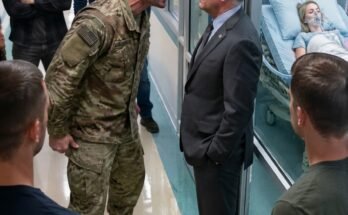
Before either officer reached me, the main corridor doors opened, and a tall man wearing an Army service uniform entered with several aides. Silver stars rested across his shoulders, and every service member in the lobby immediately straightened.
The receptionist indicated the wallet. “General Callahan, this child claims she discovered something belonging to you.”
The general recognized his wallet before his attention shifted toward the bright coral-colored eviction notice protruding from my backpack.
His face lost every trace of color.
“Where did you receive that document?” he asked.
I stepped backward because his reaction frightened me more than the approaching officers.
Before I could answer, General Callahan turned sharply toward security.
“Secure every entrance immediately, and allow nobody inside this lobby to leave until identification has been verified,” he commanded.
The doors locked while conversations disappeared around us. I stood beneath dozens of watchful eyes, holding the wallet I had returned instead of the money my family desperately needed.
The Name Inside a Sealed File
General Callahan approached slowly after noticing my fear.
“You are not in trouble, but I need to understand why that notice carries a mark I have not seen in thirteen years,” he said. “What is your name?”
“My name is Lily Reed, sir.”
His expression tightened.
“Who is your mother, Lily?”
“Her name is Hannah Reed, and she works at Brightway Laundry before serving dinner at Miller’s Roadhouse.”
The general looked toward a female officer standing near the corridor.
“Captain Morgan, locate Colonel Hayes and request the sealed Jefferson housing investigation,” he ordered. “Then contact Army legal assistance and treat the matter as restricted.”
Captain Laura Morgan, his military aide, acknowledged the order before leaving quickly. General Callahan asked permission to examine my eviction notice, carefully emphasizing that I could refuse.
I removed the wrinkled document and placed it in his hand. A purple square stamped near the bottom carried the words Jefferson Family Housing Trust, although the print had nearly disappeared beneath several property-management signatures.
“Did your mother receive this notice today?” General Callahan asked.
“She found it beneath our door this morning and told me to take it to the community housing office after school.”
“Did you travel here alone?”
“Yes, sir, because returning your wallet seemed more important than eating lunch.”
The receptionist lowered her eyes, while the general appeared deeply troubled.
He led me into a smaller conference room overlooking a carefully maintained courtyard. Instead of occupying the chair at the head of the table, he sat across from me and ordered a turkey sandwich, fruit, milk, and cookies.
I attempted to eat slowly, but hunger made my hands move too quickly. General Callahan noticed without embarrassing me.
“You could have kept the money, especially after seeing this eviction notice,” he said.
“I almost did, because nine hundred dollars would solve several problems at our apartment.”
“Choosing correctly after temptation requires greater integrity than never feeling tempted,” he replied.
Captain Morgan returned with an older male officer wearing reading glasses around his neck. Colonel David Hayes introduced himself as an Army attorney who had reviewed unresolved housing disputes throughout his career.
A thin gray folder lay beneath his arm.
“Lily, your family has not committed any legal violation,” Colonel Hayes explained. “However, somebody may have violated the law while using your family’s address.”
General Callahan opened the folder, revealing yellowed reports, financial ledgers, and several faded photographs. He selected one picture and turned it toward me.
The photograph showed my mother twelve years younger, standing beneath a large maple tree with a uniformed soldier. The man held a baby wrapped inside a green blanket, and his crooked smile created the same dimple that appeared beside my mouth.
“That is my mother, and the baby must be me,” I whispered. “Is the soldier my father?”
General Callahan nodded.
“His name was Sergeant Michael Reed, and he served in a logistics unit assigned to Fort Jefferson,” he explained.
Mom had always said my father had gone far away while trying to protect us. Whenever I pressed for details, she would repeat that he loved me before changing the subject.
“Did my father leave because he did not want us?” I asked.
“Your father disappeared while investigating stolen funds intended for military families,” General Callahan answered. “Everything we discovered suggested that he was trying to return to you.”
Thirteen years earlier, Sergeant Reed had found payments diverted from emergency family-housing accounts into private property companies. He gave copies to Grace Holloway, a civilian records clerk who had agreed to help him submit a protected report.
Before the report reached investigators, Michael vanished, the files disappeared, and Grace resigned without notice. Rumors suggested that they had stolen the money together, although no conclusive evidence supported those accusations.
“Was my father responsible for stealing the housing money?” I asked.
“No evidence ever proved that allegation, and I personally believed he was exposing the theft,” General Callahan said. “Unfortunately, believing something and proving it are very different responsibilities.”
Colonel Hayes pointed toward the purple mark on our eviction notice. The Jefferson Family Housing Trust had supposedly closed more than a decade earlier. However, our apartment building remained controlled by a company using the trust’s authority.
Another page identified Apartment 2C at the Cedar Terrace building as protected housing assigned to Michael Reed, Hannah Reed, and their infant daughter.
Your mother should never have paid rent for that apartment,” Colonel Hayes explained. “The property was reserved for your family under a survivor-protection agreement.”
I thought about Mom washing commercial sheets until her fingers split, serving diner customers through exhaustion, and choosing between rent and groceries.
“We have paid every month for eight years,” I said.
General Callahan’s jaw tightened.
“Then somebody collected money that never legally belonged to them,” he replied.
My Mother Entered Wearing Her Laundry Uniform
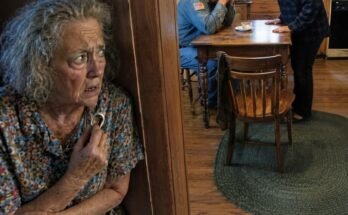
Captain Morgan contacted Brightway Laundry, and Mom arrived twenty minutes later wearing her blue work coat. Detergent powder marked one sleeve, while strands of brown hair had escaped from her hurried bun.
She found me immediately and pulled me into her arms.
“What were you thinking when you crossed the city without telling anybody?” she demanded. “Do you understand how frightened I became?”
“I found the general’s wallet and needed to return it, but then he recognized our eviction notice,” I explained.
Mom’s body became rigid when she saw General Callahan.
“Robert,” she said.
The general’s military composure changed into something resembling grief.
“Hannah, I believed you and Lily had entered a protected relocation program,” he replied.
“Somebody told me that Michael had deserted after stealing from the trust,” Mom said. “They warned that remaining near the base could lead investigators toward Lily.”
General Callahan opened the old photograph.
“Michael attempted to expose the fraud, and I failed to prove his innocence before the case disappeared behind classified restrictions.”
Mom pressed one hand against the conference table.
“You were his commander, so why did nobody tell me that another investigation existed?”
“Because somebody inside the installation altered records, redirected correspondence, and closed access around every surviving document,” he answered. “I accepted those restrictions longer than I should have.”
Colonel Hayes showed her the protected-housing agreement. Mom read the document twice before lowering herself into a chair.
“They took rent from us while sending notices that threatened to leave my daughter homeless,” she whispered.
Captain Morgan’s phone rang before anyone could respond. The property manager had scheduled our eviction for the following morning despite legal assistance requesting an emergency delay.
General Callahan did not use his rank to issue an unlawful order. Instead, Colonel Hayes contacted the county court, presented evidence questioning ownership authority, and obtained a temporary injunction preventing removal until the trust records could be examined.
“Stopping tomorrow’s eviction solves only the immediate crisis,” Mom said. “There must be other families paying companies that have no right to collect anything.”
General Callahan nodded. “We will identify every household, preserve their records, and provide independent legal representation.”
Mom looked directly at him.
“This investigation cannot disappear behind another military door,” she said.
“Civilian authorities and outside auditors will receive identical copies before sunset,” he promised. “Nobody will control the evidence alone again.”
The Key Hidden Behind an Old Photograph
While examining the sealed folder, Captain Morgan noticed a handwritten sequence beneath the photograph of my parents: C-19, North Annex, Union Terminal.
Mom recognized the writing as Michael’s. The old Union Terminal had served as a transportation and storage point for Fort Jefferson before becoming a county archive.
Tucked behind the photograph was a small brass key wrapped inside wax paper.
Colonel Hayes requested a preservation order before anyone visited the archive. A county representative, an outside investigator, Mom, General Callahan, Captain Morgan, and I traveled together after every transfer had been officially documented.
The Union Terminal stood beneath a broken clock tower on the eastern side of Columbus. Much of the building remained unused, although county archivist Eleanor Shaw maintained several rooms containing transportation and military-administration records.
She led us through a long corridor toward a secured storage area.
“Containers numbered one through thirty were transferred here from the Fort Jefferson annex eleven years ago,” Eleanor explained. “Nobody has requested Container Nineteen since the transfer.”
Unlike the surrounding cardboard boxes, Container Nineteen was a narrow gray metal case with a brass lock. Mom held the key but hesitated before inserting it.
I placed my hand across her wrist.
“We can open it together because Dad left the clue for both of us,” I said.
Mom looked at me with tears gathering in her eyes.
“Then we will discover the truth together,” she answered.
The lock released with a quiet click.
Inside rested a sealed envelope, several banking ledgers, an audio cassette, and a photograph showing three people outside the same terminal. My father stood beside Grace Holloway and a young maintenance technician carrying a toolbox.
The back contained Michael’s handwriting:
Grace, Michael, and Peter. Evidence survives only when three witnesses remember where it sleeps.
Eleanor recognized the technician as Peter Lawson, a former terminal employee who had passed away unexpectedly twelve years earlier. His daughter, Natalie Lawson, currently worked in the county property office.
The ledgers documented rent collected from protected military families and transferred through multiple shell companies. Our names appeared near the top beside a red stamp reading PROTECTED DEPENDENTS.
Mom touched the entry carefully.
“Somebody knew exactly who we were while allowing us to struggle,” she said.
Colonel Hayes continued turning pages before his expression darkened.
“At least twenty-seven families appear inside these records, and several are still paying rent through the same network,” he explained.
The discovery expanded beyond our threatened apartment. Other children had probably watched parents choose between utilities and food while property managers collected payments through fraudulent authority.
“Then helping us is not enough because every family deserves their money and home back,” Mom said.
“We will trace all twenty-seven households before this investigation closes,” General Callahan promised.
Eleanor produced an old cassette player used for recorded histories. When Captain Morgan pressed the play button, static filled the room before my father’s voice emerged.
“This is Sergeant Michael Reed, recording from Union Terminal on November seventh,” he began. “Emergency housing funds are being redirected through private companies with assistance from somebody inside Fort Jefferson.”
Mom covered her mouth while I moved closer. I had never heard my father’s voice, but something inside its patient rhythm felt familiar.
Michael described the fraudulent accounts and explained that Grace had duplicated the property records while Peter hid them inside Container Nineteen. He believed at least one trusted official had compromised the reporting system.
Then his voice softened.
“Hannah, keeping you uninformed seemed like protection when I recorded this message, but secrecy can injure the people we love as deeply as danger,” he said. “If I cannot return, please tell Lily that leaving was never my choice.”
Mom began crying silently.
“She was still a baby when you recorded this,” she whispered.
The tape continued.
“Robert, remember the station clock and the number five twenty-three. It does not describe the time, because the truth remains beneath whatever makes people look upward.”
General Callahan stared toward the broken clock tower above the terminal.
“Old luggage lockers were installed beneath the tower stairs,” Eleanor said. “Most were sealed before the county acquired the building.”
Michael delivered one final message before the tape ended.
“If Lily ever reaches this evidence, tell her I believed she would inherit her mother’s courage and return what never belonged to her.”
I pressed my face against Mom’s shoulder.
“Dad somehow knew what kind of person I would become,” I said.
“He knew what kind of heart we would teach you to protect,” she answered.
Locker 523 and the Living Witness
The luggage lockers beneath the clock tower had lost most of their numbers beneath rust and paint. After examining each door, I noticed three shallow markings scratched near the lower corner of one locker: 5 | 23.
The brass key did not fit its lock, while the county maintenance keys also failed. A thin object protruded through a bent opening near the bottom, so I carefully pulled it free under Captain Morgan’s supervision.
It was a recently issued county employee badge belonging to Natalie Lawson, Peter’s daughter.
A white label covered the barcode with a handwritten instruction:
Ask Natalie what Peter guarded after Michael disappeared.
Captain Morgan immediately requested Natalie’s location, while outside investigators verified that she was scheduled inside the county property office that afternoon. Before anyone could reach her, Eleanor received a call from the terminal’s reception desk.
“A woman at the entrance is asking to speak with Lily Reed,” she announced.
Mom wrapped one arm around me.
“Who is she?”
Eleanor lowered the phone.
“She identified herself as Grace Holloway, although records indicate that Grace disappeared thirteen years ago.”
General Callahan instructed security to verify her identity while keeping the public entrance open under controlled observation. Several minutes later, a woman in her late fifties entered with gray-streaked hair, a canvas document case, and both hands visible.
She stopped when she saw Mom.
“Hannah, Michael asked me to protect you, but every method we chose caused another kind of harm,” she said.
Mom moved slightly in front of me.
“Where is my husband?”
Grace’s eyes filled with sorrow.
“Michael survived the night he disappeared, but he was injured while attempting to reach federal investigators,” she explained. “Peter and I moved him through a private medical clinic because compromised officials were monitoring local hospitals.”
General Callahan stepped closer.
“Did Michael survive afterward?”
“He remained alive for nearly two years, although his condition prevented safe travel and eventually took his life,” Grace answered. “He spent that time assembling evidence and recording statements that could not be dismissed as speculation.”
Mom closed her eyes, absorbing the cruelty of learning that Michael had lived while she believed he had abandoned her.
“Why did nobody contact me after the danger passed?”
“The danger never passed because the property network expanded through county offices,” Grace said. “Peter was discovered first, and his death was presented as a medical emergency. Afterward, I changed my identity and preserved the remaining evidence.”
Grace opened the canvas case, revealing Michael’s dog tags, letters addressed to Mom and me, medical records, and a notarized statement identifying those who controlled the fraud.
She explained that Peter’s daughter had recently found Locker 523 while reviewing old maintenance plans. Natalie removed one document before becoming frightened and hid her badge inside the locker as a signal for Grace.
“Who controls the network now?” Colonel Hayes asked.
Grace looked toward the eviction notice in Mom’s hand.
“The property company collecting Hannah’s rent belongs to the son of the civilian housing director who originally organized the scheme,” she answered. “He continued the operation because everybody believed the evidence had disappeared.”
County investigators located Natalie safely inside her office. She admitted copying documents proving that officials had manipulated deeds, trust closures, and eviction proceedings. She had concealed herself after receiving anonymous threats but agreed to testify once independent protection became available.
The evidence inside Locker 523 completed the financial trail. Under Eleanor’s supervision, maintenance staff opened it without damaging the contents. Investigators recovered Michael’s original ledger, correspondence between the conspirators, and a second recording establishing his innocence.
General Callahan stood beside Mom while each item entered an official evidence log.
“Michael came to me before he disappeared, and I allowed procedure to delay action,” he said. “I cannot undo that failure, but I will ensure his service record reflects the truth.”
Mom regarded him carefully.
“Clearing Michael’s name matters, although the living families matter more than another ceremony,” she replied.
“Then every correction will begin with them.”
What Honesty Returned to Us
The investigation lasted more than a year. Civilian prosecutors charged several property executives and former officials with fraud, conspiracy, document falsification, and theft involving protected housing funds.
All twenty-seven families received legal assistance. Improper eviction proceedings were canceled, ownership records were corrected, and stolen rent payments entered a court-supervised restitution process.
Our apartment transferred into Mom’s name under the original survivor agreement. She received reimbursement for years of unauthorized rent, although she continued working at the laundromat until she felt secure enough to leave one job.
General Callahan restored my father’s military record during a private ceremony chosen by Mom. No reporters attended, and nobody turned our experience into publicity for the installation.
He handed Mom Michael’s corrected service documents before kneeling so that he could speak to me at eye level.
“Your father exposed the crime, but your decision beneath a bus bench finally brought his evidence into daylight,” he said.
“I only returned something that was not mine,” I replied.
“That simple principle becomes uncommon when people believe nobody is watching.”
Grace Holloway testified publicly and helped investigators identify additional accounts. Natalie Lawson entered witness protection temporarily before returning to county employment after the immediate danger ended.
Mom read Michael’s letters slowly because each page delivered comfort and grief together. His final letter to me described the baby he remembered and the child he hoped I would become.
He never asked me to be fearless. Instead, he wrote that courage meant carrying fear while refusing to let it decide what was right.
Several months after the investigation concluded, General Callahan visited our apartment without an official entourage. Mom served coffee, while I showed him the framed photograph of my parents beneath the maple tree.
The eviction notice remained preserved inside another frame beside it.
“Why would anyone display something that caused so much fear?” the general asked.
“Because it reminds us that a threat can also become evidence when somebody finally examines it,” Mom answered.
The nine hundred dollars from the wallet never paid our rent, groceries, or electricity. Returning it gave us something larger than temporary relief because it reopened a case, restored my father’s honor, protected twenty-seven families, and ended a system that depended upon silence.
Whenever life later asked whether honesty was worthwhile, I remembered the wallet beneath the Cedar Street bench.
Doing the right thing did not immediately make my circumstances easier. It required two buses, an empty stomach, a locked military lobby, and enough fear to make my knees shake.
However, honesty carried me toward a truth that money could never have purchased.