On Thanksgiving, my 14-year-old nephew locked my 8-year-old son inside the chest freezer in Grandma’s garage. “It’s a prank, Aunt Keira. Relax.” My mother kept carving the turkey. “Boys will roughhouse.” I ran to the garage. The freezer had a padlock on it. And the knocking from inside had stopped.
My name is Keira. I’m a paramedic in Cedar Rapids, Iowa.
My son, Elias, is eight. He’s small for his age. He has asthma and wears glasses. He’s gentle and shy, and he loves building things out of Legos.
Every Thanksgiving, my whole family gathers at my mother’s farmhouse outside town. My mother, Magda. My older sister, Yvonne. Her three kids. My son and me.
Yvonne’s oldest son is Wolfe. He’s fourteen. He’s big for his age. He’s always been mean to Elias.
He calls him “Four Eyes.” He takes his inhaler and holds it over his head. Last Christmas, he pushed Elias into the snow and sat on him until he cried.
Every time, I complained to Yvonne. Every time, she rolled her eyes.
“Wolfe’s just a boy, Keira. Your son needs to toughen up.”
Every time, my mother agreed with her.
“You baby that child. Boys roughhouse. That’s how they learn.”
This Thanksgiving, I almost didn’t go. But Elias wanted to see his grandma.
“Please, Mom. I’ll stay away from Wolfe. I promise.”
We got there at noon. The house smelled like turkey and pumpkin pie. The kids went to play in the barn and the garage. The adults stayed in the kitchen.
I kept checking on Elias every few minutes. He was building a fort out of hay bales with the younger cousins.
At 3 p.m., my mother asked me to help her mash the potatoes.
I was in the kitchen for maybe fifteen minutes.
Then Wolfe walked in, laughing, with two of his younger brothers.
“Where’s Elias?” I asked.
Wolfe grinned at his brothers.
“Playing hide and seek.”
The younger boys giggled. Then they looked at each other.
Something in my stomach turned cold.
“Wolfe. Where is my son?”
He shrugged.
“He’s hiding. In the garage. It’s a prank, Aunt Keira. Relax.”
“What kind of prank?”
One of the younger boys, a seven-year-old, blurted it out.
“Wolfe put him in the big freezer!”
The kitchen went silent.
My mother didn’t even look up from the turkey. She kept carving.
“Oh, for heaven’s sake. Boys will roughhouse. He’ll pop right out.”
Yvonne laughed. “He’s fine, Keira. It’s a joke.”
I didn’t scream. Paramedics don’t scream. We move.
I said, “Okay,” and I ran.
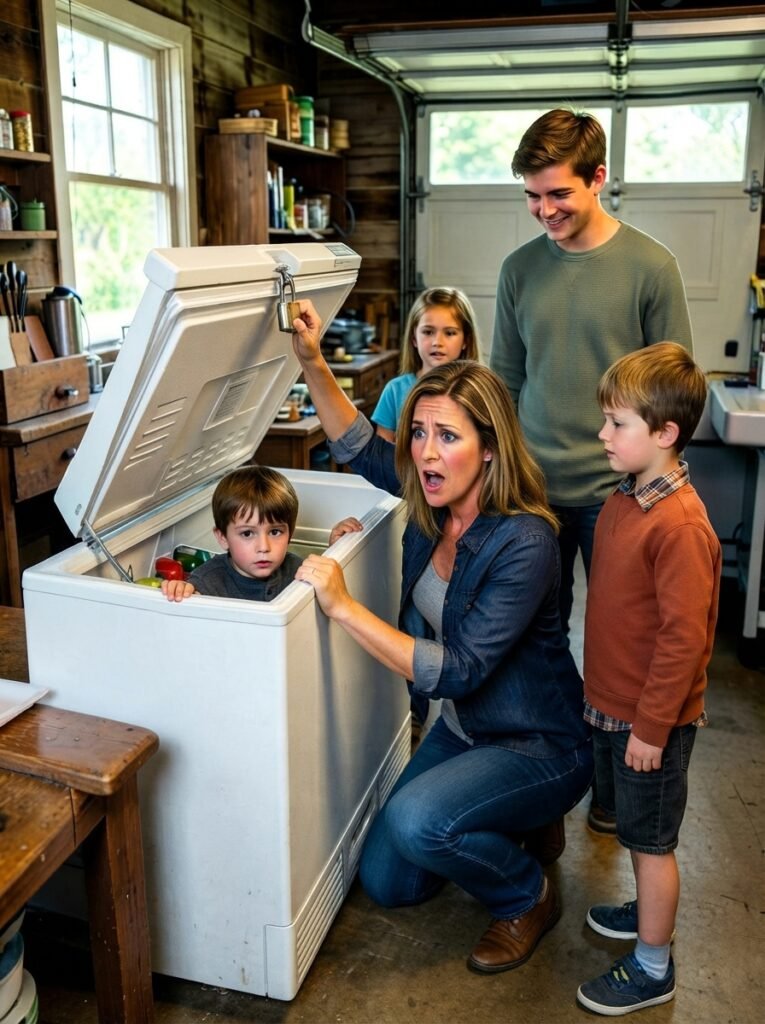
The garage was cold and dark. In the back corner, next to my father’s old workbench, was the big white chest freezer my mother keeps full of venison.
It was closed.
The latch on the front had a padlock through it.
My mother’s padlock. The one she uses so the raccoons can’t get in.
“Elias!” I pounded on the lid. “ELIAS! Mommy’s here!”
I put my ear against the lid.
Nothing.
No knocking. No crying. No sound at all.
I’ve been a paramedic for eleven years. I know how long a person can last in a small, airtight box. I know what freezing air does to small lungs. I know what it does to a child with asthma.
I yanked on the padlock. It didn’t move.
I ran back into the kitchen.
“Where’s the key? WHERE IS THE KEY?”
Wolfe was leaning against the counter, eating a dinner roll.
He smirked at me.
“I don’t know,” he said. “I think I dropped it in the snow.”
Then he laughed.
“He’s only been in there for twenty minutes.”
PART 2
I didn’t waste another second on him.
I jammed it under the hinges at the back of the freezer lid. The hinges are weaker than the latch. I learned that on a call years ago.
I pushed with everything I had.
The first hinge snapped. Then the second.
I ripped the lid up and to the side.
My son was curled up on top of the frozen packages of meat. His knees against his chest. His glasses were fogged over and frosted at the edges.
His lips were blue.
He wasn’t moving.
I pulled him out and laid him on the garage floor. He was ice cold. His chest wasn’t moving.
I tilted his head back and gave him two breaths. Then I checked his pulse.
There. Weak. Slow. But there.
I gave him another breath. And another.
Then he coughed. A terrible, wheezing, rattling cough.
His asthma.
“Somebody get his inhaler!” I screamed. “Front pocket of my bag! And call 911!”
My sister’s youngest son ran inside. He came back with the inhaler. I put it to Elias’s mouth and pressed it.
“Breathe, baby. Breathe for Mommy.”
He took a shaky breath. Then another.
His eyes opened.
“Mommy,” he whispered. “It was so dark. I couldn’t breathe. I knocked and knocked.”
“I know, baby. I’m here.”
By the time the ambulance arrived, the whole family was standing in the garage doorway. My mother was holding the carving knife. Yvonne had her hand over her mouth.
Wolfe was standing behind them. He wasn’t laughing anymore.
The paramedics knew me. One of them, a guy I’ve worked with for years, looked at the freezer with the broken lid.
“Keira, how long was he in there?”
“Twenty minutes. Maybe more.”
His face went pale.
At the hospital, Elias was treated for hypothermia and a severe asthma attack. The doctor said the freezer had almost no air left inside. Another five or ten minutes, and the outcome would have been very different.
A sheriff’s deputy came to the hospital that evening.
He’d gone to my mother’s house. He’d found the padlock key.
It wasn’t in the snow.
It was in Wolfe’s jacket pocket.
Wolfe was charged as a juvenile with reckless endangerment and unlawful restraint. The judge ordered him into counseling and community service. He’s not allowed near my son.
Yvonne called me screaming.
“You’re ruining his life over a prank! He’s fourteen!”
“He locked my eight-year-old in a freezer and lied about the key while my son was suffocating,” I said. “That’s not a prank, Yvonne. And you laughed.”
I hung up.
My mother didn’t call for three weeks.
When she finally did, she was crying so hard I could barely understand her.
“I keep seeing his blue lips,” she said. “I said boys will roughhouse. I said it every time. I never once listened to you.”
“No, Mom,” I said. “You didn’t.”
“I’m sorry, Keira. I’m so sorry. Can I see him?”
I let her come. Once a week. With me in the room.
The first time she visited, she brought Elias a huge box of Legos. She sat on the floor and helped him build for three hours.
The next week, my mother had the freezer hauled away. She sold it for scrap.
Elias is nine now. He still doesn’t like the dark. He sleeps with a night-light shaped like a star.
But last month, he told me something.
“Mom, when I was in the freezer, I wasn’t scared you wouldn’t come. I knew you would. I just didn’t know if you’d come in time.”
I held him close.
“I’ll always come in time,” I said.
THE END.