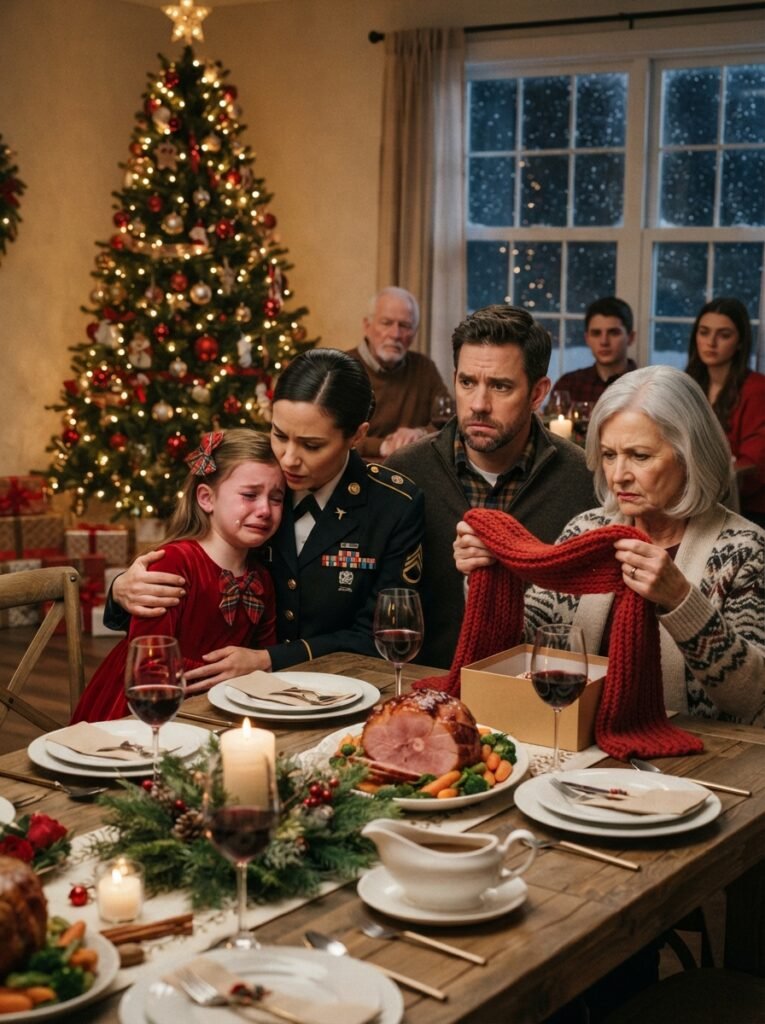
The night my eight-year-old daughter learned that love could be rejected, my husband finally stood up to his mother.
Three weeks later, I discovered that the woman who had humiliated my little girl at Christmas had been hiding something far worse than a cruel heart.
Something involving $17,400, a secret bank account, a forged legal document, and my daughter’s name.
But the most terrifying part wasn’t the money.
It was the realization that my husband knew more than he was telling me.
And by the time I discovered the truth, someone had already made plans to take something from our daughter that she didn’t even know belonged to her.
My name is Rebecca Lawson.
I’m forty years old, a staff sergeant in the North Carolina Army National Guard, a wife of thirteen years, and the mother of a little girl named Lily.
I have served through emergencies, spent sleepless nights during military training, and learned to remain calm when everything around me seems to be falling apart.
But nothing in my training prepared me for the moment I watched my daughter’s grandmother deliberately crush her spirit.
It happened on Christmas Day.
And it began with a red scarf.
Three weeks before Christmas, Lily sat cross-legged on our living room carpet, struggling to hold two knitting needles.
A bright red ball of yarn rolled across the floor.
“Mommy, it’s doing it again!”
I looked up from the laundry I was folding.
“What’s happening, sweetheart?”
“The holes keep getting bigger!”
I smiled and moved beside her.
Lily had decided to knit a scarf for her grandmother, Margaret Lawson.
She’d gotten the idea after watching me repair an old sweater in November.
“Grandma always says she’s cold,” Lily had explained.
“If I make her a scarf, she’ll be warm because I love her.”
I remembered feeling a little pinch in my chest.
Margaret wasn’t an easy woman to love.
She was sixty-eight, fiercely opinionated, obsessed with appearances, and convinced that everyone around her should organize their lives according to her preferences.
She’d never approved of my military career.
She frequently complained that my training weekends inconvenienced her son, Daniel.
She criticized my cooking, my clothes, and sometimes even the way I spoke.
But with Lily, she’d generally maintained enough politeness that my daughter still adored her.
Or perhaps Lily simply hadn’t learned to recognize coldness disguised as good manners.
I guided her small fingers around the needles.
“Try again.”
She sighed.
“What if Grandma doesn’t like it?”
“She’ll love that you made something for her.”
It was the kind of reassurance parents give without thinking.
I would spend months wishing I’d chosen my words more carefully.
For three weeks, Lily worked on that scarf every evening.
She knitted after homework.
She knitted while Daniel watched football.
She knitted through Christmas movies, sometimes counting stitches aloud while the rest of us whispered so we wouldn’t distract her.
The scarf wasn’t perfect.
One end was wider than the other.
There was an awkward bump halfway down.
But every stitch represented patience, determination, and the innocent certainty that love could be wrapped in something handmade.
On Christmas morning, Lily burst into our bedroom before sunrise.
“Mommy!
Is it time?”
Daniel groaned and pulled the blankets over his head.
“Santa’s union doesn’t start work before seven.”
Lily giggled and climbed onto the bed.
“Grandma’s going to be so surprised!”
I kissed her forehead.
“Yes, baby.
She is.”
I had no idea just how surprised we would all be.
Margaret’s house stood in a quiet, expensive neighborhood in North Raleigh.
It was a handsome two-story brick home with white columns, a circular driveway, and landscaping maintained by professionals.
My father-in-law, Edward, had died three years earlier.
Since his death, Margaret had repeatedly complained about the costs of keeping the property.
“The taxes are unbelievable,” she’d say.
“Nobody realizes what it costs to maintain a place like this.”
I sympathized.
Losing a spouse after forty years had to be painful.
Even when Margaret’s comments became pointed, I tried to remember that grief sometimes emerged as bitterness.
We arrived shortly after four.
Daniel carried our sweet potato casserole.
I carried a pecan pie from Harris Teeter.
Lily carried her shoebox wrapped in green tissue paper.
Margaret opened the door wearing an expensive cream-colored sweater and a pearl necklace.
“Daniel!
Finally!”
She kissed his cheek.
Then she looked past me.
“Rebecca.
I see you’re wearing boots again.”
I glanced at my brown ankle boots.
“It’s cold outside.”
“Well, some people still dress up for Christmas.”
I smiled tightly.
“Merry Christmas, Margaret.”
My sister-in-law, Cynthia, sat in the living room with her husband, Frank, and their two teenage sons.
Cynthia was forty-five and worked in real estate.
She was beautiful in the carefully maintained way of someone who considered appearances a full-time occupation.
Her blond hair was perfectly styled.
Her diamond bracelet sparkled when she lifted her wineglass.
Margaret practically worshipped her.
“Cynthia closed another big sale last week,” Margaret announced before we’d even removed our coats.
“That’s wonderful,” I said.
Cynthia smiled.
“Some of us don’t have the luxury of playing soldier on weekends.”
Daniel heard it.
I knew he did.
But he simply carried the casserole into the kitchen.
That had always been our arrangement.
Margaret and Cynthia made remarks.
I ignored them.
Daniel kept the peace.
Until Christmas dinner.
Dinner itself was ordinary enough.
Ham, dressing, green beans, sweet potatoes, and rolls filled the table.
The Christmas tree glowed beside the window.
Silver ornaments reflected the candlelight.
Cynthia talked about property prices.
Margaret complained about her expenses.
Then she turned toward me.
“Another training weekend next month?”
“Yes.”
She sighed.
“Poor Daniel.”
I kept my voice even.
“We’ve worked out our schedule.”
“Children need consistency, Rebecca.”
I looked at Lily, who was happily eating a roll beside her father.
“She has consistency.”
Margaret lifted an eyebrow.
“Well, everyone has their own standards.”
Daniel cleared his throat.
“Mom, could you pass the green beans?”
And the conversation moved on.
As always.
After dessert, Lily tugged on Daniel’s sleeve.
“Daddy, can I give Grandma her present now?”
He smiled.
“Of course, sweetheart.”
She climbed down from her chair, collected her shoebox, and walked around the table.
Her cheeks were pink with excitement.
“Merry Christmas, Grandma!”
Margaret accepted the box with one hand.
She pulled away the tissue paper.
Lifted the scarf.
Turned it over.
Then she frowned.
“Oh.”
Lily’s smile faltered.
“Do you like it?”
Margaret held the scarf between two fingers.
“Well, it’s certainly… handmade.”
“I made it all by myself!”
“Yes, I can see that.”
Then Margaret placed the scarf back into the shoebox and pushed it toward my daughter.
“Give it to someone who’ll actually wear it, honey.”
Silence swept across the table.
Lily blinked.
“But Grandma…”
“I’m simply being practical, sweetheart.”
“I made it for you.”
“And I’m telling you I won’t use it.”
I watched my daughter’s face change.
It happened slowly.
First confusion.
Then embarrassment.
Then a terrible, wounded understanding.
Her lower lip trembled.
“Was it ugly?”
I felt something hot rise in my throat.
“Margaret—”
“Oh, don’t make such a fuss, Rebecca.
Children need to learn that not everybody appreciates homemade things.”
I was already pushing my chair backward when Daniel put down his fork.
The small sound seemed impossibly loud.
“Mom.”
Margaret turned toward him.
“What?”
“You could have thanked her.”
“I appreciate the thought.”
“Then why would you say something so cruel?”
“Daniel, honestly.
You’re being ridiculous.”
He stood.
His chair scraped across the hardwood floor.
“Lily, get your coat.”
My daughter stared up at him.
“Daddy?”
He walked over, knelt in front of her, and gently lifted the shoebox from her hands.
“Say goodbye to Grandma, sweetheart.”
Margaret rolled her eyes.
“Oh, for heaven’s sake.”
Then Daniel said something I’d never heard him say in thirteen years.
“It’s the last time.”
Margaret’s expression hardened.
“Excuse me?”
“We’re leaving.”
“Over a ridiculous scarf?”
Daniel looked directly at her.
“No, Mom.
We’re leaving because you hurt my daughter, and you don’t even care.”
Cynthia stood.
“Daniel, don’t let Rebecca turn this into some ridiculous family drama.”
He turned toward his sister.
“Stay out of it.”
Cynthia’s mouth fell open.
Daniel looked back at Margaret.
“We’re not coming back for another holiday like this.”
Then he took Lily’s hand.
I grabbed our coats.
And we left.
The drive home was nearly silent.
Lily sat in the back seat holding the shoebox against her chest.
Outside, the familiar streets of Raleigh passed beneath yellow streetlights.
Near Six Forks Road, she finally spoke.
“Daddy?”
“Yes, honey?”
“Was my scarf really that bad?”
Daniel’s knuckles tightened around the steering wheel.
“No, sweetheart.”
“Then why didn’t Grandma want it?”
He looked into the rearview mirror.
“Because Grandma didn’t understand how special it was.”
Lily considered that.
Then she whispered something that almost broke me.
“Maybe I should’ve bought her something instead.”
I turned around.
“No, baby.
You made something wonderful.”
“But she didn’t like it.”
“That doesn’t change what you made.”
Lily nodded, though I could tell she didn’t believe me.
That night, after she’d gone to bed, Daniel sat at our kitchen table staring at his phone.
“Mom’s called six times.”
I poured two cups of coffee.
“Are you going to answer?”
He shook his head.
Then he rubbed his forehead.
“I keep thinking about how she spoke to Lily.”
I sat across from him.
“And I keep thinking about how she’s spoken to you for years.”
I looked at him.
He swallowed.
“I knew she was doing it, Rebecca.
I just kept telling you to ignore her.”
I didn’t answer.
Because for once, I wasn’t interested in making him feel better.
He reached across the table.
“I’m sorry.”
I wanted to believe this was the beginning of something different.
Maybe it was.
But sometimes the first truth only opens the door to something much uglier.
Three days later, I discovered the first bank statement.
I was reviewing our household expenses when an unfamiliar payment caught my attention.
$850.
The recipient was listed as Margaret Property Services.
The description referenced Margaret’s North Raleigh property.
I opened another statement.
Then another.
And another.
Not every month contained the same payment, but enough did that my stomach began tightening.
I carried the paperwork into the living room.
“Daniel, what’s this?”
He glanced at it.
Then looked away.
That was all I needed to know.
“Daniel.”
He rubbed his hands against his jeans.
“It’s money I’ve been sending Mom.”
“Eight hundred and fifty dollars?”
“Sometimes.”
“How long?”
He hesitated.
“Almost two years.”
I sat down.
We had a mortgage.
We had a daughter.
Our washing machine had been making a grinding noise for months.
We discussed school supplies, groceries, car insurance, and whether we could afford to replace our aging refrigerator.
Yet my husband had secretly been supporting a woman who lived in a house worth more than anything we owned.
“How much?”
I asked.
He didn’t answer.
“Daniel, how much money have you sent her?”
He stared at the floor.
“Seventeen thousand, four hundred dollars.”
For a moment, the room seemed to move.
“$17,400?”
“Rebecca—”
“While we’ve been postponing repairs?
While I’ve been picking up extra shifts?”
“Mom said she was struggling.”
“Did you verify that?”
He looked miserable.
“No.”
I laughed once.
It wasn’t a happy sound.
“Of course you didn’t.”
Then his phone rang.
Margaret.
Daniel stared at the screen.
“Answer it,” I said.
He hesitated.
“Put it on speaker.”
He did.
“Daniel!”
Margaret snapped.
“Cynthia says Rebecca has been asking questions about my finances.”
My skin prickled.
I hadn’t spoken to Cynthia.
“Margaret,” I said, “where has the money been going?”
A pause.
Then an unpleasant little laugh.
“Oh, Rebecca.
You wouldn’t understand.”
“Try me.”
“That money was never yours to question.”
Daniel leaned forward.
“Mom, answer her.”
Her voice changed instantly.
“Daniel, don’t forget what happens if Rebecca discovers the other account.”
The room went still.
I looked at my husband.
“What other account?”
“Mom, stop talking,” Daniel whispered.
But I was already on my feet.
“Daniel, what account?”
He ended the call.
His face had turned white.
Then my phone vibrated.
An unfamiliar number had sent me a photograph of a legal document.
Beneath it were six words.
YOUR HUSBAND HASN’T TOLD YOU EVERYTHING.
I enlarged the photograph.
At the top was the name of a family trust.
Below it appeared a section marked Beneficiary Consent and Parental Acknowledgment.
And there, printed in unmistakable black letters, was a name that made my heart slam against my ribs.
LILY REBECCA LAWSON.
My daughter’s full legal name.
Underneath was a signature that appeared to be mine.
But I had never signed that document.
Not once.
I turned toward Daniel.
“Explain this.”
He looked at the screen.
And for the first time in our marriage, I saw something worse than shame in his eyes.
Fear.
“What is this, Daniel?”
He reached for the phone.
I pulled it away.
“Don’t.”
“Rebecca, let me explain.”
“Then explain.”
He stood, walked to the window, and pressed both hands against the frame.
“After Dad died, Mom told me he’d created a trust for Lily.”
I stared at him.
“What kind of trust?”
“An inheritance.
Property.
Some investments.”
“How much?”
“I don’t know exactly.”
“Daniel.”
“I’m telling you the truth!”
I looked at the document again.
It mentioned the Lawson Heritage Trust, a property transfer, and a company called Cedar Vale Holdings.
The photograph showed only the first two pages.
At the bottom of the second page was my supposed signature.
“Why is my name on this?”
Daniel swallowed.
“Mom said there were some documents we needed to sign.”
“We?”
“Yes.”
“Did you sign them?”
He nodded.
“Did you sign my name?”
“No!”
He answered so quickly that I wanted to believe him.
“Then who did?”
“I don’t know.”
I stared at him until he looked away.
Then another thought struck me.
“How long have you known Lily has an inheritance?”
“Since Dad died.”
“Three years?”
He said nothing.
Three years.
For three years, my husband had known that our daughter was the beneficiary of some kind of family trust.
For three years, he’d kept that information from me.
And now my name appeared on a legal document I’d never seen.
I felt an unfamiliar distance open between us.
“Why didn’t you tell me?”
“Mom said Dad wanted it to be a surprise when Lily turned eighteen.”
“And you believed her?”
“She’s my mother.”
“She’s also the woman who threw our daughter’s Christmas gift back at her!”
He flinched.
I took a slow breath.
“Daniel, I need you to listen carefully.
I’m not asking whether your mother loves you.
I’m asking whether you’ve helped her do something illegal.”
His face crumpled.
“I don’t know anymore.”
That frightened me more than a denial would have.
I looked down at my phone.
The anonymous sender had included a second message.
Ask about the January fifteenth closing.
There’s still time to stop it.
I read it twice.
January fifteenth.
Eighteen days away.
Whatever Margaret and Cynthia were planning, it hadn’t happened yet.
And that meant we had a chance.
The following morning, I contacted an attorney named Ellen Voss.
Ellen specialized in estate disputes and trust litigation.
Her office was in downtown Raleigh, on the third floor of a brick building with tall windows and a surprisingly cheerful waiting room.
I arrived carrying every document I could find.
Bank statements.
Screenshots.
The photograph of the forged signature.
Daniel came with me.
We sat on opposite sides of the small conference table.
Ellen was a woman in her early fifties with dark-framed glasses and the calm, attentive expression of someone who had spent years listening to people explain disasters they never expected.
She examined the documents without interrupting.
Then she removed her glasses.
“Rebecca, did you sign this acknowledgment?”
“No.”
“Did you give anyone permission to sign for you?”
“Absolutely not.”
“Did you authorize Margaret or Cynthia to represent your daughter in this transaction?”
“No.”
Ellen turned toward Daniel.
“Did you know Rebecca hadn’t signed it?”
He hesitated.
“I knew she’d never mentioned signing it.”
“That’s not what I asked.”
He lowered his eyes.
“My mother told me Rebecca had completed it electronically during a training assignment.”
I stared at him.
“You never asked me?”
“Mom said it was confidential.”
Ellen folded her hands.
“Mr.
Lawson, confidential from whom?”
Daniel had no answer.
Ellen studied the photograph again.
“The document appears to concern the sale of trust-owned real estate.
If the information here is accurate, your daughter is a beneficiary whose interests may be affected.”
“How much real estate?”
I asked.
She opened her laptop.
“Let’s find out.”
For the next twenty minutes, she reviewed public property records and documents from the county register of deeds.
Her expression gradually changed.
Finally, she turned the screen toward us.
Two parcels appeared on a property map.
One was a large tract of undeveloped land outside Apex.
The other was a residential property in North Raleigh.
Margaret’s house.
“These properties appear to be held by the Lawson Heritage Trust,” Ellen said.
I frowned.
“But Margaret owns her house.”
“That’s what she told you?”
“Yes.”
Ellen tapped the screen.
“According to the recorded documents, title was transferred into the trust before Edward Lawson died.”
Daniel leaned forward.
“I thought Dad left the house to Mom.”
“She may have a right to live there,” Ellen said.
“But that’s not the same thing as owning the property outright.”
I stared at the map.
“Who owns it, then?”
“Legally, the trustee holds title under the terms of the trust.
We need the complete agreement to determine the beneficiaries and their respective rights.”
Then she clicked another document.
“Now, this is interesting.”
“What?”
“A notice associated with a proposed transfer of the Apex property.”
She enlarged the page.
The proposed purchaser was Cedar Vale Holdings LLC.
The purchase price was listed as $340,000.
Daniel frowned.
“That seems low.”
Ellen nodded.
“Depending on the property, it may be extremely low.”
She showed us a county assessment and nearby development transactions.
The figures weren’t identical, and she warned that tax assessments weren’t formal appraisals.
But the difference was enormous.
Similar land in that area had recently attracted offers worth several million dollars.
I felt cold.
“Someone’s trying to buy my daughter’s inheritance for a fraction of what it might be worth?”
“Possibly,” Ellen said.
“But we need to establish who controls the purchasing company, who authorized the transaction, and whether the trustee is acting properly.”
She leaned forward.
“Rebecca, you need to understand something.”
I nodded.
“If your signature was forged, this is more than a family disagreement.”
Daniel pressed his fingers against his temples.
Ellen continued.
“And if trust assets are being transferred for less than fair value to someone connected with the trustees, that could be a serious breach of fiduciary duty.”
I looked at my husband.
He wouldn’t meet my eyes.
“Can we stop it?”
“We can seek records immediately and, if warranted, ask the court for emergency relief.”
I swallowed.
“What do you need from us?”
“Everything.
Every bank statement, email, message, and document you can lawfully access.
Don’t confront anyone about the sale just yet.
Don’t destroy anything.
And don’t sign anything they send you.”
Then she looked directly at Daniel.
“Mr.
Lawson, I need you to be completely honest with me.
Whatever you’ve already signed, I need to see it.”
He nodded.
“I understand.”
But as we left her office, he whispered something that stopped me in the hallway.
“Rebecca, there’s one more thing.”
I turned.
“What?”
He took a breath.
“Mom gave me a copy of the original trust agreement after Dad’s funeral.”
I stared at him.
“Where is it?”
He looked sick.
“In the safe at home.”
For a moment, I couldn’t speak.
Then I walked toward the elevator.
Daniel followed.
“Rebecca, please.”
I pressed the button.
“Three years, Daniel.”
“I know.”
“Three years, and you watched me worry about our daughter’s future while you kept her inheritance locked in our safe.”
His eyes filled.
“I thought I was protecting her.”
I shook my head.
“You were protecting your mother from me.”
He didn’t deny it.
That evening, Daniel opened the small fireproof safe in our bedroom closet.
Inside were our passports, birth certificates, insurance documents, and a thick manila envelope.
He handed it to me.
I recognized Edward Lawson’s handwriting on the front.
Daniel — Family Records.
For several seconds, I stared at the familiar letters.
Edward had been a quiet man.
He’d worked for decades as a civil engineer, invested carefully, and never talked much about money.
When Lily was born, he’d been the first person to arrive at the hospital.
He’d held her in his arms and cried.
I remembered him standing beside her crib, whispering, “There you are, little one.
We’ve been waiting for you.”
He’d died from complications following a stroke when Lily was five.
She still remembered him.
Sometimes she asked why Grandpa couldn’t come back for Christmas.
I opened the envelope.
Inside were photocopies of the trust agreement, a handwritten note, and several financial statements.
The trust was far more complicated than I’d expected.
Edward had placed his Raleigh home, the acreage outside Apex, and several investment accounts into it.
Margaret was entitled to certain income and had permission to continue living in the house.
Daniel and Cynthia had limited interests.
But the documents identified Lily as the primary beneficiary of the remaining property.
There were also provisions designed to prevent trust assets from being sold improperly or transferred to anyone connected with a trustee without appropriate oversight.
I read until my eyes burned.
Then I found Edward’s note.
Daniel,
Your mother has always believed that security comes from owning things.
I’ve spent most of my life believing that security comes from taking care of people.
I hope this trust will protect Lily’s future without becoming a burden to her parents.
If there is ever a disagreement about the property, please remember that the person with the most money does not always have the greatest right.
Take care of your girls.
Dad.
I sat on the edge of the bed.
Daniel stood in the doorway.
“Why did he give this to you?”
“Mom handed it to me after the funeral.
She said Dad wanted me to keep it somewhere safe.”
“Did you read it?”
“Some of it.”
I looked up sharply.
“Some of it?”
He swallowed.
“Rebecca, I know how that sounds.”
“No.
I don’t think you do.”
I held up the letter.
“Your father trusted you to protect our daughter.”
His face twisted.
“I know.”
“And you let your mother convince you to hide everything from me.”
Daniel sat down beside me.
“I thought if Mom had her house and Lily had her inheritance, everyone would be okay.”
I shook my head.
“That’s not protection.
That’s avoidance.”
He covered his face with both hands.
For the first time, I saw clearly how much his childhood had shaped him.
Margaret had taught Daniel that disagreement was betrayal.
That questioning her meant disrespect.
That peace could only exist when everyone did what she wanted.
He’d spent his entire life trying to keep his mother happy.
And somewhere along the way, he’d forgotten that his first responsibility was to the family he’d created.
I wanted to reach for him.
I didn’t.
Because love couldn’t erase the damage he’d done.
The next day, I visited someone I hadn’t spoken to in almost a year.
Her name was Evelyn Walker.
She lived two houses down from Margaret and had been friends with Edward for more than thirty years.
Evelyn was seventy-three, sharp-eyed, and famous in the neighborhood for knowing everyone’s business.
She opened her door wearing slippers and a floral sweater.
“Rebecca!
Well, this is a surprise.”
I smiled.
“Do you have a few minutes?”
“For you?
Of course.”
Her living room smelled of cinnamon and fresh coffee.
She poured two cups and settled into an armchair.
I started carefully.
“Evelyn, did Edward ever talk to you about the land outside Apex?”
Her expression changed.
“The old family acreage?”
“Yes.”
“He loved that place.”
“Did he ever mention selling it?”
Evelyn shook her head.
“Quite the opposite.”
I leaned forward.
“What do you mean?”
She looked toward the window.
“About six months before he died, Edward told me Cynthia had been pushing him to sell.”
My pulse quickened.
“Why?”
“Some developer was interested.
Apparently, the property had become valuable.”
“Did Edward want to sell?”
“No.
He said there was no reason to rush.
He wanted Lily to have options when she was older.”
I glanced at my coffee.
“And Margaret?”
Evelyn gave me a long look.
“Rebecca, are you sure you want to know?”
“Yes.”
She sighed.
“Margaret was furious.”
“About what?”
“Edward putting the property in the trust.
She said he’d made a fool of her.”
I stared at her.
“Why?”
“Because she expected everything to become hers when he died.”
Evelyn leaned closer.
“I remember one evening particularly well.
They’d argued on the back porch.
Margaret shouted that Edward loved his granddaughter more than his own wife.”
My stomach tightened.
“What did he say?”
Evelyn smiled sadly.
“He told her love wasn’t a competition.”
I looked down.
That sounded exactly like Edward.
Then Evelyn said something unexpected.
“Did you know he used to sew?”
I blinked.
“What?”
“Edward.
His mother taught him when he was a boy.
He could mend a shirt better than most professional tailors.”
I laughed despite myself.
“No, I didn’t know that.”
“After Lily was born, he used to tell me he hoped she’d learn to make things with her hands.”
My throat tightened.
“She knitted him a little square once when she was learning.”
Evelyn smiled.
“Then he would have been proud.”
I looked toward the window.
For the first time since Christmas, I felt my anger mingle with grief.
Edward would have cherished that crooked red scarf.
He would have worn it even in July.
Evelyn’s expression grew serious again.
“Rebecca, there’s something else.”
I turned.
“A few weeks before his stroke, Edward came over here with a folder.”
My heart began pounding.
“What kind of folder?”
“Financial papers.
He was upset.”
“Why?”
“He said he’d discovered something about one of Cynthia’s business arrangements.”
I sat forward.
“Did he tell you what?”
“Not exactly.
He said he was going to speak to his attorney.”
Evelyn paused.
“Then he had the stroke.”
A cold sensation moved through me.
“Do you think—”
“No,” Evelyn interrupted gently.
“Don’t jump to conclusions about his death.
He’d had health problems for years.”
She rested her hand over mine.
“But I do think you should find out what troubled him.”
When I left, she walked me to the door.
Then she said something I would never forget.
“Edward spent his life making sure the people he loved had somewhere safe to stand.
Don’t let anyone turn that gift into a weapon.”
By the first week of January, Ellen had obtained additional records.
The financial picture was worse than we’d imagined.
Margaret and Cynthia had been serving as co-trustees since the retirement of the independent trustee originally appointed by Edward.
That arrangement had certain restrictions.
Significant property sales required proper documentation and review, especially transactions involving a company connected to the family.
But the paperwork suggested those protections had been bypassed.
An independent trust adviser named Naomi Brooks was supposed to receive notice of major transactions.
According to the records Ellen reviewed, someone had represented that Naomi had already approved the sale.
Naomi had not.
When Ellen contacted her, she was furious.
“I haven’t approved anything,” Naomi said during a conference call.
“I haven’t even received the documents.”
Ellen’s voice sharpened.
“Do you know Cedar Vale Holdings?”
“No.”
“Do you know why the property is being sold for $340,000?”
“No.”
Then Naomi said something that made my blood run cold.
“The last professional valuation I saw was substantially higher than that.”
“How much higher?”
I asked.
She hesitated.
“The land was valued at approximately $2.8 million when Edward completed his estate planning.
That was several years ago.”
I pressed a hand against my mouth.
$2.8 million.
And someone was attempting to transfer it for $340,000.
Even allowing for changes in the market and differences in valuation, the gap was staggering.
Ellen asked Naomi to send everything she had.
Then she looked at me.
“We’re going to need an independent appraisal and a complete accounting.”
“How quickly?”
“We’re pursuing emergency protection now.”
I stared at the date on my calendar.
January ninth.
Six days until the proposed closing.
That afternoon, Cynthia called Daniel.
I was sitting beside him when her name appeared on his screen.
“Answer it,” I said.
He put the phone on speaker.
“Daniel, where have you been?” she demanded.
“Busy.”
“Mom’s beside herself.
You haven’t returned her calls.”
“Then she can give me time.”
Cynthia laughed.
“Oh, please.
Rebecca has you acting like a stranger.”
Daniel looked at me.
Then he said calmly, “Cynthia, we’re getting legal advice about Dad’s trust.”
Silence.
Not the surprised silence of someone learning something new.
The silence of someone calculating.
“What exactly do you mean?” she asked.
“We’ve seen the sale documents.”
Another pause.
Then Cynthia’s voice became softer.
“Daniel, sweetheart, you don’t understand how these things work.”
I nearly laughed.
It was Margaret’s favorite sentence, now delivered by her daughter.
Daniel answered.
“Then explain why Lily’s property is being sold for so little.”
“It’s a complicated transaction.”
“Who owns Cedar Vale Holdings?”
“Why?”
“Because I want to know.”
Cynthia exhaled sharply.
“Are you recording this?”
“No.”
“Good.
Then listen carefully.”
Her voice turned cold.
“If Rebecca keeps digging into Dad’s estate, she’ll regret it.”
I leaned toward the phone.
“Hello, Cynthia.”
She stopped speaking.
“I’ve heard enough,” I said.
“If you have anything to say about me, you can say it to my attorney.”
Cynthia gave a brittle laugh.
“You really think your little military attitude will scare me?”
“No,” I said.
“I think the documents will.”
Then I ended the call.
Daniel stared at me.
For a moment, neither of us spoke.
Finally, he said, “She’s scared.”
I nodded.
“And that scares me.”
Because people protecting harmless secrets don’t usually threaten families.
People protecting millions of dollars sometimes do.
That night, Lily knocked on our bedroom door.
She was wearing pink pajamas and holding the shoebox.
“Mommy?”
I put down my book.
“Come here, sweetheart.”
She climbed onto the bed.
“Can I ask something?”
“Anything.”
She carefully opened the box.
The red scarf lay folded inside.
“Do you think Grandpa would’ve liked it?”
My chest tightened.
“Oh, Lily.”
She touched the uneven stitches.
“Grandma didn’t.”
I wrapped my arm around her.
“Grandpa would have loved it.”
“How do you know?”
“Because he loved you.
And because he understood how much work goes into making something.”
She was quiet.
Then she whispered, “Maybe if I make Grandma another scarf, she’ll like that one.”
I closed my eyes.
That was the cruelty of what Margaret had done.
She hadn’t simply rejected a gift.
She’d made an eight-year-old child believe she needed to work harder to deserve love.
I gently took Lily’s hands.
“Sweetheart, you don’t have to make another scarf.”
“But—”
“Listen to me.
You never have to earn someone’s kindness by making yourself smaller or trying harder.”
Her eyes filled.
“Even Grandma’s?”
“Even Grandma’s.”
She leaned against me.
After a long moment, she said, “Can we give this one to somebody who really needs it?”
I kissed the top of her head.
“Yes, baby.”
And for the first time since Christmas, she smiled.
I had no idea that this small decision would eventually become one of the most important moments in our story.
The next morning, I drove Lily to a community donation center near our neighborhood.
She’d carefully washed the scarf, folded it, and placed it in a paper bag.
Inside the bag was a note written in purple marker.
I made this scarf myself.
I hope it keeps you warm.
Love, Lily.
I helped her spell a few words, but the message was entirely hers.
At the front desk, a volunteer named Mary accepted the bag.
“What have we got here?”
“A scarf,” Lily said shyly.
“I knitted it.”
Mary unfolded it.
“Oh, honey, this is beautiful.”
Lily looked at her suspiciously.
“Really?”
“Absolutely.”
“It’s a little crooked.”
Mary examined the stitches.
“That means somebody made it with their own two hands.
I think that’s wonderful.”
For the first time in weeks, Lily’s whole face brightened.
Mary promised the scarf would go to someone who needed it.
As we walked back to the car, Lily slipped her hand into mine.
“Mommy?”
“Yes?”
“I think I like making presents better than buying them.”
I smiled.
“So do I.”
She looked back toward the building.
“Maybe I could make more scarves for people who are cold.”
I squeezed her hand.
“That sounds like a lovely idea.”
While my daughter was learning that her kindness still had value, I was about to learn just how much greed had poisoned her father’s family.
On January tenth, someone knocked on our door shortly after seven in the evening.
Daniel was working late.
Lily was upstairs brushing her teeth.
I checked the porch camera.
Standing outside was Cynthia’s older son, Ethan.
He was seventeen, tall and painfully thin, with curly brown hair falling over his forehead.
I hadn’t seen him since Christmas.
When I opened the door, he looked over his shoulder before speaking.
“Aunt Rebecca?”
“Ethan?
What’s wrong?”
He swallowed.
“Can I come in?”
I stepped aside.
He entered, keeping his hands buried in the pockets of his hoodie.
In the kitchen, I offered him a soda.
He shook his head.
“I can’t stay long.”
“What’s happened?”
He removed his phone.
“I sent you those pictures.”
I froze.
“What pictures?”
“The trust documents.”
I stared at him.
“That was you?”
He nodded.
“I’m sorry I didn’t say who I was.”
I sat down across from him.
“Ethan, why would you send them?”
He looked miserable.
“Because I knew what Mom was doing was wrong.”
My heartbeat quickened.
“What exactly is she doing?”
He opened a folder on his phone.
For several seconds, he searched through photographs.
Then he turned the screen toward me.
There were pictures of documents, emails, and a spreadsheet.
“Mom sometimes makes me help at her office,” he explained.
“Scanning things.
Organizing files.
Stuff like that.”
I nodded.
“Right before Christmas, she asked me to scan a bunch of papers.”
“What kind?”
“Property records.
Contracts.
Something about Cedar Vale.”
I leaned closer.
“Did you read them?”
“Not at first.”
He swallowed.
“Then I saw Lily’s name.”
I felt my hands go cold.
“Why would that bother you?”
“Because Mom was laughing about it.”
I stared at him.
“What do you mean?”
Ethan looked down.
“Grandma was there.
They were talking about how Uncle Daniel would sign anything Grandma put in front of him.”
My stomach twisted.
“Go on.”
“Mom said the easiest part was getting his signature.
The hard part was getting yours.”
I gripped the edge of the table.
“And then?”
Ethan’s voice became very quiet.
“Grandma said they didn’t need to get yours.”
For a moment, the refrigerator’s hum was the only sound in the kitchen.
“Did your grandmother say who would sign it?”
Ethan nodded.
“Mom said she knew someone who could make it look real.”
I felt sick.
He swiped to another photograph.
It showed part of an email chain.
A message from Cynthia.
The parental acknowledgment is complete.
Proceed with the closing documents.
I took a slow breath.
“Ethan, have you told anybody else?”
He shook his head.
“Dad doesn’t want to know about Mom’s business.
Noah thinks I should mind my own business.”
“Why did you tell me?”
He stared at the table.
“Because Lily cried at Christmas.”
My throat tightened.
He continued.
“I saw her holding that stupid box after everyone left.
Grandma acted like Lily had done something embarrassing.”
His voice cracked.
“She’s eight.”
I reached across the table.
“Ethan, you did the right thing telling me.”
He nodded, but he didn’t look relieved.
“There’s something else.”
My stomach dropped.
He opened another photograph.
It was a spreadsheet.
At the top was the name LILY LAWSON PRESERVATION ACCOUNT.
Several transactions were highlighted.
Large transfers.
Some exceeding $20,000.
Others much larger.
The recipients included Cedar Vale Holdings and Margaret Property Services.
I stared at the numbers.
“Where did you get this?”
“Mom’s office computer.
I photographed the screen.”
“Do you know what these payments mean?”
He shook his head.
“But I heard Grandma say something.”
“What?”
Ethan swallowed hard.
“She said they needed everything finished before Lily got old enough to ask questions.”
I looked at the screen again.
Then I saw a transaction amount that made me stop breathing.
$86,500.
One transfer.
Made seven months earlier.
From an account bearing my daughter’s name.
I couldn’t even speak.
Ethan looked up.
“Aunt Rebecca?”
I forced myself to breathe.
“Thank you for bringing this.”
He nodded.
Then he hesitated.
“Please don’t tell Mom I came here.”
I looked at the frightened boy sitting across from me.
His mother had placed him in an impossible position.
He was trying to protect his cousin while fearing the people who were supposed to protect him.
“I won’t volunteer your name to your family,” I said carefully.
“But if this becomes part of a legal case, I can’t promise nobody will find out.
The attorney may need to speak with you.”
He nodded.
“I figured.”
As he stood to leave, I asked one final question.
“Ethan, did your grandmother ever say why she wanted the property sold?”
He looked toward the door.
Then back at me.
“She said she was tired of living in a house that wasn’t really hers.”
Daniel came home twenty minutes later.
I was still sitting at the kitchen table.
When he saw my expression, he stopped.
“What happened?”
I held up the phone.
“Your nephew came here.”
His face changed.
“Ethan?”
I nodded.
“He sent the photographs.”
Daniel sat down slowly.
I showed him the account spreadsheet.
He stared at it.
“Where did he get this?”
“Cynthia’s office.”
Daniel ran a hand through his hair.
“I didn’t know about these transfers.”
“Did you know the account existed?”
He hesitated.
My heart sank.
“Daniel.”
“Yes.”
I closed my eyes.
“What did you know?”
“Mom told me Dad had left some cash investments for Lily.
She said they were in a separate account.”
“Did you ever see the balance?”
“Once.”
“How much?”
“About three hundred thousand.”
I opened my eyes.
“And you didn’t think to tell me our daughter had three hundred thousand dollars?”
“Rebecca, I thought it was supposed to stay untouched until she was older.”
“Then why was your mother touching it?”
“I didn’t know she was!”
He sounded desperate.
But desperation wasn’t an answer.
I pushed the bank statements toward him.
“And why were you sending Margaret money if she had access to investments?”
“She said the money in the trust was restricted.”
“Maybe it was.
But that doesn’t explain why she needed your money, or why she was transferring Lily’s.”
He stared at the papers.
Then his shoulders slumped.
“I think Mom lied to me.”
I laughed bitterly.
“Daniel, your mother didn’t just lie to you.”
I pointed at the photograph of the forged acknowledgment.
“Someone used my name to make it look like I agreed to take something away from our daughter.”
He looked up.
Tears stood in his eyes.
“I never meant for this to happen.”
“I know.”
His expression softened for one fleeting second.
Then I continued.
“But that doesn’t undo it.”
He lowered his head.
I pushed back my chair.
“Starting tomorrow, we separate our finances until we understand the full extent of this.
No more private payments.
No more agreements I don’t see.
And if you’re serious about fixing this marriage, you’re going to tell Ellen everything.”
Daniel nodded.
“Okay.”
I stood.
“And one more thing.”
He looked up.
“You don’t get to decide what I can handle anymore.”
Ellen reviewed Ethan’s photographs the following morning.
She immediately warned us that the images were leads, not a substitute for authenticated records.
“We need documents directly from the banks and trustees,” she said.
“Can you get them?”
I asked.
“We’ve requested them.
We’re also asking the court for urgent protections.”
Naomi Brooks joined the conversation by phone.
She had reviewed the original trust agreement.
Her voice was tight.
“Edward created the trust with very specific safeguards.
Margaret was supposed to receive income and continued housing.
Lily was supposed to receive the long-term benefit.”
“Then why were Margaret and Cynthia allowed to transfer money?”
I asked.
“Trustees can have legitimate reasons to manage funds.
But they must do it for authorized purposes and keep proper records.”
Ellen spread a set of documents across the conference table.
“There’s another concern.”
I leaned forward.
“The original trust records describe an investment account containing several hundred thousand dollars at Edward’s death.”
Daniel stared.
“Mom told me that.”
Ellen nodded.
“But the partial records suggest significant withdrawals after his death.
We don’t yet know which expenses were legitimate.”
She turned one page.
“Meanwhile, the purchase contract for the Apex land appears to be moving forward.”
“Can we stop the closing?”
“We’ve filed for emergency temporary relief and expedited disclosure.
The court will decide.”
I stared at the documents.
Everything seemed so horribly ordinary.
Dates.
Signatures.
Account numbers.
Boxes checked.
Lines initialed.
A theft measured in paperwork rather than broken windows.
Then Naomi said, “Rebecca, I need to ask whether Margaret has ever made comments about your military service.”
I frowned.
“Constantly.
Why?”
“Because the parental acknowledgment claims you’re frequently absent and unavailable to participate in decisions concerning Lily.”
I sat perfectly still.
“What?”
Ellen slid the relevant paragraph toward me.
I read it.
Then read it again.
The document characterized my National Guard commitments as extended absences.
It suggested I had delegated financial decisions concerning Lily to Daniel.
And it cited my supposed unavailability as a reason for allowing a transaction to proceed with his signature.
I felt heat flood my face.
“They used my military service?”
Ellen nodded grimly.
“That’s what this document appears to say.”
I gripped the paper.
For years, Margaret had criticized the time I spent serving.
She’d mocked my training weekends.
She’d told Daniel that I wasn’t home enough.
And now those same accusations had appeared in a legal document designed to weaken my position as my daughter’s parent.
Margaret hadn’t merely disrespected my service.
She’d tried to turn it into evidence against me.
Ellen touched the page.
“Rebecca, don’t let them make you react in a way that distracts from the documents.
We can establish your actual schedule and show that this acknowledgment wasn’t authorized.”
I nodded.
My hands were trembling.
“I’m not going to lose control.”
And I meant it.
But deep inside, something had changed.
Until then, I’d believed this was primarily about money.
Now I understood that Margaret and Cynthia were willing to use my identity, my marriage, and my responsibilities as a mother to get what they wanted.
That made it personal in a way no dollar amount ever could.
The emergency hearing took place on January twelfth.
The courthouse was colder than I expected.
Daniel sat beside me in the hallway, holding a folder of documents.
Across from us stood Margaret and Cynthia.
Margaret wore a dark green suit and carried an expensive handbag.
She looked exactly as she always did.
Perfect hair.
Perfect posture.
The expression of a woman certain that everything could be solved by speaking firmly enough.
When she spotted Daniel, she walked toward us.
“Finally,” she said.
“Perhaps we can settle this nonsense.”
Daniel stood.
“Mom, we’re not discussing anything without our attorney.”
Margaret stared at him.
“Excuse me?”
Cynthia stepped closer.
“Daniel, honestly.
You’re embarrassing the family.”
I stood beside my husband.
“Good morning, Cynthia.”
She gave me a poisonous smile.
“I hope you’re enjoying all this attention, Rebecca.”
I looked at her.
“Not particularly.”
Margaret folded her arms.
“This has gone far enough.
I have every right to manage my own property.”
A woman approaching from behind us stopped.
Naomi Brooks.
She was small, silver-haired, and carried a leather briefcase.
Her expression was severe.
“Margaret,” she said, “you know that statement isn’t accurate.”
Margaret stiffened.
“Naomi.”
“The properties are held in trust.”
“Don’t lecture me about my husband’s estate.”
Naomi looked directly at her.
“Edward’s estate was carefully planned.
The trust exists for a reason.”
Margaret’s jaw tightened.
“Edward made a mistake.”
Naomi didn’t blink.
“Then you should have challenged it lawfully.”
For the first time, I saw genuine uncertainty in Margaret’s eyes.
Before she could respond, Ellen appeared and motioned us toward the courtroom.
The hearing was brief but devastating.
Ellen presented the disputed acknowledgment, the approaching sale, the potential valuation discrepancy, and the evidence that Naomi had never approved the transaction.
Cynthia’s attorney argued that the sale was a legitimate business decision.
Margaret insisted that she was only trying to preserve family assets.
But when the judge asked about the signature appearing to be mine, the atmosphere shifted.
I testified that I’d never signed the document.
Daniel testified that he couldn’t confirm I’d authorized it.
Naomi stated that she had not approved the transaction or waived the required review.
The judge made no final finding of fraud that morning.
But the concerns were serious enough to justify temporary protection while the evidence was examined.
The proposed sale was halted.
The court also ordered preservation of relevant records and expedited production of trust documents.
Margaret’s attorney requested time to respond to the financial allegations.
The judge allowed it.
But the January fifteenth closing would not proceed.
When we stepped back into the hallway, Cynthia’s face was pale.
Margaret walked directly toward Daniel.
“Are you satisfied now?”
He looked exhausted.
“Mom, I didn’t want any of this.”
“Then you should have controlled your wife.”
Something inside me went very still.
Daniel looked at her for a long moment.
Then he said, “Rebecca isn’t the person who needs controlling.”
Margaret recoiled as though he’d struck her.
Cynthia grabbed her arm.
“Come on, Mom.”
But Margaret wasn’t finished.
She turned toward me.
“You’ve always thought you were better than this family.”
I met her eyes.
“No, Margaret.”
My voice was steady.
“I just thought my daughter was part of it.”
The following week was the hardest of our marriage.
Daniel moved into the guest bedroom.
Not because I hated him.
Because I no longer knew how to trust him.
At night, I lay awake staring at the ceiling while memories replayed in my head.
Every time he’d told me Margaret was struggling.
Every time he’d suggested we postpone an expense.
Every time he’d asked me to be patient with his mother.
All those little moments had looked harmless when I’d believed we were facing life together.
Now they formed a pattern I couldn’t ignore.
One evening, Daniel knocked on my bedroom door.
“Can we talk?”
I sat up.
“Yes.”
He stood near the dresser.
“I contacted a marriage counselor.”
I waited.
“I know that doesn’t fix anything,” he continued.
“But I want to understand why I kept choosing the easy answer instead of telling you the truth.”
I looked at him.
“Daniel, you didn’t choose the easy answer.”
He frowned.
“What do you mean?”
“You chose the answer that kept your mother happy.”
His eyes filled.
I continued.
“And every time you did that, somebody else paid the price.”
He sat on the edge of the bed.
“I know.”
“Do you?”
He nodded.
“I think I’ve known for years.”
For a moment, I saw the young man I’d married.
The Daniel who brought me coffee when I studied.
The Daniel who cried when Lily was born.
The Daniel who once drove four hours through a thunderstorm because my car had broken down during a training trip.
That man was still there.
But so was the frightened son who had learned to avoid his mother’s anger at any cost.
I couldn’t fix that for him.
“Rebecca,” he whispered, “are you going to leave me?”
I looked away.
“I don’t know.”
He nodded slowly.
Then he stood.
At the door, I stopped him.
“Daniel.”
He turned.
“I still love you.”
His face crumpled.
“But love isn’t enough if I can’t trust you.”
He pressed his lips together.
“I understand.”
And for once, I believed he did.
On January eighteenth, Ellen called with news.
The court-ordered disclosures were beginning to arrive.
An independent forensic accountant, Sandra Miller, had started reviewing the trust records.
Sandra was direct, meticulous, and apparently immune to emotional manipulation.
She’d spent fifteen years investigating business disputes and suspected financial misconduct.
When we met, she spread a series of bank statements across Ellen’s conference table.
“Let’s start with the legitimate account,” she said.
I leaned forward.
“Legitimate?”
“Yes.
The Lawson Heritage Trust maintained an investment account after Edward’s death.”
She pointed to a balance.
At the relevant starting date, the account held approximately $312,000.
I stared at the number.
Sandra continued.
“Some withdrawals appear ordinary.
Property taxes, insurance, maintenance, reasonable administrative expenses.”
She tapped another page.
“But others require explanation.”
She highlighted three transfers.
$86,500.
$54,000.
$39,200.
All paid to entities connected with Cedar Vale Holdings.
I whispered, “That’s almost $180,000.”
“Correct.
There are additional smaller payments we’re examining.”
Daniel leaned forward.
“Mom said Cedar Vale handled property maintenance.”
Sandra raised an eyebrow.
“Did you ever see any actual maintenance work?”
“No.”
“Any invoices?”
“No.”
She nodded.
“That’s a problem.”
Then she opened another folder.
“Now, let’s discuss Margaret Property Services.”
My stomach tightened.
“The company receiving Daniel’s payments?”
“Yes.”
She slid a document toward us.
It was a corporate filing.
The registered manager was Cynthia Lawson’s real estate office.
I looked at Daniel.
He went pale.
Sandra continued.
“Your $17,400 did not go directly into Margaret’s personal checking account.
It went to a company associated with Cynthia.”
Daniel stared at her.
“So Mom wasn’t getting it?”
“We can’t yet say exactly how it was used.
But it was not simply being deposited into an account owned solely by your mother.”
I felt dizzy.
“We’ve been paying money to a company controlled by Cynthia?”
“That’s what the records indicate.”
Then Sandra turned another page.
“And there’s something else.”
I almost didn’t want to ask.
“What?”
“We’ve obtained records identifying the person who originally organized Cedar Vale Holdings.”
She paused.
I looked at Daniel.
He looked at me.
I expected Cynthia’s name.
Perhaps Frank’s.
Maybe some business partner we’d never met.
Instead, Sandra placed the filing in front of us.
The organizer’s name was printed at the bottom.
MARGARET ELAINE LAWSON.
I stared at the page.
“Margaret?”
Sandra nodded.
“Your mother-in-law organized the company.
Cynthia later became its manager.”
Daniel closed his eyes.
Sandra continued.
“This was not simply Cynthia taking advantage of an elderly parent.
The available evidence suggests Margaret was actively involved in arranging the transaction.”
For weeks, I’d imagined Cynthia manipulating her grieving mother.
Cynthia was ambitious.
Cynthia understood real estate.
Cynthia knew how to structure deals.
Margaret, I’d thought, was probably allowing herself to be convinced that everything was perfectly legal.
But the documents told a different story.
Margaret hadn’t been dragged into the scheme.
She had helped create it.
And suddenly her behavior at Christmas looked different.
Not like an elderly woman who had never learned kindness.
Like someone who had convinced herself she could take whatever she wanted from a little girl.
Even her pride.
Two days later, Daniel received a letter from his mother.
It arrived in an expensive cream-colored envelope.
Inside was a single page.
Daniel,
I am deeply disappointed by the way you’ve allowed Rebecca to interfere in matters that should remain between us.
Your father worked hard for everything we have.
I will not permit an outsider to destroy what he built.
You have until Friday to withdraw your cooperation from this ridiculous legal proceeding.
If you refuse, you should understand that your relationship with me may be permanently damaged.
Mother.
Daniel read it twice.
Then he handed it to me.
I watched his face carefully.
“What are you thinking?”
He sat down.
“That she’s threatening to stop speaking to me.”
I nodded.
“And?”
He looked at the letter again.
Then he gave a sad, humorless laugh.
“She’s been threatening that my whole life.”
I sat beside him.
He continued.
“When I was twelve, I wanted to go to a friend’s birthday party instead of visiting her sister.
Mom didn’t talk to me for three days.”
I listened.
“When I was sixteen, I wanted to take a summer job.
She said I was abandoning her.”
He swallowed.
“When I married you, she cried for a week because I didn’t want to live closer to her.”
I reached for his hand.
He stared at our joined fingers.
“Rebecca, I think I’ve spent forty years trying to prevent a punishment that never really stopped.”
Tears filled my eyes.
“Daniel…”
He folded the letter.
Then he said something I’d needed to hear for years.
“I don’t want Lily growing up believing love works like that.”
He placed the letter in the folder for Ellen.
And for the first time, he didn’t call his mother back.
The next major discovery came from a document nobody had initially thought to examine closely.
An application for a commercial bridge loan.
Cedar Vale Holdings had approached a private lender for financing while arranging the land purchase.
The application included a projected resale value.
Sandra highlighted the figure.
$4.15 million.
I stared.
“That’s the price of the land?”
“A proposed resale price,” Sandra corrected.
“We found correspondence with a developer expressing interest at approximately that amount, subject to conditions.”
I looked at Ellen.
“So Margaret and Cynthia were trying to buy Lily’s property for $340,000 and resell it for more than four million?”
“That’s what the documents suggest,” Ellen said.
The room went silent.
Daniel stared at his hands.
Then Sandra opened another page.
“The proposed financing was also supported by a certificate purporting to pledge additional trust property.”
“What additional property?”
I asked.
Sandra turned the page.
And there it was.
Margaret’s Raleigh address.
The beautiful brick house.
The circular driveway.
The place where Lily had been humiliated on Christmas Day.
I looked at Ellen.
“Why would they use the house as security?”
“To make the lender more comfortable financing the transaction,” she said.
“But the trust documents don’t appear to permit this arrangement.”
Naomi, seated beside her, looked furious.
“Edward specifically prohibited that kind of self-dealing.”
I remembered Ethan’s words.
Grandma said she was tired of living in a house that wasn’t really hers.
My pulse quickened.
“Naomi, what exactly did Edward give Margaret?”
She opened the original trust agreement.
“Income rights and permission to occupy the Raleigh residence during her lifetime, subject to certain conditions.”
“Conditions?”
“She couldn’t sell the residence, mortgage it, assign her right to live there, or use it as collateral for her own transactions.”
I stared at her.
“And if she tried?”
Naomi looked toward Ellen.
Ellen answered carefully.
“The agreement provides that an attempted unauthorized transfer or encumbrance may terminate her occupancy permission.
Whether that has happened, and what relief is appropriate, is for the court to determine.”
I sat back.
Suddenly, I understood the enormous risk Margaret had taken.
She hadn’t merely tried to steal value from Lily’s inheritance.
She had put her own right to remain in that house in jeopardy.
But the worst revelation was still waiting.
During the next phase of the case, Ellen obtained correspondence between Margaret, Cynthia, and their attorneys.
One exchange concerned an application for authority over Lily’s property interests.
A draft supporting statement described Daniel as financially dependent on his mother.
It characterized me as frequently absent because of military commitments.
And it suggested that Margaret should be granted greater control over decisions involving Lily’s assets.
I read the pages in stunned silence.
The application hadn’t been filed.
It had no legal effect.
But it showed what Margaret had been considering.
“She wanted control over Lily’s money,” I whispered.
Ellen nodded.
“That’s one reasonable interpretation of these documents.”
I stared at the paragraph describing my military service.
“She wanted to make it look like I wasn’t a proper mother.”
Ellen’s expression softened.
“Rebecca, nothing here changes your parental rights.
These are unsupported allegations in a draft document.”
I knew that.
But knowing it didn’t stop my hands from shaking.
For three years, Margaret had told everyone she was struggling financially.
For two years, she’d accepted money Daniel hid from me.
For months, she’d helped arrange a transaction that could strip millions in value from her granddaughter’s inheritance.
And when that apparently wasn’t enough, she’d explored ways to weaken our ability to protect Lily.
I thought of my daughter sitting at the Christmas table.
Her little red scarf.
Her trembling voice.
Grandma, I made it myself.
Then I thought of Margaret’s answer.
Give it to someone who’ll actually wear it.
I finally understood something terrible.
Margaret hadn’t rejected the scarf because it was crooked.
She’d rejected it because she couldn’t recognize the value of anything that didn’t increase her wealth or make her feel powerful.
In February, Daniel was asked to give a formal statement.
He spent two hours answering questions about the money he’d sent, the documents he’d signed, and what Margaret had told him.
When he returned home, he looked exhausted.
I was in the kitchen preparing dinner.
He stood in the doorway.
“I told them everything.”
I turned off the stove.
“Everything?”
He nodded.
“Even the parts that make me look terrible.”
I studied him.
“How do you feel?”
He swallowed.
“Ashamed.”
Then he looked toward the staircase.
“But relieved.”
I walked over.
He reached for my hand.
I let him take it.
Not because everything was forgiven.
Because for the first time, he was choosing the truth even when it hurt.
Later that evening, Lily came downstairs carrying another small knitting project.
“Daddy?”
Daniel looked up.
“Yes, sweetheart?”
“Can you help me hold the yarn?”
His face softened.
“Of course.”
He sat beside her.
She began counting stitches.
One.
Two.
Three.
I watched them from the kitchen.
And I realized that healing might look less like a dramatic apology and more like hundreds of ordinary moments when someone finally did the right thing.
The civil proceedings continued through spring.
Cynthia argued that the proposed transactions had been designed to generate money for property improvements and family support.
Margaret claimed she hadn’t understood every document she’d signed.
But the emails, corporate filings, financial records, and testimony increasingly contradicted those explanations.
Margaret had participated in organizing Cedar Vale.
She’d approved transfers.
She’d discussed the proposed resale.
And she’d signed documents purporting to use trust property as security.
The disputed parental acknowledgment became the subject of a separate investigation after I formally reported the apparent forgery.
Ellen warned us that such matters could take time and that we shouldn’t assume any criminal outcome.
I wasn’t interested in making predictions.
I wanted the property protected.
I wanted the missing money accounted for.
And I wanted Lily’s name kept out of any future scheme.
Eventually, the court removed Margaret and Cynthia from their positions as trustees and approved independent management of the trust.
The proposed Cedar Vale transaction never closed.
The financial accounting identified substantial improper payments, and the court ordered restitution and other remedies.
Recovering every dollar would require additional proceedings.
But the land remained in the trust.
The investment accounts were placed under proper supervision.
And Lily’s interests were finally being protected by people who understood what that responsibility meant.
Then came the ruling concerning Margaret’s residence.
Because of her participation in the unauthorized attempt to pledge trust property, the court determined that her conditional right to occupy the Raleigh house had been breached.
Her attorneys fought the finding.
They argued over the wording, the evidence, and the consequences.
But after the legal challenges were resolved, Margaret no longer had the right to remain in the house.
The same house where she’d treated my daughter as though her love was worthless.
The same house where she’d acted like the unquestioned ruler of the entire family.
The same house she’d been willing to risk in pursuit of millions.
Margaret was given a lawful period to make other living arrangements.
She eventually moved into a condominium.
Cynthia’s real estate business suffered serious consequences from the financial dispute and the related investigations.
Frank separated from her for several months.
Ethan stayed with his father while the family worked through the aftermath.
Nothing happened as cleanly or quickly as it does in movies.
There were attorneys’ fees.
Arguments.
Delayed hearings.
Sleepless nights.
And moments when I wondered whether the process would ever end.
But one thing was certain.
The people who had tried to take Lily’s future had lost control of it.
In late summer, Ellen asked us to come to her office for one final meeting about the house.
Naomi was there.
So was the independent trustee appointed to help manage the remaining assets.
They’d been reviewing the long-term plan for the property.
Ellen placed a folder on the table.
“Rebecca, there’s something Edward wanted to happen if the original trustees were unable to continue.”
I leaned forward.
“What?”
“He named a successor who could serve alongside an independent professional trustee, subject to the necessary approvals.”
Daniel frowned.
“Who?”
Ellen turned the document toward me.
I read the line.
Then I stopped.
REBECCA LAWSON.
I stared at my own name.
“What?”
Naomi smiled gently.
“Edward trusted you.”
I looked at Daniel.
He looked just as surprised as I felt.
Ellen explained that Edward had included the provision as a safeguard.
He hadn’t wanted Lily’s inheritance controlled entirely by people whose interests might conflict with hers.
He’d believed an independent professional and a responsible family member could provide balance.
My eyes filled with tears.
“Why didn’t anyone tell me?”
“The provision hadn’t become operative under the earlier arrangement,” Ellen explained.
“And when those arrangements changed, we needed to review the documents and obtain the necessary approval.”
I looked down again.
Edward’s signature appeared near the bottom.
I remembered him holding Lily in the hospital.
I remembered his quiet smile.
I remembered how he’d always asked about my Guard service with genuine interest.
Unlike Margaret, he’d never treated my career as an inconvenience.
He’d once told me, “Rebecca, the world needs people who show up when things get difficult.”
And now, years after his death, I discovered that he’d trusted me with something extraordinarily precious.
His granddaughter’s future.
I pressed a hand against my mouth.
Daniel reached for me.
“Rebecca…”
I shook my head, crying.
“I just wish I could thank him.”
Naomi’s eyes glistened.
“I think he’d be glad to know Lily is safe.”
That autumn, Lily started third grade.
She’d grown taller.
Her front teeth had finally come in.
And she’d become remarkably good at knitting.
Our living room filled with yarn.
Blue.
Green.
Purple.
Red.
She began making scarves for a local program supporting families in temporary housing.
Sometimes her friends helped.
Other times, Daniel and I sat beside her, winding yarn and listening to her excited plans.
One afternoon, the volunteer we’d met after Christmas called me.
“Rebecca, I hope you don’t mind me contacting you.”
“Not at all, Mary.”
“Do you remember the red scarf Lily donated?”
My heart tightened.
“Of course.”
“Well, I wanted you to know what happened to it.”
I sat down.
Mary explained that the scarf had gone to an older woman named Helen, who had been staying in temporary housing after losing her apartment.
Helen had been having a particularly difficult winter.
She’d cried when she read Lily’s handwritten note.
“She wore that scarf almost every day,” Mary said.
My eyes filled.
Then Mary added, “She asked whether the little girl who made it might like a photograph.”
A moment later, my phone vibrated.
The photograph showed a smiling woman with silver hair standing outside a community center.
Wrapped around her neck was Lily’s crooked red scarf.
The same uneven end.
The same little bump near the middle.
And beneath the photograph was a message.
Dear Lily,
Your scarf kept me warm on some very cold mornings.
But knowing someone made it with love warmed my heart even more.
Thank you for thinking of someone you didn’t even know.
Love, Helen.
I sat at the kitchen table and cried.
When Lily came home from school, I showed her the picture.
Her eyes widened.
“Mommy!
That’s my scarf!”
“Yes, sweetheart.”
“She’s wearing it!”
I nodded.
Lily read the note twice.
Then she looked up at me.
“She really likes it?”
I pulled her into my arms.
“She loves it, baby.”
Lily smiled so brightly that I felt something inside me finally begin to heal.
By the following Christmas, our lives looked very different.
Daniel and I were still married.
But I won’t pretend the past year had been easy.
We attended counseling.
We rebuilt financial transparency.
We learned to have uncomfortable conversations without treating them as threats.
Daniel learned that saying no to his mother didn’t make him a bad son.
And I learned that rebuilding trust required more than apologies.
It required consistent honesty.
We weren’t perfect.
But we were moving forward together.
Lily hadn’t seen Margaret since that disastrous Christmas dinner.
Margaret had sent several letters.
The first demanded an apology.
The second blamed Cynthia.
The third claimed the entire family had misunderstood her intentions.
Eventually, a fourth arrived.
It was shorter.
I miss Lily.
Perhaps she would like to visit.
I read it carefully.
Then I showed Daniel.
“What do you think?”
I asked.
He was quiet for a long time.
Finally, he said, “I think Mom misses the version of our family where nobody questioned her.”
I nodded.
He continued.
“If she ever wants a relationship with Lily, she’ll need to show that she understands what she’s done.”
I looked at him.
“And until then?”
He took my hand.
“Until then, we protect our daughter.”
For once, there was no argument.
No guilt.
No pressure to keep the peace.
Just two parents making a decision together.
A few days before Christmas, we visited the old Raleigh house.
It had been empty for several months.
The independent trustee was considering proposals for its future use, including a carefully structured lease that would benefit Lily’s trust.
One proposal particularly interested us.
A nonprofit serving veterans and families experiencing housing instability wanted to use the property for transitional family accommodation and community programs.
The arrangement would require proper review, fair financial terms, and approval through the trust’s management process.
But the possibility was real.
And it felt right.
As we walked through the front door, Lily looked around.
The Christmas decorations were gone.
The silver ornaments.
The expensive table settings.
The perfectly arranged furniture.
The house seemed smaller without Margaret’s presence.
Lily wandered into the dining room.
Then she stopped beside the spot where she’d stood the previous Christmas.
“Mommy?”
I knelt beside her.
“Yes?”
“Is this still Grandma’s house?”
I looked toward Daniel.
Then back at Lily.
“No, sweetheart.
Grandma doesn’t live here anymore.”
“Whose house is it?”
I considered how to explain something so complicated to an eight-year-old.
“Grandpa put it in a trust to help take care of you when you’re older.”
Lily frowned.
“So it’s kind of mine?”
“In a way, yes.
There are grown-ups whose job is to look after it for you.”
She looked around.
Then asked the question that made my chest ache.
“Can we let people who don’t have houses stay here?”
I swallowed.
“That’s something we’re hoping might happen.”
She smiled.
“Like the lady who got my scarf?”
“Yes, sweetheart.
Like Helen.”
She thought about that.
Then she said, “Grandpa would like that.”
I nodded.
“I think he would.”
Daniel stood behind us, wiping his eyes.
Lily reached for his hand.
“Daddy?”
“Yes, pumpkin?”
“Do you think Grandma knows Grandpa wanted people to be happy here?”
He looked toward the empty dining table.
“I don’t know, sweetheart.”
Lily considered his answer.
Then she shrugged.
“Well, maybe she’ll figure it out someday.”
And just like that, she walked toward the kitchen.
Leaving Daniel and me standing in the room where everything had begun.
The final surprise came that Christmas Eve.
A package arrived at our door.
There was no return address.
Inside was an envelope from Naomi Brooks.
She’d been sorting through Edward’s remaining estate records when she’d discovered a small sealed letter among his personal papers.
On the front, written in Edward’s unmistakable handwriting, were four words.
For my granddaughter, Lily.
The letter had been written before his stroke.
Naomi had verified its origin and sent us the original.
We sat together on the couch while Daniel carefully opened it.
Lily leaned against my shoulder.
Inside was a single handwritten page.
My dear Lily,
You are still very small as I write this, but I hope one day you will be old enough to understand something your grandfather learned the hard way.
Money can buy a house, but it cannot make a home.
It can buy beautiful clothes, but it cannot make a person kind.
It can buy expensive gifts, but it cannot create love.
I have tried to leave you some security because life can be difficult, and I want you to have choices.
But my greatest hope is that you never confuse what something costs with what it is worth.
One day, somebody may make you feel that your kindness is foolish or that your generosity is weakness.
Please don’t believe them.
The world has enough people who know how to take.
Be someone who knows how to give.
Love always,
Grandpa Edward.
For a long moment, nobody spoke.
Then Lily reached into the knitting basket beside the couch.
She pulled out a newly finished scarf.
It was dark blue, with neat, even stitches and a small white stripe near each end.
“Mommy?”
“Yes, sweetheart?”
“Can I give this one to the people who are moving into Grandpa’s house?”
I couldn’t speak.
Daniel pulled her into his arms.
“Of course you can.”
She grinned.
“Good.
Because I think everybody should have something warm.”
I looked at Edward’s letter.
Then at my daughter.
And suddenly I understood the most extraordinary part of the entire story.
Margaret had spent years trying to claim Edward’s wealth.
Cynthia had tried to turn his property into millions.
Daniel had nearly destroyed his marriage trying to avoid his mother’s anger.
And I had spent months fighting to protect what Edward had left.
But the one person who truly understood his legacy was the little girl who had never cared how much any of it was worth.
Lily.
The same little girl whose grandmother had rejected a crooked red scarf.
The same little girl who’d cried because she believed her gift wasn’t good enough.
The same little girl who’d asked whether she could give it to someone who needed it.
A year after that terrible Christmas dinner, I received a photograph from Mary.
The veterans’ housing nonprofit had finally begun operating from the old house under an approved lease arrangement.
In the photograph, several families stood on the front porch.
Children smiled beneath the white columns.
Winter coats hung near the doorway.
Inside, a large basket overflowed with handmade scarves.
Above the basket was a small sign.
Made With Love.
Lily had helped make many of them.
I showed her the picture.
She examined it carefully.
Then she looked at me.
“Mommy?”
“Yes?”
“Remember when Grandma didn’t want my first scarf?”
I felt the old ache.
“I remember.”
She smiled.
“I’m glad she gave it back.”
I stared at her.
“Why, sweetheart?”
“Because Helen really needed it.”
My eyes filled with tears.
Lily looked back at the photograph.
“And now all those other people have somewhere warm, too.”
I hugged her.
For a long time, I couldn’t speak.
Because the grandmother who had rejected a handmade Christmas gift had lost her control over a house worth hundreds of thousands of dollars.
The aunt who had tried to steal a multimillion-dollar inheritance had lost her authority to touch it.
And the little girl who’d been told to give her gift to someone who wanted it had done exactly that.
She’d given warmth to someone who needed it.
Then helped inspire something much bigger.
Margaret believed the greatest thing Edward could leave behind was his fortune.
But Edward’s real legacy was a granddaughter who understood something his own wife never had.
Money is only valuable because of what it allows us to do.
And love is only valuable when we’re willing to give it freely.
That Christmas night, Lily fell asleep beneath a blanket on our couch, her knitting needles resting beside her.
Daniel sat next to me, his arm around my shoulders.
Outside, tiny snowflakes drifted through the cold North Carolina air.
Our house wasn’t enormous.
Our furniture wasn’t expensive.
The washing machine we’d finally replaced hummed softly in the laundry room.
But our daughter was safe.
Our family was learning to be honest.
And somewhere across town, people who had nowhere else to go were sleeping beneath a roof Edward had spent his life working to provide.
I thought about Margaret’s words.
Give it to someone who’ll actually wear it.
Then I remembered Helen smiling in her red scarf.
And I realized something that made me smile through my tears.
Margaret had believed she was rejecting something worthless.
She never imagined that the little girl she’d humiliated would grow up knowing how to give away more kindness than Margaret had ever possessed.
That was the real inheritance.
Not the land.
Not the investments.
Not the house.
The ability to love without demanding anything in return.
And as I kissed my sleeping daughter’s forehead, I whispered the words I’d wanted her to believe from the very beginning.
“Your scarf was beautiful, sweetheart.”
Then I added something I hoped she would remember for the rest of her life.
“And so is the heart that made it.”
THE END.