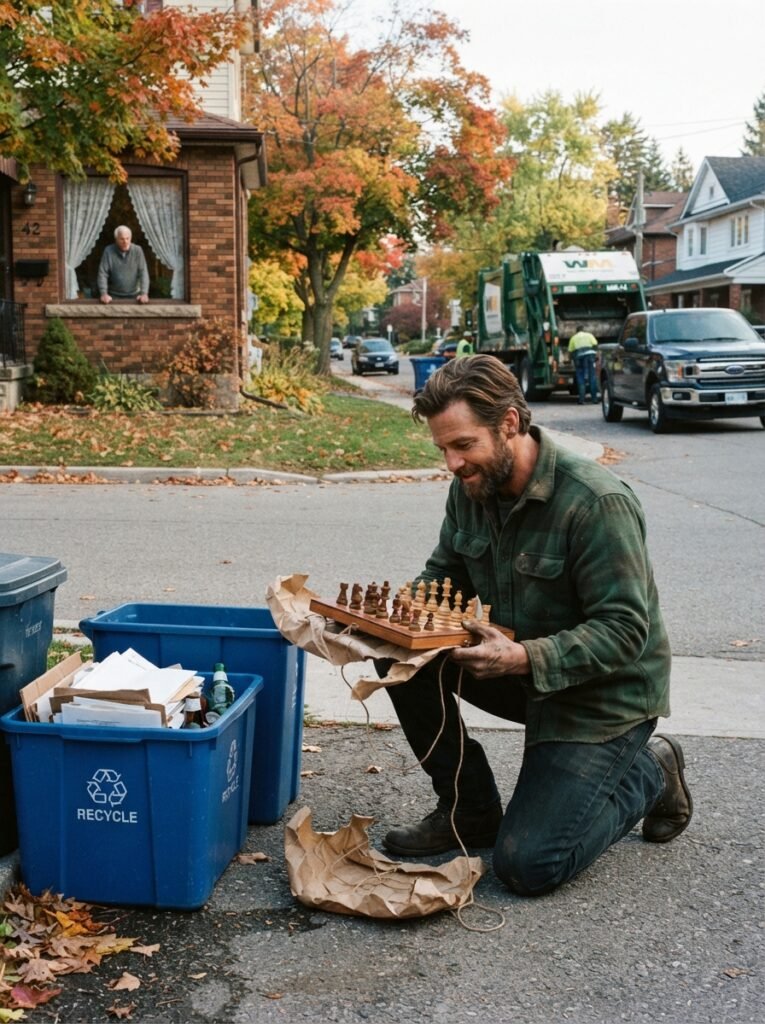
The garbage truck was three houses away when I found three months of my life in my father’s recycling bin.
For a second, I thought someone had made a mistake.
That was the last favor I did my father without asking.
It was seven thirty on a Sunday morning outside Knoxville, and the street smelled of wet grass and diesel.
I had come back for a jacket.
Instead, I stood over an open bin, holding the birthday present I had spent three months making.
Brown paper still surrounded the case.
Someone had pulled the twine back around it after opening it.
A crushed beer can rested against the corner.
Through the kitchen window, Dad lifted his coffee.
My brother’s watch gleamed on his wrist.
I waited for him to turn, to see me, to come outside and explain.
He never looked.
I carried the box to my truck, set it on the passenger seat, and buckled it in because I couldn’t bear the thought of it sliding onto the floor.
Then I drove away without my jacket.
At the first stoplight, I noticed that a little maple shaving had caught in the seam of my jeans.
I had cleaned the workshop twice since finishing the set.
Somehow, I was still carrying pieces of it around.
I picked the shaving free.
That was when I started crying.
My father, Warren Carter, could look at an unfinished house and tell you where the weight would fall.
He knew which walls mattered.
He knew when a beam would hold, when a foundation would shift, when something handsome had been built to hide a serious mistake.
For thirty-two years, I believed he simply hadn’t found the right angle from which to look at me.
My older brother, Trent, never had that problem.
At fourteen, Trent could throw a football through a tire swing.
At sixteen, he spent summers carrying lumber beside Dad.
By twenty-five, his name was printed under Dad’s on the trucks: CARTER & SON CONTRACTING.
One son.
There were two of us.
“Customers know what it means,” Mom said when I mentioned it.
We were standing in her kitchen.
She was folding dish towels into squares so precise they could have been measured.
“It means Trent works there,” I said.
“Well, Michael, you could’ve worked there.”
Dad had offered me a job sweeping sites when I was eighteen.
He had also told me that if I wanted to waste my nights playing with little wooden animals, I shouldn’t expect special treatment when I overslept.
I had never overslept.
I took the job at a hardware store instead.
Mom’s name was Jolene.
She remembered birthdays, brought casseroles to sick neighbors, and could make an insult sound like concern if you weren’t paying attention.
“You’re so sensitive,” she would tell me.
Eventually, I learned to make my face pleasant before I entered a room.
Grandpa Silas was the first person who noticed.
“Your cheeks tired?” he asked once.
I was twelve, sitting on the porch of his cabin with a grin that had survived an entire afternoon of Dad and Trent teasing me about the bird I had tried to carve.
I let the grin fall.
Grandpa nodded, as though I had finally put down something heavy.
He handed me a block of cedar.
“What do you see?”
“A block.”
“Good.
Start with the truth.”
He showed me how to read the grain before I touched a blade to it.
How forcing a cut could split the thing you were trying to save.
How a mistake sometimes demanded patience instead of more pressure.
His cabin stood on five wooded acres outside town, with a porch that slanted slightly toward the creek.
The kitchen faucet knocked.
The chimney smoked when the wind came from the east.
A red toolbox sat beneath his workbench, and above it hung a crooked little shelf he refused to replace.
“First thing your grandmother and I built together,” he said.
“It’s uneven.”
“So were we.”
At sixteen, I carved an eagle from a piece of storm-fallen walnut.
Its wings curved forward, protecting something you couldn’t see.
I worked on the feathers for six weeks.
On the underside of the base, I cut a tiny crescent beside three short lines, a maker’s mark Grandpa helped me design.
“Anybody can copy a signature,” he said.
“Make something your hands will remember.”
The eagle won a blue ribbon at the state fair.
I carried it into our living room while Dad watched Tennessee play.
“That’s nice, bud.”
He never turned his head.
Trent’s second-place football trophy went on the mantel that same weekend.
A few months later, two men in clean boots visited the house.
Dad asked me to bring out the eagle.
One man lifted it carefully and asked how old I was.
“Seventeen next month.”
“Got yourself a good eye.”
Dad sent me to the garage for folding chairs before I could ask what he meant.
Later, he said they supplied decorations to mountain lodges.
They might use something similar in a catalog.
“Did they like it?”
“They liked the idea,” he said.
“Don’t let it go to your head.”
He gave me a hundred-dollar bill that Friday.
“Little bonus.
Buy some tools.”
I bought a set of gouges.
For years, I remembered that afternoon as proof he had tried.
By thirty-two, I rented a small apartment with a detached workshop behind a hardware store whose owner liked me enough to charge reasonable rent.
I still worked part time at the store.
The rest of my income came from custom carving.
Collectors bought my chess sets for hundreds of dollars.
A couple in Oregon ordered anniversary pieces shaped like the birds that visited their backyard.
A school principal commissioned an owl for a retiring librarian.
Strangers trusted me with the things they loved.
I found that easier to believe than the possibility that my father might.
Every Christmas, every Father’s Day, I made him something.
A walnut picture frame.
A desk box with dovetailed corners.
A coat rack shaped from oak I had salvaged off one of his own job sites.
The coat rack disappeared behind paint cans in the garage.
The desk box sat in the basement with tissue still tucked around it.
I told myself he was saving them.
I told myself construction dust would ruin them.
I developed explanations with the care other people put into growing roses.
For his sixtieth birthday, I decided to make him something he couldn’t mistake for an ordinary gift.
I carved our family into a chess set.
Grandpa Silas, who had died three years earlier, became the king.
Grandma Ruth, gone long before him, became the queen.
My parents were bishops.
Trent and I were knights.
For the rooks, I carved our childhood house and Grandpa’s cabin.
The pawns were tools: hammers, saws, chisels, wrenches.
Things Dad understood.
Things that built something useful.
I chose walnut and maple for the board, working the squares until I could pass my fingers across the seams without feeling them.
I lined the case with deep burgundy velvet.
The brass plate inside read:
To Dad.
60 years of building things that last.
Love, Michael.
Some nights, I worked until two in the morning.
I ate sandwiches standing up.
I canceled a movie with a friend because the little roof on the cabin rook needed another attempt.
That was the piece that gave me the most trouble.
Every version looked like a small house.
I needed it to look like home.
The week before the party, my friend Ben came to the workshop and stood over the finished board.
“Man,” he said softly.
“Too much?”
He looked at me.
“You ever think about giving him a gift card?”
I laughed because I knew what he meant and couldn’t bear to answer.
Ben touched the edge of the case.
“What would you charge a customer?”
“I don’t know.”
“Michael.”
“Maybe fifteen hundred.
More for all the portraits.”
“And how much are you charging yourself?”
I wrapped the case in kraft paper.
“It’s his sixtieth.”
Ben nodded, but he didn’t say anything else.
Thirty people came to the party.
Mom had hired no caterer, bought no fancy decorations.
There were streamers, a sheet cake, country music, and folding tables on the patio.
Dad preferred things simple, which usually meant Mom did the complicated work before anyone arrived.
I carried the box through the gate.
Trent stood beside Dad with a narrow blue package.
“Open mine first,” he said.
Inside was a Seiko watch, stainless steel, about two hundred dollars.
Dad put it on immediately.
“Now that’s a watch.”
He held up his wrist.
“My boy knows what I like.”
Trent grinned.
Mom snapped a picture.
I waited until the laughter settled, then stepped forward with my box.
“I made you something.”
Dad glanced at the twine.
“Hope it’s not another coat rack.”
People laughed because he did.
I laughed because they were looking at me.
Then he opened the lid.
For one brief moment, Dad’s face changed.
He recognized Silas in the king.
I saw it happen: a flicker around his eyes, something caught between surprise and memory.
He lifted the piece, turned it over, and set it down.
“Huh,” he said.
“That’s something.”
I waited.
He closed the case and put it beside the used cake plates.
“Who wants another beer?”
Behind him, somebody called his name.
He lifted his wrist to show the watch.
I stayed another hour.
Aunt Dela found me by the cooler.
“You made that whole thing?”
“Yeah.”
She was Mom’s older sister, a retired school secretary who wore practical shoes and said things slowly enough that people sometimes assumed she didn’t understand them.
“Your grandfather would’ve had it on the table before you got the paper off.”
I looked away.
She squeezed my shoulder.
I wanted that to be enough.
After I rescued the set the next morning, I put it on my kitchen table and left it closed for four days.
On Wednesday, I opened it.
A shallow dent marked the corner of the case.
Something wet had stained the wrapping, but the velvet was dry.
Grandpa’s king lay tilted against the queen.
I straightened him.
Then I sat down and tried to remember the last time I had gone to my parents’ house without bringing something, fixing something, or rehearsing something.
I couldn’t.
Mom called that afternoon.
“Sunday dinner.
Six o’clock.”
“I’m busy.”
“With what?”
“Work.”
“You have to eat.”
“I know.”
She waited for the explanation I normally supplied.
I let her wait.
Trent called the following week.
“Mom says you’re buried.”
“Got a lot going on.”
“Good problem to have.”
“Yeah.”
“Listen, Dad’s having trouble with the router in his office.
You still good with that stuff?”
There it was: my place at the table, offered as a repair request.
“I can’t help this week.”
“Sure.
Whatever.”
He never called back.
Dad didn’t call at all.
Six weeks after the party, Mom appeared at my apartment with chicken-and-rice casserole.
She set it on the counter and studied me.
“Are you sick?”
“No.”
“Money trouble?”
“No.”
“Then what is it?”
For a moment, I could almost see the conversation.
I would tell her about the bin.
Her face would fall.
She would sit down, take my hand, and say something simple and unbearable.
That was a cruel little fantasy.
I knew my mother.
“I’ve been working.”
“You could at least answer your father.”
“He hasn’t called.”
She adjusted the foil on the casserole.
“Well, you know how he is.”
I did know.
I was beginning to understand how much that sentence had cost me.
Before leaving, she asked a favor.
“Your aunt and I need someone to look at Silas’s cabin.
See if the roof’s worse.
We’re thinking about selling.”
I gripped the edge of the counter.
“Selling?”
“It’s been three years.
Nobody’s living there.”
“I go out there.”
“Sometimes.”
“I keep the gutters clear.”
“That’s nice, honey.
But nice doesn’t pay property taxes.”
She hugged me and left.
The casserole was still warm.
I put it in the refrigerator and stood there with the door open until the light went off.
The cabin smelled the same.
Cedar, iron, old coffee, the creek pushing damp air beneath the porch.
Grandpa’s workbench stood under the west window.
The red toolbox was gone; Dad had helped clear some things after the funeral, and I had assumed the tools went somewhere safe.
I found the lockbox in a lower kitchen cabinet while looking for a mouse nest.
It held tax receipts, photographs, and a folded page written in Grandpa’s square, deliberate hand.
I recognized the heading before I understood the rest.
A draft of his will.
Halfway down, one sentence stopped me.
The cabin and the surrounding five acres should go to my grandson, Michael Carter, who knows what they are for.
I read it again.
The final estate papers had left the property to Mom and Dela.
I remembered signing a receipt for a box of books and being told the rest was settled.
I hadn’t challenged it.
Grief had made the whole world sound far away.
Now I sat on the kitchen floor with Grandpa’s handwriting shaking between my hands.
There was a penciled note in the margin.
“Ask Warren about packet.”
I stared at it.
Outside, a woodpecker struck a dead tree with steady, patient blows.
Sullivan Pratt’s office occupied the second floor above a pharmacy.
He wore inexpensive ties and listened without looking at the clock.
I showed him the draft.
He read it twice.
“Did he execute a later will?”
“Yes.”
“Then I need you to understand this before we go any further.
A handwritten statement of intention doesn’t automatically undo the documents that were actually signed.”
“So it means nothing?”
“It means he wrote it.
That matters.
What it does legally is a different question.”
I liked him for refusing to give me the answer I wanted.
He asked for the estate records.
He asked about the packet.
“I don’t know what it was.”
“Let’s find out.”
For the next several weeks, he reviewed what could be obtained and reached out to people who had known Silas.
There was no dramatic hearing.
No judge handed me keys.
Mostly, there were unanswered calls and invoices I could barely afford.
One evening, I told Ben I might be spending money just to confirm that Grandpa had wanted something he never finished arranging.
“Would you rather keep wondering?”
“No.”
“Then you’re buying an answer.”
Around the same time, a customer asked what I would charge for a walnut chess set.
I started typing six hundred.
Then I looked at my hands.
I deleted it and wrote $1,200.
The set sold in three days.
I sat in the workshop staring at the payment notification until the screen went dark.
I met Elise Hart because her fence was leaning.
She owned a little veterinary practice near the road to the cabin.
I had stopped to ask if the dog wandering by the ditch belonged to anyone.
“He’s mine,” she said.
“He considers fencing a suggestion.”
The dog, a yellow mutt with one bent ear, sat on my boot.
“Post is rotten,” I said.
“You diagnosing my fence?”
“I work at a hardware store.”
“Then yes, please.”
We replaced it the following Saturday.
She brought sandwiches.
I brought a level.
The dog supervised.
Elise asked what I did besides fixing strangers’ fences.
“I carve.”
“What?”
“Mostly chess sets.”
She waited, interested.
I was so accustomed to making that answer small that I almost missed the fact that she wanted a larger one.
A week later, she came to the workshop.
She watched while I shaped a knight’s jaw.
“It’s beautiful to watch,” she said.
I stopped cutting.
“What?”
“Your hands.
You know exactly where they’re going.”
I looked at the piece.
“Sometimes.”
She smiled.
“That’s more than most of us get.”
She didn’t ask why I still worked retail.
She didn’t suggest turning the hobby into something useful.
She stayed until I finished the cut, then asked whether I wanted dinner.
I did.
Five months after the birthday party, Sullivan sent a formal inquiry concerning the estate and the unexplained packet.
Mom called within an hour.
“You went behind everyone’s back?”
“I hired someone to help me understand Grandpa’s papers.”
“We could have talked.”
“We could have.”
Trent texted next.
Is a cabin really worth tearing the family apart?
I watched the typing bubble appear, vanish, and appear again.
Neither of them asked where I had been.
Dad arrived the following afternoon in jeans and a flannel shirt.
He stood in my living room studying the shelves as though inspecting someone else’s framing.
“Your mother says you’re trying to take the cabin.”
“I’m trying to honor what Grandpa wanted.”
“Silas was sentimental.
Said a lot of things in his last years.”
He sat down.
“It’s old, Michael.
Needs a roof.
Plumbing’s shot.”
“It’s worth everything to me.”
He folded his arms.
“I don’t understand what’s gotten into you.”
I looked at the watch.
Then I told him.
He listened to the part about the recycling bin without interrupting.
“That chess thing?” he asked.
I brought the case to the coffee table.
“Three months, Dad.
You threw away three months before breakfast.”
He reached for the king.
I shut the lid.
“You don’t get to pretend you’re interested now.”
“You should’ve said something.”
“I spent twenty years saying something.
Every piece I made you.”
He looked away.
Finally, he stood.
“Your mother’s upset.
Just call her.”
My phone rang.
Sullivan.
“Your aunt came by,” he said.
“She brought a letter Silas wrote to your father.”
Dad stopped beside the door.
“What letter?”
I put the phone on speaker.
“Michael,” Sullivan said, “your grandfather asked your father to deliver something after his death.
Did you receive it?”
“No.”
Dad’s hand tightened on the doorknob.
“What were you supposed to give me?”
I asked.
For the first time that afternoon, he couldn’t look at me.
“A toolbox,” Dad said.
Sullivan’s voice came through the phone.
“And the packet inside it.”
Dad pulled his hand from the doorknob.
“It’s been sitting in my garage.
I forgot.”
“For three years?”
“Things get put away, Michael.”
I looked at the case on the coffee table.
“Yes,” I said.
“They do.”
Sullivan asked him to bring the box to his office the next morning, with nothing removed.
Dad glanced at me before agreeing.
I could have asked a dozen questions after he left.
Instead, I called Aunt Dela.
She answered on the second ring.
“I should’ve looked through those books sooner.”
“What books?”
“Daddy’s account books.
The ones from the cabin.
Your lawyer asked whether I had anything written about his intentions.
I started opening everything.”
Her voice shook.
“The letter was folded inside one.
A copy.
I don’t know whether he trusted the mail, or Warren, or himself.”
“What did it say?”
“It said there were things you should have known a long time ago.”
Dad arrived at Sullivan’s office carrying the red toolbox.
I recognized the little white scar across its lid.
At thirteen, I had dropped a clamp on it.
Grandpa had laughed and said the box looked less unemployed.
Now I rested my hand on the dent while Sullivan photographed the contents.
Three old gouges.
A sharpening stone.
A bundle of photographs.
A packet wrapped in a grocery sack.
Dad sat near the door.
“You could’ve just asked me,” he said.
“I didn’t know there was something to ask.”
Sullivan opened the packet.
The first page was a letter addressed to me.
My name sat alone at the top.
Michael.
For several seconds, that was all I could read.
Then the words steadied.
Your father has told me for years that some things are between the two of you, and I have respected that more than I should have.
I recently learned that a carving of yours was sold under an agreement you may never have seen.
I have asked him to explain.
I have asked him to show you these papers.
If I die before we settle this, they are yours.
So are the tools.
Nobody is to decide for you whether you need them.
I stopped reading.
Dad stared at the carpet.
“What carving?”
He rubbed his palms over his knees.
“The eagle.”
Sullivan lifted a stapled document from the packet.
A reproduction license.
The name of a company, Appalachian Hearthworks, appeared above a photograph of a walnut eagle with curved wings.
My eagle.
Not a similar design.
Not an idea somebody else had.
There was a shallow irregularity beneath the left wing where I had worked around a knot.
I knew it as surely as I knew an old scar on my own body.
The agreement had been signed when I was seventeen.
An advance of forty-eight thousand dollars.
Quarterly royalties.
My name appeared as the artist.
Dad’s signature appeared beneath it as my parent and representative.
I looked at him.
“You said they gave me a bonus.”
“You got a hundred dollars.”
“Yes,” I said.
“I remember.”
He leaned forward.
“It wasn’t that simple.”
Sullivan put down his pen.
“Mr.
Carter, you should have your own counsel before we discuss the substance of this.”
Dad stood so quickly his chair scraped the wall.
“Fine.”
He looked at me, waiting for something.
Permission, perhaps.
The familiar little retreat.
I stayed seated.
When the door closed, Sullivan said my name.
I couldn’t answer.
On the page, the wings of my eagle sheltered an empty space.
For the first time, I understood how much could fit inside it.
The facts came slowly.
They arrived in boxes, in forwarded emails, in statements pulled from old records.
They arrived with missing pages and inconsistent explanations.
Appalachian Hearthworks still existed.
The original owner had retired.
A woman named June Martin had handled accounts there for almost twenty years.
After Sullivan contacted the company and established what he needed, June agreed to meet.
She brought a sample from a cabinet in their warehouse.
A smaller eagle, made for production, with simplified feathers.
I turned it over.
Under the base was my crescent and three short cuts.
“They kept the mark,” I said.
“We were told it was part of the design.”
June looked distressed.
“We used your name in the original artist notes.
Your father asked us to remove it from later marketing.
Said you wanted privacy.”
Dad had told them I hated publicity.
That I preferred royalties managed through the family business.
That I was too busy working on other pieces to deal with routine correspondence.
Mail went to my parents’ house.
Later, payments went to an account connected to the contracting company.
Sullivan cautioned me not to turn a stack of troubling records into a conclusion about every transaction.
“We’ll need an accountant.
We’ll need their explanation.
Some questions are clearer than others.”
“Was any of it mine?”
He looked at the agreement again.
“Yes,” he said.
“That much is clear.”
The work my father called a hobby had been earning money while he told me to find something useful to do.
I drove to the cabin afterward.
For an hour, I sat on the porch without turning on a light.
I thought about the shifts I had worked through holidays.
The winter I had kept the apartment thermostat at fifty-eight.
The tooth I had waited four months to fix because I didn’t have enough saved.
Then I thought about Grandpa.
Why hadn’t he told me?
The answer was in the rest of his letter.
I had folded it away at Sullivan’s office because I couldn’t take another sentence.
Now I opened it.
The first notice reached me after the company tried an old address.
I asked questions and got answers that did not sit right.
Your father said you knew.
Then he said he would speak to you.
I believed I was giving him a chance to do the right thing.
I have been foolish about what a man will do when he is afraid of losing his children’s respect.
You are coming Sunday.
We will talk whether Warren likes it or not.
Grandpa had died on a Friday.
I remembered the planned visit.
I remembered buying a bag of his favorite coffee and leaving it on my counter for a week after the funeral.
At the bottom, his handwriting grew uneven.
You don’t have to forgive someone because they ask.
You don’t have to keep waiting because you love them.
I wish I had learned that before I got old.
I put the letter down.
For years, I had kept Grandpa safely apart from the rest of my family.
He had been the good one, the person who always knew what to do.
Now I had to make room for the fact that he had hesitated, too.
It hurt.
It also made the letter feel more like his hand resting on mine.
Elise found me on the porch after I missed our dinner.
I had sent a message saying where I was.
She brought takeout and two forks.
She listened while I explained.
“Forty-eight thousand,” I said.
“At seventeen.”
“And the royalties?”
“We don’t know the full amount yet.”
She let that settle.
“I keep thinking about things I couldn’t afford.”
“Of course you do.”
“I also keep thinking I must be stupid.”
She set down her food.
“Look at me.”
I did.
“You were a kid.
They were your parents.”
“I’m not a kid now.”
“No.
That’s why you’re asking.”
We ate noodles that had gone cold.
After a while, I said, “Part of me wants Dad to tell me there was some reason.”
“What kind of reason?”
“One I could live with.”
Elise didn’t try to answer that.
The creek moved in the dark below us.
Inside, the cabin’s old refrigerator hummed and clicked.
“I think,” she said eventually, “you’ll have to decide what to do with the reason he actually gives you.”
Mom arrived at the hardware store two days later.
She waited until the customer at my register left.
“You need to stop this before it gets ugly.”
I signed out and asked my manager for a few minutes.
Outside, Mom pulled her cardigan tight.
“Your father was trying to build a business.
We had bills.
You have no idea what it took to keep a family afloat.”
“Did you know about the money?”
Her silence answered first.
“Did you?”
“Of course I knew.”
The parking lot seemed to tilt.
“Did you know I didn’t?”
She looked at a car passing on the road.
“You never asked about business.”
There it was.
My fault, fitted neatly into the space where her answer should have been.
“I thought it was a hundred dollars.”
“You were seventeen.”
“I was your son.”
Her mouth tightened.
“And you were fed.
You had a roof.
Your brother didn’t get everything he wanted either.”
I looked through the store window at a father helping his little girl choose a paint sample.
“Tell your attorney to talk to Sullivan.”
“Michael—”
“I’m going back to work.”
She caught my sleeve.
“People will hear about this.”
I gently removed her hand.
For thirty-two years, I had worried about embarrassing my family.
It had never occurred to me to ask whether they were ashamed of what they had done.
The next week, people started calling.
An uncle who hadn’t spoken to me since Christmas wanted to know why I was suing my parents over a shack.
A cousin said Mom was crying every night.
A former neighbor told me successful men sometimes had to make difficult decisions.
I asked each of them the same question.
“Did they tell you about the licensing money?”
Most went quiet.
One said, “I don’t want to get in the middle.”
“You called me.”
He hung up first.
Then Mom posted a birthday photograph online.
Dad stood between Trent and me, his new watch raised, my wrapped box at the edge of the picture.
The caption said something about loving your children even when they broke your heart.
I looked at it longer than I should have.
Then I saved a copy for Sullivan and closed the app.
That afternoon, I ruined a queen.
My blade followed the grain too far and split the narrow neck.
I stared at the broken piece, furious with myself for letting them into the one place I had always been able to work.
Ben came by and found me sweeping.
“You eat?”
“I’m fine.”
“That wasn’t the question.”
We ate burgers on the back steps.
“I could end this,” I said.
“Sure.”
“Tell Sullivan to stop.”
“You could.”
“Then things would go back.”
Ben looked through the workshop door at the birthday set.
“Would they?”
I dropped a fry into the paper bag.
“No.”
The accountant’s name was Marlene Voss.
She carried a green binder and asked questions that made people reach for water.
Over several weeks, she matched company statements to payments, followed transfers where records allowed, and marked gaps that still needed answers.
The total she could document was
$286,410, including the original advance.
I read it without feeling anything.
Then she showed me the first payment.
The money had arrived shortly before Dad bought the equipment and leased the bigger yard that let him expand the contracting business.
I remembered that year.
New trucks.
New shirts with the company name.
Dad saying hard work was finally paying off.
At dinner, he had lifted his iced tea.
“Nothing handed to us.”
I had raised my glass with everyone else.
Later payments had covered different things: business expenses, family bills, transfers to accounts I had never seen.
There were still questions about which amounts could be recovered, how, and from whom.
Sullivan explained them carefully.
I didn’t want promises anymore.
I wanted facts sturdy enough to stand on.
Marlene turned a page.
“The hundred dollars your father gave you is the only payment to you that we’ve identified so far.”
A hundred dollars.
I remembered the gouges.
How carefully I had selected them.
How grateful I had been.
He had let me thank him for a fragment of my own money.
I excused myself and went into the bathroom.
There was nothing elegant about what happened next.
I sat on the closed toilet, pressed my hands against my mouth, and sobbed so hard my ribs hurt.
When I came back, Sullivan had moved the binder aside.
“We can stop for today.”
“No,” I said.
My voice surprised me.
“Keep going.”
Dad called that night.
“Can we talk without lawyers?”
“We can talk.
I’m not agreeing to anything.”
He breathed out sharply.
“Everything’s a negotiation now?”
“I’m learning from you.”
We met at a diner by the interstate.
He arrived early and stood when I approached, as if we were meeting a client.
I sat.
For a while, we studied menus neither of us wanted.
Then he said,
“I was going to pay it back.”
I looked at him.
“The first money.
We were stretched thin.
I had a chance to take a bigger contract.
If I’d missed it—”
“Did you tell me?”
“You were seventeen.”
“So tell me now.”
He rubbed a thumb against the edge of his menu.
“I thought once things got steady, I’d put it aside.”
“And when did they get steady?”
He didn’t answer.
A waitress filled our water glasses.
Dad thanked her with the warm, easy voice he used for strangers.
After she left, I asked about the royalties.
“Your mother handled most of that.”
“You signed the agreement.”
“Yes.”
“You told the company I knew.”
He stared at the table.
“Yes.”
“Why keep telling me carving wouldn’t support me?”
His jaw worked.
At last, he said, “I thought if you got used to checks coming in for something you made once, you’d never learn to work.”
I heard a fork hit a plate somewhere behind me.
I waited until I trusted my voice.
“I worked nights.
Weekends.
I stocked shelves with the flu because I couldn’t miss the pay.”
“I know.”
“No.
You knew I was doing it.
That’s different.”
His eyes shone, but I couldn’t let that become the whole conversation.
“And the chess set?”
“Michael—”
“Why?”
He looked toward the window.
“I had people coming over the next day.
Trent’s project manager.
A couple of men from the supplier.”
“What does that have to do with it?”
“It was on the table.
Your mother was cleaning.
I said get rid of the party stuff.”
“Did you know it was in there?”
A long silence.
“Yes.”
There it was.
No mistaken bag.
No secret rescue ruined by bad timing.
No explanation that would let me put the night back together.
He had known what he was throwing away.
“I thought you had plenty of those,” he said.
I stood.
Dad reached across the table, then stopped.
“I’m trying to explain.”
“You did.”
I paid for my coffee and left him with two untouched menus.
Trent came to my workshop on a rainy Tuesday.
He stood outside until I let him in.
His eyes traveled over the clamps, the wood stacked beneath the bench, the boxes waiting to ship.
“I didn’t know you had all this.”
“You’ve never been here.”
He nodded.
For once, he didn’t argue with a fact.
“Dad says the accountant’s digging through everything.”
“Yes.”
“He says it could hurt the business.”
“Did you know?”
Trent pushed his hands into his jacket pockets.
“Not all of it.”
I felt myself go cold.
“What part?”
“I saw deposits.
A couple of years ago.
Asked Dad what they were.
He said payments for your designs.”
“And?”
“He said you’d worked out an arrangement.”
“You never asked me?”
“No.”
Rain tapped the metal awning.
“I liked being the one he trusted,” Trent said.
The words came out flat, stripped of any excuse.
“I didn’t look too hard at what that meant for you.”
I sat on the stool.
He kept standing.
“I can’t tell you I didn’t benefit.
I did.
That business paid for a lot.”
“What do you want from me?”
“Nothing.”
I waited.
He swallowed.
“I’m getting copies of what I can legally give you from our office files.
I told the company attorney.
I’m not helping anybody hide it.”
“You expect me to thank you?”
“No.”
He looked at the chess set.
“Can I see it?”
“Not today.”
“All right.”
That answer unsettled me more than an argument would have.
Before he left, he said, “Mom’s trying to sell the cabin.”
My stomach tightened.
“She called someone Dad knows.”
“Dela has to agree.”
“I think Mom told her you weren’t interested anymore.”
After he left, I called my aunt.
She listened without interrupting.
Then she said, “Well, that will be a short conversation.”
“What will?”
“The one where your mother explains why she thinks she can sign my name.”
Dela met me at the cabin the next morning.
She brought coffee and a folder.
“Nothing’s being sold without me,” she said.
“And I’m not signing under pressure.”
I stood beside her on the porch, breathing properly for the first time since Trent’s visit.
“I can’t ask you to lose money.”
“You haven’t.”
“You could use your share.”
“I can.
Which is why I’d like us to get a fair appraisal and work from facts.”
I smiled faintly.
“You and Sullivan would get along.”
“We already do.”
She looked at the sloping porch.
“I should’ve asked more questions after Daddy died.
About the tools.
About why you weren’t here more.”
“I stopped telling people.”
“I know.”
She turned toward me.
“That doesn’t mean we were right to stop listening.”
Inside, we opened the shutters.
Morning light fell across Grandpa’s workbench.
I took the cabin rook from my pocket.
I had brought it without quite knowing why.
Dela watched me set it on the sill.
“That little thing,” she said, “looks more like this place than any photograph.”
I rested a finger against its miniature roof.
For once, I let myself believe someone.
There were easier endings available to me.
I imagined them while lying awake.
A judge would slam a gavel.
Dad would lose everything.
Mom would confess in front of every relative who had called me ungrateful.
Trent would finally understand what it felt like to stand outside a room where everyone else belonged.
In those versions, I always felt better afterward.
Real life kept asking harder questions.
What did I want back?
What could actually be repaired?
How much of the next ten years was I willing to spend proving the last fifteen had happened?
Sullivan never answered those questions for me.
He explained options.
He discussed uncertainty.
He told me when anger was making me accept an offer too quickly, and when it was making me reject something useful.
One afternoon, he asked me to write a list without using anyone else’s name.
I sat in his office with a yellow pad.
The first line took a long time.
I want to own my work.
Then another.
I want the money that can be recovered fairly.
Then:
I want the cabin, if I can buy it without owing anyone my silence.
The last line came easiest.
I want a life that doesn’t stop every time my father is disappointed in me.
Sullivan read the page.
“Now we have somewhere to start.”
While the attorneys worked, I kept carving.
That sounds simple.
It wasn’t.
Some mornings, the sight of an eagle made me sick.
Other days, I wanted to carve one so beautiful that Dad would have to admit everything he had refused to see.
Neither feeling helped me hold a knife.
So I made a spoon.
An ordinary cherry spoon, too thick in the handle, meant for my own kitchen.
Then I made a small bowl.
Then I finished the queen I had broken.
Elise washed dishes while I showed her the replacement.
“You changed her face.”
“Did I?”
“She looks less worried.”
I turned the piece in the light.
“Maybe I finally let her sit down.”
At the hardware store, my manager asked whether I would teach a Saturday workshop.
“Little project for the kids.
Parents stay.
We’ll provide materials.”
“I’ve never taught.”
“You’ve explained hinges to angry homeowners for eight years.
You’ll be fine.”
We started with sanding pre-cut wooden birds.
Nine children came.
One girl spent twenty minutes trying to make the two wings exactly match.
Her father leaned over her shoulder, pointing out every difference.
I recognized the way she hunched.
“Can I show you something?”
I asked her.
She nodded.
I held up the sample I had made.
One wing rose higher than the other.
“Birds move,” I said.
Her father stepped back.
The girl touched her uneven wings.
Then she smiled.
That evening, I went home tired in a way I hadn’t felt in months.
For the first time, the work had given me more than my family could take away.
Our first formal settlement meeting lasted six hours.
Dad came with an attorney.
Mom brought a folder thick with household expenses, as if she could turn my childhood into an invoice.
Trent sat beside them for the first hour, then asked to speak separately with his own attorney about the business records.
Dela came with the independent cabin appraisal.
The property was valued at two hundred and twelve thousand dollars.
Its condition mattered.
So did its land, its access, the creek.
Grandpa’s old draft didn’t make me its owner, and Sullivan never pretended otherwise.
But Mom’s share could become part of a broader agreement, if she chose.
She didn’t choose quickly.
“You’re asking me to give up my inheritance.”
“I’m asking you to account for mine,” I said.
“It wasn’t an inheritance.”
“My earnings, then.”
Her eyes hardened.
“You always did find a way to make yourself the victim.”
Sullivan rested his pen on the table.
“We can take a break.”
“No,” I said.
“I’m all right.”
I was astonished to discover it was true.
Mom had said something cruel, and I had heard it.
The room had not collapsed.
I did not have to persuade her to take it back before I could continue breathing.
Dad’s attorney discussed a proposed payment structure.
A transfer of Mom’s half of the cabin.
Cash raised partly against the company’s property.
An agreement about the old accounts.
Proper arrangements for future licensing payments.
There would be releases of specified civil claims.
There would be records, valuations, and written obligations.
Mom wanted a statement that this had all been a family misunderstanding.
I refused.
Dad wanted the disagreement kept out of the company’s day-to-day operations.
I was willing to discuss that.
I had no interest in taking paychecks from people who had never even met me.
Then Mom said, “And we expect you to come home.
Sunday dinners.
Holidays.
We’re not signing something so you can take what you want and disappear.”
The room went still.
I thought of my list on Sullivan’s yellow pad.
“I’m not agreeing to visits in exchange for money.”
“That’s your family.”
“I know.”
“You’ll regret this when we’re gone.”
My hands lay flat on the table.
“You’re here now,” I said.
“You could talk to me differently while you’re here.”
Dad shut his eyes.
For a moment, Mom looked genuinely startled.
Then she gathered her folder and said she needed air.
We didn’t settle that day.
Or the next week.
There were corrections, arguments, more documents.
Some claims were disputed.
Some expenses had to be separated from others.
Nothing happened as neatly as it did in the revenge stories I had told myself at night.
Eventually, an agreement took shape.
Mom’s cabin interest would count toward the documented money owed.
Dad would fund the cash portion through arrangements his attorney and lender worked out.
I would buy Dela’s half at its appraised value.
Future royalties would come to me under updated instructions confirmed directly with the licensing company.
My name would return to the product information.
I would pay my own agreed professional costs from the recovery.
It would not restore every opportunity I had lost.
It would give me choices I had been denied.
Dela called after reviewing the draft.
“You sure you don’t want me to knock something off my half?”
“You worked forty years.
Take the fair price.”
“I’d like to help.”
“You did.”
She was quiet.
Then she said, “I suppose I did.”
Dad came to the workshop before the final papers were signed.
He brought the coat rack.
It stuck awkwardly out of the back seat of his truck, and for a moment I saw how ridiculous it must have felt to carry an unwanted gift back to the person who had made it.
Good, I thought.
Then I hated myself for thinking it.
Then I decided I didn’t have to tidy every feeling before I was allowed to have it.
He leaned the rack against the wall.
“The box and the frame are in the truck, too.”
“Why?”
“You should have them.”
I looked at the oak.
There was dried white paint on one hook.
“You didn’t have to bring them today.”
“I know.”
Through the open door, children’s voices carried from the hardware store.
Ben was helping set up another class.
Dad looked toward them.
“You teaching now?”
“Sometimes.”
He ran a finger along the rack, then dropped his hand.
“I saw the eagle in a catalog once,” he said.
“I know.”
“No.
I mean I showed a man at a supply dinner.
Told him my son made it.”
I looked at him.
“When?”
“Years ago.”
“Did you tell him you’d said it wasn’t real work?”
His shoulders fell.
“No.”
I waited.
“I liked saying it when you weren’t there,” he said finally.
The confession was so small and ugly that I believed it.
“Why?”
“Because then you couldn’t ask me why I never said it to you.”
Outside, a child laughed.
Dad looked older than sixty.
That didn’t make him innocent.
It made him a man who had spent a long time refusing something he knew how to give.
“I don’t know how to fix this,” he said.
“Start by signing the agreement because it’s right.
Don’t make it another gift I have to thank you for.”
He nodded.
At the doorway, he stopped.
“Michael.
I’m sorry I threw it away.”
I looked at the birthday set on the shelf.
For months, I had imagined those words rescuing me.
They didn’t.
They arrived late, and they mattered, and neither fact erased the other.
“I heard you,” I said.
It was the most honest answer I had.
That night, Trent sent the last batch of office records through the attorneys.
There were old expense reports, card statements, reimbursements, receipts saved in folders nobody had expected me to open.
I didn’t read them immediately.
I had a class in the morning.
For once, something in my life got to come before the next thing my family had done.
I opened the expense files three nights before the signing.
Mostly, I was checking dates.
Marlene had already done the hard work.
The packet was part of the supporting record, the ordinary paper trail beneath the larger numbers.
Then I found a folder marked FAMILY GIFTS.
A jewelry receipt sat inside.
Seiko.
The date was two days before Dad’s birthday.
I leaned closer.
A company card had paid for it.
A reimbursement entry assigned the purchase to the design reserve, the account into which the remaining licensing payments were being swept.
Beneath the receipt was a printed email from Mom to Trent.
Picked up the watch.
Blue box in the pantry.
Give it to him first, before Michael gives him whatever he’s making.
Let your father have a nice moment.
Don’t tell him I bought it.
I read it once.
Then I read it again, slower.
Trent hadn’t chosen the watch.
He hadn’t paid for it.
The gift Dad had held up as proof that his other son understood him had been purchased with money from my carving.
For a minute, the room seemed perfectly quiet.
I could hear the refrigerator, the traffic beyond my window, the little creak of the chair beneath me.
I remembered standing at the party with a box against my chest.
I remembered telling myself I should have bought something sensible.
Then, unexpectedly, I laughed.
It came out broken.
It wasn’t amusement.
For years, I had studied my brother, trying to discover the missing quality that made loving him so easy.
The answer was in a pantry, wrapped in blue paper.
They had arranged the moment.
They had given him the right gift.
And they had used my work to pay for it.
I brought one printed page to the signing.
We finished the legal business first.
The obligations were clear.
The documents had been reviewed.
There were no surprise conditions waiting beneath the last paragraph.
Dad paused before signing.
I expected an argument.
Instead, he read the page again.
Then he signed.
Mom signed without looking at me.
Trent waited near the window.
He had come to support the accounting and to deal with the separate business arrangements his family now had to make.
When Sullivan put the final document aside, I laid the jewelry receipt on the table.
“What’s this?”
Dad asked.
“Your watch.”
Mom’s face changed.
Trent closed his eyes.
I looked at my brother.
“You knew she bought it.”
“Yes.”
“And you let him think you did.”
“Yes.”
There was no point asking whether he understood that part.
He did now.
Dad turned toward Mom.
She folded her hands.
“It was a birthday gift.
I don’t know why we’re still discussing this.”
“Because you paid for it from my design money,” I said.
“It was all family money.”
“No.”
The word felt calm in my mouth.
“Some of it was mine.
That’s why we’re here.”
Sullivan confirmed that the transaction was already included in the accounting.
I wasn’t asking for another payment.
I wanted the sentence spoken where everyone could hear it.
I looked at Dad.
“You threw out the gift I made and wore the one I paid for.”
He stared at the receipt.
Then, slowly, he unfastened the watch.
For a moment, I thought he would offer it to me.
“Keep it,” I said.
His hand stopped.
“I don’t want it.”
He laid it beside his copy of the agreement.
Mom started to speak, then didn’t.
It was a small silence.
I had waited most of my life for it.
Dad looked up.
“I said he knew what I liked.”
“Yes.”
His eyes filled.
I didn’t reach across the table.
Some grief belonged to him.
I got the cabin on a Thursday.
There was no cheering crowd, no overturned family portrait, no relative begging outside a locked gate.
There was a deed, a bank transfer, and Dela handing me the keys she had carried since her father died.
“I expect coffee when I visit.”
“You’ll get coffee.”
“Good coffee.”
“Don’t push it.”
She laughed and hugged me so hard I felt her glasses against my shoulder.
I paid her the agreed price.
She bought a reliable car and finally took the trip to the coast she had postponed for eleven years.
Mom didn’t attend the closing.
For a while, she sent messages about everything except what had happened.
A recipe.
A photograph of flowers.
A warning about icy roads.
I answered the ones I wanted to answer.
When she asked whether I was coming to dinner, I said I wasn’t ready.
She said I was making things harder than they needed to be.
I put the phone down and finished what I was doing.
That was new.
The roof cost more than I expected.
So did the plumbing.
Owning a beloved place did not exempt it from being an old building with a bad water line.
Ben helped tear out damaged shelves.
Dela argued with me about curtain rods.
Elise brought the dog, who immediately found the one patch of wet stain we had failed to fence off.
I kept Grandpa’s crooked shelf.
I also kept his letter.
For a while, I couldn’t read it without feeling angry.
He had been close enough to see something wrong.
He had still given Dad another chance to explain before coming to me.
But he had left me the facts.
He had admitted his hesitation.
He had written my name on something and made it mine without asking what I would do for him in return.
I could love him without pretending he had been perfect.
That became useful knowledge.
I needed it for myself, too.
The first evening I slept at the cabin, I woke at three and didn’t know where I was.
Then I heard the creek.
I lay still until morning.
The licensing company put my name back where it belonged.
The first corrected payment arrived directly in an account I had opened myself.
I didn’t quit the hardware store that day.
I built a cushion.
Finished outstanding orders.
Talked to an accountant about the business I actually wanted.
Then I gave notice.
My manager shook my hand and asked whether I would keep teaching.
“Absolutely.”
The classes grew slowly.
Parents came back with older children.
A retired nurse asked whether adults could take lessons.
A man who had lost his wife brought her old rolling pin and wanted help turning the cracked end into something he could keep.
I learned that people often brought more than wood.
I learned to ask what they hoped to carry home.
Trent brought his daughter, Lucy, one Saturday.
She was eight, missing a front tooth, and determined to make a bird with purple wings.
When she finished, she held it out to him.
“It’s crooked.”
He crouched beside her.
“Can I put it on my desk?”
She considered him carefully.
“Where you’ll see it?”
“Where I’ll see it.”
I turned toward the supply table before either of them noticed my face.
Later, Trent asked me to make a small box for her birthday.
“Send me the price first.”
I did.
He paid it.
We were not brothers the way we might have been.
We were finding out whether we could become brothers some other way.
Dad took longer.
He called before visiting.
Sometimes I said yes.
Sometimes I didn’t.
He began seeing a counselor after his physician suggested he needed somewhere to talk that wasn’t a job site or his kitchen.
He told me that himself.
I said I hoped it helped.
I did not ask for reports.
At our first dinner, he tried to tell me how ashamed he felt.
After a few minutes, I said I couldn’t be the person who made that feeling easier for him.
He looked hurt.
Then he nodded and asked about my work.
I told him about a set of river birds I was carving for a woman in Minnesota.
He listened.
He asked another question.
It was an ordinary conversation.
I thought about it for three days.
Nearly two years after the birthday party, Dad came to an adult class at the cabin.
He had registered through the same form everyone else used.
When I saw his name, I stared at it for a long time.
Then I sent the materials list.
He arrived ten minutes early with safety glasses and a block of basswood, looking like a man who knew how to build a house and wasn’t sure he could enter this room.
The other students came in behind him.
Nobody knew our story.
For two hours, he listened while I explained grain and pressure.
He made a rough bird with a head too large for its body.
At the end, he turned it over in his hands.
“Looks pretty bad.”
“Looks like a first one.”
He nodded.
On the way out, he stopped beside the glass-fronted cabinet near my desk.
The birthday chess set stood inside.
I had repaired the case but left the shallow dent visible.
Every face remained as I had carved it.
Dad studied the little cabin rook.
Then the king.
Then the brass plate.
His mouth moved, but no words came.
I opened the cabinet and lifted out my knight.
“Grandpa taught me to make the ears separately at first,” I said.
“I kept breaking them.”
Dad looked at the piece.
“How’d you learn?”
“I broke a lot of them.”
He gave a small, unhappy laugh.
I put the knight back.
The set stayed in my cabinet.
Dad understood.
At the door, he held up his rough little bird.
“Think Lucy would want this?”
“Ask her.”
He nodded.
After he left, Elise came from the kitchen with two mugs.
“How are you?”
I looked around the room.
At the worn tools.
The finished orders.
The chairs where people had sat because they wanted to learn something I knew.
“Good,” I said.
The word needed no explanation.
Outside, Dad stood beside his truck, photographing the bird before he drove away.
I watched for a moment, then turned back to my bench.
A fresh block of walnut waited beneath the lamp.
I had spent years trying to carve something my father would keep.
Now I was building a life I wanted to keep for myself.