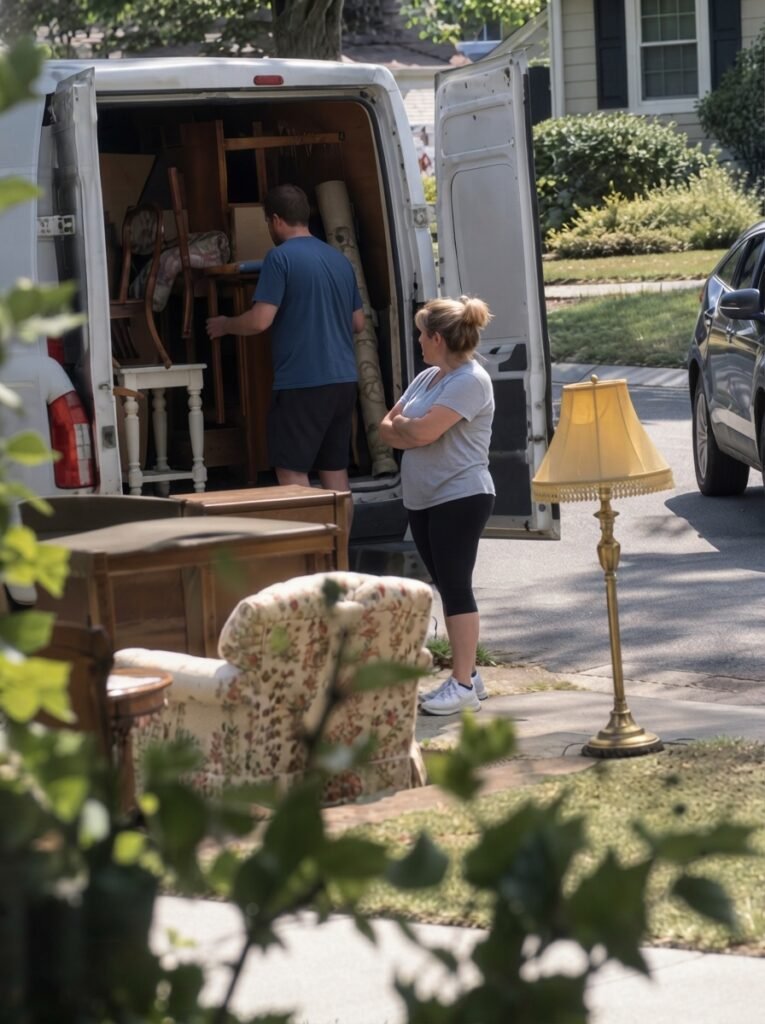
By 3:00 p.m. on my 50th birthday, I was crying because my husband and grown children had seemingly forgotten me. Then a moving truck arrived, and among the unfamiliar furniture I spotted my late mother’s yellow lamp. How did it get there?
My husband, David, had never forgotten my birthday. Not once in 27 years.
So when I woke up on my 50th and found his side of the bed empty, I expected flowers downstairs.
But there was nothing except a note on the counter that read, “Working late. Don’t wait for me.”
I was so surprised that I actually checked the date on my phone.
Our two grown children didn’t call either.
By noon, I felt ridiculous for caring so much.
By 3 p.m., I was crying at the kitchen table.
Then a truck rumbled outside.
A huge moving truck stopped directly in our driveway.
Two men jumped out and opened the back.
I hurried outside.
“Excuse me! You have the wrong house,” I said.
One checked his clipboard.
“We’re at the right place.”
The truck was packed with furniture.
But not ours.
An antique dresser. A floral armchair. Wooden bookshelves. Dozens of sealed boxes.
Then I saw a familiar yellow lamp.
It was my mother’s lamp.
The one that had stood beside her bed throughout my childhood.
Mom died 12 years ago, and after we sold her house, I’d been told most of her belongings had been donated.
My hands started shaking.
“Where did you get all this?”
The mover frowned.
“Storage unit. Your husband hired us.”
Then David’s car pulled in.
I marched toward him.
“You remembered.”
He smiled nervously.
“Happy birthday.”
“Why do you have Mom’s things?”
His smile vanished.
Before he could answer, one mover called from inside the truck.
“Sir? What about this one?”
David turned.
His face went white.
The man was holding a small locked wooden trunk.
“No,” David said sharply. “That wasn’t supposed to come here.”
I stared at him.
“What is it?”
“Laura, go inside.”
Instead, I walked toward the trunk.
David grabbed my arm.
“Please. Not today.”
The mover looked confused.
I pulled away from David.
“Laura, don’t…”
“Don’t what?” I asked.
David stared at the trunk as if it contained something dangerous.
“Please,” he said quietly. “Let me explain first.”
“Then explain.”
The movers were watching us, so David asked them to unload everything into the garage. I pointed at the trunk.
“That comes inside.”
“Laura.”
“Inside.”
He didn’t argue again.
Ten minutes later, the trunk sat on our kitchen floor while furniture from my childhood passed the window behind us.
I recognized almost everything.
I looked at David.
“I was told these things were donated,” I said.
“Most of her things were,” he replied.
“That’s not what I said.”
He lowered his eyes.
“No. These weren’t.”
“You’ve had them?”
He nodded.
“For 12 years?”
“Yes.”
I had spent the morning believing my husband had forgotten my birthday. Now that hurt seemed embarrassingly small.
“Why?”
“Because your mother asked me to keep them.”
I stared at him.
He pulled out a chair but didn’t sit.
“A few months before she died, she called me. She’d been sorting through the house. She said there were things she wanted you to have someday.”
“Then why didn’t she give them to me?”
“Because she knew you wouldn’t take them.”
That stung because it was probably true.
Mom’s final months had been difficult. She knew her health was declining, but I refused to talk about what would happen afterward. Every time she tried, I’d change the subject.
After she died, her house became unbearable.
Her cardigan was still hanging over a chair. Her grocery list was stuck to the refrigerator. Her reading glasses were beside the bed under that yellow lamp.
I couldn’t stand there deciding what to keep.
I told David and my brother to handle it.
A week later, David said most of what remained had been donated.
I believed him.
“She thought you’d regret getting rid of everything once the worst of the grief passed,” David said. “She asked me to save the things that mattered.”
“And you decided 12 years was the appropriate waiting period?”
“No. At first I thought I’d wait a year. Then two. Every time I considered telling you, you still couldn’t talk about her without falling apart.”
“So you lied.”
“Yes.”
The answer came without an excuse.
I glanced through the window. One mover carried Mom’s floral chair toward the garage.
A painful warmth pushed through my anger.
David had saved it.
All of it.
I touched the yellow lamp sitting on the counter.
“Why today?”
“Because you’ve been talking about her a lot lately. Last month you said you wished you’d kept something from her bedroom.”
I remembered.
We had been replacing a lamp upstairs, and I’d mentioned Mom’s yellow one.
David had barely reacted.
Now I understood why.
“I thought bringing these home for your 50th might be…” He hesitated. “I don’t know. A way of giving something back.”
My anger weakened.
Then I looked at the trunk.
“If that’s all this is, why are you afraid of that?”
David’s expression answered before he did.
“The trunk is different.”
“What’s inside?”
“Letters. Photographs. Some things from when you were little.”
“Letters from Mom?”
“Yes.”
The warmth disappeared.
“To me?”
“Some of them.”
I stared at him.
“You’ve had letters from my mother for 12 years?”
“I didn’t read the ones addressed to you.”
“That’s supposed to make this better?”
“No.”
“Open it.”
He shook his head.
“Laura, today was supposed to be happy.”
“Then you shouldn’t have kept secrets from me for 12 years.”
“I wanted to give you the furniture today. I was going to deal with the trunk separately.”
“Deal with it?”
“I didn’t mean it like that.”
“Open it.”
He went upstairs.
When he returned, he was holding a small brass key.
That somehow hurt almost as much as the trunk itself.
He had known exactly where the key was.
The lock clicked.
I lifted the lid.
The smell of old paper and cedar drifted out.
There were photographs, birthday cards, school drawings, a baby blanket, and envelopes tied into bundles.
I picked up the blanket.
My mother had made it when she was pregnant with me.
Beneath it was a photograph of me at about six, asleep in her bed.
The yellow lamp glowed behind my head.
A note on the back, in Mom’s handwriting, read, “Laura came in during the storm and stole my whole pillow.”
I laughed before I could stop myself.
Then I cried.
David stepped toward me.
“Don’t.”
He stopped.
I began opening envelopes.
Some weren’t really letters. They were notes explaining why she’d saved particular objects. The dresser had belonged to her mother. The Christmas box contained ornaments I’d made in elementary school.
She had kept the lamp because I’d been afraid of the dark as a child and used to fall asleep beneath its yellow glow whenever I crawled into her bed.
Then I found an envelope with my name on it.
Inside were three pages.
The first two were ordinary. Mom wrote about memories, mistakes, and things she’d never been good at saying aloud.
On the third page, I saw a sentence that made everything else disappear.
She mentioned our argument.
I stopped breathing for a moment.
“What did you know about this?” I asked.
David didn’t answer.
I looked up.
“What did you know?”
“Laura…”
“What did you know about our last fight?”
He sat across from me.
“More than I told you.”
That fight had happened six days before Mom died.
It started over something stupid. She wanted to discuss what would happen to the house if her health got worse. I accused her of giving up.
She accused me of refusing to see reality.
We both said things we regretted.
I left angry.
Two days later, I called her, but she didn’t answer. I told myself I’d try again when I’d calmed down.
I never got the chance.
For 12 years, I’d lived with the belief that my mother’s final clear memory of me was watching me walk out her door furious.
“What does ‘more’ mean?” I asked.
David looked toward the window.
“She came here.”
I thought I’d misheard him.
“When?”
“The night after your argument.”
My chair scraped backward.
“Mom came to this house?”
“Yes.”
“Was I here?”
“Yes.”
I couldn’t understand the words.
“Where was I?”
“Upstairs. You’d been crying most of the evening. You finally fell asleep.”
“And she left?”
David nodded.
“Why didn’t you wake me?”
“I wanted to.”
“Then why didn’t you?”
“She wouldn’t let me.”
He told me Mom had called and asked if she could come over.
When she arrived, she looked exhausted. David made tea, and they sat at the kitchen table where we were sitting now.
She told him about our fight.
She admitted she’d pushed too hard. She said she knew I was frightened and that she’d mistaken my fear for stubbornness.
“She wanted to apologize,” David said.
I pressed both hands against the table.
“Then why didn’t she wake me?”
“She came upstairs. She stood outside the bedroom.”
I closed my eyes.
“She heard you crying in your sleep. She said she’d already upset you enough.”
“So she left.”
“She said she’d come back the next day.”
“But she didn’t.”
“No.”
Mom became seriously ill the following morning.
She died days later without us having another real conversation.
My voice shook.
“You knew.”
David looked at me.
“You knew all these years that she came back.”
“Yes.”
“Did she tell you she was still angry with me?”
“No.”
“Did she say she didn’t forgive me?”
“No.”
“What did she say?”
His eyes filled.
“She said she loved you. She said the argument was as much her fault as yours.”
I stood so quickly the chair nearly fell.
For 12 years, I’d replayed that fight.
I had heard my own cruelest sentences thousands of times.
David knew there had been another chapter.
And he’d let me believe the story ended where I thought it did.
“Why?”
“She made me promise not to tell you she’d come.”
I stared at him.
“Why would she do that?”
“Because she wanted to apologize herself. She said she didn’t want me fixing things between you. She wanted to come back and do it properly.”
“She meant don’t tell me that night.”
“I know.”
“No, David. Do you?”
He went silent.
“She didn’t ask you to keep it from me after she died.”
“No.”
There it was.
Not an impossible promise.
A choice. His choice.
“After the funeral, you were barely sleeping,” he said. “You kept saying you should’ve gone back. I thought if I told you she’d been downstairs while you were asleep, you’d blame yourself for that too.”
“So you decided what I could handle.”
“I thought I was protecting you.”
“For 12 years?”
He looked down.
“At first, yes.”
“And later?”
He didn’t answer.
“Later, David?”
His voice was quiet.
“Later I was ashamed.”
That stopped me.
“The longer I waited, the worse it became. After a year, I would’ve had to explain why I’d waited a year. After five, I’d have to explain five. Every time I thought about telling you, I knew I’d also have to admit I’d watched you blame yourself.”
I wiped my face.
“You did watch me.”
“I know.”
“You held me while I cried about that argument.”
“I know.”
“You heard me say she died angry with me.”
“I know.”
“And you said nothing.”
He couldn’t look at me.
For the first time that afternoon, I understood why he’d panicked when he saw the trunk.
He hadn’t been protecting my birthday surprise.
He’d been protecting the secret he’d buried inside it.
I returned to Mom’s letter.
Near the end, she had written about our argument.
She said she’d been frightened too.
Frightened of dying. Frightened of leaving things unfinished. Frightened that pushing me to prepare had made me feel as though she were choosing to leave.
Then came the words I’d needed for 12 years.
She wrote that no argument could undo a lifetime of loving me.
She intended to tell me that herself.
I covered my mouth.
David stayed on the other side of the kitchen.
This time he didn’t come closer.
I read the paragraph again.
And again.
Mom hadn’t died hating me.
She hadn’t spent her final days thinking I was an ungrateful daughter.
She had come back.
She had stood a few feet from me while I slept.
It hurt horribly.
At 5:30 p.m., the front door opened.
Our daughter called, “Mom?”
Our son came in behind her carrying a cake.
They were smiling until they saw my face.
My daughter set down a bag.
“What happened?”
I looked at David.
“How much do they know?”
“About the furniture,” he said. “That’s all.”
Their expressions confirmed it.
My son glanced toward the garage.
“Did the truck come too early?”
“The truck was fine,” I said.
My daughter looked horrified.
“Oh, Mom. I’m sorry we didn’t call. Dad made us promise. I told him this morning that pretending we’d forgotten was mean.”
Despite everything, I almost laughed.
“You were right.”
David sighed.
“I was.”
My son put the cake on the counter.
“Dad said we’d all show up tonight after you saw Grandma’s furniture.”
“That was the plan,” David said.
“Next time,” I told him, “try a surprise that doesn’t require making your wife cry first.”
“There won’t be a next time like this.”
There was no big birthday dinner.
I couldn’t pretend nothing had happened, and nobody asked me to.
We ate takeout around the kitchen table with Mom’s trunk beside us.
Later, the kids helped me look through some of the boxes.
Every object seemed to return a tiny part of my childhood.
Before they left, my daughter plugged in the yellow lamp.
Its light was softer than I remembered.
Afterward, David and I stood alone in the living room.
“I’m sorry,” he said.
“I know.”
“I don’t expect you to forgive me tonight.”
“Good.”
He nodded.
I looked at the lamp.
“What you did with her things was beautiful.”
His face tightened.
“But?”
“But keeping that night from me wasn’t.”
“I know.”
“You don’t ever get to decide what truth I can handle again.”
“I won’t.”
“I mean it.”
“So do I.”
I believed he meant it.
That didn’t erase 12 years.
But it mattered.
David reached for the lamp.
“Where do you want this?”
I put my hand over his.
“I’ll decide.”
He let go.
I carried it upstairs myself.
I put it beside my favorite chair, plugged it in, and watched the familiar yellow light spread across the room.
That morning, I’d cried because I thought everyone had forgotten me.
I had been wrong. My children remembered.
David remembered so much that he’d spent 12 years paying to preserve pieces of a home I thought I’d lost.
And my mother had remembered something too.
She’d remembered that we were bigger than our last argument.
I wasn’t ready to forgive David completely. Maybe forgiveness wasn’t something that should happen in one dramatic birthday conversation.
But for the first time in 12 years, I went to bed without wondering whether my mother had died angry with me.
She hadn’t.
And that was a truth I should have been given long ago.
So here’s the real question: If you discovered your spouse had withheld something important about your late parent for years because they believed they were protecting you, could you forgive them?
If you enjoyed reading this story, here’s another one you might like: Grief had already made the afternoon difficult enough. Then Katherine noticed a weathered gravestone bearing information no stranger should have shared with her.