Every October, my neighbor found a new reason to complain about my Halloween decorations. But when I finally agreed to remove the one decoration she seemed to hate most, her reaction made me realize her complaints weren’t really about my yard.
Every October, my neighbor Diane found something wrong with my Halloween decorations.
The pumpkins were too close to the sidewalk.
The orange lights shining through my front windows were too bright.
One year, she complained that the plastic skeleton hanging from my porch frightened her dog, although I’d never once seen her dog react to it.
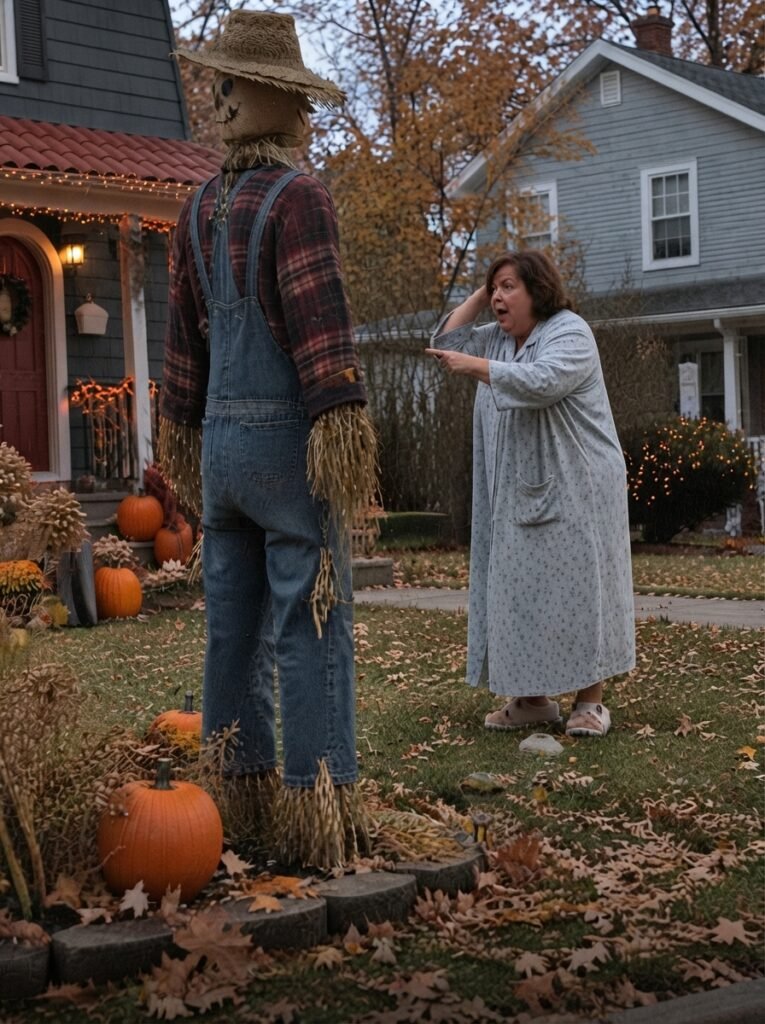
So when she objected to the scarecrow, I wasn’t surprised.
I’d found it while cleaning out my late father’s garage.
Dad had died the previous spring, and at 36, I had somehow become responsible for deciding which objects from an entire lifetime deserved to stay.
The scarecrow was buried behind old garden tools and boxes of Christmas decorations.
It was life-size, with a wooden body, an old red flannel shirt, faded jeans, and a straw hat.
Its hand-painted face had a crooked smile that was friendly from one angle and slightly unsettling from another.
I’d never seen it before.
Dad had built plenty of things, so I figured it was another forgotten project.
I put it beside the maple tree in my front yard.
That afternoon, Diane appeared.
“That thing is creepy, Susan.”
I glanced at the scarecrow.
“I think he’s charming.”
“Please move it.”
“Where?”
“Somewhere I don’t have to look at it.”
After years of complaints, my patience was gone.
“It’s my yard, Diane.”
Her expression tightened.
“Fine.”
She walked home.
Three days later, I came outside and stopped halfway down my front steps.
The scarecrow had been turned around.
Instead of facing the street, it faced Diane’s house.
I assumed neighborhood teenagers had done it.
I turned it back and forgot about it.
The next morning, it was facing Diane’s house again.
That afternoon, I caught Diane standing beside it.
“What are you doing?”
She jumped.
“Nothing.”
“You’ve been moving it, haven’t you?”
Her eyes went toward the scarecrow.
“I said I wasn’t.”
I’d had enough.
“Fine. I’ll take it down tomorrow.”
Her reaction stunned me.
“No!”
She grabbed my arm.
Diane had spent six years complaining about almost every decoration I put outside.
Now her fingers were digging into my sleeve as if I’d threatened to throw away something priceless.
“Please don’t,” she said.
I stared at her.
“You’ve complained about it all week.”
“I know.”
“You asked me to move it.”
“I was wrong.”
“Why?”
Her gaze drifted toward its painted face.
She didn’t answer.
The next morning, someone pounded on my front door hard enough to wake me before my alarm.
Diane stood outside in her robe.
“Is it still there?”
“What?”
“The scarecrow.”
I looked across the yard.
It hadn’t moved.
“Yes.”
She exhaled.
Then she asked, “Did your father make that?”
“Yes. At least, I think so.”
“When?”
“I don’t know. Maybe 30 years ago. Maybe longer.”
Her face went pale.
Without another word, she crossed my lawn.
“Diane?”
She stopped beside the scarecrow and lifted its left sleeve.
Then she stumbled backward.
I stepped closer.
Carved into the wooden forearm, hidden beneath the fabric, were four characters and a date: “R + D OCT. ’79”
I read it twice.
Then I looked at her.
“R is Robert.”
She nodded.
My father’s name.
My eyes dropped to the second initial.
“D?”
Diane closed her eyes.
When she opened them again, she looked older somehow.
“Me.”
I stared at her.
“What do you mean, you?”
“We made him together.”
“You knew my father?”
A humorless little smile crossed her face.
“Before he was your father.”
Something about the way she said it made my stomach tighten.
“How well?”
She looked toward her house. The two homes had stood side by side longer than either of us had been alive.
“We grew up together.”
I waited.
Diane finally said, “I loved him.”
My first thought was my mother.
“Were you having an affair with my father?”
Diane’s head snapped toward me.
“No.”
“Then explain this.”
“I hadn’t seen your father in years by the time he married your mother.”
That stopped me.
She touched the scarecrow’s sleeve carefully.
“Robert and I were next-door neighbors. Those two houses were ours before they were yours.”
I knew Diane’s parents had once owned her house, but Dad had never mentioned her.
“We were kids together,” she continued. “Then teenagers. Then we weren’t kids anymore.”
She gave a faint laugh.
“Your father kissed me for the first time behind that garage because he was terrified my mother would see us.”
I didn’t know what to say.
Dad had been Dad.
He’d mowed the lawn on Saturday mornings, burned pancakes on Sundays, and called every remote control “the clicker.”
Imagining him as a nervous 18-year-old kissing the girl next door felt strangely invasive.
Diane nodded toward the scarecrow.
“Halloween was ours. Robert built things. I painted them. In 1979, we decided every proper yard needed a scarecrow.”
“You painted the face?”
“He couldn’t paint at all.”
I smiled.
Dad couldn’t.
“Why did you leave?”
Her expression changed.
“My parents didn’t approve of him. They had very specific ideas about what my life was supposed to look like, and Robert wasn’t part of them. My father took a job several states away, and we moved that winter.”
“You were an adult.”
“I was 19.”
There was no self-pity in her voice.
“At 67, 19 feels like an adult. At 19, with no money of your own and parents who control everything, it doesn’t always feel that way.”
She and Dad tried to stay connected through letters.
At first they wrote constantly.
Then the letters became less frequent.
Diane’s family moved again.
Mail had to be forwarded.
Her parents discouraged the relationship and made it difficult for her to maintain contact.
Eventually, neither of them seemed to be hearing from the other.
Diane interpreted Robert’s silence as an answer.
She assumed he had moved on.
“So that’s why you hate Halloween?” I asked.
Diane looked embarrassed.
“I don’t hate Halloween.”
“You’ve spent six years acting like you do.”
“I know.”
“Every October you complain.”
“I know, Susan.”
Her voice cracked.
She looked back at the scarecrow.
“I came home because this neighborhood was the only place that still felt like him. Then every October, you’d put lights everywhere and pumpkins on the steps, and suddenly I could remember being 17 again.”
I folded my arms.
“So you complained about my yard.”
“It was easier to be angry at your lights than admit why they bothered me.”
That didn’t excuse it, and apparently she knew that.
“I’m sorry,” she said. “You didn’t deserve that.”
I looked at the scarecrow.
“Why did you turn him toward your house?”
Her cheeks colored.
“The first time, I told myself I didn’t want him looking at the street.”
“And the second?”
She glanced at an upstairs window of her house.
“My childhood bedroom is still up there.”
I understood before she finished.
“When Robert and I built him, he stood almost exactly there. I could see him from my bedroom.”
“So you wanted to see him.”
“I didn’t think I did.”
Her answer should have satisfied me.
It didn’t.
Something else was bothering me.
“If you loved Dad that much, why didn’t you ever come back?”
Diane became very still.
Then she said, “I did.”
That changed everything.
It took Diane several years to get out from under her parents’ control.
She worked, saved money, and eventually became independent enough to choose her own life.
Then she returned to the neighborhood.
She intended to knock on Dad’s door.
Instead, she saw him outside with my mother.
Pregnant with me.
“I stood across the street for about five minutes,” Diane said. “Your father had his hand on her back. She laughed at something he said. He looked happy.”
“You didn’t talk to him?”
“No.”
“Why?”
“Because I had come back thinking maybe we could still have the life we’d planned. He already had a life.”
I swallowed.
“He never knew you came back?”
“Not then.”
Diane left again without knocking.
For years, she’d wondered whether she should have spoken to him, not to break up his marriage, but simply to tell him she hadn’t disappeared because she’d stopped loving him.
Eventually, too much time had passed.
I went inside without inviting her.
I needed to think.
Then I went to the garage.
Dad had kept everything.
Receipts from appliances we hadn’t owned in 20 years.
School pictures.
Broken tools.
My kindergarten artwork.
If he’d kept anything connected to Diane, there was a good chance it was still there.
I spent nearly two hours opening boxes.
Then I found a photograph.
Dad was maybe 20, skinny and grinning, wearing the same red flannel shirt now hanging from the scarecrow.
Beside him was Diane.
I recognized her only because of her eyes.
Between them stood a brand-new scarecrow with a crooked painted smile.
Behind them were our two houses.
I found more pictures underneath.
Dad carving pumpkins.
Diane holding a paintbrush.
The two of them sitting on the porch steps with bowls of candy.
Then I found an envelope tied with string.
Inside were letters.
Diane’s name was on several.
Some were from her to Dad.
I didn’t read every word.
They weren’t mine.
But I read enough.
They were young and ridiculous and in love.
One letter ended, “Next October, I’m painting the pumpkins because yours look demented.”
I laughed out loud because Dad’s pumpkins had looked terrible my entire childhood.
Then I noticed the dates.
Some of Diane’s letters were dated months after she’d believed their correspondence had ended.
A few envelopes had forwarding marks.
One had apparently been returned and mailed again.
There wasn’t one dramatic explanation for why they’d lost each other.
Their story had simply frayed through bad timing, distance, family pressure, delayed mail, and two young people who eventually stopped knowing what the other’s silence meant.
At the bottom of the box was another photograph of the scarecrow.
Dad had written on the back: “Don’t throw out the scarecrow.”
Some memories don’t need fixing.
I sat on the garage floor for a long time.
That evening, I carried the box next door.
Diane opened one of the letters and covered her mouth.
“He got this?”
“Apparently.”
She sat at her kitchen table reading.
Then she laughed softly through tears.
“He used to draw that stupid pumpkin.”
A tiny pumpkin face was sketched beside Dad’s signature on one of the photographs.
I had seen the same face hundreds of times on notes he’d left me.
That hurt more than I expected.
Not because Diane had known him.
Because she’d known him first.
She had memories of a version of Dad I’d never meet.
Then another thought crept in.
“He kept all of this.”
Diane looked up.
“The letters. Pictures. The scarecrow.”
She understood what I was asking.
“Did he love you his whole life?”
“I don’t know.”
Her answer surprised me.
“You must have wondered.”
“Of course.”
“And?”
Diane folded the letter carefully.
“Susan, loving me when he was 20 doesn’t mean he loved your mother less when he was 30 or 40 or 50.”
“You don’t know that.”
“No.”
She pushed the box gently toward me.
“But neither do you.”
I started putting the photographs back.
One slipped sideways.
As I reached for it, I noticed the bottom of the box wasn’t sitting flat.
I lifted the cardboard lining.
A thin envelope was wedged underneath.
It wasn’t addressed.
Inside was a single sheet in Dad’s handwriting, much newer than the letters around it.
I read it once.
Then again.
Dad wrote that, years after Diane’s brief return to the neighborhood, an old mutual friend had finally mentioned that she’d been back.
He wondered whether she’d come looking for him.
By then, years had passed.
He was deep into the life I’d known, married to my mother and raising me.
Then I reached the lines that made me stop.
“I loved who Diane and I were. I don’t wish away who I became. I love my wife, and Susan is the best thing that ever happened to me.”
Diane didn’t ask to read it.
I handed it to her anyway.
She read it once.
Then she smiled.
Not happily exactly.
Peacefully.
“He always was better with wood than words.”
I laughed.
“So what does that mean?”
“It means your father remembered me.”
She placed the letter back into the envelope.
“And it means he loved his life.”
I looked through her kitchen window toward my yard.
The scarecrow stood beneath the maple tree.
For days, I’d thought Dad might have kept it because he couldn’t let Diane go.
Now I saw something different.
Dad had kept birthday cards, my mother’s recipes, my childhood drawings, photographs of people I’d never met.
He hadn’t preserved the scarecrow because he was trapped in 1979.
He’d preserved it because 1979 had happened.
Diane had spent decades doing the opposite.
Trying to make it disappear.
“Halloween doesn’t make you angry,” I said.
She smiled sadly.
“No.”
“It makes you miss him.”
“Yes.”
The following evening, Diane came to my porch.
“I owe you another apology.”
“For the scarecrow?”
“For six Octobers.”
I raised an eyebrow.
“That’s a lot of apologies.”
“I’ll pace myself.”
She looked toward the yard.
“I kept punishing you for reminding me of something you didn’t even know existed.”
I appreciated that she said it plainly.
No excuses.
On Halloween night, I left the scarecrow exactly where it was.
Diane came over shortly before sunset carrying an old paintbrush.
“For tradition,” she said.
She touched up one chipped corner of its smile while children began filling the sidewalks.
Then she told me stories.
Dad once fell off a ladder because he refused to let anyone hold it.
He believed pumpkins needed “personality.”
He and Diane once spent three hours building a fake ghost that collapsed before the first trick-or-treater arrived.
I laughed harder than I had since Dad died.
And slowly, something stopped bothering me.
Diane had known a Robert I never did.
But I’d known the man he became.
Neither version erased the other.
As darkness settled, I asked, “Do you want him?”
Diane glanced at the scarecrow.
“No.”
“You sure?”
“Your father kept him all these years. He belongs here.”
I smiled.
“Should I at least turn him toward your house?”
Diane looked up at her old bedroom window.
For a moment, I thought she might say yes.
Instead, she reached out and straightened the scarecrow’s straw hat.
“No,” she said.
Then she turned his shoulders slightly until he faced the sidewalk again.
“Leave him facing the street.”
And this time, she did.
But here’s the real question: If someone had spent years criticizing you and you later learned there was a deeply personal reason behind it, would an apology be enough for you to forgive them?
Enjoyed this story? Here’s another one you’re absolutely going to want to read: A woman thought her nervous new neighbor was simply being friendly when she arrived at the door with a homemade pie. But the moment her knife struck something hidden beneath the crust, every strange little detail she’d noticed about the couple next door suddenly took on a much more unsettling meaning.